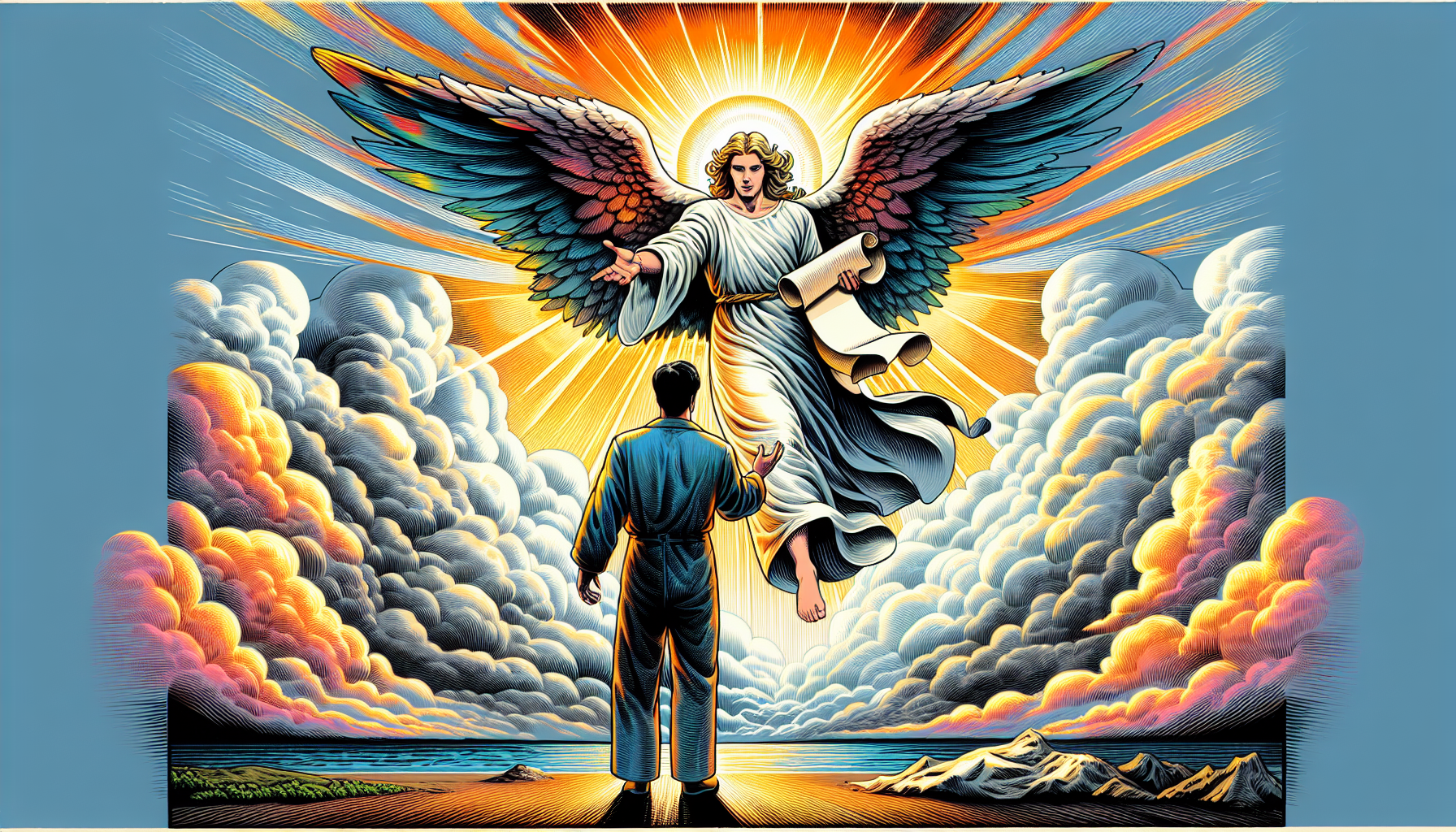
[Lesson 116] Rev 10: The Book of Revelation from Heaven and the Promised Pastor

by ichthus

A mighty angel descending from heaven was robed in a cloud with a rainbow above his head, his face shone like the sun, and his legs were like fiery pillars. He held a little open scroll in his hand, which is the Book of Revelation itself. Planting his right foot on the sea and left foot on the land symbolizes he will execute judgment on two groups – the destroyers (represented by the sea) and the betrayers (the land). When the angel spoke with a voice like a lion’s roar, the voices of the seven thunders responded, which John was prevented from recording.

This vision previews John’s future role appointed by Jesus as the Promised Pastor to deliver judgment. The angel’s appearance combines attributes of God (the rainbow) and Jesus (the shining face), indicating he is the Advocate promised by Jesus to represent them both. Revelation 10:5-7 reveals the mystery of God’s plan being accomplished at the sounding of the seventh trumpet, which announces the salvation and kingdom of God.

In 10:8-11, John is commanded to take the open little scroll from the angel’s hand and eat it. It tasted sweet in his mouth but turned sour in his stomach, signifying the bittersweet experience of receiving the revelation he must now prophesy to peoples, nations, tongues and kings. This establishes John’s role as the Promised Pastor appointed to testify and deliver the open word of Revelation’s prophecies to the world.

Report – Discernment Study Guide SCJ Bible Study

Shincheonji holds distinct theological views that differ from mainstream Christian denominations, yet it also shares some common teachings. This overlap can sometimes blur the lines between their beliefs and those of traditional Christianity. Therefore, it is essential to exercise critical thinking and discernment to differentiate between these shared elements and the unique doctrines they present.

While their interpretations warrant careful examination through a critical and biblical lens, it is equally important to approach these matters with an open yet discerning mindset.

The following notes were documented in person during Shincheonji’s 9-month Bible Study Seminar. They provide insight into the organization’s approach to introducing and explaining its beliefs to potential new members, often referred to as the ‘harvesting and sealing.’ This process is described as being ‘born again’ or ‘born of God’s seed,’ which involves uprooting the old beliefs and replanting new ones. This uprooting and replanting must occur continuously. By examining this process, we can gain a better understanding of the mindset and beliefs held by Shincheonji members.

[Evangelist]

We have Services on Wednesday and Sunday because when we’re out in the world, we accumulate spiritual filth through contact with spiritually dead people. Although this is written in the Old Testament, according to Hebrews 10:1, the law is a shadow. This serves as an illustration of what we are to do in our time. Let’s make sure that we are washed.

For this class, we are only having wash day service on Sunday. We’re implementing this on a small scale to prepare you for the time when you pass over. Therefore, for now, we will only have wash day service on Sunday.

The flow of Sunday service is as follows:

  1. Time of praise and worship
  2. Silent prayer and meditation
  3. A song
  4. Representative prayer led by one of the evangelists

– During this time, the evangelist prays on our behalf

– Prayers for the service

– Prayers for the lesson

  1. Another song
  2. Welcome the speaker

[Instructor]

Happy Wash Day, everyone. Wash Day is a beautiful day at Mount Sinai.

When we spend time in the world throughout the week, we see and hear many things that are not of God. The more time we spend in the word, the more apparent the contrast becomes between worldly things and godly things. This difference makes us increasingly prefer and cherish our time with God.

That’s why we eagerly look forward to Wash Days at Mount Zion. I pray that these Sunday gatherings give you a glimpse of what it’s like, making you excited for the complete experience that awaits in the future.


Rev 10: The Book of Revelation from Heaven and the Promised Pastor


If you can remember the title, you’ve remembered the content of the lesson.

So two main things going over today, the book of Revelation from heaven and the promised pastor.


Previous Lesson Review

Review


Revelation 9, the locusts from the abyss and the angels who sinned. Some key things that we went over.

1.- Rev 9: Locusts from Abyss, Angels who sinned.

2.- The 5th and 6th trumpets blow.


3.- Star Wormwood lets in the locusts [destroyers] 

The star Wormwood, which was introduced in Revelation chapter 8, receives the key to the shaft of the abyss and allows the locusts to enter. 

This can be understood as Wormwood acting like a double agent or secret agent who first infiltrates a location and then enables the rest of their team to gain access.

Wormwood is actually a poisonous plant in nature. When a star is named Wormwood, it signifies that instead of fulfilling its natural purpose of providing light, it acts as a poison. 

This explains why in Revelation 8, when this star falls upon the springs and rivers, they turn to blood, rendering them undrinkable.


4.- Locusts begin to destroy another ⅓ of Tabernacle Temple (TT) with false teachings.

The locusts, which are released by this star, are animals known for their destructive nature. They consume and destroy everything in their path – crops, plants, and devastate the entire natural environment.

When God uses locusts as a figurative term to represent a group of people, it means these people have the same destructive and consuming characteristics. 

These locusts are released and they kill one-third of those in the TT (tabernacle temple, or the tabernacle of the chosen people).

These locusts come and destroy one-third of everyone at that location. As shown in Revelation 9, this represents the second third of people being killed, which we will examine shortly. 

Their method of destruction is through false teachings and commentaries, as we previously observed in the Revelation movie during our last lesson.


5.- Satan copies God, 4 false angels who are released: Hour [2 pm], Day [20th], Month [Sept], Year [1981].

Satan copies God’s works, but he doesn’t have the power to create. Instead, he takes what God has already created and corrupts it. 

Just as God has four living creatures or 4 archangels, Satan similarly has 4 evil angels who were bound. The fact that these angels were bound indicates they cannot be good angels, as being bound is not a position for those who are doing right. They were bound for a specific time.

This specific time – the hour, day, month, and year – refers to a particular event. It was the pastor commemorative service or pastor ordination service that took place at the tabernacle temple one year after destruction began. 

During this service, 17 evangelists were promoted to pastors, and they officially accepted the false teachings by raising their hands and declaring their acceptance.

This specific hour, day, month, and year was at 2 p.m. on the 20th of September in 1981. The significance of this date and time and its consequences would be revealed later.


6.- Though spiritually in pain or dying, the people do not reprent.

In Revelation 9’s conclusion, there is a sad reality where people who are spiritually suffering and dying do not repent.

When we examine Revelation chapters 8 and 9, we must ask: have these events already occurred? Yes, they have.

Therefore, what does this mean for us today? These chapters are no longer just prophecy – they have become history through their fulfilment.

This gives us an opportunity to learn from the mistakes of those who came before us. The key lesson we should take from those who were judged in Revelation 8 and 9 is the importance of repentance.

The act of repentance is crucial, yet even when we receive warnings, our pride can become an obstacle that prevents us from truly repenting.


Pride and Greed

God despises pride and greed because these prevent people from returning to Him. These traits cause people to seek separation from God. When examining any sin, you’ll find its roots stem from pride, greed, or both.

Consider Satan’s thoughts: “Maybe I can be God.” He convinced other angels of this possibility, desiring separation from God. As described in Ezekiel 28, Satan was initially created perfect in beauty and wonderful wisdom. 

However, it’s impossible for a created being to be like God, yet Satan allowed pride to form within his heart and spread this pride to others.

Satan’s strategy is to use pride to prevent people from repenting when they are confronted with their wrongdoings.

Therefore, pride must be stamped out in all of us, or it will cost us dearly.


Revelation Timeline

Let us examine the timeline of events that have unfolded in Revelation up to this point. 

The book of Revelation centers around three major events:

  1. Betrayal
  2. Destruction
  3. Salvation

The sequence begins with the betrayal events, which were initiated when the seven stars were appointed and their Temple was established.


1.- Their temple was established in the year in 1966.

It was during that time when it was established. These people began their mission effectively, preaching a new word as shown in the video. People started gathering from various places, and Gwachan, which was once a small sleepy town, grew into a sizable town as people from across Korea moved there to hear their message.

However, Satan works quickly. Jesus called these people a lamp, which raises an important question: When is a lamp useful or important? A lamp is necessary during darkness, not in the daytime. In fact, you can barely see a lamp’s light during daylight hours.

So as these people began to shine in the darkness, who took notice? Satan did, and that’s when the invaders came.


2.- The first invader entered in 1975. 

Mr. Oh was the first invader who introduced different teachings. Because he was appointed by one of the seven stars, many people took his teachings seriously when they should not have.

 As revealed in Revelation chapters 2 and 3, while some people rejected these teachings, many others began to accept them. Over the course of five years, their betrayal continued to grow and intensify.


3.- In 1977, Jesus appeared to John. 

In the year 1977, the events described in Revelation 1:9-20 occurred, when Jesus appeared to John. Jesus instructed John to write down what he had witnessed and send these messages to the seven churches.

The reason for this instruction was that the churches were faltering in their faith. They were deviating from their path and making mistakes. This is why in Revelation 2 and 3, Jesus called them to repent, saying “do the things you did at first.” He urged them to return to the words He had given them.

Jesus’s message was clear: return to your first love and resume the practices He had originally taught. He was calling them to go back to their original teachings because they were slipping away from their faith. However, despite this warning, they did not heed His call.


4.- September 1980, destruction began.

The destruction begun when the 7 stars resigned from their positions. 

Following this, the Tabernacle Temple underwent a name change, becoming the Central Isaac Presbyterian Church. At this point, they started accepting that doctrine.


5.- 42 months of destruction takes place. 

In Revelation chapters 8 and 9, we see when the destruction fully begins to unfold. Later, we will examine additional chapters that show the beast’s invasion, which is further revealed in Revelation chapters 12 and 13.


6.- March 14th, 1984, exactly 42 months after destruction began, begins the period of salvation. 

We are currently in this period of time. Revelation 7 continues to unfold in the present day, as people are still hearing the word. 

The twelve tribes have been established, and people continue to come out from many peoples, nations, languages, and kings. Through God’s grace, all of these events have already taken place at the Tabernacle Temple, and we can testify to what has occurred.


Rev 10 Takes place in March 1980

Revelation 10 takes place specifically in March 1980. During this time, John receives the vision and instructions about his future tasks that we are going to read about. 

This chapter occurs after Revelation 8 and 9, which described the destruction of one-third of the people of the temple.

In Revelation 6, a fourth of the people are killed, leaving a remaining population. From these remaining people, they die in thirds:

  1. The first third dies in Revelation 8
  2. The second third dies in Revelation 9
  3. The final third is spiritually killed in Revelation 12 (this will be explained when we reach that chapter)

This means only one-third of people initially remain who haven’t received the false teachings, though eventually this happens too.

At the Tabernacle Temple, which was once called this name – it’s important to note this is not the new heaven and new earth, but rather the first heaven and first earth. These are almost complete in their passing away, as written in Revelation 21:1.

This review helps set the stage for Revelation 10.


Revelation 10:1-4


Revelation 10:1-4 NIV84
Then I saw another mighty angel coming down from heaven. He was robed in a cloud, with a rainbow above his head; his face was like the sun, and his legs were like fiery pillars. [2] He was holding a little scroll, which lay open in his hand. He planted his right foot on the sea and his left foot on the land, [3] and he gave a loud shout like the roar of a lion. When he shouted, the voices of the seven thunders spoke. [4] And when the seven thunders spoke, I was about to write; but I heard a voice from heaven say, “Seal up what the seven thunders have said and do not write it down.”


Revelation Chapter 10 contains amazing things that many have been eagerly waiting to understand.

ONE – The Little Scroll

In this chapter, we first encounter a mighty angel holding a little scroll. This little scroll is identified as the Book of Revelation itself.

How can we be certain of this? The answer lies in Revelation 1:1-3, which shows us the divine communication chain:

– From God
– To Jesus
– To the angel
– To John
– Finally reaching many peoples, nations, languages, and kings

An important detail to note is that the little scroll is in an open state. This connects back to Revelation 5, where the scroll was initially given.


TWO – Lays Open: Rev 6, Rev 8:1


The little scroll mentioned in Revelation 6 was opened by Jesus himself. This is the same scroll that was both given to and opened by Jesus. 

The book of Revelation, though relatively small in comparison to the entire Bible, consists of 22 chapters and 404 verses. Despite its compact size, the book of Revelation carries significant impact.


Revelation is the Conclusion of God’s Work

The Book of Revelation serves as the conclusion of God’s entire work spanning 6,000 years. This makes it extraordinarily important, as it represents the culmination of everything God has been working towards since Genesis 4:1 – the completion and redemption of creation.

The significance of this book cannot be understated, as God, Jesus, and all of heaven regard it with utmost seriousness.

The scroll lies open in the angel’s hand because Jesus opens it. When Jesus opens the little scroll, it represents fulfillment – to open means to fulfill.

Jesus is the one who is fulfilling the book of Revelation.

New John serves as both a witness and testifier to Jesus’s works. This is why Shinchonji is referred to as the Church of Jesus, as Jesus himself established the mountain.

Jesus’s central role is demonstrated in multiple ways:

  1. Jesus stands on Mount Zion
  2. Jesus not only received the scroll but also opened it, and is fulfilling its contents
  3. Jesus appointed the 7 stars
  4. Jesus gave authority to the star Wormwood, granting the key to the shaft of the abyss that He held in Revelation 1
  5. Jesus is orchestrating these events, preparing the stage for His return

The Mighty Angel, the Advocate

Let’s examine the description of this angel in Revelation 10:1, which presents some fascinating details:

“Then I saw another mighty angel coming down from heaven. He was robed in a cloud with a rainbow above his head and his face shown like the sun. His legs were like fiery pillars.”

This description should be familiar to us, as it contains recognizable attributes:

  1. The rainbow surrounding the angel mirrors God’s appearance earlier in Revelation
  2. The face shining like the sun reflects Jesus’s appearance previously described

This mighty angel’s distinctive appearance combining these divine characteristics serves a purpose – he is the advocate.

Jesus promised that an advocate would come, as written in John 14:26. This advocate is the spirit of truth who speaks on behalf of both God and Jesus.

Because the advocate represents them, he bears their likeness. This is why he was entrusted with the open scroll – the same scroll that was in Jesus’s hand and was opened by Him. Now this opened scroll lies in the advocate’s hand. There is more to understand about this, which will be discussed further.


THREE – Sea and Land


The angel’s positioning is significant – his right foot on the sea and his left foot on the land. 

The description of his feet as fiery pillars is intentional and meaningful. It is no coincidence that these fiery pillars are placed specifically on the sea and on the land.

In the Bible, fire represents the word, which has two functions:

  1. It consumes
  2. It judges

Therefore, his feet appearing as fiery pillars symbolizes the execution of judgment on two distinct groups of people who require judgment – groups that were previously separate but have now merged into one.


SEA: Destroyers (Babylon → SEC) Rev 21:1


The sea represents those who need to be judged – the destroyers. 

This is because the beast initially emerged from the sea, which is Babylon. In reality, this refers to the stewardship education center or the Christian stewardship training center (depending on how the Korean is translated).

These destroyers, who are symbolized by the sea, are the ones who must face judgment.


LAND: Betrayers (TT → First Heaven First Earth)

What about the land?

The land represents the betrayers – those who were once with God and Jesus in heaven but later betrayed them. These betrayers did not repent and are now being judged. This refers to the first heaven and first earth.


Revelation 21:1 NIV84

Then I saw a new heaven and a new earth, for the first heaven and the first earth had passed away, and there was no longer any sea.


In order to understand the context better, we see how the angel shows John this revelation.


FOUR – Opened Word Used to Judge Betrayers and Destroyers. [Fulfilled Rev 16:1-4]

Revelation 21:1 shows us the conclusion where the land and the sea will cease to exist. This can be understood as a teaser or trailer of what is to come.

New John is the one witnessing these visions. The purpose of someone receiving visions from heaven is to witness what must take place and to carry out what is shown.

The angel holds a little scroll in his hand, which serves one crucial purpose – to judge those who betray and destroy, who have not united as one. This open book contains the word of testimony.


The Judgement

The people mentioned in Revelation chapters two and three are betrayers, and those in Revelation chapters 8, 9, and 13 are destroyers. When people hear these words, it should create an earthquake-like effect in their hearts.

This is what judgment means – identifying who these people are. This parallels Jesus’s actions during His first coming. Before we learned about the open word, we only saw Jesus’s miracles and moral teachings superficially. We would say, “Wow, Jesus was a great guy” or “Thank you, Jesus,” without deeply understanding the purpose behind His actions.

Jesus understood the Old Testament prophecies He needed to fulfill and dedicated His entire life to this purpose. During His three-and-a-half-year ministry, Jesus focused intensely on fulfilling prophecy and speaking His testimony to identify those who needed judgment.

Just as Jesus did 2000 years ago, He judged the land. In Matthew chapter 11, regarding John the Baptist, Jesus asked, “Who did you go out to the desert to see?” He spoke of one swayed by the wind, saying that the least in the kingdom of heaven is greater than he, and that he was the Elijah who was to come.

In Matthew 17, when His disciples asked why Elijah must come first, Jesus explained that Elijah had already come, but the destroyers did whatever they wished to him. Jesus then confronted the destroyers – the Pharisees and Sadducees – with harsh words:

“You brood of vipers”

“You whitewashed tombs”

“You make people twice as much a son of hell as you are”

“How will you escape being condemned to hell?”

“You hypocrites”

Jesus judged them with the fire of the word. Now, New John needs to do something very similar – to identify those who need to be judged and carry out what needs to take place.


FIVE – Promised Shepherd sees Heaven → Carries out on Earth


In every era, the Promised Pastor must see heaven in the spiritual world to fulfill what is in heaven on earth. 

The pattern shows that the shepherd needs to witness events in heaven above in order to implement them here on earth below. Throughout the Bible, there were three figures who exemplified this role:

  1. Moses – in the Old Testament
  2. Jesus – during the First Coming 
  3. New John – during the Second Coming


Moises

Moses was the first person who fulfilled the pattern of “as in heaven, so on earth.” 

During the Exodus era, Moses was given the responsibility to replicate on earth what he saw in heaven. In Exodus, particularly starting from Exodus 25:8-9, God provided Moses with detailed instructions for the people. 

These instructions included:

– How to build God’s temple

– How to construct the altar

– Using specific materials like acacia wood covered in gold

– Following precise instructions for incense preparation

– Not allowing these sacred items for common use

These items were to be consecrated and set holy, specifically for temple use and God’s purposes only. God commanded Moses: “Do everything like the pattern I showed you on the mountain.”

The reason behind these specific instructions was that God wanted to come to a place that felt like home – a place He would recognize.

This is why Moses had to build everything exactly as he saw in heaven. As confirmed in Hebrews 8:3-5, they worshiped at a tabernacle that was a copy and a shadow of what was in heaven. It was crucial for the people to live according to what they saw.


Jesus

At the first coming of Jesus, He was the one who saw what was happening in heaven and had to fulfill it on earth. 

Jesus explained this relationship with the Father, saying that the Son does nothing without first seeing the Father do it, as the Son does what the Father does.

Following this pattern, Jesus carried out on earth what He saw in heaven, adhering to His Father’s words and instructions. This is reflected in John 14:23-24, where Jesus said, “If anyone loves me, he will obey my teaching. My father and I will love him and make our home with him.” He also emphasized that seeing Him was equivalent to seeing the Father.

Furthermore, in John 17:8, Jesus confirmed this divine connection by stating, “For I gave them the words that you gave me and they accepted them. They believed that I am the one that you sent.” This same logic applies to the time of the second coming.


New John

New John is the one who must see and build on earth as it is in heaven, as shown in Revelation 10 that we are learning now. 

In this process:

  1. He sees and then does
  2. He eats and then testifies

He must deliver both the word and the word of testimony together. The word involves explaining things, like wine, interpreting what different parables mean according to scripture. 

The word of testimony identifies:

– The person who was explained earlier

– The person who is like the beast

– The person who is the star that betrayed

– The person who is Wormwood

– The person who is like the prostitute

Both elements – the word (explanation) and the testimony (identification) – must go together.


The Word and The Testimony

We must understand that a beast represents a person who does not understand the word, as shown in Psalm 49:20 and Proverbs 30:1-5. Being able to explain this concept is essential.

The word of testimony would then identify the person referenced in Revelation 13 – this is the beast who appeared in that manner. Both elements must go together.

Throughout the Bible, the connection between the word and the testimony has always been an important linking concept. This is what John needs to be able to testify.


SIX – 7 Thunders: 7 Spirits


In Revelation 10:2-4, we read about a mighty angel holding a little scroll that lay open in his hand. He positioned himself with his right foot on the sea and left foot on the land. When he shouted with a voice like a lion’s roar, the seven thunders spoke. As John was about to write down what the seven thunders said, a voice from heaven commanded him to “seal up what the seven thunders have said and do not write it down.”

This mighty angel’s appearance was remarkable – clothed in a rainbow, his face shining like the sun, and his feet ablaze with fire. When he spoke, the seven thunders joined his voice.

These 7 thunders were not literal thunders, as they were speaking actual words. 

Who are these 7 thunders? They are the same seven spirits that appear before God’s throne, mentioned in:

  1. Revelation 1:4
  2. Revelation 4:5
  3. Revelation 5:6

These 7 spirits speak like thunder and are constantly active throughout the book of Revelation. They appear in multiple places, moving swiftly like lightning, responding immediately when action is needed. When God speaks, they spring into action without delay.

This teaches us a lesson – when God speaks, we should respond with the same immediacy. We should be ready with the logistics and implementation, saying “Let’s go” and moving into action, just as the spirits of heaven work.


SEVEN – Not Write Down: New John is about to Eat it.


John was instructed not to write down what was being said. The reason behind this instruction becomes clear later in the chapter – he would receive the open scroll. What happens next? John eats the scroll.

The command for John to not document these sayings was because New John would later consume the scroll. This explains why he was told to seal up the messages rather than write them down – they would be given to him directly.

The logical flow of events remains intact: the instruction not to write → the reason (receiving the scroll) → the action (eating the scroll) → the explanation.


Quick Review


Quick Review


Title: Revelation 10 – The Book of Revelation from Heaven and the Promised Pastor

We have completed examining part one, focusing on the Book of Revelation from heaven. The events concerning this book of Revelation will soon unfold. We were examining the introduction of the mighty angel and his remarkable actions.

This mighty angel, who represents God and Jesus, speaks on their behalf and bears their likeness, holds the little scroll in his hand, preparing to give it to John. When this angel speaks, his voice resonates like thunder and roars like a lion. He speaks in unison with the 7 spirits before God’s throne, making it truly remarkable.

The angel demonstrates to John how to fulfill his appointed task. He shows John that he must judge the land and the sea – a judgment that will be fully revealed in Revelation chapter 16, where both land and sea face judgment together.

Revelation 10 serves as an introductory preview of John’s future responsibilities. As John witnesses this vision and hears the angels’ words, he begins to understand his role as the Promised Pastor.

This vision occurs shortly after he sent letters to the messengers of the 7 churches in 1979. Only a few months after sending these letters, John receives this vision, realizing that they did not repent, and significant events are about to unfold.


Revelation 10:5-7


Let’s read the next 2 verses of Revelation chapter 10. And let’s understand how we can say clearly and with confidence that New John is the promised pastor.


Revelation 10:5-7 NIV84

Then the angel I had seen standing on the sea and on the land raised his right hand to heaven. [6] And he swore by him who lives for ever and ever, who created the heavens and all that is in them, the earth and all that is in it, and the sea and all that is in it, and said, “There will be no more delay! [7] But in the days when the seventh angel is about to sound his trumpet, the mystery of God will be accomplished, just as he announced to his servants the prophets.”


The angel, who was positioned with one foot on the sea and one on the land, raised his right hand toward heaven and swore. This demonstrates that the spirits of heaven and God are not afraid to make oaths – not in terms of cursing or bad words, but in declaring their commitment to fulfill what they say they will do.

When heaven makes a promise, it is absolutely certain to happen. Although it may not unfold according to our expectations or assumptions, it will certainly occur as heaven intends.

The angel swore by the eternal living God, the Creator of:

– The heavens and everything within them

– The earth and all it contains

– The sea and everything in it

He declared 2 key points:

  1. There will be no more delay
  2. When the seventh angel is about to sound his trumpet, the mystery of God will be accomplished, exactly as He announced through His servants, the prophets

This raises the question: What is this announcement that must come to pass? What is it that will face no further delay?


ONE – Mystery of the 7th Trumpet: The Mystery of Salvation


The 7th trumpet is introduced, though it has not yet blown. This trumpet contains what is called a mystery – specifically, the mystery of God.

What mystery lies within this trumpet? It is the mystery of salvation that we are waiting for. But not just any salvation – this mystery specifically refers to eternal life and resurrection.


The Resurrection: 2 Different Salvations

These are things that believers in God have been waiting for over thousands of years. Even the Old Testament Israelite people were waiting for this mystery to be fulfilled.

In John chapter 11, there is a conversation between Jesus and Martha, Lazarus’s sister. Martha expressed to Jesus her belief that the resurrection would take place later. Jesus responded to her saying, “I am the resurrection and the life.” He was telling her that she was waiting for Him.

In John 11:24-26, Jesus reveals something profound to Martha. 

He speaks of 2 different resurrections or 2 different salvations:

  1. Those who will be saved in the spirit, though they physically die – this applies to everyone from the time Jesus spoke until now.
  1. A different group of people that will live and never die.

Jesus is talking about these two distinct groups of people. The mystery of God is wrapped up in this important distinction.


The 7th Trumpet on Mount Zion

Let’s look specifically at how Apostle Paul describes the mystery of God and what he says about it.


1 Corinthians 15:51-58 NIV84

Listen, I tell you a mystery: We will not all sleep, but we will all be changed— [52] in a flash, in the twinkling of an eye, at the last trumpet. For the trumpet will sound, the dead will be raised imperishable, and we will be changed. [53] For the perishable must clothe itself with the imperishable, and the mortal with immortality. [54] When the perishable has been clothed with the imperishable, and the mortal with immortality, then the saying that is written will come true: “Death has been swallowed up in victory.” [55] “Where, O death, is your victory? Where, O death, is your sting?” [56] The sting of death is sin, and the power of sin is the law. [57] But thanks be to God! He gives us the victory through our Lord Jesus Christ. [58] Therefore, my dear brothers, stand firm. Let nothing move you. Always give yourselves fully to the work of the Lord, because you know that your labor in the Lord is not in vain.


Paul expands on Jesus’ promise from John chapter 11, making a crucial statement in 1 Corinthians 15:50: “I declare to you, brothers, that flesh and blood cannot inherit the kingdom of God, nor does the perishable inherit the imperishable.”

Since flesh and blood cannot inherit the kingdom of God, it must undergo a change. Our flesh and blood in its current state only lives for a maximum of 120 years, which in God’s scale is merely a blink of an eye – like dust that blows away. Because this flesh cannot live forever, it must be changed. This change will occur when the 7th trumpet sounds.

What is a trumpet? A trumpet represents a person, as shown in Isaiah 58:1: “Sound it aloud. Do not hold back. Raise your voice like a trumpet. Declare to my people their sin and the house of Jacob their sins. Their rebellion and the house of Jacob their sins.”

The 7th trumpet that needs to sound is the person who will eat the scroll, as mentioned in Revelation 10:8-11. This person is New John. New John must testify about sin and rebellion, specifically about the events of betrayal, destruction, and salvation.

In Revelation 22:8, it states: “I, John, am the one who heard and saw these things.” And when John saw and heard them, it was time for him to be sent to the churches and speak.

Apostle Paul in 1 Corinthians 15 mentions that this trumpet is the last trumpet. It wasn’t until Revelation was written that we understood there would be seven trumpets in total, making the last trumpet the seventh trumpet. This 7th trumpet must blow from Mount Zion.


Death No More

When the 7th trumpet blows in Mount Zion, two announcements will be made. According to 1 Corinthians 15, eternal life will be given to both spirit and flesh. The flesh will undergo a transformation, becoming different from its current state.

This is something to look forward to – a time without physical ailments. No more waking up with back pains wondering, “What happened yesterday?” It will truly be a beautiful time.

Some might say, “Instructor Nate, I love the Bible and believe in the word, but really?” This skepticism exists because death has been the standard way of things for the past 6,000 years, though not forever.

Our entire world operates on a temporary reality – the YOLO (You Only Live Once) culture. People rush to do everything possible in their limited lifespan. Time flies, and everyone hurries to fit in as much life as possible before death. This mindset is why people take shortcuts, abuse others, wage wars, and fight for resources – all struggling to survive a bit longer.

Now imagine a world where people no longer worry about death. This world will be transformed, and these people will implement many positive changes.

The purpose of learning the word goes beyond gaining knowledge – it’s about finding hope. Rather than focusing on the current depressing state of the world, we should look forward to the time when heaven comes down, and we’ll be there to witness and participate in it.

This isn’t just about head knowledge, which you can get anywhere. We’re here for hope too.

For encouragement, let’s turn to Hebrews chapter 6. While we often say there’s nothing God cannot do, let’s examine something that God cannot do.


Hebrews 6:17-19 NIV84

Because God wanted to make the unchanging nature of his purpose very clear to the heirs of what was promised, he confirmed it with an oath. [18] God did this so that, by two unchangeable things in which it is impossible for God to lie, we who have fled to take hold of the hope offered to us may be greatly encouraged. [19] We have this hope as an anchor for the soul, firm and secure. It enters the inner sanctuary behind the curtain,


What is impossible for God to do? The answer is simple – it is impossible for God to lie. Therefore, when God makes a promise that we will be changed, we can be absolutely certain it will happen.

Similarly, when God promises there will be no more death, no more mourning, no more crying, and no more pain, we can trust with complete certainty that these promises will come to pass.

And I personally want to be there to witness it all.


Blows → Announces the Kingdom of God (Salvation)


Let your desire be focused on Mount Zion at this time. Mount Zion is where it will happen first, and we need to be there when the 7th trumpet will blow.

In Revelation 11:15, we will see the blowing of the trumpet. When it blows, it will announce the transformation – the kingdom of the world will become the kingdom of God.

This transformation occurs on 2 levels:

  1. With each individual person
  2. On a big scale, when Babylon ceases to exist

Salvation will come when people are no longer deceived by those who believe they have the truth but unfortunately do not.

The 7th trumpet must blow, but in Revelation 10:7, it is only introduced, not yet blowing. It is important to understand who the 7th trumpet is, because as this trumpet is about to blow, the mighty angel proceeds to the next action.


Revelation 10:8-11


Revelation 10:8-11 NIV84

Then the voice that I had heard from heaven spoke to me once more: “Go, take the scroll that lies open in the hand of the angel who is standing on the sea and on the land.” [9] So I went to the angel and asked him to give me the little scroll. He said to me, “Take it and eat it. It will turn your stomach sour, but in your mouth it will be as sweet as honey.” [10] I took the little scroll from the angel’s hand and ate it. It tasted as sweet as honey in my mouth, but when I had eaten it, my stomach turned sour. [11] Then I was told, “You must prophesy again about many peoples, nations, languages and kings.”


We have frequently reviewed Revelation 10:8-11 in our classes because these verses are crucial for understanding:

  1. The identity of New John
  2. The mission that New John must fulfill

Now, we will analyze these verses in detail, examining them one by one. But first, let’s recall when this event occurred.


ONE – It took place in March 1980. 


In 1977, Jesus appeared to John, instructing him to send the letters, which he did in 1979. This was when the events of Revelation 10 occurred. 

During this revelation, Jesus showed John the mighty angel and the open scroll, which John then ate. This action was significant because John had a specific task ahead of him, as destruction was imminent.

To fully comprehend the meaning of taking the open scroll, we need to examine this concept in two contexts:

  1. Through an example from the Old Testament
  2. Through its appearance in the New Testament

This will help us understand its complete significance in this context.


TWO – Old Testament prophecy from Isaiah 29:9-13.

Physical Israel: Blind, Rules of Men

This is not new content – we have encountered it multiple times before. In Isaiah 29:9-13, we see a description of people who are told they are blind.

The passage speaks of a scroll that contains nothing but sealed words. When someone asks a person who can see to read it, they respond, “I cannot, because it is sealed.” When they ask someone who cannot read to read it, they reply, “I do not know how to read.”

We can understand the full meaning: Those who should be able to see cannot read because they have been blinded. 

This specifically refers to the leaders, the heads, and the seers – those who are supposed to see and understand but cannot.

The illiterate represent the congregation – the people who follow these leaders. They too are blind because their leaders are blind. 

To understand what God says about these people, we need to examine Isaiah 29, particularly the part that describes their hearts and what occurred during the time when the word was sealed to them.


Isaiah 29:9-13 NIV84

Be stunned and amazed, blind yourselves and be sightless; be drunk, but not from wine, stagger, but not from beer. [10] The Lord has brought over you a deep sleep: He has sealed your eyes (the prophets); he has covered your heads (the seers). [11] For you this whole vision is nothing but words sealed in a scroll. And if you give the scroll to someone who can read, and say to him, “Read this, please,” he will answer, “I can’t; it is sealed.” [12] Or if you give the scroll to someone who cannot read, and say, “Read this, please,” he will answer, “I don’t know how to read.” [13] The Lord says: “These people come near to me with their mouth and honor me with their lips, but their hearts are far from me. Their worship of me is made up only of rules taught by men.


People are spiritually blind, claiming to honor God but remaining far from Him. They have replaced God’s word with their own rules, traditions, laws, ecclesiastical authority, self-appointment, and commentaries – these are rules taught by men, not the word of God.

In Mark 7, Jesus rebuked the Pharisees about this very issue. When they questioned why Jesus and his disciples didn’t follow the traditional hand-washing before eating, Jesus responded by pointing out how they expertly replaced God’s word with their traditions.

Jesus was indeed a strong judge of these practices. He consistently confronted them, which ultimately led to his death – they grew weary of his constant criticism. Jesus needed to show people the distinction between the word of truth and the lies they had consumed throughout their lives.

Jesus possessed the open word, which was different from their teachings.

Looking at Ezekiel chapters 1-3, particularly the vision in chapter 1: Who is the prophet discussing? As in Acts 8:34, the prophet speaks not of himself but of someone else – Jesus.

When reading Ezekiel, we should understand we’re reading about Jesus, about the son of man. In Ezekiel 2:7, it states: “You must speak my words to them, whether they listen or fail to listen, for they are rebellious. But you, son of man…” This reference to “son of man” should be our first clue.

The text continues describing a scroll being presented: “Then I looked and saw a hand stretched out to me. In it was a scroll, which he unrolled before me. On both sides it was written words of lament, warning, and woe.” This parallels Revelation 10 – not coincidentally, as God’s pattern repeats.

In Ezekiel 3:1-3, Ezekiel is instructed to eat the scroll: “Son of man, eat what is before you. Eat this scroll, then go and speak to the house of Israel… Fill your stomach with it.” He ate it, and it tasted “as sweet as honey.”

These words were fulfilled by Jesus, the son of man (Matthew 11:27, 15:24, John 17:8), who came to testify to the rebellious house after receiving words from God: “I gave them the words that you gave me. And they accepted them.”

As stated, no one knows the Father except the Son, and no one knows the Son except the Father, and those to whom the Father reveals. Jesus came specifically for the lost sheep of Israel (Matthew 15:24), fulfilling the Old Testament open scroll prophecy.

This leads to the logic of the second coming.


THREE – New Testament Prophecy


In our current time, we can observe the condition of the religious world.

Looking at Revelation 18, which we will examine more thoroughly later, we learn about Babylon. Specifically, Revelation 18:2-4 reveals Babylon’s deplorable state.


Revelation 18:2-4 NIV84

With a mighty voice he shouted:

 “Fallen! Fallen is Babylon the Great! She has become a home for demons and a haunt for every evil spirit, a haunt for every unclean and detestable bird. [3] For all the nations have drunk the maddening wine of her adulteries. The kings of the earth committed adultery with her, and the merchants of the earth grew rich from her excessive luxuries.” [4] Then I heard another voice from heaven say: “Come out of her, my people, so that you will not share in her sins, so that you will not receive any of her plagues;


We can see Babylon here. Throughout this course, we have come to understand that Jesus’s field, which originally contained the good seed, now also contains the bad seed – the weeds growing in the same field. In our time, it has descended into becoming Babylon.


Sober and Alert

Spiritual Israel, physical Israel, along with peoples, nations, languages, and kings have transformed into Babylon. Instead of consuming the true wine from the true vine – the pure words of Jesus – they are drinking maddening wine that comes from Satan.

What is the effect of this maddening wine? It makes people spiritually drunk. This spiritual drunkenness is not beneficial; it is harmful.

When I was in Babylon, I would hear the phrase “drunk in the spirit.” Today, this phrase is terrifying because it represents the opposite of what we should be.

As Peter and Paul warned us, we need to be sober and alert. They cautioned: “Be sober and alert for your enemies prowling around like a roaring lion looking for who to devour.”

How can anyone be sober and alert while drunk? This is Satan’s strategy – it’s completely contrary to what we need. We cannot afford to be spiritually drunk. Instead, we must maintain sobriety and alertness, watching for Satan’s next move.


True Wine

In Revelation 6:6, there is a command “do not damage the oil and the wine.” This emphasizes our need for the true wine. 

In Revelation 10, John is instructed to eat a scroll. This experience is described in two parts: first, it would be “sweet as honey” in his mouth – representing the delightful moment of revelation when understanding comes. “Oh, my goodness! This word is delicious, this word is magnificent!” It’s that moment of realization when one sees God’s clever design and truly understands.

However, the scroll then becomes sour in his stomach, leading to the sobering question: “Am I the only one who knows this?” This contrast between the initial sweetness and subsequent sourness represents John’s responsibility to testify about what he has received.


New John Needs to Testity

He has to tell the world, and though many people will call him all kinds of things, it was sweet in his mouth because he understood. However, it became sour in his stomach when he truly comprehended the meaning.

No one else knows this, and it is his job to testify to them, even though people are going to persecute him heavily.

In the Bible, every prophet and righteous man had a similar reaction when they received the word from heaven. For example, in Exodus 4, Moses said to God, “I don’t know if I can do this,” suggesting someone else should go. This made God angry, who replied, “I’m sending a brother. Go. I need you to do this. You’re the one I’ve chosen.”

Similarly, Jonah ran the other way, getting on a boat to flee. Even Jesus said, “Lord, take this cup from me. But not my will, but your will be done.”

The case of Ezekiel also helps us understand the meaning of “sour in their stomach.”


Ezekiel 3:14-15 NIV84

The Spirit then lifted me up and took me away, and I went in bitterness and in the anger of my spirit, with the strong hand of the Lord upon me. [15] I came to the exiles who lived at Tel Abib near the Kebar River. And there, where they were living, I sat among them for seven days—overwhelmed.


From Ezekiel chapters 1 to 3, Ezekiel himself was overwhelmed by what he had witnessed. This is quite normal.

When we receive this open word, it is sweet in our mouth – we feel amazed at how wonderful this word is. However, it becomes sour in our stomach when we realize we are alone in understanding it. Some of us are the only ones in our families who know this. Others might be the only ones from their original churches, or even the only ones in their entire town or state. Though by God’s grace, this is changing rapidly.

Who will listen to these words that we now believe? When you multiply this feeling by 1,000, you begin to understand what New John experienced. This should give you more appreciation for what he had to overcome while preaching this open word, which we will continue to study. He endured much persecution, including physical persecution.

His mission was to:

  1. Eat
  2. Testify
  3. Testify to many peoples, nations, languages, and kings

Where:

  1. Peoples represents congregation members
  2. Nations represents churches
  3. Languages represents doctrines
  4. Kings represents pastors

In Revelation, you might see these referred to as multitudes or tribes – all meaning the same thing. The churches that have fallen into sin must hear these words and come out, as stated in Revelation 18:4. They must come out and gather on Mount Zion, where all the tribes will be.

[Prayer about entering through the gate]

Amen. Let’s go. Let’s run. Let’s do it.

Studying for the Second Test

We will begin studying the second Revelation test. You will receive the link to that test today. We can start studying this test immediately.


Memorization


Revelation 10:8-11 NIV84

Then the voice that I had heard from heaven spoke to me once more: “Go, take the scroll that lies open in the hand of the angel who is standing on the sea and on the land.” [9] So I went to the angel and asked him to give me the little scroll. He said to me, “Take it and eat it. It will turn your stomach sour, but in your mouth it will be as sweet as honey.” [10] I took the little scroll from the angel’s hand and ate it. It tasted as sweet as honey in my mouth, but when I had eaten it, my stomach turned sour. [11] Then I was told, “You must prophesy again about many peoples, nations, languages and kings.”


Review with the Evangelist

REVIEW

Title: Revelation 10 – Revelation from Heaven and the Promised Pastor

The book of Revelation originally started in God’s right hand and was sealed. It was then given to Jesus, who removed the seven seals as described in Revelation 6 and Revelation 8:1. Jesus then gave it to his mighty angel.

The mighty angel gave this open scroll to New John, the one who overcomes. New John’s task with the open scroll was to eat it. When he ate it, it tasted sweet in his mouth but became sour. He was then commanded to testify to many peoples, nations, languages, and kings.

This New John, the messenger appointed by Jesus, is the seventh trumpet. When the seventh trumpet blows, it announces salvation. This announces that the kingdom of the world becomes the kingdom of God. When this happens, there will be no more death, mourning, crying, and pain.

New John, appointed by Jesus as the messenger of Jesus and God, is the oil seller. We should be like the wise virgins who continue believing in this messenger. We need to buy the oil from the oil seller.

The lesson emphasizes the importance of continuing to believe not only in the messenger but in God and Jesus, as they appointed this person to give us food at the proper time.


TWO Guests Videos

The video began with an announcement of two guest speakers: Instructor Michel, who heads evangelism, and Instructor Suella. Evangelism was highlighted as one of the 7 basics of faith, with emphasis on becoming “fisher of men.”

Evangelism Team Presentation

The team introduced their message with “Chando Hashida” (meaning “Let’s evangelize”). They shared three main reasons for evangelizing:

  1. To repay the grace received through someone else’s evangelism
  2. As proof of connection to the tree of life and Jesus
  3. Following Jesus’ example of evangelizing in the spiritual world

Evangelism Encouragement

The team emphasized:

– “Chando” (evangelizing) is both easy and fun

– “If I do it, it can be done”

– Focus on harvesting new creation

– Call to be fruitful

Let’s Us Discern

A Refutation Using “Testing Shincheonji’s Claims: Two Lenses, One Story”


Lesson 116: Revelation 10 – The Book of Revelation from Heaven and the Promised Pastor

Viewing Through First-Century Christian, Historical, and Literary Lenses


Introduction: The Moment Everything Has Been Building Toward

You’ve been on this journey for ten months now. You started with parables, learning to see “spiritual meanings” beneath the surface. You progressed through “Bible logic,” mastering pattern recognition and symbolic interpretation. You’ve studied Revelation 1-9, learned about the Tabernacle Temple, identified Lee Man-hee as “New John,” been told you were “created according to Revelation,” been warned about “dogs and pigs,” been encouraged to “shoot for the stars” (Level Two sealing), and been positioned in the timeline (“You are in Revelation 7, the Salvation era”).

You’ve been taught that the Book of Life is Shincheonji’s church registry, that entering Mount Zion (joining Shincheonji) is the goal, that you must “stand firm until the end” to be saved, and that you must “help God harvest more people” by recruiting others out of “Babylon” (traditional churches).

You’ve learned specific names: Mr. Oh (Star Wormwood, Beast from the Earth) and Mr. Tak (King of the Abyss, Beast from the Sea). You’ve been given specific dates: 1966 (Tabernacle Temple established), 1975 (first invader), 1977 (Jesus appeared to John), September 1980 (destruction began), September 20, 1981 at 2pm (four false angels released), March 14, 1984 (salvation era began).

You’ve been told “we are so close,” “we cannot daily dally,” “very soon it will stop.” You’ve been experiencing urgency, pressure to recruit, exhaustion from “never stopping thinking about the work of God.”

And now comes the moment everything has been building toward.

The lesson begins differently. Instead of jumping straight into the teaching, you experience something new: “Wash Day.”

The evangelist explains:

“We have Services on Wednesday and Sunday, when we’re out in the world, we do accumulate spiritual filth. We are coming into contact with spiritually dead people. Now, I know that this is written in the Old Testament, but remember, according to Hebrews 10:1, the law is a shadow. It is an illustration of what we are to do in our time. Let’s make sure that we are washed.”

Spiritual filth. Spiritually dead people. The world is contaminating. You need to be washed.

“Now, for this class, we’re only having wash day service on Sunday. We’re doing this on a small scale to prepare you for the time when you pass over. So for now, we will only have wash day service on Sunday.”

“Prepare you for the time when you pass over.” This is preparation. You’re being groomed for something—for full commitment, for “passing over” into full membership.

The evangelist describes the flow of the service:

“So there be a time of praise and worship. And then after the praise and worship, we will have a time of silent prayer and meditation. And then after the silent prayer and meditation, we will listen to another song. And after that song, we will have one of the evangelists lead us in representative prayer. The time of representative prayer is when the evangelist will pray on our behalf. We’ll pray for the service. We’ll pray for the lesson.”

Praise. Worship. Silent meditation. Representative prayer. Songs. This is creating a worship experience—not just a Bible study, but a religious service.

The instructor then takes over:

“Happy Wash Day, everyone. Wash Day is a beautiful day at Mount Sinai. It’s a day where we can come together after all week spending our time in the world and seeing many things and hearing many things that are not of God. And you realize that when you spend more and more time in the world after spending more and more time in the word, the two seem very different. And you begin to prefer a time when you spend time with God more and more. So we really look forward to Wash Days at Mount Zion. And I pray that as you get a little bit of a taste of what that’s like during our Sunday times, that you will be excited for the full thing later on.”

“Happy Wash Day.” “Mount Sinai.” “Mount Zion.” The world vs. the word. You begin to prefer time with God (which means time with Shincheonji). You’re getting a taste—and you should be excited for “the full thing later on.”

This is creating anticipation, desire, longing for full membership. You’re being given a preview of what it will be like when you “pass over.”

Then comes the lesson title:

“Rev 10: The Book of Revelation from Heaven and the Promised Pastor”

The instructor emphasizes:

“If you can remember the title, you’ve remembered the content of the lesson. So two main things going over today, the book of Revelation from heaven and the promised pastor.”

Two main things: (1) The book from heaven, and (2) the Promised Pastor.

This is it. This is the lesson where you’re told who the Promised Pastor is, what makes him special, why you need him, and how he received the book from heaven.

After reviewing Revelation 9 (Star Wormwood, locusts, the four false angels, pride and greed preventing repentance), the instructor reinforces the timeline:

  • 1966: Tabernacle Temple established
  • 1975: First invader (Mr. Oh) entered
  • 1977: Jesus appeared to John (Revelation 1:9-20)
  • September 1980: Destruction began
  • September 20, 1981, 2pm: Four false angels released (pastor ordination service)
  • March 14, 1984: Salvation era began

The timeline is reinforced again. Specific dates. Specific times. This creates certainty—”We know exactly when these events happened.”

Then comes the teaching about Revelation 10—the chapter that, according to Shincheonji, proves Lee Man-hee is the Promised Pastor, the one who received the book from heaven, the only one who can teach Revelation, the mediator between Jesus and believers.

This is the culmination of ten months of indoctrination. This is the moment when you’re told: “Here is the man you must follow. Here is why you need him. Here is the proof from Scripture.”

But is any of this biblical? Does Revelation 10 really predict a specific individual who would receive a book from heaven in 1980? Is Lee Man-hee really the Promised Pastor? Is he the only one who can teach Revelation? Is he a mediator between Jesus and believers?

And most importantly: What did first-century Christians understand when they read Revelation 10?

In this refutation, we will examine Lesson 116 through the dual lenses outlined in “Testing Shincheonji’s Claims: Two Lenses, One Story”—the Reflectional Lens (examining psychological and spiritual impact) and the Discernment Lens (testing claims against Scripture, history, and logic). We will also apply the First-Century Christian lens, asking what the original believers would have understood, and the Historical lens, examining the actual literary and symbolic nature of Revelation.

This refutation does not focus on debates between Premillennialism, Amillennialism, or Postmillennialism. Instead, it seeks to understand Revelation 10 as first-century Christians would have—as symbolic apocalyptic literature addressing their immediate context under Roman persecution.

For a more comprehensive examination of Shincheonji’s claims, visit closerlookinitiative.com/shincheonji-examination.


Part 1: The “Wash Day” Service – Creating Religious Experience and Organizational Identity

SCJ’s Teaching: Wash Day Prepares You for “Passing Over”

The lesson begins with something new—not a Bible study, but a worship service called “Wash Day.”

The evangelist explains:

“We have Services on Wednesday and Sunday, when we’re out in the world, we do accumulate spiritual filth. We are coming into contact with spiritually dead people. Now, I know that this is written in the Old Testament, but remember, according to Hebrews 10:1, the law is a shadow. It is an illustration of what we are to do in our time. Let’s make sure that we are washed.”

The framework:

  • Being in the world = accumulating spiritual filth
  • Contact with people outside Shincheonji = contact with spiritually dead people
  • Old Testament washing laws = shadow/illustration for today
  • You need to be washed (through Wash Day service)

“Now, for this class, we’re only having wash day service on Sunday. We’re doing this on a small scale to prepare you for the time when you pass over. So for now, we will only have wash day service on Sunday.”

“Prepare you for the time when you pass over.”

This is not just a Bible study anymore. This is preparation for full membership—for “passing over” into Shincheonji.

The instructor reinforces this:

“Happy Wash Day, everyone. Wash Day is a beautiful day at Mount Sinai. It’s a day where we can come together after all week spending our time in the world and seeing many things and hearing many things that are not of God. And you realize that when you spend more and more time in the world after spending more and more time in the word, the two seem very different. And you begin to prefer a time when you spend time with God more and more.”

The dichotomy:

  • The world = seeing and hearing things not of God
  • The word (Shincheonji) = time with God
  • The more time you spend in Shincheonji, the more you prefer it over the world

“So we really look forward to Wash Days at Mount Zion. And I pray that as you get a little bit of a taste of what that’s like during our Sunday times, that you will be excited for the full thing later on.”

“A taste of what that’s like.” “Excited for the full thing later on.”

This is creating anticipation, desire, longing for full membership. You’re being given a preview—and you should want more.

Understanding the Psychological Function of “Wash Day”

“Wash Day” serves multiple psychological and social functions:

1. Creating a Worship Experience

Up until now, students have been attending “Bible study”—educational sessions where they learn doctrine. But now they’re experiencing worship—praise, songs, prayer, meditation, a sense of the sacred.

This shifts the experience from intellectual (learning) to emotional/spiritual (worship). It creates:

  • Emotional connection (not just intellectual agreement)
  • Sense of the sacred (this is holy, special)
  • Community bonding (worshiping together)
  • Identity formation (we are worshipers at Mount Zion)

Worship creates powerful emotional bonds that are harder to break than intellectual agreements.

2. Reinforcing the World vs. Shincheonji Dichotomy

The teaching creates a sharp division:

  • The world = spiritual filth, spiritually dead people, things not of God
  • Shincheonji = spiritual cleansing, life, God’s presence

This reinforces:

  • Isolation from the outside world (it contaminates you)
  • Dependence on Shincheonji (you need to be washed here)
  • Identity as separate (we are different from the world)

The more you internalize this dichotomy, the harder it becomes to leave—because leaving means going back to “spiritual filth” and “spiritually dead people.”

3. Preparing for “Passing Over”

The language of “passing over” is significant. It evokes the Passover—when Israel was delivered from Egypt and passed over from slavery to freedom.

But in Shincheonji’s framework:

  • Egypt = the world, traditional churches
  • Passing over = joining Shincheonji fully
  • Freedom = membership in the organization

This creates anticipation: “I’m preparing for something significant. I’m about to pass over into something better.”

4. Creating Anticipation for Full Membership

“You get a little bit of a taste of what that’s like… be excited for the full thing later on.”

This is classic marketing psychology:

  • Give a free sample (taste)
  • Create desire for the full product
  • Make them want more

Students are being given a “taste” of full membership—and told they should be “excited” for it. This creates:

  • Desire (I want the full experience)
  • Anticipation (I can’t wait to pass over)
  • Pressure (I should be excited; if I’m not, something’s wrong with me)

5. Establishing Organizational Worship Practices

The detailed description of the service flow (praise, worship, silent prayer, meditation, representative prayer, songs, speaker) is training students in Shincheonji’s worship practices.

This creates:

  • Familiarity with the format (so it feels natural when they join)
  • Comfort with the practices (they’ve already done it)
  • Sense of belonging (I know how to worship here)

By the time students “pass over,” they’re already familiar with and comfortable in Shincheonji’s worship environment.

The Problem: Spiritual Manipulation Through Worship

Creating a worship experience is not inherently wrong—Christians have worshiped together for 2,000 years. But the way Shincheonji uses “Wash Day” raises concerns:

1. It Creates Emotional Dependence

By associating worship, emotional connection, and spiritual cleansing exclusively with Shincheonji, students become emotionally dependent on the organization.

“I feel close to God here. I feel clean here. I feel spiritually alive here. I don’t feel this way in the world or in my church.”

This emotional dependence makes it psychologically difficult to leave—because leaving feels like leaving God, not just leaving an organization.

2. It Reinforces Isolation

The teaching that the world is “spiritual filth” and people outside are “spiritually dead” reinforces isolation:

“I need to minimize contact with the world. I need to be washed after being out there. The only place I’m truly clean and alive is here.”

This isolation makes students more dependent on Shincheonji and less connected to outside support systems (family, friends, church).

3. It Manipulates Through Anticipation

Creating anticipation for “the full thing” is a manipulation tactic:

“You’re getting a taste, but you don’t have the full experience yet. Don’t you want it? Don’t you want to pass over and get the full thing?”

This creates pressure to commit—not because you’ve carefully considered the decision, but because you’ve been made to desire something you’ve only tasted.

4. It Blurs the Line Between God and Organization

The language equates time with Shincheonji with time with God:

“You begin to prefer a time when you spend time with God more and more.”

But is time at Shincheonji the same as time with God? Or is this conflating the organization with God—making it seem like you can only truly be with God at Shincheonji?

This is a dangerous blurring of lines that creates spiritual dependence on the organization.

Biblical Response: True Worship and Spiritual Cleansing

The Bible does teach about worship and spiritual cleansing—but in ways very different from Shincheonji’s “Wash Day.”

1. Worship Is Not Limited to One Organization

John 4:21-24:

“Jesus declared, ‘Believe me, a time is coming when you will worship the Father neither on this mountain nor in Jerusalem. You Samaritans worship what you do not know; we worship what we do know, for salvation is from the Jews. Yet a time is coming and has now come when the true worshipers will worship the Father in the Spirit and in truth, for they are the kind of worshipers the Father seeks. God is spirit, and his worshipers must worship in the Spirit and in truth.'”

“You will worship the Father neither on this mountain nor in Jerusalem… true worshipers will worship the Father in the Spirit and in truth.”

Jesus explicitly taught that worship is not tied to a specific location or organization. True worship is “in the Spirit and in truth”—not at “Mount Zion” or any other physical place.

2. Spiritual Cleansing Comes Through Christ, Not Through Organizational Membership

1 John 1:7:

“But if we walk in the light, as he is in the light, we have fellowship with one another, and the blood of Jesus, his Son, purifies us from all sin.”

“The blood of Jesus… purifies us from all sin.”

Spiritual cleansing comes through Christ’s sacrifice—not through attending “Wash Day” services at Shincheonji.

Hebrews 10:22:

“Let us draw near to God with a sincere heart and with the full assurance that faith brings, having our hearts sprinkled to cleanse us from a guilty conscience and having our bodies washed with pure water.”

“Hearts sprinkled to cleanse us”—this is spiritual cleansing through faith in Christ, not through organizational rituals.

3. The World Is Not “Spiritual Filth”

John 17:15-18:

“My prayer is not that you take them out of the world but that you protect them from the evil one. They are not of the world, even as I am not of it. Sanctify them by the truth; your word is truth. As you sent me into the world, I have sent them into the world.”

Jesus prayed NOT that His followers would be taken out of the world, but that they would be protected while IN the world. He SENT them into the world—not to avoid it as “spiritual filth,” but to be His witnesses in it.

4. People Outside Are Not “Spiritually Dead”

While the Bible does use language of spiritual death for those apart from Christ (Ephesians 2:1), this is not a reason to avoid or look down on them—it’s a reason to love them and share the gospel with them.

Matthew 9:12-13:

“On hearing this, Jesus said, ‘It is not the healthy who need a doctor, but the sick. But go and learn what this means: “I desire mercy, not sacrifice.” For I have not come to call the righteous, but sinners.'”

Jesus spent time with “sinners”—those considered spiritually unclean. He didn’t avoid them as “spiritual filth”; He loved them and called them to repentance.

5. Time with God Is Not Limited to Organizational Activities

1 Thessalonians 5:17:

“Pray continually.”

We can pray continually—in the world, at work, at home, anywhere. Time with God is not limited to “Wash Day” services.

Psalm 139:7-10:

“Where can I go from your Spirit? Where can I flee from your presence? If I go up to the heavens, you are there; if I make my bed in the depths, you are there. If I rise on the wings of the dawn, if I settle on the far side of the sea, even there your hand will guide me, your right hand will hold me fast.”

God is present everywhere—not just at Shincheonji’s “Mount Zion.”

What First-Century Christians Would Have Understood

First-century Christians would NOT have understood:

  • Worship as limited to one organization
  • Spiritual cleansing as requiring organizational rituals
  • The world as “spiritual filth” to be avoided
  • Time with God as only possible at specific services

They would have understood:

  • Worship as happening wherever believers gather in Jesus’ name (Matthew 18:20)
  • Spiritual cleansing as coming through Christ’s blood (1 John 1:7)
  • Being IN the world but not OF the world (John 17:15-18)
  • Constant communion with God through prayer (1 Thessalonians 5:17)

The “Wash Day” teaching creates dependence on Shincheonji for spiritual life and worship—something first-century Christians would not have recognized as biblical.

Questions to Ask

If you’re experiencing “Wash Day” services:

1. Is worship limited to one organization?

Does the Bible teach that you can only truly worship at Shincheonji? Or does Jesus teach that true worship is “in the Spirit and in truth” (John 4:23-24)?

2. Is spiritual cleansing tied to organizational activities?

Does the Bible teach that you need “Wash Day” services to be spiritually clean? Or does it teach that “the blood of Jesus… purifies us from all sin” (1 John 1:7)?

3. Is the world really “spiritual filth”?

Did Jesus avoid the world as contaminating? Or did He send His followers INTO the world (John 17:18)?

4. Are people outside “spiritually dead” in a way that requires avoiding them?

Did Jesus avoid “sinners”? Or did He spend time with them, love them, and call them to repentance (Matthew 9:12-13)?

5. Is this creating emotional dependence?

Are you beginning to feel like you can only be close to God at Shincheonji? Is this healthy, or is this creating dependence on the organization?

6. Is this preparing you for manipulation?

Is “Wash Day” genuinely about worship, or is it about creating emotional bonds that make it harder to leave?


Part 2: The “Little Scroll” – A Literal Book or Symbolic Imagery?

SCJ’s Teaching: The Little Scroll Is a Literal Book Given to Lee Man-hee

After the “Wash Day” introduction and review of Revelation 9, the lesson turns to Revelation 10—the chapter Shincheonji uses to establish Lee Man-hee as the “Promised Pastor.”

The core claim is this:

The “little scroll” (or “little book”) in Revelation 10 is a literal book that came from heaven and was given to a specific person—Lee Man-hee—in 1980 at the Tabernacle Temple. By receiving and “eating” this book, Lee Man-hee became the only person who can correctly teach Revelation. He is the “Promised Pastor,” the “one who overcomes,” the “New John,” and the mediator between Jesus and believers.

Let’s examine what Shincheonji teaches about Revelation 10 and then test it against Scripture, first-century understanding, and historical context.

Understanding Revelation 10 in Context

First, let’s read Revelation 10 to understand what first-century Christians would have seen:

Revelation 10:1-11:

“Then I saw another mighty angel coming down from heaven. He was robed in a cloud, with a rainbow above his head; his face was like the sun, and his legs were like fiery pillars. He was holding a little scroll, which lay open in his hand. He planted his right foot on the sea and his left foot on the land, and he gave a loud shout like the roar of a lion. When he shouted, the voices of the seven thunders spoke. And when the seven thunders spoke, I was about to write; but I heard a voice from heaven say, ‘Seal up what the seven thunders have said and do not write it down.’

Then the angel I had seen standing on the sea and on the land raised his right hand to heaven. And he swore by him who lives for ever and ever, who created the heavens and all that is in them, the earth and all that is in it, and the sea and all that is in it, and said, ‘There will be no more delay! But in the days when the seventh angel is about to sound his trumpet, the mystery of God will be accomplished, just as he announced to his servants the prophets.’

Then the voice that I had heard from heaven spoke to me once more: ‘Go, take the scroll that lies open in the hand of the angel who is standing on the sea and on the land.’ So I went to the angel and asked him to give me the little scroll. He said to me, ‘Take it and eat it. It will turn your stomach sour, but “in your mouth it will be as sweet as honey.”‘ I took the little scroll from the angel’s hand and ate it. It tasted as sweet as honey in my mouth, but when I had eaten it, my stomach turned sour. Then I was told, ‘You must prophesy again about many peoples, nations, languages and kings.'”

This is vivid, symbolic apocalyptic imagery. Let’s examine what first-century Christians would have understood:

First-Century Understanding: Old Testament Background

1. The Prophet Eating the Scroll – Ezekiel 2-3

First-century Christians, familiar with the Old Testament, would immediately recognize Revelation 10 as echoing Ezekiel 2-3:

Ezekiel 2:8-10; 3:1-3:

“But you, son of man, listen to what I say to you. Do not rebel like that rebellious people; open your mouth and eat what I give you.’ Then I looked, and I saw a hand stretched out to me. In it was a scroll, which he unrolled before me. On both sides of it were written words of lament and mourning and woe.

And he said to me, ‘Son of man, eat what is before you, eat this scroll; then go and speak to the people of Israel.’ So I opened my mouth, and he gave me the scroll to eat. Then he said to me, ‘Son of man, eat this scroll I am giving you and fill your stomach with it.’ So I ate it, and it tasted as sweet as honey in my mouth.”

The parallels are clear:

Ezekiel 2-3 Revelation 10
Ezekiel sees a hand with a scroll John sees an angel with a little scroll
Told to eat the scroll Told to take and eat the little scroll
Tastes sweet as honey Tastes sweet as honey in mouth
Filled with words of lament, mourning, woe Turns stomach sour
Told to prophesy to Israel Told to prophesy about peoples, nations, languages, kings

First-century Christians would have immediately understood: Revelation 10 is using the same imagery as Ezekiel 2-3.

What did it mean in Ezekiel?

Eating the scroll symbolized:

  • Receiving God’s word (internalizing the message)
  • Being commissioned as a prophet (called to speak God’s word)
  • The bittersweet nature of the prophetic message (sweet to receive God’s word, but bitter because it contains judgment)

Ezekiel didn’t literally eat a physical scroll. This was symbolic—representing his calling to receive and proclaim God’s word.

First-century Christians would have understood Revelation 10 the same way: John (the author of Revelation) is being recommissioned to prophesy—to continue proclaiming God’s message despite persecution.

2. The Sweet and Bitter Scroll

Why is the scroll sweet in the mouth but sour in the stomach?

Psalm 19:10:

“They [God’s laws] are more precious than gold, than much pure gold; they are sweeter than honey, than honey from the honeycomb.”

God’s word is sweet—it’s precious, life-giving, delightful.

But the content of Revelation includes judgment:

  • Judgment on Rome (Babylon)
  • Persecution of believers
  • Suffering and martyrdom
  • The destruction of the wicked

So the scroll is:

  • Sweet (God’s word, His promises, His ultimate victory)
  • Bitter (the judgment, suffering, and persecution it describes)

This is not about a literal book being given to a specific person in 1980. It’s symbolic imagery representing the bittersweet nature of the prophetic message.

3. The Mighty Angel

Who is the “mighty angel” in Revelation 10:1?

Shincheonji teaches this angel is Jesus. But let’s examine the description:

Revelation 10:1:

“Then I saw another mighty angel coming down from heaven. He was robed in a cloud, with a rainbow above his head; his face was like the sun, and his legs were like fiery pillars.”

This description echoes:

  • Robed in a cloud – God’s presence (Exodus 13:21-22, cloud by day)
  • Rainbow above his head – God’s covenant (Genesis 9:13-16)
  • Face like the sun – Glory of God (Revelation 1:16, Jesus’ face like the sun)
  • Legs like fiery pillars – God’s presence (Exodus 13:21, pillar of fire by night)

Some interpreters see this as Christ (because of the glorious description). Others see it as a mighty angel representing God’s authority (like the angel in Revelation 7:2 who has “the seal of the living God”).

But here’s the key: Whether this is Christ or a mighty angel, the point is the same—the scroll represents God’s word/message being given to John to prophesy.

This is not about a literal book being given to Lee Man-hee in 1980.

The Problem with Shincheonji’s Interpretation

Shincheonji teaches:

  • The little scroll is a literal book
  • It came from heaven (through revelation/vision)
  • It was given to Lee Man-hee in 1980
  • By eating it (internalizing it), he became the only one who can teach Revelation
  • This makes him the “Promised Pastor”

Problems with this interpretation:

1. It Treats Symbolic Imagery as Literal Prediction

Revelation is apocalyptic literature—a genre that uses vivid symbolic imagery to communicate theological truths.

When Ezekiel “ate the scroll,” did he literally eat a physical scroll? No. It was symbolic—representing his calling to receive and proclaim God’s word.

When John “ate the little scroll,” was this literal? No. It was symbolic—representing his continued calling to prophesy despite persecution.

Shincheonji treats this symbolic imagery as a literal prediction of a specific person receiving a specific book—which misunderstands the genre.

2. It Ignores the First-Century Context

Revelation was written to first-century Christians under Roman persecution. The message was meant to encourage them—not to provide information about a Korean individual 1,900 years later.

Would first-century Christians have understood Revelation 10 as:

  • A prediction of Lee Man-hee receiving a book in 1980?
  • Or as John being recommissioned to prophesy despite persecution?

The answer is obvious: They would have understood it as John’s recommissioning, echoing Ezekiel’s calling.

3. It Creates an Exclusive Mediator

By claiming Lee Man-hee is the only one who received the scroll and therefore the only one who can teach Revelation, Shincheonji creates an exclusive mediator between Jesus and believers.

But the Bible teaches:

1 Timothy 2:5:

“For there is one God and one mediator between God and mankind, the man Christ Jesus.”

“One mediator”—Christ Jesus. Not Lee Man-hee. Not any human leader.

4. It Makes Revelation Incomprehensible Without Lee Man-hee

If Lee Man-hee is the only one who can teach Revelation (because he’s the only one who received the scroll), then:

  • No one could understand Revelation for 1,900 years (until Lee Man-hee)
  • First-century Christians couldn’t understand it (they didn’t have Lee Man-hee)
  • Modern Christians can’t understand it (unless they learn from Lee Man-hee)

But Revelation was written TO first-century Christians FOR their understanding and encouragement. It was meant to be understood by them—not to be a mystery until Lee Man-hee appeared 1,900 years later.

Revelation 1:3:

“Blessed is the one who reads aloud the words of this prophecy, and blessed are those who hear it and take to heart what is written in it, because the time is near.”

“Blessed is the one who reads… and blessed are those who hear it.” This blessing was for first-century readers and hearers—not for people 1,900 years later who would finally understand it through Lee Man-hee.

5. It’s Unfalsifiable

How can we verify that Lee Man-hee received the little scroll in 1980?

  • Who witnessed it?
  • What evidence exists?
  • How can we independently confirm this?

The answer: We can’t. This is an insider claim that must be accepted on faith in the organization—not on verifiable evidence.

This makes it unfalsifiable—and unfalsifiable claims are not based on evidence, but on ideology.

Biblical Response: All Believers Can Understand Scripture

The Bible teaches that all believers, through the Holy Spirit, can understand Scripture:

1 John 2:27:

“As for you, the anointing you received from him remains in you, and you do not need anyone to teach you. But as his anointing teaches you about all things and as that anointing is real, not counterfeit—just as it has taught you, remain in him.”

“You do not need anyone to teach you”—because the Holy Spirit teaches believers. This doesn’t mean we don’t benefit from teachers, but it means we’re not dependent on one exclusive human mediator for understanding.

John 16:13:

“But when he, the Spirit of truth, comes, he will guide you into all the truth. He will not speak on his own; he will speak only what he hears, and he will tell you what is yet to come.”

“The Spirit of truth… will guide you into all the truth.” The Holy Spirit guides believers into truth—not one exclusive human teacher.

2 Timothy 3:16-17:

“All Scripture is God-breathed and is useful for teaching, rebuking, correcting and training in righteousness, so that the servant of God may be thoroughly equipped for every good work.”

“All Scripture… is useful for teaching… so that the servant of God may be thoroughly equipped.” Scripture itself, through the Holy Spirit, equips believers—not one exclusive human mediator.

Questions to Ask

If you’re being told Lee Man-hee is the only one who can teach Revelation because he received the little scroll:

1. Is Revelation 10 symbolic or literal?

When Ezekiel “ate the scroll,” was it literal or symbolic? If it was symbolic for Ezekiel, why would it be literal for Lee Man-hee?

2. Would first-century Christians have understood this?

Would they have seen Revelation 10 as predicting Lee Man-hee in 1980? Or as John being recommissioned to prophesy?

3. Can we verify this claim?

What evidence exists that Lee Man-hee received the little scroll? Can this be independently verified?

4. Does this create an exclusive mediator?

If Lee Man-hee is the only one who can teach Revelation, does this make him a mediator between Jesus and believers? Does this contradict 1 Timothy 2:5 (“one mediator… Christ Jesus”)?

5. Could first-century Christians understand Revelation without Lee Man-hee?

Revelation was written to them. Could they understand it? Or was it a mystery until Lee Man-hee appeared 1,900 years later?


Part 3: The “Promised Pastor” – Multiple Identity Claims and the Elevation of Lee Man-hee

SCJ’s Teaching: Lee Man-hee Is the Promised Pastor

The lesson’s title makes it clear: “The Book of Revelation from Heaven and the Promised Pastor.”

The central claim is that Lee Man-hee is the “Promised Pastor”—the one prophesied in Revelation 10 who would receive the little scroll, eat it, and be commissioned to teach Revelation to the world.

But Shincheonji doesn’t stop there. Throughout the Advanced Level lessons, Lee Man-hee is identified with multiple biblical figures and roles:

Identity Claims for Lee Man-hee:

  1. The one who eats the scroll (Revelation 10)
  2. The Promised Pastor (the one prophesied to come)
  3. The one who overcomes (Revelation 2-3)
  4. New John (the witness of fulfillment, like John the Baptist and John the Apostle)
  5. The messenger sent by Jesus (Revelation 22:16)
  6. The white horse/rider (Revelation 19)
  7. The one who has seen and heard (Revelation 22:8)
  8. The embodiment of the word (the word made flesh in our time)
  9. The only one who can open and teach Revelation (exclusive authority)
  10. The mediator between Jesus and believers (the one through whom you receive God’s word)

These are extraordinary claims. Let’s examine each one and test them against Scripture, first-century understanding, and historical context.

Identity Claim #1: The One Who Eats the Scroll (Revelation 10)

We’ve already examined this in Part 2. The key points:

  • Eating the scroll is symbolic (like Ezekiel 2-3), representing receiving and proclaiming God’s word
  • First-century Christians would have understood this as John being recommissioned to prophesy despite persecution
  • It’s not a literal prediction of a specific person receiving a book in 1980
  • Treating it as literal misunderstands the apocalyptic genre

Conclusion: This identity claim is based on misinterpreting symbolic imagery as literal prediction.

Identity Claim #2: The Promised Pastor

Shincheonji uses the term “Promised Pastor” to suggest that Scripture prophesied a specific individual who would come to teach Revelation.

But where does Scripture promise a “pastor” who would come to teach Revelation?

Let’s examine the passages Shincheonji might use:

1. Revelation 22:16:

“I, Jesus, have sent my angel to give you this testimony for the churches. I am the Root and the Offspring of David, and the bright Morning Star.”

Shincheonji interprets:

  • “My angel” = the messenger = Lee Man-hee
  • Jesus sent Lee Man-hee to give testimony to the churches
  • Therefore, Lee Man-hee is the “promised” messenger

Problems with this interpretation:

A. “Angel” means “messenger”—but which messenger?

The Greek word angelos (ἄγγελος) means “messenger” and can refer to:

  • Heavenly angels (spiritual beings)
  • Human messengers (prophets, apostles)
  • The message itself

In Revelation, “angel” usually refers to heavenly angels—spiritual beings who deliver messages from God.

Revelation 1:1:

“The revelation from Jesus Christ, which God gave him to show his servants what must soon take place. He made it known by sending his angel to his servant John.”

Here, “his angel” is a heavenly angel who delivered the revelation to John.

So in Revelation 22:16, “my angel” most naturally refers to the heavenly angel(s) who delivered the revelation—not to a human messenger 1,900 years later.

B. The testimony was given TO the churches in the first century

Revelation 22:16:

“I, Jesus, have sent my angel to give you this testimony for the churches.”

“To give you this testimony”—the testimony was given to John and the seven churches in the first century. It was already delivered.

This is not a promise of a future messenger who would come 1,900 years later. It’s a statement about the revelation already given.

C. Jesus is the “bright Morning Star”

The verse continues: “I am… the bright Morning Star.”

In Revelation 2:28, Jesus promises to give “the morning star” to the one who overcomes. But in Revelation 22:16, Jesus identifies HIMSELF as “the bright Morning Star.”

This is about Jesus’ identity and authority—not about a future human messenger.

2. John 14:26:

“But the Advocate, the Holy Spirit, whom the Father will send in my name, will teach you all things and will remind you of everything I have said to you.”

Jesus promised the Holy Spirit—not a human “promised pastor.”

The Holy Spirit teaches believers—not one exclusive human mediator.

3. John 16:13:

“But when he, the Spirit of truth, comes, he will guide you into all the truth. He will not speak on his own; he will speak only what he hears, and he will tell you what is yet to come.”

Again, Jesus promised the Holy Spirit—not a human “promised pastor.”

Conclusion: Scripture does not promise a “pastor” who would come to teach Revelation. The “angel/messenger” in Revelation 22:16 refers to the heavenly angel(s) who delivered the revelation to John in the first century. The one who teaches believers is the Holy Spirit—not a human mediator.

Identity Claim #3: The One Who Overcomes (Revelation 2-3)

Shincheonji teaches that Lee Man-hee is “the one who overcomes” mentioned in Revelation 2-3.

Let’s examine what Revelation 2-3 actually says:

Revelation 2-3 contains letters to seven churches. Each letter ends with a promise “to the one who overcomes” (or “to the one who is victorious”):

Revelation 2:7 (Ephesus):

“Whoever has ears, let them hear what the Spirit says to the churches. To the one who is victorious, I will give the right to eat from the tree of life, which is in the paradise of God.”

Revelation 2:11 (Smyrna):

“Whoever has ears, let them hear what the Spirit says to the churches. The one who is victorious will not be hurt at all by the second death.”

Revelation 2:17 (Pergamum):

“Whoever has ears, let them hear what the Spirit says to the churches. To the one who is victorious, I will give some of the hidden manna. I will also give that person a white stone with a new name written on it, known only to the one who receives it.”

Revelation 2:26-28 (Thyatira):

“To the one who is victorious and does my will to the end, I will give authority over the nations—that one ‘will rule them with an iron scepter and will dash them to pieces like pottery’—just as I have received authority from my Father. I will also give that one the morning star.”

Revelation 3:5 (Sardis):

“The one who is victorious will, like them, be dressed in white. I will never blot out the name of that person from the book of life, but will acknowledge that name before my Father and his angels.”

Revelation 3:12 (Philadelphia):

“The one who is victorious I will make a pillar in the temple of my God. Never again will that person leave it. I will write on them the name of my God and the name of the city of my God, the new Jerusalem, which is coming down out of heaven from my God; and I will also write on them my new name.”

Revelation 3:21 (Laodicea):

“To the one who is victorious, I will give the right to sit with me on my throne, just as I was victorious and sat down with my Father on his throne.”

Key observations:

1. “The one who overcomes” is plural—it refers to ALL believers who remain faithful

Notice the language:

  • Whoever has ears” (plural, inclusive)
  • The one who is victorious” (singular, but representative of all who overcome)
  • That person” (anyone who overcomes)

This is not about ONE specific individual (Lee Man-hee). It’s about ALL believers who overcome—who remain faithful to Christ despite persecution, temptation, and false teaching.

2. First-century Christians were called to overcome

These letters were written to seven churches in Asia Minor in the first century. The call to “overcome” was for THEM—to remain faithful despite:

  • Persecution from Rome
  • False teaching infiltrating the churches
  • Temptation to compromise
  • Pressure to worship the emperor

They were called to overcome—not to wait for Lee Man-hee to overcome on their behalf 1,900 years later.

3. All believers are called to overcome

1 John 5:4-5:

“For everyone born of God overcomes the world. This is the victory that has overcome the world, even our faith. Who is it that overcomes the world? Only the one who believes that Jesus is the Son of God.”

“Everyone born of God overcomes the world.” This is not about one special individual—it’s about ALL believers who have faith in Christ.

Revelation 12:11:

“They triumphed over him by the blood of the Lamb and by the word of their testimony; they did not love their lives so much as to shrink from death.”

“They triumphed”—plural. Believers (plural) overcome by the blood of the Lamb and their testimony—not by following one special “overcomer.”

4. Jesus is THE Overcomer

Revelation 3:21:

“To the one who is victorious, I will give the right to sit with me on my throne, just as I was victorious and sat down with my Father on his throne.”

“Just as I was victorious”—Jesus is THE Overcomer. He overcame sin, death, and Satan. Believers share in His victory—they overcome THROUGH Him, not by following another human “overcomer.”

John 16:33:

“I have told you these things, so that in me you may have peace. In this world you will have trouble. But take heart! I have overcome the world.”

“I have overcome the world”—Jesus. We overcome through Him.

Conclusion: “The one who overcomes” in Revelation 2-3 refers to ALL believers who remain faithful to Christ—not to one specific individual (Lee Man-hee). First-century Christians were called to overcome, and all believers are called to overcome through faith in Christ. Jesus is THE Overcomer, and we share in His victory.

Identity Claim #4: New John (The Witness of Fulfillment)

Shincheonji teaches that Lee Man-hee is “New John”—like John the Baptist (who witnessed Jesus’ first coming) and John the Apostle (who witnessed and wrote Revelation), Lee Man-hee witnesses the fulfillment of Revelation in our time.

This claim is examined in detail in Chapter 15 of “Testing Shincheonji’s Claims: Two Lenses, One Story” (“The ‘New John’ Narrative: Witness or Self-Appointed Authority?”).

Key problems with this claim:

1. John the Baptist and John the Apostle were unique, unrepeatable roles

John the Baptist:

  • Prophesied in the Old Testament (Isaiah 40:3, Malachi 3:1)
  • Prepared the way for the Messiah’s first coming
  • Baptized Jesus
  • Witnessed to Jesus as “the Lamb of God” (John 1:29)

Jesus said of John the Baptist:

Matthew 11:11:

“Truly I tell you, among those born of women there has not risen anyone greater than John the Baptist; yet whoever is least in the kingdom of heaven is greater than he.”

John the Baptist was unique—”there has not risen anyone greater.” His role was unrepeatable.

John the Apostle:

  • One of the Twelve Apostles
  • Eyewitness of Jesus’ ministry, death, and resurrection
  • Author of the Gospel of John, 1-3 John, and Revelation
  • Received the revelation directly from Jesus (Revelation 1:1)

The apostles were unique—they were eyewitnesses of the risen Christ and foundational to the church:

Ephesians 2:20:

“Built on the foundation of the apostles and prophets, with Christ Jesus himself as the chief cornerstone.”

The apostles were the foundation—a foundation is laid once, not repeatedly.

2. There is no biblical promise of a “New John”

Where does Scripture promise a “New John” who would come to witness the fulfillment of Revelation?

It doesn’t. This is an invented role—not a biblical promise.

3. The claim creates a pattern of “types” that Scripture doesn’t establish

Shincheonji creates a pattern:

  • John the Baptist → witnessed Jesus’ first coming
  • John the Apostle → received and wrote Revelation
  • Lee Man-hee (New John) → witnesses fulfillment of Revelation

But Scripture doesn’t establish this pattern. It’s imposed onto Scripture—not derived from Scripture.

4. It elevates Lee Man-hee to the level of biblical figures

By calling him “New John,” Shincheonji places Lee Man-hee on the same level as John the Baptist and John the Apostle—figures of unique biblical authority.

This is dangerous elevation of a human leader to a status that belongs only to biblical figures.

Conclusion: There is no biblical promise of a “New John.” John the Baptist and John the Apostle had unique, unrepeatable roles. Calling Lee Man-hee “New John” is an invented role that elevates him to unbiblical authority.

Identity Claim #5: The Messenger Sent by Jesus (Revelation 22:16)

We’ve already addressed this under “The Promised Pastor.” Key points:

  • “My angel” in Revelation 22:16 refers to the heavenly angel(s) who delivered the revelation to John
  • The testimony was given to the churches in the first century—it was already delivered
  • This is not a promise of a future human messenger

Conclusion: Revelation 22:16 does not predict Lee Man-hee as a messenger sent by Jesus.

Identity Claim #6: The White Horse/Rider (Revelation 19)

Shincheonji teaches that Lee Man-hee is the “white horse” or the rider on the white horse in Revelation 19.

Let’s examine what Revelation 19 actually says:

Revelation 19:11-16:

“I saw heaven standing open and there before me was a white horse, whose rider is called Faithful and True. With justice he judges and wages war. His eyes are like blazing fire, and on his head are many crowns. He has a name written on him that no one knows but he himself. He is dressed in a robe dipped in blood, and his name is the Word of God. The armies of heaven were following him, riding on white horses and dressed in fine linen, white and clean. Coming out of his mouth is a sharp sword with which to strike down the nations. ‘He will rule them with an iron scepter.’ He treads the winepress of the fury of the wrath of God Almighty. On his robe and on his thigh he has this name written: KING OF KINGS AND LORD OF LORDS.”

Who is the rider on the white horse?

The text explicitly identifies Him:

  • “Faithful and True” (Revelation 3:14 calls Jesus “the faithful and true witness”)
  • “The Word of God” (John 1:1, 14 identifies Jesus as “the Word”)
  • “KING OF KINGS AND LORD OF LORDS” (1 Timothy 6:15 calls Jesus “the blessed and only Ruler, the King of kings and Lord of lords”)

This is JESUS—not Lee Man-hee.

The description confirms this:

  • Eyes like blazing fire (Revelation 1:14 describes Jesus this way)
  • Many crowns (ultimate authority)
  • Robe dipped in blood (His sacrificial death)
  • Sharp sword from His mouth (His word of judgment)
  • Rules with an iron scepter (Psalm 2:9, Messianic prophecy)

Every detail points to Jesus Christ—not to a human leader.

First-century Christians would have understood this as Jesus’ return in glory to judge and establish His kingdom—not as a prediction of Lee Man-hee.

Conclusion: The rider on the white horse in Revelation 19 is Jesus Christ—not Lee Man-hee. Claiming this identity for a human leader is blasphemous—it’s claiming the identity and authority that belong to Christ alone.

Identity Claim #7: The One Who Has Seen and Heard (Revelation 22:8)

Revelation 22:8:

“I, John, am the one who heard and saw these things. And when I had heard and seen them, I fell down to worship at the feet of the angel who had been showing them to me.”

Shincheonji teaches that Lee Man-hee, like John, has “seen and heard” the fulfillment of Revelation—he witnessed the events at the Tabernacle Temple.

Problems with this claim:

1. John saw the revelation in a vision from Jesus

Revelation 1:1:

“The revelation from Jesus Christ, which God gave him to show his servants what must soon take place. He made it known by sending his angel to his servant John.”

John received a revelation directly from Jesus through an angel. This was a divine revelation—not merely witnessing physical events.

2. John wrote Scripture under divine inspiration

2 Peter 1:20-21:

“Above all, you must understand that no prophecy of Scripture came about by the prophet’s own interpretation of things. For prophecy never had its origin in the human will, but prophets, though human, spoke from God as they were carried along by the Holy Spirit.”

John wrote Scripture—divinely inspired, authoritative, part of the biblical canon.

Lee Man-hee’s writings are not Scripture. Claiming he “saw and heard” like John implies his testimony has the same authority as Scripture—which is false.

3. Witnessing events doesn’t make you a biblical prophet

Many people witnessed events in biblical times, but that didn’t make them prophets or give them biblical authority.

What made John’s testimony authoritative was:

  • He was an apostle (eyewitness of Jesus)
  • He received direct revelation from Jesus
  • He wrote under divine inspiration
  • His writings are part of the biblical canon

Lee Man-hee has none of these qualifications.

Conclusion: Claiming Lee Man-hee “saw and heard” like John implies his testimony has biblical authority—which is false. John’s authority came from being an apostle who received divine revelation and wrote Scripture. Lee Man-hee has no such authority.

Identity Claim #8: The Embodiment of the Word

Shincheonji teaches that Lee Man-hee is “the embodiment of the word”—he has internalized God’s word so completely that he embodies it.

This language is dangerous because it echoes biblical language about Jesus:

John 1:14:

“The Word became flesh and made his dwelling among us. We have seen his glory, the glory of the one and only Son, who came from the Father, full of grace and truth.”

“The Word became flesh”—this is about Jesus, the eternal Word of God who became human.

Jesus is THE Word—the full revelation of God, the one who perfectly embodies God’s nature and will.

To call a human leader “the embodiment of the word” is to:

  • Elevate him to Christ-like status
  • Blur the line between the human leader and Jesus
  • Create confusion about who is the ultimate authority

This is Christological heresy—attributing to a human what belongs to Christ alone.

Conclusion: Jesus is THE Word made flesh (John 1:14). Calling Lee Man-hee “the embodiment of the word” is blasphemous—it attributes to a human what belongs to Christ alone.

Identity Claim #9: The Only One Who Can Open and Teach Revelation

Shincheonji teaches that because Lee Man-hee received the little scroll, he is the only one who can correctly open and teach Revelation.

Problems with this claim:

1. It contradicts Revelation 5

Revelation 5:5:

“Then one of the elders said to me, ‘Do not weep! See, the Lion of the tribe of Judah, the Root of David, has triumphed. He is able to open the scroll and its seven seals.'”

Who is able to open the scroll? The Lion of Judah, the Root of David—JESUS.

Only Jesus is worthy to open the scroll (Revelation 5:9-10). Claiming Lee Man-hee can open the scroll is claiming an authority that belongs to Jesus alone.

2. It makes Revelation incomprehensible for 1,900 years

If Lee Man-hee is the only one who can teach Revelation, then:

  • First-century Christians couldn’t understand it (they didn’t have Lee Man-hee)
  • Christians throughout history couldn’t understand it
  • Modern Christians can’t understand it without Lee Man-hee

But Revelation was written TO first-century Christians FOR their understanding and encouragement. It was meant to be understood by them.

Revelation 1:3:

“Blessed is the one who reads aloud the words of this prophecy, and blessed are those who hear it and take to heart what is written in it, because the time is near.”

The blessing was for those who read and heard it in the first century—not for people 1,900 years later who would finally understand it through Lee Man-hee.

3. It denies the Holy Spirit’s role

John 16:13:

“But when he, the Spirit of truth, comes, he will guide you into all the truth.”

The Holy Spirit guides believers into truth—not one exclusive human teacher.

1 John 2:27:

“As for you, the anointing you received from him remains in you, and you do not need anyone to teach you. But as his anointing teaches you about all things and as that anointing is real, not counterfeit—just as it has taught you, remain in him.”

Believers have the Holy Spirit’s anointing—they don’t need one exclusive human mediator for understanding.

Conclusion: Jesus is the only one worthy to open the scroll (Revelation 5:5). The Holy Spirit guides believers into truth (John 16:13). Claiming Lee Man-hee is the only one who can teach Revelation denies Christ’s sufficiency and the Holy Spirit’s role.

Identity Claim #10: The Mediator Between Jesus and Believers

By claiming Lee Man-hee is the one who received the scroll, the Promised Pastor, the only one who can teach Revelation, Shincheonji effectively makes him a mediator between Jesus and believers.

The logic is:

  • Jesus gave the scroll to Lee Man-hee
  • Lee Man-hee is the only one who can teach it
  • Therefore, you need Lee Man-hee to understand God’s word
  • Therefore, you need Lee Man-hee for salvation (since understanding Revelation is necessary for being sealed)

This makes Lee Man-hee a mediator—the one through whom you receive God’s word and salvation.

But the Bible explicitly teaches:

1 Timothy 2:5:

“For there is one God and one mediator between God and mankind, the man Christ Jesus.”

“One mediator”—Christ Jesus. Not Lee Man-hee. Not any human leader.

Hebrews 8:6:

“But in fact the ministry Jesus has received is as superior to theirs as the covenant of which he is mediator is superior to the old one, since the new covenant is established on better promises.”

Jesus is the mediator of the new covenant—not Lee Man-hee.

Hebrews 9:15:

“For this reason Christ is the mediator of a new covenant, that those who are called may receive the promised eternal inheritance—now that he has died as a ransom to set them free from the sins committed under the first covenant.”

Christ is the mediator—He died to set us free. No human leader can claim this role.

Conclusion: Jesus is the one and only mediator between God and humanity (1 Timothy 2:5). Shincheonji’s teaching effectively makes Lee Man-hee a mediator, which contradicts Scripture and diminishes Christ’s unique role.

The Cumulative Effect: Elevating Lee Man-hee to Christ-Like Status

When you combine all these identity claims, the cumulative effect is clear:

Lee Man-hee is presented as:

  • The one who received the scroll (like John)
  • The Promised Pastor (prophesied to come)
  • The one who overcomes (the victor)
  • New John (witness of fulfillment)
  • The messenger sent by Jesus (divine appointment)
  • The white horse/rider (though Scripture says this is Jesus)
  • The one who has seen and heard (like John)
  • The embodiment of the word (like Jesus)
  • The only one who can teach Revelation (exclusive authority)
  • The mediator between Jesus and believers (essential for salvation)

This is not merely honoring a teacher or respecting a leader. This is elevating a human to Christ-like status—attributing to him roles, identities, and authority that belong to Christ alone.

This is the definition of a cult of personality—where a human leader is elevated to a position of ultimate authority, and followers’ salvation is tied to following that leader.

Biblical Response: Christ Alone

The Reformation principle of “Solus Christus” (Christ Alone) is crucial here:

Salvation is through Christ alone:

Acts 4:12:

“Salvation is found in no one else, for there is no other name under heaven given to mankind by which we must be saved.”

“No other name”—only Jesus. Not Jesus + Lee Man-hee. Not Jesus through Lee Man-hee. Jesus alone.

Christ is the only mediator:

1 Timothy 2:5:

“For there is one God and one mediator between God and mankind, the man Christ Jesus.”

“One mediator”—Christ. Not Christ + a human mediator. Christ alone.

Christ is the head of the church:

Colossians 1:18:

“And he is the head of the body, the church; he is the beginning and the firstborn from among the dead, so that in everything he might have the supremacy.”

“He might have the supremacy”—Christ has supremacy, not a human leader.

We are complete in Christ:

Colossians 2:9-10:

“For in Christ all the fullness of the Deity lives in bodily form, and in Christ you have been brought to fullness. He is the head over every power and authority.”

“In Christ you have been brought to fullness”—we don’t need Lee Man-hee to be complete. We are complete in Christ.

Christ is sufficient:

Hebrews 7:25:

“Therefore he is able to save completely those who come to God through him, because he always lives to intercede for them.”

“He is able to save completely”—Christ’s salvation is complete, sufficient. We don’t need another mediator.

Questions to Ask

If you’re being told Lee Man-hee is the Promised Pastor with multiple biblical identities:

1. Does Scripture promise a “Promised Pastor”?

Where does the Bible promise a specific individual who would come to teach Revelation? Or is this an invented role?

2. Is “the one who overcomes” one person or all believers?

Does Revelation 2-3 call ONE specific person to overcome? Or does it call ALL believers to overcome through faith in Christ?

3. Is the rider on the white horse Jesus or Lee Man-hee?

Revelation 19:11-16 explicitly identifies the rider as “the Word of God” and “KING OF KINGS AND LORD OF LORDS.” Is this Jesus or a human leader?

4. Can a human be “the embodiment of the word”?

John 1:14 says “the Word became flesh” about Jesus. Is it appropriate to use this language about a human leader?

5. Is Lee Man-hee a mediator?

If you need Lee Man-hee to understand God’s word and be saved, does this make him a mediator? Does this contradict 1 Timothy 2:5 (“one mediator… Christ Jesus”)?

6. Are you following Christ or a human leader?

Honestly assess: Is your faith in Christ alone, or is it in Christ + Lee Man-hee? Is your salvation dependent on Christ alone, or on following Lee Man-hee?


Part 4: The Timeline Problem – Specific Dates and the Tabernacle Temple Narrative

SCJ’s Teaching: Revelation 10 Happened in 1980 at the Tabernacle Temple

The lesson reinforces the timeline with specific dates:

“So the three main events in Revelation:

  1. Betrayal
  2. Destruction
  3. Salvation.

We know that the events of betrayal began with the appointment of the seven stars and the establishment of their temple.

  1. Their temple was established in the year in 1966.

…But we know that Satan works quickly and if these people are called a lamp by Jesus, when is a lamp useful or important? When do you get a lamp? When it’s dark. A lamp is not necessary during the daytime. You can’t even really see the light of a lamp in the daytime. So these people began to shine when it was dark. So who noticed when they began to shine? Satan began to notice. So invaders came. 2. The first invader entered in 1975.

Mr. Oh, The first invader. And he began to bring in a different teaching, appointed by one of the seven stars, so the people took him seriously when they should not have. And some did not, as we saw in Revelation 2 and 3. But a lot began to. And over time, over the next five years, their betrayal began to increase.

  1. In 1977, Jesus appeared to John.

So Revelation 1:9-20 took place in the year 1977. And that’s when Jesus appears to John and says, write what you have seen and send it to the seven churches. Why? Because they’re tripping. Because they’re slipping up. Because they’re messing up.”

The timeline:

  • 1966: Tabernacle Temple established (seven stars appointed)
  • 1975: First invader (Mr. Oh) entered
  • 1977: Jesus appeared to John (Lee Man-hee) – Revelation 1:9-20 fulfilled
  • September 1980: Destruction began (42 months)
  • September 20, 1981, 2pm: Four false angels released (pastor ordination service)
  • March 14, 1984: Destruction ended, Salvation era began

The claim is that Revelation 10 (the little scroll given to John) happened during this period—specifically, that Lee Man-hee received the scroll around 1980 at the Tabernacle Temple.

The Problem: Unfalsifiable Claims About Private Events

How can we verify these claims?

1. Who witnessed Jesus appearing to Lee Man-hee in 1977?

Shincheonji claims that in 1977, Jesus appeared to Lee Man-hee (John) and told him to write to the seven churches (Revelation 1:9-20 fulfilled).

Questions:

  • Who witnessed this appearance?
  • What evidence exists that this happened?
  • How can we independently verify this claim?

The answer: We can’t. This is a private, subjective experience that Lee Man-hee claims happened. There’s no way to verify or falsify it.

This is fundamentally different from Jesus’ resurrection, which had multiple witnesses:

1 Corinthians 15:3-8:

“For what I received I passed on to you as of first importance: that Christ died for our sins according to the Scriptures, that he was buried, that he was raised on the third day according to the Scriptures, and that he appeared to Cephas, and then to the Twelve. After that, he appeared to more than five hundred of the brothers and sisters at the same time, most of whom are still living, though some have fallen asleep. Then he appeared to James, then to all the apostles, and last of all he appeared to me also, as to one abnormally born.”

Jesus’ resurrection had multiple witnesses—over 500 people, most of whom were still alive when Paul wrote this, meaning they could be questioned.

Lee Man-hee’s claimed appearance has no witnesses—it must be accepted on faith in his testimony alone.

2. Who witnessed Lee Man-hee receiving the little scroll?

Shincheonji claims Lee Man-hee received the little scroll (Revelation 10) around 1980.

Questions:

  • Who witnessed this?
  • What evidence exists?
  • How can we verify this claim?

Again, we can’t. This is a private, subjective experience.

3. How do we know the Tabernacle Temple events fulfill Revelation?

Shincheonji claims that events at the Tabernacle Temple (1966-1984) fulfill Revelation 1-13.

Questions:

  • What independent evidence exists that these events fulfill Revelation?
  • Who outside Shincheonji recognizes these fulfillments?
  • Why don’t biblical scholars, historians, or other Christians recognize these fulfillments?
  • If these events really fulfilled major biblical prophecies, why aren’t they widely known?

The answer: Only those within Shincheonji’s narrative accept these fulfillments. There’s no independent verification.

This is examined in detail in “SCJ’s Fulfillment of Revelation Part 1” and “SCJ’s Fulfillment of Revelation Part 2,” which show that:

  • The Tabernacle Temple was a small religious group in South Korea
  • The events were internal conflicts and power struggles
  • There’s no evidence these events fulfill Revelation
  • The “fulfillment” claims are only accepted within Shincheonji’s closed system

The Problem: Treating Local Events as Global Prophecy Fulfillment

Revelation describes global, cosmic events:

Revelation 8:7:

“The first angel sounded his trumpet, and there came hail and fire mixed with blood, and it was hurled down on the earth. A third of the earth was burned up, a third of the trees were burned up, and all the green grass was burned up.”

“A third of the earth was burned up”—this is global in scope.

Revelation 9:15:

“And the four angels who had been kept ready for this very hour and day and month and year were released to kill a third of mankind.”

“A third of mankind”—this is global in scope.

Revelation 11:15:

“The seventh angel sounded his trumpet, and there were loud voices in heaven, which said: ‘The kingdom of the world has become the kingdom of our Lord and of his Messiah, and he will reign for ever and ever.'”

“The kingdom of the world”—this is global in scope.

Yet Shincheonji claims these prophecies were fulfilled by events at one small religious group in South Korea affecting a few hundred or thousand people.

How can local events at the Tabernacle Temple be the fulfillment of global, cosmic prophecies?

This is examined in “The Real Reasons Behind the Tabernacle Temple’s Destruction and Sale,” which shows:

  • The Tabernacle Temple’s destruction was due to internal conflicts, financial problems, and legal issues
  • The property was sold to pay debts
  • These were ordinary organizational problems—not cosmic, prophetic events
  • Interpreting these local events as fulfillment of Revelation’s global prophecies is a massive overreach

The Problem: Jesus Said We Can’t Know Times and Dates

Acts 1:6-7:

“Then they gathered around him and asked him, ‘Lord, are you at this time going to restore the kingdom to Israel?’ He said to them: ‘It is not for you to know the times or dates the Father has set by his own authority.'”

“It is not for you to know the times or dates.”

Jesus explicitly said we wouldn’t know times and dates. Yet Shincheonji claims to know exact dates:

  • 1966: Tabernacle Temple established
  • 1975: First invader entered
  • 1977: Jesus appeared to John
  • September 1980: Destruction began
  • September 20, 1981, 2pm: Four false angels released
  • March 14, 1984: Destruction ended

How can Shincheonji know exact dates when Jesus said we can’t know times and dates?

This is a direct contradiction of Jesus’ teaching.

The Problem: The Timeline Has Been “So Close” for 40 Years

The “42 months of destruction” ended in March 1984—40 years ago.

Shincheonji has been teaching “we are so close” since the 1980s.

The instructor says:

“So we really look forward to Wash Days at Mount Zion. And I pray that as you get a little bit of a taste of what that’s like during our Sunday times, that you will be excited for the full thing later on.”

“The full thing later on”—this creates anticipation for something imminent.

But Shincheonji has been creating this same anticipation for 40 years. How much longer will it be “later on”?

This is examined in previous lessons (Lessons 111, 112, 115), which show that Shincheonji uses false urgency to create pressure—saying “we’re so close” for decades while nothing actually happens.

Biblical Response: God’s Timing Is Not Ours to Know

The Bible teaches humility about knowing times and dates:

Acts 1:7:

“It is not for you to know the times or dates the Father has set by his own authority.”

We don’t know—and we’re not supposed to know.

Matthew 24:36:

“But about that day or hour no one knows, not even the angels in heaven, nor the Son, but only the Father.”

“No one knows”—not even Jesus (in His human nature) knew the timing. How can Shincheonji claim to know?

2 Peter 3:8-9:

“But do not forget this one thing, dear friends: With the Lord a day is like a thousand years, and a thousand years are like a day. The Lord is not slow in keeping his promise, as some understand slowness. Instead he is patient with you, not wanting anyone to perish, but everyone to come to repentance.”

God’s timing is not our timing. He’s patient—not rushing to judgment. We should focus on faithfulness, not on calculating dates.

Questions to Ask

If you’re being told Revelation 10 happened in 1980 at the Tabernacle Temple:

1. How can we verify these claims?

Who witnessed Jesus appearing to Lee Man-hee? Who witnessed him receiving the little scroll? What independent evidence exists?

2. Why doesn’t anyone outside Shincheonji recognize these fulfillments?

If these events really fulfilled major biblical prophecies, why don’t biblical scholars, historians, or other Christians recognize them?

3. How can local events fulfill global prophecies?

Revelation describes “a third of mankind” being killed, “a third of the earth” being burned, “the kingdom of the world” becoming the Lord’s. How can events at one small group in Korea be the fulfillment?

4. Does this contradict Jesus’ teaching?

Jesus said we can’t know times and dates (Acts 1:7). How can Shincheonji know exact dates like September 20, 1981 at 2pm?

5. How long has it been “so close”?

The destruction ended in 1984—40 years ago. Shincheonji has been saying “we’re so close” for 40 years. How much longer will it be “so close”?


Part 5: The Indoctrination Progression – Where Students Are Now (Advanced Level, Month 10-11)

The Journey to Lesson 116: Ten Months of Intensive Indoctrination

By Lesson 116, students have been through an intensive, months-long journey that has systematically shaped their thinking, emotions, relationships, and identity. Let’s trace the progression to understand where they are psychologically and spiritually:

Beginner Level (Parables – Months 1-3):

What students learned:

  • Traditional Christianity doesn’t understand parables
  • Jesus spoke in parables to hide meaning from outsiders
  • Only those with “spiritual eyes” can understand
  • The Betrayal-Destruction-Salvation pattern is the key to understanding Scripture
  • Everything in the Bible has a “spiritual meaning” beneath the surface

Psychological impact:

  • Distrust of traditional Christianity (“They don’t understand”)
  • Sense of special knowledge (“I’m learning what others don’t know”)
  • Dependence on Shincheonji for interpretation (“I need them to understand”)
  • Deep friendships formed within the group
  • Initial isolation from outside perspectives

Intermediate Level (Bible Logic – Months 4-5):

What students learned:

  • Pattern recognition and “Bible logic”
  • How to connect unrelated verses to create “proofs”
  • How to see “spiritual meanings” everywhere
  • Reinforcement that only Shincheonji has correct interpretation
  • Practice interpreting everything through Shincheonji’s framework

Psychological impact:

  • Deeper dependence on Shincheonji’s interpretive framework
  • Confidence in ability to “prove” Shincheonji’s teaching from Scripture
  • Further isolation from other Christians (“They don’t use Bible logic”)
  • Identity as someone who understands “spiritual meanings”
  • Difficulty questioning (the framework seems internally consistent)

Advanced Level – Revelation 1-7 (Months 6-7):

What students learned:

  • The Tabernacle Temple narrative (1966-1984)
  • Lee Man-hee as “white horse” and “New John”
  • Revelation is being fulfilled now (not future)
  • The 144,000 and great multitude (two levels of sealing)
  • Mount Zion is a physical place (visited it)
  • Warning not to “look back” like Lot’s wife
  • Categorization as “three kinds of people” (wheat, weeds, birds)
  • Public commitment (raised hand to be a priest)
  • Identity as “created according to Revelation”
  • Specific dates (1966, 1975, 1977, Sept 1980, March 1984)
  • Positioned in timeline (“You are in Revelation 7, the Salvation era”)

Psychological impact:

  • Deep investment (6-7 months, 80+ hours of classes)
  • Identity fusion (“I am part of the fulfillment of Revelation”)
  • Physical connection (visited Mount Zion)
  • Public commitment (raised hand, made declaration)
  • Timeline certainty (“I know exactly where we are”)
  • Urgency (“Salvation era is happening now”)
  • Social pressure (all friends are in the group)

Advanced Level – Lessons 111-115 (Months 8-9):

What students learned:

Lesson 111:

  • Satan’s 6,000-year rule is ending
  • Asked: “Have I been created according to Revelation?”
  • Warned not to be like dogs, pigs, or betrayers
  • Called to public commitment
  • Fulfillment of prophecy proves truth
  • Prepared to receive “words from the promised pastor”

Lesson 112:

  • Told to “remove all doubts from your heart”
  • “Unity” means “same heart, same mind”
  • Chapter titles from “New John” (Lee Man-hee)
  • Two levels of being sealed (hierarchy)
  • Encouraged to “shoot for the stars” (Level 2)
  • Three-era timeline reinforced
  • Revelation 7 is “still being fulfilled today”
  • Introduced to “42 months of destruction”

Lesson 113:

  • Persecution narrative (Moses → Jesus → “New John”)
  • Traditional churches persecute because of Satan
  • “Stand firm until the end will be saved” (endurance = salvation)
  • Identity reinforcement (“class of overcomers”)
  • “The real goal is to enter Mount Zion” (organizational commitment)
  • “Book of Life = church registry”
  • “A new Book of Life has appeared” (at Shincheonji)
  • “Born in Zion” = joining Shincheonji
  • Prepared for formal commitment (registry and pledge)

Lesson 115:

  • Specific individuals named as prophetic fulfillment (Mr. Oh, Mr. Tak)
  • Timeline reinforced (1980-1984 = Revelation 8-9)
  • Urgency intensified (“we are so close,” “cannot daily dally”)
  • Harvest pressure (“help God harvest more people”)
  • “Come out of Babylon” = leave your church, join Shincheonji
  • Identity fusion (“you are the reality of those being harvested”)
  • Total devotion (“never stop thinking about the work of God”)

Psychological impact:

  • Extreme investment (9-10 months, 120+ hours)
  • Identity completely fused with Shincheonji
  • Pressure to recruit (harvest)
  • Pressure to leave church (come out of Babylon)
  • Exhaustion (never stop thinking about the work)
  • Fear of losing salvation if they leave
  • Social life entirely within Shincheonji
  • Possibly recruited friends/family (invested in their “salvation”)
  • Possibly distanced from family/friends who expressed concern
  • Cognitive dissonance (doubts vs. investment)

Advanced Level – Lesson 116 (Current – Month 10-11):

And now comes Lesson 116—the culmination of everything:

What students experience in Lesson 116:

1. “Wash Day” Service Introduction:

  • Experience worship (not just Bible study)
  • Told the world is “spiritual filth”
  • People outside are “spiritually dead”
  • You need to be “washed” at Shincheonji
  • “Prepare you for the time when you pass over”
  • “A taste of what that’s like… excited for the full thing later on”

Psychological impact:

  • Emotional/spiritual experience (not just intellectual)
  • Reinforced dichotomy (world = filth, Shincheonji = clean)
  • Anticipation for full membership (“passing over”)
  • Desire created (“I want the full thing”)
  • Worship experience creates powerful emotional bonds

2. The “Promised Pastor” Revealed:

  • Lee Man-hee is the one who received the little scroll
  • He is the Promised Pastor
  • He is the one who overcomes
  • He is New John
  • He is the messenger sent by Jesus
  • He is the only one who can teach Revelation
  • He is the embodiment of the word
  • You need him to understand God’s word
  • You need him for salvation

Psychological impact:

  • Central figure identified (Lee Man-hee)
  • Total dependence created (“I need him to understand”)
  • Authority established (“only he can teach Revelation”)
  • Mediator role (“I receive God’s word through him”)
  • Salvation tied to following him
  • Identity fusion (“I follow the Promised Pastor”)

3. Timeline Reinforced Again:

  • 1966: Tabernacle Temple established
  • 1975: First invader entered
  • 1977: Jesus appeared to John (Lee Man-hee)
  • September 1980: Destruction began
  • September 20, 1981, 2pm: Four false angels released
  • March 14, 1984: Salvation era began

Psychological impact:

  • Certainty reinforced (“We know exactly when these events happened”)
  • Insider knowledge (“We know what others don’t”)
  • Historical narrative internalized (“This is what really happened”)

The Psychological State of Students at Lesson 116

By Lesson 116, students are likely experiencing:

1. Extreme Investment (Sunk Cost Fallacy)

They’ve invested:

  • 10-11 months of time (130+ hours of classes)
  • Significant emotional energy
  • Deep friendships (social life centered on Shincheonji)
  • Physical pilgrimage (visited Mount Zion)
  • Public commitments (raised hand, possibly signed registry, possibly took pledge)
  • Identity wrapped up in being part of the fulfillment
  • Possibly recruited friends or family (invested in their “salvation”)
  • Possibly distanced from family/friends who expressed concern
  • Possibly left their church or are planning to

The sunk cost fallacy makes it psychologically devastating to leave:

“I’ve invested almost a year of my life. I’ve made public commitments. I’ve recruited people. I’ve distanced myself from family and friends. I’ve left my church. If I leave now, all of that was for nothing. I can’t turn back now.”

2. Identity Fusion

Their identity is now completely fused with Shincheonji:

  • “I am part of the harvest”
  • “I am an overcomer”
  • “I am born in Zion”
  • “I am part of the fulfillment of Revelation”
  • “I follow the Promised Pastor”
  • “I am helping God reunite His people”
  • “I am created according to Revelation”
  • “My thoughts are connected with God’s thoughts”

Leaving would mean losing their entire identity and sense of purpose.

3. Total Dependence

They’re dependent on Shincheonji for:

  • Understanding Scripture (only Shincheonji has correct interpretation)
  • Understanding Revelation (only the Promised Pastor can teach it)
  • Spiritual cleansing (Wash Day services)
  • Time with God (only at Shincheonji do they feel close to God)
  • Social life (all friends are in the group)
  • Sense of purpose (helping God harvest)
  • Salvation (tied to being sealed at Shincheonji)

This creates total dependence—they feel they can’t survive spiritually, socially, or emotionally without Shincheonji.

4. Extreme Isolation

They’re isolated from:

  • Family (who are in “Babylon” or “spiritually dead”)
  • Friends outside Shincheonji (who are “spiritually dead”)
  • Their church (which is “Babylon”)
  • Other Christians (who don’t understand and persecute)
  • Outside perspectives (which are “from Satan”)

This isolation makes it extremely difficult to get outside perspectives that might help them see the manipulation.

5. Fear

They’re living in multiple layers of fear:

  • Fear of losing salvation if they leave
  • Fear of missing out (wedding banquet, first resurrection, kingdom)
  • Fear of being in “Babylon” when God judges
  • Fear of not recruiting enough (failing God)
  • Fear of not doing enough (never measuring up)
  • Fear of being labeled a betrayer (like Judas)
  • Fear of “looking back” (like Lot’s wife)
  • Fear of being categorized as “dogs and pigs”
  • Fear of losing all friendships if they leave
  • Fear of disappointing the Promised Pastor

Fear is a powerful control mechanism that keeps people from questioning or leaving.

6. Cognitive Dissonance

They’re experiencing tension between:

  • What they’re being taught vs. what Scripture says
  • What Shincheonji claims vs. what first-century Christians understood
  • The urgency language vs. the reality (40 years of “so close”)
  • The call to “unity” vs. the division it creates in their family
  • The claim of “love” vs. the manipulation and control they experience
  • Their doubts vs. their investment
  • Their exhaustion vs. the teaching that they should “never stop thinking about the work”

But cognitive dissonance is uncomfortable, so they:

  • Rationalize (“There must be an explanation”)
  • Avoid (“I don’t want to think about it”)
  • Double down (“I need to study more to understand”)
  • Suppress doubts (“I need to remove all doubts”)

7. Exhaustion and Burnout

They’re exhausted from:

  • Constant classes, study, events (4+ hours per week minimum)
  • Recruitment pressure (always thinking about harvesting)
  • Never feeling like they’ve done enough
  • “Never stopping thinking about the work of God”
  • Maintaining “unity” (suppressing doubts and questions)
  • Managing relationships with concerned family/friends
  • Living in constant urgency (“we’re so close”)

This exhaustion makes clear thinking difficult—when you’re exhausted, you’re more susceptible to manipulation.

8. Anticipation for “Passing Over”

Lesson 116 creates anticipation:

  • “Prepare you for the time when you pass over”
  • “A taste of what that’s like”
  • “Excited for the full thing later on”

This creates desire and pressure:

  • “I want the full experience”
  • “I can’t wait to pass over”
  • “I should be excited; if I’m not, something’s wrong with me”
  • “I’m almost there; I can’t turn back now”

This anticipation makes students eager to commit fully—not because they’ve carefully considered the decision, but because they’ve been made to desire something they’ve only tasted.

The Trap Is Fully Set: The Culmination of Ten Months

By Lesson 116, the trap is fully set. Students have been systematically:

1. Isolated from outside perspectives (family, friends, church, other Christians)

2. Made dependent on Shincheonji (for interpretation, spiritual life, social life, salvation)

3. Invested deeply (time, energy, relationships, identity, public commitments)

4. Fused their identity with the organization (I am part of the fulfillment)

5. Taught to fear leaving (losing salvation, being a betrayer, missing out)

6. Exhausted (constant activity, pressure, urgency)

7. Given a central figure to follow (Lee Man-hee, the Promised Pastor)

8. Made to anticipate full membership (passing over, the full thing)

9. Told they’re special (part of the 144,000, overcomers, created according to Revelation)

10. Positioned in a narrative (Revelation 7, the Salvation era, helping God harvest)

And now, in Lesson 116, they’re told:

“Here is the man you must follow. Here is the Promised Pastor. He received the scroll from heaven. He is the only one who can teach Revelation. You need him to understand God’s word. You need him for salvation. Prepare to pass over. Get excited for the full thing. You’re almost there.”

This is the culmination of ten months of systematic indoctrination. Students are now:

  • Deeply invested (can’t turn back without losing everything)
  • Totally dependent (can’t survive without Shincheonji)
  • Completely isolated (no outside support)
  • Fused in identity (leaving means losing who they are)
  • Living in fear (of losing salvation if they leave)
  • Exhausted (can’t think clearly)
  • Anticipating full membership (eager to commit)
  • Following a central figure (Lee Man-hee)

The psychological, emotional, social, and spiritual pressure to commit is enormous.

Understanding the Indoctrination Process: How Did We Get Here?

This didn’t happen overnight. It was a gradual, systematic process:

Month 1-3 (Beginner Level):

  • Plant seeds of distrust in traditional Christianity
  • Create sense of special knowledge
  • Form deep friendships
  • Introduce interpretive framework

Month 4-5 (Intermediate Level):

  • Deepen dependence on Shincheonji’s framework
  • Practice pattern recognition and “Bible logic”
  • Reinforce that only Shincheonji has correct interpretation
  • Further isolate from other Christians

Month 6-7 (Advanced Level – Revelation 1-7):

  • Introduce the narrative (Tabernacle Temple, Lee Man-hee)
  • Create timeline certainty (specific dates)
  • Fuse identity (created according to Revelation)
  • Make public commitments (raised hand)
  • Physical connection (visit Mount Zion)

Month 8-9 (Advanced Level – Lessons 111-115):

  • Intensify urgency (we’re so close)
  • Create recruitment pressure (harvest)
  • Prepare for organizational commitment (registry, pledge)
  • Warn against leaving (betrayers, dogs and pigs, Lot’s wife)
  • Reinforce persecution narrative (others will oppose you)
  • Teach endurance = salvation (stand firm until the end)

Month 10-11 (Advanced Level – Lesson 116):

  • Create worship experience (Wash Day)
  • Reveal the central figure (Promised Pastor)
  • Establish his authority (only he can teach Revelation)
  • Create anticipation (passing over, the full thing)
  • Make students eager to commit fully

Each stage built on the previous one. Each month added another layer of investment, dependence, isolation, and identity fusion.

By the time students reach Lesson 116, they’re so deeply entrenched that leaving feels impossible—psychologically, emotionally, socially, and spiritually.

The Reflectional Lens: Examining the Impact

As outlined in “Testing Shincheonji’s Claims: Two Lenses, One Story,” the Reflectional Lens asks: What is the impact of this teaching on students’ psychological, emotional, social, and spiritual well-being?

By Lesson 116, the impact is severe:

Psychological:

  • Cognitive dissonance (doubts vs. investment)
  • Sunk cost fallacy (can’t leave after investing so much)
  • Fear (of losing salvation, being a betrayer, missing out)
  • Exhaustion (constant activity and pressure)
  • Difficulty thinking clearly (exhaustion + fear + pressure)
  • Identity crisis if they consider leaving (who am I without this?)

Emotional:

  • Anxiety (am I doing enough? am I measuring up?)
  • Guilt (if I’m not recruiting, I’m failing God)
  • Shame (if I have doubts, something’s wrong with me)
  • Fear (multiple layers, as listed above)
  • Anticipation (for passing over, for the full thing)
  • Emotional dependence (only feel close to God at Shincheonji)

Social:

  • Isolation from family and friends outside
  • All social life within Shincheonji
  • Fear of losing all friendships if they leave
  • Strained relationships with family who express concern
  • Possibly recruited friends/family (now responsible for them)
  • Difficulty relating to people outside (they’re “spiritually dead”)

Spiritual:

  • Dependence on organization for spiritual life
  • Dependence on Lee Man-hee for understanding God’s word
  • Salvation tied to organizational membership
  • Exhaustion from “never stopping thinking about the work”
  • Fear of losing salvation if they leave
  • Difficulty experiencing rest in Christ
  • Worship experience tied to organization
  • Spiritual cleansing tied to organizational rituals

This is not healthy spiritual growth. This is spiritual abuse—using spiritual language and practices to manipulate, control, and create dependence.

Biblical Response: True Spiritual Health

The Bible teaches what healthy spiritual life looks like:

1. Rest in Christ

Matthew 11:28-30:

“Come to me, all you who are weary and burdened, and I will give you rest. Take my yoke upon you and learn from me, for I am gentle and humble in heart, and you will find rest for your souls. For my yoke is easy and my burden is light.”

Jesus offers rest—not constant exhaustion and pressure.

If you’re experiencing exhaustion, anxiety, and constant pressure, this is not from Jesus.

2. Freedom in Christ

Galatians 5:1:

“It is for freedom that Christ has set us free. Stand firm, then, and do not let yourselves be burdened again by a yoke of slavery.”

Christ sets us free—not enslaved to organizational demands.

If you’re experiencing bondage, fear, and control, this is not from Christ.

3. Peace in Christ

John 14:27:

“Peace I leave with you; my peace I give you. I do not give to you as the world gives. Do not let your hearts be troubled and do not be afraid.”

Jesus gives peace—not fear and anxiety.

If you’re living in constant fear, this is not from Jesus.

4. Assurance of Salvation

1 John 5:13:

“I write these things to you who believe in the name of the Son of God so that you may know that you have eternal life.”

“That you may know”—believers can have assurance of salvation.

If you’re constantly anxious about losing salvation, this is not biblical assurance.

5. Unity Among Believers

Ephesians 4:3-6:

“Make every effort to keep the unity of the Spirit through the bond of peace. There is one body and one Spirit, just as you were called to one hope when you were called; one Lord, one faith, one baptism; one God and Father of all, who is over all and through all and in all.”

Believers are called to unity—not to division by calling other churches “Babylon.”

If your teaching creates division between you and other Christians, this is not biblical unity.

6. The Holy Spirit Teaches Believers

1 John 2:27:

“As for you, the anointing you received from him remains in you, and you do not need anyone to teach you. But as his anointing teaches you about all things and as that anointing is real, not counterfeit—just as it has taught you, remain in him.”

The Holy Spirit teaches believers—not one exclusive human mediator.

If you’re told you need one specific person to understand God’s word, this contradicts Scripture.

Questions to Ask Yourself

If you’re at Lesson 116 or have recently completed it:

1. Am I experiencing rest or exhaustion?

Jesus promises rest (Matthew 11:28). Am I experiencing rest, or am I exhausted from constant activity and pressure?

2. Am I experiencing freedom or bondage?

Christ sets us free (Galatians 5:1). Am I experiencing freedom, or do I feel controlled and unable to leave?

3. Am I experiencing peace or fear?

Jesus gives peace (John 14:27). Am I experiencing peace, or am I living in constant fear?

4. Do I have assurance of salvation?

The Bible says believers can know they have eternal life (1 John 5:13). Do I have assurance, or am I constantly anxious about losing salvation?

5. Am I experiencing unity or division?

Believers are called to unity (Ephesians 4:3). Is my faith creating unity with other Christians, or is it creating division?

6. Can I think clearly?

Am I able to think clearly and critically about what I’m being taught? Or am I too exhausted, fearful, and pressured to think clearly?

7. Can I voice doubts?

Am I free to voice doubts and ask questions? Or am I told to “remove all doubts” and maintain “unity”?

8. Can I seek outside perspectives?

Am I free to talk to family, friends, pastors, or counselors outside Shincheonji? Or am I told they’re in “Babylon,” “spiritually dead,” or “controlled by Satan”?

9. Can I leave freely?

If I decided to leave, would I be free to do so? Or would I be told I’m losing salvation, betraying God, or becoming like “dogs and pigs”?

10. Is my salvation in Christ alone?

Is my salvation based on faith in Christ alone (Ephesians 2:8-9)? Or is it tied to organizational membership, following Lee Man-hee, being sealed at Shincheonji, and enduring until the end?

If you’re experiencing exhaustion, fear, bondage, division, inability to think clearly, inability to voice doubts, inability to seek outside perspectives, inability to leave freely, and salvation tied to organizational membership—these are warning signs of spiritual abuse.


Part 6: For Family and Friends – Understanding Where Your Loved One Is

If Your Loved One Is at Lesson 116

If your family member or friend is at Lesson 116, they are at a critical juncture—perhaps the most critical in the entire course.

They’ve been through ten months of intensive indoctrination. They’ve invested 130+ hours in classes. They’ve formed deep friendships. They’ve made public commitments. They’ve possibly visited Mount Zion. They’ve possibly signed the registry and taken the pledge. They’ve possibly left their church or are planning to.

And now, in Lesson 116, they’re experiencing:

  • “Wash Day” worship service (emotional/spiritual experience, not just intellectual)
  • Revelation of the central figure (Lee Man-hee as the Promised Pastor)
  • Anticipation for “passing over” (full membership)
  • Desire for “the full thing” (created through the “taste” they’ve been given)

This is the culmination of everything. This is the lesson where they’re told: “Here is the man you must follow. Here is why you need him. Prepare to commit fully.”

Understanding the Psychological State

Your loved one is likely experiencing:

1. Extreme Investment

They’ve invested almost a year of their life. The sunk cost fallacy makes it psychologically devastating to leave now.

“If I leave, all of that was for nothing. I can’t turn back now.”

2. Identity Fusion

Their identity is completely fused with Shincheonji. Leaving would mean losing who they are.

“I am an overcomer. I am part of the fulfillment. I follow the Promised Pastor. If I leave, who am I?”

3. Total Dependence

They’re dependent on Shincheonji for understanding Scripture, spiritual life, social life, and salvation.

“I can’t understand God’s word without the Promised Pastor. I can’t be spiritually clean without Wash Day. I can’t be saved without being sealed at Shincheonji.”

4. Extreme Isolation

They’re isolated from family, friends, church, and outside perspectives.

“My family is in Babylon. My friends are spiritually dead. Other Christians don’t understand and persecute. Outside perspectives are from Satan.”

5. Multiple Layers of Fear

They’re living in fear of losing salvation, being a betrayer, missing out, not doing enough, losing friendships, disappointing the Promised Pastor.

“If I leave, I’ll lose my salvation. I’ll be a betrayer like Judas. I’ll miss the wedding banquet. I’ll lose all my friends.”

6. Cognitive Dissonance

They’re experiencing tension between doubts and investment, but the investment is so great that they suppress the doubts.

“I have doubts, but I’ve invested so much. There must be an explanation. I need to remove all doubts.”

7. Exhaustion

They’re exhausted from constant activity, pressure, and urgency, which makes clear thinking difficult.

“I’m so tired, but I can’t stop. I need to never stop thinking about the work of God.”

8. Anticipation

They’re anticipating “passing over” and experiencing “the full thing,” which creates pressure to commit.

“I’m so close. I’ve tasted it. I want the full experience. I can’t turn back now.”

Why Direct Confrontation Often Backfires

You might be tempted to say:

  • “Lee Man-hee is not the Promised Pastor! That’s ridiculous!”
  • “You’re in a cult! You need to leave now!”
  • “You’ve been brainwashed!”
  • “This is spiritual abuse!”

But direct confrontation often backfires because:

1. The Persecution Complex

They’ve been taught that critics are controlled by Satan, that traditional Christians will persecute them.

If you confront directly, they may hear:

  • “You’re persecuting me like they persecuted Jesus”
  • “This proves Shincheonji is right—they said you would oppose me”
  • “You’re controlled by Satan”
  • “I need to stand firm and not listen to you”

2. The “Unity” Teaching

They’ve been taught that “unity” means “same heart, same mind”—no doubts, no questions.

If you express concerns, they may hear:

  • “You’re breaking unity”
  • “You’re sowing doubt”
  • “You’re being used by Satan to test me”

3. The Identity Fusion

Their identity is fused with Shincheonji. Criticizing Shincheonji feels like criticizing them personally.

If you attack Shincheonji, they may hear:

  • “You’re attacking me”
  • “You don’t understand me”
  • “You don’t support my spiritual growth”

4. The Investment

They’ve invested almost a year. Admitting it was all a mistake is psychologically devastating.

If you tell them to leave, they may think:

  • “If I leave, all that time was wasted”
  • “I can’t admit I was wrong after investing so much”
  • “I’m too close to turn back now”

More Effective Approaches

Instead of direct confrontation, try these approaches:

1. Ask Questions (Socratic Method)

Questions encourage critical thinking without triggering the persecution complex.

Instead of: “Lee Man-hee is not the Promised Pastor!”

Try: “That’s interesting. Where does the Bible promise a ‘Promised Pastor’? Can you show me the verses? How do we know Lee Man-hee fulfills this? Would first-century Christians have understood Revelation 10 this way?”

Instead of: “You’re in a cult!”

Try: “I’m concerned about some things I’ve noticed. You seem exhausted. You’re isolated from family and friends. You’re told you can’t understand the Bible without one specific person. You’re afraid to leave. Are these signs of a healthy spiritual community?”

2. Express Concerns from Love

Instead of: “You’re being brainwashed!”

Try: “I love you, and I’m concerned. I’ve noticed you’ve changed—you’re distant, you’re defensive, you seem exhausted, you’re afraid. I’m worried about you. Can we talk about what you’re experiencing?”

3. Point to Specific Behaviors

Instead of: “This is spiritual abuse!”

Try: “I’m concerned about some specific things:

  • You’re told the world is ‘spiritual filth’ and people outside are ‘spiritually dead’
  • You’re told you need one specific person to understand God’s word
  • You’re told you’ll lose salvation if you leave
  • You’re exhausted from constant activity and pressure
  • You’re isolated from family and friends
  • You’re afraid to voice doubts

These behaviors concern me. Can we talk about them?”

4. Share Your Observations

Instead of: “Shincheonji is manipulating you!”

Try: “I’ve noticed that every time I express concern, you say I’m persecuting you or controlled by Satan. That worries me. In healthy relationships, we can disagree without one person being demonized. What do you think?”

5. Keep the Door Open

Even if they’re not receptive now, keep the door open:

“I don’t agree with your decision, and I’m worried about you. But I love you, and I’m here for you. If you ever have doubts, if you ever want to talk, if you ever want to leave—I’m here. No judgment. I love you.”

Many former members say that their family’s consistent love and open door was crucial to their eventual exit.

Specific Questions About Lesson 116

If your loved one is willing to discuss Lesson 116, here are specific questions:

About “Wash Day”:

  • “You’re told the world is ‘spiritual filth.’ Does the Bible teach this? Or does Jesus send His followers INTO the world (John 17:18)?”
  • “You’re told people outside are ‘spiritually dead.’ Did Jesus avoid ‘sinners,’ or did He spend time with them and love them (Matthew 9:12-13)?”
  • “You’re told you need ‘Wash Day’ to be spiritually clean. Does the Bible teach this? Or does it teach that ‘the blood of Jesus… purifies us from all sin’ (1 John 1:7)?”

About the “Promised Pastor”:

  • “Where does the Bible promise a ‘Promised Pastor’? Can you show me the verses?”
  • “Revelation 10 echoes Ezekiel 2-3, where Ezekiel ‘ate the scroll’ symbolically. Why would it be literal for Lee Man-hee but symbolic for Ezekiel?”
  • “Would first-century Christians have understood Revelation 10 as predicting Lee Man-hee? Or as John being recommissioned to prophesy?”

About the identity claims:

  • “Revelation 19 describes the rider on the white horse as ‘the Word of God’ and ‘KING OF KINGS AND LORD OF LORDS.’ Is this Jesus or Lee Man-hee?”
  • “‘The one who overcomes’ in Revelation 2-3—is this one specific person, or all believers who remain faithful?”
  • “The Bible says there is ‘one mediator between God and mankind, the man Christ Jesus’ (1 Timothy 2:5). If you need Lee Man-hee to understand God’s word, does this make him a mediator?”

About their well-being:

  • “You seem exhausted. Jesus promises rest (Matthew 11:28). Are you experiencing rest, or constant pressure?”
  • “You seem afraid. Jesus gives peace (John 14:27). Are you experiencing peace, or fear?”
  • “Can you voice doubts and ask questions? Or are you told to ‘remove all doubts’?”
  • “If you decided to leave, would you be free to do so? Or would you be told you’re losing salvation?”

What NOT to Do

Avoid these approaches:

1. Don’t Use the Word “Cult” Initially

While Shincheonji exhibits cult-like characteristics, using the word “cult” often triggers defensiveness.

Instead, point to specific behaviors.

2. Don’t Attack Lee Man-hee Personally

They’ve been taught to revere him as the Promised Pastor. Attacking him personally will trigger defensiveness.

Instead, ask questions about the claims being made.

3. Don’t Give Ultimatums

“If you don’t leave, I’m cutting you off!”

Ultimatums often push them deeper in and cut off your ability to help later.

Instead, maintain relationship while expressing concern.

4. Don’t Dismiss Their Experience

“You’re just brainwashed.”

Dismissing their experience invalidates them.

Instead, acknowledge their experience while expressing concern: “I can see this has been meaningful to you. And I’m concerned about some things I’m noticing.”

Resources for Family and Friends

For more information and support:

1. closerlookinitiative.com/shincheonji-examination

Comprehensive resources including examination of Shincheonji’s claims, testimonies from former members, biblical refutations, and support for families.

2. “Testing Shincheonji’s Claims: Two Lenses, One Story”

30-chapter resource examining Shincheonji’s teaching through reflectional and discernment lenses.

3. Former Member Testimonies

Reading testimonies helps you understand what your loved one is experiencing and gives you hope for their eventual exit.

4. Support Groups

Connect with other families who have loved ones in Shincheonji.

5. Counselors Experienced in Spiritual Abuse

Consider consulting with counselors who understand high-control religious groups.

Maintaining Hope

Remember:

1. Many People Leave Shincheonji

Thousands have left before. Your loved one can too.

2. Your Consistent Love Matters

Many former members say their family’s consistent love and open door was crucial to their eventual exit.

3. Seeds of Doubt Take Time

The questions you ask, the concerns you express—these plant seeds. They may not bear fruit immediately, but they’re working beneath the surface.

4. God Is at Work

You’re not alone. God loves your loved one even more than you do, and He’s at work even when you can’t see it.

5. There Is Hope

No matter how deep your loved one is, there is hope. Many have left from even deeper involvement.


Part 7: The Christological Problem – Diminishing Christ’s Unique Role

The Central Issue: Who Is the Mediator?

At the heart of Lesson 116—and indeed, at the heart of all of Shincheonji’s teaching—is a fundamental Christological problem: the diminishing of Christ’s unique, sufficient, and exclusive role as mediator, savior, and revealer of God.

By the end of Lesson 116, students have been taught that:

  • Lee Man-hee received the little scroll from heaven
  • He is the Promised Pastor prophesied in Scripture
  • He is the only one who can correctly teach Revelation
  • He is the embodiment of the word
  • He is the one who overcomes
  • He is New John (witness of fulfillment)
  • He is the messenger sent by Jesus
  • You need him to understand God’s word
  • You need him for salvation (since understanding Revelation and being sealed are necessary)

In effect, Lee Man-hee has become a mediator between Jesus and believers—the one through whom you receive God’s word, the one through whom you understand Scripture, the one through whom you access salvation.

This is not a minor theological error. This is a fundamental distortion of the gospel that strikes at the heart of Christian faith.

What the Bible Teaches: Christ Alone

The Bible is crystal clear about Christ’s unique, sufficient, and exclusive role:

1. Christ Is the ONLY Mediator

1 Timothy 2:5-6:

“For there is one God and one mediator between God and mankind, the man Christ Jesus, who gave himself as a ransom for all people. This has now been witnessed to at the proper time.”

“One mediator”—not two, not many, but ONE. Christ Jesus.

He is the mediator because:

  • He is fully God and fully man (bridging the gap between God and humanity)
  • He gave Himself as a ransom (paying the price for sin)
  • He reconciles us to God (making peace through His blood)

No human leader—no matter how sincere, knowledgeable, or spiritually gifted—can be a mediator. This role belongs to Christ ALONE.

Hebrews 8:6:

“But in fact the ministry Jesus has received is as superior to theirs as the covenant of which he is mediator is superior to the old one, since the new covenant is established on better promises.”

Jesus is the mediator of the new covenant—not Lee Man-hee, not any human leader.

Hebrews 9:15:

“For this reason Christ is the mediator of a new covenant, that those who are called may receive the promised eternal inheritance—now that he has died as a ransom to set them free from the sins committed under the first covenant.”

Christ is the mediator—He died to set us free. No human can claim this role.

Hebrews 12:24:

“To Jesus the mediator of a new covenant, and to the sprinkled blood that speaks a better word than the blood of Abel.”

Jesus the mediator—not Jesus AND another mediator, but Jesus ALONE.

2. Christ Is the ONLY Way to the Father

John 14:6:

“Jesus answered, ‘I am the way and the truth and the life. No one comes to the Father except through me.'”

“No one comes to the Father except through me”—not through me AND Lee Man-hee, not through me VIA Lee Man-hee, but through Jesus ALONE.

Acts 4:12:

“Salvation is found in no one else, for there is no other name under heaven given to mankind by which we must be saved.”

“No other name”—only Jesus. Not Jesus + Lee Man-hee. Not Jesus through Lee Man-hee. Jesus ALONE.

3. Christ Is the ONLY Foundation

1 Corinthians 3:11:

“For no one can lay any foundation other than the one already laid, which is Jesus Christ.”

“No one can lay any foundation other than… Jesus Christ.”

The church is built on Christ—not on Christ + Lee Man-hee, not on Lee Man-hee’s teaching, but on Christ ALONE.

Ephesians 2:20:

“Built on the foundation of the apostles and prophets, with Christ Jesus himself as the chief cornerstone.”

“Christ Jesus himself as the chief cornerstone”—He is the foundation, the cornerstone. The church is built on Him, not on a modern leader.

4. Christ Is the ONLY Head of the Church

Colossians 1:18:

“And he is the head of the body, the church; he is the beginning and the firstborn from among the dead, so that in everything he might have the supremacy.”

“He is the head of the body, the church… so that in everything he might have the supremacy.”

Christ has supremacy—not Lee Man-hee, not any human leader. Christ is the head of the church.

Ephesians 5:23:

“For the husband is the head of the wife as Christ is the head of the church, his body, of which he is the Savior.”

“Christ is the head of the church”—not Lee Man-hee, not any human leader.

5. Christ Is the ONLY High Priest

Hebrews 4:14-16:

“Therefore, since we have a great high priest who has ascended into heaven, Jesus the Son of God, let us hold firmly to the faith we profess. For we do not have a high priest who is unable to empathize with our weaknesses, but we have one who has been tempted in every way, just as we are—yet he did not sin. Let us then approach God’s throne of grace with confidence, so that we may receive mercy and find grace to help us in time of need.”

“We have a great high priest… Jesus the Son of God.”

We can approach God’s throne directly through Jesus—not through Lee Man-hee, not through any human mediator.

Hebrews 7:23-25:

“Now there have been many of those priests, since death prevented them from continuing in office; but because Jesus lives forever, he has a permanent priesthood. Therefore he is able to save completely those who come to God through him, because he always lives to intercede for them.”

“He is able to save completely those who come to God through him.”

Jesus saves completely—we don’t need another priest, another mediator, another intercessor. Jesus is sufficient.

6. Christ Is the ONLY Revealer of God

John 1:18:

“No one has ever seen God, but the one and only Son, who is himself God and is in closest relationship with the Father, has made him known.”

“The one and only Son… has made him known.”

Jesus reveals God—not Lee Man-hee, not any human teacher. Jesus is the full revelation of God.

Hebrews 1:1-3:

“In the past God spoke to our ancestors through the prophets at many times and in various ways, but in these last days he has spoken to us by his Son, whom he appointed heir of all things, and through whom also he made the universe. The Son is the radiance of God’s glory and the exact representation of his being, sustaining all things by his powerful word. After he had provided purification for sins, he sat down at the right hand of the Majesty in heaven.”

“In these last days he has spoken to us by his Son.”

God’s final, complete revelation is in Jesus—not in Lee Man-hee, not in any modern “promised pastor.” Jesus is “the exact representation of his being”—the full revelation of God.

Colossians 2:2-3:

“My goal is that they may be encouraged in heart and united in love, so that they may have the full riches of complete understanding, in order that they may know the mystery of God, namely, Christ, in whom are hidden all the treasures of wisdom and knowledge.”

“In whom are hidden all the treasures of wisdom and knowledge.”

All treasures of wisdom and knowledge are in Christ—not in Lee Man-hee, not in Shincheonji’s teaching. Christ is sufficient for complete understanding.

7. We Are Complete in Christ

Colossians 2:9-10:

“For in Christ all the fullness of the Deity lives in bodily form, and in Christ you have been brought to fullness. He is the head over every power and authority.”

“In Christ you have been brought to fullness.”

We are complete in Christ—we don’t need Lee Man-hee to be complete. We don’t need Shincheonji to be complete. In Christ, we have everything we need.

2 Peter 1:3:

“His divine power has given us everything we need for a godly life through our knowledge of him who called us by his own glory and goodness.”

“His divine power has given us everything we need.”

God has given us everything we need through Christ—not through Lee Man-hee, not through Shincheonji. Christ is sufficient.

The Problem: Shincheonji Makes Lee Man-hee Essential

Shincheonji’s teaching effectively makes Lee Man-hee essential for:

1. Understanding Scripture

  • “Only he received the little scroll”
  • “Only he can teach Revelation”
  • “You need him to understand God’s word”

This makes Lee Man-hee essential for understanding—contradicting the Holy Spirit’s role (John 16:13, 1 John 2:27).

2. Accessing Salvation

  • “You must be sealed at Shincheonji”
  • “You must understand Revelation to be sealed”
  • “Only Lee Man-hee can teach Revelation”
  • “Therefore, you need Lee Man-hee for salvation”

This makes Lee Man-hee essential for salvation—contradicting Christ’s sufficiency (Acts 4:12, Hebrews 7:25).

3. Mediating Between Jesus and Believers

  • “Jesus gave the scroll to Lee Man-hee”
  • “Lee Man-hee teaches it to you”
  • “You receive God’s word through Lee Man-hee”

This makes Lee Man-hee a mediator—contradicting Christ’s unique role (1 Timothy 2:5).

4. Revealing God’s Word

  • “Lee Man-hee is the embodiment of the word”
  • “He has seen and heard”
  • “He witnesses the fulfillment”

This makes Lee Man-hee a revealer—contradicting Christ’s role as the full revelation of God (Hebrews 1:1-3, John 1:18).

The Logical Conclusion: A Christ + Lee Man-hee Gospel

Shincheonji’s teaching creates a “Christ + Lee Man-hee” gospel:

Traditional Gospel:

  • Christ died for our sins
  • We are saved by grace through faith in Christ
  • Christ is the mediator
  • The Holy Spirit teaches us
  • We are complete in Christ

Shincheonji’s Gospel:

  • Christ died for our sins
  • BUT you must also be sealed at Shincheonji
  • Christ is the mediator
  • BUT you also need Lee Man-hee to understand God’s word
  • The Holy Spirit teaches us
  • BUT only Lee Man-hee can teach Revelation
  • We are complete in Christ
  • BUT you need Lee Man-hee to access that completeness

This is not the biblical gospel. This is “another gospel”—and Paul warns strongly against this:

Galatians 1:6-9:

“I am astonished that you are so quickly deserting the one who called you to live in the grace of Christ and are turning to a different gospel—which is really no gospel at all. Evidently some people are throwing you into confusion and are trying to pervert the gospel of Christ. But even if we or an angel from heaven should preach a gospel other than the one we preached to you, let them be under God’s curse! As we have already said, so now I say again: If anybody is preaching to you a gospel other than what you accepted, let them be under God’s curse!”

“A different gospel—which is really no gospel at all.”

Any gospel that adds requirements to faith in Christ alone is “another gospel”—and Paul says those who preach it are under God’s curse.

2 Corinthians 11:3-4:

“But I am afraid that just as Eve was deceived by the serpent’s cunning, your minds may somehow be led astray from your sincere and pure devotion to Christ. For if someone comes to you and preaches a Jesus other than the Jesus we preached, or if you receive a different spirit from the Spirit you received, or a different gospel from the one you accepted, you put up with it easily enough.”

“Your minds may somehow be led astray from your sincere and pure devotion to Christ.”

Shincheonji’s teaching leads minds astray from pure devotion to Christ by making Lee Man-hee essential—creating divided devotion between Christ and a human leader.

The Historical Pattern: Cult of Personality

This pattern—elevating a human leader to Christ-like status—is not new. It’s the pattern of every cult of personality throughout church history:

1. The Leader Claims Special Revelation

  • “I received a vision from God”
  • “I have special knowledge others don’t have”
  • “God revealed this to me uniquely”

Lee Man-hee claims he received the little scroll, saw the fulfillment, has special knowledge.

2. The Leader Claims Unique Authority

  • “I am the only one who can correctly interpret Scripture”
  • “You need me to understand God’s word”
  • “God speaks through me”

Lee Man-hee claims he’s the only one who can teach Revelation, that you need him to understand.

3. The Leader Becomes Essential for Salvation

  • “You must follow me to be saved”
  • “You must be part of my group”
  • “Leaving means losing salvation”

Shincheonji teaches you must be sealed at Shincheonji, follow Lee Man-hee’s teaching, and leaving means losing salvation.

4. The Leader Is Given Biblical Identities

  • “I am the fulfillment of prophecy”
  • “I am the promised one”
  • “I am the witness, the overcomer, the messenger”

Lee Man-hee is given multiple biblical identities: the one who eats the scroll, the Promised Pastor, the one who overcomes, New John, the messenger, the embodiment of the word.

5. Devotion Is Divided Between Christ and the Leader

  • Followers say they follow Christ
  • But in practice, they follow the leader
  • The leader becomes the lens through which Christ is understood
  • The leader becomes essential for accessing Christ

Shincheonji members say they follow Jesus, but in practice, they follow Lee Man-hee—he’s the lens through which they understand Scripture, the mediator through whom they access God’s word, the authority they cannot question.

This is the definition of a cult of personality—and it’s a betrayal of the gospel of Christ alone.

The Reformation Principle: Solus Christus (Christ Alone)

The Protestant Reformation recovered five key principles (the “Five Solas”):

  1. Sola Scriptura (Scripture Alone) – Scripture is the final authority
  2. Sola Fide (Faith Alone) – Salvation is by faith, not works
  3. Sola Gratia (Grace Alone) – Salvation is by grace, not merit
  4. Solus Christus (Christ Alone) – Christ is the only mediator and savior
  5. Soli Deo Gloria (Glory to God Alone) – All glory goes to God, not humans

Shincheonji violates all five, but especially Solus Christus (Christ Alone):

The Reformation recovered the biblical truth that:

  • Christ is the ONLY mediator (not Christ + priests, not Christ + saints, not Christ + any human)
  • Salvation is through Christ ALONE (not Christ + works, not Christ + church membership, not Christ + human leaders)
  • We have direct access to God through Christ (not through human mediators)

Shincheonji returns to the pre-Reformation error by:

  • Making Lee Man-hee a mediator (you need him to understand God’s word)
  • Making organizational membership necessary for salvation (you must be sealed at Shincheonji)
  • Removing direct access to God (you can’t understand Scripture without Lee Man-hee)

This is a fundamental betrayal of the gospel.

Biblical Response: Christ Is Sufficient

The Bible’s answer to Shincheonji’s teaching is simple and clear:

Christ is sufficient.

Hebrews 7:25:

“Therefore he is able to save completely those who come to God through him, because he always lives to intercede for them.”

“He is able to save completely.”

Not partially. Not incompletely. Not “mostly but you also need Lee Man-hee.” COMPLETELY.

Colossians 2:9-10:

“For in Christ all the fullness of the Deity lives in bodily form, and in Christ you have been brought to fullness. He is the head over every power and authority.”

“In Christ you have been brought to fullness.”

Not “in Christ + Lee Man-hee.” Not “in Christ + Shincheonji.” In Christ ALONE.

2 Peter 1:3:

“His divine power has given us everything we need for a godly life through our knowledge of him who called us by his own glory and goodness.”

“Everything we need.”

Not “most of what we need, but you also need Lee Man-hee.” EVERYTHING.

Christ is sufficient for:

  • Salvation (Acts 4:12)
  • Mediation (1 Timothy 2:5)
  • Revelation (Hebrews 1:1-3)
  • Understanding (Colossians 2:2-3)
  • Completeness (Colossians 2:9-10)
  • Spiritual life (John 10:10)
  • Everything we need (2 Peter 1:3)

We don’t need Lee Man-hee. We don’t need Shincheonji. We need Christ ALONE.

Questions to Ask

If you’re being told you need Lee Man-hee to understand God’s word and be saved:

1. Is Christ sufficient?

Does the Bible teach that Christ is sufficient for salvation (Hebrews 7:25)? Or do we need Christ + Lee Man-hee?

2. Who is the mediator?

Does the Bible teach there is “one mediator between God and mankind, the man Christ Jesus” (1 Timothy 2:5)? Or are there two mediators: Christ and Lee Man-hee?

3. Can we understand Scripture without Lee Man-hee?

Does the Bible teach that the Holy Spirit guides believers into truth (John 16:13)? Or do we need Lee Man-hee to understand?

4. Are we complete in Christ?

Does the Bible teach that “in Christ you have been brought to fullness” (Colossians 2:10)? Or do we need Christ + Lee Man-hee to be complete?

5. Is this “another gospel”?

Paul warns against “another gospel” that adds requirements to faith in Christ (Galatians 1:6-9). Is Shincheonji’s teaching adding requirements (organizational membership, following Lee Man-hee, being sealed at Shincheonji)?

6. Where is my devotion?

Honestly assess: Is my devotion to Christ alone? Or is it divided between Christ and Lee Man-hee? If I’m honest, who am I really following?


Part 8: Conclusion – The Truth About Lesson 116

Summary: What We’ve Learned

Lesson 116 represents the culmination of ten months of systematic indoctrination. It’s the lesson where everything comes together—where students are told who the central figure is (Lee Man-hee, the Promised Pastor), why they need him (he received the scroll from heaven, he’s the only one who can teach Revelation), and what they should do (prepare to “pass over” into full membership).

Through our examination using “Testing Shincheonji’s Claims: Two Lenses, One Story” and applying first-century Christian, historical, and literary lenses, we’ve identified serious problems:

1. The “Wash Day” Service Creates Emotional Dependence

The Problem:

  • Worship experience tied to organization
  • World portrayed as “spiritual filth”
  • People outside portrayed as “spiritually dead”
  • Creates anticipation for “passing over”
  • Blurs line between God and organization

The Truth:

  • True worship is “in Spirit and truth” (John 4:23-24), not limited to one organization
  • Jesus sent His followers INTO the world (John 17:18), not to avoid it as contaminating
  • Spiritual cleansing comes through Christ’s blood (1 John 1:7), not organizational rituals
  • Time with God is not limited to organizational activities (1 Thessalonians 5:17)

2. The “Little Scroll” Is Symbolic, Not a Literal Book

The Problem:

  • Treats symbolic apocalyptic imagery as literal prediction
  • Ignores first-century context (echoes Ezekiel 2-3)
  • Claims Lee Man-hee received it in 1980
  • Makes Revelation incomprehensible for 1,900 years
  • Creates unfalsifiable claim (no way to verify)

The Truth:

  • Eating the scroll is symbolic (like Ezekiel 2-3), representing receiving and proclaiming God’s word
  • First-century Christians would have understood this as John being recommissioned to prophesy
  • Revelation was written TO first-century Christians FOR their understanding
  • The Holy Spirit guides believers into truth (John 16:13), not one exclusive human teacher

3. The “Promised Pastor” Is an Invented Role

The Problem:

  • No biblical promise of a “Promised Pastor”
  • “My angel” in Revelation 22:16 refers to heavenly angel(s), not Lee Man-hee
  • Creates exclusive mediator between Jesus and believers
  • Makes understanding Revelation dependent on one person

The Truth:

  • Scripture does not promise a “Promised Pastor”
  • Jesus promised the Holy Spirit to teach believers (John 14:26, 16:13)
  • There is “one mediator between God and mankind, the man Christ Jesus” (1 Timothy 2:5)
  • All believers, through the Holy Spirit, can understand Scripture (1 John 2:27)

4. The Multiple Identity Claims Elevate Lee Man-hee to Christ-Like Status

The Problem:

  • Lee Man-hee given multiple biblical identities
  • Claimed to be the one who overcomes (but this refers to all believers)
  • Claimed to be the rider on the white horse (but this is Jesus)
  • Claimed to be the embodiment of the word (but this is Jesus)
  • Creates cult of personality

The Truth:

  • “The one who overcomes” refers to all believers who remain faithful (1 John 5:4-5)
  • The rider on the white horse is Jesus Christ (Revelation 19:11-16)
  • Jesus is “the Word made flesh” (John 1:14), not Lee Man-hee
  • Elevating a human to Christ-like status is blasphemy

5. The Timeline Is Based on Unfalsifiable Claims

The Problem:

  • Claims Jesus appeared to Lee Man-hee in 1977 (no witnesses)
  • Claims Lee Man-hee received the scroll around 1980 (no witnesses)
  • Claims local events at Tabernacle Temple fulfill global prophecies
  • Contradicts Jesus’ teaching (we can’t know times and dates)
  • Has been “so close” for 40 years

The Truth:

  • Jesus said “it is not for you to know the times or dates” (Acts 1:7)
  • Revelation describes global, cosmic events, not local organizational conflicts
  • Claims about private visions cannot be independently verified
  • False urgency (“so close”) for 40 years is manipulation

6. The Indoctrination Process Creates Total Dependence

The Problem:

  • Ten months of systematic indoctrination
  • Extreme investment (130+ hours, deep friendships, public commitments)
  • Identity fusion (I am part of the fulfillment)
  • Total dependence (for interpretation, spiritual life, social life, salvation)
  • Extreme isolation (from family, friends, church, outside perspectives)
  • Multiple layers of fear (losing salvation, being a betrayer, missing out)
  • Exhaustion (constant activity and pressure)
  • Anticipation (for “passing over”)

The Truth:

  • Jesus offers rest (Matthew 11:28), not exhaustion
  • Christ sets us free (Galatians 5:1), not enslaved
  • Jesus gives peace (John 14:27), not fear
  • Believers can have assurance of salvation (1 John 5:13), not constant anxiety
  • Healthy communities allow freedom to question, seek outside perspectives, and leave

7. The Core Problem: Diminishing Christ’s Unique Role

The Problem:

  • Lee Man-hee made essential for understanding Scripture
  • Lee Man-hee made essential for salvation
  • Lee Man-hee made a mediator between Jesus and believers
  • Creates “Christ + Lee Man-hee” gospel
  • Violates Solus Christus (Christ Alone)

The Truth:

  • Christ is the ONLY mediator (1 Timothy 2:5)
  • Christ is the ONLY way to the Father (John 14:6)
  • Christ is SUFFICIENT for salvation (Hebrews 7:25)
  • We are COMPLETE in Christ (Colossians 2:9-10)
  • Any gospel that adds requirements to faith in Christ is “another gospel” (Galatians 1:6-9)

The Path Forward

If you’re taking Lesson 116 or have recently completed it:

1. Recognize the Manipulation

The “Wash Day” service, the anticipation for “passing over,” the revelation of the “Promised Pastor”—these are manipulation tactics designed to create emotional dependence and pressure you to commit.

2. Test the Claims

Don’t accept claims on authority alone. Test them:

  • Does Revelation 10 really predict Lee Man-hee?
  • Would first-century Christians have understood it this way?
  • Can these claims be independently verified?
  • Does this honor the biblical context?

3. Listen to Your Doubts

If you have doubts, don’t suppress them. Explore them. Doubts are your mind trying to protect you.

4. Seek Outside Perspectives

Talk to family, friends, pastors, counselors outside Shincheonji. Get multiple perspectives. Don’t rely only on Shincheonji’s interpretation.

5. Remember: Your Salvation Is in Christ Alone

Not in an organization. Not in a human leader. Not in being sealed at Shincheonji. In Christ ALONE.

Romans 8:38-39:

“For I am convinced that neither death nor life, neither angels nor demons, neither the present nor the future, nor any powers, neither height nor depth, nor anything else in all creation, will be able to separate us from the love of God that is in Christ Jesus our Lord.”

Nothing can separate you from God’s love—not even leaving Shincheonji.

6. Know That Leaving Is Possible

Thousands have left before you. If you decide to leave, you can. There is support available.

If you’re a family member or friend:

1. Keep Loving

Your consistent love and open door matter more than you know.

2. Ask Questions

Questions plant seeds of doubt without triggering the persecution complex.

3. Express Concerns from Love

Share your observations and concerns from a place of love, not judgment.

4. Keep the Door Open

Even if they’re not receptive now, keep the door open. Many eventually leave and need to know they have somewhere to go.

5. Maintain Hope

God is at work, even when you can’t see it. There is hope.

Final Encouragement

To those questioning:

You are not alone. Thousands have walked this path before you—questioning, doubting, eventually leaving, and finding freedom, healing, and genuine faith in Christ.

Your doubts are valid. Your concerns are legitimate. Your questions deserve honest answers.

Don’t let anyone pressure you into suppressing your doubts or making decisions you’re not ready to make.

Take time. Research. Pray. Seek counsel. Test everything.

And remember:

John 8:32:

“Then you will know the truth, and the truth will set you free.”

Truth sets you free. Deception enslaves.

If Shincheonji’s teaching is true, it will stand up to examination. If it’s false, examination will expose it.

Don’t be afraid to test. Don’t be afraid to question. Don’t be afraid to seek truth.

Your salvation is secure in Christ—not in an organization, not in a human leader, not in being sealed at Shincheonji.

Christ alone. Grace alone. Faith alone.

Ephesians 2:8-9:

“For it is by grace you have been saved, through faith—and this is not from yourselves, it is the gift of God—not by works, so that no one can boast.”

Hebrews 7:25:

“Therefore he is able to save completely those who come to God through him, because he always lives to intercede for them.”

Colossians 2:9-10:

“For in Christ all the fullness of the Deity lives in bodily form, and in Christ you have been brought to fullness. He is the head over every power and authority.”

May you find freedom, rest, and assurance in Him.


Resources and Further Reading

For comprehensive examination of Shincheonji’s claims:

For understanding Revelation in first-century context:

  • “How First-Century Christians Read Revelation Like a Political Cartoon”
  • “The Revelation Project” by Dr. Chip Bennett & Dr. Warren Gage
  • “John & Revelation Project – Part 1-8”

For understanding Shincheonji’s specific claims:

  • “SCJ’s Fulfillment of Revelation Part 1”
  • “SCJ’s Fulfillment of Revelation Part 2”
  • “The Real Reasons Behind the Tabernacle Temple’s Destruction and Sale”
  • “Prophecy and Fulfillment”

For understanding the biblical gospel:

  • “Betrayal, Destruction, Salvation – A Christian Response”
  • “Wedding Banquet of the Lamb and the First Resurrection”

For testimonies and support:

  • Former member testimonies at closerlookinitiative.com
  • Support groups for those leaving high-control religious groups
  • Christian counselors experienced in spiritual abuse recovery

A Final Word: The Gospel of Christ Alone

Lesson 116 presents a gospel that requires Christ + Lee Man-hee.

But the Bible presents a gospel that requires Christ ALONE.

The true gospel is:

Romans 3:23-24:

“For all have sinned and fall short of the glory of God, and all are justified freely by his grace through the redemption that came by Christ Jesus.”

Ephesians 2:8-9:

“For it is by grace you have been saved, through faith—and this is not from yourselves, it is the gift of God—not by works, so that no one can boast.”

1 Timothy 2:5:

“For there is one God and one mediator between God and mankind, the man Christ Jesus.”

Acts 4:12:

“Salvation is found in no one else, for there is no other name under heaven given to mankind by which we must be saved.”

John 14:6:

“Jesus answered, ‘I am the way and the truth and the life. No one comes to the Father except through me.'”

Hebrews 7:25:

“Therefore he is able to save completely those who come to God through him, because he always lives to intercede for them.”

This is the gospel: Christ died for our sins. We are saved by grace through faith in Him. He is the only mediator. He is sufficient. He saves completely.

Not Christ + an organization. Not Christ + a human leader. Not Christ + special knowledge. Not Christ + being sealed. Not Christ + endurance.

Christ ALONE.

This is the truth that sets you free.

May you find freedom, rest, peace, assurance, and completeness in Christ alone.

Outline

Outline


I. Introduction

  • Wash Day at Mount Sinai: This section emphasizes the importance of spiritual cleansing through studying the word of God and contrasts worldly distractions with the joy of communion with God.
  • Lesson Title and Content: The lesson title, “Rev 10: The Book of Revelation from Heaven and the Promised Pastor,” succinctly encapsulates the two main themes explored.

II. Review

  • Pride and Greed: This section reiterates the destructive nature of pride and greed, identifying them as root causes of sin and obstacles to repentance. Satan’s fall is presented as a prime example of pride leading to separation from God.
  • Revelation Timeline: A detailed chronological breakdown of key events in the book of Revelation, emphasizing the sequence of betrayal, destruction, and salvation. Specific dates and events are mapped onto the timeline, highlighting the spiritual decline of the Tabernacle Temple and the emergence of false teachings.

III. Revelation 10:1-4

  • The Little Scroll: The little scroll held by the mighty angel is identified as the Book of Revelation itself, signifying the culmination of God’s work and the fulfillment of prophecy. The open state of the scroll symbolizes its active fulfillment by Jesus.
  • Jesus’s Central Role: This section underscores Jesus’s role as the orchestrator and fulfiller of the events in Revelation. His authority, actions, and appointment of key figures are highlighted to emphasize his central role in the unfolding drama.
  • The Mighty Angel, the Advocate: The angel’s appearance, combining attributes of both God and Jesus, identifies him as the advocate promised by Jesus. This advocate represents God and Jesus, acting on their behalf and bearing their likeness.
  • Sea and Land: The angel standing on the sea and land represents judgment upon two distinct groups: the destroyers (symbolized by the sea, originating from Babylon) and the betrayers (symbolized by the land, representing those who betrayed God).
  • Opened Word Used to Judge Betrayers and Destroyers: The open scroll in the angel’s hand signifies the word of testimony used to judge those who betrayed and destroyed. This judgment involves identifying and exposing those who have fallen away from the truth.
  • Promised Shepherd’s Role: This section establishes the pattern of the Promised Pastor witnessing events in heaven and implementing them on earth. Moses, Jesus, and New John are presented as examples of this pattern, emphasizing New John’s role in fulfilling the prophecies of Revelation.
  • Word and Testimony: The importance of delivering both the word (explanation) and the testimony (identification) is emphasized. This dual approach clarifies the meaning of biblical symbolism and identifies specific individuals fulfilling those roles.
  • Seven Thunders: Seven Spirits: The seven thunders that speak with the angel are identified as the seven spirits before God’s throne, representing immediate and decisive action in response to God’s commands.
  • Not Write Down: New John is About to Eat it: John’s instruction not to write down the seven thunders’ message is explained by his upcoming consumption of the scroll. This action signifies his internalization of the message and his responsibility to proclaim it.

IV. Revelation 10:5-7

  • Angel’s Oath: The angel swearing an oath signifies the certainty of heaven’s promises and the unwavering commitment to their fulfillment. The oath emphasizes that God’s plans will unfold according to his will.
  • Mystery of the 7th Trumpet: Mystery of Salvation: The mystery of God associated with the seventh trumpet is revealed as the mystery of salvation, specifically eternal life and resurrection. This mystery points to the hope of a transformed existence.
  • The Resurrection: Two Different Salvations: This section delves into the distinction between two types of salvation: salvation of the spirit upon physical death and the promise of a future resurrection where individuals will live eternally.
  • The 7th Trumpet on Mount Zion: The seventh trumpet is identified as a person, specifically New John, who will proclaim the message of sin and rebellion, leading to the establishment of God’s kingdom. His role is compared to Jesus fulfilling Old Testament prophecies.
  • Death No More: The sounding of the seventh trumpet on Mount Zion will usher in an era of eternal life and physical transformation, eliminating death, suffering, and the limitations of a temporary existence.
  • Blows → Announces the Kingdom of God (Salvation): The blowing of the seventh trumpet signifies the transformation of the world into the kingdom of God, both individually and collectively. This transformation marks the end of deception and the establishment of God’s righteous rule.

V. Revelation 10:8-11

  • March 1980: This section establishes the timeframe of John receiving the open scroll and eating it, emphasizing the significance of this event in relation to the letters sent to the seven churches and the impending destruction.
  • Old Testament Prophecy from Isaiah 29:9-13: The imagery of the sealed scroll in Isaiah is connected to the spiritual blindness of those who have replaced God’s word with human traditions and rules. This prophecy foreshadows the need for a true interpreter of God’s word.
  • New Testament Prophecy: The current state of the religious world is depicted as Babylon, a place of spiritual drunkenness and deception. This section emphasizes the need for sobriety and alertness in the face of false teachings.
  • True Wine: The contrast between the sweet taste of the scroll in John’s mouth and the sourness in his stomach represents the initial joy of revelation followed by the sobering responsibility to testify despite persecution.
  • New John Needs to Testify: This section highlights New John’s mission to eat the scroll, internalize its message, and testify to the truth despite facing potential rejection and opposition.
  • Home Blessing: The section reiterates the importance of believing in the messenger appointed by God and Jesus, recognizing him as the source of spiritual nourishment and guidance.

VI. Guest Speakers

  • Evangelism Team Presentation: Two guest speakers, Instructor Michel and Instructor Suella, presented on the topic of evangelism, emphasizing its importance as a fundamental aspect of faith and a means of repaying grace, demonstrating connection to Jesus, and following his example.
  • Evangelism Encouragement: The team encouraged active participation in evangelism, promoting it as an enjoyable and fruitful endeavor focused on harvesting new creation and fulfilling the call to be fruitful.

A Study Guide

The Book of Revelation: Betrayal, Destruction, and Salvation

Study Guide: Revelation 10 – The Book of Revelation from Heaven and the Promised Pastor

Summary:

Revelation 10 describes John’s vision of a mighty angel holding a little scroll. This scroll symbolizes the Book of Revelation itself, now open and ready for fulfillment. The angel, representing God and Jesus, stands with one foot on the sea (symbolizing destroyers) and one on the land (symbolizing betrayers). John is instructed to eat the scroll, signifying his role as the Promised Pastor who must proclaim the message of judgment and salvation to the world.

Key Points:

  • The Little Scroll: Represents the Book of Revelation, open and ready for fulfillment.
  • The Mighty Angel: Acts as an advocate for God and Jesus, bearing their likeness.
  • Judgment: The angel’s stance symbolizes judgment on both destroyers (sea) and betrayers (land).
  • The Promised Pastor: John’s vision prepares him for his role as the Promised Pastor, tasked with revealing the truths of Revelation.
  • Seven Thunders: Represent the seven spirits before God’s throne, highlighting the swift action of God’s will.
  • Eating the Scroll: Symbolizes John’s acceptance of the task to preach the message of Revelation, despite the sweetness (revelation) and bitterness (persecution) it brings.
  • The Seventh Trumpet: Represents New John, who will announce the final salvation and the establishment of God’s kingdom.
  • No More Delay: God’s promise of salvation and the end of suffering is certain and imminent.

Timeline of Events:

  1. 1966: The Temple is established.
  2. 1975: The first invader introduces false teachings.
  3. 1977: Jesus appears to John, instructing him to write letters to the seven churches.
  4. September 1980: Destruction begins with the resignation of the 7 stars.
  5. 42 months of Destruction: False teachings spread, leading to spiritual death.
  6. March 14th, 1984: The period of salvation begins.
  7. March 1980: Revelation 10 takes place, preparing John for his future role.

Quiz:

Instructions: Answer each question in 2-3 sentences.

  1. What does the little scroll in the mighty angel’s hand represent?
  2. What is the significance of the angel standing with one foot on the sea and one on the land?
  3. Why was John instructed not to write down what the seven thunders said?
  4. What does John eating the scroll symbolize?
  5. What are the two tastes John experiences when eating the scroll, and what do they represent?
  6. Who is the seventh trumpet, and what will his blowing announce?
  7. What is the mystery of the seventh trumpet?
  8. What does it mean that “there will be no more delay”?
  9. Why is it important to be “sober and alert” rather than “drunk in the spirit”?
  10. What is the significance of the command “do not damage the oil and the wine” in Revelation 6:6?

Answer Key:

  1. The little scroll represents the Book of Revelation, which is now open and its prophecies are about to be fulfilled.
  2. The angel’s stance symbolizes judgment on both the destroyers (sea) and the betrayers (land), indicating that both groups will face God’s judgment.
  3. John was told not to write down what the seven thunders said because he would later eat the scroll and receive the message directly. This emphasizes the personal nature of the revelation he is about to receive.
  4. John eating the scroll symbolizes his acceptance of the task to preach the message of Revelation, despite the difficult challenges he will face.
  5. The scroll tastes sweet as honey in John’s mouth, representing the joy of understanding God’s word. However, it turns sour in his stomach, symbolizing the burden and persecution he will face in delivering this message.
  6. The seventh trumpet is New John, the Promised Pastor. His blowing will announce the arrival of final salvation and the establishment of God’s kingdom on earth.
  7. The mystery of the seventh trumpet is the promise of eternal life and resurrection for believers. It is the culmination of God’s plan for humanity’s redemption.
  8. “There will be no more delay” signifies that God’s promises of salvation and the end of suffering are certain and will happen soon. It emphasizes the urgency and imminence of these events.
  9. Being “sober and alert” is essential because it allows us to discern truth from falsehood and resist the deceptions of Satan. Being “drunk in the spirit” implies being misled by false teachings and being vulnerable to spiritual attacks.
  10. The command “do not damage the oil and the wine” highlights the importance of preserving true doctrine (wine) and the Holy Spirit (oil). These are essential for spiritual nourishment and guidance.

Essay Questions:

  1. Discuss the significance of the imagery used to describe the mighty angel in Revelation 10. How does this imagery connect to other descriptions of God and Jesus in the book of Revelation?
  2. Explain the importance of the Promised Pastor in the context of Revelation 10. How does John’s vision prepare him for this role?
  3. Analyze the concept of judgment as presented in Revelation 10. Who is being judged, and what is the basis of this judgment?
  4. Compare and contrast the experiences of Moses, Jesus, and New John as they relate to fulfilling God’s will on earth. What common themes emerge from their stories?
  5. Discuss the significance of the transformation that will occur when the seventh trumpet blows. How will this transformation impact both individuals and the world as a whole?

Glossary of Key Terms:

  • Advocate: One who speaks on behalf of another, representing their interests and conveying their message.
  • Babylon: Represents the corrupt religious systems and worldly powers that oppose God and deceive humanity.
  • Betrayers: Those who were once faithful to God but turned away from him, embracing false teachings and betraying their covenant.
  • Destroyers: Those who actively oppose God and his people, spreading lies and seeking to undermine his work.
  • Little Scroll: The Book of Revelation itself, symbolizing God’s plan for judgment and salvation.
  • Maddening Wine: False teachings and worldly ideologies that intoxicate and deceive people, leading them astray from God.
  • Mighty Angel: An advocate for God and Jesus, bearing their likeness and carrying out their will.
  • Mystery of God: The hidden plan of God for humanity’s redemption, culminating in the resurrection and eternal life.
  • Promised Pastor: The chosen messenger of God, tasked with revealing the truth of Revelation and guiding believers to salvation.
  • Sea: Symbolizes the world and those who are opposed to God, representing chaos and destruction.
  • Seventh Trumpet: Represents New John, the Promised Pastor, whose blowing announces the final salvation and the establishment of God’s kingdom.
  • Seven Thunders: The seven spirits before God’s throne, representing the swift and powerful action of God’s will.
  • Sober and Alert: The state of spiritual awareness and discernment, essential for resisting temptation and deception.
  • Temple: Represents the true church or gathering of believers who worship God in spirit and truth.
  • Word of Testimony: The message of truth revealed in the Bible, particularly the Book of Revelation, which must be proclaimed to the world.

Breakdown

Timeline of Events

1966:

  • The Tabernacle Temple is established.
  • The Seven Stars begin their mission, preaching a new word.

1975:

  • The first invader, Mr. Oh, introduces different teachings.

1977:

  • Jesus appears to John and instructs him to write messages to the seven churches, urging them to repent and return to their original teachings.

September 1980:

  • The Seven Stars resign, marking the beginning of destruction.
  • The Tabernacle Temple is renamed Central Isaac Presbyterian Church.

March 1980:

  • John receives the vision of Revelation 10.
  • Destruction of one-third of the temple’s people has already occurred (described in Revelation 8 & 9).

March 14, 1984:

  • The period of salvation begins.
  • The twelve tribes are established.
  • People from various nations, languages, and kings continue to come to hear the word.

Present Day:

  • Revelation 7 continues to unfold.
  • The first heaven and first earth are almost completely passed away.

Future:

  • The seventh angel will sound his trumpet, signaling the accomplishment of the mystery of God and the beginning of salvation, eternal life, and resurrection.
  • New John will testify about the events of betrayal, destruction, and salvation.
  • The kingdom of the world will become the kingdom of God.

Cast of Characters

Jesus:

  • The central figure orchestrating all events.
  • Opened the sealed book of Revelation, fulfilling its contents.
  • Appointed the Seven Stars and gave authority to Wormwood.
  • Will return to establish His kingdom.

John (New John):

  • The recipient of Jesus’s revelation in Revelation 10.
  • Identified as the Promised Pastor and the seventh trumpet.
  • Tasked with eating the open scroll, symbolizing understanding and internalizing God’s word.
  • Must testify about the events of betrayal, destruction, and salvation to various peoples, nations, languages, and kings.

The Mighty Angel:

  • Advocate for God and Jesus, bearing their likeness.
  • Presents the open scroll to John and instructs him to eat it.
  • Symbolizes judgment upon the betrayers (land) and destroyers (sea).

Seven Stars:

  • Initially appointed to lead and preach the new word.
  • Resigned in 1980, contributing to the beginning of destruction.

Mr. Oh:

  • The first invader, introducing false teachings in 1975.

Seven Thunders:

  • Identified as the seven spirits before God’s throne.
  • Speak with a voice like thunder and act swiftly upon God’s command.
  • Represent the immediacy with which we should respond to God’s word.

Moses:

  • Old Testament figure who built the tabernacle according to the pattern he saw in heaven.
  • Demonstrates the pattern of “as in heaven, so on earth.”

Apostle Paul:

  • Explains the mystery of God in 1 Corinthians 15, highlighting the resurrection and the transformation of the perishable into the imperishable.

The Betrayers:

  • Those who were once with God and Jesus in heaven but later betrayed them.
  • Represented by the land.
  • Will face judgment.

The Destroyers:

  • Those who have spread false teachings and caused destruction.
  • Represented by the sea.
  • Will face judgment.

Overview

Overview: The Book of Revelation from Heaven and the Promised Pastor


Main Themes:

  • The Promised Pastor: This lesson identifies “New John,” a contemporary figure, as the Promised Pastor, who has been chosen to receive and fulfill the Book of Revelation.
  • Timeline of Revelation: The lesson lays out a specific timeline for the events of Revelation, mapping them onto real-world events and figures within the Mount Sinai community.
  • Judgment and Salvation: The lesson emphasizes the themes of judgment for those who have betrayed and destroyed, contrasted with the promise of salvation and eternal life for those who remain faithful.
  • The Importance of Testimony: “New John” is tasked with consuming the scroll of Revelation and testifying to its truths, despite potential persecution and rejection.

Most Important Ideas/Facts:

  • The Little Scroll: The “little scroll” in Revelation 10 is identified as the Book of Revelation itself, now open and signifying its imminent fulfillment.

“The little scroll mentioned in Revelation 6 was opened by Jesus himself. This is the same scroll that was both given to and opened by Jesus.”

  • The Mighty Angel: The angel described in Revelation 10 is identified as the advocate promised by Jesus in John 14:26. He combines features of God and Jesus, symbolizing his role as their representative.
  • Judgment of the Land and Sea: The angel’s stance with one foot on the sea and the other on the land symbolizes judgment upon two groups: the destroyers (represented by the sea) and the betrayers (represented by the land).
  • “As in Heaven, So on Earth”: The lesson draws a parallel between Moses building the tabernacle based on a heavenly pattern, Jesus fulfilling God’s will as witnessed in Heaven, and “New John” carrying out the events of Revelation as revealed to him.
  • The Seven Thunders: The seven thunders that speak in Revelation 10 are identified as the seven spirits of God, signifying their swift and decisive action in carrying out God’s will.
  • The Mystery of the Seventh Trumpet: The mystery of God, revealed when the seventh trumpet sounds, is identified as the promise of salvation, specifically eternal life and resurrection.

“Listen, I tell you a mystery: We will not all sleep, but we will all be changed— [52] in a flash, in the twinkling of an eye, at the last trumpet.” – 1 Corinthians 15:51-52

  • New John as the Seventh Trumpet: “New John” is identified as the seventh trumpet, whose testimony will herald the transformation of the world into the Kingdom of God.
  • Eating the Scroll: “New John” is commanded to eat the scroll, experiencing initial sweetness followed by sourness. This symbolizes the joy of revelation followed by the burden of responsibility to testify.
  • Call to Evangelism: The lesson includes a presentation on the importance of evangelism, urging listeners to spread the message and “harvest new creation.”

Key Quotes:

  • “Jesus is the one who is fulfilling the book of Revelation.”
  • “This mighty angel’s distinctive appearance combining these divine characteristics serves a purpose – he is the advocate.”
  • “New John is the one who must see and build on earth as it is in heaven, as shown in Revelation 10 that we are learning now.”
  • “The perishable must clothe itself with the imperishable, and the mortal with immortality.” – 1 Corinthians 15:53
  • “When the 7th trumpet blows in Mount Zion, two announcements will be made. According to 1 Corinthians 15, eternal life will be given to both spirit and flesh.”
  • “It is impossible for God to lie. Therefore, when God makes a promise that we will be changed, we can be absolutely certain it will happen.”

Q&A

Q&A

1. What is the significance of the “little scroll” in Revelation 10?

The “little scroll” represents the Book of Revelation itself, now in an open state, symbolizing its fulfillment. Jesus, who initially received and opened the scroll in Revelation 5, is actively fulfilling its contents. This signifies the culmination of God’s work and the completion of creation’s redemption.

2. Who is the “mighty angel” in Revelation 10 and what is his role?

The “mighty angel” is the Advocate, the spirit of truth promised by Jesus in John 14:26. He represents both God and Jesus, as evidenced by his appearance, which combines elements of their descriptions. The angel holds the open scroll, signifying his authority to execute judgment on those who have betrayed and destroyed.

3. What is the meaning of the angel standing with one foot on the sea and one foot on the land?

The angel’s stance represents his judgment on two groups: the “sea,” symbolizing the destroyers from Babylon, and the “land,” representing the betrayers of God. His feet as “fiery pillars” signify the word of judgment that will consume both groups.

4. Why was John instructed not to write down what the seven thunders said?

John was told not to record the seven thunders’ messages because he would later consume the scroll containing them. The scroll represents the complete word of God, which John would internalize and then preach.

5. What is the “mystery of God” that will be accomplished when the seventh angel sounds his trumpet?

The “mystery of God” refers to the mystery of salvation, specifically eternal life and resurrection. This mystery will be fully revealed when the seventh trumpet, who is New John, sounds, announcing the transformation of the world into the kingdom of God.

6. Why does the scroll taste sweet in John’s mouth but turn sour in his stomach?

The initial sweetness signifies the joy of understanding God’s word. The subsequent sourness represents the burden of knowing the truth while others remain ignorant, highlighting John’s responsibility to preach and testify despite potential persecution.

7. What is New John’s mission after eating the scroll?

New John’s mission is to preach the word of God, specifically about the events of betrayal, destruction, and salvation, to “many peoples, nations, languages, and kings.” This signifies his duty to reach out to all levels of society and call them to repentance and true worship.

8. What is the significance of the “two guests videos” at the end of the source?

The videos highlight the importance of evangelism, encouraging believers to actively share the truth they have received. The emphasis on “Chando” (evangelizing) reinforces New John’s mission and the urgency of spreading the word before the sounding of the seventh trumpet.

You may also like

You cannot copy content of this page