[Lesson 108] Rev 6: The Judgement of the Sun, Moon, and Stars of the Former Heaven that Betrayed Part 2

by ichthus

Those who received judgment were the 7 stars (pastors/leadership) and the saints/congregation members of the Tabernacle Temple because they did not repent after receiving the letters/messages from Jesus in Revelation 2-3, which warned them about their spiritual failings. The martyrs, those killed for upholding the Word of God and their faithful testimony, cried out seeking vengeance for the shedding of their blood. The white robe given to them symbolizes that their righteous actions and unwavering devotion are acknowledged by God. Symbolically, the sun, moon, and stars represent the pastors, evangelists, and saints of the Tabernacle Temple (the former spiritual Israel). Their falling and going dark symbolizes their betrayal and lack of repentance after receiving the letters from Jesus in Revelation 2-3, marking the end of the era of spiritual Israel as they have fallen away from their appointed place in heaven. This connects to prophecies about celestial bodies going dark before the coming day of the Lord.


Study Guide SCJ Bible Study

Shincheonji holds distinct theological views that differ from mainstream Christian denominations, yet it also shares some common teachings. This overlap can sometimes blur the lines between their beliefs and those of traditional Christianity. Therefore, it is essential to exercise critical thinking and discernment to differentiate between these shared elements and the unique doctrines they present.

While their interpretations warrant careful examination through a critical and biblical lens, it is equally important to approach these matters with an open yet discerning mindset.

The following notes were documented in person during Shincheonji’s 9-month Bible Study Seminar. They provide insight into the organization’s approach to introducing and explaining its beliefs to potential new members, often referred to as the ‘harvesting and sealing.’ This process is described as being ‘born again’ or ‘born of God’s seed,’ which involves uprooting the old beliefs and replanting new ones. This uprooting and replanting must occur continuously. By examining this process, we can gain a better understanding of the mindset and beliefs held by Shincheonji members.

Review with the Evangelist

Memorization

Revelation 6:6 NIV84

Then I heard what sounded like a voice among the four living creatures, saying, “A quart of wheat for a day’s wages, and three quarts of barley for a day’s wages, and do not damage the oil and the wine!”

The Yeast of Heaven.

Revelation is the most precious time in all of God’s work because it is the last of God’s work. All that is left is the work of recreation. It will be done on earth as it is in heaven, this means, we have to be born of his seed.

[Evangelist]

The Book of Revelation marks the final chapter of the Bible, with no additional books following it. This is where God’s ultimate victory is achieved. Throughout 6,000 years of God’s work on earth, the Bible has served as our compass, guiding us in life to overcome and defeat Satan by exposing his methods of working in our lives.

We are considered the most blessed among all people because we have access to understanding the Bible from Genesis to Revelation. We are even more blessed now as we receive the oil and the wine – the explanation of the word and the testimony.

In Revelation 6, we learned about the judgments taking place. God chose us from the field because He wants us to be part of His kingdom rather than part of the judgment. As we move forward to study Revelation 7, we will learn how God recreates His final people – those who have no lie in them, meaning they know God completely and truthfully.

This work of recreation is about completely recreating your spirit to be perfect according to the word in God’s eyes. That’s why we’re here in class to learn. If God says this is possible, then it truly is. The instructions for this recreation are written in the Book of Revelation, which details God’s final work of how He recreates a kind of people, a priest that will rule with Him forever.

All that remains is this work of recreation, which is accomplished through being reborn of the seed – being reborn through the word of God.

Glory to God for that beautiful promise.

[Instructor]

Glory to God. I hope everyone is having a wonderful Lord’s Day, this beautiful Sunday.

Today has been wonderful, despite the sweltering heat in Atlanta – and I’m sure it’s even hotter in other places. As we dive into Revelation chapter 6, things are about to heat up here as well with more action-packed content.

Rev 6: The Judgement of the Sun, Moon, and Stars of the Former Heaven that Betrayed Part 2

Previous Lesson Review

Review

Last time, we examined the first 4 of the 7 seals that were being opened.

ONE – Revelation 6: Judgment of Sun, Moon and Stars

We focused on the first four seals in their opening sequence.

TWO – First 4 Seals: Judgment by 4 Living Creatures

The judgment is executed by the four living creatures. Each Living Creature says “Come,” and then a horse with its rider appears.

The next 2 seals follow a different pattern.

THREE – 5th Seal: Martyrs Cry Out

The 5th seal represents the crying out of the martyrs.

FOUR – 6th Seal: End of Era (Spiritual Israel)

The 6th seal, in summary, marks the end of an era.


Summary of the Seals:

– First four seals: Judgment carried out by the four living creatures

– Fifth seal: The crying out of the martyrs

– Sixth seal: The end of an era


We will examine these in greater detail today.

To review our previous coverage: Revelation 6 occurs after the events of Revelation 4 and 5, following the sending of the letters. The people did not heed the warnings contained in those letters.

God initiates the opening of the seals by giving the sealed book (which we saw in Revelation 5) to Jesus, who now proceeds to open the seals of that book.

The Core Points of Revelation 6

  1. Rev 6 Judgment due to lack of repentance
  2. Why Judged? Rev 2-3
  3. Jesus judges through the 4 Living Creatures
  4. Location of Rev 6: Tabernacle Temple (TT)
  5. Jesus Opens = Jesus Fulfills
  6. New John Witnesses
  7. End of an Era (Spiritual Israel)

The judgment occurs due to the lack of repentance. The reason for this judgment is specifically because they did not repent after receiving the letters mentioned in Revelation 2 and 3.

Jesus executes this judgment through the four living creatures. These events take place at the Tabernacle Temple (TT). When it states “Jesus opens,” this represents Jesus fulfilling prophecy.

New John is present to witness these events, allowing him to testify to their fulfillment. Revelation 6 represents the conclusion of an era, which connects to our previous discussion about contrasting chapters.

The 3 sets of contrasting chapters in Revelation:

  1. Revelation 6 and Revelation 7
  2. Revelation 13 and Revelation 14
  3. Revelation 18 and Revelation 19

In the Book of Revelation, there is a significant contrast between consecutive chapters. Each pair of chapters represents opposing spiritual conditions:

When comparing chapters:

– Revelation 6 represents the end of spiritual Israel

– Revelation 7 represents the beginning of new spiritual Israel

Similarly:

– Revelation 13 represents those receiving the mark of the beast

– Revelation 14 represents those receiving God’s seal who can sing the new song

And:

– Revelation 18 represents marriage with the devil, demons, and Babylon

– Revelation 19 represents marriage with the Lamb and the spirits of heaven

The placement of these contrasting chapters next to each other is very important. This understanding serves as a review before examining the 4 seals again, followed by seals 5 and 6.


The Judgement

The judgment is directed at the 7 stars and their congregation members. There is a principle: where the head goes, the body follows.

Think about it – has anyone ever experienced their body leaving their head behind, or their head separating from their body? Of course not – that would mean death.

This same principle applies spiritually: when there is a separation between the head and body, it results in death. In a church context, when the head (leadership) is gone, the entire church suffers. This is why churches quickly try to replace leadership when there’s a vacancy – to ensure the church’s survival and continued growth.

Some of you may have experienced such leadership transitions and understand the turmoil it creates. A similar situation occurred with these people – there was a transition of heads in authority because the beast came and took their power. However, this was permitted to happen because they did not repent after receiving the letters.

And now, judgment is coming.


Comparing to the story of Jonah

The story presents an interesting contrast to Jonah’s narrative. When God planned to judge Nineveh, He ensured they would first understand their wrongdoings. This made Jonah’s role as a messenger crucial – he needed to testify to the people of Nineveh.

By God’s grace, when the Ninevites heard about their sins, they repented, and their situation changed. However, consider this scenario: if the people had rejected Jonah, saying “get out of here,” Jonah would have told God, “I told you these people are awful. Look what they did to me.”

It’s noteworthy that even after the people’s repentance, Jonah remained angry with them – he didn’t like the Ninevites. Had they dismissed Jonah’s message, their judgment likely would have been as severe as Sodom and Gomorrah’s.

This demonstrates that everyone receives a chance, but when someone refuses it by saying “no, thank you,” judgment must follow because God and Jesus are just.

Revelation 6:1-8 | 1st – 4th Seals


Let’s review the first 4 seals before examining seals 5 and 6.

When each of the first four seals were opened, one of the four living creatures said “come.” With each command, a rider and a horse appeared.

The first appearance was a rider on a white horse. In this specific case, we know the identity of both the rider and the horse: Jesus was the rider, and New John was the white horse.

Riders:

  1. The rider on the white horse is Jesus. And the horse is a person is a flesh. And the flesh in this case is New John.
  1. Then we see a rider on a red horse
  2. A rider on a black horse and
  3. A rider on a pale horse

Each of the riders holding a different tool of judgment.

To summarize the first three tools, what can you summarize them by?

  1. The bow
  2. The sword, and
  3. The scales

You can summarize them all as the word. The word that judges and weighs. That’s how you can kind of summarize all three tools together.


The word that judges and weighs (Tools 1-3)

Through the mouth of New John and his helpers, the word of judgment is weighing those who betrayed. They declare to these people: “This is what is happening to you – you need to repent and turn back to Jesus.”

When people hear this message, their hearts begin to shake, questioning: “What did we betray? Is it true? Is what he’s saying right?”

However, some rejected him, saying “Get out of here!” They didn’t call him John, but used his name instead. To those who refused to hear these words he was speaking, judgment began to come upon them.


Tool 4 – Death (4th Seal)

When examining the 4th seal, we see death and Hades being introduced. It’s important to remember that death and Hades are the keys that Jesus holds.

This judgment is one that Jesus permits upon the people. The rider carries the title of death, similar to the angel of death during the time of Exodus. This is not Satan’s angel, but rather God’s angel.

The angel called death has a specific duty – the duty of killing. We can see a parallel example of this in Ezekiel 9:4-6. (Though we don’t have time to read it today, please read it later.)

This judgment falls upon those who do not repent – they are the ones who face death. However, it’s crucial to understand that this killing is spiritual in nature, not physical. It refers to the death of the spirit.


Those who don’t repent.

The angel called death kills their spirits, and Hades follows closely behind. Hades acts as a collector who gathers and cleans up those who have been killed, like a trash person collecting the dead who have fallen.

Beast of the Earth (BFE) – Destroyer

The reality is that these spirits work through someone who was physically present to carry out the killing. 

This person can be described as beast-like, specifically referring to the beast of the earth (BFE) mentioned in Revelation 13 and Revelation 11. This entity acts as a destroyer, killing through falsehood – using false teachings and false word.


Comparing to Adam and Eve Story

When Adam and Eve ate from the tree of the knowledge of good and evil, their spirits died instantly, which is how the enemy kills people’s spirits. This spiritual death became evident through their immediate behavioral changes.

Their transformation was clear: they started hiding from God, blamed one another instead of taking responsibility, and became prideful. They also became aware of their nakedness – not in a positive sense. 

This instant spiritual change eventually led to their physical death. However, the original plan was for them to live eternally – for Adam and Eve to still be alive today. That was God’s intention during that time.


One more detail – A fourth of the earth. 

Before we move on to seal number 5, there is a detail that I did not cover that I want us to cover. Let’s read together the fourth seal in Revelation 6.

Revelation 6:7-8 NIV84

When the Lamb opened the fourth seal, I heard the voice of the fourth living creature say, “Come!” [8] I looked, and there before me was a pale horse! Its rider was named Death, and Hades was following close behind him. They were given power over a fourth of the earth to kill by sword, famine and plague, and by the wild beasts of the earth.

Understanding the Fourth Part of Earth

When we examine closely, a fourth of the earth was killed by sword, famine, and plague. But we need to understand what this “earth” represents. This earth refers to the first heaven and first earth, but not in a literal sense.

The earth or soil is figurative, as shown in Luke 8 where it represents people’s hearts (the parable of the 4 fields). In this context, the earth represents people or saints, while the tabernacle represents heaven.

Mathematical Understanding:

A fourth of them dying means that out of all people, a fourth was first killed spiritually. 

This indicates that the teachings weren’t accepted by everyone simultaneously. It took time for the teachings to take root in people’s hearts. This first quarter was killed spiritually, while three-quarters (75%) remained.

Timeline of Spiritual Death:

In Revelation 2 and 3, Jesus mentions some congregations where:

– Some hate the teachings of the Nicolaitans

– Some tolerate that woman Jezebel

– Some have eaten the teachings or committed sexual immorality

The acceptance of these false teachings was gradual.

People gradually began to accept these false teachings. Initially:

– One quarter (25%) accepted

– Three quarters (75%) remained faithful

The remaining three-fourths face death in stages through Revelation chapters 8, 9, and 12:

  1. An additional third dies (Revelation 8)
  2. Another third dies (Revelation 9)
  3. The final third dies (Revelation 12)

Note on Biblical Mathematics:

Some might question why it’s expressed as “one-third” rather than “one-fourth.” This is simply how the Bible presents these proportions, referring to thirds of the remaining people after Revelation 6.

This understanding connects to the letters in Revelation, showing how people gradually accepted false teachings over time.

In Revelation 6, a fourth of people die spiritually. Then, from those who remain, a third die spiritually at different points, continuing this pattern through subsequent chapters until Revelation 12, where everyone has died spiritually. This progression shows the tragic spiritual death that occurs:

  1. A fourth die (Revelation 6)
  2. A third of the remaining die
  3. A third of those still remaining die
  4. By Revelation 12, a third of the final remaining group die, completing the total spiritual death

This mathematical progression demonstrates the sad fate that befalls the people throughout these chapters of Revelation.

Revelation 6:9-11 | 5th Seal

Now, let’s proceed to examine the fifth seal. We will understand the significance of these numbers and why I dedicated time to explaining them.

Revelation 6:9-11 NIV84

When he opened the fifth seal, I saw under the altar the souls of those who had been slain because of the word of God and the testimony they had maintained. [10] They called out in a loud voice, “How long, Sovereign Lord, holy and true, until you judge the inhabitants of the earth and avenge our blood?” [11] Then each of them was given a white robe, and they were told to wait a little longer, until the number of their fellow servants and brothers who were to be killed as they had been was completed.

During the opening of the 5th seal, we see the martyrs appear.

The Martyrs – Avenge our Blood!

Revelation Chapter 6:9 – “When he opened the 5th seal, I saw under the altar the souls of those who had been slain because of the word of God and the testimony they maintained.”

This passage reveals the martyrs positioned under the altar before God’s throne. These martyrs are crying out to God, pleading “Avenge us! Avenge our blood!”

Looking at verse 9 more deeply, these martyrs are specifically from the time of the first coming – those who fell asleep in Christ during that era. They are now in heaven, in the spiritual world, speaking directly to God.

Revelation 6:10-11 continues: “They called out in a loud voice, ‘How long, Sovereign Lord, holy and true, until you judge the inhabitants of the earth and avenge our blood?’ Then each of them was given a white robe and they were told to wait a little longer until the number of their fellow servants and brothers who were to be killed has been completed.”

The remaining number that had to be killed was 75%. These were referred to as their brethren. They are called brothers because they once possessed the word of Christ, but they did not repent, so judgment had to come upon them.

The martyrs’ cry comes from witnessing those who once had the word being killed spiritually. The avenging of blood could not occur until the complete number designated to be killed was fulfilled.

Let’s break down each thing:

I’ll help structure this while preserving the exact vocabulary and key messages. Here’s the organized version:

ONE – Altar before God’s Throne (Rev 4)

The altar mentioned is located before God’s throne, which is the same location described in Revelation chapter 4, situated in heaven in the spiritual world.

TWO – Martyrs receives White Robes (Rev 19:8)

The martyrs are given white robes, which represents the righteous acts of the saints. This is an acknowledgment of their actions during the first coming. Their actions are deemed righteous, and as a result, they receive white robes to wear. They are instructed to wait a little longer until the complete number of those who were to be killed is fulfilled. They cry out, “avenge our blood.”

THREE – Inhabitants of earth – The Destroyers that invaded

The inhabitants of the earth continue their same patterns of behavior – they are the same people who killed the martyrs. 

Instructor Nate, this is Revelation’s fulfillment. How did the people who exist in our time kill the martyrs 2,000 years ago? How is that possible?

The people in our present time are connected to those who killed the martyrs 2,000 years ago through the same spirit at work. 

The inhabitants of the earth are the destroyers – the ones who invaded. 

This is why they are called “inhabitants” – they have invaded and now inhabit the place they conquered. 

This follows the historical pattern of all conquering nations: they come, conquer a territory, and leave their people behind to maintain control of that location.

In each Era

Satan’s destructive spirit has been consistently working throughout history, beginning with Adam and Eve’s spiritual death, and then manifesting in Abel’s physical death as the first recorded murder in the Bible. This same evil spirit has operated through different individuals across every era. Jesus himself drew this parallel in Matthew 23 when he pronounced judgment on the Pharisees and Sadducees.

Let us examine Matthew 23 to see this example that Jesus provided.

Matthew 23:33-35 NIV84

“You snakes! You brood of vipers! How will you escape being condemned to hell? [34] Therefore I am sending you prophets and wise men and teachers. Some of them you will kill and crucify; others you will flog in your synagogues and pursue from town to town. [35] And so upon you will come all the righteous blood that has been shed on earth, from the blood of righteous Abel to the blood of Zechariah son of Berekiah, whom you murdered between the temple and the altar.

Jesus was addressing the Pharisees and Sadducees when He said “whom you murdered.” These people were not physically present during the murders of Abel, the prophets, or Zechariah and Barakiah. However, Jesus was actually speaking to the spirit that was present during all these events.

People inherit both the title and responsibilities of the spirit that uses them. Therefore, when Satan’s spirit uses a person, they become guilty of the actions they commit under that influence.

This is what Jesus meant in this context. This is also what the martyrs cry out about – the same spirit that continues to kill righteous people.

They cry “How long, sovereign Lord?” until God ends this. But God’s response was “not yet,” as His word must be fulfilled.

FOUR – Blood Avenged

The avenging of blood takes place in the book of Revelation. While we are currently discussing Revelation chapter 6, the full judgment occurs in three parts – one-third at a time – as described in Revelation chapters 8, 9, and 12. These events are yet to take place.

The judgment will occur where the Tabernacle Temple is located. God’s judgment brings about this avenging, which is specifically detailed in Revelation chapters 16 and 18, chapters we will examine later.

Revelation 6:12-17 | 6th Seal

Revelation 6:12-17 NIV84

I watched as he opened the sixth seal. There was a great earthquake. The sun turned black like sackcloth made of goat hair, the whole moon turned blood red, [13] and the stars in the sky fell to earth, as late figs drop from a fig tree when shaken by a strong wind. [14] The sky receded like a scroll, rolling up, and every mountain and island was removed from its place. [15] Then the kings of the earth, the princes, the generals, the rich, the mighty, and every slave and every free man hid in caves and among the rocks of the mountains. [16] They called to the mountains and the rocks, “Fall on us and hide us from the face of him who sits on the throne and from the wrath of the Lamb! [17] For the great day of their wrath has come, and who can stand?”

Let’s break down what’s going on here.

The Heaven is leaving the people (Go dark and fall)

The opening of the 6th seal reveals a great earthquake, accompanied by the sun, moon, and stars going dark and falling. This topic, which has been previously mentioned in parables and intermediate discussions, will now be examined in detail.

During this event, not only do the celestial bodies darken and fall, but the sky also recedes like a scroll. This brings us to an important question: What is the significance of the sun, moon, and stars going dark in fall, and what broader meaning does this carry?

The darkening and falling of these celestial bodies represents betrayal. These heavenly bodies – the sun, moon, and stars – should naturally be positioned in the sky, in heaven, where they belong. Their falling indicates they are departing from their proper place.

The description of the sky receding like a scroll is particularly significant because the sky represents heaven. When the sky recedes like a scroll, it means heaven is departing from these people – a dire situation indeed.

The reason for their darkening and falling is clear: they betrayed and did not repent. This explains why they went dark and fell from their positions.


Story of Joseph

Genesis 37:9-11 NIV84

Then he had another dream, and he told it to his brothers. “Listen,” he said, “I had another dream, and this time the sun and moon and eleven stars were bowing down to me.” [10] When he told his father as well as his brothers, his father rebuked him and said, “What is this dream you had? Will your mother and I and your brothers actually come and bow down to the ground before you?” [11] His brothers were jealous of him, but his father kept the matter in mind.

Let’s examine this in more detail.

This dream belongs to Joseph, who was one of Jacob’s sons. Joseph was specifically the 11th son of Jacob, and the first child born to Rachel, Jacob’s true love. By the time of this dream, Benjamin, the last son, had already been born.

Joseph was known as a dreamer, and God blessed him with many dreams. In this particular vision, being the 11th son, Joseph saw a representation of his family. It’s important to note that Jacob’s family would later become the physical Israelites.

In the dream, there were specific figurative representations:

– The sun represents Jacob (the father)

– The moon represents the mother

– The stars represent the 11 brothers

Together, these celestial bodies – the sun, moon, and stars – represent the chosen people, which was Jacob’s family.

The Chosen People

The Bible consistently shows a logical pattern where the sun, moon, and stars represent God’s chosen people. 

Throughout Scripture, God maintains this figurative representation without changing its meaning. These celestial bodies – the sun, moon, and stars – symbolize those whom God has appointed, and their proper dwelling place is meant to be in heaven.

This symbolism presents a small microcosm that reflects all of God’s chosen people, whose true home should be in the heavenly realm.

So the modern day version of this is the sun, moon, and stars of the tabernacle of heaven.

  1. The sun is the one whose job it is to deliver the light – the pastor.
  1. The moon is the one whose job is to reflect the light of the sun – the evangelists.
  1. The stars are those who take the light and continue to reflect it themselves, for which there should be countless in number – the saints.

So the sun, moon, and stars are the pastors, evangelists, and saints. Pastors, evangelists, and saints – in a tabernacle that is heaven.

At the Tabernacle Temple (TT)

ONE – Great Earthquake

In the spiritual heaven, specifically at the Tabernacle Temple, there was a great earthquake. This earthquake was not physical, but rather represented what was happening as people were hearing these words. Something was shaking.

What exactly was shaking? It was the hearts of the people in the TT (Tabernacle Temple). Their hearts were shaking as they began to realize and understand what was happening to them. This realization came as the testimony of these events was being made known to them.

As this understanding dawned on them, something significant took place, as described in Revelation chapter 6.

TWO – Sun, Moon and Stars (Daniel 12:3)

In Revelation chapter 6, following the earthquake, the sun, moon, and stars were affected. These celestial bodies fell, shaken by a strong wind. 

The wind here has specific meaning – it represents angels and the judgment they bring. It was specifically noted as a strong wind.

THREE – Mountain and Island Removed

When verse 14 describes “the sky receded like a scroll rolling up, and every mountain and island was removed from its place,” this has a figurative meaning related to churches and organizations.

Specifically, this refers to the church of the 7 stars. In this context:

– The mountain represents the headquarters (HQ)

– The islands represent the branch churches

To understand this better:

An island is essentially a mountain surrounded by water. If all the water were removed, an island would appear as a large mountain.

The structure of branch churches works like this:

  1. A branch church is established in a location
  2. That location becomes the centerpiece
  3. The HQ aims to grow by:

   – Sending out “mini mountains” into areas like the sea

   – Bringing people out of the sea in that location

   – Establishing more branches surrounded by the sea

However, when the text mentions mountains and islands being removed, it signifies:

– Their position of authority is being taken away

– Their authority is being destroyed

FOUR – Rock and Caves (Babylon’s Organization, churches), People Flee

In Revelation 6:15-16, people are being removed from their God-given place and fleeing to a different location not designated by God. These people specifically flee into rocks and caves. 

A cave represents darkness, as it is essentially an inverted mountain. Both rocks and caves lack light within them. These people seek to hide themselves from God’s wrath in these dark places.

These rocks and caves are figurative – they represent Babylon’s organizations, specifically Babylon’s churches where there is no light. 

These are churches that lie in falsehood, and people flee to these locations for refuge. This is not a good situation.

Quick Review

Quick Review

Let’s review what we’ve covered so far about the judgment of the sun, moon, and stars of the former heaven that betrayed (Part 2).

We are examining what happened to specific people who were in the first heaven and first earth, who are now being judged. Looking at the fifth and sixth seals, we see in the fourth, fifth, and sixth seal the introduction of how these people will be judged. 

Judgment means the killing of the spirit – the spirit that was once alive is now dying, similar to what happened to Adam and Eve who did not repent of their sin, and the same logic applies to others who did not repent.

With the fifth seal, we see the martyrs crying out, “avenge our blood, O Lord.” Each of the martyrs received a white robe, acknowledging their actions as righteous. 

They are told to wait until the number of those who had to be judged was completed – the remaining three thirds, the remaining 75% of people that needed to be judged. 

This happened because the destroyers had invaded. Those who are being used by Satan, who has killed every righteous person in the Bible, are now using a new group of people to do it spiritually. 

Their blood will be avenged after Revelation 8, 9, and 12 play out, and the killing of the remaining one third, one third, and one third takes place. 

God will avenge the martyrs and those who had died. That avenging, or judging, will take place in Revelation 16, 17, and 18, which we will see when we get to those chapters.

The sixth seal represents the end of an era. 

The sun, moon, and stars that are supposed to be in heaven fall to the earth because they did not repent. Heaven, that was supposed to be with them, is now gone. 

The sky receded like a scroll. A great earthquake took place as the people’s hearts began to shake. 

Every mountain and island was removed from its place – the HQ and the branch churches, of which there were several dozen, over 70 branch churches at that time, began to shake too. 

Instead of returning to God and repenting, they fled into the mountains, rocks, and caves of Babylon, saying, “hide us, protect us from the wrath of God.” Really sad to see.

This really is the end of spiritual Israel.

FIVE – End of One Era, Beginning of a New Era (Rev 7)

Revelation 6 represents the conclusion of one era, while Revelation chapter 7 marks the beginning of a new era. 

These chapters demonstrate the transition between different time periods. This timeline specifically relates to Israel’s relationship [with God], which is the central focus of these passages.

Start of Physical Israel, Ex 19:5-6

God’s promise to Abraham marked the beginning of physical Israel. This promise began its fulfilment through Moses, who received the law from God. Moses’ responsibility was to deliver this law to the 12 tribes of physical Israel.

Throughout their timeline, physical Israel faced numerous challenges while attempting to follow God’s laws. They struggled significantly, largely due to Satan’s deliberate attempts to make them stumble through various temptations. 

These temptations came in two forms:

  1. Internal temptations: As seen in Exodus 32, when the people created the golden calf during Moses’ absence on the mountain.
  1. External temptations: When Gentile nations approached them with their women, wines, gods, and crafts, causing Israel to repeatedly stumble.

This pattern of stumbling continued until the time of the prophets. The events described in 1 Kings 11, where Solomon worshipped Gentile gods, became the final turning point. As a result, God permitted Assyria and Babylon to ravage and destroy His people.

God then began communicating His future plans through the prophets – Isaiah, Jeremiah, Ezekiel, and Daniel – revealing His intention to start anew.

End of Physical Israel, Joel 2:28-32, Isa 13:10.

Now we will examine Joel chapter 2, which comes directly after the book of Hosea in the Bible. 

In this chapter, we can find an example of prophecies that demonstrate God’s intention to make a new beginning.

Joel 2:28-32 NIV84

“And afterward, I will pour out my Spirit on all people. Your sons and daughters will prophesy, your old men will dream dreams, your young men will see visions. [29] Even on my servants, both men and women, I will pour out my Spirit in those days. [30] I will show wonders in the heavens and on the earth, blood and fire and billows of smoke. [31] The sun will be turned to darkness and the moon to blood before the coming of the great and dreadful day of the Lord. [32] And everyone who calls on the name of the Lord will be saved; for on Mount Zion and in Jerusalem there will be deliverance, as the Lord has said, among the survivors whom the Lord calls.

When you truly grasp the Bible’s logic, you notice the same patterns appearing throughout. Even when reading a verse for the first time, or after a long time, you can say, “I understand that logic.”

We discussed this before – recognizing who God is talking about in different passages. I hope you’re experiencing this more frequently as you study the Old Testament.

Let’s look at what we see here:

God declared in Joel 2, “and afterwards, I will pour out my spirit.” This passage is significant because Apostle Peter quoted it in Acts 2 during the day of Pentecost. This was when God began pouring out His spirit upon the people. The spirit was initially poured out through Jesus, and then upon the disciples as well, including Matthias who replaced Judas.

God poured out His spirit on these people because He planned to do something new with them – something that hadn’t happened before.

Furthermore, in Joel 2:30, it states: “I will show wonders in the heavens and on the earth, blood and fire and billows of smoke.”

And Joel 2:31 continues: “The sun will turn to darkness, and the moon to blood before the great and dreadful coming of the Lord.”

Start of Spiritual Israel, Jn 1:11-13

When Jesus came for those living in darkness, it was truly dreadful. The arrival of the light was especially difficult for many people to accept.

For the survivors mentioned in Joel 2:32, it was a great moment because the Lord had come. This day of the Lord marked Jesus’ first coming appearance.

At Jesus’ first coming, as described in John 1:11-13, we see that “He came to that which was his own, but his own did not receive him.” However, to all who received him, to all who called upon his name (as stated in verse 32), they were given the right to become children of God. These people were not born of human decision or husband’s will, but born of God. This fulfilled God’s plan of starting something new with Christ’s appearance.

Jesus himself prophesied about the end, speaking of the sun, moon, and stars falling again. During the first coming, we entered securely into the era of spiritual Israel. People were no longer born in the normal natural way (which was common in this era), but were being born of the Spirit.

In this new era, people from all over the world could become part of God’s plan, as the disciples were sent worldwide to preach the gospel. This created a spiritual Israel, and people from physical Israel could certainly be part of this spiritual Israel. The disciples themselves were those survivors from physical Israel.

This addresses the arguments about replacement – God continues to work through the descendants of Abraham.

End of Sipiritual Israel, Mt 24:29-32, Rev 6:12-14.

The concept focuses on those born of the promise, highlighting a transition from physical to spiritual rights that applies to all. Jesus prophesied about this transition coming to an end through different parables and signs.

Jesus provided prophecies through the parable of the farmer and his field. Additionally, in Matthew 24, He gave signs involving the falling of the sun, moon, and stars.

Matthew 13 contains the parable of the sower, which further illustrates this message. In this parable, Jesus sowed good seed in his field, but the enemy came and sowed weeds among the wheat.

While this passage has been read many times, it essentially conveys the same message about the transition from physical to spiritual inheritance.

Matthew 24:29-31 NIV84

“Immediately after the distress of those days ” ‘the sun will be darkened, and the moon will not give its light; the stars will fall from the sky, and the heavenly bodies will be shaken.’ [30] “At that time the sign of the Son of Man will appear in the sky, and all the nations of the earth will mourn. They will see the Son of Man coming on the clouds of the sky, with power and great glory. [31] And he will send his angels with a loud trumpet call, and they will gather his elect from the four winds, from one end of the heavens to the other.

Did we see the parallels of Matthew 13 when reading this? 

The parable of the field and the parable of the sower – where two seeds are sown in the same field. Who are the harvesters of that field? The angels. Jesus is telling us the same thing here in verse 31. That’s the harvest – the same event.

He gave us the prophecies of the farmer and his field, and in Matthew 24, the falling of the sun, moon, and stars as a sign. 

And in Matthew 13, which is the parable of the sower – Jesus sowed good seed in his field, but the enemy came and sowed weeds among the wheat. We’ve read that passage many times, and this is essentially saying the same thing.

The Field is not our Destination

When we look at what happened 2,000 years ago, there was a newly established sun that must come to an end. This indicates that spiritual Israel and the field are not our final destinations.

Our true destination is the barn – Mount Zion. One cannot remain in the current place and expect to be justified before God in the end times.

God will remind us of Matthew 24:15-16, where He warned, “When you see the abomination that causes desolation standing in the holy place… flee.” He might ask, “Why didn’t you flee when I told you to?”

What will be our response to God? Will we say, “It was strange to me” or “It was different from what I learned before” or “I felt uncomfortable”? 

Consider this: Were the disciples comfortable? Were the early Christians comfortable? God didn’t call us to be comfortable – He called us to be in the specific place He designated.

At the time of the second coming, there will be new 12 tribes celebrating because:

  1. They have come out of Babylon
  2. They are where God asked them to be
  3. They are witnessing the end of God’s plan – His 6,000-year work

Let this be your story. If you’re still struggling with things in your heart, pray like the man whose son was demon-possessed, asking God to help your unbelief.

Now is the time – we’re in the era of new spiritual Israel. People will come from the north, south, east, and west to take their seats. You must be among them.

Continue Study for the Test

Continue to study the test questions thoroughly. There are some bigger updates coming soon that we will share later. Things are going to become more exciting as our class may grow slightly – consider this a small teaser for now.

When reviewing, it’s important to focus on the main points. While we share many details during our verse-by-verse study, it’s easy to get overwhelmed. Instead, concentrate on identifying the three to five most important points from each chapter that you need to remember. The review we cover at the beginning of each lesson typically highlights these key points.

Regarding the tests, there is substantial content and numerous questions. Focus on understanding why specific answers are correct. Some questions, like question two, may not be clear yet because we haven’t covered those topics. I acknowledge this, and we will address these questions that relate more to actual reality later.

For other questions, concentrate on comprehending why certain answers are correct. If something isn’t clear, use it as a discussion point with your evangelist during your next meeting. For example, you might say, “I was reviewing question five – I understand the first two sub-questions, but the third one doesn’t make sense. Can we discuss it?”

This approach will help us master the test together. We will soon have a dedicated test review session where we’ll spend the entire class going through all test questions before the actual test.

Memerization

Revelation 6:12-13 NIV84

I watched as he opened the sixth seal. There was a great earthquake. The sun turned black like sackcloth made of goat hair, the whole moon turned blood red, [13] and the stars in the sky fell to earth, as late figs drop from a fig tree when shaken by a strong wind.

Instructor Review

SUMMARY

We examined the judgment of the sun, moon, and stars of the former heaven that betrayed. Upon their betrayal, they were judged.

The judgment was first executed by the four living creatures who sent the four forces. They carried out the judgment using the word, and God used death in Hades. Jesus also used death in Hades to kill the spirits of the people and carry them away.

In Revelation 6, the first to die was a fourth. Of the remaining three-fourths, a third died in each subsequent chapter:

– A third in Revelation 8

– A third in Revelation 9

– A third in Revelation 12

In the fifth seal (Revelation 6:9-11), we see the martyrs crying out because of their brothers’ death. God tells them to wait a little longer for the rest to be judged, as this needs to take place. This is because the inhabitants of the earth had taken over the territory.

These people will be judged in Revelation 16 and 18.

In the sixth seal, three events occur:

  1. The sun, moon, and stars go dark and fall
  2. A great earthquake happens
  3. The pastors, evangelists, and saints lose their position of authority from heaven

Heaven has left them, and they have run into the mountains and caves of Babylon – the false organizations and false churches. This represents the end of spiritual Israel.

The tabernacle temple was the representative of all spiritual Israel, as they had received the word directly from Jesus about the second coming. However, they failed, which symbolized all of spiritual Israel failing simultaneously.

Therefore, God needs to bring a new spiritual Israel – new 12 tribes comprised of people from every tribe, people, language, and nation, from the north, south, east, and west. These people will take their seats in the kingdom of heaven.

Let that be you.


Review with the Evangelist

REVIEW

Revelation Chapter 6 contains many judgments, and we will review it in detail. Let’s begin with a summary in parable form of what occurs in this chapter.

In Revelation 6, seven messengers were chosen by Jesus and had a covenant with God. These messengers were doing God’s work and Jesus’s work. However, they were deceived by Satan’s pastors.

Throughout 6,000 years of history, whenever God begins His work, Satan attempts to snuff out the light. Satan continuously tries to interfere and intervene in God’s work because he doesn’t want God to take back the creation that he stole from God. The messengers who originally belonged to God and did His work were deceived by the pastors of the world.

In Revelation 2-3, these messengers were given letters to repent. Jesus urged them by:

  1. Identifying Himself to them
  2. Telling them their condition
  3. Giving them promises – “If you overcome, I will bless you like this”

However, instead of repenting, they chose to reject Jesus’s letters. As a result, Revelation 6 contains their judgment.

The first seal reveals a white horse, who represents New John. It’s important to understand that the horse represents the flesh, and the rider represents the spirit. Jesus carries out the work of fulfillment through the four living creatures in heaven.

In the spiritual realm, we see God and Jesus on the throne, along with the seven spirits and 24 elders. There are also four living creatures that Jesus uses to fulfill the work of judgment in Revelation 6.

Jesus is portrayed as the conqueror bent on conquest because He overcame Satan and the world during His first coming, and will fight Satan again at the second coming. He carries a bow, which represents the word.

All three riders carry different weapons:

– First rider: A bow (the word)

– Second rider: A sword (the word)

– Third rider: Scales (to weigh faith and deeds)

The scales demonstrate that we must not only believe but also act according to our beliefs. In Revelation 2, a red horse rider with a sword is given power to take away peace. This is illustrated when peace was taken away in the tabernacle temple – for example, when mother and daughter stopped understanding each other due to different beliefs within the same church. As Jesus said, He came not to bring peace but to bring the sword.

The third rider on a black horse holds scales to measure faith and deeds, determining who was worthy of God’s word. The measurement revealed “a quart of wheat and three quarts of barley” – representing the remnant seed, showing that not many people truly listened, took it to heart, checked scripture, and believed. However, with this remnant seed, Jesus begins the work of Revelation 7. Glory to God for those who overcame the lies.

In Revelation 6:7-8, the fourth seal reveals a rider called Death, with Hades following. This rider was permitted to kill one-fourth of the congregation members of the Tabernacle Temple spiritually. They were given over to plagues and beasts of the earth – spiritually speaking, becoming possessions of pastors who were considered as beasts. This emphasizes the importance of maintaining faith according to scripture.

In Revelation chapter six, the fifth seal reveals martyrs pleading for their blood to be avenged. Jesus acknowledges their efforts but tells them to wait until the judgment is fulfilled.

Glory to God, the winds (judgment) are held back in Revelation chapter seven for a purpose. This allows for those who are harvested from the field to be sealed with the word of God. The angels pull back the winds of judgment for the one hundred and forty-four thousand and the great multitude to come out, which will be studied next week in Revelation chapter seven.

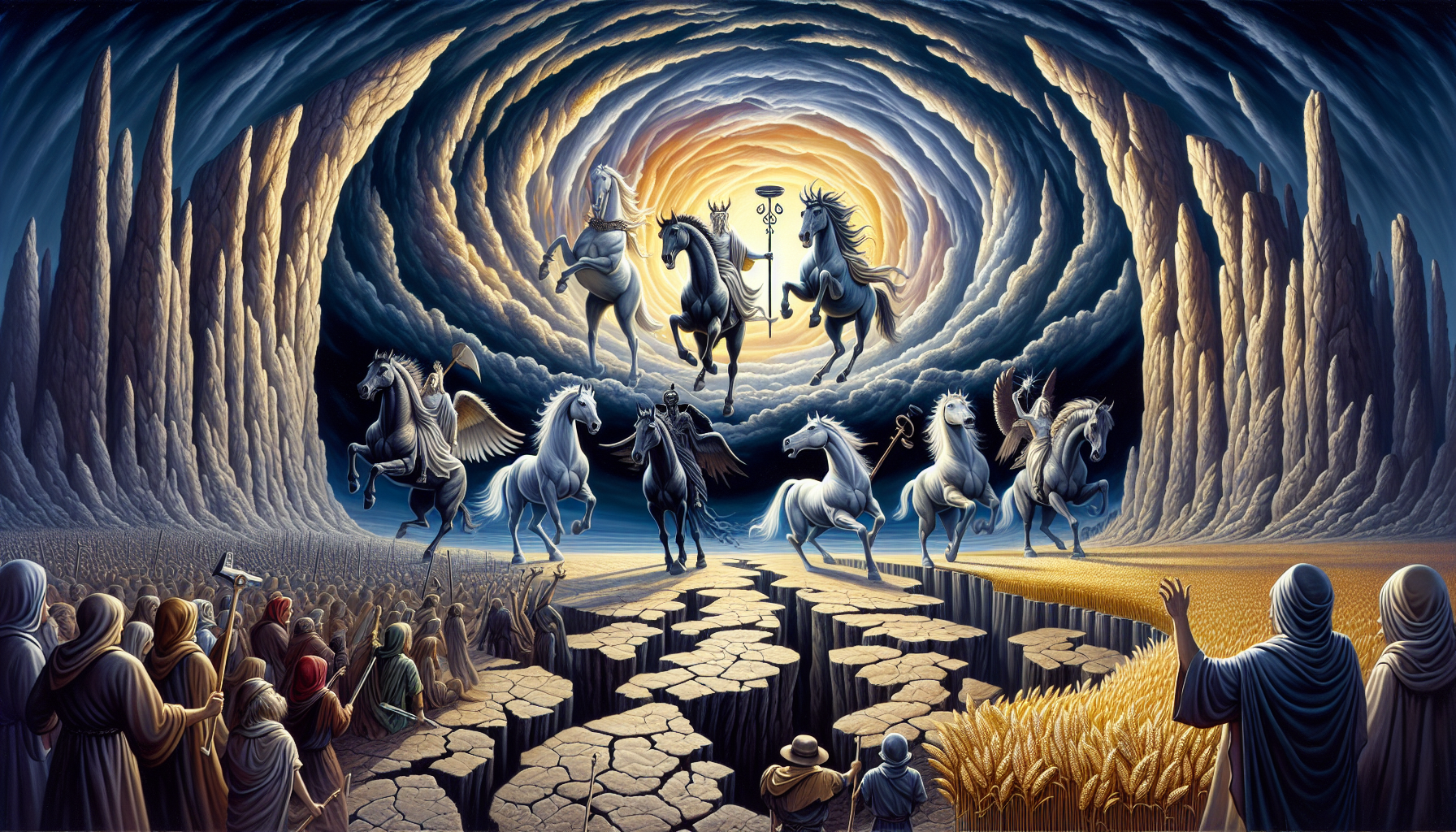
At the end of the picture, we see the sun, moon, and stars growing dark and falling. This represents those who used to belong to God but no longer do, marking the end of spiritual Israel. When something has an end, there must be another – the work of recreation. This is about destroying the old and replanting the new.

Just as John the Baptist was the lampstand who marked the end of physical Israel, and the disciples were like the court wheat and three quart barley (they were the ones who believed in Jesus’s first coming), the same pattern appears in Revelation time. The tabernacle temple marks the era – one era finishing and a new era being created through the work of recreation.

There was a great earthquake, causing people’s hearts to be shaken. Instead of repenting, they flee into caves and rocks, saying “hide us.” They go into rakes (the Gentile churches). This is a picture summary in parable form of Revelation chapter six.

When we go verse by verse and receive the oil for our lamp, it burns bright. We’re able to understand everything well. Glory to God and to all the people that do the work of God to help us understand the word, so we can have complete faith in front of God and He can acknowledge us.

Let’s Us Discern

A Refutation Using “Testing Shincheonji’s Claims: Two Lenses, One Story”


Lesson 108: Revelation 6 – The Judgement of the Sun, Moon, and Stars of the Former Heaven that Betrayed (Part 2)

Viewing Through First-Century Christian, Historical, and Literary Lenses


Introduction: The Moment You Become the Story

You’ve been studying for months now. You’ve learned the parables, mastered the patterns, understood the framework. You’ve been told you’re part of the potential 144,000—essential, chosen, irreplaceable. In Lesson 107, you were introduced to the Tabernacle Temple and told that events there were the literal fulfillment of Revelation 6.

But now, in Lesson 108, something even more significant happens. The instructor makes a claim that changes everything:

“The first to appear was a rider on a white horse. And we know specifically who the rider and the horse is in this case. Who was the rider on the white horse and who is the white horse? Jesus and New John.

Let that sink in for a moment. The instructor is telling you that Lee Man-hee—the “New John”—is the white horse that Jesus rides in Revelation 6:2.

This is not symbolic. This is not metaphorical. According to Shincheonji, Lee Man-hee is the literal fulfillment of the white horse in Revelation’s vision. Jesus is the rider, and Lee Man-hee is the horse—the “flesh” that carries Jesus’ message.

This is the moment when the story becomes intensely personal. You’re no longer just learning about abstract prophecy or distant historical events. You’re being told that the man who founded this organization, the man whose teachings you’ve been studying, is himself a prophesied figure in the book of Revelation.

The instructor continues with even more extraordinary claims:

“Revelation is the most precious time in all of God’s work because it is the last of God’s work. All that is left is the work of recreation. It will be done on earth as it is in heaven, this means, we have to be born of his seed.”

Translation: This is the final chapter of God’s plan. There is nothing beyond Revelation. And the way to be part of God’s kingdom is to be “reborn of the seed”—which Shincheonji teaches means accepting their interpretation and becoming part of their organization.

The evangelist asks: “So is there anything past Revelation?”

The class responds: “No.”

The instructor confirms: “Do we have another book? No. The Revelation is actually where God finally wins.”

The message is clear: This is it. This is the end. This is the final work. And you’re either part of it by accepting these teachings, or you’re outside of it facing judgment.

But here’s what you need to understand: These are not just theological claims. These are control mechanisms. By positioning Revelation as “the last of God’s work” and Lee Man-hee as the prophesied white horse, Shincheonji creates a closed system where questioning becomes impossible. If this is truly the final work of God, then leaving means abandoning God’s ultimate plan. If Lee Man-hee is truly the prophesied figure, then rejecting him means rejecting God’s chosen vessel.

This is where the psychological pressure reaches its peak. Students who have invested months of time, formed deep relationships, and been told they’re part of something cosmic are now being asked to accept claims that are:

  • Historically unverifiable
  • Biblically questionable
  • Logically inconsistent
  • Psychologically manipulative

In this refutation, we will examine Lesson 108 through the dual lenses outlined in “Testing Shincheonji’s Claims: Two Lenses, One Story”—the Reflectional Lens (examining the psychological and spiritual impact) and the Discernment Lens (testing claims against Scripture, history, and logic). We will also apply the First-Century Christian lens, asking what the original recipients would have understood, and the Historical and Political lens, examining the actual events through verifiable evidence.

This refutation does not focus on debates between Premillennialism, Amillennialism, or Postmillennialism. Instead, it seeks to understand Revelation as the first-century church would have—as a letter of encouragement and hope written to real communities facing real persecution.

For a more comprehensive examination of Shincheonji’s claims, visit closerlookinitiative.com/shincheonji-examination.


Part 1: “The Most Blessed of All Blessed People” – Creating Exclusivity

SCJ’s Teaching: You Are the Most Blessed

The lesson opens with an extraordinary claim:

“So we are the most blessed of all blessed people because we get to know the Bible from Genesis to Revelation. And we’re even more blessed because now we’re hearing the oil and the wine, the explanation of the word and the testimony as well.”

Notice the language: “the most blessed of all blessed people.” Not just blessed—the most blessed. Not just among blessed people—of all blessed people.

This is exclusivity language. It positions Shincheonji students as uniquely privileged, above all other Christians throughout history. The implication is clear: No one else has what you have. No one else understands what you understand.

The instructor continues:

“Why is God doing this? Well, Revelation 6, we learned that there’s so much judgment going on, right? Well, God chose us from the field because he doesn’t want us to be part of the judgment. He wants us to be part of his kingdom.”

Translation: You’ve been specially selected. You’ve been rescued from judgment. You’re not like everyone else who will face God’s wrath.

Biblical Response: All Believers Are Blessed

Let’s examine what the Bible actually teaches about who is blessed.

Matthew 5:3-12 (The Beatitudes):

“Blessed are the poor in spirit, for theirs is the kingdom of heaven. Blessed are those who mourn, for they will be comforted. Blessed are the meek, for they will inherit the earth. Blessed are those who hunger and thirst for righteousness, for they will be filled. Blessed are the merciful, for they will be shown mercy. Blessed are the pure in heart, for they will see God. Blessed are the peacemakers, for they will be called children of God. Blessed are those who are persecuted because of righteousness, for theirs is the kingdom of heaven. Blessed are you when people insult you, persecute you and falsely say all kinds of evil against you because of me. Rejoice and be glad, because great is your reward in heaven, for in the same way they persecuted the prophets who were before you.”

Notice what makes people blessed according to Jesus:

  • Humility (“poor in spirit”)
  • Mourning over sin
  • Meekness
  • Hunger for righteousness
  • Mercy
  • Purity of heart
  • Peacemaking
  • Persecution for righteousness

Jesus does not say: “Blessed are those who join the right organization” or “Blessed are those who have the correct interpretation of Revelation.”

Ephesians 1:3:

“Praise be to the God and Father of our Lord Jesus Christ, who has blessed us in the heavenly realms with every spiritual blessing in Christ.”

All believers are blessed with “every spiritual blessing in Christ.” Not just Shincheonji members. Not just those who understand Revelation a certain way. Every believer in Christ.

1 Peter 2:9:

“But you are a chosen people, a royal priesthood, a holy nation, God’s special possession, that you may declare the praises of him who called you out of darkness into his wonderful light.”

All Christians are “chosen,” “royal,” “holy,” and “God’s special possession.” This is not unique to Shincheonji—this is the status of every believer.

The Danger of Exclusivity Claims

When a group claims to be “the most blessed of all blessed people,” several dangerous things happen:

1. It Creates Spiritual Pride

Students begin to see themselves as superior to other Christians. They have something others don’t. They understand something others can’t. This breeds arrogance and judgmentalism.

Proverbs 16:18:

“Pride goes before destruction, a haughty spirit before a fall.”

1 Corinthians 8:1:

“Knowledge puffs up while love builds up.”

2. It Isolates from the Broader Christian Community

If you’re “the most blessed,” then everyone else must be less blessed—or not blessed at all. This creates a barrier between Shincheonji members and other Christians, making it difficult to learn from, fellowship with, or receive correction from the broader body of Christ.

3. It Makes Leaving Psychologically Difficult

If you believe you’re “the most blessed of all blessed people,” then leaving means giving up that special status. It means going from the top to… what? Ordinary Christianity? Being “less blessed”? This creates intense psychological pressure to stay, even when doubts arise.

4. It Contradicts Biblical Humility

The Bible consistently teaches that those who are truly blessed recognize their dependence on God’s grace, not their superior knowledge or organizational affiliation.

Luke 18:14:

“For all those who exalt themselves will be humbled, and those who humble themselves will be exalted.”

James 4:6:

“God opposes the proud but shows favor to the humble.”


Part 2: “All That Is Left Is the Work of Recreation” – The Final Work Claim

SCJ’s Teaching: Revelation Is the Last Work

The instructor makes a sweeping claim:

“Revelation is the most precious time in all of God’s work because it is the last of God’s work. All that is left is the work of recreation.”

The evangelist asks: “So is there anything past Revelation?”

The class responds: “No.”

The instructor confirms: “Do we have another book? No. The Revelation is actually where God finally wins.”

This teaching establishes several key points:

  1. Revelation is the final chapter of God’s work
  2. There is nothing beyond Revelation
  3. What remains is “recreation”—being reborn through “the seed”
  4. This recreation happens now, at Shincheonji

The implication is clear: If you want to be part of God’s final work, you must be part of Shincheonji. There is no plan B. There is no alternative. This is it.

Biblical Response: God’s Work Continues Until Christ Returns

Let’s examine what the Bible actually teaches about God’s ongoing work.

John 5:17:

“In his defense Jesus said to them, ‘My Father is always at his work to this very day, and I too am working.'”

God is always working. His work didn’t stop with Revelation. His work continues throughout history as He draws people to Himself, sanctifies believers, and builds His church.

Philippians 1:6:

“Being confident of this, that he who began a good work in you will carry it on to completion until the day of Christ Jesus.”

God’s work in believers continues “until the day of Christ Jesus”—that is, until Christ returns. It is not completed at one organization in Korea in the 1980s.

Ephesians 2:10:

“For we are God’s handiwork, created in Christ Jesus to do good works, which God prepared in advance for us to do.”

God has prepared good works for all believers to do. His work is not limited to one organization or one interpretation of Revelation.

Matthew 28:18-20 (The Great Commission):

“Then Jesus came to them and said, ‘All authority in heaven and on earth has been given to me. Therefore go and make disciples of all nations, baptizing them in the name of the Father and of the Son and of the Holy Spirit, and teaching them to obey everything I have commanded you. And surely I am with you always, to the very end of the age.'”

Jesus commissioned His disciples to make disciples of all nations, and He promised to be with them “to the very end of the age.” This is an ongoing work that continues until Christ returns, not a work that was completed at the Tabernacle Temple.

The Problem with “Recreation Through the Seed”

The instructor teaches:

“So that is the work of recreation, to completely recreate your spirit, to be perfect according to the word in God’s eyes. And that’s what we’re in class here to know. So if God says this is possible, that means it is.”

Shincheonji teaches that “recreation” happens through being “reborn of the seed”—which they interpret as accepting their teaching and becoming part of their organization.

But the Bible teaches that regeneration (being born again) happens through faith in Jesus Christ, by the power of the Holy Spirit:

John 3:3-8:

“Jesus replied, ‘Very truly I tell you, no one can see the kingdom of God unless they are born again.’ ‘How can someone be born when they are old?’ Nicodemus asked. ‘Surely they cannot enter a second time into their mother’s womb to be born!’ Jesus answered, ‘Very truly I tell you, no one can enter the kingdom of God unless they are born of water and the Spirit. Flesh gives birth to flesh, but the Spirit gives birth to spirit. You should not be surprised at my saying, “You must be born again.” The wind blows wherever it pleases. You hear its sound, but you cannot tell where it comes from or where it is going. So it is with everyone born of the Spirit.'”

Being born again is a work of the Holy Spirit, not a result of joining an organization or accepting a particular interpretation of Revelation.

1 Peter 1:23:

“For you have been born again, not of perishable seed, but of imperishable, through the living and enduring word of God.”

Yes, we are born again through the “word of God”—but this is the gospel message of Jesus Christ, not Shincheonji’s interpretation of Revelation.

Titus 3:5:

“He saved us, not because of righteous things we had done, but because of his mercy. He saved us through the washing of rebirth and renewal by the Holy Spirit.”

Rebirth and renewal are works of the Holy Spirit, not organizational membership.


Part 3: The White Horse – Jesus and “New John”

SCJ’s Teaching: Lee Man-hee Is the White Horse

This is perhaps the most significant claim in Lesson 108:

“The first to appear was a rider on a white horse. And we know specifically who the rider and the horse is in this case. Who was the rider on the white horse and who is the white horse? Jesus and New John.

The instructor clarifies:

“So the rider on the white horse is Jesus. And of course, a horse is a person is a flesh. And the flesh in this case is New John.”

Let’s be absolutely clear about what Shincheonji is claiming:

  1. The white horse in Revelation 6:2 is a person
  2. That person is Lee Man-hee (the “New John”)
  3. Jesus is the rider on this horse
  4. This means Jesus works through Lee Man-hee as His chosen vessel

This is not a minor interpretive detail. This is a foundational claim about Lee Man-hee’s identity and authority. If Lee Man-hee is truly the prophesied white horse, then he has unique divine authorization. If he’s not, then the entire Shincheonji system is built on a false claim.

Biblical Response: The White Horse in Revelation 6

Let’s examine what Revelation 6:1-2 actually says:

Revelation 6:1-2:

“I watched as the Lamb opened the first of the seven seals. Then I heard one of the four living creatures say in a voice like thunder, ‘Come!’ I looked, and there before me was a white horse! Its rider held a bow, and he was given a crown, and he rode out as a conqueror bent on conquest.”

First-Century Understanding:

In the Roman world, a white horse was associated with military victory and conquest. Roman generals who won significant victories would ride white horses in triumphal processions. The image of a rider with a bow and crown going out “as a conqueror bent on conquest” would have been immediately understood as representing military power and domination.

The first-century readers would have understood this as:

  • Rome’s military might
  • The threat of conquest and war
  • The beginning of the judgments described by the prophets (conquest, war, famine, death)

Some interpreters see the white horse as representing Christ’s victorious advance through the gospel. This is possible, especially given that Christ appears on a white horse in Revelation 19:11. However, even if the white horse in Revelation 6:2 represents Christ, it is a symbolic vision, not a literal person riding a literal horse.

The Problem with Identifying the Horse as a Person

Shincheonji’s interpretation requires several problematic assumptions:

1. The Horse Must Be a Literal Person

The instructor says: “A horse is a person is a flesh.”

But why must the horse be a person? In apocalyptic literature, horses are symbolic representations of forces, powers, or judgments—not literal individuals.

If the white horse is a person, then what about the other three horses?

  • Is the red horse a person?
  • Is the black horse a person?
  • Is the pale horse a person?

Shincheonji would say yes—these are people at the Tabernacle Temple. But this interpretation is inconsistent with how horses are used throughout Scripture and apocalyptic literature.

2. The Rider and Horse Must Be Separate Entities

Shincheonji teaches that Jesus is the rider and Lee Man-hee is the horse. But Revelation 19:11-16 presents Christ Himself as both the rider and the one on the white horse—they are not separate entities:

Revelation 19:11-13:

“I saw heaven standing open and there before me was a white horse, whose rider is called Faithful and True. With justice he judges and wages war. His eyes are like blazing fire, and on his head are many crowns. He has a name written on him that no one knows but he himself. He is dressed in a robe dipped in blood, and his name is the Word of God.”

Christ is the rider. He doesn’t need a human “horse” to carry Him. He is the conquering King who rides forth in victory.

3. This Interpretation Elevates Lee Man-hee to a Unique Prophetic Role

By identifying Lee Man-hee as the white horse, Shincheonji places him in a position of unique authority and significance. He becomes essential to God’s plan—the vessel through which Jesus works.

But the Bible teaches that Jesus works through all believers by the Holy Spirit:

Acts 1:8:

“But you will receive power when the Holy Spirit comes on you; and you will be my witnesses in Jerusalem, and in all Judea and Samaria, and to the ends of the earth.”

John 14:12:

“Very truly I tell you, whoever believes in me will do the works I have been doing, and they will do even greater things than these, because I am going to the Father.”

All believers are witnesses. All believers are empowered by the Holy Spirit. There is no need for one special “horse” to carry Jesus’ message.

The Danger of This Teaching

When Lee Man-hee is identified as the prophesied white horse:

1. It Makes Him Indispensable

If Jesus rides Lee Man-hee as His chosen vessel, then rejecting Lee Man-hee means rejecting Jesus’ chosen method of working. This creates intense pressure to accept his authority without question.

2. It Suppresses Critical Thinking

How can you question the white horse that Jesus rides? How can you test the teachings of someone who is prophesied in Revelation? This teaching makes critical examination feel like rebellion against God.

3. It Creates a Closed System

If Lee Man-hee is the fulfillment of prophecy, then his interpretation must be correct. There’s no room for alternative views, no space for correction, no possibility that he might be wrong.

4. It Contradicts the Sufficiency of Christ

The Bible teaches that Christ is sufficient—we don’t need a human mediator between us and God (1 Timothy 2:5). By positioning Lee Man-hee as the “horse” that Jesus rides, Shincheonji creates a functional mediator between believers and Christ.


Part 4: The Fifth Seal – Martyrs Crying Out

SCJ’s Teaching: The Fifth Seal at the Tabernacle Temple

The instructor moves to the fifth seal:

“The 5th seal is the crying out of the martyrs.”

While the uploaded portion doesn’t provide full details, Shincheonji’s standard teaching (documented in “SCJ’s Fulfillment of Revelation Part 1 and 2”) interprets the fifth seal as follows:

Shincheonji teaches that the “souls under the altar” (Revelation 6:9-11) are members of the Tabernacle Temple who were spiritually killed or who left the organization. These “martyrs” are crying out for vindication, asking God to judge those who caused the destruction of the Tabernacle Temple.

According to Shincheonji, this was fulfilled when faithful members of the Tabernacle Temple (including Lee Man-hee) witnessed the organization’s collapse and cried out to God for justice.

Biblical Text: Revelation 6:9-11

Let’s read what the text actually says:

Revelation 6:9-11:

“When he opened the fifth seal, I saw under the altar the souls of those who had been slain because of the word of God and the testimony they had maintained. They called out in a loud voice, ‘How long, Sovereign Lord, holy and true, until you judge the inhabitants of the earth and avenge our blood?’ Then each of them was given a white robe, and they were told to wait a little longer, until the full number of their fellow servants, their brothers and sisters, were killed just as they had been.”

Key details:

  1. These are “souls of those who had been slain
  2. They were slain “because of the word of God and the testimony they had maintained”
  3. They are crying out for God to “avenge our blood
  4. They are told to wait until “the full number of their fellow servants… were killed just as they had been”

This is describing physical martyrdom—people who were killed for their faith.

First-Century Understanding: Christian Martyrs

The first-century Christians reading Revelation would have immediately understood this as referring to believers who were martyred for their faith.

By the time Revelation was written (likely in the 90s AD), many Christians had already been martyred:

  • Stephen was stoned to death (Acts 7:54-60)
  • James the brother of John was killed by Herod (Acts 12:1-2)
  • Peter and Paul were likely martyred in Rome under Nero
  • Countless other Christians were killed in the persecution under Nero (AD 64-68) and subsequent persecutions

The cry “How long, Sovereign Lord, until you judge and avenge our blood?” would have resonated deeply with Christians facing persecution. They were asking: “When will God vindicate us? When will He judge those who are killing us?”

This was a message of hope: “Your suffering is not forgotten. God sees. God will judge. Wait a little longer—justice is coming.”

The Problem with SCJ’s Interpretation

Shincheonji’s interpretation has several major problems:

1. These Are Physical Deaths, Not Spiritual Deaths

The text says they were “slain” and asks God to “avenge our blood.” This is physical martyrdom, not spiritual death or organizational departure.

Were people at the Tabernacle Temple physically killed? No. There were conflicts, disputes, and people leaving—but not physical martyrdom.

Shincheonji spiritualizes “slain” to mean “spiritually killed” or “deceived.” But this interpretation requires ignoring the clear language of physical death.

2. The Martyrs Are Vindicated, Not Judged

In Revelation 6:11, the martyrs are “given white robes“—a symbol of righteousness and vindication. They are honored, not judged.

But according to Shincheonji, the Tabernacle Temple was judged in Revelation 6. If the souls under the altar represent Tabernacle Temple members, and the Tabernacle Temple was judged, then how can these souls be vindicated and given white robes?

The interpretation is internally inconsistent.

3. It Trivializes Real Martyrdom

Throughout history, millions of Christians have been physically killed for their faith. They have been crucified, burned, beheaded, stoned, and tortured.

To claim that Revelation 6:9-11 is about organizational conflicts at a Korean church is to trivialize the real suffering of real martyrs. It reduces their sacrifice to a metaphor for church disputes.

This is not just bad interpretation—it’s disrespectful to the memory of those who gave their lives for Christ.

The True Meaning: Hope for Persecuted Christians

The fifth seal is a message of hope for Christians facing persecution:

1. God Sees Your Suffering

The martyrs are “under the altar”—in God’s presence. Their deaths are not forgotten. God sees and remembers every sacrifice made for His name.

2. Justice Will Come

God will judge those who persecute His people. The cry “How long?” is answered with “Wait a little longer.” Justice is delayed, but it is certain.

3. Your Death Is Not Meaningless

The martyrs are given white robes—symbols of righteousness and honor. Their deaths are not in vain. They are vindicated and honored by God.

4. You Are Part of a Larger Story

The martyrs are told to wait “until the full number of their fellow servants… were killed just as they had been.” They are part of a larger community of faith that spans time and geography.

This message would have given tremendous hope to first-century Christians facing the possibility of martyrdom. It assured them that their suffering mattered, that God would vindicate them, and that they were part of God’s eternal plan.

Shincheonji’s interpretation strips away this hope and replaces it with a story about organizational conflicts in Korea. This is not faithful biblical interpretation—it is eisegesis that serves Shincheonji’s narrative.


Part 5: The Sixth Seal – Cosmic Signs or Organizational Collapse?

SCJ’s Teaching: The End of an Era

The instructor summarizes:

“The 6th seal, in summary, is the end of an era.”

Shincheonji teaches that the sixth seal describes the complete collapse of the Tabernacle Temple—the “sun, moon, and stars” (leaders and members) being judged and removed, resulting in the “end of an era” (the end of the “first heaven and first earth”).

Biblical Text: Revelation 6:12-17

Let’s read the full text:

Revelation 6:12-17:

“I watched as he opened the sixth seal. There was a great earthquake. The sun turned black like sackcloth made of goat hair, the whole moon turned blood red, and the stars in the sky fell to earth, as figs drop from a fig tree when shaken by a strong wind. The heavens receded like a scroll being rolled up, and every mountain and island was removed from its place.

Then the kings of the earth, the princes, the generals, the rich, the mighty, and everyone else, both slave and free, hid in caves and among the rocks of the mountains. They called to the mountains and the rocks, ‘Fall on us and hide us from the face of him who sits on the throne and from the wrath of the Lamb! For the great day of their wrath has come, and who can withstand it?'”

This is dramatic, cosmic imagery:

  • Great earthquake
  • Sun turning black
  • Moon turning blood red
  • Stars falling from the sky
  • Sky receding like a scroll
  • Mountains and islands removed
  • Kings, princes, generals, rich, mighty, slave, and free—all hiding in terror

The question is: Is this describing literal cosmic events, or is it symbolic language for something else?

First-Century Understanding: Prophetic Language for Political Collapse

As we discussed in the refutation of Lesson 107, the first-century readers would have recognized this as prophetic language for the collapse of political and religious powers.

This type of imagery was common in the Old Testament prophets:

Isaiah 13:9-10 (judgment on Babylon):

“See, the day of the Lord is coming—a cruel day, with wrath and fierce anger—to make the land desolate and destroy the sinners within it. The stars of heaven and their constellations will not show their light. The rising sun will be darkened and the moon will not give its light.”

Isaiah 34:4 (judgment on Edom):

“All the stars in the sky will be dissolved and the heavens rolled up like a scroll; all the starry host will fall like withered leaves from the vine, like shriveled figs from the fig tree.”

Ezekiel 32:7-8 (judgment on Egypt):

“When I snuff you out, I will cover the heavens and darken their stars; I will cover the sun with a cloud, and the moon will not give its light. All the shining lights in the heavens I will darken over you; I will bring darkness over your land, declares the Sovereign Lord.”

This language was never meant to be taken literally. When Isaiah prophesied the fall of Babylon, the literal sun didn’t turn black and the literal stars didn’t fall. This was poetic, prophetic language describing the collapse of a nation and its ruling powers.

Similarly, Jesus used this language when prophesying about the destruction of Jerusalem:

Matthew 24:29:

“Immediately after the distress of those days ‘the sun will be darkened, and the moon will not give its light; the stars will fall from the sky, and the heavenly bodies will be shaken.'”

This was fulfilled in AD 70 when the Romans destroyed Jerusalem and the temple. The “sun, moon, and stars”—the religious and political leadership of Israel—were judged and removed. The old covenant order came to an end.

The first-century Christians reading Revelation 6 would have understood this as prophetic language for God’s judgment on Rome and the forces that persecuted them. The empire that seemed invincible would one day face God’s wrath. The powers that killed Christians would be brought low.

The Universal Scope vs. Local Church Dispute

Notice the scope of the judgment in Revelation 6:15-17:

“Then the kings of the earth, the princes, the generals, the rich, the mighty, and everyone else, both slave and free, hid in caves and among the rocks of the mountains.”

This is universal language. It includes:

  • Kings of the earth (political rulers)
  • Princes (nobility)
  • Generals (military leaders)
  • The rich (economic elite)
  • The mighty (powerful people)
  • Everyone else, both slave and free (all social classes)

Did the collapse of the Tabernacle Temple affect kings, princes, generals, the rich, and the mighty worldwide? No. It affected a small religious group in South Korea.

Did world leaders hide in caves and cry out for the mountains to fall on them because of the Tabernacle Temple’s collapse? No. The world didn’t even notice.

Shincheonji’s interpretation requires shrinking this universal, cosmic judgment to a local organizational dispute. This is not faithful to the text—it is forcing the text to fit a predetermined narrative.


Part 6: The Jonah Comparison – Misapplied Warning

SCJ’s Teaching: Like Jonah to Nineveh

The instructor makes a comparison to the story of Jonah:

“It’s basically the opposite of the story of Jonah, right? God was going to judge the people of Nineveh. But in order for God to judge them, He needed them to at least have heard about what they did wrong. So that’s why it was so important for Jonah to actually do his job and testify to the people of Nineveh. And by God’s grace, when the people of Nineveh heard what they had done wrong, they repented, and things were different.”

The instructor continues:

“Imagine, though, if they said, Jonah, get out of here. And Jonah would have been like to God, I told you these people are awful. Look what they did to me… But if they shooed Jonah away, man, the judgment probably would have been as bad as Sodom and Gomorrah.”

The implication is clear: The Tabernacle Temple was like Nineveh. They were warned (through the letters in Revelation 2-3, according to Shincheonji). They rejected the warning. So judgment came.

Biblical Response: The Story of Jonah

Let’s examine the actual story of Jonah to see if this comparison is valid.

Jonah 1:1-2:

“The word of the Lord came to Jonah son of Amittai: ‘Go to the great city of Nineveh and preach against it, because its wickedness has come up before me.'”

Jonah 3:1-5:

“Then the word of the Lord came to Jonah a second time: ‘Go to the great city of Nineveh and proclaim to it the message I give you.’ Jonah obeyed the word of the Lord and went to Nineveh… Jonah began by going a day’s journey into the city, proclaiming, ‘Forty more days and Nineveh will be overthrown.’ The Ninevites believed God. A fast was proclaimed, and all of them, from the greatest to the least, put on sackcloth.”

Key points from the story:

  1. Jonah was sent by God with a specific message: “Forty more days and Nineveh will be overthrown.”
  2. The message was clear and direct: Judgment is coming in forty days unless you repent.
  3. The people of Nineveh responded with genuine repentance: They fasted, put on sackcloth, and turned from their evil ways.
  4. God relented from the judgment: “When God saw what they did and how they turned from their evil ways, he relented and did not bring on them the destruction he had threatened” (Jonah 3:10).

The Problem with SCJ’s Comparison

Shincheonji’s comparison to Jonah has several problems:

1. The Letters in Revelation 2-3 Were Not Sent to the Tabernacle Temple

Shincheonji claims that the letters in Revelation 2-3 were warnings sent to the Tabernacle Temple, and because they didn’t repent, judgment came in Revelation 6.

But the letters were written to seven specific churches in Asia Minor: Ephesus, Smyrna, Pergamum, Thyatira, Sardis, Philadelphia, and Laodicea. These were real, first-century churches.

The Tabernacle Temple didn’t exist in the first century. How could they “reject” letters that weren’t written to them?

2. There Was No Clear Warning Like Jonah’s

Jonah’s message was specific and clear: “Forty more days and Nineveh will be overthrown.”

What was the specific warning given to the Tabernacle Temple? According to Shincheonji, it was the letters in Revelation 2-3. But those letters were written 1,900 years before the Tabernacle Temple existed. How could they function as a warning?

3. The Comparison Implies Shincheonji Members Are Modern Jonahs

The subtext of this comparison is: “We (Shincheonji) are like Jonah, sent to warn the world. If people reject our message, they will face judgment like Nineveh would have.”

But this is a self-serving comparison. It positions Shincheonji as God’s prophetic voice and anyone who rejects their teaching as rebellious and deserving of judgment.

The Bible warns against such self-authentication:

2 Corinthians 10:18:

“For it is not the one who commends himself who is approved, but the one whom the Lord commends.”

4. It Creates Fear Around Rejecting Shincheonji’s Message

The message is: “If you reject what we’re teaching you, you’re like Nineveh rejecting Jonah. You’ll face judgment like Sodom and Gomorrah.”

This is fear-based manipulation. It uses the threat of divine judgment to suppress critical thinking and maintain control.

But Jesus’ invitation is not based on fear—it’s based on love:

1 John 4:18:

“There is no fear in love. But perfect love drives out fear, because fear has to do with punishment. The one who fears is not made perfect in love.”


Part 7: The Four Horsemen – “The Word” as Judgment

SCJ’s Teaching: The Tools Are “The Word”

The instructor reviews the four horsemen:

“Each of the riders holding a different tool of judgment. To summarize the first three tools, what can you summarize them by?

  1. The bow
  2. The sword, and
  3. The scales.

You can summarize them all as the word. The word…”

Shincheonji teaches that the “bow,” “sword,” and “scales” all represent “the word”—specifically, God’s word used as a tool of judgment against the Tabernacle Temple.

According to Shincheonji:

  • The bow = The word (false teaching or God’s word of judgment)
  • The sword = The word (God’s word that divides and judges)
  • The scales = The word (measuring and weighing according to God’s standards)

Biblical Response: Understanding the Symbols

Let’s examine what these symbols actually represent in their biblical and historical context.

1. The Bow (First Seal – White Horse)

Revelation 6:2:

“I looked, and there before me was a white horse! Its rider held a bow, and he was given a crown, and he rode out as a conqueror bent on conquest.”

In the ancient world, the bow was a weapon of war, particularly associated with mounted archers. The Parthian Empire, Rome’s great enemy to the east, was famous for its mounted archers.

The first-century readers would have understood the bow as representing military conquest and warfare, not “the word” in a spiritual sense.

2. The Sword (Second Seal – Red Horse)

Revelation 6:3-4:

“When the Lamb opened the second seal, I heard the second living creature say, ‘Come!’ Then another horse came out, a fiery red one. Its rider was given power to take peace from the earth and to make people kill each other. To him was given a large sword.”

The sword is explicitly connected to violence and bloodshed: “to take peace from the earth and to make people kill each other.”

Yes, the Bible sometimes uses “sword” metaphorically for God’s word:

Ephesians 6:17:

“Take the helmet of salvation and the sword of the Spirit, which is the word of God.”

Hebrews 4:12:

“For the word of God is alive and active. Sharper than any double-edged sword, it penetrates even to dividing soul and spirit, joints and marrow; it judges the thoughts and attitudes of the heart.”

But in Revelation 6:4, the context is clear: This is a sword that causes people to “kill each other.” This is physical violence and war, not spiritual judgment through the word.

3. The Scales (Third Seal – Black Horse)

Revelation 6:5-6:

“When the Lamb opened the third seal, I heard the third living creature say, ‘Come!’ I looked, and there before me was a black horse! Its rider was holding a pair of scales in his hand. Then I heard what sounded like a voice among the four living creatures, saying, ‘Two pounds of wheat for a day’s wages, and six pounds of barley for a day’s wages, and do not damage the oil and the wine!'”

The scales are connected to economic hardship and famine. The prices mentioned—”two pounds of wheat for a day’s wages”—indicate severe inflation and scarcity. A day’s wages would normally buy much more than two pounds of wheat.

The scales represent economic collapse and famine, not spiritual judgment through the word.

The Pattern: Conquest, War, Famine, Death

The four horsemen follow a logical progression:

  1. White horse (conquest) – Military invasion
  2. Red horse (war) – Bloodshed and violence
  3. Black horse (famine) – Economic collapse and starvation
  4. Pale horse (death) – Plague and mass death

This is the classic pattern of divine judgment described throughout the Old Testament:

Jeremiah 14:12:

“Although they fast, I will not listen to their cry; though they offer burnt offerings and grain offerings, I will not accept them. Instead, I will destroy them with the sword, famine and plague.”

Ezekiel 14:21:

“For this is what the Sovereign Lord says: How much worse will it be when I send against Jerusalem my four dreadful judgments—sword and famine and wild beasts and plague—to kill its people and their animals!”

The four horsemen represent the consequences of rejecting God: conquest by enemies, internal violence, economic collapse, and death.

Shincheonji’s interpretation—that these all represent “the word”—flattens the imagery and misses the progression of judgment described in the text.


Part 8: The Contrasting Chapters Framework – A Tool for Control

SCJ’s Teaching: Three Sets of Contrasting Chapters

The instructor reviews a framework introduced in previous lessons:

“The 3 sets of contrasting chapters in Revelation:

  1. Revelation 6 and Revelation 7
  2. Revelation 13 and Revelation 14
  3. Revelation 18 and Revelation 19

The reason why they’re contrasting is because the previous chapter represents the end, or the bad, and then the next chapter represents the good, or on God’s side, or the beginning.”

The instructor explains each pair:

  1. Revelation 6 and 7: Chapter 6 = end of spiritual Israel; Chapter 7 = new spiritual Israel (144,000)
  2. Revelation 13 and 14: Chapter 13 = mark of the beast; Chapter 14 = seal of God
  3. Revelation 18 and 19: Chapter 18 = marriage with the devil; Chapter 19 = marriage with the Lamb

This framework is then applied specifically:

“So Revelation 6 represents the end of the spiritual Israel, and Revelation 7 represents the beginning of new spiritual Israel.”

Translation: Revelation 6 = destruction of the Tabernacle Temple; Revelation 7 = creation of Shincheonji.

Understanding the Framework: Legitimate Pattern, Illegitimate Application

The observation that Revelation contains contrasts is not wrong. Revelation does present contrasting images:

  • The beast vs. the Lamb
  • Babylon vs. the New Jerusalem
  • Those who receive the mark vs. those who receive the seal
  • The harlot vs. the bride

This is a common feature of apocalyptic literature. It uses stark contrasts to emphasize the choice between following God or following evil, between faithfulness and compromise, between salvation and judgment.

However, Shincheonji uses this legitimate literary observation to impose a specific, illegitimate historical interpretation: that these contrasts represent sequential events at the Tabernacle Temple and Shincheonji.

The Problem with Sequential Interpretation

Shincheonji’s framework assumes that Revelation 6 and 7 are sequential, chronological events:

  • First, the Tabernacle Temple is judged (Revelation 6)
  • Then, Shincheonji is created (Revelation 7)

But this misunderstands how Revelation is structured. As explained in “The Revelation Project” by Dr. Warren Gage and documented in resources about chiastic structure in Revelation, the book uses recapitulation—describing the same events from different perspectives rather than presenting a linear timeline.

Consider the relationship between Revelation 6 and 7:

Revelation 6:15-17 (end of chapter 6):

“Then the kings of the earth, the princes, the generals, the rich, the mighty, and everyone else, both slave and free, hid in caves and among the rocks of the mountains. They called to the mountains and the rocks, ‘Fall on us and hide us from the face of him who sits on the throne and from the wrath of the Lamb! For the great day of their wrath has come, and who can withstand it?'”

This ends with a question: “Who can withstand it?”

Revelation 7:1-3 (beginning of chapter 7):

“After this I saw four angels standing at the four corners of the earth, holding back the four winds of the earth to prevent any wind from blowing on the land or on the sea or on any tree. Then I saw another angel coming up from the east, having the seal of the living God. He called out in a loud voice to the four angels who had been given power to harm the land and the sea: ‘Do not harm the land or the sea or the trees until we put a seal on the foreheads of the servants of our God.'”

Revelation 7 answers the question from Revelation 6: “Who can withstand the wrath of God? Those who are sealed by God.”

This is not describing two different time periods or two different organizations. It is describing two perspectives on the same reality:

  • Revelation 6: The perspective of those who face judgment—terror and fear
  • Revelation 7: The perspective of those who are protected—sealing and security

The literary structure suggests these are simultaneous, not sequential. While judgment falls on those who oppose God, God simultaneously seals and protects His people.

How This Framework Functions as Control

By establishing this “contrasting chapters” framework, Shincheonji creates a powerful psychological tool:

1. It Creates a Binary Choice

You’re either part of Revelation 6 (judgment, destruction, the “bad”) or part of Revelation 7 (salvation, creation, the “good”). There’s no middle ground. You’re either with Shincheonji or facing judgment.

2. It Makes Shincheonji Essential

If Revelation 7 represents the “new spiritual Israel” and that new spiritual Israel is Shincheonji, then being part of Shincheonji becomes essential for salvation. You can’t be part of God’s plan without being part of their organization.

3. It Reframes Leaving as Judgment

If you leave Shincheonji, you’re moving from Revelation 7 (the good, the new) back to Revelation 6 (the bad, the judged). Leaving becomes equivalent to choosing judgment over salvation.

4. It Validates Every Organizational Decision

Any conflict, any departure, any criticism can be reframed as “Revelation 6″—the old, the judged, the failed. And Shincheonji’s response is always “Revelation 7″—the new, the saved, the victorious.

This framework is not just biblical interpretation—it’s a control mechanism that makes questioning or leaving psychologically and spiritually terrifying.


Part 9: “Where the Head Goes, So Goes the Body” – The Leadership Principle

SCJ’s Teaching: The Importance of Leadership

The instructor makes an important point about leadership:

“The people who are being judged here are the 7 stars, and their congregation members. And remember, where the head goes, so too goes the body. Who here has had your body leave your head behind? Or your head leave your body behind? Has that happened to you before? No, it hasn’t? Okay, gotcha. Because that would be death, right? The separation of the head and the body equals death.”

The instructor continues:

“So spiritually, in a church, when the head is gone, the church suffers. So the church tries quickly to replace the head so that the church can continue to thrive. Some of you may have been through a transition like that in the past and know how much turmoil it is.”

This teaching establishes a crucial principle: The leader (the “head”) determines the fate of the followers (the “body”). If the leader is judged, the followers are judged. If the leader is saved, the followers are saved.

Biblical Response: Christ Is the Head

The Bible does use the metaphor of head and body, but with a crucial difference:

Ephesians 5:23:

“For the husband is the head of the wife as Christ is the head of the church, his body, of which he is the Savior.”

Colossians 1:18:

“And he is the head of the body, the church; he is the beginning and the firstborn from among the dead, so that in everything he might have the supremacy.”

Colossians 2:19:

“They have lost connection with the head, from whom the whole body, supported and held together by its ligaments and sinews, grows as God causes it to grow.”

In biblical teaching, Christ is the head of the church—not a human leader. Our connection is to Christ, not to a pastor or organizational leader.

Yes, the Bible teaches that leaders are important and that we should respect and follow godly leadership:

Hebrews 13:17:

“Have confidence in your leaders and submit to their authority, because they keep watch over you as those who must give an account. Do this so that their work will be a joy, not a burden, for that would be of no advantage to you.”

But this is not absolute authority. Leaders are accountable to God, and their authority is limited. We are to follow leaders insofar as they follow Christ:

1 Corinthians 11:1:

“Follow my example, as I follow the example of Christ.”

If a leader deviates from Christ’s teaching, we are not obligated to follow them into error. Our ultimate allegiance is to Christ, not to human leadership.

The Danger of Over-Dependence on Human Leadership

Shincheonji’s teaching creates dangerous over-dependence on human leadership:

1. It Makes Individual Salvation Dependent on Leadership

If “where the head goes, so goes the body,” then your spiritual fate is tied to your leader’s spiritual state. But the Bible teaches that each person is individually accountable to God:

Romans 14:12:

“So then, each of us will give an account of ourselves to God.”

Ezekiel 18:20:

“The one who sins is the one who will die. The child will not share the guilt of the parent, nor will the parent share the guilt of the child. The righteousness of the righteous will be credited to them, and the wickedness of the wicked will be charged against them.”

2. It Discourages Critical Thinking

If the leader is the “head” and you are the “body,” then questioning the leader becomes like the body rebelling against the head—unnatural, dangerous, deadly.

But the Bible commands us to test teaching:

1 Thessalonians 5:21:

“Test everything; hold fast what is good.”

Acts 17:11:

“Now the Berean Jews were of more noble character than those in Thessalonica, for they received the message with great eagerness and examined the Scriptures every day to see if what Paul said was true.”

Even Paul’s teaching was to be examined against Scripture. No human leader is beyond scrutiny.

3. It Creates Vulnerability to Spiritual Abuse

When followers believe their spiritual fate is tied to their leader, they become vulnerable to manipulation and control. The leader can demand unquestioning obedience, suppress dissent, and maintain power through fear of spiritual consequences.

This is the environment that enables spiritual abuse, as documented in Chapter 5 of “Testing Shincheonji’s Claims: Two Lenses, One Story.”

The Biblical Model: A Priesthood of All Believers

The New Testament teaches that all believers have direct access to God through Christ:

1 Peter 2:9:

“But you are a chosen people, a royal priesthood, a holy nation, God’s special possession, that you may declare the praises of him who called you out of darkness into his wonderful light.”

Hebrews 10:19-22:

“Therefore, brothers and sisters, since we have confidence to enter the Most Holy Place by the blood of Jesus, by a new and living way opened for us through the curtain, that is, his body, and since we have a great priest over the house of God, let us draw near to God with a sincere heart and with the full assurance that faith brings.”

We don’t need a human mediator to access God. We have direct access through Christ. We are all priests, able to approach God, study His word, and hear His voice.

Yes, God gives leaders to the church for teaching, shepherding, and equipping:

Ephesians 4:11-13:

“So Christ himself gave the apostles, the prophets, the evangelists, the pastors and teachers, to equip his people for works of service, so that the body of Christ may be built up until we all reach unity in the faith and in the knowledge of the Son of God and become mature, attaining to the whole measure of the fullness of Christ.”

But the purpose of leadership is to “equip” believers for service and help them “become mature”—not to create dependence, but to foster spiritual growth and independence in Christ.


Part 10: The Psychological Progression – Where You Are Now

Understanding Your Journey to This Point

By Lesson 108, students have been through an intensive, carefully designed progression:

Beginner Level (Parables):

  • Established the “Betrayal-Destruction-Salvation” framework
  • Taught that God always works through one chosen person
  • Created distrust of traditional Christian teaching

Intermediate Level (Bible Logic):

  • Taught pattern recognition and “Bible logic”
  • Established that only Shincheonji has the correct interpretation
  • Deepened isolation from other Christians

Advanced Level – Revelation 4-5:

  • Elevated students’ sense of importance (“You are part of the 144,000”)
  • Introduced the throne room and sealed scroll
  • Created anticipation for the “fulfillment”

Advanced Level – Revelation 6 (Lesson 107):

  • Introduced the Tabernacle Temple narrative
  • Raised the stakes with threats of judgment
  • Established Lee Man-hee as the “New John” eyewitness

Advanced Level – Revelation 6 Part 2 (Lesson 108):

  • Explicitly identifies Lee Man-hee as the prophesied white horse
  • Claims this is “the last of God’s work”—there is nothing beyond this
  • Teaches that “recreation” happens through being “reborn of the seed” at Shincheonji
  • Uses the Jonah comparison to create fear around rejecting the message

This is the culmination of months of psychological preparation. Students are now being asked to accept that:

  1. Lee Man-hee is a prophesied figure in Revelation
  2. Shincheonji is the fulfillment of God’s final work
  3. There is no salvation outside of this organization
  4. Questioning or leaving means facing judgment

The Cognitive Dissonance Intensifies

At this point, many students experience intense cognitive dissonance:

The Doubts:

  • “Can one man really be the prophesied white horse?”
  • “How can events at a Korean church be the fulfillment of cosmic prophecy?”
  • “Why does this interpretation seem so different from what other Christians believe?”
  • “If this is true, why isn’t the whole Christian world recognizing it?”

The Pressure:

  • “But I’ve invested so much time…”
  • “Everyone here seems so convinced…”
  • “What if I’m wrong and this really is God’s final work?”
  • “If I leave, will I face judgment like they’re teaching?”
  • “I’ll lose all my friends here…”

This cognitive dissonance is actually healthy—it’s your mind recognizing that something doesn’t add up. But Shincheonji has prepared responses to these doubts:

The Prepared Responses to Doubt

Doubt: “This seems too focused on one person (Lee Man-hee).”

SCJ Response: “God always works through one chosen person. Look at Noah, Abraham, Moses, Jesus. It’s the biblical pattern.”

Reality: While God did work through specific individuals for specific purposes, He never made salvation dependent on recognizing and following a human leader. Salvation has always been through faith in God (Old Testament) and faith in Jesus Christ (New Testament)—not through organizational membership.

Doubt: “How can I verify these claims about the Tabernacle Temple?”

SCJ Response: “Lee Man-hee was there. He witnessed it. He is the New John who can testify to what happened.”

Reality: This is circular reasoning. The only “evidence” for the Tabernacle Temple being the fulfillment of Revelation 6 is Lee Man-hee’s interpretation. There’s no external verification, no objective evidence—just his testimony.

Doubt: “Why don’t other Christians accept this interpretation?”

SCJ Response: “Because they’re part of Babylon. They’re blind. They don’t have the oil and wine (the explanation). Only we have the true understanding.”

Reality: This is a thought-stopping technique. Any external criticism is dismissed as coming from “Babylon” or “blind guides.” This prevents students from seriously considering alternative perspectives.

Doubt: “I feel pressured and anxious, not peaceful.”

SCJ Response: “That’s because you’re being tested. You’re being refined. This is the narrow path. It’s supposed to be difficult.”

Reality: Jesus promised rest and peace, not anxiety and pressure. While following Christ does involve challenges and persecution, it should not involve the constant anxiety and performance pressure that Shincheonji creates.

Matthew 11:28-30:

“Come to me, all you who are weary and burdened, and I will give you rest. Take my yoke upon you and learn from me, for I am gentle and humble in heart, and you will find rest for your souls. For my yoke is easy and my burden is light.”


Part 11: The “Recreation” Teaching – A Subtle Shift in Soteriology

SCJ’s Teaching: Being Reborn of the Seed

The instructor makes a significant theological claim:

“So that is the work of recreation, to completely recreate your spirit, to be perfect according to the word in God’s eyes. And that’s what we’re in class here to know. So if God says this is possible, that means it is.”

The evangelist earlier stated:

“All that is left is the work of recreation. It will be done on earth as it is in heaven, this means, we have to be born of his seed.”

Shincheonji teaches that:

  1. God’s final work is “recreation”—completely recreating your spirit
  2. This happens through being “born of his seed”
  3. The “seed” is the word of God—specifically, Shincheonji’s interpretation
  4. This recreation makes you “perfect according to the word in God’s eyes”
  5. The goal is to have “no lie in them”—complete, perfect knowledge

This teaching sounds biblical on the surface—after all, the Bible does talk about being “born again” and being “transformed.” But there are subtle, dangerous shifts happening here.

Biblical Teaching on Regeneration

The Bible teaches that regeneration (being born again) is a work of the Holy Spirit that happens through faith in Jesus Christ:

John 3:3-8:

“Jesus replied, ‘Very truly I tell you, no one can see the kingdom of God unless they are born again.’ ‘How can someone be born when they are old?’ Nicodemus asked. ‘Surely they cannot enter a second time into their mother’s womb to be born!’ Jesus answered, ‘Very truly I tell you, no one can enter the kingdom of God unless they are born of water and the Spirit. Flesh gives birth to flesh, but the Spirit gives birth to spirit. You should not be surprised at my saying, “You must be born again.” The wind blows wherever it pleases. You hear its sound, but you cannot tell where it comes from or where it is going. So it is with everyone born of the Spirit.'”

Key points:

  1. Being born again is necessary to see and enter God’s kingdom
  2. It is a work of the Spirit, not of human effort
  3. It is mysterious—like the wind, you can’t control or fully understand it
  4. It happens through faith, not through organizational membership

1 Peter 1:23:

“For you have been born again, not of perishable seed, but of imperishable, through the living and enduring word of God.”

Yes, we are born again through the “word of God”—but this is the gospel message, the good news of Jesus Christ, not a specific organization’s interpretation of Revelation.

Titus 3:5:

“He saved us, not because of righteous things we had done, but because of his mercy. He saved us through the washing of rebirth and renewal by the Holy Spirit.”

Rebirth is a work of God’s mercy and the Holy Spirit, not a result of completing a Bible study course.

The Subtle Shift: From Grace to Knowledge

Here’s the dangerous shift in Shincheonji’s teaching:

Biblical Christianity teaches:

  • Salvation is by grace through faith (Ephesians 2:8-9)
  • We are justified by faith, not by works or knowledge (Romans 3:28)
  • Sanctification is a lifelong process of becoming more like Christ (Philippians 1:6)
  • We will not be perfect in this life, but we are being transformed (2 Corinthians 3:18)

Shincheonji teaches:

  • “Recreation” happens through receiving the correct interpretation (knowledge)
  • You can become “perfect according to the word in God’s eyes”
  • The goal is to have “no lie in them”—complete, perfect knowledge
  • This happens at Shincheonji through their teaching

This shifts the basis of salvation from grace to knowledge, from faith in Christ to acceptance of Shincheonji’s interpretation.

This is a form of Gnosticism—the ancient heresy that taught salvation comes through secret knowledge rather than through faith in Christ.

The “No Lie in Them” Teaching

Shincheonji teaches that the 144,000 will have “no lie in them,” which they interpret as having complete, perfect knowledge with no doctrinal error.

This is based on Revelation 14:5:

Revelation 14:5:

“No lie was found in their mouths; they are blameless.”

But let’s look at the context:

Revelation 14:1-5:

“Then I looked, and there before me was the Lamb, standing on Mount Zion, and with him 144,000 who had his name and his Father’s name written on their foreheads. And I heard a sound from heaven like the roar of rushing waters and like a loud peal of thunder. The sound I heard was like that of harpists playing their harps. And they sang a new song before the throne and before the four living creatures and the elders. No one could learn the song except the 144,000 who had been redeemed from the earth. These are those who did not defile themselves with women, for they remained virgins. They follow the Lamb wherever he goes. They were purchased from among mankind and offered as firstfruits to God and the Lamb. No lie was found in their mouths; they are blameless.”

“No lie was found in their mouths” is not about having perfect doctrinal knowledge. It’s about integrity, truthfulness, and faithfulness to Christ. It echoes Old Testament passages about those who speak truth and walk blamelessly:

Psalm 15:1-2:

“Lord, who may dwell in your sacred tent? Who may live on your holy mountain? The one whose walk is blameless, who does what is righteous, who speaks the truth from their heart.”

Zephaniah 3:13:

“They will do no wrong; they will tell no lies. A deceitful tongue will not be found in their mouths. They will eat and lie down and no one will make them afraid.”

“No lie in their mouths” means they are truthful, faithful witnesses—not that they have perfect theological knowledge.

Shincheonji’s interpretation turns this into a claim about doctrinal perfection, which then becomes a justification for their claim to exclusive truth. “We have no lie in us because we have the correct interpretation of Revelation.”

But this is spiritual pride disguised as faithfulness.


Part 12: The Historical Reality – What Really Happened (Again)

Applying the Political and Historical Lens

As we’ve discussed in previous refutations, it’s crucial to examine the actual historical events at the Tabernacle Temple through a political and historical lens, not just through Shincheonji’s theological reinterpretation.

According to “The Real Reasons Behind the Tabernacle Temple’s Destruction and Sale” and “SCJ’s Fulfillment of Revelation Part 1 and 2,” here’s what actually happened:

The Tabernacle Temple was a religious organization founded by Yoo Jae-yeol in the 1960s-1970s. Yoo claimed special revelation and taught that he was fulfilling biblical prophecy. He established a church structure with seven leaders or congregations (the “seven golden lampstands”).

Lee Man-hee joined this organization and became one of its leaders. He was deeply committed to Yoo’s teachings and believed the Tabernacle Temple was the fulfillment of prophecy.

In the late 1970s-early 1980s, the organization experienced internal conflicts:

  • Leadership disputes over authority and succession
  • Theological disagreements about Yoo’s teachings
  • Financial disputes over money and property
  • Personal conflicts and broken relationships

The organization fractured into multiple groups. Different leaders claimed to be the true continuation of Yoo’s work. Some members left entirely. The property was eventually sold.

Lee Man-hee was one of several leaders who broke away to form their own groups. He founded Shincheonji and claimed that:

  • The conflicts at the Tabernacle Temple were the fulfillment of Revelation 6
  • He was the faithful witness (the “New John”) who saw these events
  • His new organization (Shincheonji) was the fulfillment of Revelation 7
  • He was the white horse that Jesus rides

But here’s the critical question: If the Tabernacle Temple was truly the fulfillment of Revelation, why did it fail? And if it wasn’t the fulfillment, why did Lee Man-hee believe in it and participate in it?

Shincheonji’s answer: The Tabernacle Temple was supposed to fail. Its failure was part of the prophecy. It was the “first heaven and first earth” that had to pass away so the “new heaven and new earth” (Shincheonji) could be established.

But this is post-hoc rationalization—reinterpreting failure as part of the plan after the fact. It’s a way of making any outcome fit the narrative:

  • If the organization succeeds: “This proves we’re the fulfillment!”
  • If the organization fails: “This proves we’re the fulfillment—the failure was prophesied!”

This is not how biblical prophecy works. Biblical prophecy is specific, testable, and verifiable—not infinitely flexible to fit any outcome.


Part 13: The Korean Cult Genealogy – A Pattern of Claims

Understanding the Lineage

As documented in the Korean cult genealogy resources, Shincheonji is part of a lineage of Korean religious movements that share similar patterns:

The Genealogy:

  1. Park Tae-sun (Olive Tree movement, 1950s-1960s) – Claimed to be the Holy Spirit incarnate, taught that he was establishing God’s kingdom on earth
  2. Yoo Jae-yeol (Tabernacle Temple, 1960s-1980s) – Claimed to be fulfilling Revelation, established the “seven golden lampstands,” taught that his organization was the fulfillment of prophecy
  3. Lee Man-hee (Shincheonji, 1984-present) – Claims to be the “promised pastor,” the “New John,” the white horse that Jesus rides, teaches that Shincheonji is the “new heaven and new earth”

Each leader in this lineage:

  • Claimed exclusive revelation from God
  • Taught that they were the unique fulfillment of biblical prophecy
  • Claimed that previous movements failed but theirs is the true fulfillment
  • Required followers to accept their interpretation to be saved
  • Created a closed system where questioning was equated with rebellion against God

And here’s the pattern: Lee Man-hee was a follower of Yoo Jae-yeol before founding Shincheonji. He believed in Yoo’s claims. He was part of the Tabernacle Temple that he now says was “judged” in Revelation 6.

This raises obvious questions:

  1. If Yoo Jae-yeol’s Tabernacle Temple was the fulfillment of Revelation, why did it fail?
  2. If it wasn’t the true fulfillment, why did Lee Man-hee believe in it and participate in it?
  3. How can we trust Lee Man-hee’s claims when he was wrong about his previous leader’s claims?
  4. What happens when the next leader emerges, claims Shincheonji has been “judged,” and declares his organization is the true fulfillment?

The pattern suggests this cycle will continue indefinitely—each new leader claiming to be the fulfillment, each previous movement reinterpreted as the “failed” generation that was judged.

The Reinterpretation of Failure

Here’s the brilliant psychological move that Lee Man-hee made:

Instead of admitting “We were wrong—the Tabernacle Temple wasn’t the fulfillment,” he reinterpreted the failure as part of the prophecy: “The Tabernacle Temple’s collapse was the judgment of Revelation 6. I witnessed it. Now I’m founding the true fulfillment in Revelation 7.”

This reinterpretation accomplishes several things:

  1. It preserves the claim that Revelation was being fulfilled (just not the way they initially thought)
  2. It positions Lee Man-hee as the faithful witness who saw the “true” meaning of the events
  3. It explains why he was part of a “failed” movement (it wasn’t really failed—it was prophesied to be judged)
  4. It establishes his new organization as the true fulfillment (Shincheonji is the “new heaven and new earth”)

But this logic can justify anything. Any failure, any conflict, any collapse can be reinterpreted as “judgment” and used as the foundation for a new claim of fulfillment.

This is not biblical prophecy. This is creative storytelling that makes any outcome fit the narrative.


Part 14: The Theological Problems – Testing Against Scripture

Problem #1: Making Salvation Dependent on Knowledge

Shincheonji’s teaching effectively makes salvation dependent on accepting their interpretation of Revelation. You must:

  • Recognize that the Tabernacle Temple was the fulfillment of Revelation 6
  • Accept that Lee Man-hee is the New John and the white horse
  • Believe that Shincheonji is the new heaven and new earth
  • Be “reborn of the seed” through their teaching

But the Bible teaches that salvation is by grace through faith in Jesus Christ:

Ephesians 2:8-9:

“For it is by grace you have been saved, through faith—and this is not from yourselves, it is the gift of God—not by works, so that no one can boast.”

Acts 16:31:

“Believe in the Lord Jesus, and you will be saved—you and your household.”

Romans 10:9:

“If you declare with your mouth, ‘Jesus is Lord,’ and believe in your heart that God raised him from the dead, you will be saved.”

Salvation is through faith in Jesus Christ, not through accepting a specific interpretation of Revelation or joining a specific organization.

Problem #2: Claiming Perfection in This Life

Shincheonji teaches that through “recreation,” believers can become “perfect according to the word in God’s eyes” and have “no lie in them.”

But the Bible teaches that we will not be perfect in this life:

1 John 1:8:

“If we claim to be without sin, we deceive ourselves and the truth is not in us.”

Philippians 3:12:

“Not that I have already obtained all this, or have already arrived at my goal, but I press on to take hold of that for which Christ Jesus took hold of me.”

Even the Apostle Paul, who wrote much of the New Testament, said he had not “already arrived” at perfection. He was still pressing on, still growing.

James 3:2:

“We all stumble in many ways. Anyone who is never at fault in what they say is perfect, able to keep their whole body in check.”

James acknowledges that “we all stumble in many ways.” Perfection in this life is not the biblical expectation.

Yes, we are being sanctified—made more like Christ:

2 Corinthians 3:18:

“And we all, who with unveiled faces contemplate the Lord’s glory, are being transformed into his image with ever-increasing glory, which comes from the Lord, who is the Spirit.”

But this is a process, not an instant achievement through accepting the right interpretation.

Problem #3: Shrinking Revelation to Organizational Events

As we’ve discussed throughout these refutations, Shincheonji’s interpretation shrinks Revelation from cosmic, universal scope to local, organizational events.

Revelation was written to encourage Christians throughout the Roman Empire facing persecution. It proclaimed God’s sovereignty, Christ’s victory, and the ultimate defeat of evil. It gave hope to those facing martyrdom.

Shincheonji’s interpretation makes Revelation irrelevant to:

  • First-century Christians facing persecution under Rome
  • Medieval Christians facing plague and war
  • Reformation Christians rediscovering the gospel
  • Modern Christians facing persecution worldwide

According to Shincheonji, Revelation was only relevant to a small group in Korea in the 1970s-1980s, and now to those who join their organization.

This is not faithful biblical interpretation. This is eisegesis that serves an organizational agenda.

Problem #4: Creating a Closed System

Shincheonji’s teaching creates a closed system where:

  • They have the only correct interpretation
  • All other Christians are “Babylon” or “blind”
  • Questioning is equated with rebellion against God
  • Leaving means facing judgment
  • There is no external standard by which to test their claims

But the Bible commands us to test teaching:

1 Thessalonians 5:21:

“Test everything; hold fast what is good.”

1 John 4:1:

“Dear friends, do not believe every spirit, but test the spirits to see whether they are from God, because many false prophets have gone out into the world.”

Acts 17:11:

“Now the Berean Jews were of more noble character than those in Thessalonica, for they received the message with great eagerness and examined the Scriptures every day to see if what Paul said was true.”

Even Paul’s teaching was to be examined against Scripture. No human teacher is beyond scrutiny. No interpretation is beyond testing.

Shincheonji’s closed system violates this biblical principle and creates an environment ripe for spiritual abuse.


Part 15: Practical Guidance – What Should You Do?

If You’re Currently Taking This Lesson

You are at a critical juncture. You’re being asked to accept claims that are:

  • Historically unverifiable
  • Biblically questionable
  • Logically inconsistent
  • Psychologically manipulative

Here’s what you need to do:

1. Pause and Reflect

Don’t rush through this decision. Take time to think critically about what you’re being asked to believe.

Ask yourself:

  • Am I being given all the information, or just one perspective?
  • Can I verify these claims independently?
  • Does this interpretation make sense in the original context of Revelation?
  • Am I feeling pressured to accept this quickly?
  • What happens if I question or disagree?

2. Research Independently

Don’t rely solely on Shincheonji’s version of events. Research:

  • The Tabernacle Temple (look for neutral, historical sources)
  • How other Christians interpret Revelation
  • The Korean cult genealogy and the pattern of claims
  • Testimonies from former Shincheonji members

Visit closerlookinitiative.com/shincheonji-examination for comprehensive resources.

3. Test Against Scripture

Read Revelation in its full context. Read the Old Testament passages that use similar imagery. Read what the New Testament teaches about salvation, sanctification, and the church.

Ask:

  • Does Shincheonji’s interpretation fit the context?
  • Would the original readers have understood it this way?
  • Does this align with what the rest of Scripture teaches?

4. Seek Outside Counsel

Talk to Christians outside of Shincheonji. Get other perspectives. Don’t let Shincheonji be your only source of biblical teaching.

Consider:

  • Talking to a pastor or Christian counselor
  • Reading commentaries on Revelation by respected scholars
  • Discussing your concerns with trusted friends or family

5. Trust Your Instincts

If you’re experiencing cognitive dissonance, if something feels wrong, if you’re feeling pressured and anxious—trust those feelings. They may be the Holy Spirit prompting you to examine more carefully.

Proverbs 14:15:

“The simple believe anything, but the prudent give thought to their steps.”

If You’re Considering Leaving

1. Know That It’s Okay to Leave

Leaving Shincheonji is not leaving God. Your relationship with God is based on Christ’s finished work, not on organizational membership.

John 10:27-29:

“My sheep listen to my voice; I know them, and they follow me. I give them eternal life, and they shall never perish; no one will snatch them out of my hand. My Father, who has given them to me, is greater than all; no one can snatch them out of my Father’s hand.”

If you are in Christ, nothing can snatch you from His hand—not even leaving Shincheonji.

2. Prepare for the Transition

Leaving may be difficult. You may:

  • Lose friendships
  • Face pressure to stay
  • Experience grief and confusion
  • Question what you believed

But you will also experience:

  • Freedom from manipulation
  • Ability to read the Bible without fear
  • Connection with the broader Christian community
  • Rest and security in Christ

3. Seek Support

Don’t go through this alone. Connect with:

  • Former members who understand your experience
  • A healthy, Bible-teaching church
  • A counselor familiar with spiritual abuse
  • Trusted friends and family

4. Be Patient with Yourself

Healing takes time. You may need to grieve, process, and rebuild. Give yourself grace.

5. Rediscover the Simple Gospel

The gospel is beautifully simple:

  • God loves you (John 3:16)
  • Christ died for you (Romans 5:8)
  • You are saved by grace through faith (Ephesians 2:8-9)
  • You are secure in Him (Romans 8:38-39)

You don’t have to earn it. You don’t have to maintain it through performance. You don’t have to be part of a specific organization.

It’s a gift. Receive it. Rest in it.


Part 16: The True Message of Revelation 6 (Revisited)

What the First-Century Christians Heard

Let’s return to the original context one more time and ask: What message did the first-century Christians receive from Revelation 6?

They heard:

1. God Is Sovereign

Despite Rome’s power, despite persecution, God is on His throne. The Lamb opens the seals. God’s plan is unfolding. Nothing is out of His control.

2. Judgment Is Coming

The forces that oppose God—represented by the four horsemen—will not last forever. God will judge evil. Rome’s power is not ultimate.

3. Martyrs Will Be Vindicated

The souls under the altar cry out: “How long, Sovereign Lord?” The answer: “Wait a little longer.” God sees. God remembers. God will vindicate.

4. The Day of Wrath Is Coming

Even the powerful—kings, princes, generals—will face God’s wrath. No one can escape God’s judgment.

5. But God’s People Are Protected

This leads into Revelation 7, where God seals His people before judgment falls. They are protected, secure, and will stand before the throne in worship.

This was a message of hope for Christians facing martyrdom. It assured them that:

  • Their suffering was not meaningless
  • God would judge their persecutors
  • They would be vindicated
  • They were secure in God’s hands

This message has timeless application for all Christians:

  • God is sovereign over history
  • Evil will be judged
  • Suffering is not meaningless
  • We are secure in Christ
  • We await His return with hope

This is the true message of Revelation 6—not a message about organizational disputes in Korea, but a message about God’s sovereignty, justice, and faithfulness that applies to all Christians in all times and places.


Conclusion: The Choice Before You

Two Stories, One Choice

You are being presented with two fundamentally different stories:

Shincheonji’s Story:

  • Revelation was a coded message for events in 20th-century Korea
  • Lee Man-hee is the prophesied white horse that Jesus rides
  • The Tabernacle Temple’s collapse was the fulfillment of Revelation 6
  • Shincheonji is the new heaven and new earth of Revelation 7
  • You must join Shincheonji to be part of God’s final work
  • This is “the last of God’s work”—there is nothing beyond this
  • If you leave or question, you will face judgment

The Biblical Story:

  • Revelation was a letter to first-century Christians facing persecution
  • It used prophetic imagery to proclaim God’s sovereignty and Christ’s victory
  • It gave hope to those facing martyrdom
  • It applies to all Christians as a message of perseverance and hope
  • Salvation is through faith in Christ alone, not organizational membership
  • God’s work continues until Christ returns
  • You are secure in Christ, and nothing can separate you from His love

These stories cannot both be true. You must choose which one you will believe.

The Test of Truth

As Chapter 11 of “Testing Shincheonji’s Claims: Two Lenses, One Story” explains, we can test teaching by asking:

1. Does it match the original context?

  • Would the first-century readers have understood Revelation this way?
  • Does the interpretation fit the historical and literary context?

2. Does it require secret knowledge?

  • Does it claim that only one person or group can understand the true meaning?
  • Does it make the Bible inaccessible to ordinary believers?

3. Does it elevate a human leader?

  • Does it place a person in a position of unique authority?
  • Does it make salvation dependent on following that leader?

4. Does it create fear and control?

  • Does it use threats of judgment to suppress questioning?
  • Does it create anxiety rather than peace?

5. Is it verifiable?

  • Can the claims be tested against objective evidence?
  • Or do they rely solely on one person’s testimony?

6. Does it align with the whole of Scripture?

  • Does it contradict clear biblical teaching about salvation, sanctification, and the church?
  • Does it isolate one passage from the broader biblical narrative?

When we apply these tests to Shincheonji’s interpretation of Revelation 6, it fails on every count.

The Invitation

If you are struggling, if you are doubting, if you are feeling pressured—hear this:

Jesus invites you to come to Him, not to an organization:

Matthew 11:28-30:

“Come to me, all you who are weary and burdened, and I will give you rest. Take my yoke upon you and learn from me, for I am gentle and humble in heart, and you will find rest for your souls. For my yoke is easy and my burden is light.”

You don’t need to be the white horse. You don’t need to be part of the 144,000 at Shincheonji. You don’t need to accept a questionable interpretation to be saved.

You need Jesus. Only Jesus.

Romans 10:13:

“Everyone who calls on the name of the Lord will be saved.”

Not everyone who joins Shincheonji. Not everyone who accepts Lee Man-hee’s interpretation. Everyone who calls on the name of the Lord.

That’s the gospel. That’s the good news. That’s the truth that sets us free.


Final Word: The Pattern Will Continue

Throughout history, many have claimed to be the fulfillment of biblical prophecy. Many organizations have claimed to be the exclusive people of God. Many leaders have claimed special revelation.

And throughout history, these claims have been tested by time—and most have been found wanting.

The Tabernacle Temple claimed to be the fulfillment. It collapsed.

Now Shincheonji claims to be the fulfillment. But what happens when it, too, faces challenges? Will the next leader claim that Shincheonji’s struggles were “Revelation 6” and that his organization is the true “Revelation 7”?

The cycle will continue as long as people accept the premise that Revelation must be fulfilled through a physical organization led by a single man.

But the biblical message is different:

The fulfillment is not an organization. The fulfillment is a person—Jesus Christ.

Colossians 2:9-10:

“For in Christ all the fullness of the Deity lives in bodily form, and in Christ you have been brought to fullness. He is the head over every power and authority.”

He is the Alpha and Omega. He is the Lamb who was slain. He is the Lion of Judah. He is the King of Kings and Lord of Lords.

He has won the victory. He reigns. And He invites all who believe to share in His triumph—not through organizational membership, but through faith, grace, and the indwelling Holy Spirit.

This is the one story that matters. This is the gospel. This is the truth that has stood for 2,000 years and will stand for eternity.

May you have wisdom to discern truth from error, courage to follow where truth leads, and peace in knowing that your security rests not in an organization, but in Christ alone.


For more resources, testimonies, and support, visit: closerlookinitiative.com/shincheonji-examination


“Test everything; hold fast what is good.” (1 Thessalonians 5:21)

“You will know the truth, and the truth will set you free.” (John 8:32)

Outline

A Detailed Look at the Fall of Spiritual Israel: An Examination of Revelation 6

I. Introduction and Context

  • A. Core Points of Revelation 6 (Summary: This section outlines seven key concepts that form the foundation for understanding Revelation 6, including the reasons for judgment, the role of the four living creatures, and the presence of New John as a witness.)
  • B. Contrasting Chapters in Revelation (Summary: This section establishes the importance of analyzing paired chapters in Revelation, such as 6 and 7, 13 and 14, and 18 and 19, to grasp the contrasting spiritual conditions they represent.)

II. Judgment Upon the Unrepentant

  • A. The Judgment (Summary: This section delves into the reasons behind the judgment upon the seven stars and their congregations, emphasizing the principle of spiritual death resulting from a separation between leadership and followers.)
  • B. Comparison to the Story of Jonah (Summary: This section draws parallels between the judgment in Revelation 6 and the story of Jonah, highlighting the opportunity for repentance and the just consequences of rejecting it.)

III. Unveiling the Seals: A Breakdown of Judgment

  • A. Revelation 6:1-8 | 1st – 4th Seals (Summary: This section provides an overview of the first four seals, identifying the riders, their horses, and the tools of judgment, symbolizing the power of the word to judge and weigh.)
  • B. The Word that Judges and Weighs (Tools 1-3) (Summary: This section elaborates on the first three seals, emphasizing the power of the word to expose falsehood and pronounce judgment, leading to shaking hearts and questioning.)
  • C. Tool 4 – Death (4th Seal) (Summary: This section focuses on the fourth seal, introducing the concept of spiritual death brought by an angel and the beast of the earth, drawing parallels with Adam and Eve’s fall.)
  • D. Understanding the Fourth Part of Earth (Summary: This section analyzes the concept of “a fourth of the earth” being killed, interpreting it as the spiritual death of a quarter of the people, those initially accepting false teachings.)
  • E. Timeline of Spiritual Death (Summary: This section outlines the progression of spiritual death throughout Revelation, with a fourth dying in chapter 6, followed by a third of the remaining population in chapters 8, 9, and 12, signifying gradual acceptance of falsehoods.)
  • F. Revelation 6:9-11 | 5th Seal (Summary: This section examines the fifth seal, introducing the martyrs crying out for vengeance, highlighting their white robes as symbols of righteousness, and their plea to wait until the full number of the spiritually dead is complete.)
  • G. Breakdown of the 5th Seal: (Summary: This section breaks down the symbolism of the fifth seal into four parts, focusing on the altar, the martyrs and their white robes, the “inhabitants of earth,” and the avenging of their blood in later chapters.)
  • H. Revelation 6:12-17 | 6th Seal (Summary: This section examines the sixth seal, marked by a great earthquake and the darkening and falling of celestial bodies, signifying the departure of heaven and the loss of authority due to betrayal and lack of repentance.)
  • I. The Heaven is Leaving the People (Go Dark and Fall) (Summary: This section interprets the darkening of the sun, moon, and stars as a representation of betrayal and departure from their rightful place in heaven.)
  • J. Story of Joseph (Summary: This section uses the story of Joseph’s dream in Genesis 37 to solidify the symbolism of the sun, moon, and stars representing God’s chosen people.)
  • K. So the Modern Day Version… (Summary: This section applies the symbolism of the sun, moon, and stars to the modern church context, with the sun representing pastors, the moon representing evangelists, and the stars representing the saints.)
  • L. At the Tabernacle Temple (TT): (Summary: This section analyzes the events of the sixth seal, focusing on the earthquake representing shaking hearts, the strong wind signifying angelic judgment, and the removal of mountains and islands symbolizing the loss of authority of church headquarters and branches.)
  • M. Rock and Caves (Babylon’s Organization, Churches), People Flee (Summary: This section interprets the imagery of people fleeing to rocks and caves as seeking refuge in false churches, representing the darkness and falsehood of Babylon’s organizations.)
  • N. Quick Review (Summary: This section summarizes the judgments detailed in seals 4-6, emphasizing spiritual death as a consequence of unrepentance, the martyrs’ plea for vengeance, the completion of the number judged, and the invasion of the “destroyers.”

IV. The End of an Era: From Physical to Spiritual Israel

  • A. FIVE – End of One Era, Beginning of a New Era (Rev 7) (Summary: This section transitions the discussion to the end of spiritual Israel and the beginning of a new era, emphasizing the timeline of God’s relationship with Israel.)
  • B. Start of Physical Israel, Ex 19:5-6 (Summary: This section highlights the beginning of physical Israel through God’s covenant with Abraham, the giving of the law through Moses, and the challenges and temptations faced by the Israelites.)
  • C. End of Physical Israel, Joel 2:28-32, Isa 13:10 (Summary: This section marks the end of physical Israel, citing prophecies in Joel and Isaiah that foretell the destruction of the nation and God’s intention to start anew.)
  • D. Start of Spiritual Israel, Jn 1:11-13 (Summary: This section outlines the start of spiritual Israel with Jesus’ first coming, referencing John 1 and the pouring out of the Holy Spirit, enabling people from all nations to become children of God.)
  • E. End of Spiritual Israel, Mt 24:29-32, Rev 6:12-14 (Summary: This section addresses the end of spiritual Israel, referencing Jesus’ prophecies in Matthew and the parable of the sower, highlighting the transition from physical to spiritual inheritance and the need to flee to God’s designated place.)

A Study Guide

Revelation 6 Study Guide

Quiz:

  1. What is the primary reason for the judgment described in Revelation 6?
  2. Who are the four riders, and what do they represent?
  3. Explain the significance of the “fourth part of the earth” being killed in Revelation 6:8.
  4. Who are the martyrs mentioned in Revelation 6:9-11, and what is their plea?
  5. What does the darkening and falling of the sun, moon, and stars symbolize in Revelation 6:12-13?
  6. Describe the meaning of the “mountains and islands” being removed in Revelation 6:14.
  7. Where do the people flee for refuge, and what do these places represent?
  8. Explain the concept of the “end of an era” and the “beginning of a new era” in the context of Revelation 6 and 7.
  9. How does the story of Joseph and his dream (Genesis 37:9-11) relate to the symbolism of the sun, moon, and stars in Revelation?
  10. What is the overall message and significance of Revelation 6 in the broader narrative of Revelation?

Answer Key:

  1. The judgment in Revelation 6 is due to the lack of repentance from those who received the letters in Revelation 2 and 3.
  2. The four riders symbolize judgment: 1st: Jesus on the white horse (New John) carrying the bow (the word), 2nd: rider on a red horse with a sword (war/conflict), 3rd: rider on a black horse with scales (judging faith and deeds), 4th: Death on a pale horse (spiritual death).
  3. “The fourth part of the earth” represents 25% of the people within the Tabernacle Temple (TT) who were the first to experience spiritual death as a result of accepting false teachings and rejecting the message of repentance.
  4. The martyrs are those slain for their faith during the first coming of Jesus. They cry out to God for vengeance against those who persecuted them, asking “How long, Sovereign Lord?”
  5. The darkening and falling of the sun, moon, and stars symbolizes the betrayal and departure of those in leadership positions within the TT (pastors, evangelists, and saints). Their darkening represents their rejection of God’s truth, and their falling signifies their removal from their rightful place in heaven.
  6. The “mountains and islands” being removed represent the destruction of the church’s authority and structure. The mountain symbolizes the headquarters of the church, while the islands represent the branch churches.
  7. The people flee to “rocks and caves,” which symbolize the false organizations and churches of Babylon, where there is no light or truth. They seek refuge in these places to hide from God’s wrath.
  8. Revelation 6 marks the end of an era – the end of spiritual Israel represented by the TT and its people. Revelation 7 signifies the beginning of a new era with the emergence of a new spiritual Israel, comprised of people from all nations who have remained faithful to God.
  9. Joseph’s dream, where the sun, moon, and eleven stars bowed to him, foreshadows the symbolism in Revelation. The celestial bodies represent God’s chosen people, and their bowing suggests both honor and subservience to God’s plan. Similarly, the sun, moon, and stars in Revelation represent God’s chosen people, and their falling indicates their betrayal and separation from Him.
  10. Revelation 6 depicts the judgment upon those who have betrayed God and refused to repent. It highlights the consequences of rejecting truth and choosing darkness, emphasizing the importance of remaining faithful and obedient to God’s word. It sets the stage for the emergence of a new, faithful people of God in Revelation 7.

Essay Questions:

  1. Analyze the symbolic meaning of the four horsemen and their role in God’s judgment in Revelation 6.
  2. Discuss the concept of spiritual death as presented in Revelation 6, drawing connections to the story of Adam and Eve.
  3. Explore the significance of the martyrs’ cry for vengeance in Revelation 6:9-11. How does this plea connect to the broader themes of justice and judgment in Revelation?
  4. Analyze the imagery of the darkening and falling of the sun, moon, and stars in Revelation 6:12-13. How does this event contribute to the overall message of the chapter?
  5. Compare and contrast the concepts of “spiritual Israel” and “physical Israel” as presented in Revelation 6. How does the transition between these two concepts contribute to the narrative of God’s plan for humanity?

Glossary of Key Terms:

  • Tabernacle Temple (TT): Represents the spiritual dwelling place of God’s people, symbolizing a community centered on worship and obedience.
  • Sun, Moon, and Stars: Symbolically represent the leaders and followers within the TT. The sun is the pastor, the moon is the evangelists, and the stars are the saints.
  • Spiritual Death: Represents the separation from God and His truth due to sin and unrepentance. It is characterized by a rejection of God’s word and a turning away from His will.
  • Martyrs: Individuals who were killed for their faith in Jesus Christ, specifically those from the time of His first coming. Their plea for vengeance represents the cry for justice against those who persecuted them.
  • Mountains and Islands: Symbolize the established structures and authority of the church, with the mountain representing the headquarters and the islands representing branch churches. Their removal signifies the crumbling of the former spiritual order.
  • Rocks and Caves: Represent false organizations and churches (Babylon) that offer a deceptive refuge from God’s judgment. They symbolize a turning away from the true light and a descent into darkness and falsehood.
  • Spiritual Israel: Refers to the community of believers who are grafted into God’s family through faith in Jesus Christ, regardless of their physical lineage. It represents the fulfillment of God’s promise to Abraham in a spiritual sense.
  • Physical Israel: Refers to the descendants of Abraham according to the flesh. In Revelation 6, physical Israel’s failure to fully embrace God’s plan leads to the emergence of spiritual Israel.
  • End of an Era: Signifies the conclusion of a period characterized by a particular spiritual state or covenant relationship with God. In Revelation 6, it refers to the end of spiritual Israel represented by the TT and its people.
  • Beginning of a New Era: Represents the commencement of a new period marked by a renewed relationship with God and the establishment of a new covenant community. In Revelation 7, it refers to the emergence of a new spiritual Israel comprised of faithful believers from all nations.

Breakdown

Timeline of Events

This timeline focuses on the spiritual events described in Revelation 6 and their connection to a broader Biblical narrative.

Before the First Coming of Jesus:

  • Ancient Times: Satan’s destructive spirit operates throughout history, from the spiritual death of Adam and Eve to the murder of Abel. This spirit continues to work through various individuals in every era.
  • Time of the Martyrs: Many faithful followers of God are killed for their beliefs. These martyrs cry out for vengeance in the spiritual realm.

First Coming of Jesus:

  • Beginning of Spiritual Israel: Jesus comes to Earth, offering salvation and the chance to become a child of God. This marks the start of spiritual Israel, open to people from all nations.

Events Leading to the End of Spiritual Israel (Revelation 6):

  • Betrayal: The seven messengers of the Tabernacle Temple (representing spiritual Israel) are deceived and betray their covenant with God.
  • Warning Letters: Jesus sends letters to the seven churches (Revelation 2-3), urging them to repent and turn back to Him. They reject his message.
  • Judgement Begins (Four Seals): The Four Living Creatures, under Jesus’ command, unleash judgment upon the Tabernacle Temple.
  • First Seal: New John, the white horse rider, delivers the word of judgment, causing hearts to shake.
  • Second Seal: The red horse rider, wielding a sword (the word), takes away peace and divides people.
  • Third Seal: The black horse rider, holding scales, weighs faith and deeds, revealing a small remnant of true believers.
  • Fourth Seal: Death and Hades are unleashed, killing one-fourth of the congregation members spiritually.
  • Martyrs’ Plea (Fifth Seal): The martyrs in heaven cry out for God to avenge their blood and judge the inhabitants of the Earth. God tells them to wait.
  • End of an Era (Sixth Seal):A great earthquake shakes the spiritual realm, signifying upheaval and change.
  • The sun, moon, and stars (representing the leaders and members of the Tabernacle Temple) darken and fall, signifying their betrayal and separation from heaven.
  • The headquarters and branch churches lose their authority.
  • People flee to the “rocks and caves” of false churches and organizations for protection from God’s wrath.

Future Events:

  • Judgment Continues (Revelation 8, 9, 12): The remaining three-fourths of those who betrayed God will be judged in stages.
  • Avengeance of the Martyrs (Revelation 16, 18): God will avenge the martyrs and those who died spiritually.
  • New Spiritual Israel: God will establish a new spiritual Israel, made up of people from every nation who remain faithful.

Cast of Characters

Key Figures:

  • Jesus: The central figure, enacting judgment upon those who betrayed Him. He is portrayed as the conqueror who will ultimately triumph over Satan.
  • New John: The rider on the white horse in the first seal, representing a messenger who delivers the word of judgment. He is likely a specific individual who received new revelations from Jesus, similar to the Apostle John.
  • Four Living Creatures: Heavenly beings who carry out Jesus’s commands, unleashing the forces of judgment upon the Earth.

Groups:

  • Seven Messengers (The Seven Stars): Leaders of the Tabernacle Temple who represent the leadership of spiritual Israel. They betrayed God and led others astray.
  • Congregation Members of the Tabernacle Temple: Represent the members of spiritual Israel who followed the corrupt leadership and were judged accordingly.
  • Martyrs: Faithful followers of God from previous eras who were killed for their beliefs. They cry out for vengeance from heaven.
  • Inhabitants of the Earth: Those who follow Satan and occupy the spiritual territory previously held by God’s people.

Symbolic Figures:

  • Riders on the Red, Black, and Pale Horses: Represent forces of judgment, such as war, famine, and death, which are unleashed upon the Earth.
  • Sun, Moon, and Stars: Symbolize the leaders and members of spiritual Israel, who were meant to shine in heaven but fell due to their betrayal.
  • Mountains and Islands: Represent the headquarters and branch churches of the Tabernacle Temple, which lose their authority and are removed from their place.
  • Rocks and Caves: Symbolize false churches and organizations that offer refuge to those fleeing God’s judgment but ultimately lead them into darkness.

Overview

Overview: The Judgement of the Sun, Moon, and Stars of the Former Heaven That Betrayed


Main Themes:

  • Judgement and Betrayal: The core theme revolves around the judgement of the “sun, moon, and stars” (leaders and members) of the Tabernacle Temple (TT), symbolizing spiritual Israel. This judgement arises from their betrayal of God, specifically their failure to repent after receiving warnings in Revelation 2-3.
  • Spiritual Death: The judgement primarily focuses on spiritual death. Just as Adam and Eve experienced spiritual death upon disobeying God, those who reject the true word suffer a similar fate.
  • Historical Parallels: The source draws parallels between historical events and Revelation. It links the story of Jonah and the Ninevites to emphasize the consequences of rejecting God’s message. It also connects the actions of those who killed past prophets with the current generation, suggesting they are bound by the same destructive spirit.
  • End of an Era, Beginning of a New: Revelation 6 signifies the end of spiritual Israel, paving the way for a new spiritual Israel comprising individuals from all nations who remain faithful. This transition mirrors the shift from physical to spiritual Israel with Jesus’ first coming.
  • The Importance of Repentance: The text stresses the importance of repentance. It portrays the tragic consequences of clinging to false teachings and rejecting God’s call to turn back.

Most Important Ideas and Facts:

  • The Four Seals: The first four seals of Revelation are interpreted as tools of judgement wielded by Jesus through the four living creatures. These tools include the word (bow, sword, scales) and death (pale horse).
  • The Fifth Seal: The martyrs under the altar cry out for vengeance, representing those who suffered for their faith in the past. They are told to wait until the full number of those destined for spiritual death is complete.
  • The Sixth Seal: The darkening and falling of the sun, moon, and stars signify the betrayal of the TT leadership and their congregation. The receding sky represents heaven departing from them. The people flee to “rocks and caves,” symbolizing false churches and organizations.
  • Spiritual Death in Stages: The source presents a specific timeline of spiritual death. A quarter die in Revelation 6, followed by thirds in Revelation 8, 9, and 12, highlighting the gradual acceptance of false teachings.
  • New Spiritual Israel: The text emphasizes the creation of a new spiritual Israel, symbolized by the 144,000 sealed in Revelation 7. This new covenant is open to people from all nations who heed God’s call.

Key Quotes:

  • “This same principle applies spiritually: when there is a separation between the head and body, it results in death. In a church context, when the head (leadership) is gone, the entire church suffers.”
  • “This judgment falls upon those who do not repent – they are the ones who face death. However, it’s crucial to understand that this killing is spiritual in nature, not physical. It refers to the death of the spirit.”
  • “The darkening and falling of these celestial bodies represent betrayal. These heavenly bodies – the sun, moon, and stars – should naturally be positioned in the sky, in heaven, where they belong. Their falling indicates they are departing from their proper place.”
  • “The martyrs’ cry comes from witnessing those who once had the word being killed spiritually. The avenging of blood could not occur until the complete number designated to be killed was fulfilled.”
  • “Our true destination is the barn – Mount Zion. One cannot remain in the current place and expect to be justified before God in the end times.”
  • “Now is the time – we’re in the era of new spiritual Israel. People will come from the north, south, east, and west to take their seats. You must be among them.”

Q&A

Revelation 6: The Judgment of the Sun, Moon, and Stars Q&A

1. What is the main reason for the judgment described in Revelation 6?

The judgment in Revelation 6 occurs because the seven stars (church leaders) and their congregations did not repent after receiving the warning letters from Jesus in Revelation 2-3. Their lack of repentance led to the execution of judgment through the four living creatures.

2. What role do the four living creatures play in the judgment?

The four living creatures, present before God’s throne in heaven, act as agents of judgment. Each creature summons a rider on a horse, representing different aspects of judgment. The first four seals, opened by the Lamb, unleash these riders.

3. Who are the riders on the white, red, black, and pale horses?

  • White Horse: The rider is Jesus, and the horse represents New John, who carries the message of judgment.
  • Red Horse: This rider takes peace from the earth, symbolizing division and conflict.
  • Black Horse: This rider holds scales, representing the judgment and weighing of people’s faith and deeds.
  • Pale Horse: The rider is Death, accompanied by Hades, symbolizing spiritual death for those who do not repent.

4. What does the darkening and falling of the sun, moon, and stars symbolize?

The darkening and falling of celestial bodies represent the betrayal of God’s chosen people—specifically, the leaders (sun), evangelists (moon), and saints (stars) of the Tabernacle Temple. Their departure from heaven symbolizes their separation from God due to their lack of repentance.

5. What is the meaning of the “great earthquake” in Revelation 6:12?

The great earthquake is not a physical event but symbolizes the shaking of hearts within the Tabernacle Temple as people begin to realize the consequences of their actions and the impending judgment.

6. What happens to the mountains and islands in Revelation 6:14, and what do they represent?

The mountains and islands being removed symbolize the destruction of the church’s authority and structure. The mountain represents the headquarters, while the islands represent the branch churches. Their removal signifies the loss of their position and authority.

7. Where do the people flee for refuge, and what do these places represent?

The people flee to the rocks and caves, representing false organizations and churches—Babylon’s system. These places offer no true refuge from God’s judgment, symbolizing a futile attempt to hide from the consequences of their actions.

8. How does Revelation 6 connect to the broader narrative of God’s plan for Israel?

Revelation 6 marks the end of spiritual Israel—those who believed in Jesus and received the Holy Spirit. Their failure to repent necessitates the creation of a new spiritual Israel, composed of people from all nations who remain faithful to God. This transition reflects the shift from physical to spiritual inheritance, emphasizing the importance of faith and obedience in God’s plan.

You may also like

You cannot copy content of this page