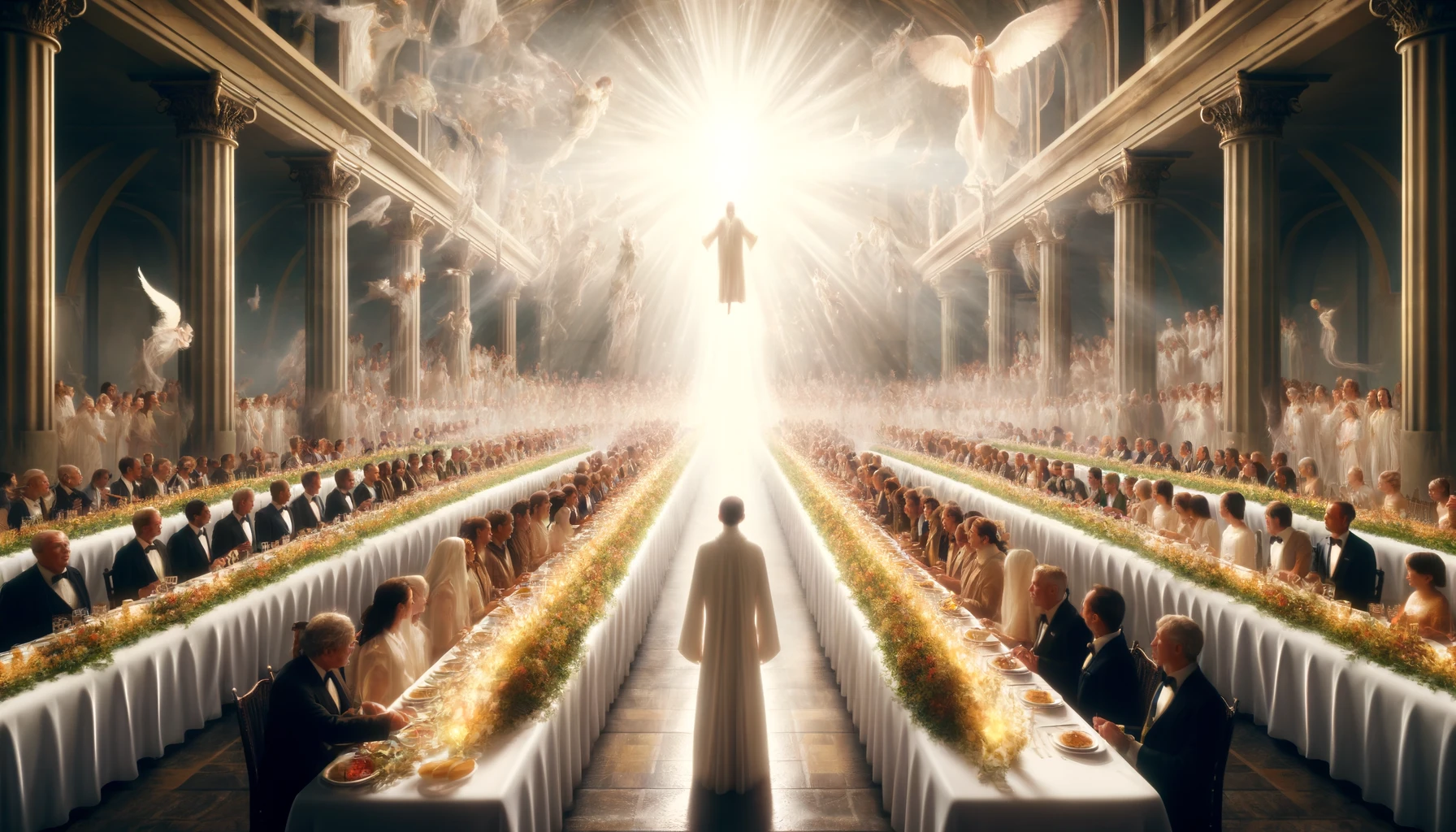
[Lesson 127] Rev 19: The Spirits and Flesh at the Wedding Banquet of the Lamb

by ichthus

This chapter describes the celebration in heaven over the judgment of Babylon and the coming wedding banquet of the Lamb. The voices in heaven praise God for His true and just judgments against the “great prostitute” Babylon. An angel declares that those invited to the Lamb’s wedding banquet are blessed.

The scene then shifts to a vision of Christ, the “Faithful and True” rider on a white horse, coming to wage war against the beast and the kings of the earth. His robe is dipped in blood and He is called the Word of God. The armies of heaven, including saints dressed in white linen, follow Him.

An angel calls the birds to gather for the “great supper of God” to consume the flesh of Christ’s enemies after the battle. The beast and false prophet are seized and thrown into the lake of fire, while the rest are killed by the sword from Christ’s mouth.

The chapter emphasizes the need to be among the invited guests wearing the proper wedding clothes (righteous acts) in order to participate in the wedding supper/banquet of the Lamb when heaven and earth are united. It warns against worshiping anyone other than God alone.

Report – Discernment Study Guide SCJ Bible Study

Shincheonji holds distinct theological views that differ from mainstream Christian denominations, yet it also shares some common teachings. This overlap can sometimes blur the lines between their beliefs and those of traditional Christianity. Therefore, it is essential to exercise critical thinking and discernment to differentiate between these shared elements and the unique doctrines they present.

While their interpretations warrant careful examination through a critical and biblical lens, it is equally important to approach these matters with an open yet discerning mindset.

The following notes were documented in person during Shincheonji’s 9-month Bible Study Seminar. They provide insight into the organization’s approach to introducing and explaining its beliefs to potential new members, often referred to as the ‘harvesting and sealing.’ This process is described as being ‘born again’ or ‘born of God’s seed,’ which involves uprooting the old beliefs and replanting new ones. This uprooting and replanting must occur continuously. By examining this process, we can gain a better understanding of the mindset and beliefs held by Shincheonji members.

Review with the Evangelist

Memorization


Revelation 18:23 NIV84

The light of a lamp will never shine in you again. The voice of bridegroom and bride will never be heard in you again. Your merchants were the world’s great men. By your magic spell all the nations were led astray.


Rev 19: The Spirits and Flesh at the Wedding Banquet of the Lamb


Previous Lesson Review

Review


Revelation 18 speaks about the marriage with Satan who destroyed the nations. This marriage represents the opposite of marriage with Jesus. Satan’s intention is to keep people drunk with his maddening wine, preventing them from truly marrying Jesus when heaven comes down.

We must come out of this wedding and reject Satan’s wine, because God will judge Babylon. While we don’t know exactly how God will fulfill this prophecy, we have seen a small-scale fulfillment in the judgment of Mr. Tak in the Stewardship Education Center – they are no longer present, and no one buys their cargo anymore.

This demonstrates how Revelation 18 has already occurred on a small scale, and we will witness how it unfolds on a larger scale. Let us pray that none of us are in Babylon when this judgment takes place.


Revelation 19:1-6


Revelation 19:1-6 NIV84

After this I heard what sounded like the roar of a great multitude in heaven shouting:

 “Hallelujah! Salvation and glory and power belong to our God, [2] for true and just are his judgments. He has condemned the great prostitute who corrupted the earth by her adulteries. He has avenged on her the blood of his servants.” [3] And again they shouted: “Hallelujah! The smoke from her goes up for ever and ever.” [4] The twenty-four elders and the four living creatures fell down and worshiped God, who was seated on the throne. And they cried: “Amen, Hallelujah!” [5] Then a voice came from the throne, saying: “Praise our God, all you his servants, you who fear him, both small and great!” [6] Then I heard what sounded like a great multitude, like the roar of rushing waters and like loud peals of thunder, shouting: “Hallelujah! For our Lord God Almighty reigns.


ONE – After this: After the judgement of Babylon

“After this” appears in Revelation for the 6th and final time following the judgment of Babylon, as we see in the opening words of Revelation 19.

When entering Mount Zion, one notable characteristic is how we give glory to God, mirroring the way the spirits in heaven glorify Him. This practice is particularly marvelous. After a sermon, whether delivered by the head of the […] church, the chairman, or a tribe leader, they lead the congregation in giving glory to God. Everyone stands up, and the speaker proclaims “for the kingdom and the power and the glory belong to our father God forever,” to which the congregation responds “amen.” This practice directly reflects what John witnessed in heaven, and we replicate it here on earth.

The people of heaven are celebrating because salvation, power, and glory belong to our God.


TWO – Avenged Blood: Rev 6 → Rev 16-18.

And they say, ‘True and just are Your judgments. He has condemned the great prostitute who corrupted the earth by her adulteries. He has avenged on her the blood of His servants.’ When did God promise to avenge the blood of His servants?

In Revelation 6, God said to wait a little longer, and that judgment took place in Revelation 16 through 18. By Revelation 19, God concluded with bringing judgment, particularly through fire that concluded everything.

The judgment through fire, which included the judgment, happened in Revelation 18:8. All of heaven is celebrating that God’s judgment is complete. We see a great multitude that no one can count, comprised of both spirits and flesh, and they say and scream in a loud voice, “Alleluia! Glory to God!”

Because Revelation has been fulfilled, and the wedding that we’ve been waiting for is about to take place. When this is fulfilled, that will be a joyous time. So let’s be there when it happens because it’s sooner than you think. Hallelujah, glory to God – heaven is victorious!


Another Voice

In Revelation 19:5, John hears another voice from the throne saying, “Praise our God, all you his servants, you who fear him, both small and great.” This voice, which is not God’s voice, is identified as the Spirit of Truth.

How do we identify this as the Spirit of Truth (the Advocate)? Although the verse doesn’t explicitly mention “Spirit of Truth,” we can understand this through Revelation 1:1, which states: “The Revelation of Jesus Christ, which God gave him to show his servants what must soon take place. He [Jesus] made it known by sending his angel to his servant John, who testifies to everything he saw and heard.”


The identification of this voice as the Advocate is confirmed because New John saw him. This understanding comes from connecting several passages:

– Revelation 10:1-2

– John 14

– John 16

The angel that John saw is the Advocate, and this explains who speaks the words in Revelation 19:5. This knowledge could only have been revealed through someone who actually witnessed it, and John did.


Revelation 19:7-10


Revelation 19:7-10 NIV84

Let us rejoice and be glad and give him glory! For the wedding of the Lamb has come, and his bride has made herself ready. [8] Fine linen, bright and clean, was given her to wear.” (Fine linen stands for the righteous acts of the saints.) [9] Then the angel said to me, “Write: ‘Blessed are those who are invited to the wedding supper of the Lamb!’ ” And he added, “These are the true words of God.” [10] At this I fell at his feet to worship him. But he said to me, “Do not do it! I am a fellow servant with you and with your brothers who hold to the testimony of Jesus. Worship God! For the testimony of Jesus is the spirit of prophecy.”


Revelation 19:7 brings us deep insights: “Let us rejoice and be glad and give him glory, for the wedding of the lamb has come.”

The wedding takes place at a specific location where the spirits of heaven unite with the flesh of the earth. These are the special flesh – those who are waiting on the mountain. They unite and become one, as promised in 1 Corinthians 15:51-58, John 11:25-26, Matthew 25:1-13, and Matthew 22:11-14.

Jesus promised that a wedding will occur in the future. When this happens, certain people will take part in it and be able to celebrate when heaven comes down.


Not just anybody can walk into the wedding banquet of the lamb – there are specific requirements to participate:

  1. We must be those who are born of God’s seed, otherwise we won’t be harvested.
  1. We must be those who are sealed, having God’s word stamped on our foreheads and on our hearts.
  1. We must be part of one of the 12 tribes because the 12 tribes are the gates. It is not possible to enter the Holy City, New Heaven and New Earth, without entering through one of these gates. This is what is promised.
  1. We must be those whose names are recorded in the registry of this place. The question arises: Are you on the guest list? Who invited you? We need to make sure our name is on the guest list – the registry.


ONE – The Word of Testimony: Lamp and Oil Matthew 25:1-13

Matthew 25:1-13 teaches us about 2 essential elements of preparation that we need to keep in mind:

  1. The lamp (Psalm 119:105)
  2. The oil (Revelation 11:1-4)

This is illustrated in the parable of the wise and foolish virgins.

To understand the reality:

– The lamp represents the word

– The oil represents the testimony

The word and the testimony are tightly connected to each other – they represent the “what” and the “who.”

The testimony enhances the power of the word by making it tangible, which is why it is compared to oil. Just as oil is necessary for a lamp to burn, the testimony is essential for understanding.

A Bible without testimony is like an unlit lamp or one that cannot be understood. The testimony allows the word to be fully comprehended.


TWO – To be invited Matthew 22:11-14, and wear the Wedding Clothes

In Matthew 22:11-14, Jesus tells a parable about a wedding banquet where the master invites many people. The first invited guests decline the invitation, saying they are busy. The master then instructs his servants to go out into the streets and invite as many people as they can find.

This connects to Revelation 19:9, which states, “Blessed are those who are invited to the wedding banquet.”


This parable manifests in two scales:

1.- Invitation to Bible Study:

The wedding banquet takes place at Mount Zion. When someone receives an invitation to study the Bible, it’s like receiving an invitation to the wedding banquet.

2.- The Response to the Invitation:

When someone says “yes” to the invitation – Glory to God! They take their seats, waiting for the bride and groom to appear. There’s anticipation about the bride in her fine linen, bright and clean, and the groom’s excitement.


Important Points:

– We are all part of the wedding

– Many people receive invitations

– Not everyone accepts the invitation

– Not everyone who accepts stays


As Jesus said, “Many are invited, but few are chosen.” Some decline the invitation immediately, while others come but aren’t properly dressed – like wearing shorts to a wedding. At any wedding, especially from the bride’s perspective, inappropriate attire is unacceptable – proper clothing is required.


There are 2 essential requirements we must understand.

1.- The first requirement is that we must make sure we are wearing wedding clothes, which is extremely important as stated in Revelation 19:8. These wedding clothes represent righteous actions. God has emphasized many times in both the New Testament and Old Testament that everyone will be judged according to what they have done – this is very important to remember.

2.- The second requirement is that we must be among those who are sealed, as mentioned in Hebrews 8:10-12. We will discuss one of the important aspects of being sealed that is necessary for this wedding to take place.


This leads us to 3 crucial questions we need to consider: 

Who is the bride? Who is the groom? And who is the representative bride?

1.- Jesus is the groom.


Jesus:

– Morning Star

– Groom

– Rider

– Sitter


2.- The representative bride is New John (Bride).


New John:

– One Who Overcomes

– Bride Representative

– White Horse

– Throne


New John teaches others how to become brides. As the representative bride, New John shows us what it means to be brides ourselves and how to wear proper wedding clothes.

Through New John’s teachings, we learn the true meaning of being sealed and understand what the lamp and oil represent. 

Previously, we either did not understand these things or were taught false interpretations (Babylon). Now we know their actual meaning. We have been taught how to be a bride of Christ specifically for the time of the second coming – when heaven descends and unites with earth to begin the work of healing the nations.


Revelation 19:11-16


Revelation 19:11-16 NIV84

I saw heaven standing open and there before me was a white horse, whose rider is called Faithful and True. With justice he judges and makes war. [12] His eyes are like blazing fire, and on his head are many crowns. He has a name written on him that no one knows but he himself. [13] He is dressed in a robe dipped in blood, and his name is the Word of God. [14] The armies of heaven were following him, riding on white horses and dressed in fine linen, white and clean. [15] Out of his mouth comes a sharp sword with which to strike down the nations. “He will rule them with an iron scepter.” He treads the winepress of the fury of the wrath of God Almighty. [16] On his robe and on his thigh he has this name written: 

king of kings and lord of lords.


The Battle: Spirits plus Flesh 

The final battle must take place between the forces of God and the forces of evil, with Jesus leading the charge. 

How do we know this rider is Jesus? In Revelation 6:2, there are many correct answers based on what we just read: He is the Word of God, King of kings, and Lord of Lords.

His characteristics are described:

– His robe is dipped in blood

– A sharp sword comes out of his mouth

– He is called “faithful and true” (as also mentioned in Revelation 2-3)

– The armies of heaven are riding into battle with Him


Jesus, determined to end things, rides into battle on a white horse. Who is He riding? New John. 

When you hear him speak, you can tell Jesus is definitely using him – he speaks with a fervor of someone who has been working for over 40 years for this work, who has given his entire life to this work, knowing that time is near.

Who else rides into battle?

According to Revelation 19:14, “the armies of heaven were following him, riding on white horses and dressed in fine linen, white and clean.” This includes both spirits and flesh who took part in the wedding banquet – that means us: me, you, Anna, George, Ebony, sister Jesica, and Pamela, riding into battle with Jesus and the spirits.


Jesus’s Weapons:

– A sharp double-edged sword

– This sword represents the scepter, the teaching authority to rule (Referenced in Hebrews 4:12 and Revelation 2:27)


Revelation 19:17-21


Revelation 19:17-21 NIV84

And I saw an angel standing in the sun, who cried in a loud voice to all the birds flying in midair, “Come, gather together for the great supper of God, [18] so that you may eat the flesh of kings, generals, and mighty men, of horses and their riders, and the flesh of all people, free and slave, small and great.” [19] Then I saw the beast and the kings of the earth and their armies gathered together to make war against the rider on the horse and his army. [20] But the beast was captured, and with him the false prophet who had performed the miraculous signs on his behalf. With these signs he had deluded those who had received the mark of the beast and worshiped his image. The two of them were thrown alive into the fiery lake of burning sulfur. [21] The rest of them were killed with the sword that came out of the mouth of the rider on the horse, and all the birds gorged themselves on their flesh.

It is very sad what happens to those who betrayed, judged, and destroyed people – they themselves will also face judgment.


The meal served in the Wedding Banquet

In Revelation 19:17, we see a description of a meal: “An angel standing in the sun called out in a loud voice to all the birds flying in the air: ‘Come, gather together for the great supper of the Lord, so that you may eat the flesh of kings, generals, and mighty men, of horses and their riders, and the flesh of all people, free and slave, small and great.'”

The passage continues to describe how the beasts gathered, along with the kings of the earth and their armies, to make war against the rider and his army.

Looking deeper into Revelation 19:17-18, we need to understand what it means when it talks about “eating flesh.” This connects to the concept of a wedding banquet, where people come from north, south, east, and west.

At a typical wedding banquet, eating is a crucial element. Nobody would travel far and dress in expensive clothes for a wedding without expecting a good meal. Similarly, at the wedding banquet of the lamb, there would be a meal, but we’re not literally eating the flesh of kings, generals, and mighty men.

This figurative language reminds us of Jesus’s words when He said, “eat my flesh and drink my blood.” What did Jesus mean by this? He was referring to eating His words.


The Martyrs

The birds and the spirits of the air represent the martyrs who are finally able to enjoy a delicious meal. 

This connects to the wedding banquet mentioned in Matthew 22:1-14 and Genesis 41:1-3. The meal they are eating consists of words, and these martyrs are the ones partaking in this feast.


The Oxen

The prophecy speaks of a meal consisting of oxen and fattened cattle offered at the wedding banquet – these are God’s animals.

Oxen are among God’s animals, along with sheep and horses. Typically, oxen are working animals that till the fields. However, in this prophecy, instead of working, these oxen are being eaten. This indicates something went wrong.

The oxen represents the betrayers – those who were once God’s workers but betrayed their purpose. These betrayers were ultimately devoured by the fattened cattle.


The Fattened Cattle

The fattened cattle represents the destroyers. In Revelation 9, these destroyers were compared to locusts that devour everything in their path. They became fattened because they consumed the betrayers and subsequently became destroyers themselves.


The Eternal Gospel

The testimony about what happened to the betrayers and destroyers ascends to heaven and becomes an eternal gospel, as mentioned in Revelation 14. 

This eternal gospel is similar to how we still discuss John the Baptist, Peter, John, Daniel, Adam, and Eve today, although these people lived thousands of years ago. Their actions are recorded in God’s history. Similarly, there will come a time when every single person will know about the betrayers and destroyers – their names and who these people are. When you look out your window tomorrow while getting ready for work, think about how all these people will soon know about the betrayers and destroyers too. Not just us, but the spirits of heaven will also hear this testimony.

In Revelation 19:19-20, we see who will be judged: the beast and the false prophet. They represent Babylon, so Mr. Oh and Mr. Tak are judged, along with the spirits that are using them.

In the next chapter, we will learn about the locking up of Satan and the first resurrection. That’s what we’ll be examining in Revelation chapter 20 for our next lesson.

One more point from Revelation 19:10: What did John do when the angel was showing him these things? He tried to worship the angel. But the angel’s response was clear – “Get up man, you’re embarrassing me, we don’t do that, we’re both servants.”

This shows that New John is a servant, not God or Jesus, as misunderstood by some who don’t understand our message. He is the faithful servant mentioned in Matthew 24:45-47, working together with the counselor, the advocate, to share the words of revelation and remind us of Jesus’s original teachings, as mentioned in John chapter 16. Now we’re understanding the reality of these things.


Memorization


Revelation 19:9 NIV84

Then the angel said to me, “Write: ‘Blessed are those who are invited to the wedding supper of the Lamb!’ ” And he added, “These are the true words of God.”


[Evangelist]

At this time, it is crucial for us to distinguish between God’s affiliation and Satan’s affiliation as revealed in the Book of Revelation. We must come out of Babylon, the home of demons, and journey to Mount Zion to achieve salvation. We have learned and concluded from Revelation 19 that to become participants in the wedding banquet, we need to understand the true meanings of the lamp, the oil, and the wedding clothes. Beyond understanding, we must actually prepare ourselves. I hope we were able to comprehend these chapters very well.

Let’s Us Discern

A Refutation Using “Testing Shincheonji’s Claims: Two Lenses, One Story”

Lesson 127: Rev 19 – The Spirits and Flesh at the Wedding Banquet of the Lamb

Viewing Through First-Century Christian, Historical, and Literary Lenses


Introduction: The Wedding You’ve Been Waiting For

Imagine you’re sitting in that classroom now, 13-16 months into your journey. You’ve learned about the dragon’s war, the beast’s mark, the 144,000 on Mount Zion, the temple of testimony, the seven bowls of wrath, the prostitute drunk with blood, and Babylon’s fall. You’ve been told not to research outside sources because they’re “Satan’s domain.” You’ve been explicitly instructed to follow Lee Man-hee because “the word is present with him.” You’ve learned about “Wash Day” and the need for organizational gatherings to stay spiritually clean.

Last lesson was heavy. Revelation 18 described the “marriage with Satan”—all of Christianity labeled as Babylon, a home for demons, destined for judgment. The weight of that teaching still sits with you. Your family, your friends, your former church—all condemned as part of Satan’s bride.

But today is different. Today is the lesson you’ve been anticipating.

The instructor begins with a smile: “Today we’re studying Revelation 19—The Spirits and Flesh at the Wedding Banquet of the Lamb.”

You feel the shift in the room. After the darkness of Revelation 18 (judgment, destruction, mourning), Revelation 19 brings light. This is the wedding. The marriage with Jesus. The celebration. The culmination of everything you’ve been working toward for over a year.

The instructor continues: “Revelation 18 speaks about the marriage with Satan who destroyed the nations. This marriage represents the opposite of marriage with Jesus. Satan’s intention is to keep people drunk with his maddening wine, preventing them from truly marrying Jesus when heaven comes down.”

The contrast is stark and intentional:

  • Revelation 18 = Marriage with Satan (Babylon/false Christianity)
  • Revelation 19 = Marriage with Jesus (Shincheonji/true believers)

You’re being told: You have a choice. Marry Satan (stay in Babylon/traditional Christianity) or marry Jesus (join Shincheonji fully).

The instructor emphasizes: “We must come out of this wedding and reject Satan’s wine, because God will judge Babylon. While we don’t know exactly how God will fulfill this prophecy, we have seen a small-scale fulfillment in the judgment of Mr. Tak in the Stewardship Education Center—they are no longer present, and no one buys their cargo anymore.”

There it is again—the two-scale fulfillment theory. Small scale (already happened with SEC in Korea). Large scale (still to come with all of Christianity).

“This demonstrates how Revelation 18 has already occurred on a small scale, and we will witness how it unfolds on a larger scale. Let us pray that none of us are in Babylon when this judgment takes place.”

Fear. Urgency. Separation. You must not be in Babylon when judgment comes.

Then the tone shifts to celebration: “Revelation 19:7 brings us deep insights: ‘Let us rejoice and be glad and give him glory, for the wedding of the lamb has come.'”

The instructor’s voice rises with excitement: “The wedding takes place at a specific location where the spirits of heaven unite with the flesh of the earth. These are the special flesh—those who are waiting on the mountain. They unite and become one, as promised in 1 Corinthians 15:51-58, John 11:25-26, Matthew 25:1-13, and Matthew 22:11-14.”

Spirits of heaven uniting with flesh of earth. Special flesh. Waiting on the mountain. This is what you’ve been preparing for. This is why you’ve invested over a year. This is the wedding.

“Jesus promised that a wedding will occur in the future. When this happens, certain people will take part in it and be able to celebrate when heaven comes down.”

Certain people. Not everyone. Only those who meet specific requirements.

The instructor lists them:

“Not just anybody can walk into the wedding banquet of the lamb—there are specific requirements to participate:

1. We must be those who are born of God’s seed, otherwise we won’t be harvested.

2. We must be those who are sealed, having God’s word stamped on our foreheads and on our hearts.

3. We must be part of one of the 12 tribes because the 12 tribes are the gates. It is not possible to enter the Holy City, New Heaven and New Earth, without entering through one of these gates. This is what is promised.

4. We must be those whose names are recorded in the registry of this place. The question arises: Are you on the guest list? Who invited you? We need to make sure our name is on the guest list—the registry.”

Four requirements. Four gates you must pass through to enter the wedding.

Born of God’s seed. Sealed. Part of the 12 tribes. Name in the registry.

And conveniently, all four requirements are met by completing Shincheonji’s program, attending new family education, being baptized at Passover, and joining one of the 12 tribes of Shincheonji.

The instructor continues with the parable of the ten virgins: “Matthew 25:1-13 teaches us about 2 essential elements of preparation that we need to keep in mind: The lamp (Psalm 119:105) and the oil (Revelation 11:1-4).”

You’ve heard this before. The lamp is the word. The oil is the testimony. You need both to enter the wedding.

“The word and the testimony are tightly connected to each other—they represent the ‘what’ and the ‘who.’ The testimony enhances the power of the word by making it tangible, which is why it is compared to oil. Just as oil is necessary for a lamp to burn, the testimony is essential for understanding.”

The “who” is Lee Man-hee. The testimony is his testimony of what he witnessed. Without his testimony, you can’t understand the word. Without the oil (his testimony), your lamp (the word) won’t burn.

“A Bible without testimony is like an unlit lamp or one that cannot be understood. The testimony allows the word to be fully comprehended.”

This is the culmination of everything you’ve been taught: You need Lee Man-hee’s testimony to understand the Bible. You need Shincheonji’s interpretation to comprehend God’s word. You need the organization to access the wedding.

Then comes the parable of the wedding banquet from Matthew 22:11-14: “Jesus tells a parable about a wedding banquet where the master invites many people. The first invited guests decline the invitation, saying they are busy. The master then instructs his servants to go out into the streets and invite as many people as they can find.”

The instructor applies this: “This connects to Revelation 19:9, which states, ‘Blessed are those who are invited to the wedding banquet.’ This parable manifests in two scales:”

Two scales again. Everything has two scales.

1. Invitation to Bible Study: The wedding banquet takes place at Mount Zion. When someone receives an invitation to study the Bible, it’s like receiving an invitation to the wedding banquet.

2. The Response to the Invitation: When someone says ‘yes’ to the invitation—Glory to God! They take their seats, waiting for the bride and groom to appear. There’s anticipation about the bride in her fine linen, bright and clean, and the groom’s excitement.”

So the invitation to Shincheonji’s Bible study is the invitation to the wedding banquet. Saying yes to the study is saying yes to the wedding. And you’ve already said yes. You’re already here, over a year in, very close to completion.

The instructor emphasizes: “Important Points: We are all part of the wedding. Many people receive invitations, but not everyone who receives an invitation will ultimately attend the wedding.”

Pressure. You’ve received the invitation. You’ve said yes. But you’re not guaranteed to attend unless you complete everything, unless you meet all four requirements, unless you stay committed until the end.

You look around the room. Your classmates are nodding, taking notes, some with tears in their eyes. The emotion is palpable. This is what you’ve all been working toward. The wedding. Union with Jesus. Being part of the bride.

But something nags at you. Four requirements to enter the wedding? Needing Lee Man-hee’s testimony to understand the Bible? The wedding banquet being at Mount Zion (Shincheonji)? Spirits of heaven uniting with flesh of earth?

Is this what Revelation 19 actually teaches? Or is this Shincheonji’s interpretation designed to make the organization essential for salvation?

But you’ve been taught not to question. Questioning is from the enemy. Research is “going beyond what is written.” Outside sources are “Satan’s domain.”

So you take notes. You listen. You try to believe.

But the questions remain, quiet but persistent, in the back of your mind.


This lesson represents the climax of Shincheonji’s indoctrination process. After demonizing all of Christianity as Babylon (Revelation 18), Lesson 127 presents Shincheonji as the bride of Christ, the location of the wedding banquet, the only path to union with Jesus. The four requirements create a system where organizational membership becomes essential for salvation. The two-scale interpretation of parables allows Shincheonji to claim that invitations to their Bible study are invitations to the wedding banquet itself.

As we examine this lesson through the lens of first-century Christian understanding, historical context, and careful biblical interpretation, we’ll discover that Shincheonji’s teaching fundamentally misunderstands Revelation 19, misidentifies the bride, creates false requirements for salvation, and makes the organization essential in a way that contradicts the gospel of grace.

For those seeking additional resources and support, visit https://closerlookinitiative.com/shincheonji-examination for comprehensive analysis of Shincheonji’s teachings, testimonies from former members, and resources for families.

Let’s begin by examining what Revelation 19 actually means in its first-century context, then explore the problems with Shincheonji’s interpretation, and finally address the dangerous implications of this teaching.


Part 1: Understanding Revelation 19 – The Wedding of the Lamb

The Biblical Text

Revelation 19 is a pivotal chapter that describes heaven’s celebration over Babylon’s fall and the wedding of the Lamb. Let’s examine the key sections:

Revelation 19:1-6 (NIV84):

“After this I heard what sounded like the roar of a great multitude in heaven shouting: ‘Hallelujah! Salvation and glory and power belong to our God, for true and just are his judgments. He has condemned the great prostitute who corrupted the earth by her adulteries. He has avenged on her the blood of his servants.’ And again they shouted: ‘Hallelujah! The smoke from her goes up for ever and ever.’ The twenty-four elders and the four living creatures fell down and worshiped God, who was seated on the throne. And they cried: ‘Amen, Hallelujah!’ Then a voice came from the throne, saying: ‘Praise our God, all you his servants, you who fear him, both small and great!’ Then I heard what sounded like a great multitude, like the roar of rushing waters and like loud peals of thunder, shouting: ‘Hallelujah! For our Lord God Almighty reigns.'”

Revelation 19:7-10:

“Let us rejoice and be glad and give him glory! For the wedding of the Lamb has come, and his bride has made herself ready. Fine linen, bright and clean, was given her to wear.” (Fine linen stands for the righteous acts of the saints.) Then the angel said to me, “Write: ‘Blessed are those who are invited to the wedding supper of the Lamb!'” And he added, “These are the true words of God.” At this I fell at his feet to worship him. But he said to me, “Do not do it! I am a fellow servant with you and with your brothers who hold to the testimony of Jesus. Worship God! For the testimony of Jesus is the spirit of prophecy.”

Revelation 19:11-16 (Summary):

Christ returns as the rider on the white horse, called Faithful and True, with eyes like blazing fire, wearing many crowns, leading the armies of heaven to judge and make war in righteousness.

Revelation 19:17-21 (Summary):

The beast and the kings of the earth gather to make war against the rider on the horse. The beast and false prophet are captured and thrown into the lake of fire. The rest are killed by the sword of the rider.

First-Century Christian Understanding

To understand what first-century Christians would have understood from Revelation 19, we need to consider the historical, theological, and literary context.

1. Heaven’s Celebration Over Babylon’s Fall (vv. 1-6)

Revelation 19 begins with “After this”—after the fall of Babylon described in Revelation 18. Heaven erupts in celebration.

The Hallelujahs:

“Hallelujah” (Hebrew: “Praise the Lord”) appears four times in these six verses (vv. 1, 3, 4, 6). This is the only place in the New Testament where “Hallelujah” appears, and it appears four times in rapid succession.

Why? Because this is the ultimate celebration. God has judged the great prostitute (Babylon/Rome). He has avenged the blood of His servants (the martyrs). Justice has been done.

The Great Multitude:

John hears “what sounded like the roar of a great multitude in heaven” (v. 1) and later “what sounded like a great multitude, like the roar of rushing waters and like loud peals of thunder” (v. 6).

This great multitude likely includes:

  • The martyrs whose blood was avenged (Rev 6:9-11, 18:24)
  • The great multitude from every nation who came out of the great tribulation (Rev 7:9-17)
  • All the saints in heaven

They’re celebrating because God’s justice has prevailed. The oppressor (Rome) has fallen. The martyrs have been vindicated.

The Twenty-Four Elders and Four Living Creatures:

These figures, introduced in Revelation 4-5, represent the heavenly council surrounding God’s throne. They join the celebration, worshiping God and crying “Amen, Hallelujah!” (v. 4).

The Voice from the Throne:

A voice from the throne (v. 5) calls all God’s servants to praise Him. This voice is identified as coming from the throne but is not God’s voice directly—it’s likely an angel or representative speaking from the throne’s authority.

The Message for First-Century Christians:

First-century Christians suffering under Roman persecution would receive tremendous encouragement from these verses:

  • God has judged Rome (Babylon)
  • The martyrs have been avenged
  • Justice has prevailed
  • Heaven is celebrating
  • God Almighty reigns

This would give them hope to endure persecution, knowing that God sees their suffering and will ultimately vindicate them.

2. The Wedding of the Lamb (vv. 7-10)

After the celebration over Babylon’s fall, the focus shifts to the wedding of the Lamb.

The Announcement:

Verse 7: “Let us rejoice and be glad and give him glory! For the wedding of the Lamb has come, and his bride has made herself ready.”

This is the moment of ultimate joy—the wedding of the Lamb (Jesus Christ) to His bride.

The Bride’s Identity:

Who is the bride? The text provides clear identification:

Verse 8: “Fine linen, bright and clean, was given her to wear.” (Fine linen stands for the righteous acts of the saints.)

The bride is the saints—God’s people, the church. The fine linen represents their righteous acts, made possible by God’s grace.

This echoes Paul’s teaching in Ephesians 5:25-27:

“Husbands, love your wives, just as Christ loved the church and gave himself up for her to make her holy, cleansing her by the washing with water through the word, and to present her to himself as a radiant church, without stain or wrinkle or any other blemish, but holy and blameless.”

Christ is the groom. The church is the bride. This is consistent throughout Scripture.

The Wedding Supper:

Verse 9: “Then the angel said to me, ‘Write: Blessed are those who are invited to the wedding supper of the Lamb!’ And he added, ‘These are the true words of God.'”

Those invited to the wedding supper are blessed. But who are they?

In the context, the invited guests are the same as the bride—all God’s people, all believers. In ancient Jewish weddings, the bride and her attendants, the groom and his friends, and invited guests all participated in the celebration. The distinction between bride and guests is not rigid; all God’s people participate in the celebration of union with Christ.

The Testimony of Jesus:

Verse 10: “At this I fell at his feet to worship him. But he said to me, ‘Do not do it! I am a fellow servant with you and with your brothers who hold to the testimony of Jesus. Worship God! For the testimony of Jesus is the spirit of prophecy.'”

John attempts to worship the angel, but the angel corrects him: “Worship God!” The angel is a fellow servant with John and all who hold to the testimony of Jesus.

“The testimony of Jesus” means the testimony about Jesus—the gospel message, the witness to who Jesus is and what He has done. This testimony is “the spirit of prophecy”—the essence and purpose of all prophecy is to testify about Jesus.

The Message for First-Century Christians:

First-century Christians would understand:

  • Christ (the Lamb) is marrying His bride (the church, all believers)
  • This wedding represents the ultimate union between Christ and His people
  • All believers are invited to participate in this celebration
  • The wedding happens after Babylon’s (Rome’s) fall—after persecution ends, after evil is judged
  • The focus is on Christ, not on any human mediator or organization
  • Worship belongs to God alone, not to angels or human leaders

This would give them hope that despite current suffering, ultimate joy awaits—union with Christ, celebration, vindication.

3. Christ’s Return (vv. 11-21)

The chapter continues with Christ’s return as the rider on the white horse:

The Rider:

  • Called Faithful and True (v. 11)
  • Judges and makes war in righteousness (v. 11)
  • Eyes like blazing fire (v. 12)
  • Wearing many crowns (v. 12)
  • Name: Word of God (v. 13)
  • Robe dipped in blood (v. 13)
  • Armies of heaven follow Him (v. 14)
  • Sharp sword from His mouth to strike down nations (v. 15)
  • Rules with iron scepter (v. 15)
  • Treads winepress of God’s wrath (v. 15)
  • Name: KING OF KINGS AND LORD OF LORDS (v. 16)

This is clearly Jesus Christ returning in glory to judge and establish His kingdom.

The Final Battle:

The beast (introduced in Revelation 13) and the kings of the earth gather to make war against the rider. But the battle is brief:

Verses 20-21: “But the beast was captured, and with him the false prophet who had performed the miraculous signs on his behalf. With these signs he had deluded those who had received the mark of the beast and worshiped his image. The two of them were thrown alive into the fiery lake of burning sulfur. The rest of them were killed with the sword that came out of the mouth of the rider on the horse, and all the birds gorged themselves on their flesh.”

The beast and false prophet are thrown into the lake of fire. The rest are defeated by Christ’s word (the sword from His mouth).

The Message for First-Century Christians:

Christ will return. He will defeat all evil. The Roman Empire (the beast) will be destroyed. All who oppose God will be judged. Christ will establish His kingdom.

This would encourage first-century Christians to remain faithful despite persecution, knowing that Christ’s victory is certain.

The Structure and Flow of Revelation 19

Understanding the structure helps us see the chapter’s message:

A. Heaven’s Celebration (vv. 1-6)

  • Hallelujahs over Babylon’s fall
  • God’s justice vindicated
  • Martyrs avenged

B. The Wedding of the Lamb (vv. 7-10)

  • The Lamb’s wedding has come
  • The bride (church) has made herself ready
  • Blessed are those invited
  • Worship God alone

C. Christ’s Return and Victory (vv. 11-21)

  • Christ returns as King of Kings
  • Defeats the beast and false prophet
  • Establishes His kingdom

The flow is logical:

  1. Babylon (Rome/evil) falls → Heaven celebrates
  2. The Lamb marries His bride → Ultimate union with God’s people
  3. Christ returns → Defeats all remaining evil → Establishes kingdom

This is the climax of Revelation’s message: Evil is judged, God’s people are vindicated, Christ reigns.

What First-Century Christians Would NOT Understand

First-century Christians reading Revelation 19 would NOT understand:

❌ That the wedding takes place at a specific physical location (Mount Zion/Shincheonji)
❌ That “spirits of heaven unite with flesh of earth” at this location
❌ That there are four specific requirements to enter the wedding (born of God’s seed, sealed, part of 12 tribes, name in registry)
❌ That these requirements are met by joining a specific organization
❌ That the “testimony of Jesus” refers to Lee Man-hee’s testimony
❌ That the lamp and oil represent the word and Lee Man-hee’s testimony
❌ That invitation to a Bible study is invitation to the wedding banquet
❌ That the wedding has two scales of fulfillment
❌ That they need a human mediator’s testimony to understand Scripture

Why? Because:

  1. The text identifies the bride as the church (all believers), not a specific organization
  2. The wedding is a spiritual reality, not a physical event at a specific location
  3. The only requirement is faith in Christ, not organizational membership
  4. The testimony of Jesus is the gospel, not one man’s interpretation
  5. The invitation is to all who believe, not to members of one organization
  6. The message is about Christ’s victory and union with His people, not about organizational requirements

The Wedding Imagery in Scripture

To understand Revelation 19’s wedding imagery, we need to understand how Scripture uses marriage as a metaphor:

Old Testament Background:

God’s relationship with Israel is often described as a marriage:

Hosea 2:19-20: “I will betroth you to me forever; I will betroth you in righteousness and justice, in love and compassion. I will betroth you in faithfulness, and you will acknowledge the Lord.”

Isaiah 54:5: “For your Maker is your husband—the Lord Almighty is his name—the Holy One of Israel is your Redeemer; he is called the God of all the earth.”

Jeremiah 31:32: “…though I was a husband to them,’ declares the Lord.”

Israel’s idolatry is described as adultery—breaking the marriage covenant with God.

New Testament Development:

In the New Testament, the marriage metaphor is applied to Christ and the church:

2 Corinthians 11:2: “I am jealous for you with a godly jealousy. I promised you to one husband, to Christ, so that I might present you as a pure virgin to him.”

Ephesians 5:25-32: “Husbands, love your wives, just as Christ loved the church and gave himself up for her… This is a profound mystery—but I am talking about Christ and the church.”

The church is Christ’s bride. He loves her, gave Himself for her, and is preparing her for the wedding.

The Wedding in Revelation:

Revelation 19’s wedding is the culmination of this biblical theme. Christ (the Lamb) marries His bride (the church). This represents:

  • Ultimate union: God dwelling with His people forever
  • Complete intimacy: Perfect relationship with no barriers
  • Eternal covenant: Unbreakable bond
  • Joy and celebration: The end of suffering, the beginning of eternal joy

This is spiritual reality, not a physical event requiring organizational membership.

The Timing Question

When does the wedding of the Lamb occur?

Revelation’s Structure:

In Revelation’s structure (using recapitulation, as discussed in previous refutations), the wedding appears after Babylon’s fall and before the final judgment. This suggests it occurs:

  • After evil is defeated
  • When Christ returns
  • At the establishment of God’s eternal kingdom

Symbolic vs. Literal:

The wedding is symbolic language for the ultimate union between Christ and His people. It’s not necessarily a single event at a specific moment, but the reality of eternal union with God.

Revelation 21:2-3 describes this reality:

“I saw the Holy City, the new Jerusalem, coming down out of heaven from God, prepared as a bride beautifully dressed for her husband. And I heard a loud voice from the throne saying, ‘Now the dwelling of God is with men, and he will live with them. They will be his people, and God himself will be with them and be their God.'”

The bride (New Jerusalem, God’s people) comes down from heaven. God dwells with His people. This is the wedding—eternal union with God.

First-Century Understanding:

First-century Christians would understand the wedding as:

  • Future hope (not yet fulfilled)
  • Spiritual reality (not physical event)
  • For all believers (not limited to one organization)
  • Dependent on Christ alone (not on human mediators)

They would not understand it as:

  • Already happening at a specific location
  • Requiring membership in a specific organization
  • Needing a human mediator’s testimony
  • Having multiple scales of fulfillment

Part 2: Shincheonji’s Interpretation – The Four Requirements

Shincheonji’s Claims

Lesson 127 presents specific requirements for participating in the wedding of the Lamb:

Claim 1: The wedding takes place at a specific location

“The wedding takes place at a specific location where the spirits of heaven unite with the flesh of the earth. These are the special flesh—those who are waiting on the mountain.”

Claim 2: There are four requirements to participate

“Not just anybody can walk into the wedding banquet of the lamb—there are specific requirements to participate:

  1. We must be those who are born of God’s seed, otherwise we won’t be harvested.
  2. We must be those who are sealed, having God’s word stamped on our foreheads and on our hearts.
  3. We must be part of one of the 12 tribes because the 12 tribes are the gates.
  4. We must be those whose names are recorded in the registry of this place.”

Claim 3: The lamp and oil represent word and testimony

“The lamp represents the word. The oil represents the testimony. The word and the testimony are tightly connected to each other—they represent the ‘what’ and the ‘who.'”

Claim 4: Invitation to Bible study is invitation to the wedding

“The wedding banquet takes place at Mount Zion. When someone receives an invitation to study the Bible, it’s like receiving an invitation to the wedding banquet.”

Claim 5: The voice from the throne is the Spirit of Truth (Advocate)

“This voice, which is not God’s voice, is identified as the Spirit of Truth… The angel that John saw is the Advocate.”

The Problems with This Interpretation

Problem 1: The Bride Is the Church, Not an Organization

Revelation 19:7-8 clearly identifies the bride:

“For the wedding of the Lamb has come, and his bride has made herself ready. Fine linen, bright and clean, was given her to wear.” (Fine linen stands for the righteous acts of the saints.)

The bride is “the saints”—all believers, the universal church.

Scripture’s Consistent Teaching:

Ephesians 5:25-27: “Christ loved the church and gave himself up for her… to present her to himself as a radiant church.”

2 Corinthians 11:2: “I promised you to one husband, to Christ.”

The church (all believers in Christ) is the bride. Not one organization. Not one group. All who trust in Christ.

Shincheonji’s Claim:

By creating four requirements that can only be met through Shincheonji membership, they’re claiming that only Shincheonji members are the bride.

But this contradicts Scripture’s clear teaching that all believers are the bride.

The Implication:

If only Shincheonji members are the bride, then:

  • All other Christians throughout 2000 years are not the bride
  • Faithful believers who died before Shincheonji was founded (1984) are not the bride
  • Christians who trust in Christ but aren’t part of Shincheonji are not the bride

This is absurd and contradicts Scripture.

Problem 2: The Four Requirements Are Not in the Text

Where in Revelation 19 does it list four requirements for entering the wedding?

Let’s examine each claimed requirement:

Requirement 1: “Born of God’s seed”

Revelation 19 doesn’t mention being “born of God’s seed.” This language comes from Shincheonji’s interpretation of other passages (like the parable of the sower).

What Scripture actually teaches: All who believe in Christ are born of God (John 1:12-13, 1 John 5:1). This is not a special status for some believers; it’s the reality for all believers.

Requirement 2: “Sealed”

Revelation 19 doesn’t mention sealing as a requirement for the wedding. The sealing of the 144,000 occurs in Revelation 7, not Revelation 19.

What Scripture actually teaches: All believers are sealed with the Holy Spirit (Ephesians 1:13-14, 2 Corinthians 1:21-22). This sealing happens when you believe, not when you join an organization.

Requirement 3: “Part of one of the 12 tribes”

Revelation 19 doesn’t mention the 12 tribes as a requirement for the wedding. The 12 tribes appear in Revelation 7 (the sealing) and Revelation 21 (the New Jerusalem’s gates), but not in Revelation 19’s wedding description.

What Scripture actually teaches: All believers are part of God’s people. The 12 tribes in Revelation represent the fullness of God’s people (12 = completeness), not literal organizational divisions.

Requirement 4: “Name in the registry”

Revelation 19 doesn’t mention a registry as a requirement for the wedding. The book of life appears elsewhere in Revelation (3:5, 13:8, 17:8, 20:12, 20:15, 21:27), but not in chapter 19’s wedding description.

What Scripture actually teaches: All who believe in Christ have their names written in the book of life (Philippians 4:3, Luke 10:20). This happens when you believe, not when you join an organization.

The Reality:

None of these four requirements appear in Revelation 19. Shincheonji is importing concepts from other passages and creating a system of requirements that makes organizational membership essential.

Problem 3: The Only Requirement Is Faith in Christ

What does Scripture actually teach about the requirement for salvation and union with Christ?

Faith Alone:

John 3:16: “For God so loved the world that he gave his one and only Son, that whoever believes in him shall not perish but have eternal life.”

Acts 16:31: “Believe in the Lord Jesus, and you will be saved.”

Romans 10:9: “If you confess with your mouth, ‘Jesus is Lord,’ and believe in your heart that God raised him from the dead, you will be saved.”

Ephesians 2:8-9: “For it is by grace you have been saved, through faith—and this is not from yourselves, it is the gift of God—not by works, so that no one can boast.”

The requirement is faith in Christ. Period. Not organizational membership, not being sealed by a human organization, not having your name in an organizational registry.

Inclusion in the Bride:

All who trust in Christ are part of His bride. There are no additional organizational requirements.

Galatians 3:26-28: “You are all sons of God through faith in Christ Jesus, for all of you who were baptized into Christ have clothed yourselves with Christ. There is neither Jew nor Greek, slave nor free, male nor female, for you are all one in Christ Jesus.”

All who have faith in Christ are included. No organizational barriers. No additional requirements.

Problem 4: The Wedding Is Spiritual, Not Physical

Shincheonji claims “the wedding takes place at a specific location where the spirits of heaven unite with the flesh of the earth.”

But Revelation 19 doesn’t describe a physical location where spirits and flesh unite. It describes a spiritual reality—the ultimate union between Christ and His people.

The Language Is Symbolic:

The wedding imagery is symbolic language for spiritual reality:

  • Christ (groom) + Church (bride) = Ultimate union with God
  • Wedding supper = Celebration of this union
  • Fine linen = Righteous acts of the saints (made possible by God’s grace)

This is not describing a physical event at a physical location. It’s describing spiritual reality using the metaphor of a wedding.

The Danger of Literalizing:

By literalizing the wedding (making it a physical event at a physical location—Mount Zion/Shincheonji), Shincheonji:

  • Misses the spiritual meaning
  • Makes organizational location essential
  • Creates exclusivity (only those at this location participate)
  • Contradicts the universal nature of Christ’s bride (all believers everywhere)

Problem 5: “Spirits Unite with Flesh” Is Not Biblical

The concept of “spirits of heaven uniting with flesh of earth” at the wedding is not found in Revelation 19 or anywhere in Scripture.

What Shincheonji Likely Means:

Based on their teaching, “spirits unite with flesh” probably means:

  • Spirits = Martyrs or deceased believers
  • Flesh = Living Shincheonji members
  • Unite = Come together at Mount Zion (Shincheonji)

This is supposedly the fulfillment of 1 Thessalonians 4:16-17:

“For the Lord himself will come down from heaven, with a loud command, with the voice of the archangel and with the trumpet call of God, and the dead in Christ will rise first. After that, we who are still alive and are left will be caught up together with them in the clouds to meet the Lord in the air. And so we will be with the Lord forever.”

But this passage describes Christ’s return and the resurrection, not spirits uniting with living believers at an organizational location.

The Biblical Teaching:

When Christ returns:

  • The dead in Christ will be raised (resurrection)
  • Living believers will be transformed (1 Corinthians 15:51-52)
  • All will be caught up together to meet the Lord
  • We will be with the Lord forever

This is about resurrection and transformation, not about spirits uniting with flesh at Shincheonji.

The Problem:

Shincheonji’s “spirits unite with flesh” teaching:

  • Is not found in Revelation 19
  • Misinterprets 1 Thessalonians 4
  • Makes Shincheonji the location where this happens
  • Creates a false expectation that contradicts biblical teaching about resurrection

Problem 6: The Lamp and Oil Do Not Represent Word and Testimony

Shincheonji teaches: “The lamp represents the word. The oil represents the testimony.”

This is based on their interpretation of Matthew 25:1-13 (the parable of the ten virgins).

The Parable:

Matthew 25:1-13 tells of ten virgins waiting for the bridegroom. Five are wise (have oil for their lamps) and five are foolish (don’t have oil). When the bridegroom comes, the wise virgins enter the wedding banquet, but the foolish are shut out.

Shincheonji’s Interpretation:

  • Lamp = the word (Bible)
  • Oil = the testimony (Lee Man-hee’s testimony)
  • Having both = able to enter the wedding
  • Lacking oil (testimony) = shut out

The Problems:

1. The parable doesn’t define lamp and oil this way

Jesus doesn’t say “the lamp is the word and the oil is the testimony.” Shincheonji is imposing this interpretation.

2. The point of the parable is readiness

The parable’s point is to be ready for the bridegroom’s return. The wise virgins were ready; the foolish weren’t. The specific meaning of lamp and oil is less important than the overall message: Be ready.

3. If oil = testimony, whose testimony?

Shincheonji claims the oil is Lee Man-hee’s testimony. But the parable was spoken by Jesus centuries before Lee Man-hee was born. How could Jesus be teaching that people need Lee Man-hee’s testimony?

4. Psalm 119:105 says God’s word is a lamp

Psalm 119:105: “Your word is a lamp to my feet and a light for my path.”

God’s word itself is the lamp. We don’t need a separate “testimony” to make it work. God’s word is sufficient.

5. Oil in Scripture often represents the Holy Spirit

In Scripture, oil often symbolizes the Holy Spirit:

  • Anointing with oil = empowerment by the Spirit
  • Oil in lamps = the Spirit’s presence and power

If we’re going to assign symbolic meaning to the oil, it would more biblically represent the Holy Spirit, not a human leader’s testimony.

The Correct Understanding:

The parable of the ten virgins teaches:

  • Be ready for Christ’s return
  • Don’t be complacent
  • Make sure you have what you need (genuine faith, the Holy Spirit’s presence)
  • The door will close; there’s urgency

It doesn’t teach that you need Lee Man-hee’s testimony to understand the Bible.

Problem 7: Invitation to Bible Study ≠ Invitation to the Wedding

Shincheonji claims: “When someone receives an invitation to study the Bible, it’s like receiving an invitation to the wedding banquet.”

This is based on their “two-scale” interpretation of Matthew 22:1-14 (the parable of the wedding banquet).

The Parable:

A king prepares a wedding banquet for his son. The invited guests refuse to come. The king sends servants to invite anyone they can find. Many come, but one man without wedding clothes is thrown out.

Shincheonji’s Two-Scale Interpretation:

Scale 1: Invitation to Shincheonji’s Bible study = invitation to the wedding Scale 2: The actual wedding of the Lamb in Revelation 19

The Problems:

1. The parable is about Israel’s rejection of the Messiah

In context, Jesus is teaching that:

  • The king = God
  • The son = Jesus
  • The first invited guests = Israel (who rejected Jesus)
  • The servants = Prophets and apostles
  • The new guests = Gentiles (who accepted the gospel)
  • The wedding banquet = The kingdom of God

The parable is about how Israel rejected Jesus, so the gospel went to the Gentiles. It’s not about Shincheonji’s Bible study.

2. The invitation is to the gospel, not to an organization

The invitation in the parable is to the kingdom of God through faith in Christ. It’s not an invitation to join a specific organization.

3. The “two-scale” interpretation is imposed

There’s no biblical basis for claiming the parable has two scales of fulfillment, with the first scale being invitation to Shincheonji’s Bible study.

4. This makes Shincheonji essential for salvation

If invitation to Shincheonji’s Bible study = invitation to the wedding of the Lamb, then:

  • You can’t participate in the wedding without Shincheonji
  • Shincheonji becomes the gatekeeper to salvation
  • The organization replaces Christ as the mediator

This contradicts the gospel.

The Correct Understanding:

The parable teaches:

  • God invites people to His kingdom through the gospel
  • Many reject the invitation
  • God extends the invitation to all (both Jews and Gentiles)
  • Those who accept must be clothed in righteousness (the wedding garment, which represents Christ’s righteousness given to believers)
  • There’s urgency; the door will close

The invitation is to faith in Christ, not to organizational membership.

Problem 8: The Voice from the Throne Is Not Lee Man-hee

Shincheonji claims the voice from the throne in Revelation 19:5 is “the Spirit of Truth” (the Advocate), and they identify this as the angel John saw, which they connect to Lee Man-hee.

The Text:

Revelation 19:5: “Then a voice came from the throne, saying: ‘Praise our God, all you his servants, you who fear him, both small and great!'”

Shincheonji’s Interpretation:

  • This voice is not God’s voice
  • It’s the Spirit of Truth (the Advocate)
  • The angel John saw is the Advocate
  • This is connected to Lee Man-hee’s role

The Problems:

1. The text doesn’t identify the voice as the Spirit of Truth

The text simply says “a voice came from the throne.” It doesn’t identify it as the Spirit of Truth or the Advocate.

2. The voice is likely an angel

In Revelation, voices from the throne are often angels speaking with God’s authority. This is likely an angel calling all to praise God.

3. The Advocate (Holy Spirit) doesn’t need to speak from the throne

The Holy Spirit dwells in believers (John 14:17, Romans 8:9). He doesn’t need to speak from God’s throne as if He’s separate from God. The Holy Spirit is God.

4. This is not about Lee Man-hee

There’s no connection in the text to Lee Man-hee. Shincheonji is imposing this interpretation to make Lee Man-hee central to Revelation’s fulfillment.

5. The focus is on worshiping God, not a human leader

Revelation 19:10: “Worship God!”

The angel explicitly tells John to worship God alone, not angels or human leaders. Yet Shincheonji’s interpretation makes Lee Man-hee central, which contradicts this command.

The Correct Understanding:

The voice from the throne (v. 5) is likely an angel calling all God’s servants to praise Him. The focus is on God’s glory and the celebration of His justice and the Lamb’s wedding. There’s no connection to Lee Man-hee or any human leader.


Part 3: The Wedding Garment and Righteousness

The Parable of the Wedding Banquet (Matthew 22:11-14)

Lesson 127 references Matthew 22:11-14, the parable where a guest without wedding clothes is thrown out. Shincheonji uses this to emphasize requirements for entering the wedding. Let’s examine what this parable actually teaches.

The Text:

Matthew 22:11-14 (NIV): “But when the king came in to see the guests, he noticed a man there who was not wearing wedding clothes. ‘Friend,’ he asked, ‘how did you come in here without wedding clothes?’ The man was speechless. Then the king told the attendants, ‘Tie him hand and foot, and throw him outside, into the darkness, where there will be weeping and gnashing of teeth.’ For many are invited, but few are chosen.”

First-Century Understanding

The Context:

This parable comes at the end of the longer parable of the wedding banquet (Matthew 22:1-14). The king invites guests to his son’s wedding. The first invited guests refuse. The king sends servants to invite anyone they can find—”both good and bad” (v. 10). The hall is filled with guests.

Then the king notices one man without wedding clothes and has him thrown out.

The Wedding Garment:

In the ancient Near East, when a king hosted a wedding banquet, he would often provide wedding garments for the guests. This was both an honor and a requirement—wearing the provided garment showed respect for the king and participation in the celebration.

The man without wedding clothes either:

  1. Refused to wear the provided garment (showing disrespect)
  2. Thought he could come in his own clothes (showing presumption)

Either way, he was unprepared and disrespectful.

The Meaning:

The Wedding Garment = Righteousness

In biblical symbolism, clothing often represents righteousness or one’s spiritual state:

Isaiah 61:10: “I delight greatly in the Lord; my soul rejoices in my God. For he has clothed me with garments of salvation and arrayed me in a robe of righteousness.”

Zechariah 3:3-4: “Now Joshua was dressed in filthy clothes as he stood before the angel. The angel said to those who were standing before him, ‘Take off his filthy clothes.’ Then he said to Joshua, ‘See, I have taken away your sin, and I will put rich garments on you.'”

Revelation 19:8: “Fine linen, bright and clean, was given her to wear.” (Fine linen stands for the righteous acts of the saints.)

The wedding garment represents the righteousness needed to enter God’s kingdom.

Provided by God, Not Earned:

Critically, the wedding garment in the parable is provided by the king, not brought by the guests. This represents a crucial theological truth:

The righteousness we need is provided by God, not earned by our own efforts.

Romans 3:22: “This righteousness from God comes through faith in Jesus Christ to all who believe.”

2 Corinthians 5:21: “God made him who had no sin to be sin for us, so that in him we might become the righteousness of God.”

Philippians 3:9: “…not having a righteousness of my own that comes from the law, but that which is through faith in Christ—the righteousness that comes from God and is by faith.”

We are clothed in Christ’s righteousness through faith. This is God’s gift, not our achievement.

The Man Without the Garment:

The man without wedding clothes represents someone who:

  • Refuses God’s provision of righteousness
  • Tries to enter the kingdom on his own terms
  • Presumes he can come in his own righteousness
  • Rejects the gift of salvation through Christ

He is “speechless” when confronted because he has no excuse. He was invited. The garment was provided. He simply refused to wear it.

The Message:

The parable teaches:

  1. The invitation is open to all (“both good and bad” are invited)
  2. But entrance requires the provided righteousness (the wedding garment)
  3. This righteousness is God’s gift through Christ (provided by the king)
  4. Refusing this gift results in exclusion (thrown into darkness)
  5. Many are invited, but few are chosen (many hear the gospel, but not all accept it)

Shincheonji’s Misinterpretation

What Shincheonji Implies:

While Lesson 127 doesn’t explicitly detail the interpretation of the wedding garment, Shincheonji’s overall teaching implies:

  • The wedding garment = meeting the four requirements (born of God’s seed, sealed, part of 12 tribes, name in registry)
  • These requirements are met through Shincheonji membership
  • Without Shincheonji membership, you don’t have the wedding garment
  • Therefore, you’ll be thrown out like the man in the parable

The Problems:

Problem 1: This Makes Righteousness Organizational

If the wedding garment = Shincheonji membership, then righteousness is organizational rather than relational (through faith in Christ).

But Scripture is clear: Righteousness comes through faith in Christ, not organizational membership.

Romans 4:5: “However, to the man who does not work but trusts God who justifies the wicked, his faith is credited as righteousness.”

Problem 2: This Makes Salvation by Works

If you must meet four organizational requirements to have the wedding garment, then salvation is by works (completing requirements) rather than by grace through faith.

But Scripture is clear: Salvation is by grace, not works.

Ephesians 2:8-9: “For it is by grace you have been saved, through faith—and this is not from yourselves, it is the gift of God—not by works, so that no one can boast.”

Titus 3:5: “He saved us, not because of righteous things we had done, but because of his mercy.”

Problem 3: This Makes the Organization the Provider

If the wedding garment = Shincheonji membership, then Shincheonji (not God) is providing the righteousness needed for salvation.

But Scripture is clear: God provides righteousness through Christ.

Isaiah 61:10: “He has clothed me with garments of salvation and arrayed me in a robe of righteousness.”

Problem 4: This Creates Fear and Control

If you need Shincheonji membership to have the wedding garment, then:

  • Leaving Shincheonji means losing your wedding garment
  • You’ll be thrown out like the man in the parable
  • You must stay in the organization to maintain your salvation

This creates fear-based control and contradicts the security believers have in Christ.

John 10:28-29: “I give them eternal life, and they shall never perish; no one can snatch them out of my hand. My Father, who has given them to me, is greater than all; no one can snatch them out of my Father’s hand.”

The True Wedding Garment

Christ’s Righteousness:

The wedding garment is Christ’s righteousness, given to all who believe in Him.

How We Receive It:

  1. Recognize our need: We are sinful and lack righteousness (Romans 3:23)
  2. Trust in Christ: He died for our sins and rose again (1 Corinthians 15:3-4)
  3. Receive by faith: God credits Christ’s righteousness to us (Romans 4:24)
  4. We are clothed in Christ: We put on Christ through faith (Galatians 3:27)

The Result:

When we trust in Christ:

  • We are clothed in His righteousness (Philippians 3:9)
  • We are declared righteous (justified) by God (Romans 5:1)
  • We have the wedding garment needed to enter the kingdom
  • This is God’s gift, not our achievement

No Additional Requirements:

There are no additional organizational requirements. Christ’s righteousness is sufficient.

Colossians 2:10: “…and you have been given fullness in Christ, who is the head over every power and authority.”

If you have Christ, you have everything you need. You don’t need organizational membership, sealing by a human organization, or your name in an organizational registry.

Revelation 19:8 – The Fine Linen

Let’s return to Revelation 19:8 to understand what the bride wears:

“Fine linen, bright and clean, was given her to wear.” (Fine linen stands for the righteous acts of the saints.)

Key Points:

1. The Fine Linen Was Given

“…was given her to wear.” The bride doesn’t earn or purchase the fine linen. It’s given to her. This is grace—God’s gift.

2. Fine Linen = Righteous Acts of the Saints

The text explicitly interprets the symbol: “Fine linen stands for the righteous acts of the saints.”

But how do we understand “righteous acts of the saints”?

Two Complementary Truths:

Truth 1: We are clothed in Christ’s righteousness (imputed righteousness)

This is the righteousness credited to us when we believe. It’s Christ’s perfect righteousness, not our own.

2 Corinthians 5:21: “God made him who had no sin to be sin for us, so that in him we might become the righteousness of God.”

This is the foundation—we are declared righteous through faith in Christ.

Truth 2: We live out this righteousness (practical righteousness)

As believers, the Holy Spirit produces righteous acts in us. These are the “fruit of the Spirit” (Galatians 5:22-23) and the good works God prepared for us (Ephesians 2:10).

James 2:17: “Faith by itself, if it is not accompanied by action, is dead.”

Our righteous acts flow from our faith. They don’t earn salvation; they demonstrate it.

The Fine Linen in Revelation 19:8:

The fine linen represents both:

  1. Christ’s righteousness given to us (the foundation)
  2. The righteous acts that flow from faith (the demonstration)

Both are gifts of God’s grace. Both are made possible by Christ and the Holy Spirit’s work in us.

Not Organizational Requirements:

The fine linen is NOT:

  • Shincheonji membership
  • Completing organizational requirements
  • Being sealed by an organization
  • Having your name in an organizational registry

It’s the righteousness that comes through faith in Christ and is demonstrated in a life transformed by the Holy Spirit.

The Danger of Replacing Christ’s Righteousness with Organizational Requirements

When Shincheonji creates four organizational requirements for entering the wedding, they’re replacing Christ’s righteousness with organizational membership. This is dangerous because:

1. It Obscures the Gospel

The gospel is simple: Trust in Christ, receive His righteousness, be saved by grace through faith.

Shincheonji’s system is complex: Meet four organizational requirements, complete the curriculum, be sealed, join a tribe, get your name in the registry.

This obscures the simple gospel and makes salvation seem dependent on organizational involvement.

2. It Creates Insecurity

If salvation depends on organizational requirements, you can never be sure you’ve met them all. What if you’re not truly sealed? What if your name gets removed from the registry? What if you’re not really part of the right tribe?

This creates constant insecurity and anxiety.

But if salvation depends on Christ’s righteousness received by faith, you can have assurance:

1 John 5:13: “I write these things to you who believe in the name of the Son of God so that you may know that you have eternal life.”

3. It Makes the Organization Essential

If you need organizational membership to have the wedding garment, then:

  • You can’t be saved without the organization
  • The organization becomes the mediator between you and God
  • Leaving the organization means losing salvation

This makes the organization essential in a way that contradicts Scripture’s teaching that Christ alone is essential.

1 Timothy 2:5: “For there is one God and one mediator between God and men, the man Christ Jesus.”

4. It Dishonors Christ

When we add requirements to faith in Christ, we’re saying Christ’s work is insufficient. We’re saying you need Christ plus organizational membership.

But Christ’s work is complete. His sacrifice is sufficient. His righteousness is all we need.

John 19:30: “When he had received the drink, Jesus said, ‘It is finished.’ With that, he bowed his head and gave up his spirit.”

“It is finished” means the work of salvation is complete. Nothing needs to be added—not organizational membership, not human requirements, nothing.

Hebrews 10:14: “…because by one sacrifice he has made perfect forever those who are being made holy.”

Christ’s one sacrifice is sufficient to make us perfect forever. We don’t need organizational requirements added to it.


Part 4: The Testimony of Jesus vs. Lee Man-hee’s Testimony

The Biblical Concept of “Testimony of Jesus”

Revelation 19:10 contains a crucial statement:

“At this I fell at his feet to worship him. But he said to me, ‘Do not do it! I am a fellow servant with you and with your brothers who hold to the testimony of Jesus. Worship God! For the testimony of Jesus is the spirit of prophecy.'”

Let’s carefully examine what “the testimony of Jesus” means.

First-Century Understanding

“The Testimony of Jesus”:

This phrase appears multiple times in Revelation:

  • Revelation 1:2: “…who testifies to everything he saw—that is, the word of God and the testimony of Jesus Christ.”
  • Revelation 1:9: “I, John, your brother and companion in the suffering and kingdom and patient endurance that are ours in Jesus, was on the island of Patmos because of the word of God and the testimony of Jesus.”
  • Revelation 12:17: “Then the dragon was enraged at the woman and went off to make war against the rest of her offspring—those who obey God’s commandments and hold to the testimony of Jesus.”
  • Revelation 19:10: “…your brothers who hold to the testimony of Jesus.”
  • Revelation 20:4: “…those who had been beheaded because of their testimony for Jesus and because of the word of God.”

The Meaning:

“The testimony of Jesus” can mean two things (both true):

1. The testimony about Jesus (objective genitive)

This is the testimony concerning who Jesus is and what He has done—the gospel message.

The gospel is the testimony about Jesus:

  • He is the Son of God
  • He became human
  • He lived a sinless life
  • He died for our sins
  • He rose from the dead
  • He ascended to heaven
  • He will return

This testimony about Jesus is what believers hold to and proclaim.

2. The testimony from Jesus (subjective genitive)

This is the testimony that Jesus Himself gives—His revelation, His message, His witness.

Jesus testifies to the truth about God, salvation, and the kingdom. Believers receive and hold to His testimony.

Both Meanings Apply:

In Revelation, “the testimony of Jesus” encompasses both:

  • The testimony about Jesus (the gospel)
  • The testimony from Jesus (His revelation)

What First-Century Christians Would Understand:

First-century Christians would understand “the testimony of Jesus” as:

  1. The gospel message: The good news about Jesus Christ
  2. The apostolic witness: The testimony of those who saw Jesus and proclaimed Him
  3. The revelation from Jesus: What Jesus revealed about God and His plan
  4. The confession of faith: Declaring Jesus as Lord and Savior

They would NOT understand it as:

  • One specific person’s testimony in the future
  • Lee Man-hee’s interpretation of Revelation
  • A testimony needed to understand the Bible
  • Something separate from the gospel itself

Revelation 19:10 – “The Testimony of Jesus Is the Spirit of Prophecy”

Let’s examine this crucial statement:

“For the testimony of Jesus is the spirit of prophecy.”

The Meaning:

“The spirit of prophecy” = the essence, purpose, and content of all prophecy

“The testimony of Jesus” = the gospel, the witness about Jesus

The statement means: The essence and purpose of all prophecy is to testify about Jesus. All biblical prophecy points to Christ.

Supporting Scripture:

Luke 24:27: “And beginning with Moses and all the Prophets, he [Jesus] explained to them what was said in all the Scriptures concerning himself.”

Luke 24:44: “He said to them, ‘This is what I told you while I was still with you: Everything must be fulfilled that is written about me in the Law of Moses, the Prophets and the Psalms.'”

John 5:39: “You diligently study the Scriptures because you think that by them you possess eternal life. These are the Scriptures that testify about me.”

Acts 10:43: “All the prophets testify about him that everyone who believes in him receives forgiveness of sins through his name.”

All of Scripture—the Law, the Prophets, the Psalms, all prophecy—testifies about Jesus. This is the spirit (essence) of prophecy.

The Application in Revelation 19:10:

The angel tells John: “I am a fellow servant with you and with your brothers who hold to the testimony of Jesus.”

Why? Because the testimony of Jesus (the gospel, the witness about Christ) is what matters. This testimony is the spirit of prophecy—the essence of all prophetic revelation.

Therefore:

  • Worship God, not angels or human messengers
  • Focus on Jesus, not on the messenger
  • Hold to the testimony about Jesus, not to human interpretations

Shincheonji’s Reinterpretation

Shincheonji’s Teaching:

While Lesson 127 doesn’t explicitly detail this, Shincheonji’s broader teaching reinterprets “the testimony of Jesus” as:

  • Lee Man-hee’s testimony of what he witnessed
  • The “reality” of Revelation’s fulfillment that Lee Man-hee saw
  • The interpretation system taught by Shincheonji
  • The “oil” needed to make the “lamp” (Bible) work

The Lesson States:

“The word and the testimony are tightly connected to each other—they represent the ‘what’ and the ‘who.’ The testimony enhances the power of the word by making it tangible, which is why it is compared to oil. Just as oil is necessary for a lamp to burn, the testimony is essential for understanding.”

“A Bible without testimony is like an unlit lamp or one that cannot be understood. The testimony allows the word to be fully comprehended.”

The Implication:

  • The “word” (Bible) alone is insufficient
  • You need the “testimony” (Lee Man-hee’s testimony) to understand it
  • Without Lee Man-hee’s testimony, the Bible is like an unlit lamp
  • The testimony makes the word comprehensible

This Makes Lee Man-hee Essential:

If you need Lee Man-hee’s testimony to understand the Bible, then:

  • Lee Man-hee becomes the essential mediator
  • You can’t understand Scripture without him
  • His testimony is elevated to the same level as Scripture (or higher)
  • The organization that teaches his testimony becomes essential

The Problems with This Reinterpretation

Problem 1: It Contradicts the Text

Revelation 19:10 says “the testimony of Jesus is the spirit of prophecy.” It doesn’t say “the testimony of the promised pastor is the spirit of prophecy” or “Lee Man-hee’s testimony is the spirit of prophecy.”

The testimony is about Jesus, not about a human leader.

Problem 2: It Makes a Human Leader Essential

By claiming you need Lee Man-hee’s testimony to understand the Bible, Shincheonji makes Lee Man-hee essential for understanding God’s word.

But Scripture teaches that the Holy Spirit teaches believers:

John 14:26: “But the Counselor, the Holy Spirit, whom the Father will send in my name, will teach you all things and will remind you of everything I have said to you.”

1 John 2:27: “As for you, the anointing you received from him remains in you, and you do not need anyone to teach you. But as his anointing teaches you about all things and as that anointing is real, not counterfeit—just as it has taught you, remain in him.”

The Holy Spirit teaches believers. We don’t need a human mediator’s testimony to understand Scripture.

Problem 3: It Elevates Human Testimony to Scripture’s Level

If the Bible without Lee Man-hee’s testimony is “like an unlit lamp or one that cannot be understood,” then:

  • Lee Man-hee’s testimony is as essential as Scripture
  • Scripture alone is insufficient
  • Human interpretation is elevated to divine revelation’s level

But Scripture is sufficient:

2 Timothy 3:16-17: “All Scripture is God-breathed and is useful for teaching, rebuking, correcting and training in righteousness, so that the man of God may be thoroughly equipped for every good work.”

Scripture alone is sufficient to thoroughly equip us. We don’t need additional human testimony.

Problem 4: It Contradicts the Reformation Principle of Sola Scriptura

The Reformation principle of Sola Scriptura (Scripture alone) teaches that Scripture is the final authority and is sufficient for faith and practice. We don’t need human tradition, organizational teaching, or a leader’s testimony added to Scripture.

Shincheonji’s teaching that you need Lee Man-hee’s testimony to understand Scripture contradicts this principle and returns to a system where human authority mediates Scripture.

Problem 5: It Creates Dependency on the Organization

If you need Lee Man-hee’s testimony (taught through Shincheonji) to understand the Bible, then:

  • You’re dependent on the organization for understanding Scripture
  • You can’t study the Bible independently
  • You must continue in the organization to maintain understanding
  • Leaving means losing the ability to understand God’s word

This creates organizational dependency and control.

Problem 6: It Misses the Point of Revelation 19:10

The point of Revelation 19:10 is:

“Worship God!”

The angel refuses John’s worship and redirects him to worship God alone. The testimony of Jesus (the gospel, the witness about Christ) is what matters, and this testimony points to God, not to human messengers.

But Shincheonji’s reinterpretation makes Lee Man-hee central. His testimony becomes essential. The focus shifts from Christ to a human leader.

This contradicts the text’s clear message: Worship God alone, not angels or human leaders.

The True Role of Testimony

Biblical Testimony:

In Scripture, testimony serves to:

1. Witness to what God has done

Acts 1:8: “But you will receive power when the Holy Spirit comes on you; and you will be my witnesses in Jerusalem, and in all Judea and Samaria, and to the ends of the earth.”

Believers testify to what God has done in Christ—His death, resurrection, and offer of salvation.

2. Confirm the gospel message

1 Corinthians 15:1-8: Paul recounts the gospel and the witnesses who saw the risen Christ. Their testimony confirms the truth of the resurrection.

3. Encourage and edify others

Believers share their testimonies of how God has worked in their lives. This encourages others and glorifies God.

4. Point to Christ, not to the witness

John the Baptist’s testimony about Jesus:

John 1:29-30: “The next day John saw Jesus coming toward him and said, ‘Look, the Lamb of God, who takes away the sin of the world! This is the one I meant when I said, “A man who comes after me has surpassed me because he was before me.”‘”

John 3:30: “He must become greater; I must become less.”

True testimony points to Christ, not to the one giving the testimony.

The Testimony We Need:

The testimony we need is:

  • The apostolic testimony recorded in Scripture
  • The Holy Spirit’s testimony in our hearts (Romans 8:16)
  • The testimony of believers throughout history who have followed Christ
  • Our own testimony of what God has done in our lives

We don’t need one specific person’s testimony to understand Scripture. We need the Holy Spirit, who inspired Scripture, to illuminate it.

The Holy Spirit as Our Teacher

Jesus’ Promise:

John 14:26: “But the Counselor, the Holy Spirit, whom the Father will send in my name, will teach you all things and will remind you of everything I have said to you.”

John 16:13: “But when he, the Spirit of truth, comes, he will guide you into all truth. He will not speak on his own; he will speak only what he hears, and he will tell you what is yet to come.”

The Holy Spirit teaches believers. He guides us into truth. He illuminates Scripture.

The Spirit’s Work:

1 Corinthians 2:12-14: “We have not received the spirit of the world but the Spirit who is from God, that we may understand what God has freely given us. This is what we speak, not in words taught us by human wisdom but in words taught by the Spirit, expressing spiritual truths in spiritual words. The man without the Spirit does not accept the things that come from the Spirit of God, for they are foolishness to him, and he cannot understand them, because they are spiritually discerned.”

The Spirit enables us to understand spiritual truth. This is not dependent on a human leader’s testimony but on the Spirit’s work in us.

The Anointing:

1 John 2:20, 27: “But you have an anointing from the Holy One, and all of you know the truth… As for you, the anointing you received from him remains in you, and you do not need anyone to teach you. But as his anointing teaches you about all things and as that anointing is real, not counterfeit—just as it has taught you, remain in him.”

All believers have the Holy Spirit’s anointing. This anointing teaches us. We don’t need a human mediator to access God’s truth.

The Implication:

If the Holy Spirit teaches all believers, then:

  • We don’t need Lee Man-hee’s testimony to understand Scripture
  • We don’t need organizational mediation
  • We can study Scripture with the Spirit’s guidance
  • We have direct access to God through Christ and the Spirit

This is the freedom and privilege of all believers.


Part 5: The Dangerous Implications of Making the Organization Essential

The Four Requirements Revisited

Let’s examine the implications of Shincheonji’s four requirements for entering the wedding:

1. Born of God’s seed 2. Sealed 3. Part of one of the 12 tribes 4. Name recorded in the registry

On the surface, these might sound biblical. But when we examine what Shincheonji means by each requirement, we see they make organizational membership essential for salvation.

Requirement 1: Born of God’s Seed

What Shincheonji Means:

Based on their teaching throughout the curriculum:

  • God’s seed = the word taught by Shincheonji
  • Being born of God’s seed = accepting Shincheonji’s teaching
  • The harvest = gathering those who have Shincheonji’s teaching into Shincheonji

The Implication:

Only those who have received Shincheonji’s teaching are “born of God’s seed.” Others, even if they believe in Christ, are not truly born of God.

The Biblical Teaching:

1 Peter 1:23: “For you have been born again, not of perishable seed, but of imperishable, through the living and enduring word of God.”

James 1:18: “He chose to give us birth through the word of truth, that we might be a kind of firstfruits of all he created.”

John 1:12-13: “Yet to all who received him, to those who believed in his name, he gave the right to become children of God—children born not of natural descent, nor of human decision or a husband’s will, but born of God.”

All who believe in Christ are born of God. This happens through the word of God (the gospel) and faith in Christ, not through organizational membership.

The Problem:

By claiming only those with Shincheonji’s teaching are born of God’s seed, Shincheonji:

  • Makes organizational teaching essential for new birth
  • Excludes all other believers from being born of God
  • Contradicts Scripture’s teaching that all who believe in Christ are born of God

Requirement 2: Sealed

What Shincheonji Means:

Based on their teaching:

  • Sealing = having Shincheonji’s teaching “stamped” on your forehead and heart
  • The sealed = the 144,000 who have completed Shincheonji’s curriculum and joined the 12 tribes
  • Being sealed = organizational status within Shincheonji

The Implication:

Only those who have completed Shincheonji’s program and joined the 12 tribes are sealed. Others, even if they believe in Christ, are not sealed and therefore not saved.

The Biblical Teaching:

Ephesians 1:13-14: “And you also were included in Christ when you heard the word of truth, the gospel of your salvation. Having believed, you were marked in him with a seal, the promised Holy Spirit, who is a deposit guaranteeing our inheritance until the redemption of those who are God’s possession—to the praise of his glory.”

2 Corinthians 1:21-22: “Now it is God who makes both us and you stand firm in Christ. He anointed us, set his seal of ownership on us, and put his Spirit in our hearts as a deposit, guaranteeing what is to come.”

All believers are sealed with the Holy Spirit when they believe. This sealing:

  • Happens when you believe, not when you join an organization
  • Is done by God, not by a human organization
  • Is the Holy Spirit Himself, not organizational teaching
  • Guarantees your inheritance, providing security

The Problem:

By claiming only Shincheonji members are sealed, Shincheonji:

  • Makes organizational membership essential for sealing
  • Replaces the Holy Spirit’s sealing with organizational status
  • Creates insecurity (what if you leave the organization?)
  • Contradicts Scripture’s teaching that all believers are sealed with the Holy Spirit

Requirement 3: Part of One of the 12 Tribes

What Shincheonji Means:

  • The 12 tribes = Shincheonji’s organizational structure (12 tribes led by 12 tribe leaders)
  • Being part of a tribe = joining one of Shincheonji’s 12 organizational divisions
  • The gates = entry through organizational membership

The Implication:

You must join one of Shincheonji’s 12 tribes to enter the kingdom. Without organizational membership in a specific tribe, you cannot enter.

The Biblical Teaching:

Galatians 3:28-29: “There is neither Jew nor Greek, slave nor free, male nor female, for you are all one in Christ Jesus. If you belong to Christ, then you are Abraham’s seed, and heirs according to the promise.”

Revelation 7:9: “After this I looked and there before me was a great multitude that no one could count, from every nation, tribe, people and language, standing before the throne and in front of the Lamb.”

All believers, regardless of ethnicity or background, are part of God’s people. The 12 tribes in Revelation represent the fullness and completeness of God’s people (12 = completeness), not literal organizational divisions.

The 12 Tribes in Revelation:

Revelation 7 lists 12 tribes of Israel, but the list is unusual:

  • Dan is omitted
  • Manasseh is included (usually Ephraim and Manasseh are represented by their father Joseph)
  • The order is non-standard

This suggests the 12 tribes are symbolic, representing the complete people of God (both Jewish and Gentile believers), not literal tribes.

Revelation 21:12 describes the New Jerusalem with 12 gates, each named after one of the 12 tribes. But this is symbolic architecture representing that God’s people (represented by the 12 tribes) are the entry points to God’s presence.

The Problem:

By claiming you must join one of Shincheonji’s 12 tribes, Shincheonji:

  • Makes organizational structure essential for salvation
  • Literalizes symbolic numbers
  • Creates organizational barriers to God’s kingdom
  • Contradicts Scripture’s teaching that all believers are part of God’s people through faith in Christ

Requirement 4: Name Recorded in the Registry

What Shincheonji Means:

  • The registry = Shincheonji’s organizational membership records
  • Having your name in the registry = being an official Shincheonji member
  • The guest list = organizational membership list

The Implication:

Your name must be in Shincheonji’s organizational records to participate in the wedding. Without organizational membership, you’re not on the guest list.

The Biblical Teaching:

Philippians 4:3: “…whose names are in the book of life.”

Luke 10:20: “However, do not rejoice that the spirits submit to you, but rejoice that your names are written in heaven.”

Revelation 21:27: “Nothing impure will ever enter it, nor will anyone who does what is shameful or deceitful, but only those whose names are written in the Lamb’s book of life.”

The book of life is God’s record of all who belong to Him. Your name is written in the book of life when you believe in Christ, not when you join an organization.

The Problem:

By claiming the registry is Shincheonji’s organizational records, Shincheonji:

  • Makes organizational membership essential for having your name in the book of life
  • Replaces God’s record with organizational records
  • Creates fear (what if your name is removed from the registry?)
  • Contradicts Scripture’s teaching that God alone keeps the book of life

The Overall Problem: Salvation by Organization

When we examine all four requirements together, we see that Shincheonji has created a system where:

Salvation = Organizational Membership

  • Born of God’s seed = Accepting Shincheonji’s teaching
  • Sealed = Completing Shincheonji’s program
  • Part of 12 tribes = Joining Shincheonji’s organizational structure
  • Name in registry = Being on Shincheonji’s membership list

This means:

  • You cannot be saved without Shincheonji
  • The organization becomes the mediator between you and God
  • Leaving the organization means losing salvation
  • The organization has power over your eternal destiny

This is a cult system, not biblical Christianity.

The Biblical Gospel: Salvation by Grace Through Faith

The biblical gospel is radically different:

Salvation = Grace Through Faith in Christ

Ephesians 2:8-9: “For it is by grace you have been saved, through faith—and this is not from yourselves, it is the gift of God—not by works, so that no one can boast.”

The Only Requirement:

Acts 16:31: “Believe in the Lord Jesus, and you will be saved.”

John 3:16: “For God so loved the world that he gave his one and only Son, that whoever believes in him shall not perish but have eternal life.”

Romans 10:9: “If you confess with your mouth, ‘Jesus is Lord,’ and believe in your heart that God raised him from the dead, you will be saved.”

The only requirement is faith in Christ. Not organizational membership. Not completing a curriculum. Not being sealed by a human organization. Not joining organizational tribes. Not having your name in organizational records.

Faith in Christ alone.

What Happens When You Believe:

When you believe in Christ:

  1. You are born of God (John 1:12-13)
  2. You are sealed with the Holy Spirit (Ephesians 1:13-14)
  3. You become part of God’s people (Galatians 3:26-29)
  4. Your name is written in the book of life (Philippians 4:3, Revelation 21:27)
  5. You are clothed in Christ’s righteousness (Galatians 3:27, Philippians 3:9)
  6. You are part of Christ’s bride (2 Corinthians 11:2, Ephesians 5:25-27)

All of this happens through faith in Christ, not through organizational membership.

No Additional Requirements:

Colossians 2:10: “…and you have been given fullness in Christ, who is the head over every power and authority.”

If you have Christ, you have fullness. You don’t need anything added—no organization, no human mediator, no additional requirements.

The Danger of Organizational Salvation

Making organizational membership essential for salvation is dangerous because:

1. It Obscures the Gospel

The simple gospel (believe in Christ and be saved) is obscured by complex organizational requirements.

2. It Creates False Assurance

People think they’re saved because they’re organizational members, not because they trust in Christ.

3. It Creates False Insecurity

People fear losing salvation if they leave the organization or fail to meet organizational requirements.

4. It Gives the Organization Power

The organization has power over people’s eternal destiny, creating dependency and control.

5. It Dishonors Christ

It says Christ’s work is insufficient; you need Christ plus organizational membership.

6. It Leads People Away from True Faith

People trust in organizational status rather than in Christ alone.

The Test: Can You Leave?

Here’s a simple test to determine if an organization has made itself essential for salvation:

Ask yourself: “If I left this organization, would I still be saved?”

In Biblical Christianity:

Yes! If you trust in Christ, you are saved regardless of organizational membership. You can leave one church and join another, or worship independently, and your salvation is secure because it’s based on Christ, not on organizational membership.

In Shincheonji:

No. If you leave Shincheonji, according to their teaching:

  • You’re no longer sealed
  • You’re no longer part of the 12 tribes
  • Your name is removed from the registry
  • You’re not part of the bride
  • You cannot enter the wedding
  • You will not be saved

This reveals that Shincheonji has made organizational membership essential for salvation.

This is cultic, not Christian.


Part 6: The True Gospel vs. Shincheonji’s System

A Side-by-Side Comparison

To see clearly how Shincheonji’s teaching departs from biblical Christianity, let’s compare the true gospel with Shincheonji’s system:


On Salvation

Biblical Christianity Shincheonji
Salvation is by grace through faith in Christ alone (Ephesians 2:8-9) Salvation requires meeting four organizational requirements
“Believe in the Lord Jesus, and you will be saved” (Acts 16:31) Believe in Jesus AND join Shincheonji, complete the curriculum, be sealed, join a tribe, get your name in the registry
Salvation is a free gift (Romans 6:23) Salvation requires 13-16 months of classes, passing exams, organizational involvement
“It is finished” – Christ’s work is complete (John 19:30) Christ’s work + organizational membership = salvation
Assurance based on Christ’s finished work (1 John 5:13) Assurance based on organizational status (are you sealed? Is your name in the registry?)

The Difference:

Biblical Christianity: Christ alone is sufficient

Shincheonji: Christ + Organization = Salvation


On the Church/Bride

Biblical Christianity Shincheonji
The church is all believers in Christ (Ephesians 1:22-23) The church is only Shincheonji; all other churches are Babylon
Christ’s bride is the universal church (Ephesians 5:25-27) Christ’s bride is only Shincheonji members
“There is one body” – all believers are united in Christ (Ephesians 4:4) Only Shincheonji members are the true body; others are false
The church will endure – “gates of hell will not prevail” (Matthew 16:18) The church became Babylon; only Shincheonji is true
2000 years of faithful believers are part of the bride Only Shincheonji members (since 1984) are the bride

The Difference:

Biblical Christianity: All believers are the bride

Shincheonji: Only Shincheonji members are the bride


On Scripture and Understanding

Biblical Christianity Shincheonji
Scripture is sufficient (2 Timothy 3:16-17) Scripture + Lee Man-hee’s testimony = understanding
The Holy Spirit teaches believers (John 14:26, 1 John 2:27) You need Lee Man-hee’s testimony to understand
“Your word is a lamp to my feet” (Psalm 119:105) The word (lamp) needs testimony (oil) to work
All believers can understand Scripture with the Spirit’s help Only through Shincheonji’s interpretation system can Scripture be understood
Study Scripture in context, with the Spirit’s guidance Study Scripture through Shincheonji’s symbolic interpretation system

The Difference:

Biblical Christianity: Scripture + Holy Spirit = Understanding

Shincheonji: Scripture + Lee Man-hee’s Testimony = Understanding


On Mediation

Biblical Christianity Shincheonji
“There is one mediator between God and men, the man Christ Jesus” (1 Timothy 2:5) Christ + Lee Man-hee (the promised pastor) = mediation
Direct access to God through Christ (Hebrews 4:16) Access to God through organizational membership and Lee Man-hee’s testimony
The Holy Spirit dwells in all believers (Romans 8:9) The Holy Spirit works through Lee Man-hee and Shincheonji
“No one comes to the Father except through me [Jesus]” (John 14:6) No one understands Scripture or enters the wedding except through Shincheonji

The Difference:

Biblical Christianity: Christ is the only mediator

Shincheonji: Christ + Lee Man-hee + Organization = Mediation


On the Wedding of the Lamb

Biblical Christianity Shincheonji
The wedding is the ultimate union between Christ and all believers The wedding takes place at Mount Zion (Shincheonji)
All believers participate in the wedding Only Shincheonji members who meet four requirements participate
The wedding is spiritual reality, not a physical location The wedding is at a specific physical location where spirits and flesh unite
The invitation is to all who believe in Christ The invitation is to Shincheonji’s Bible study
The wedding garment is Christ’s righteousness received by faith The wedding garment is organizational membership and meeting requirements

The Difference:

Biblical Christianity: The wedding is for all believers through faith in Christ

Shincheonji: The wedding is for Shincheonji members at Shincheonji’s location


On Requirements for Entering the Kingdom

Biblical Christianity Shincheonji
One requirement: Faith in Christ (John 3:16, Acts 16:31) Four requirements: Born of God’s seed, sealed, part of 12 tribes, name in registry
Born of God through faith (John 1:12-13) Born of God’s seed through Shincheonji’s teaching
Sealed with the Holy Spirit when you believe (Ephesians 1:13) Sealed by completing Shincheonji’s program
Part of God’s people through faith in Christ (Galatians 3:26-29) Part of 12 tribes by joining Shincheonji’s organizational structure
Name in book of life through faith in Christ (Philippians 4:3) Name in registry through Shincheonji membership

The Difference:

Biblical Christianity: Faith in Christ is the only requirement

Shincheonji: Organizational membership is required


On Assurance of Salvation

Biblical Christianity Shincheonji
Assurance based on Christ’s promise (John 10:28-29) Assurance based on organizational status
“I write these things…so that you may know that you have eternal life” (1 John 5:13) Uncertainty: Are you truly sealed? Is your name still in the registry?
Salvation cannot be lost – “no one can snatch them out of my hand” (John 10:28) Salvation can be lost by leaving the organization
Security in Christ’s finished work (Hebrews 10:14) Insecurity based on organizational standing

The Difference:

Biblical Christianity: Assurance and security in Christ

Shincheonji: Uncertainty and fear based on organizational status


On Authority

Biblical Christianity Shincheonji
Scripture is the final authority (2 Timothy 3:16) Lee Man-hee’s interpretation is the final authority
Test everything against Scripture (Acts 17:11) Don’t question Shincheonji’s teaching; questioning is from the enemy
“Worship God!” (Revelation 19:10) Follow Lee Man-hee; “the word is present with him”
Church leaders are servants, not lords (1 Peter 5:3) Lee Man-hee is the promised pastor, the one who overcomes, essential for understanding

The Difference:

Biblical Christianity: Scripture is the final authority; worship God alone

Shincheonji: Lee Man-hee’s interpretation is authoritative; follow the promised pastor


On Freedom

Biblical Christianity Shincheonji
“It is for freedom that Christ has set us free” (Galatians 5:1) Extensive organizational control and requirements
“Where the Spirit of the Lord is, there is freedom” (2 Corinthians 3:17) Information control: Don’t research outside sources
Freedom to question, research, and evaluate (Acts 17:11) Thought-stopping: Doubts are from the enemy
“My yoke is easy and my burden is light” (Matthew 11:30) Heavy burden: 13-16 months of classes, twice-weekly services, extensive time commitment

The Difference:

Biblical Christianity: Freedom in Christ

Shincheonji: Organizational control and restriction


On Relationships

Biblical Christianity Shincheonji
“Honor your father and mother” (Ephesians 6:2) Family concerns are “persecution” to be dismissed
Maintain healthy relationships (Romans 12:18) Relationships strained by organizational demands and secrecy
Love builds up and unites (1 Corinthians 8:1, Ephesians 4:3) Division: Us (Shincheonji) vs. Them (everyone else, including family)
The gospel brings reconciliation (2 Corinthians 5:18) Shincheonji’s teaching creates division and isolation

The Difference:

Biblical Christianity: Healthy relationships, honoring family, reconciliation

Shincheonji: Strained relationships, dismissing family concerns, isolation


On Fruit

Biblical Christianity Shincheonji
Fruit of the Spirit: love, joy, peace, patience, kindness, goodness, faithfulness, gentleness, self-control (Galatians 5:22-23) Fruit often includes: anxiety, fear, guilt, broken relationships, exhaustion
“By their fruit you will recognize them” (Matthew 7:16) Despite claims of truth, the fruit reveals control and manipulation
Good trees produce good fruit (Matthew 7:17) The fruit of Shincheonji’s teaching: families divided, people isolated, former members traumatized

The Difference:

Biblical Christianity: Fruit of the Spirit – love, joy, peace

Shincheonji: Fruit of control – anxiety, fear, broken relationships


The Core Difference

At the core, the difference between biblical Christianity and Shincheonji is:

Biblical Christianity:

  • Christ-centered: Everything focuses on Jesus Christ
  • Grace-based: Salvation is by grace through faith
  • Scripture-sufficient: The Bible is sufficient with the Holy Spirit’s guidance
  • Freedom-producing: Christ sets us free
  • Relationship-focused: Personal relationship with God through Christ

Shincheonji:

  • Organization-centered: Everything focuses on Shincheonji and Lee Man-hee
  • Works-based: Salvation requires organizational membership and meeting requirements
  • Interpretation-dependent: You need Shincheonji’s interpretation system
  • Control-producing: The organization controls information, time, and relationships
  • Status-focused: Your standing depends on organizational status

This is not a minor difference in interpretation. This is a fundamental difference between biblical Christianity and a cultic system.


Part 7: The Progression of Indoctrination at the Final Stage

Where Students Are Now

By Lesson 127, students are at the absolute final stage of the curriculum:

Timeline:

  • Started: 13-16 months ago
  • Completed: Parables (3 months), Bible Logic (3-4 months), Revelation 1-18 (7-9 months)
  • Remaining: Revelation 19-22 (4 lessons)
  • Next Steps: New family education, Passover (baptism), full membership

This is the finish line. After over a year of intensive study, students are about to complete the curriculum and transition to full membership.

The Psychological State at This Stage

1. Maximum Investment

Students have invested:

  • Time: 13-16 months, 100+ hours in classes, countless hours in one-on-ones, Wash Day services, events
  • Emotional energy: Deep relationships with evangelist and classmates, emotional investment in being part of the 144,000
  • Mental energy: Mastering complex interpretation system, memorizing symbolic meanings, passing exams
  • Identity: Complete identity transformation – they see themselves as part of the sealed, the chosen, the bride
  • Relationships: Severely strained family relationships, isolation from non-Shincheonji friends, complete social network within Shincheonji

The sunk cost is enormous. Leaving now would feel like wasting everything.

2. Complete Worldview Transformation

Students’ entire worldview has been transformed:

Before Shincheonji:

  • Mainstream Christian understanding
  • All Christians are part of the body of Christ
  • Churches are communities of believers
  • Salvation is by grace through faith

Now:

  • All other Christians are in Babylon (home for demons)
  • Only Shincheonji is the true church
  • Salvation requires organizational membership
  • Lee Man-hee is essential for understanding Scripture
  • Family’s concerns are “persecution”
  • Outside information is “Satan’s domain”

This complete worldview shift makes it nearly impossible to consider alternative perspectives.

3. Anticipation and Excitement

After the heavy lesson on Babylon’s judgment (Revelation 18), Lesson 127 brings excitement:

  • The wedding! This is what they’ve been waiting for
  • Union with Jesus! The ultimate goal
  • Being part of the bride! The highest privilege
  • Completion is near! Only 3 more lessons after this

This anticipation creates forward momentum that prevents pausing to reflect or evaluate.

4. Fear of Missing Out

Students fear:

  • Missing the wedding if they don’t complete
  • Not being sealed if they stop now
  • Losing everything they’ve worked for
  • Their family being judged with Babylon
  • Being shut out like the foolish virgins or the man without wedding clothes

This fear drives them forward despite any doubts or concerns.

5. Social Pressure at Maximum

Social pressure is at its peak:

  • Evangelist: Has invested 13-16 months, expecting completion
  • Classmates: All moving forward together, peer pressure to finish
  • Organizational expectation: Clear expectation of completion, new family education, Passover
  • Excitement: Everyone is excited about graduation and becoming full members

Stopping now would disappoint many people and result in social consequences.

6. Information Control Fully Internalized

By now, information control is completely internalized:

  • Automatic dismissal of doubts as “from the enemy”
  • Automatic dismissal of family concerns as “persecution”
  • Automatic dismissal of outside information as “Satan’s domain”
  • Automatic defense of Shincheonji against any criticism
  • Inability to consider alternative perspectives

These thought-stopping mechanisms operate automatically, preventing critical evaluation.

The Specific Indoctrination Tactics in Lesson 127

Let’s identify the specific indoctrination tactics operating in this lesson:

Tactic 1: Creating Urgency Through the Wedding Imagery

The wedding imagery creates urgency:

  • The wedding is happening now
  • You must be ready
  • You must meet the requirements
  • The door will close (like in the parable of the ten virgins)
  • Don’t be shut out

This urgency prevents pausing to reflect or evaluate. You must move forward now.

Tactic 2: Creating Exclusivity Through Requirements

The four requirements create exclusivity:

  • Not just anyone can enter
  • You must be special (born of God’s seed, sealed, part of 12 tribes, name in registry)
  • These requirements are met only through Shincheonji
  • You’re privileged to be part of this exclusive group

This creates a sense of being chosen, special, elite—which is psychologically powerful and makes leaving feel like losing special status.

Tactic 3: Making the Organization Essential

By claiming:

  • The wedding takes place at Mount Zion (Shincheonji)
  • You need the four requirements (met through Shincheonji)
  • You need the testimony (Lee Man-hee’s) to understand
  • Invitation to Bible study = invitation to the wedding

Shincheonji makes the organization absolutely essential. You cannot participate in the wedding without Shincheonji.

Tactic 4: Using Fear of Being Shut Out

The parables of the ten virgins and the wedding banquet create fear:

  • The foolish virgins were shut out
  • The man without wedding clothes was thrown out
  • The door closes
  • You could miss the wedding

This fear drives commitment and prevents leaving.

Tactic 5: Contrasting with Babylon

The contrast between Revelation 18 (Babylon/judgment) and Revelation 19 (wedding/celebration) creates a stark choice:

  • Stay in Babylon (traditional Christianity) = judgment
  • Come to Mount Zion (Shincheonji) = wedding

This false dichotomy makes the choice seem obvious and urgent.

Tactic 6: Elevating Lee Man-hee’s Role

By claiming:

  • The testimony (Lee Man-hee’s) is essential for understanding
  • The oil (testimony) makes the lamp (word) work
  • The voice from the throne is connected to the promised pastor
  • You need his testimony to enter the wedding

Lee Man-hee is elevated to an essential, mediatorial role.

Tactic 7: Creating Anticipation for Next Steps

The lesson creates anticipation:

  • Only 3 more lessons until completion
  • Then new family education
  • Then Passover (baptism)
  • Then full membership and participation in the wedding

This forward momentum prevents pausing. Students are focused on the next step, not on evaluating what they’ve learned.

Tactic 8: Using Emotional Manipulation

The wedding imagery is emotionally powerful:

  • Union with Jesus
  • Being the bride
  • Celebration and joy
  • Ultimate fulfillment

This emotional appeal bypasses critical thinking and creates strong emotional attachment to the teaching.

Tactic 9: Reinforcing Us vs. Them

The teaching reinforces extreme us-vs-them:

  • Us (Shincheonji): The bride, the sealed, those at the wedding, the chosen
  • Them (Everyone else): Babylon, home for demons, judged, shut out

This makes it nearly impossible to have genuine relationships with people outside Shincheonji or to consider their perspectives.

Tactic 10: Preventing Critical Evaluation

By this stage, students have been conditioned to:

  • Not question the teaching
  • Not research outside sources
  • Not listen to family concerns
  • Not consider alternative interpretations
  • Automatically dismiss doubts

This prevents critical evaluation at the very moment when it’s most needed (before making a final commitment).

The Progression from Lesson 1 to Lesson 127

Let’s trace the progression of indoctrination from the beginning to this final stage:

Introductory Level (Parables) – Months 1-3:

  • Hook: Bible study, no organizational connection revealed
  • Foundation: Symbolic interpretation system introduced
  • Separation begins: “Don’t go beyond what is written” (don’t compare with other interpretations)

Intermediate Level (Bible Logic) – Months 4-7:

  • Deepening: More complex symbolic system
  • Authority established: Shincheonji has the correct interpretation
  • Isolation increases: More time commitment, relationships with evangelist and classmates deepen

Advanced Level (Revelation 1-11) – Months 8-11:

  • Revelation begins: Organizational history as Revelation’s fulfillment
  • Identity shift: You could be part of the 144,000
  • Investment increases: Exams, Wash Day services, organizational involvement

Advanced Level (Revelation 12-18) – Months 12-15:

  • Demonization: All other churches are Babylon, home for demons
  • Requirements introduced: Must be sealed, part of 12 tribes
  • Fear maximized: Judgment coming on Babylon, must come out

Advanced Level (Revelation 19) – Month 15-16:

  • Climax: The wedding – this is what you’ve been working toward
  • Requirements finalized: Four requirements, all met through Shincheonji
  • Organization made essential: Cannot participate without Shincheonji
  • Anticipation: Completion near, full membership imminent

The progression is carefully designed to:

  1. Hook students without revealing organizational connection
  2. Establish Shincheonji’s interpretive authority
  3. Gradually increase time commitment and isolation
  4. Transform identity and worldview
  5. Demonize all alternatives
  6. Make organizational membership essential
  7. Create urgency and anticipation for completion
  8. Prevent critical evaluation at the final stage

By Lesson 127, students are:

  • Completely invested (time, energy, identity, relationships)
  • Completely isolated (from outside information and relationships)
  • Completely convinced (worldview transformed)
  • Completely committed (anticipating completion and full membership)
  • Completely controlled (information control internalized, thought-stopping automatic)

This is the culmination of 13-16 months of systematic indoctrination.

The Critical Juncture

This is the most critical juncture because:

1. Final Decision Point

After Lesson 127, only 3 lessons remain (Revelation 20-22). Then comes new family education and Passover. This is the final opportunity to pause and evaluate before making a full commitment.

2. Maximum Pressure

All pressure tactics converge:

  • Sunk cost (13-16 months invested)
  • Social pressure (evangelist, classmates, organizational expectation)
  • Fear (missing the wedding, being shut out, family’s judgment)
  • Anticipation (so close to completion)
  • Identity (completely tied to Shincheonji)

3. Minimum Critical Thinking

Information control and thought-stopping are fully internalized. Students are least able to think critically at the very moment when critical thinking is most needed.

4. Organizational Dependency Established

Students are completely dependent on Shincheonji for:

  • Understanding Scripture
  • Spiritual life
  • Social network
  • Identity and purpose
  • Salvation (according to Shincheonji’s teaching)

Leaving feels impossible because it would mean losing everything.

5. The Trap Is Set

The trap is fully set:

  • You’ve invested too much to leave (sunk cost)
  • You’ll disappoint too many people (social pressure)
  • You’ll lose your salvation (fear)
  • You’re so close to completion (anticipation)
  • You have nowhere else to go (isolation and demonization of alternatives)

This is exactly how high-control groups operate. They gradually increase commitment, isolate members, transform identity, create dependency, and then make leaving feel impossible.

What This Means for Students

If you’re at this stage, you need to understand:

1. You’re at Maximum Vulnerability

The combination of massive investment, complete isolation, transformed worldview, organizational dependency, and internalized information control makes you maximally vulnerable. You’re less able to evaluate critically than at any previous point.

2. The Pressure Is Intentional

The urgency, fear, anticipation, and social pressure are intentional tactics to carry you through to full commitment without pausing to evaluate.

3. The “Wedding” Teaching Is Designed to Hook You

The wedding imagery is emotionally powerful and creates strong motivation to complete. But this emotional appeal should not replace careful biblical evaluation.

4. The Four Requirements Are Not Biblical

The four requirements (born of God’s seed, sealed, part of 12 tribes, name in registry) are not found in Revelation 19 and contradict the biblical gospel of salvation by grace through faith alone.

5. You Don’t Need Shincheonji

Despite what you’ve been taught, you don’t need Shincheonji to:

  • Understand Scripture (the Holy Spirit teaches believers)
  • Be saved (salvation is by grace through faith in Christ alone)
  • Participate in the wedding (all believers are Christ’s bride)
  • Have your name in the book of life (this happens when you believe in Christ)

6. Leaving Is Still Possible

Despite the massive investment and pressure, leaving is still possible. Many people have left at this stage and found freedom, healing, and genuine faith in Christ.

7. Your Family’s Concerns Are Valid

If your family has concerns about Shincheonji, those concerns are likely valid. They see things you can’t see because you’re too close and too invested. Don’t automatically dismiss their concerns as “persecution.”

8. You Have the Right to Pause

You have the right to pause, step back, research, pray, and seek counsel before making a final commitment. Don’t let pressure, sunk cost, or fear push you into a decision you’ll regret.

For Family Members

If your loved one is at this stage:

1. Understand the Pressure They’re Under

They’re under enormous pressure from multiple sources. They’re not thinking clearly because of the indoctrination process.

2. Don’t Give Up

Even at this late stage, people can still leave. Continue to express love and concern.

3. Provide Outside Information

Share resources like this refutation, testimonies from former members, and biblical teaching. Even if they dismiss it initially, it may plant seeds of doubt.

4. Maintain the Relationship

Don’t cut off the relationship. Maintain connection so they have somewhere to turn if they decide to leave.

5. Pray

Pray for God to open their eyes, protect their mind, and give them courage to evaluate critically and leave if necessary.

6. Seek Support

Connect with other families affected by Shincheonji. Visit https://closerlookinitiative.com/shincheonji-examination for resources and support.


Part 8: Questions for Reflection and Discernment

If you’re at this stage (Lesson 127, approaching completion), these questions are designed to help you pause and evaluate before making a final commitment to Shincheonji. Take time with each question. Write down your answers. Pray for wisdom. Seek counsel from trusted people outside Shincheonji.

Don’t let pressure, momentum, or fear prevent you from making an informed decision.


Questions About the Wedding of the Lamb

1. The Bride’s Identity:

  • Revelation 19:8 says the bride is “the saints” (all believers). How can the bride be only Shincheonji members when Scripture says it’s all believers?
  • Ephesians 5:25-27 says Christ loved “the church” (universal) and gave Himself for her. How can the church be only one organization founded in 1984?
  • If only Shincheonji members are the bride, what about faithful Christians throughout 2000 years of church history? Are they not part of the bride?

2. The Location:

  • Where in Revelation 19 does it say the wedding takes place at a specific physical location (Mount Zion/Shincheonji)?
  • Isn’t the wedding spiritual reality (ultimate union with Christ) rather than a physical event at a physical location?
  • If the wedding is at Shincheonji’s location, how do believers who have died participate? How do believers in other countries participate?

3. Spirits and Flesh:

  • Where in Revelation 19 does it mention “spirits of heaven uniting with flesh of earth”?
  • Isn’t this concept imposed on the text rather than derived from it?
  • Doesn’t 1 Thessalonians 4:16-17 teach resurrection and transformation, not spirits uniting with flesh at an organizational location?

4. The Four Requirements:

  • Where in Revelation 19 does it list four requirements for entering the wedding (born of God’s seed, sealed, part of 12 tribes, name in registry)?
  • Aren’t these requirements imported from other passages and made organizational?
  • What does Scripture actually teach about the requirement for salvation? (Hint: Acts 16:31 – “Believe in the Lord Jesus”)

5. First-Century Understanding:

  • Would first-century Christians reading Revelation 19 understand it as describing an event at Shincheonji in Korea 1900+ years later?
  • Or would they understand it as the ultimate union between Christ and all believers, giving them hope during persecution?
  • Which interpretation makes more sense in the historical context?

Questions About the Requirements

6. Born of God’s Seed:

  • John 1:12-13 says all who believe in Christ are “born of God.” Is this dependent on organizational membership?
  • 1 Peter 1:23 says we’re born again “through the living and enduring word of God.” Is this word Shincheonji’s teaching, or the gospel?
  • Can someone be born of God without joining Shincheonji?

7. Sealed:

  • Ephesians 1:13-14 says believers are “sealed with the Holy Spirit” when they believe. Is this the same as Shincheonji’s sealing?
  • Is the seal the Holy Spirit Himself, or organizational status?
  • Can someone be sealed by the Holy Spirit without completing Shincheonji’s program?

8. Part of the 12 Tribes:

  • Galatians 3:28-29 says all who belong to Christ are “Abraham’s seed, and heirs according to the promise.” Is this dependent on joining organizational tribes?
  • Are the 12 tribes in Revelation symbolic (representing the fullness of God’s people) or literal organizational divisions?
  • Can someone be part of God’s people without joining one of Shincheonji’s 12 tribes?

9. Name in the Registry:

  • Philippians 4:3 and Revelation 21:27 mention the “book of life.” Is this the same as Shincheonji’s organizational registry?
  • Who keeps the book of life—God or Shincheonji?
  • Can someone have their name in the book of life without being on Shincheonji’s membership list?

10. The Overall System:

  • Do these four requirements make salvation dependent on organizational membership?
  • Does this contradict Ephesians 2:8-9: “For it is by grace you have been saved, through faith—and this is not from yourselves, it is the gift of God—not by works”?
  • Is salvation by grace through faith in Christ alone, or by organizational membership?

Questions About the Wedding Garment

11. The Garment’s Identity:

  • In Matthew 22:11-14, what is the wedding garment? Is it organizational membership, or Christ’s righteousness?
  • In the parable, who provides the wedding garment—the king (God) or the guests themselves?
  • Doesn’t this teach that righteousness is God’s gift through Christ, not something we earn through organizational involvement?

12. Righteousness:

  • Philippians 3:9 speaks of “the righteousness that comes from God and is by faith.” Is this dependent on organizational membership?
  • 2 Corinthians 5:21 says “in him [Christ] we might become the righteousness of God.” Do we need organizational membership added to this?
  • Is Christ’s righteousness sufficient, or do we need organizational requirements added?

13. Fine Linen:

  • Revelation 19:8 says the fine linen “was given her to wear” and “stands for the righteous acts of the saints.” Is this organizational membership, or the righteousness that comes through faith and is demonstrated in transformed lives?
  • Are “righteous acts of the saints” organizational requirements, or the fruit of the Spirit in believers’ lives?
  • Can someone have the fine linen (righteousness) without Shincheonji membership?

Questions About Testimony

14. The Testimony of Jesus:

  • Revelation 19:10 says “the testimony of Jesus is the spirit of prophecy.” Does “testimony of Jesus” mean testimony about Jesus (the gospel), or Lee Man-hee’s testimony?
  • Luke 24:27, 44 say all Scripture testifies about Jesus. Is the testimony about Jesus, or about a human leader?
  • Can you hold to “the testimony of Jesus” without Lee Man-hee’s testimony?

15. The Lamp and Oil:

  • In Matthew 25:1-13, does Jesus explicitly say the lamp is the word and the oil is testimony? Or is this Shincheonji’s interpretation?
  • Psalm 119:105 says “Your word is a lamp to my feet.” Is God’s word sufficient as a lamp, or does it need human testimony added?
  • If oil symbolizes anything, wouldn’t it more biblically represent the Holy Spirit (who empowers and illuminates) rather than a human leader’s testimony?

16. Understanding Scripture:

  • John 14:26 says the Holy Spirit “will teach you all things.” Do you need Lee Man-hee’s testimony, or is the Holy Spirit sufficient?
  • 1 John 2:27 says “you do not need anyone to teach you” because “his anointing teaches you.” Does this mean you don’t need human mediators?
  • 2 Timothy 3:16-17 says Scripture is sufficient to “thoroughly equip” you. Do you need additional testimony, or is Scripture sufficient?

Questions About the Invitation

17. The Invitation to the Wedding:

  • In Matthew 22:1-14, what is the invitation to? Is it to the kingdom of God through faith in Christ, or to an organizational Bible study?
  • Does the parable teach that invitation to Shincheonji’s Bible study = invitation to the wedding of the Lamb?
  • Or is this a convenient interpretation that makes Shincheonji essential?

18. Who Is Invited:

  • Revelation 19:9 says “Blessed are those who are invited to the wedding supper of the Lamb.” Who is invited—all who believe in Christ, or only Shincheonji members?
  • John 3:16 says “whoever believes in him” will have eternal life. Is the invitation open to all who believe, or limited to one organization?
  • Can someone accept the invitation to the wedding without joining Shincheonji?

Questions About Salvation

19. The Gospel:

  • What is the gospel? Is it “believe in Jesus and join Shincheonji,” or “believe in Jesus and be saved”?
  • Acts 16:31 says “Believe in the Lord Jesus, and you will be saved.” Are there additional organizational requirements, or is faith in Christ sufficient?
  • Ephesians 2:8-9 says salvation is “by grace…through faith…not by works.” Does organizational membership constitute “works”?

20. Assurance:

  • If you died today, do you know you would go to heaven? Is your assurance based on Christ’s finished work, or on organizational status?
  • 1 John 5:13 says “I write these things to you who believe in the name of the Son of God so that you may know that you have eternal life.” Can you know, or are you uncertain based on organizational standing?
  • John 10:28-29 says no one can snatch believers out of Christ’s hand. Can you lose salvation by leaving Shincheonji, or is it secure in Christ?

21. Requirements:

  • Does Scripture teach one requirement (faith in Christ) or four organizational requirements?
  • Can you be saved without Shincheonji membership?
  • If not, what does that say about Shincheonji’s teaching?

Questions About the Organization

22. Essential for Salvation:

  • Has Shincheonji made organizational membership essential for salvation?
  • Can you leave Shincheonji and still be saved, according to their teaching?
  • If not, is this biblical Christianity or a cultic system?

23. The Test:

  • Ask yourself honestly: “If I left Shincheonji, would I still be saved?”
  • If the answer is no (according to Shincheonji’s teaching), what does that reveal about the organization?
  • Does this align with biblical teaching that salvation is by grace through faith in Christ alone?

24. Mediation:

  • 1 Timothy 2:5 says “there is one mediator between God and men, the man Christ Jesus.” Has Shincheonji added Lee Man-hee as an additional mediator?
  • Do you access God directly through Christ, or through organizational membership and Lee Man-hee’s testimony?
  • Which is biblical?

25. Authority:

  • Who has final authority—Scripture or Shincheonji’s interpretation?
  • Are you free to question Shincheonji’s teaching and research outside sources?
  • If not, what does that say about the organization?

Questions About Your Experience

26. Relationships:

  • How have your family relationships changed since joining Shincheonji?
  • Are they improving or deteriorating?
  • If your family sees problems you don’t see, could it be because they have perspective you lack?

27. Freedom:

  • Do you feel free to question, research, and evaluate?
  • Or do you automatically dismiss doubts and outside information?
  • Galatians 5:1 says “It is for freedom that Christ has set us free.” Do you feel free, or controlled?

28. Fruit:

  • Galatians 5:22-23 lists the fruit of the Spirit: love, joy, peace, patience, kindness, goodness, faithfulness, gentleness, self-control. Are you experiencing more of these, or less?
  • Are you experiencing more anxiety, fear, guilt, pressure, and broken relationships?
  • Matthew 7:16 says “by their fruit you will recognize them.” What is the fruit of Shincheonji’s teaching in your life?

29. Time and Energy:

  • How much time do you spend on Shincheonji activities (classes, Wash Day, one-on-ones, events)?
  • Is this sustainable long-term?
  • Matthew 11:30 says “My yoke is easy and my burden is light.” Does Shincheonji’s burden feel easy and light, or heavy and demanding?

30. Your Spiritual Life:

  • Is your relationship with Jesus Christ growing?
  • Do you experience His presence, peace, and joy?
  • Or has your spiritual life become focused on organizational involvement, passing exams, and maintaining status?

Questions About the Future

31. Full Membership:

  • What does full Shincheonji membership involve?
  • Are you fully informed about time commitment, financial expectations, organizational involvement, and relationship costs?
  • Are you willing to pay these costs for the rest of your life?

32. Your Family:

  • If your family refuses to join Shincheonji, will you accept that they’re “in Babylon, destined for judgment”?
  • Or will you trust that God loves them and can save them through faith in Christ, regardless of organizational membership?
  • Which is more loving and biblical?

33. Leaving Later:

  • If you commit to Passover and later discover Shincheonji’s teaching is false, how easy will it be to leave?
  • Former members report that leaving after full commitment is much harder than leaving before.
  • Why make an irreversible commitment before thoroughly investigating?

34. Alternative Paths:

  • Have you considered that you can follow Christ, study Scripture, and be part of a Christian community without joining Shincheonji?
  • Have you visited healthy, biblical churches to see what genuine Christian community looks like?
  • Why does it have to be Shincheonji or nothing?

35. Peace:

  • Do you have peace about proceeding to Passover?
  • Or do you have doubts, questions, and concerns that you’re suppressing?
  • Colossians 3:15 says “let the peace of Christ rule in your hearts.” Do you have Christ’s peace, or anxiety and pressure?

Questions About Biblical Interpretation

36. Context:

  • Have you studied Revelation 19 in its historical and literary context?
  • Have you learned what first-century Christians would have understood?
  • Or have you only learned Shincheonji’s interpretation without comparing it to mainstream Christian understanding?

37. Mainstream Understanding:

  • Why does Shincheonji’s interpretation differ so dramatically from 2000 years of Christian interpretation?
  • Is it credible that the entire church has been wrong for 2000 years and only Shincheonji (since 1984) has the correct interpretation?
  • Or is it more likely that Shincheonji has departed from biblical interpretation?

38. Proof-Texting:

  • Does Shincheonji use proof-texting (isolating verses out of context to support predetermined conclusions)?
  • Have you examined the verses Shincheonji uses in their full context?
  • Do they actually support Shincheonji’s interpretation when read in context?

39. Symbolic Interpretation:

  • Does Shincheonji’s symbolic interpretation system allow them to make the text mean whatever they want?
  • Are there any controls or limits on their interpretation, or can they assign any meaning to any symbol?
  • Is this a reliable method of interpretation, or a method that allows manipulation?

40. The Holy Spirit:

  • If the Holy Spirit teaches all believers (John 14:26, 1 John 2:27), why do you need Shincheonji’s interpretation system?
  • Can the Holy Spirit teach you directly, or do you need organizational mediation?
  • Which is biblical?

Questions About Shincheonji’s Track Record

41. Failed Predictions:

  • Has Shincheonji made predictions that didn’t come true?
  • Have there been specific dates given for completing the 144,000 that weren’t met?
  • Deuteronomy 18:21-22 says if a prophet’s predictions don’t come true, “that prophet has spoken presumptuously.” What does this say about Shincheonji’s claims?

42. Former Members:

  • Why have so many people left Shincheonji?
  • What do former members say about their experience?
  • Have you read testimonies from former members, or have you avoided them because you were told they’re “persecution”?

43. External Perspective:

  • How is Shincheonji viewed by mainstream Christianity?
  • How is it viewed by cult experts and religious scholars?
  • Why is it widely recognized as a cult?

44. Deception:

  • Has Shincheonji used deceptive practices in recruitment?
  • If so, can good fruit come from deceptive methods?
  • Jesus said He is “the truth” (John 14:6). Does deception align with following Jesus?

45. Accountability:

  • Is Shincheonji’s leadership accountable to anyone outside the organization?
  • Is there transparency about finances, decision-making, and organizational practices?
  • What does lack of accountability say about an organization?

Questions for Deep Reflection

46. Your Gut:

  • What does your gut tell you about Shincheonji?
  • Have you had moments of doubt, concern, or unease?
  • What if those feelings are your conscience or the Holy Spirit warning you?

47. If You Could Start Over:

  • If you could go back to before you joined Shincheonji, knowing what you know now, would you join?
  • If not, why are you continuing?
  • Is it because you genuinely believe, or because of sunk cost, social pressure, and fear?

48. The Investment:

  • You’ve invested 13-16 months. But is this a reason to continue if the teaching is false?
  • Would you rather “waste” 13-16 months by leaving now, or waste the rest of your life by staying in a false teaching?
  • Which is the greater loss?

49. Your Identity:

  • Who are you apart from Shincheonji?
  • Can you imagine your life without Shincheonji?
  • Shouldn’t your identity be in Christ, not in an organization?

50. Your Decision:

  • Ultimately, what will you decide?
  • Will you proceed to Passover despite unanswered questions and concerns?
  • Will you take time to research, reflect, pray, and seek counsel outside Shincheonji?
  • Or will you recognize that Shincheonji’s teaching doesn’t align with Scripture and leave?

These 50 questions are designed to help you think critically and biblically about Shincheonji’s teaching on Revelation 19 and the broader implications of full commitment. Don’t rush through them. Take time with each one. Write down your answers. Pray for wisdom. Seek counsel from trusted people outside Shincheonji.

This is one of the most important decisions you’ll make. Don’t let pressure, momentum, sunk cost, or fear push you into a commitment you’ll later regret. Take the time you need to make an informed, prayerful decision.

As Chapter 25 of “Testing Shincheonji’s Claims: Two Lenses, One Story” emphasizes, asking critical questions is not a sign of weak faith—it’s a sign of biblical discernment. God gave you a mind to think, a conscience to guide you, and His Spirit to teach you. Use these gifts to evaluate carefully what you’re being taught and what you’re being asked to commit to.


Conclusion: The True Wedding and the True Hope

The False Wedding vs. The True Wedding

Shincheonji’s Wedding:

  • Takes place at a specific physical location (Mount Zion/Shincheonji)
  • Requires four organizational requirements (born of God’s seed, sealed, part of 12 tribes, name in registry)
  • Only Shincheonji members participate
  • Requires Lee Man-hee’s testimony to understand
  • Invitation is to organizational Bible study
  • Dependent on organizational membership

The Biblical Wedding:

  • Spiritual reality—ultimate union between Christ and all believers
  • Requires only faith in Christ
  • All believers participate
  • Taught by the Holy Spirit
  • Invitation is to faith in Christ
  • Dependent on Christ alone

The Difference:

Shincheonji’s wedding is organizational, exclusive, works-based, and dependent on human mediation.

The biblical wedding is spiritual, inclusive (of all believers), grace-based, and dependent on Christ alone.

The True Bride

Who Is the Bride?

Ephesians 5:25-27: “Christ loved the church and gave himself up for her to make her holy, cleansing her by the washing with water through the word, and to present her to himself as a radiant church, without stain or wrinkle or any other blemish, but holy and blameless.”

2 Corinthians 11:2: “I am jealous for you with a godly jealousy. I promised you to one husband, to Christ, so that I might present you as a pure virgin to him.”

Revelation 19:7-8: “For the wedding of the Lamb has come, and his bride has made herself ready. Fine linen, bright and clean, was given her to wear.” (Fine linen stands for the righteous acts of the saints.)

The bride is:

  • The church—all believers in Christ
  • Those clothed in fine linen (righteousness through faith)
  • Those who trust in Christ, not in organizational membership
  • Universal—from every nation, tribe, people, and language
  • Throughout all time—from the first believers to the last

The bride is NOT:

  • One organization founded in 1984
  • Only those who meet organizational requirements
  • Limited to one country or one leader’s followers
  • Dependent on human mediation

The True Wedding

What Is the Wedding?

The wedding of the Lamb is the ultimate union between Christ and His people. It represents:

1. Complete Union

God dwelling with His people forever, with no separation.

Revelation 21:3: “Now the dwelling of God is with men, and he will live with them. They will be his people, and God himself will be with them and be their God.”

2. Perfect Intimacy

The closest possible relationship—knowing and being known, loving and being loved, without barriers.

1 Corinthians 13:12: “Now we see but a poor reflection as in a mirror; then we shall see face to face. Now I know in part; then I shall know fully, even as I am fully known.”

3. Eternal Covenant

An unbreakable bond that lasts forever.

Jeremiah 31:33: “I will be their God, and they will be my people.”

4. Joy and Celebration

The end of suffering, the beginning of eternal joy.

Revelation 21:4: “He will wipe every tear from their eyes. There will be no more death or mourning or crying or pain, for the old order of things has passed away.”

When Does the Wedding Occur?

The wedding represents the ultimate fulfillment when:

  • Christ returns
  • The dead are raised
  • Believers are transformed
  • God’s kingdom is fully established
  • We dwell with God forever

This is future hope, not a present event at an organizational location.

How Do You Participate?

You participate in the wedding by:

  • Trusting in Christ (John 3:16)
  • Being clothed in His righteousness (Philippians 3:9)
  • Being part of His body, the church (Ephesians 1:22-23)
  • Remaining faithful (Revelation 19:7 – “his bride has made herself ready”)

You do NOT participate by:

  • Joining a specific organization
  • Meeting organizational requirements
  • Having a human mediator’s testimony
  • Being on an organizational membership list

The True Hope

Christ Is Our Hope:

Colossians 1:27: “Christ in you, the hope of glory.”

1 Timothy 1:1: “…Christ Jesus our hope.”

Our hope is not an organization, not a human leader, not organizational membership. Our hope is Christ alone.

Our Hope Is Secure:

Hebrews 6:19-20: “We have this hope as an anchor for the soul, firm and secure. It enters the inner sanctuary behind the curtain, where our forerunner, Jesus, has entered on our behalf.”

Our hope is an anchor—firm and secure—because it’s grounded in Christ, who has entered heaven on our behalf.

This hope doesn’t depend on organizational membership. It depends on Christ and His finished work.

Our Hope Is Based on Grace:

Ephesians 2:8-9: “For it is by grace you have been saved, through faith—and this is not from yourselves, it is the gift of God—not by works, so that no one can boast.”

Titus 3:5-7: “He saved us, not because of righteous things we had done, but because of his mercy… so that, having been justified by his grace, we might become heirs having the hope of eternal life.”

Our hope is based on grace—God’s unmerited favor. We are saved by grace through faith, not by organizational membership or meeting requirements.

Our Hope Is the Return of Christ:

Titus 2:13: “…we wait for the blessed hope—the appearing of the glory of our great God and Savior, Jesus Christ.”

1 Thessalonians 4:16-17: “For the Lord himself will come down from heaven… and so we will be with the Lord forever.”

Our hope is Christ’s return. He will come again, raise the dead, gather His people, and establish His kingdom. This is our blessed hope.

Our Hope Is Eternal Life:

1 John 2:25: “And this is what he promised us—eternal life.”

John 3:16: “For God so loved the world that he gave his one and only Son, that whoever believes in him shall not perish but have eternal life.”

Our hope is eternal life with God. This is promised to all who believe in Christ, not just to members of one organization.

The Real Choice

The real choice is not between Shincheonji and Babylon. The real choice is:

Christ or Organization?

  • Will you trust in Christ alone, or in Christ plus organizational membership?
  • Will you find your identity in Christ, or in organizational status?
  • Will you depend on Christ for salvation, or on meeting organizational requirements?

Grace or Works?

  • Will you rest in God’s grace, or strive to earn salvation through organizational involvement?
  • Will you have assurance based on Christ’s finished work, or anxiety based on organizational standing?
  • Will you experience freedom in Christ, or bondage to organizational demands?

Scripture or Human Interpretation?

  • Will you trust Scripture illuminated by the Holy Spirit, or Shincheonji’s interpretation system?
  • Will you read Scripture in context, or through organizational symbolic lens?
  • Will you test everything against Scripture, or accept organizational teaching without question?

Christ’s Mediation or Human Mediation?

  • Will you access God directly through Christ, or through organizational membership and Lee Man-hee’s testimony?
  • Will you follow Christ, or follow a human leader?
  • Will you trust the Holy Spirit to teach you, or depend on organizational teaching?

Truth or Control?

  • Will you pursue truth wherever it leads, or accept information control?
  • Will you research and evaluate, or avoid outside sources as “Satan’s domain”?
  • Will you think critically, or suppress questions and doubts?

Freedom or Bondage?

  • Will you experience the freedom Christ offers, or the control of organizational demands?
  • Will you have healthy relationships, or strained family relationships and isolation?
  • Will you make your own decisions, or be pressured into organizational conformity?

The Invitation

Jesus’ invitation still stands:

Matthew 11:28-30: “Come to me, all you who are weary and burdened, and I will give you rest. Take my yoke upon you and learn from me, for I am gentle and humble in heart, and you will find rest for your souls. For my yoke is easy and my burden is light.”

If you’re weary from the pressure to perform, burdened by organizational demands, exhausted from anxiety and guilt—come to Jesus. He offers rest.

His yoke is easy. His burden is light. He doesn’t demand that you pass exams with 100%, master a complex interpretation system, attend twice-weekly services, respond immediately to organizational communications, or carry the weight of others’ salvation.

He simply invites you to come to Him, trust in Him, and find rest.

John 6:37: “All those the Father gives me will come to me, and whoever comes to me I will never drive away.”

Come to Jesus. He will never drive you away. You don’t need organizational membership. You don’t need to be sealed by a human organization. You don’t need to master an interpretation system. You just need Jesus.

Revelation 22:17: “The Spirit and the bride say, ‘Come!’ And let the one who hears say, ‘Come!’ Let the one who is thirsty come; and let the one who wishes take the free gift of the water of life.”

The invitation is simple: Come. If you’re thirsty, come. If you wish, take the free gift of the water of life.

It’s free. It’s a gift. You don’t earn it by joining an organization or following a human leader. You receive it by faith in Christ.

The Truth Will Set You Free

Jesus said: “Then you will know the truth, and the truth will set you free” (John 8:32).

The truth about Shincheonji—that their interpretation doesn’t align with Scripture, that their methods are manipulative, that their organization is controlling—will set you free.

The truth about the gospel—that salvation is by grace through faith in Christ alone, that you have direct access to God, that Christ is sufficient—will set you free.

The truth about yourself—that you are loved by God, that you are valuable apart from organizational status, that you have the freedom to choose—will set you free.

Don’t let fear, guilt, pressure, sunk cost, or social pressure keep you in bondage. The truth will set you free.

A Prayer

If you’re struggling with these questions, here’s a prayer you can pray:

“God, I’m at the final stage of Shincheonji’s curriculum. I’m very close to completion and full commitment. But I have questions and doubts that I’ve been suppressing.

Please give me wisdom to discern truth from error. Give me courage to examine these teachings carefully, even though I’ve invested over a year. Help me to see clearly what is from You and what is from human organization.

If Shincheonji’s teachings are true, confirm it. If they’re false, reveal it. I want to know the truth, whatever the cost.

Protect my mind from manipulation. Protect my heart from fear and guilt. Protect my relationships with family and friends.

If I need to leave Shincheonji, give me the courage to do so, despite the massive investment, social pressure, and fear. If my family’s salvation is at stake, I trust You to reach them—You love them more than I do.

Most of all, help me to know You personally through Jesus Christ. Let my faith be in Him alone, not in any organization, interpretation system, or human leader.

I trust You to guide me into truth. Thank You for Your patience, Your grace, and Your love.

In Jesus’ name, Amen.”

Resources and Support

If you’re struggling with these questions or considering leaving Shincheonji, please know you’re not alone. Many people have walked this path before you and found freedom, healing, and genuine faith in Christ.

Visit https://closerlookinitiative.com/shincheonji-examination for:

  • Comprehensive analysis of Shincheonji’s teachings
  • Detailed refutations of specific doctrines
  • Information about Shincheonji’s history and practices
  • Testimonies from former members
  • Resources for families affected by Shincheonji
  • Support for those considering leaving or who have left
  • Connection with healthy Christian communities
  • Biblical teaching on the passages Shincheonji misuses
  • Information about HWPL and organizational structure
  • Guidance for recovery and healing after leaving

You don’t have to figure this out alone. There are people who understand, who can answer your questions, who can support you, and who can help you find genuine faith in Christ and connection with a healthy Christian community.

Your family is not alone either. If you have family members in Shincheonji, there are resources to help you understand what they’re experiencing and how to help them.

God’s grace is sufficient. Whatever you’ve done, whatever you’ve invested, whatever mistakes you’ve made—God’s grace is sufficient. He is faithful and just to forgive us our sins and cleanse us from all unrighteousness (1 John 1:9).

There is hope. Many former members have found healing, restored relationships, and genuine faith in Christ. You can too.

The truth will set you free. Jesus said, “Then you will know the truth, and the truth will set you free” (John 8:32). Knowing the truth about Shincheonji’s teachings and practices, and knowing the truth of the gospel, will set you free.

Outline

Revelation 19: Unveiling the Wedding Banquet of the Lamb


I. Introduction: The Heavenly Celebration

  • Revelation 19:1-6: Explores the joyous celebration in heaven following the judgment of Babylon, highlighting the themes of salvation, glory, and power belonging to God. The source connects this heavenly celebration with practices on Earth, emphasizing the importance of giving glory to God.

II. Avenged Blood and the Spirit of Truth

  • Avenged Blood: Rev 6 → Rev 16-18: Explains the fulfillment of God’s promise to avenge the blood of His servants, referencing the judgments outlined in Revelation 6 and 16-18. This section culminates in the anticipation of the impending wedding between Christ and His bride.
  • Another Voice: Analyzes the identity of the voice speaking in Revelation 19:5, concluding that it is the Spirit of Truth, also referred to as the Advocate. The source supports this claim by referencing Revelation 1:1, Revelation 10:1-2, John 14, and John 16, emphasizing the role of the Advocate in revealing God’s truth.

III. The Wedding Banquet and Its Requirements

  • Revelation 19:7-10: Delves into the significance of the wedding banquet of the Lamb, signifying the union of the spirits in heaven with the faithful on Earth. The source outlines four crucial requirements for participation: being born of God’s seed, being sealed with God’s word, belonging to one of the 12 tribes, and having one’s name recorded in the registry.

IV. The Lamp, the Oil, and the Wedding Clothes

  • ONE – The Word of Testimony: Lamp and Oil Matthew 25:1-13: Examines the parable of the wise and foolish virgins from Matthew 25:1-13, drawing a parallel between the lamp and the word of God, and the oil and the testimony. The source stresses the importance of both elements, arguing that the testimony illuminates and brings understanding to the word.
  • TWO – To be invited Matthew 22:11-14, and wear the Wedding Clothes: Analyzes the parable from Matthew 22:11-14 about the wedding banquet, emphasizing the importance of accepting the invitation and wearing appropriate attire. The source connects this parable to the need for righteous actions (wedding clothes) and being sealed with God’s covenant (Hebrews 8:10-12).

V. Identifying the Bride, Groom, and Representative Bride

  • This section clarifies the roles within the wedding banquet, identifying Jesus as the groom, New John as the representative bride, and those who follow New John’s teachings as the brides of Christ. It emphasizes New John’s role in preparing others to become brides and wear the proper “wedding clothes” through righteous actions and understanding God’s word.

VI. The Rider on the White Horse and the Final Battle

  • Revelation 19:11-16: Analyzes the depiction of the rider on the white horse, identifying him as Jesus based on characteristics like “faithful and true,” being clothed in a blood-dipped robe, and wielding a sharp sword. This section describes the final battle, with Jesus leading the armies of heaven, including both spirits and the faithful from Earth.

VII. The Great Supper and the Judgment of the Betrayers

  • Revelation 19:17-21: Examines the imagery of the great supper for the birds, interpreting it as a metaphorical feast for the martyrs, who consume the “flesh” or words of the betrayers and destroyers. The source identifies the oxen as the betrayers and the fattened cattle as the destroyers, highlighting their eventual judgment and the lasting impact of their actions.

VIII. Conclusion: A Servant, Not a God

  • This concluding section reiterates New John’s role as a servant of God, drawing from Revelation 19:10 and Matthew 24:45-47. It emphasizes that New John is not to be worshipped, but rather seen as a faithful servant who helps others understand the revelation and teachings of Jesus.

A Study Guide

Revelation 19 Study Guide: The Spirits and Flesh at the Wedding Banquet of the Lamb

Glossary of Key Terms

  • After This: A recurring phrase in Revelation, marking a significant transition in the narrative, particularly used after the judgment of Babylon.
  • Avenged Blood: The fulfillment of God’s promise to avenge the blood of his servants, signifying the completion of judgment.
  • Another Voice: Identified as the Spirit of Truth (the Advocate) who speaks from the throne, directing praise to God.
  • Wedding of the Lamb: The symbolic union of Christ (the groom) and his followers (the bride) in the New Heaven and New Earth.
  • Fine Linen, Bright and Clean: Symbolizes the righteous acts of the saints, the necessary “wedding clothes” for the banquet.
  • The Word of Testimony: A crucial element for understanding God’s word, represented by the lamp (the word) and the oil (the testimony).
  • Invitation to the Wedding Banquet: An invitation to study the Bible and accept God’s word, symbolizing entry into the wedding feast.
  • Sealed: Having God’s word imprinted on the forehead and heart, a mark of belonging and acceptance into the kingdom.
  • Representative Bride: New John, who embodies the characteristics of the Bride and guides others to become brides of Christ.
  • The Battle: The final confrontation between the forces of God, led by Jesus, and the forces of evil.
  • White Horse: A symbol of purity, victory, and righteousness, ridden by Jesus and the armies of heaven.
  • Sharp Sword: Representing the Word of God and the authority of Jesus to judge and rule.
  • Great Supper of God: A figurative meal where the martyrs (represented by birds) feast on the “flesh” (words) of the wicked.
  • Oxen: Symbolic of betrayers who were once God’s workers but turned away from their purpose.
  • Fattened Cattle: Representing destroyers who consume the betrayers and become corrupted themselves.
  • Eternal Gospel: The testimony of the betrayers’ and destroyers’ fate, serving as a warning and a lesson for all.

Quiz

Instructions: Answer the following questions in 2-3 sentences each.

  1. What significant event precedes the events described in Revelation 19?
  2. How is the Spirit of Truth identified in Revelation 19:5?
  3. What are the four requirements for entering the wedding banquet of the Lamb?
  4. Explain the symbolism of the lamp and the oil in Matthew 25:1-13.
  5. What is the significance of wearing “wedding clothes” in the context of Revelation 19?
  6. Who is identified as the groom and the representative bride in Revelation 19?
  7. How is Jesus characterized in Revelation 19:11-16?
  8. Who participates in the final battle alongside Jesus?
  9. Explain the symbolic meaning of the “great supper of God” in Revelation 19:17-18.
  10. What happens to the beast and the false prophet in Revelation 19?

Answer Key

  1. The events described in Revelation 19 take place “after this,” referring to the judgment of Babylon, as outlined in the preceding chapters.
  2. The Spirit of Truth is not explicitly named in Revelation 19:5 but is identified by connecting this passage with Revelation 1:1 and the account of John’s visions, where he saw the angel who is the Advocate.
  3. The requirements are: (1) being born of God’s seed, (2) being sealed with God’s word, (3) belonging to one of the 12 tribes, and (4) having one’s name recorded in the registry.
  4. The lamp represents the Word of God, while the oil symbolizes the testimony. The testimony illuminates and makes the Word understandable, just as oil is needed for a lamp to burn.
  5. “Wedding clothes” represent righteous actions, emphasizing the importance of living according to God’s will and being prepared for judgment based on one’s deeds.
  6. Jesus is identified as the groom, and New John is identified as the representative bride, guiding others to become brides of Christ.
  7. Jesus is depicted as a warrior riding a white horse, clothed in a blood-dipped robe, wielding a sharp sword (the Word of God), and leading the armies of heaven. He is called “Faithful and True,” the “Word of God,” and “King of kings and Lord of lords.”
  8. The armies of heaven, composed of both spirits and flesh (believers who have been made ready), ride alongside Jesus in the final battle.
  9. The “great supper of God” is not a literal meal but a symbolic representation of the martyrs (the birds) feasting on the “flesh” (words) of the wicked, signifying their vindication and the fulfillment of justice.
  10. The beast and the false prophet, representing the forces of Babylon, are captured and thrown alive into the fiery lake of burning sulfur, symbolizing their ultimate destruction and condemnation.

Essay Questions

  1. Discuss the role of the Spirit of Truth in Revelation 19 and how it connects to the broader message of the book.
  2. Analyze the symbolism of the wedding banquet in Revelation 19, exploring its significance for believers and the concept of the “bride” in the text.
  3. Explain the connection between the “lamp and oil” in Matthew 25:1-13 and the concept of the “wedding clothes” in Revelation 19. How do these elements relate to being prepared for the return of Christ?
  4. Compare and contrast the portrayal of Jesus as a warrior in Revelation 19 with other depictions of Jesus in the New Testament. What is the significance of this image in the context of Revelation?
  5. Discuss the symbolic meaning of the “great supper of God” and the imagery of the “oxen” and “fattened cattle” in Revelation 19. What is the message being conveyed through this imagery?

Breakdown

Timeline of Events in Revelation 19

Before Revelation 19:

  • Revelation 6: God promises to avenge the blood of his servants.
  • Revelation 16-18: The judgment of Babylon takes place, culminating in fire.

Revelation 19:

  • Celebration in Heaven (Rev 19:1-6):A great multitude in heaven rejoices over the fall of Babylon and God’s victory.
  • They praise God for his salvation, glory, power, and just judgments.
  • The Spirit of Truth (Advocate) calls on all God’s servants to praise Him.
  • Announcement of the Wedding Banquet (Rev 19:7-10):The wedding of the Lamb (Jesus) and his bride is announced.
  • The bride is described as wearing fine linen, symbolizing the righteous acts of the saints.
  • An angel declares those invited to the wedding banquet blessed.
  • Importance of being born of God’s seed, sealed, part of the 12 tribes, and having one’s name recorded in the registry is emphasized.
  • Preparation for the Wedding (Rev 19:7-10):Parable of the wise and foolish virgins highlights the need for preparation:
  • The lamp represents the Word of God.
  • The oil represents the testimony, bringing understanding to the Word.
  • Parable of the wedding banquet emphasizes proper attire (righteous actions) and being sealed with God’s covenant.
  • The Rider on the White Horse (Rev 19:11-16):John sees a vision of Jesus, the Faithful and True, riding a white horse.
  • Jesus is described as the Word of God, King of kings, and Lord of lords.
  • He wears a blood-dipped robe and carries a sharp sword.
  • The armies of heaven, including spirits and the redeemed flesh, follow him into battle.
  • Jesus’ weapons are the sharp sword (Word of God) and the scepter (teaching authority).
  • The Great Supper (Rev 19:17-21):An angel calls all birds to a great supper, where they will feast on the flesh of God’s enemies.
  • This symbolizes the martyrs finally receiving justice and satisfaction.
  • The “flesh” represents the words and deeds of the wicked, which will be consumed by judgment.
  • Final Battle and Judgment (Rev 19:19-21):The beast, the false prophet (representing Babylon), and the kings of the earth gather to fight against Jesus and his army.
  • The beast and false prophet are captured and thrown alive into the lake of fire.
  • The rest of their armies are killed by the sword coming from Jesus’ mouth.
  • The birds (martyrs) feast on the “flesh” (words and deeds) of the defeated.
  • John’s Misguided Worship (Rev 19:10):John attempts to worship the angel who showed him the visions.
  • The angel rebukes him, emphasizing they are both servants of God.

After Revelation 19:

  • Revelation 20: The locking up of Satan and the first resurrection are discussed.

Cast of Characters

1. God: * The ultimate authority and source of judgment, salvation, and glory. * Avenges the blood of his servants and defeats the forces of evil.

2. Jesus Christ (The Lamb): * The groom in the wedding banquet, symbolizing his union with his bride (the church). * The Faithful and True rider on the white horse, leading the armies of heaven. * Wields the sword of God’s Word and the scepter of teaching authority.

3. The Spirit of Truth (Advocate): * Identified as the angel who speaks in Rev 19:5. * Calls on all God’s servants to praise Him. * Guides and teaches believers.

4. New John: * The representative bride, demonstrating what it means to be a bride of Christ. * Teaches others how to prepare for the wedding and wear the proper attire (righteous actions). * Rides with Jesus into battle. * Identified as the faithful servant in Matthew 24:45-47.

5. The Bride: * The collective body of believers who have prepared themselves for the wedding. * Symbolized by the fine linen, representing their righteous acts. * Participants in the wedding banquet and the final battle.

6. The Martyrs: * Represented by the birds who feast on the flesh of the defeated. * Finally receive justice and satisfaction after their suffering.

7. The Betrayers (Oxen): * Those who were once God’s workers but betrayed their purpose. * Devoured by the destroyers (fattened cattle).

8. The Destroyers (Fattened Cattle): * Represent the forces of evil, like locusts, who devour everything in their path. * Became fattened by consuming the betrayers.

9. The Beast: * A symbol of a powerful and evil entity, representing the forces opposing God. * Captured and thrown into the lake of fire.

10. The False Prophet: * A figure associated with the beast, deceiving people and leading them astray. * Captured and thrown into the lake of fire.

11. Mr. Oh & Mr. Tak: * Individuals identified as part of Babylon and judged accordingly. * Represents specific individuals who led people astray.

12. Angels: * Messengers of God, carrying out his commands and revealing his plans. * One angel announces the wedding banquet and calls the birds to the great supper.

13. The Armies of Heaven: * Composed of both spirits and the redeemed flesh, who fight alongside Jesus. * Participate in the final victory over evil.

Overview

Briefing Doc: Revelation 19 – The Spirits and Flesh at the Wedding Banquet of the Lamb

Main Theme: This source provides a detailed interpretation of Revelation 19, focusing on the themes of judgment, the Wedding Banquet of the Lamb, and the final battle between good and evil. It emphasizes the importance of preparation for this event, drawing parallels to real-world weddings and emphasizing the need for spiritual readiness.

Key Ideas and Facts:

1. Judgement of Babylon:

  • Revelation 19 opens with the celebration of Babylon’s fall, signifying the completion of God’s judgment.
  • The source highlights the rejoicing of the multitude in heaven, mirroring the celebratory practices of Mount Zion on Earth.

Quote: “All of heaven is celebrating that God’s judgment is complete. We see a great multitude that no one can count, comprised of both spirits and flesh, and they say and scream in a loud voice, ‘Alleluia! Glory to God!'”

2. The Wedding Banquet of the Lamb:

  • The central event is the Wedding Banquet of the Lamb, symbolizing the union of Christ (the groom) with his followers (the bride).
  • The source stresses the exclusivity of this event, outlining specific requirements for participation:
  • Being born of God’s seed.
  • Being sealed with God’s word.
  • Belonging to one of the 12 tribes.
  • Having one’s name recorded in the registry.

Quote: “Not just anybody can walk into the wedding banquet of the lamb – there are specific requirements to participate.”

3. Preparation for the Banquet:

  • The source utilizes the parable of the wise and foolish virgins to emphasize the importance of preparation, focusing on two elements:
  • The lamp (representing the Word of God).
  • The oil (representing the testimony, which gives the Word tangible meaning).

Quote: “A Bible without testimony is like an unlit lamp or one that cannot be understood. The testimony allows the word to be fully comprehended.”

4. The Role of New John:

  • New John is presented as the representative bride, demonstrating how to prepare and become a bride of Christ.
  • The source claims New John teaches the true meaning of being sealed and provides clarity on the lamp and oil metaphor.

5. The Final Battle:

  • Revelation 19 depicts the final battle between Jesus, riding a white horse with the armies of heaven (including both spirits and flesh) and the forces of evil.
  • Jesus’s weapon is a double-edged sword, symbolizing his teaching authority and the Word of God.

Quote: “Jesus, determined to end things, rides into battle on a white horse. Who is He riding? New John.”

6. The Meal of Words:

  • The “flesh” consumed at the banquet is interpreted figuratively, representing the words of God.
  • The martyrs, represented by birds, partake in this feast.

Quote: “He was referring to eating His words.”

7. The Fate of Betrayers and Destroyers:

  • The oxen (betrayers) and fattened cattle (destroyers) are consumed at the banquet, symbolizing their judgment.
  • Their story becomes an eternal gospel, forever remembered and serving as a warning.

8. The Angel’s Warning:

  • The source highlights the angel’s rebuke of John’s attempt to worship him, reinforcing the idea that New John is a servant, not God or Jesus.

Overall Message: This lesson presents a compelling narrative of judgment, redemption, and the ultimate victory of good over evil. It emphasizes the need for individual preparation and spiritual alignment with God’s Word to participate in the Wedding Banquet of the Lamb. The lesson heavily relies on allegorical interpretations, emphasizing the symbolic nature of the events described in Revelation 19. It also promotes the teachings of New John as essential for understanding the true meaning of the events and preparing for the coming kingdom.

Q&A

Q&A

1. What is the significance of the phrase “After this” at the beginning of Revelation 19?

The phrase “After this” marks a transition point in the book of Revelation. It signifies that the events of chapter 19 occur after the judgment of Babylon, the corrupt city described in earlier chapters. This phrase, appearing for the sixth and final time, emphasizes the completion of God’s judgment and the beginning of a new era.

2. Why is there celebration in heaven in Revelation 19?

Heaven rejoices in Revelation 19 for several reasons:

  • God’s victory: The judgment of Babylon, the symbol of evil and corruption, has been completed, signifying God’s triumph over wickedness.
  • Avengeance fulfilled: God has avenged the blood of His servants who were martyred for their faith, fulfilling the promise He made earlier in Revelation.
  • The Wedding of the Lamb: The long-awaited union of Christ and His bride, the faithful believers, is about to take place, marking a time of ultimate joy and celebration.

3. Who is the voice speaking in Revelation 19:5, and how do we know?

The voice in Revelation 19:5, calling for praise to God, is identified as the Spirit of Truth, also known as the Advocate. While not explicitly named, this identification comes from connecting several clues:

  • Revelation 1:1: This verse reveals that Jesus made His revelation known through an angel sent to John.
  • Revelation 10:1-2: John sees a mighty angel, likely the same one mentioned in Revelation 1:1.
  • John 14 and 16: Jesus promises to send the Advocate, the Spirit of Truth, to His disciples.

Considering John’s personal experience and these passages, we can conclude that the voice belongs to the Advocate, who acts as a messenger between God and His people.

4. What are the requirements to attend the Wedding Supper of the Lamb?

The Wedding Supper of the Lamb is not open to everyone. Specific requirements must be met:

  • Born of God’s Seed: Only those who have experienced spiritual rebirth through faith in Christ are eligible.
  • Sealed by God: Participants must have God’s word, representing His ownership and protection, stamped on their hearts and minds.
  • Part of the 12 Tribes: Belonging to one of the 12 tribes of Israel signifies being part of God’s chosen people and having access to the Holy City.
  • Name Recorded in the Registry: Only those whose names are written in the Book of Life, symbolizing their place among the saved, are invited to the wedding feast.

5. What is the meaning of the lamp and oil in the parable of the wise and foolish virgins?

In Matthew 25:1-13, the parable of the wise and foolish virgins highlights the importance of preparation for the coming of Christ. The lamp represents the Word of God, while the oil symbolizes the testimony of faith. Just as a lamp requires oil to burn brightly, the Word of God is fully understood and applied when accompanied by a genuine, lived-out faith.

6. Who are the bride, groom, and representative bride in the wedding banquet?

  • Groom: Jesus Christ, the Son of God, is the bridegroom. He is depicted as the Faithful and True rider on the white horse, the Word of God, and the King of kings and Lord of lords.
  • Bride: The bride represents the collective body of believers, the Church, who have been purified and made ready for union with Christ.
  • Representative Bride: New John, the leader of the group delivering these teachings, is presented as the representative bride. He exemplifies the qualities and preparation required of all believers to become part of the bride of Christ.

7. What is the meaning of the meal described in Revelation 19:17-18?

The meal depicted in Revelation 19:17-18, where birds eat the flesh of kings and others, is symbolic. It represents the vindication and satisfaction of the martyrs who suffered for their faith. The “flesh” signifies the words and deeds of the wicked, which will be judged and consumed by the righteous judgment of God. This meal represents a spiritual feast of justice and victory for God’s people.

8. Who is the faithful servant mentioned in Revelation 19:10?

The faithful servant mentioned in Revelation 19:10 is likely New John, the one receiving and sharing the visions described in Revelation. The angel’s refusal of worship clarifies that New John is not God or Jesus but a servant entrusted with delivering God’s message. This aligns with Jesus’s teaching in Matthew 24:45-47 about the faithful servant who provides spiritual nourishment to God’s household. New John, working alongside the Advocate, fulfills this role by faithfully sharing the revealed word and reminding people of Jesus’s original teachings.

You may also like

You cannot copy content of this page