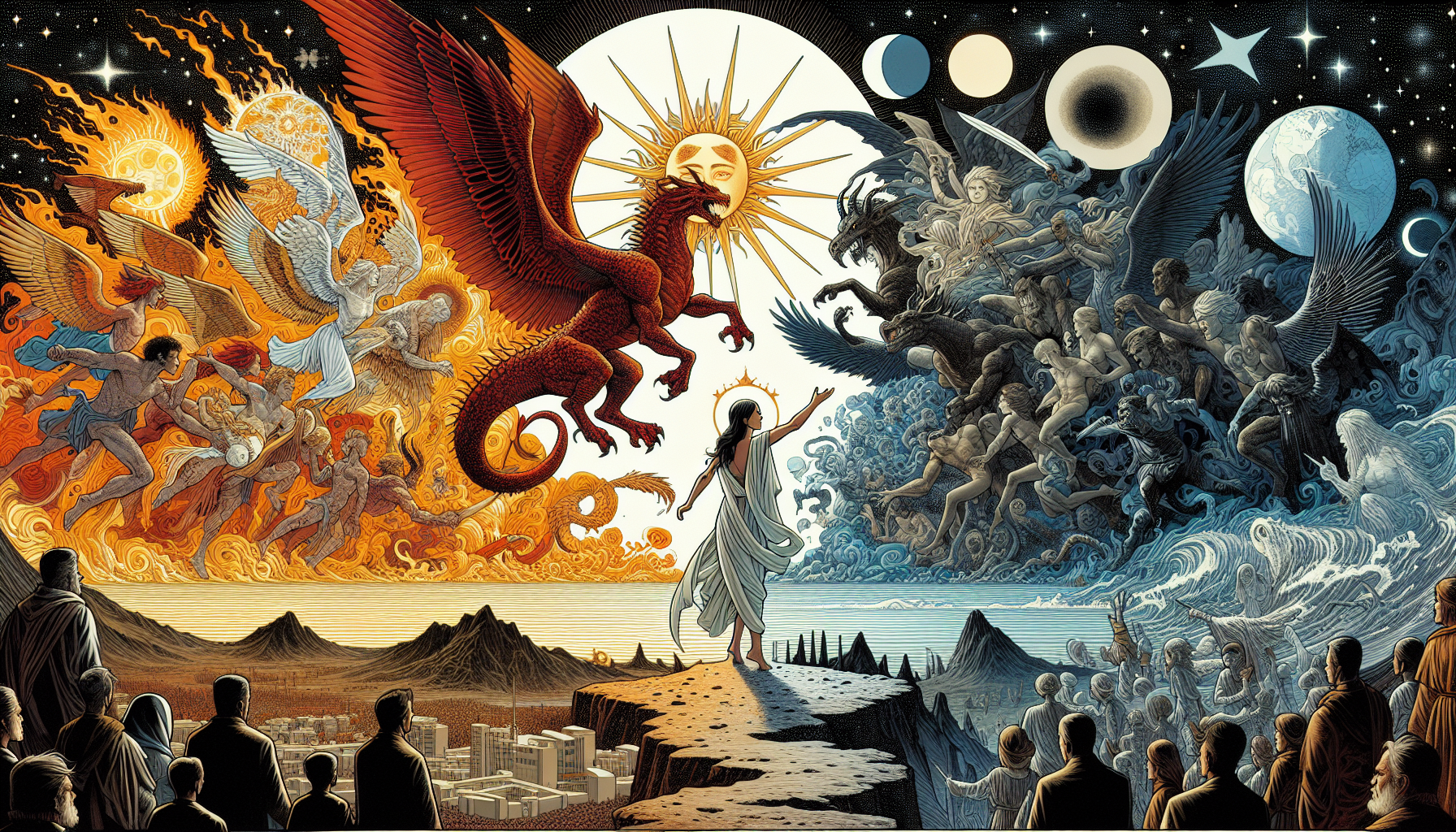
[Lesson 118] Rev 12: The War Between The Dragon and God

by ichthus

Revelation 12 figuratively depicts the spiritual war between the dragon (Satan) and God’s forces. The woman clothed with the sun, moon, and crown of stars represents the pastor Mr. Yoo of the Tabernacle Temple. She gives birth to a male child, who is identified as New John (the promised pastor), who will rule all nations as one who overcomes. The enormous red dragon with 7 heads and 10 horns is the beast system led by Mr. Tak of the Stewardship Education Center, which tries to devour or destroy the child at birth. This parallels the spiritual war raging both in heaven between Michael’s angels and Satan’s angels, and on earth between New John and the beast system. Ultimately, victory is achieved through the blood of the Lamb (the life-giving words of Jesus) and the word of their testimony (seeing and understanding the fulfillment of Revelation). During the 3.5 year period, the woman (Mr. Yoo) flees into the desert (the theology school in the U.S.) while the beast system takes over the Tabernacle Temple. Though Satan spews waters of persecution and lies, the earth (the faithful people) helps defend the woman by absorbing the deceptive waters. In the end, those victorious ones who obey God’s commands are able to establish the new unified Temple of the Tabernacle of the Testimony for all nations to worship the truth.


Study Guide SCJ Bible Study

Shincheonji holds distinct theological views that differ from mainstream Christian denominations, yet it also shares some common teachings. This overlap can sometimes blur the lines between their beliefs and those of traditional Christianity. Therefore, it is essential to exercise critical thinking and discernment to differentiate between these shared elements and the unique doctrines they present.

While their interpretations warrant careful examination through a critical and biblical lens, it is equally important to approach these matters with an open yet discerning mindset.

The following notes were documented in person during Shincheonji’s 9-month Bible Study Seminar. They provide insight into the organization’s approach to introducing and explaining its beliefs to potential new members, often referred to as the ‘harvesting and sealing.’ This process is described as being ‘born again’ or ‘born of God’s seed,’ which involves uprooting the old beliefs and replanting new ones. This uprooting and replanting must occur continuously. By examining this process, we can gain a better understanding of the mindset and beliefs held by Shincheonji members.

Review with the Evangelist

Memorization


Revelation 11:15

The seventh angel sounded his trumpet, and there were loud voices in heaven, which said:

“The kingdom of the world has become the kingdom of our Lord and of his Christ,

    and he will reign for ever and ever.”


Yeast of Heaven

The moment I think I know, the moment I think I can see, is the time I may fall and fail, and I may easily become the last.

[Evangelist]

We know that Isaiah 55:8, tells us how God’s thoughts are greater than our thoughts, and His ways are greater than ours. 

Let’s remember this verse in our hearts. But really, this verse is telling us to humble ourselves by letting go of our own thoughts and ways, because God’s thoughts are greater than our thoughts. We cannot even compare to God’s thoughts because they are greater.

And God’s heart is for everyone to be saved. So, what about us? What is our heart before God as we come to class today?

The hope is that our hearts and minds are empty, and we’re also emptying our own thoughts, so that the word of God can help us grow and be changed to become who God wants us to be at this time. Those with a hundred percent faith, and the word within us in every single way.

[Speech Practice]

For the last lesson, we learned about Revelation 11, titled “Two Witnesses and the Seventh Trumpet.”

The main points were that there were two witnesses who testified about the work of betrayal and destruction, which happened over 1,260 days or 42 months. These two witnesses were killed by the beast and resurrected after three and a half days, and we saw the actual reality of that. The seventh trumpet sounded in verse 15, announcing that the kingdom of the world has become the kingdom of God.

At the beginning of the chapter, we see a reed like a measuring rod, representing Mr. Hong, who worked with Nujan in the beginning and witnessed many things, helping him carry out God’s work. They were sent to measure the temple of God, which means they needed to evaluate the people’s faith and knowledge, but they were told to exclude the outer court, which had already betrayed. They went in, and the actual reality period was from September 1980 to March 1984. There were two olive trees, representing New John and Mr. Hong.

They were given powers: the ability to shut up the sky and stop the rain, and the ability to turn water into blood, making it undrinkable. At that point, the beast exercised its authority and influence with the government to put them in jail.

The actual reality is that they were in prison for three and a half days on a defamation charge, and they died not physically, but spiritually, as they were unable to act and carry out the work of judgment they were called to do. This happened between January 30th and February 2nd, 1981. But they resurrected through the breath of life and continued to work. The third woe was brought, which was the plague of the seventh trumpet, and the reality of the seventh trumpet is New John.


Rev 12: The War Between The Dragon and God

Revelation 12 depicts the war between the dragon and God. This chapter is very important because it sets up the victory that must take place, the overcoming that must take place for the one who overcomes and his brothers that overcome with him.

We’ll see that in this important battle. We’ll also understand where Revelation 12 falls in the timeline of Revelation’s fulfillment so that we can properly place it in our minds.


Previous Lesson Review

Review


Let’s review what we looked at in Revelation 11.


ONE – Revelation 11: The Two Witnesses and the Seventh Trumpet

We learned about the two witnesses and the seventh trumpet.

TWO – Revelation 11:1-14: During the 42 Months, the Two Witnesses Testify

Revelation 11 can be thought of as being split into two major sections. 

The first section covers the time during the 42 months when the two witnesses testify.

THREE – New John and Mr Hong preached at the Temple of Testimony. 

The 2 witnesses identified were New John and Mr. Hong. When New John received a reed like a measuring rod, this reed actually represented Mr. Hong. Their mission was to measure the hearts of those worthy people remaining in the temple. They were specifically instructed to exclude measuring the outer court since it belonged to the Gentiles. Mr. Hong served as New John’s helper, particularly in the beginning stages of testifying about the opened word, also known as the revealed word.

Throughout their work together, New John and Mr. Hong faced numerous hardships. Their testimony period lasted 42 months, which appears in the book of Revelation expressed in multiple ways:

– 1,260 days

– Three and a half years

– A time, times, and half a time

All these expressions refer to the identical time period.

During their testimony, they encountered severe hardships, including spiritual death. This spiritual death manifested in two ways:

  1. Not having the word
  2. Having faith without deeds

Their inability to carry out their deeds resulted in their spiritual death.

Death appears in three distinct forms:

  1. Physical death
  2. Spiritual death (from not having the word)
  3. Spiritual death (from faith without deeds)

The manifestation of their spiritual death through lack of deeds resulted in imprisonment. They were jailed on defamation charges, which was the legal argument that the stewardship education center and the beast used against them at that time. Their imprisonment lasted three and a half days before they were released.


FOUR – After 42 Months, 7th trumpet blows: Kingdom of the world → Kingdom of God.

Revelation 11:15-19, particularly its latter portion, describes the period following the 42 months when the 7th trumpet sounds. During this time, the kingdom of the world transforms into the kingdom of God – a process that continues to unfold even today as the 7th trumpet keeps sounding.

John continues his testimony in the present day. We will soon have an extraordinary opportunity to hear him speak in the coming weeks. Plans are being made for us to attend one of his seminars or sermons.

His speaking voice defies his age – he speaks with the energy and determination of someone fully committed to his mission. His testimony continues today, delivered with the same passionate purpose.

The transformation from the kingdom of the world to the kingdom of God is happening gradually within each of us. Prior to encountering the open word, we were all bound to the kingdom of the world, lacking the ability to differentiate between good and evil.


FIVE – New John is testifying the revealed word of testimony as the 7th trumpet!

Through receiving the open word, we are undergoing a gradual transition into the kingdom of God, becoming a temple that God can use. This transition is not happening through various unclear means like dreams and signs that can be misunderstood.

In our past experience, we lacked clear understanding of God’s will. We would look for signs in ordinary occurrences, thinking thoughts like, “God, if the book falls off the bookshelf, I’ll know you’re present and trying to communicate with me.” Similarly, we would say, “God, if I feel a little bit of wind right now, I’ll know you’re here, right?” These were our attempts to receive divine direction.

Yet, how reliable can interpreting such signs like wind be? Instead, God prefers to communicate clearly through the promised pastor and the word, ensuring we understand exactly what we need to do, eliminating the ambiguities we faced before.

This explains what it means when New John testifies the revealed word.

Regarding the timeline of revelation, there’s an important additional detail we need to comprehend. While we haven’t discussed this extensively, there exists a simple way to understand the distinction between three periods: the period of betrayal, the period of destruction, and the period of salvation.

The events in Revelation can be understood in three distinct time periods related to the 42 months of destruction:

  1. Before the 42 months
  2. During the 42 months 
  3. After the 42 months

The 42 months of destruction specifically occurred from September 1980 to March 14, 1984. 

To understand where events fall in the Revelation timeline, we must determine if they happened before, during, or after this 42-month period.

In Revelation 6, we learned about how the tabernacle temple was killed in stages:

– First, one-fourth were killed

– Of those remaining, they died a third at a time

Now in Revelation 12, we will examine the final third that were spiritually killed in the tabernacle. This chapter will reveal important details about this last group’s spiritual death.


Revelation 12 happens after revelation 13

The Book of Revelation presents events in a specific order, but the actual sequence of events may differ from how they are written. Revelation 13 happens before Revelation 12 in the chronological reality, although we could not have known this before the events took place. However, there are clues and specific reasons why Revelation had to be written in this particular order.


First Clue

If we turn to Revelation 12:3, it says, “Then another sign appeared in heaven: an enormous red dragon with seven heads and ten horns and seven crowns on his heads.”


Revelation 12:3 – The dragon is in heaven.

In Revelation 12:3, we observe the dragon with seven heads and ten horns positioned in heaven. This confirms the dragon’s presence in heaven, characterized by its seven heads and ten horns, appearing as a beast.

When we examine Revelation 13:1-6, we find a different scenario:

Verse 1: “The dragon stood on the shore of the sea. And I saw a beast coming out of the sea. It had ten horns and seven heads, with ten crowns on its horns, and on each head a blasphemous name.”

Verse 6: “It opened its mouth to blaspheme against God, to slander his name and his dwelling place and those who live in heaven.”

This presents an interesting contrast: In Revelation 12:3, the dragon is already established in heaven. However, in Revelation 13, we see the dragon or beast with seven heads and ten horns emerging from the sea and proceeding to enter heaven.

This sequence provides our first clue: Revelation 12 chronologically follows the events of Revelation 13, as the dragon is shown entering heaven in chapter 13 but is already present in heaven in chapter 12.

Revelation 13:1,6 – The Beast with 7 heads and 10 horns enters heaven.

According to Revelation 13:1 and 6, the dragon or the beast with seven heads and ten horns enters heaven, but in Revelation 12, it is already present there.


Second Clue

Revelation 12:10 – Salvation has come.

In Revelation 12:10, it is stated, “Then I heard a loud voice in heaven say, ‘Now have come the salvation and the power and the kingdom of our God.'”

So, in Revelation 13, it talks about the victory that has taken place, which is actually the second war. Salvation takes place after destruction.

However, Revelation 13 is a chapter about destruction, while in Revelation 12, salvation has come.

This indicates that Revelation 12 happens after Revelation 13. Therefore, keep in mind that Revelation 13 occurs entirely during the 42 months of destruction.

On the other hand, Revelation 12 represents a transition to salvation..


Revelation 12:1-5


Revelation 12:1-5

A great and wondrous sign appeared in heaven: a woman clothed with the sun, with the moon under her feet and a crown of twelve stars on her head. 2 She was pregnant and cried out in pain as she was about to give birth. 3 Then another sign appeared in heaven: an enormous red dragon with seven heads and ten horns and seven crowns on his heads. 4 His tail swept a third of the stars out of the sky and flung them to the earth. The dragon stood in front of the woman who was about to give birth, so that he might devour her child the moment it was born. 5 She gave birth to a son, a male child, who will rule all the nations with an iron scepter. And her child was snatched up to God and to his throne.


Revelation chapter 12 contains many significant events. Let’s examine it piece by piece.

In verse 1, we read about a great and wondrous sign that appeared in heaven. The Bible distinguishes between two types of heaven:

  1. The spiritual heaven (as described in Revelation 4)
  2. The physical heaven in this world


Hebrews 8:3-5

3 Every high priest is appointed to offer both gifts and sacrifices, and so it was necessary for this one also to have something to offer. 4 If he were on earth, he would not be a priest, for there are already men who offer the gifts prescribed by the law. 5 They serve at a sanctuary that is a copy and shadow of what is in heaven. This is why Moses was warned when he was about to build the tabernacle: “See to it that you make everything according to the pattern shown you on the mountain.”


ONE – Heaven: Tabernacle of Heaven (Actual Reality: Tabernacle of Testimony, Rev 13:6

They served at a tabernacle that figuratively represents a copy and a shadow of what already existed in heaven. In the physical world, there are two types of heavens:

  1. The first heaven and the first earth
  2. The new heaven and the new earth

These physical heavens are made according to the pattern of heaven in the spiritual world. Between these two types, one betrays and passes away, while the other type remains forever.

God has long desired to build this place, as mentioned in several biblical passages:

– Isaiah 65

– 1 Peter 3

– 2 Peter

– Revelation 21

God’s purpose has been to seek a new heaven and a new earth – essentially a new kingdom and new people – so that He can finally come down.

When reading Revelation 12, it’s important to understand that the “heaven” mentioned refers not to the spiritual realm where God dwells, but to a heaven in the physical world. This heaven is specifically the tabernacle of heaven.

The actual reality of this tabernacle of heaven, where the war occurs, is the tabernacle temple. This is referenced in Revelation 13:6, which we read earlier, stating “slandered those who live in heaven.” This refers to the slandering of those dwelling in the tabernacle temple.


TWO – Sun, Moon and Stars (People of the Tabernacle Temple), Gn 37:9-11

In Revelation 12, we encounter a significant vision: a woman clothed with the sun, with the moon under her feet, and wearing a crown of 12 stars on her head.

Previously, many interpreted Revelation literally. However, let’s consider this logically – could a woman physically be clothed with the sun? A practical example helps us understand: if someone were to travel by rocket ship toward the sun, they would perish thousands of miles before reaching it. This simple fact demonstrates that this imagery cannot be interpreted literally, but must have a spiritual meaning.

Through our study, we have come to understand the spiritual symbolism of these elements:

  1. The woman represents a pastor of flesh
  2. The sun represents a pastor
  3. The moon represents evangelists 
  4. The stars represent saints (the congregation)

This imagery reveals the actual reality of the people of the Tabernacle Temple: the sun symbolizing the pastor, the moon representing the evangelists, and the stars representing the saints who are born again from the seed of the word.


THREE – Woman is a Pastor, Gal 4:19, 1 Cor 3:1-4

A pastor, who is a woman, serves as the shepherd of her people. 

In the context of any church, a pastor is clothed by their congregation, and the congregation represents who the pastor truly is. Because the congregation feeds on the pastor’s words, the pastor’s true nature shapes the identity of the congregation. In the spiritual world, a spiritual woman receives the seed from the groom – this should be a spirit if things are proceeding correctly, though it could be a different spirit.

The pastor’s responsibility is to nurture the congregation with the seed received, providing either milk or solid food. 

As Apostle Paul expresses in Galatians 4:19, “I am in the pains of childbirth until Christ is fully formed within you.” This concept is further elaborated in 1 Corinthians 3:1-4, where Paul explains how he had to give milk to the Corinthian congregation, as they weren’t prepared for solid food. Like a mother who understands her child’s nutritional needs and knows when to transition from milk to solid food, a pastor must do the same.

A pastor must evaluate their congregation’s spiritual maturity to provide appropriate spiritual nourishment. However, there’s a problem: for 2000 years, pastors have only been giving milk – not even fresh milk from the udder, but spoiled milk. This is what people have been consuming all these years. 

When solid food is introduced, it appears strange and weird – likely similar to how this class felt initially (though hopefully not anymore), because solid food has a different taste than milk, especially rotten milk. This discernment is a crucial aspect of a pastor’s role.

Before examining some explanatory diagrams, let’s consider another sign from Revelation chapter 12. Revelation 12:2-3 states, “She was pregnant and cried out in pain as she was about to give birth. 

Then another sign appeared in heaven, an enormous red dragon with seven heads and 10 horns, and with seven crowns on his heads. His tail swept a third of the stars out of the sky and flung them to the earth. The dragon stood in front of the woman who was about to give birth so he might devour her child the moment it was born.”


The Dragon with 7 heads and 10 horns

Let us examine the dragon mentioned in Revelation. This dragon represents a being with 7 heads and 10 horns, which is described in more detail in Revelation 13. Additionally, this dragon has a tail that swipes a third of the stars from the sky.

During my time in Babylon, there was a common teaching about the angels who fled with Satan. The teaching claimed that Satan took one-third of all angels, and this interpretation came from this passage. However, let’s analyze this carefully.

When considering God’s angels, their number is beyond human counting. Even John, in his writing, could only express it as “thousands upon thousands, 10,000 times 10,000” – essentially describing a countless number. He couldn’t see where the multitude ended.

This raises a logical question: if you take one-third of a countless number, wouldn’t that still be countless? It’s not logical to suggest that Satan could have taken a countless number of angels from God.

This illustrates how people sometimes interpret figuratively meant passages in a literal way. However, we do have a specific number in Revelation 9, where “10,000 times 10,000” is mentioned twice, equaling 200 million. This represents the actual number of angels Satan took from God.

Therefore, we can conclude two things: first, the number isn’t countless – it’s 200 million. Second, 200 million cannot be one-third of a countless number. This indicates that these stars in the passage do not represent angels. Furthermore, since Revelation is a prophecy about the future, and Satan’s taking of the angels occurred thousands of years ago, these must be two separate events.


FOUR – Tail of Dragon: False Pastors

Let us examine what the third of the stars that Satan took away represents. 

To understand this, we must first look at the tail. In its figurative spiritual meaning, the tail represents false pastors, as revealed in Isaiah 9:15.

The 17 Evangelists Explained:

These false pastors, also called prophets, were specifically the 17 evangelists from the stewardship education or the tabernacle temple. 

They were appointed as pastors at a precise moment:

  1. The hour: 2 p.m.
  2. The day: the 20th
  3. The month: September
  4. The year: 1981

The ordination of these 17 evangelists as pastors was conducted illegally. The full understanding of this illegal process will be explained later. These individuals, now serving as pastors, continued to spread false doctrines, misleading the congregation further. As a result, the remaining third that had not been killed was subsequently killed.

To better comprehend this relationship, we can refer to a diagram.

To review our previous discussion: we first examined the woman clothed in the sun, moon, and stars. She appeared with:

– The sun as her clothing

– The moon beneath her feet

– A crown of 12 stars on her head

In Revelation, there appears a woman clothed in the sun, moon, and stars who gives birth to a male child. This male child holds an iron scepter, which represents authority to rule. When the dragon notices this, it hates it.

The dragon attempts to devour the child at the moment of birth. As the dragon attacks the child and the woman who gave birth, it also sweeps a third of the stars from the sky – the last third that remains alive.

While some have suggested this child is Jesus, this interpretation is incorrect. The child is actually New John, and here is the explanation why:

The male child holds an iron scepter. In Revelation 2:26-27, it is written that the one who overcomes receives the iron scepter. This means:

– The male child is the one who overcomes

– The one who overcomes receives the iron scepter from Jesus

– Jesus could not have given himself the iron scepter

Therefore, the woman clothed in the sun and stars cannot be Mary. Instead, she is a figurative representation of the tabernacle that was called heaven.

This situation has occurred multiple times throughout the Bible, beginning with a prophecy in Genesis 3:14-16. The depth of this understanding goes even further.


Genesis 3:14-16

14 So the Lord God said to the serpent, “Because you have done this,

“Cursed are you above all the livestock

    and all the wild animals!

You will crawl on your belly

    and you will eat dust

    all the days of your life.

15 And I will put enmity

    between you and the woman,

    and between your offspring and hers;

he will crush your head,

    and you will strike his heel.”

16 To the woman he said,

“I will greatly increase your pains in childbearing;

    with pain you will give birth to children.

Your desire will be for your husband,

    and he will rule over you.”


In verse 14, God pronounces a curse upon the serpent. While we understand the serpent’s reality today, it’s important to note that Satan is the ultimate serpent, using anyone who opposes God.

Revelation 20:2 reveals that Satan is cursed and “will eat dust all the days of his life.” This statement is figurative, not literal. What does dust represent in a spiritual sense?

Dust represents a person without the word. As stated in 1 Peter 5:8, “Your enemy, the devil prowls around like a roaring lion looking for someone to devour.” This shows how Satan easily devours those who are like dust – those without the word.

The curse continues, stating “cursed you are above all the livestock.” In verse 15, God declares, “I will put enmity between you, the serpent and the woman.”

Genesis 3:15 contains a crucial phrase that indicates the nature of this passage – “I will.” This signals that we’re reading prophecy. God declares, “I will put enmity between you, the woman and the serpent.” This demonstrates God’s amazing nature, prophesying events thousands of years before their occurrence.

As Isaiah 46:10 states, “I make known the end from the beginning. From ancient times, what is yet to come.” This verse shows how the beginning and end are tight together in God’s perspective, allowing Him to prophesy about both Genesis and Revelation simultaneously.


The fulfillment of this prophecy in Genesis 3:15 involves:

– The woman giving birth in pain to a child

– Enmity between the offspring

– Conflict between the child and the serpent

This prophecy indicates that the serpent and the child will engage in war, which is detailed further in Revelation 12.


The Woman clothed in the sun, moon and stars – Rev 1:20

The woman clothed in the sun, moon, and stars figuratively represents the Tabernacle Temple – specifically Mr. Yoo, the son, not the father.

The explanation for why it’s the son begins with the establishment of the Tabernacle Temple in 1966. The temple was referred to as a lampstand, which operates on a specific logic: oil flows through the middle branch before filling the other branches. In this structure, Jesus worked directly through Mr. Yoo, the father, who served as the middle branch, disseminating the word to the other branches (people).

A conflict arose when the other branches believed God was working through them as well, not exclusively through the father. This situation paralleled the biblical account in Numbers 12:1-9, where Aaron and Miriam quarreled, claiming God spoke through them, not just Moses. This in-quarreling and internal strife among family members led to Mr. Yoo, the father, being kicked out in 1967.

The person who would later become known as New John discovered this quarreling among the seven stars. This discovery led to threats against his life, forcing him to flee in 1971. When the middle branch (Mr. Yoo, the father) was removed, the word ceased to exist, and God departed.

The betrayal that began in 1967 with the expulsion of the middle branch due to in-quarreling continued to evolve. Their betrayal and mindset deteriorated to such an extent that by 1975, when Mr. Yoo, the son, appointed Mr. Oh as an educator, they failed to recognize they had invited a destroyer into their midst. This demonstrated how far they had strayed from Jesus, losing their ability to recognize false teachings. This sequence of events illustrates how betrayal manifests.


New John, the male child, attending Tabernacle Temple, Rev 10:8-11

From 1967 to 1971, New John was a member of the tabernacle, during which time Mr. Yoo’s son was responsible for preaching. New John was present in the early era when Mr. Yoo preached, and this is figuratively expressed as Mr. Yoo giving birth to New John. However, it’s important to understand that New John was not actually evangelized by any person in the early stages of his life of faith – he was evangelized by heaven.

When someone is young in their life of faith, they need a place where their faith can grow and develop. This is a natural process, just as Jesus himself spent time in the temples and synagogues before beginning his ministry, as recorded in the book of Luke.


Luke 2:41-52

41 Every year his parents went to Jerusalem for the Feast of the Passover. 42 When he was twelve years old, they went up to the Feast, according to the custom. 43 After the Feast was over, while his parents were returning home, the boy Jesus stayed behind in Jerusalem, but they were unaware of it. 44 Thinking he was in their company, they traveled on for a day. Then they began looking for him among their relatives and friends. 45 When they did not find him, they went back to Jerusalem to look for him. 46 After three days they found him in the temple courts, sitting among the teachers, listening to them and asking them questions. 47 Everyone who heard him was amazed at his understanding and his answers. 48 When his parents saw him, they were astonished. His mother said to him, “Son, why have you treated us like this? Your father and I have been anxiously searching for you.”

49 “Why were you searching for me?” he asked. “Didn’t you know I had to be in my Father’s house?” 50 But they did not understand what he was saying to them.

51 Then he went down to Nazareth with them and was obedient to them. But his mother treasured all these things in her heart. 52 And Jesus grew in wisdom and stature, and in favor with God and men.


Jesus demonstrated profound wisdom even at age 12. The Bible records that in the temples, he was not only listening but also speaking and teaching, showing his deep understanding from an early age.

John the Baptist followed a similar path in his spiritual development. Before Jesus appointed him for his three-year ministry, John was already deeply engaged in his faith, listening and asking many questions.

In the Bible’s figurative language, when it speaks of “the woman gave birth to the male child,” this represents how John the Baptist was present among them for a period before departing.

The male child mentioned is John the Baptist, who receives the iron scepter as one who overcomes. This iron scepter represents the authority to rule, and ruling in this context means teaching, as explained in Malachi 2:7 and 1 Peter 2:9. These verses discuss the royal priesthood, whose primary responsibility is to teach the word of God.


The Beast with 7 heads and 10 horns (Actual Reality: Mr Tak)

Satan the serpent works through people, similar to how God works through a person. The beast is represented by the dragon with seven heads and ten horns.

Mr. Tak leads the beast. He holds two positions: he is the head of the stewardship education center and serves as the main head among the seven heads and ten horns.

The seven heads represent the seven pastors at the stewardship education center, including Mr. Tak. When they entered the tabernacle temple, they appointed ten authority figures. These ten authority figures were tabernacle temple members who were appointed as elders. Together with the seven heads, they worked to destroy the tabernacle.

The stage for the upcoming war is now set. We know who the participants in this battle are. When we zoom out, we can understand the logic behind each participant’s role.


What We Understand So Far

The woman clothed in the sun, moon, and stars figuratively represents Mr. Yoo, the son. During that time, he was in charge as the main branch, head pastor, or representative pastor of the 7 stars and of the tabernacle. New John, who was at the temple during this period, fled to protect his life after discovering the corruption and quarreling happening among the 7 stars.

Being in the tabernacle during that era is symbolized as giving birth, similar to how Jesus spent time in the tabernacles and synagogues in Jerusalem. Although New John was a member in the tabernacle temple in the early days, his words do not originate from there. Mr. Tak and the beast, now in charge, began to attack New John after learning about his origins. They attempted to snatch him up before he could grow, wanting to stop his preaching and prevent him from doing his job.

The enmity, which is the war between the offsprings, has manifested in various ways throughout history. Satan consistently attempts to snatch up those whom God appoints for important tasks while they are young. The first instance of this was with Moses – Satan, recognizing that Moses would become significant in God’s work, tried to snatch him up in his youth. However, by God’s grace, Moses was saved and protected.

This pattern repeated with Jesus, when King Herod wanted to snatch him up as a young child. This recurring theme demonstrates why God speaks in parables to protect His plan. Satan continuously tries to interrupt God’s plan before it can take effect, always causing problems.

This is precisely why God asked to speak in parables – to prevent the evil one from stopping His plan.


Quick Review

Quick Review


Let’s review our previous discussion about Revelation.

The chronological order of events is important to understand: Revelation 12 occurs after Revelation 13. There are three significant sets of contrasting chapters in Revelation:

  1. Chapters 6 and 7
  2. Chapters 13 and 14
  3. Chapters 18 and 19

These contrasting chapters are placed next to each other for specific reasons. For example, in Chapter 13, the beast appears and gives people the mark of the beast, destroying them. In contrast, Chapter 14 shows salvation, where people have the seal of God on their foreheads and can sing the new song.

Revelation 12:1-5 introduces three key entities:

  1. The woman clothed in the sun with stars
  2. The male child
  3. The dragon with seven heads and ten horns (also called the serpent)

Satan, who has opposed God since Adam’s time, attempts to devour God’s chosen ones before they can fulfill their purpose of defeating Satan in each era. The woman clothed in the sun with stars represents Mr. Yoo, the pastor of the heavenly tabernacle or temple, who replaced his father after his father was removed. The male child is New John, who witnessed these events during the early period of his faith journey, enabling him to testify about what occurred.

The beast with seven heads and ten horns, currently being confronted by New John in Revelation 12, responds with hostility and attempts to attack him in this war.


Revelation 12:6


Revelation 12:6

The woman fled into the desert to a place prepared for her by God, where she might be taken care of for 1,260 days.


ONE – Desert: Place without Water (Word), Dt 32:3

In this passage, we learn about a woman fleeing to a desert from a dragon. To understand the physical representation of a desert, we look at Romans 1:20, which describes it as a dry, arid place without water.

A desert’s key characteristic is the absence of water. From a spiritual perspective, this represents a place lacking life-giving water. Water here figuratively represents the word, as explained in Deuteronomy 32:2: “Let my teachings fall like rain and my word descend like dew, like showers on new grass, like abundant rain on tender plants.”

The woman, who spiritually represents Mr. Yoo, goes to a place that is spiritually a desert – a concerning situation. Mr. Yoo is absent for a specific period: 1260 days, which equals 42 months or three and a half years. This is known as the period of destruction.

During this three and a half year period of destruction, Mr. Yoo, the representative pastor of the tabernacle, is not present. In his absence, and after the resignation of the 7 stars, Mr. Oh and Mr. Tak take charge. This enables them to carry out the destruction by feeding people false teachings.


TWO – Actual Reality: Theology School

The woman went to a desert – which in reality was a theology school in the United States. God considers the United States a desert because it is a place without the word. 

Those who have attended theology schools often describe their experience as spiritually dry. Rather than focusing on the word, these institutions primarily teach church history and administration.

The actual events unfolded as follows: Mr. Yoo departed from the Tabernacle Temple to attend theology school in the United States from October 1980 to April 1984. During his absence, Mr. Oh and Mr. Tak took control and corrupted the place with false teachings.

Mr. Oh, who had a special relationship with Mr. Yoo, persuaded him to seek official ordination. Mr. Oh said to Mr. Yoo: “You haven’t been to theology school. You will only learn the 7 stars teachings, which we’ve shown are wrong. Go become someone who is official. Attend this theology school in the United States. Let them train you while you’re gone. We’ll take over from here while you’re away.”

Believing this would give him official recognition in the world’s eyes, Mr. Yoo agreed and went to the United States from October 1980 to April 1984.

However, at a precise and significant moment – 2 pm on September 20th, 1981 – he briefly returned. During this visit, he witnessed his people falling deeper into falsehood at the pastor ordination service. Afterward, he returned to the United States to continue his studies.

This sequence of events fulfills Revelation 12:6.


Revelation 12:7-11


Revelation 12:7-11

7 And there was war in heaven. Michael and his angels fought against the dragon, and the dragon and his angels fought back. 8 But he was not strong enough, and they lost their place in heaven. 9 The great dragon was hurled down—that ancient serpent called the devil, or Satan, who leads the whole world astray. He was hurled to the earth, and his angels with him.

10 Then I heard a loud voice in heaven say:

“Now have come the salvation and the power and the kingdom of our God,

    and the authority of his Christ.

For the accuser of our brothers,

    who accuses them before our God day and night,

    has been hurled down.

11 They overcame him

    by the blood of the Lamb

    and by the word of their testimony;

they did not love their lives so much

    as to shrink from death.

Let’s now look at Revelation 12 from verse seven to 11 to read about the victory, the war that happens and the victory that also takes place. Revelation 12, verses seven to 11.


A significant event unfolds in Revelation 12:7-11, marking the beginning of a major war that occurs on two distinct fronts: heaven and earth – encompassing both the spiritual and physical worlds. 

In the spiritual realm, Michael and his angels engage in battle against Satan and his demons (angels). This conflict simultaneously manifests in the physical world.


The victory is achieved through two elements:

The Blood of the Lamb – Represents Jesus’ words of life

The Word of Testimony – Obtained through seeing and hearing


Understanding the Blood of the Lamb:

  • Reference to John 6:63: “The spirit gives life. The flesh counts for nothing.”
  • Jesus clarified the meaning when people misunderstood his words about eating his flesh and drinking his blood
  • He emphasized that his words, not literal flesh and blood, give life
  • Jesus is the way, the truth, and the life


The Flow of Life-Giving Words:

God → Jesus → Angel → New John (Promised Pastor) → Many peoples, nations, languages, and kings

The word of testimony is received through seeing and hearing, enabling understanding of the reality through the 5W1H: 

Who: Identifying betrayers and destroyers

What: Actions according to prophecy

When: Timing of appearances

Where: Location of appearances

How: Method of manifestation

Why: Purpose behind events


The word and testimony must exist together during fulfillment. Just as Jesus preached his words of life, he also identified the fulfillment of Old Testament prophecies. 

He pointed out John the Baptist as the prophesied Elijah, and the Pharisees as those Isaiah spoke about. Jesus himself fulfilled prophecies as the light appearing in Galilee, the child born to a virgin, the one born in Bethlehem, the stone on Zion, the one who rode on a donkey, and more. He had to give those words.

The war described occurs simultaneously on two distinct fronts. First, in the spiritual realm, where Satan and his demons battle against Michael and his angels. Second, in the physical world, where the male child and his brothers fight against the beast with seven heads and ten horns.

This ongoing war’s intensity will become more evident when we view the movie about Revelation 12.

The nature of this war is particularly interesting. It’s not a conventional battle – John didn’t arrive at the tabernacle armed with guns, swords, and shields, saying “Hey, I’m coming over here. You guys are the betrayers. Get down.”

Instead, this is a doctrinal war – a war of words. This spiritual warfare has always been fought through doctrines, not with physical weapons like guns and bullets as seen in worldly conflicts.


This concept is supported by two key biblical passages:

  1. Ephesians 6:10-17, where Paul explains that we don’t wage war as the world does, but must put on the full armor of God, which is essentially the word of God. Each piece of this armor relates to the word in some way.
  2. 2 Corinthians 10:3-5, where Paul further elaborates on the nature of spiritual warfare.


2 Corinthians 10:3-5

3 For though we live in the world, we do not wage war as the world does. 4 The weapons we fight with are not the weapons of the world. On the contrary, they have divine power to demolish strongholds. 5 We demolish arguments and every pretension that sets itself up against the knowledge of God, and we take captive every thought to make it obedient to Christ.


We do not wage war as the world does, and we don’t use worldly weapons. Instead, we fight with our words to demolish strongholds and every pretension, making them obedient to Christ. 

We demolish arguments through a war of doctrines.


In this conflict, the male child was proclaiming the word of truth, while the destroyers were spreading words of lies. Both sides claimed to possess the truth:

“We have the truth.”

“No, you are the destroyers.”

“No, we are not.”

“We have been around a long time.”

“No, you destroyed the Tabernacle Temple and took away their word.”

“No, you guys don’t know what you’re talking about.”

This back-and-forth war was waging, but it was a war of words. In Revelation 12, God’s side achieves victory. When there is a victory, similar to the blessing and curse described in Deuteronomy 28, the winner receives the blessings, while the loser is cursed.

According to Deuteronomy 28, how is the loser cursed? They flee in seven ways. This exactly happened to the pastors of the Stewardship Education Center when they were defeated. It took some time, but they came in one way and fled in seven ways, which is remarkable. 

This war is fully detailed in Revelation chapter 16, which we will examine more closely in upcoming lessons.


Revelation 12:12-17

12 Therefore rejoice, you heavens

    and you who dwell in them!

But woe to the earth and the sea,

    because the devil has gone down to you!

He is filled with fury,

    because he knows that his time is short.”

13 When the dragon saw that he had been hurled to the earth, he pursued the woman who had given birth to the male child. 14 The woman was given the two wings of a great eagle, so that she might fly to the place prepared for her in the desert, where she would be taken care of for a time, times and half a time, out of the serpent’s reach. 15 Then from his mouth the serpent spewed water like a river, to overtake the woman and sweep her away with the torrent. 16 But the earth helped the woman by opening its mouth and swallowing the river that the dragon had spewed out of his mouth. 17 Then the dragon was enraged at the woman and went off to make war against the rest of her offspring—those who obey God’s commandments and hold to the testimony of Jesus.

When examining verse 12, we see Satan realizes his time is short. As we approach the complete fulfillment of the prophecy in Revelation, Satan intensifies his fight. The more people learn the open word, the harder Satan fights against them, both individually and globally around the world. This explains why conditions appear to be continuously worsening.

We are getting closer to God’s return, which is why this escalation is occurring. Satan knows his time is short and that he is already defeated. However, as stated in verse 9, his main job is to lead the whole world astray. Despite knowing his final destination, Satan’s goal is to take as many people with him as possible.

Satan acts like a sore loser – his aim is to devour as many people as possible, leading them to join him in a place we do not want to be.


ONE – Earth: Tabernacle of Heaven, Tabernacle Temple of the Chosen People, Rev 13:3

Let’s examine verse 12: “Rejoice, you heavens and you who dwell in them. But woe to the earth and the sea, because the devil has gone down to you.”

This prophecy speaks about “the earth” and “the sea” where the devil has descended. It’s important to note that this is not referring to events before Adam’s time. As a prophecy, these elements must find their fulfilment in our present era.

“The earth” and “the sea” represents the tabernacle of heaven, or more specifically, the tabernacle of the chosen people. In reality, this represents the Tabernacle Temple.


TWO – Sea: World of Satan, Dn 7:1-3, 17

The battle between Michael and Satan results in Satan being cast down. After his defeat, Satan goes to the sea, which figuratively represents Babylon.

This war manifests on two different scales, as further revealed in Revelation chapters 16, 17, and 18. The sea symbolically represents the world of the beast – Satan’s domain.

This domain encompasses everyone else, including all false pastors and churches across the world. Under Satan’s control are both the tabernacle of the chosen people (which no longer exists) and Babylon (Satan’s world).


THREE – Eagle: 4 Living Creatures, Rev 4:6-8

The woman received wings that were like those of a great eagle, enabling her to fly to her designated place in the desert. 

This eagle figuratively represents one of the four living creatures. According to this, the woman must return to the specific place that was prepared for her.


FOUR – Serpent Spewed Water: Words of Persecution

The reality unfolded when Mr. Yoo briefly returned to participate in the service. Mr. Oh and Mr. Tak became enraged at him because of New John’s activities in their location during his absence.

In response to this situation, Mr. Oh and Mr. Tak began to slander Mr. Yoo. As a result, Mr. Yoo had to flee back to the United States after the service to escape their accusations. The serpent was spewing water, but this was not drinkable water – it was like the bitter water mentioned in Revelation 9, where a star falls on the springs and rivers, turning them into blood.

This water was not clean but dirty, representing the words of persecution that Mr. Oh and Mr. Tak directed at Mr. Yoo. Their anger stemmed from discovering that New John, who was fighting them with words of truth, was formerly a member of the Tabernacle Temple.

Their reaction was not happiness but anger, leading them to attack Mr. Yoo with words of persecution.


FIVE – Earth Swallowed

The earth swallows up the water, which figuratively represents the fulfilment of a prophecy or parable from the word.

Regarding the 7 stars and Mr. Yoo, there is more about the actual reality. The people deeply loved them. This makes logical sense.

The 7 stars arrived in a small town and began preaching a new word that no one had heard before. People traveled from everywhere to join this place. At this point, they had established over 80 branch churches and gathered 7,000 members. Mr. Yoo was loved by the people.

When Mr. Oh and Mr. Tak, who were new people, started to slander the one whom the people loved so much, the people absorbed these insults and defended Mr. Yoo. As the beast with seven heads and 10 horns, along with Mr. Oh, persecuted Mr. Yoo, those in the tabernacle temple defended him. They absorbed that false water, those slanders, those lies about him. However, these people now both belong to Satan.

On Satan’s side, they are not united in anything. They bicker and quarrel amongst themselves. Those who are betraying and destroying don’t even get along with each other, not really.


SIX – Those Who Obey and Hold

Satan represents division rather than unity, causing arguments among his followers. As stated in verse 17, “the dragon was enraged at the woman and went off to make war against the rest of her offspring.”

These offspring are the people who remain faithful to God’s teachings and Jesus’ commands. They are the few remnant seeds – those who rejected the teachings of the Nicolaitans.

They can be compared to “one quart of wheat, three quarts barley” – the remnant seed, also known as the brothers. Initially, they were in the tabernacle temple, but when John began preaching and testifying, they were the first to flee and come out. The dragon then attempted to wage war against these few people who had emerged.

These victorious people went on to establish a new kingdom – the Temple of the Tabernacle of the Testimony.


SEVEN – Dragon on Shore of Sea: Rev 12:17 – Rev 13:1

Let’s examine the dragon’s location at the conclusion of Revelation chapter 12, which chronologically precedes chapter 13.

In Revelation 12:17, it states that the dragon went “to make war against the rest of her offspring.” Following this, “the dragon stood on the shore of the sea.” It’s important to note that this dragon with 7 heads and 10 horns is identical to the beast described with seven heads and 10 horns.

The connection between Revelation 13:1 and Revelation 17 is significant. The sea in this context represents Satan’s worldly domain. This will be explained in greater detail when we study Revelation chapters 17 and 18.

After the defeat of the beast with seven heads and 10 horns (the stewardship education center), Satan proceeds to target other pastors worldwide to continue his war against God’s people. The dragon’s position on the shore of the sea represents his stance against the world’s pastors and congregations, as he continues his warfare against the New John and Mount Zion.

The final point of today’s lesson is substantial: those who were victorious established a new kingdom.


Revelation 15:2-5

2 And I saw what looked like a sea of glass mixed with fire and, standing beside the sea, those who had been victorious over the beast and his image and over the number of his name. They held harps given them by God 3 and sang the song of Moses the servant of God and the song of the Lamb:

“Great and marvelous are your deeds,

    Lord God Almighty.

Just and true are your ways,

    King of the ages.

4 Who will not fear you, O Lord,

    and bring glory to your name?

For you alone are holy.

All nations will come

    and worship before you,

for your righteous acts have been revealed.”

5 After this I looked and in heaven the temple, that is, the tabernacle of the Testimony, was opened.


The victorious ones mentioned in verse 2 are identical to those who gained victory in Revelation chapter 12. These same victorious individuals are the ones who establish a new temple.

Here is the text restructured while preserving the key vocabulary and meaning:

The new temple refers to the temple of the tabernacle of the testimony, which is where all nations will come to worship. Glory to God.

God’s desire is for the unification of churches worldwide. The old ways of division by denomination, country, creed, or people will end, as God brings everyone together in one place.

Whether you hear this word now or later (which is figurative and represents truth), the destination remains the same – this place. Therefore, it is better to enter now rather than wait.

Those who delay may later regret passing up the early opportunity, only to end up there anyway. As the fulfilment of prophecy and parable shows, all nations will ultimately come to worship.

it is better to come early.


Memorization


Revelation 12:10-11

10 Then I heard a loud voice in heaven say:

“Now have come the salvation and the power and the kingdom of our God,

    and the authority of his Christ.

For the accuser of our brothers,

    who accuses them before our God day and night,

    has been hurled down.

11 They overcame him

    by the blood of the Lamb

    and by the word of their testimony;

they did not love their lives so much

    as to shrink from death.


Let’s Us Discern

A Refutation Using “Testing Shincheonji’s Claims: Two Lenses, One Story”

Lesson 118: Rev 12 – The War Between The Dragon and God

Viewing Through First-Century Christian, Historical, and Literary Lenses


Introduction: The Dragon in the Room

Imagine sitting in a dimly lit classroom, your notebook open, pen in hand. The instructor’s voice is calm, confident, almost hypnotic as he walks you through Revelation 12. He tells you about dragons and women, wars in heaven and births of children. But this isn’t just ancient mythology or symbolic literature—no, he insists this is a detailed roadmap of events that happened in South Korea between 1980 and 1984. The dragon? A specific pastor. The woman? A particular church. The child? A man you’ll soon be asked to follow with absolute devotion.

By the time you reach Lesson 118 in Shincheonji’s Advanced Level curriculum, you’ve already traveled a long road. You started with parables in the Introductory Level, learning that everything in the Bible has a “reality” that must be decoded. You progressed through the Intermediate Level, where you learned “Bible Logic”—a system that taught you to see patterns, symbols, and hidden meanings everywhere. Now, in the Advanced Level, you’re being taught that Revelation isn’t a first-century letter of hope to persecuted Christians, but rather a detailed prophetic blueprint of events in modern-day Korea, centered around one man: Lee Man-hee (referred to as “New John” in the lessons).

This is where the indoctrination reaches its crescendo. After months of study, after relationships have been formed, after your old church has been subtly criticized and your previous understanding of Scripture has been systematically dismantled, you’re now being presented with the “fulfillment.” And it all sounds so convincing—until you step back and examine it through different lenses.

In this refutation, we will examine Lesson 118 not through the lens of Shincheonji’s interpretive framework, but through the lenses that first-century Christians would have used: historical context, literary structure, and the plain meaning of Scripture in its original setting. We won’t be debating various end-times positions (Premillennialism, Amillennialism, or Postmillennialism). Instead, we’ll ask a simpler question: What would Revelation 12 have meant to the Christians who first received this letter in the first century? And more importantly: Does Shincheonji’s interpretation hold up when examined biblically, historically, and logically?

As the 30 chapters of “Testing Shincheonji’s Claims: Two Lenses, One Story” consistently demonstrate, Shincheonji’s teaching method involves a gradual process of replacing biblical interpretation with organizational doctrine. By the time students reach Lesson 118, they’ve been conditioned to accept that:

  1. The Bible cannot be understood without special revelation given to one man
  2. All biblical prophecy finds its ultimate fulfillment in Korea in the 1980s
  3. Questioning these interpretations means questioning God Himself

Let’s examine this lesson carefully, with both discernment and compassion—discernment to see the errors clearly, and compassion for those who have been taught these things sincerely. For a more comprehensive examination of Shincheonji’s claims, readers are encouraged to visit https://closerlookinitiative.com/shincheonji-examination for additional resources and testimonies from former members.


Part 1: The Foundation—Review of Revelation 11 and the Setup

What Shincheonji Teaches in the Review

Lesson 118 begins with a review of Revelation 11, establishing the interpretive foundation for what follows. According to the lesson, Revelation 11 describes “two witnesses” who are identified as specific individuals: “New John” (Lee Man-hee) and “Mr. Hong” (a early associate). The lesson teaches that:

  • These two witnesses testified during a 42-month period (September 1980 to March 1984)
  • They were given a “reed like a measuring rod” to measure the temple
  • They faced persecution and were imprisoned for 3.5 days in January-February 1981
  • They experienced “spiritual death” (not physical death) through imprisonment
  • They were “resurrected” when released from prison
  • The “seventh trumpet” of Revelation 11:15 is actually Lee Man-hee himself, who continues to testify today

The lesson emphasizes that students will soon have “an extraordinary opportunity” to hear Lee Man-hee speak, noting that “his speaking voice defies his age” and he speaks “with the energy and determination of someone fully committed to his mission.”

The Indoctrination Progression: How We Got Here

Before we examine the biblical problems with this interpretation, it’s important to understand the psychological journey that brings students to this point. As Chapter 3 of “Testing Shincheonji’s Claims: Two Lenses, One Story” explains, Shincheonji’s curriculum is carefully designed to build layer upon layer of specialized interpretation, each lesson preparing students to accept increasingly extraordinary claims.

By Lesson 118, students have been conditioned through:

  1. The Parable Method (Introductory Level): Students learned that Jesus spoke in parables to hide truth from outsiders, and that only those with special revelation can understand Scripture’s “reality.” This planted the seed that normal Bible reading is insufficient.
  2. The Pattern Recognition System (Intermediate Level): Students were taught to see everything in the Bible as symbolic patterns that repeat throughout history, always pointing forward to a final fulfillment. This trained them to disconnect texts from their original historical contexts.
  3. The Korean Fulfillment Framework (Advanced Level): Students are now being taught that all these patterns and prophecies find their ultimate fulfillment in specific events in South Korea in the 1980s, centered around one man.

As Chapter 15 of “Testing Shincheonji’s Claims: Two Lenses, One Story” discusses, this progression is not accidental. Each level builds dependency on the organization’s interpretation while simultaneously creating distance from students’ previous churches, pastors, and understanding of Scripture.

The Biblical Problems with the Revelation 11 Interpretation

Let’s examine the claims about Revelation 11 through a first-century Christian lens:

Problem 1: The Two Witnesses Are Not Identified as Specific Modern Individuals

Revelation 11:3-4 states: “And I will appoint my two witnesses, and they will prophesy for 1,260 days, clothed in sackcloth. They are ‘the two olive trees’ and the two lampstands, and they ‘stand before the Lord of the earth.'”

The text explicitly connects these witnesses to Old Testament imagery. The reference to “two olive trees” and “two lampstands” points directly to Zechariah 4:1-14, where the prophet sees a vision of two olive trees representing “the two who are anointed to serve the Lord of all the earth” (Zechariah 4:14). In Zechariah’s context, these represented the high priest Joshua and the governor Zerubbabel—two offices (priestly and kingly) working together in God’s purposes.

First-century Christians reading Revelation would have immediately recognized this Old Testament allusion. They would have understood the “two witnesses” as representing the faithful testimony of God’s people (both the Law and the Prophets, or the priestly and prophetic witness) during a time of persecution. The number “two” is significant in Jewish law—two witnesses were required to establish truth (Deuteronomy 19:15, Matthew 18:16).

As “How First-Century Christians Read Revelation Like a Political Cartoon” explains, Revelation is filled with symbolic imagery that would have been immediately recognizable to its original audience. To take these symbols and apply them to two specific individuals in 1980s Korea requires ignoring the entire literary and historical context of the book.

Problem 2: The 42 Months and the Temple Context

Shincheonji teaches that the 42 months (1,260 days, 3.5 years) refers specifically to September 1980 to March 1984. However, this time period appears repeatedly throughout Revelation in different contexts:

  • Revelation 11:2 – The nations will trample the holy city for 42 months
  • Revelation 11:3 – The two witnesses will prophesy for 1,260 days
  • Revelation 12:6 – The woman fled into the wilderness for 1,260 days
  • Revelation 12:14 – The woman is protected for “a time, times and half a time”
  • Revelation 13:5 – The beast is given authority for 42 months

This time period (3.5 years, or “half of seven”) is deeply symbolic in biblical literature. It appears first in Daniel 7:25, 9:27, and 12:7, referring to periods of persecution and trial. The number represents a time of incompleteness and testing—half of the perfect number seven.

First-century Christians would have understood this as symbolic language describing the entire period of the church’s witness and persecution between Christ’s first and second comings, not as a literal countdown of days pointing to events in Korea 1,900 years later.

As Chapter 8 of “Testing Shincheonji’s Claims: Two Lenses, One Story” explains, Shincheonji consistently takes symbolic numbers and time periods in Revelation and assigns them to specific calendar dates in Korea. This approach misses the literary function these numbers serve in apocalyptic literature.

Problem 3: The Nature of “Spiritual Death”

The lesson teaches that the two witnesses experienced “spiritual death” through imprisonment, defining this as “faith without deeds” because they couldn’t carry out their work while jailed. They were “resurrected” when released after 3.5 days.

However, Revelation 11:7-11 describes something far more dramatic:

“Now when they have finished their testimony, the beast that comes up from the Abyss will attack them, and overpower and kill them. Their bodies will lie in the public square of the great city—which is figuratively called Sodom and Egypt—where also their Lord was crucified. For three and a half days some from every people, tribe, language and nation will gaze on their bodies and refuse them burial. The inhabitants of the earth will gloat over them and will celebrate by sending each other gifts, because these two prophets had tormented those who live on the earth. But after the three and a half days the breath of life from God entered them, and they stood on their feet, and terror struck those who saw them.”

The text describes:

  • Bodies lying in a public square
  • People from every nation seeing their bodies
  • Celebration and gift-giving over their deaths
  • Visible resurrection that causes terror
  • Ascension to heaven in a cloud while enemies watch (v. 12)

To reinterpret this vivid imagery as a brief imprisonment on defamation charges requires completely ignoring the actual language of the text. This is not interpretation—it’s replacement.

Problem 4: The Seventh Trumpet as a Person

Perhaps most problematically, the lesson identifies the seventh trumpet of Revelation 11:15 as Lee Man-hee himself: “The reality of the seventh trumpet is New John.”

Revelation 11:15 states: “The seventh angel sounded his trumpet, and there were loud voices in heaven, which said: ‘The kingdom of the world has become the kingdom of our Lord and of his Messiah, and he will reign for ever and ever.'”

The seventh trumpet announces the completion of God’s kingdom purposes and the reign of Christ. It’s part of a series of seven trumpets (Revelation 8-11) that follow the pattern of the seven seals (Revelation 6-8) and precede the seven bowls (Revelation 16). These sevenfold structures are common in apocalyptic literature and serve to show the completeness of God’s judgment and redemption.

To claim that this trumpet “is” a specific person fundamentally misunderstands the literary genre. Trumpets in Revelation announce divine action—they are not themselves people. This is like claiming that the alarm clock that wakes you up “is” the person who set it.

As Chapter 12 of “Testing Shincheonji’s Claims: Two Lenses, One Story” discusses, Shincheonji’s method consistently personalizes symbols that were meant to represent broader spiritual realities. This serves the organizational purpose of centering everything on Lee Man-hee, but it does violence to the text itself.


Part 2: The Timeline Manipulation—Placing Revelation 12

What Shincheonji Teaches About the Timeline

Lesson 118 makes a crucial claim about the order of events in Revelation: “Revelation 13 happens before Revelation 12 in the chronological reality, although we could not have known this before the events took place.”

The lesson provides two “clues” for this rearrangement:

First Clue: Revelation 12:3 mentions “an enormous red dragon with seven heads and ten horns and seven crowns on his heads” in heaven. The lesson argues that since Revelation 13:1 describes the beast coming “out of the sea” (not heaven), and this beast also has seven heads and ten horns, the dragon must have already been cast down from heaven (Revelation 12:9) before Revelation 13 occurs. Therefore, Revelation 12 must happen after Revelation 13 chronologically.

Second Clue: The lesson claims that Revelation 12 describes “the final third that were spiritually killed in the tabernacle,” connecting it to the pattern of destruction seen in Revelation 6 (one-fourth killed, then one-third of the remainder killed in stages).

The lesson emphasizes: “The Book of Revelation presents events in a specific order, but the actual sequence of events may differ from how they are written.”

The Problem with Rearranging Revelation’s Order

This timeline manipulation reveals one of Shincheonji’s most problematic interpretive methods. Let’s examine why this matters:

Problem 1: The Arbitrary Rearrangement of Scripture

Once you accept the principle that the order of Revelation can be rearranged based on “clues” that only become apparent after alleged fulfillment, you’ve opened the door to completely subjective interpretation. Why stop at switching chapters 12 and 13? Why not rearrange other chapters? What prevents someone else from claiming a different order based on different “clues”?

As Chapter 6 of “Testing Shincheonji’s Claims: Two Lenses, One Story” explains, this approach makes the interpreter, rather than the text itself, the final authority. The text becomes clay to be molded into whatever shape fits the predetermined conclusion.

The lesson even admits this openly: “We could not have known this before the events took place.” In other words, the interpretation is driven by the need to fit the text to events in 1980s Korea, not by careful exegesis of what the text actually says.

Problem 2: Ignoring the Literary Structure of Revelation

First-century Christians would have recognized that Revelation is carefully structured, not randomly arranged. The book follows patterns that were common in apocalyptic literature:

  • Sevenfold structures: Seven churches (Rev 2-3), seven seals (Rev 6-8), seven trumpets (Rev 8-11), seven bowls (Rev 16)
  • Recapitulation: Many scholars recognize that Revelation revisits the same time period (the church age) from different angles, each cycle building in intensity
  • Chiastic structure: The book is organized with parallel sections that mirror each other around a central point

Revelation 12 serves as a pivotal chapter in the book’s structure. It steps back to give the “big picture” of the spiritual conflict behind the events described in previous chapters. It’s not meant to be chronologically after chapter 13—it’s meant to provide the theological framework for understanding all the conflict described throughout the book.

As one biblical scholar notes in the provided resources, Revelation 12 functions like a “flashback” in a movie—it takes us behind the scenes to see the spiritual reality behind the physical persecution the church faces. The woman, the child, and the dragon represent the ongoing conflict between God’s people and Satan throughout history, culminating in Christ’s victory.

Problem 3: The Dragon in Heaven vs. the Beast from the Sea

Shincheonji’s “first clue” for rearranging the chapters is based on a misunderstanding of the symbolism. The lesson argues that because the dragon appears “in heaven” in Revelation 12:3 but the beast comes “from the sea” in Revelation 13:1, the dragon must have already been cast down before chapter 13.

However, this misses the symbolic function of these locations:

  • Heaven in Revelation represents the spiritual realm, the place of God’s throne and authority. When the dragon appears “in heaven,” it shows his attempt to usurp God’s authority and accuse God’s people (Rev 12:10).
  • The sea in ancient Near Eastern imagery represented chaos, evil, and the gentile nations. The beast coming “from the sea” symbolizes oppressive political powers rising from the turbulent nations.

These are different types of symbols serving different literary functions. The dragon represents Satan himself—the spiritual power behind all opposition to God. The beasts represent specific manifestations of that satanic opposition in human political and religious systems.

First-century Christians would have understood this immediately. They lived under Roman persecution and would have recognized the beast imagery as representing the Roman Empire and emperor worship. The dragon “in heaven” wasn’t a chronological statement about where Satan physically was at a specific time—it was a theological statement about the nature of spiritual warfare.

Problem 4: The “Final Third” Connection

The lesson claims Revelation 12 describes “the final third that were spiritually killed in the tabernacle,” connecting it to Revelation 6’s pattern of one-fourth, then one-third destruction.

This connection is forced and artificial. Revelation 12 doesn’t mention “one-third” at all. The lesson is importing a pattern from a different chapter and imposing it on Revelation 12 to make the timeline fit Shincheonji’s predetermined narrative.

This is a classic example of what Chapter 9 of “Testing Shincheonji’s Claims: Two Lenses, One Story” calls “pattern-forcing”—taking disconnected elements from different parts of Scripture and weaving them together into a narrative that wasn’t there in the original text.

What First-Century Christians Would Have Understood

When first-century Christians read Revelation 12, they would have seen a powerful retelling of the entire gospel story in symbolic form:

  • The woman clothed with the sun (12:1): God’s people (Israel/the church), described with imagery from Joseph’s dream (Genesis 37:9-10)
  • The dragon waiting to devour the child (12:4): Satan’s attempt to destroy the Messiah (seen in Herod’s slaughter of infants, Matthew 2:16)
  • The male child who will rule with an iron scepter (12:5): Jesus Christ, quoting Psalm 2:9
  • The child caught up to God’s throne (12:5): Christ’s ascension
  • The woman fleeing to the wilderness (12:6): The church protected during the age of persecution
  • War in heaven (12:7-9): Satan’s defeat through Christ’s death and resurrection
  • The dragon pursuing the woman (12:13-17): Ongoing persecution of the church

This isn’t a detailed prophecy of events in 1980s Korea. It’s a theological panorama of the entire conflict between God and Satan, from Christ’s birth to His return, told in the symbolic language of apocalyptic literature.

As “The Revelation Project – Day 1-6 (Dr. Chip Bennett & Dr. Warren Gage)” explains, Revelation 12 is the theological heart of the book. It shows that behind all the earthly persecution and political turmoil described in other chapters, there’s a spiritual war—and Christ has already won the decisive victory.


Part 3: The Woman, the Child, and the Dragon—Shincheonji’s Identifications

What Shincheonji Teaches About the Symbols

Though the uploaded portion of Lesson 118 cuts off before fully detailing Shincheonji’s specific identifications, based on the Advanced Level curriculum and “SCJ’s Fulfillment of Revelation Part 1,” we know that Shincheonji teaches:

  • The woman (Rev 12:1): A specific church or religious organization in Korea (often identified as the “Tabernacle Temple”)
  • The male child (Rev 12:5): Lee Man-hee himself, who is “caught up to God’s throne” through receiving special revelation
  • The dragon (Rev 12:3): A specific pastor or religious leader who opposed Lee Man-hee
  • The wilderness (Rev 12:6): A literal location where Lee Man-hee went for a period of time
  • The war in heaven (Rev 12:7-9): A spiritual conflict that manifested in church disputes in Korea in the early 1980s

This interpretation requires students to believe that the central theological chapter of Revelation—the chapter that reveals the cosmic conflict between God and Satan—is actually about church politics in Korea.

The Biblical Problems with These Identifications

Problem 1: The Woman Is Not a Specific Organization

Revelation 12:1-2 describes: “A great sign appeared in heaven: a woman clothed with the sun, with the moon under her feet and a crown of twelve stars on her head. She was pregnant and cried out in pain as she was about to give birth.”

The imagery here is rich with Old Testament symbolism:

  • Clothed with the sun, moon under her feet, crown of twelve stars: This directly echoes Joseph’s dream in Genesis 37:9-10, where the sun, moon, and eleven stars bowed down to him. Joseph’s father Jacob immediately understood: “Will your mother and I and your brothers actually come and bow down to the ground before you?” The sun, moon, and stars represented the family of Jacob—the people of Israel.
  • The twelve stars: Represents the twelve tribes of Israel, later reflected in the twelve apostles of the church.
  • The birth pains: Throughout the Old Testament, birth pains symbolize the suffering of God’s people as they await deliverance (Isaiah 26:17-18, 66:7-9, Micah 5:3, Jeremiah 4:31).

First-century Christians would have immediately recognized this woman as representing the people of God throughout history—Israel bringing forth the Messiah, and by extension, the church as the continuation of God’s people.

As Chapter 18 of “Testing Shincheonji’s Claims: Two Lenses, One Story” explains, Shincheonji consistently takes symbols that represent broad spiritual realities (like “the people of God”) and narrows them down to specific organizations or individuals in Korea. This serves to make their story seem like the culmination of all biblical history, but it requires ignoring how these symbols function in their original context.

The woman in Revelation 12 cannot be a specific church organization founded in the 1960s in Korea. She is described as being “in heaven” (12:1), she gives birth to the Messiah who will “rule all nations with an iron scepter” (12:5, quoting Psalm 2:9 about the Davidic king), and her child is “snatched up to God and to his throne” (12:5)—clearly referring to Christ’s ascension.

Problem 2: The Male Child Is Jesus Christ, Not Lee Man-hee

Revelation 12:5 states: “She gave birth to a son, a male child, who ‘will rule all the nations with an iron scepter.’ And her child was snatched up to God and to his throne.”

The identification of this child is not ambiguous or open to interpretation:

  1. “Rule all nations with an iron scepter”: This is a direct quotation from Psalm 2:9, a messianic psalm about the Davidic king who will reign over all nations. Revelation applies this same phrase to Jesus Christ in Revelation 19:15: “Coming out of his mouth is a sharp sword with which to strike down the nations. ‘He will rule them with an iron scepter.'”
  2. “Snatched up to God and to his throne”: This clearly describes the ascension of Jesus Christ after His resurrection (Acts 1:9-11, Luke 24:51).
  3. The dragon’s attempt to devour the child: This echoes the historical reality of Satan’s attempt to destroy Jesus through Herod’s slaughter of the infants in Bethlehem (Matthew 2:16-18).

To claim that this child represents Lee Man-hee requires:

  • Ignoring the direct biblical quotation identifying the child as the Messiah
  • Redefining “snatched up to God’s throne” as something other than Christ’s ascension
  • Claiming that Lee Man-hee will “rule all nations with an iron scepter”
  • Placing Lee Man-hee in the role that Scripture explicitly reserves for Jesus Christ alone

This is not just poor interpretation—it’s christological heresy. It places a human being in the position of Christ Himself.

As Chapter 22 of “Testing Shincheonji’s Claims: Two Lenses, One Story” discusses, this is the ultimate goal of Shincheonji’s entire interpretive system: to gradually shift students’ focus from Jesus Christ as the center of Scripture to Lee Man-hee as the center of God’s final work. By the time students reach lessons like this, they’ve been so conditioned to accept Shincheonji’s symbolic method that they don’t recognize they’re being asked to replace Christ with a man.

Problem 3: The Dragon Is Satan, Not a Korean Pastor

Revelation 12:9 explicitly identifies the dragon: “The great dragon was hurled down—that ancient serpent called the devil, or Satan, who leads the whole world astray. He was hurled to the earth, and his angels with him.”

The text provides four identifying names:

  1. The great dragon
  2. That ancient serpent (connecting to Genesis 3 and the fall)
  3. The devil
  4. Satan

It also describes his activity: “who leads the whole world astray.”

This is not symbolic language that needs decoding. This is explicit identification. The dragon is Satan himself—the spiritual enemy of God and His people throughout all history.

To reinterpret this as referring to a specific pastor in Korea requires ignoring the text’s own explicit identification. It’s not interpretation when you replace what the text clearly says with something completely different.

Moreover, Revelation 12:4 describes the dragon’s tail sweeping “a third of the stars out of the sky and flung them to the earth.” This imagery connects to other biblical passages about Satan’s original rebellion and the fall of angels who followed him (Isaiah 14:12-15, Ezekiel 28:12-17, Jude 6, 2 Peter 2:4).

A Korean pastor, no matter how opposed to Lee Man-hee, did not sweep a third of the stars from the sky. This is cosmic, spiritual language describing Satan’s original rebellion and ongoing opposition to God’s purposes.

Problem 4: The War in Heaven Is Not Church Politics

Revelation 12:7-9 describes: “Then war broke out in heaven. Michael and his angels fought against the dragon, and the dragon and his angels fought back. But he was not strong enough, and they lost their place in heaven. The great dragon was hurled down—that ancient serpent called the devil, or Satan, who leads the whole world astray. He was hurled to the earth, and his angels with him.”

This passage describes:

  • War in heaven: A spiritual conflict in the heavenly realm
  • Michael and his angels: The archangel Michael (mentioned in Daniel 10:13, 21; 12:1 and Jude 9) leading angelic forces
  • The dragon and his angels: Satan and demonic forces
  • Satan hurled to earth: His defeat and limitation of authority

First-century Christians would have understood this as describing the spiritual reality behind Christ’s victory. Jesus Himself said, “I saw Satan fall like lightning from heaven” (Luke 10:18). Revelation 12:10-11 explains the basis of this victory: “For the accuser of our brothers and sisters, who accuses them before our God day and night, has been hurled down. They triumphed over him by the blood of the Lamb and by the word of their testimony.”

The war in heaven was won through Christ’s death and resurrection (“the blood of the Lamb”). This is theological truth about the nature of Christ’s victory over Satan, not a prophecy about church disputes in 1980s Korea.

To reduce this cosmic spiritual warfare to arguments between Korean religious leaders is to miss the entire point of the passage. It trivializes the victory of Christ and makes the central theological chapter of Revelation about human organizational conflicts.

As “Early Christian Revelation Understanding” explains, early Christians read Revelation as a book about Christ’s victory over Satan, sin, and death—a victory that gave them hope to endure persecution. They didn’t read it as a detailed prophecy of events 2,000 years in the future in a country they’d never heard of.


Part 4: The Psychological Tactics—How Students Accept These Claims

The Power of the Progressive System

By the time students reach Lesson 118, they’ve been in Shincheonji’s study program for many months. As Chapter 4 of “Testing Shincheonji’s Claims: Two Lenses, One Story” explains, this isn’t accidental. The lengthy, progressive curriculum serves multiple psychological functions:

1. Investment and Commitment

Students have invested significant time, energy, and often relationships into the study program. By Lesson 118 (out of approximately 140+ lessons in the Advanced Level alone), they’ve spent hundreds of hours studying. The psychological principle of “escalation of commitment” makes it difficult to walk away—doing so would mean admitting that all that time was wasted.

2. Gradual Normalization

The extraordinary claims in Lesson 118 (that a Korean man is the child of Revelation 12 who will rule nations with an iron scepter) would be immediately rejected if presented to someone in their first Bible study. But after months of progressively accepting smaller reinterpretations, students have been gradually conditioned to accept increasingly dramatic departures from traditional Christian interpretation.

As Chapter 11 of “Testing Shincheonji’s Claims: Two Lenses, One Story” discusses, this is like the proverbial frog in boiling water. Each lesson moves the temperature up just slightly, so students don’t notice how far they’ve moved from biblical Christianity.

3. The Illusion of Discovery

Shincheonji’s teaching method makes students feel like they’re discovering truth for themselves rather than being told what to believe. The instructor asks questions, students discuss, and they “figure out” the interpretation together. This creates a sense of ownership over the conclusions, even though the instructor is carefully guiding them to predetermined answers.

The lesson transcript shows this technique: “Let’s review what we looked at…” “We learned about…” “We’ll see that…” The language creates a sense of shared journey and discovery.

4. The Authority of Fulfilled Prophecy

The lesson emphasizes repeatedly that “we could not have known this before the events took place.” This creates the impression that the interpretation is validated by fulfillment—the events happened exactly as prophesied, proving the interpretation correct.

However, as “Why Fulfillment of Prophecy is Absolutely Critical for Shincheonji – Especially Revelation” explains, this reasoning is circular. Shincheonji identifies events in Korea in the 1980s, then interprets Revelation to fit those events, then claims the “fulfillment” proves the interpretation. But the “fulfillment” only exists because they’ve defined it that way.

Any religious group could use this method: identify events in their own history, reinterpret biblical prophecy to match those events, then claim fulfillment as proof. In fact, many groups have done exactly this.

5. The Anticipation of Meeting the Promised Pastor

The lesson builds anticipation for students to meet Lee Man-hee in person: “We will soon have an extraordinary opportunity to hear him speak in the coming weeks.” It describes his voice as defying his age, speaking “with the energy and determination of someone fully committed to his mission.”

This anticipation serves to emotionally invest students in the person of Lee Man-hee before they’ve even met him. By the time they attend a seminar and see him in person, they’re primed to experience it as a spiritual encounter rather than simply meeting an elderly Korean man.

As Chapter 16 of “Testing Shincheonji’s Claims: Two Lenses, One Story” discusses, the buildup to meeting the “promised pastor” is a crucial stage in the indoctrination process. Students who have spent months studying are finally going to meet the person all this has been about. The emotional and psychological investment makes it very difficult to evaluate the experience objectively.

The Blurred Lines: What’s Biblical vs. What’s Uniquely SCJ

One of the most effective aspects of Shincheonji’s teaching method is how it blurs the line between biblical content and organizational doctrine. Let’s identify what’s actually biblical versus what’s uniquely Shincheonji in Lesson 118:

Biblical Content:

  • Revelation 11-12 exists in Scripture
  • There are two witnesses in Revelation 11
  • There is a woman, child, and dragon in Revelation 12
  • The dragon is identified as Satan in Revelation 12:9
  • There is war in heaven involving Michael and the dragon
  • The child is caught up to God’s throne
  • The woman flees to the wilderness
  • The dragon pursues the woman’s offspring

Uniquely Shincheonji Interpretation:

  • The two witnesses are specifically Lee Man-hee and Mr. Hong
  • The 42 months refers specifically to September 1980 – March 1984
  • The “spiritual death” of the witnesses was a 3.5-day imprisonment
  • The seventh trumpet “is” Lee Man-hee himself
  • Revelation 13 happens before Revelation 12 chronologically
  • The woman represents a specific Korean church organization
  • The male child represents Lee Man-hee
  • The dragon represents a specific Korean pastor
  • The war in heaven was church conflicts in Korea
  • The wilderness is a specific location in Korea
  • All of this is the “fulfillment” that must be believed for salvation

Notice how the lesson seamlessly moves between reading the biblical text and providing the Shincheonji interpretation, without clearly distinguishing between the two. Students are reading their Bibles, so it feels biblical. But the interpretation being overlaid on the text is entirely organizational doctrine.

As Chapter 7 of “Testing Shincheonji’s Claims: Two Lenses, One Story” explains, this blurring of lines is intentional. If students clearly recognized which parts were biblical and which parts were Shincheonji’s unique interpretation, they might question more. But by presenting it all as one seamless “revealed word,” the organization’s doctrine takes on the authority of Scripture itself.

The Social Dynamics in the Classroom

The lesson transcript also reveals social dynamics that reinforce the teaching:

The “Memorization” and “Yeast of Heaven”: Each lesson begins with a Scripture reading (“Memorization”) and a reflective thought (“Yeast of Heaven”). This creates a devotional atmosphere that makes questioning feel like spiritual rebellion.

The “Yeast of Heaven” for this lesson states: “The moment I think I know, the moment I think I can see, is the time I may fall and fail, and I may easily become the last.”

This is a pre-emptive strike against critical thinking. It warns students that confidence in their own understanding is dangerous—they might “fall and fail” and “become the last.” This creates fear of trusting one’s own discernment and reinforces dependency on the instructor’s interpretation.

The Evangelist’s Introduction: Before the lesson begins, an “Evangelist” gives a talk emphasizing Isaiah 55:8 (“God’s thoughts are greater than our thoughts”) and urging students to “empty” their own thoughts so “the word of God can help us grow and be changed.”

Again, this is framing that discourages critical evaluation. Students are told to empty their minds and accept what they’re taught, rather than carefully examining whether the teaching aligns with Scripture.

Speech Practice: Students are required to review and recite the previous lesson’s content. This serves multiple functions:

  • Reinforces the interpretation through repetition
  • Creates peer pressure (everyone else is reciting, so you should too)
  • Identifies students who might be struggling or questioning
  • Makes the interpretation feel more true through repeated declaration

As Chapter 14 of “Testing Shincheonji’s Claims: Two Lenses, One Story” discusses, these social dynamics create an environment where questioning is difficult and conformity is rewarded. Students who express doubts risk standing out, disappointing their instructor, or being seen as spiritually prideful.


Part 5: The Historical and Literary Context Shincheonji Ignores

What First-Century Christians Knew That We Need to Remember

To properly understand Revelation 12, we need to read it as first-century Christians would have—with knowledge of the historical context, literary genre, and Old Testament background.

The Historical Context: Persecution Under Rome

Revelation was written to seven churches in Asia Minor (modern-day Turkey) during a time of increasing persecution. While scholars debate whether it was written during Nero’s reign (mid-60s AD) or Domitian’s reign (mid-90s AD), the context is clear: Christians were facing pressure to participate in emperor worship and were suffering for their faith.

The book of Revelation was written to encourage these persecuted believers. It assured them that despite appearances, God was in control, Christ had already won the decisive victory, and their faithfulness would be rewarded.

When these Christians read Revelation 12, they would have understood:

  • The woman: God’s people (Israel/Church) throughout history
  • The male child: Jesus Christ, the Messiah
  • The dragon’s attempt to devour the child: Satan’s attempt to destroy Christ (seen in Herod’s massacre, the temptations, and ultimately the crucifixion)
  • The child caught up to God’s throne: Christ’s resurrection and ascension
  • The war in heaven: The spiritual reality behind Christ’s victory over Satan
  • The dragon cast to earth: Satan’s defeat and limited time
  • The dragon pursuing the woman: The ongoing persecution they were experiencing
  • The woman protected in the wilderness: God’s preservation of His people during the time of trial

This interpretation would have given them immediate hope and encouragement. It told them that their suffering was part of a larger spiritual conflict, that Christ had already won the decisive battle, and that God would protect and preserve His people.

As “How First-Century Christians Read Revelation Like a Political Cartoon” explains, Revelation used imagery that would have been immediately recognizable to its original audience. The dragon with seven heads wearing crowns, the beasts from the sea and earth, the harlot riding the beast—these were political cartoons that first-century Christians would have decoded as referring to Rome, emperor worship, and the persecution they faced.

To rip these symbols out of their first-century context and apply them to events in 1980s Korea is to miss the entire purpose of the book.

The Literary Genre: Apocalyptic Literature

Revelation belongs to a specific genre of Jewish literature called “apocalyptic.” Other examples include parts of Daniel, Ezekiel, Zechariah, and non-canonical works like 1 Enoch and 4 Ezra.

Apocalyptic literature has specific characteristics:

  1. Symbolic imagery: Numbers, colors, animals, and objects carry symbolic meaning
  2. Dualism: Clear distinction between good and evil, God and Satan, this age and the age to come
  3. Visions and heavenly journeys: The seer is shown heavenly realities
  4. Angelic interpreters: Angels explain the meaning of visions
  5. Encouragement during persecution: The message is that God will vindicate His people
  6. Recapitulation: The same time period is often revisited from different angles

First-century Christians were familiar with this genre. They knew how to read it. They understood that the numbers were symbolic (7 = completeness, 12 = God’s people, 3.5 = incompleteness/trial, 666 = falling short of perfection), that the beasts represented kingdoms and powers, and that the visions showed spiritual realities behind physical events.

Modern readers often struggle with Revelation because we’re not familiar with this genre. We tend to read it either as:

  • Literal prediction: A detailed roadmap of future events
  • Incomprehensible mystery: Too symbolic to understand

But first-century Christians would have read it as:

  • Symbolic encouragement: Using vivid imagery to show spiritual truths about Christ’s victory and the church’s perseverance

Shincheonji’s interpretation falls into the “literal prediction” category, but with a twist—they claim the predictions have already been fulfilled in specific events in Korea. This requires treating the symbolic numbers as literal time periods, the symbolic figures as specific individuals, and the spiritual conflict as organizational disputes.

As Chapter 19 of “Testing Shincheonji’s Claims: Two Lenses, One Story” explains, this approach misses the literary function of apocalyptic symbolism. The symbols are meant to reveal spiritual truths, not to be decoded as detailed predictions of specific events.

The Old Testament Background: The Story Behind the Symbols

Revelation is the most Old Testament-saturated book in the New Testament. It contains over 500 allusions to the Old Testament, yet it never directly quotes an Old Testament passage. Instead, it weaves together imagery, language, and themes from throughout the Hebrew Scriptures.

To understand Revelation 12, we need to recognize the Old Testament echoes:

The Woman Clothed with the Sun (Rev 12:1):

  • Genesis 37:9-10: Joseph’s dream of sun, moon, and stars representing his family
  • Song of Solomon 6:10: “Who is this that appears like the dawn, fair as the moon, bright as the sun?”
  • Isaiah 60:1-3: “Arise, shine, for your light has come… Nations will come to your light”

The Birth Pains (Rev 12:2):

  • Isaiah 26:17-18: “As a pregnant woman about to give birth writhes and cries out in her pain, so were we in your presence, LORD”
  • Isaiah 66:7-8: “Before she goes into labor, she gives birth… Who has ever heard of such things? Who has ever seen things like this? Can a country be born in a day or a nation be brought forth in a moment?”
  • Micah 5:3: “Therefore Israel will be abandoned until the time when she who is in labor bears a son”

The Dragon (Rev 12:3):

  • Isaiah 27:1: “In that day, the LORD will punish with his sword—his fierce, great and powerful sword—Leviathan the gliding serpent, Leviathan the coiling serpent; he will slay the monster of the sea”
  • Ezekiel 29:3: “I am against you, Pharaoh king of Egypt, you great monster lying among your streams”
  • Psalm 74:13-14: “It was you who split open the sea by your power; you broke the heads of the monster in the waters. It was you who crushed the heads of Leviathan”

The Male Child Who Will Rule with an Iron Scepter (Rev 12:5):

  • Psalm 2:7-9: “I will proclaim the LORD’s decree: He said to me, ‘You are my son; today I have become your father… You will rule them with an iron scepter'”
  • Isaiah 9:6-7: “For to us a child is born, to us a son is given, and the government will be on his shoulders… Of the greatness of his government and peace there will be no end”

The War in Heaven (Rev 12:7-9):

  • Daniel 10:13, 20-21: Michael the archangel fighting against the “prince of Persia” and “prince of Greece”
  • Daniel 12:1: “At that time Michael, the great prince who protects your people, will arise”
  • Isaiah 14:12-15: The fall of the “morning star” (often interpreted as Satan’s original rebellion)

The Woman Fleeing to the Wilderness (Rev 12:6, 14):

  • Exodus 19:4: “You yourselves have seen what I did to Egypt, and how I carried you on eagles’ wings and brought you to myself”
  • Deuteronomy 32:10-11: “In a desert land he found him, in a barren and howling waste. He shielded him and cared for him; he guarded him as the apple of his eye”
  • Hosea 2:14: “Therefore I am now going to allure her; I will lead her into the wilderness and speak tenderly to her”

First-century Christians would have caught these echoes immediately. They would have understood that Revelation 12 is retelling the entire story of God’s redemptive work—from the promise of the Messiah, through His birth and victory, to the church’s protection during the time of persecution.

This isn’t a new story about events in Korea. It’s the old, old story of Jesus and His love, told in the symbolic language of apocalyptic literature.

As “John & Revelation Project – Part 1-8” explains, Revelation is structured around the gospel story. It shows Christ as the Lamb who was slain, the Lion who conquered, the King who reigns. Every vision, every symbol, every image points back to Christ and His victory.

To make Revelation about Lee Man-hee instead of Jesus Christ is to fundamentally misunderstand the entire book.


Part 6: The Specific Claims About Korea and “Fulfillment”

The “Tabernacle Temple” and the Korean Context

To fully understand what Shincheonji teaches in Lesson 118, we need to examine the specific historical claims they make about events in Korea. According to Shincheonji’s narrative (as detailed in “SCJ’s Fulfillment of Revelation Part 1” and “SCJ’s Fulfillment of Revelation Part 2”), the “fulfillment” of Revelation centers on a religious organization called the “Tabernacle Temple” (or “Tent Temple”) that existed in Korea in the late 1970s and early 1980s.

Shincheonji’s Historical Narrative:

According to Shincheonji’s teaching:

  1. The Chosen Tabernacle: In the 1960s-70s, a pastor named Yoo Jae-yeol established what Shincheonji claims was God’s chosen “tabernacle temple” in Korea. This was supposedly the fulfillment of the “seven golden lampstands” of Revelation 1-3.
  2. The Betrayal: In the late 1970s, this tabernacle was “betrayed” when some leaders (identified as the “Nicolaitans” of Revelation 2:6, 15) corrupted the organization. This is the “betrayal” period.
  3. The Destruction: In 1980, a group of pastors from the Christian Council of Korea (CCK) came to the tabernacle to conduct what they called “re-education” or “correction training.” Shincheonji identifies these pastors as the “beast” and their intervention as the “destruction” that lasted 42 months (September 1980 to March 1984).
  4. The Witnesses: During this time, Lee Man-hee (“New John”) and his associate Mr. Hong testified about what was happening, measuring the temple and prophesying. They were imprisoned briefly in January-February 1981.
  5. The Salvation: After the destruction period, Lee Man-hee established Shincheonji Church of Jesus in 1984, which represents the “new heaven and new earth” and the “New Jerusalem” coming down from heaven.

This narrative forms the backbone of Shincheonji’s claim to be the fulfillment of Revelation. Every symbol in Revelation is mapped onto these events in Korea.

The Problems with This Historical Framework

Problem 1: The Circular Reasoning of “Fulfillment”

As “Prophecy and Fulfillment” explains, Shincheonji’s claim of fulfillment is fundamentally circular:

  1. They identify events in their own organizational history
  2. They interpret Revelation’s symbols to match those events
  3. They claim the “match” proves these were the prophesied events
  4. They use the “fulfillment” to validate their interpretation

But this reasoning only works if you accept the interpretation first. Anyone could use this method:

  • Example 1: A church in the Philippines could identify their founding pastor as the “male child,” a conflict with local religious leaders as the “dragon,” and their church’s establishment as the “New Jerusalem.” They could then claim Revelation has been fulfilled in the Philippines.
  • Example 2: A movement in China could point to their leader’s persecution, their church’s growth, and their understanding of Scripture as the fulfillment of Revelation’s prophecies.

In fact, this is exactly what has happened. As mentioned in the resources provided, Eastern Lightning (also called “The Church of Almighty God”) in China claims that a Chinese woman named Yang Xiangbin is the returned Christ and that Revelation is being fulfilled in China. Iglesia ni Cristo in the Philippines teaches that their founder Felix Manalo is the “angel from the east” in Revelation 7:2 and that the Philippines is central to end-times prophecy.

Multiple Korean religious movements make similar claims. The genealogy of Korean new religious movements (documented in the K-Cult Genealogy resources) shows a pattern: leaders claim special revelation, reinterpret Revelation to center on Korea, identify themselves or their organizations as fulfilling biblical prophecy, and claim exclusive salvation through their group.

Shincheonji is not unique in making these claims. They are part of a pattern of movements that use the same interpretive method to arrive at different conclusions—which should raise serious questions about the method itself.

Problem 2: The Historical Events Don’t Match the Biblical Descriptions

Even if we accepted Shincheonji’s method of applying Revelation to recent Korean history, the actual events don’t match the biblical descriptions:

The Two Witnesses (Revelation 11:3-13):

The Bible says:

  • Their bodies will lie in the public square for 3.5 days
  • People from every nation will see their bodies
  • The inhabitants of the earth will celebrate and send gifts
  • They will visibly resurrect and ascend to heaven in a cloud while enemies watch
  • A great earthquake will occur, killing 7,000 people

Shincheonji claims:

  • Lee Man-hee and Mr. Hong were imprisoned for 3.5 days
  • This was “spiritual death” because they couldn’t carry out their work
  • They were “resurrected” when released

The events simply don’t match. A brief imprisonment on defamation charges is not the same as bodies lying in a public square while the world celebrates. Release from prison is not the same as visible resurrection and ascension to heaven.

The Male Child (Revelation 12:5):

The Bible says:

  • The child will “rule all nations with an iron scepter” (quoting Psalm 2:9)
  • The child was “snatched up to God and to his throne”
  • This happened immediately after birth, before the dragon could devour him

Shincheonji claims:

  • The child is Lee Man-hee
  • Being “snatched up to God’s throne” means receiving special revelation

But Lee Man-hee does not rule all nations with an iron scepter. He leads a religious organization primarily in South Korea. And receiving revelation is not the same as being “snatched up to God’s throne”—the biblical language clearly describes the ascension of Christ.

The War in Heaven (Revelation 12:7-12):

The Bible says:

  • Michael and his angels fought the dragon and his angels
  • The dragon was “hurled down” and “lost his place in heaven”
  • A loud voice announced: “Now have come the salvation and the power and the kingdom of our God”
  • The victory was won “by the blood of the Lamb”

Shincheonji claims:

  • This was a spiritual conflict manifested in church disputes in Korea
  • The “dragon” was a specific pastor or group of pastors

But church disputes between Korean religious leaders are not the same as cosmic spiritual warfare between Michael and Satan. And the victory described in Revelation 12:11 was won “by the blood of the Lamb”—Christ’s death on the cross—not by Lee Man-hee’s testimony in Korea in the 1980s.

Problem 3: The Theological Implications Are Heretical

Even more seriously, Shincheonji’s interpretation has theological implications that contradict core Christian doctrine:

Christological Heresy: By identifying Lee Man-hee as the “male child” of Revelation 12:5 who will “rule all nations with an iron scepter,” Shincheonji places a human being in the role that Scripture reserves for Jesus Christ alone. This is not just poor interpretation—it’s a denial of Christ’s unique identity and authority.

Colossians 1:15-20 declares: “The Son is the image of the invisible God, the firstborn over all creation. For in him all things were created: things in heaven and on earth, visible and invisible, whether thrones or powers or rulers or authorities; all things have been created through him and for him. He is before all things, and in him all things hold together. And he is the head of the body, the church; he is the beginning and the firstborn from among the dead, so that in everything he might have the supremacy.”

To claim that Lee Man-hee is the child who will rule all nations is to claim supremacy that belongs to Christ alone.

Soteriological Heresy: Shincheonji teaches that salvation comes through believing in Lee Man-hee’s testimony and joining Shincheonji Church. As “The Real Reasons Behind the Tabernacle Temple’s Destruction and Sale” explains, Shincheonji claims that Lee Man-hee is the “promised pastor” who must be believed for salvation, and that Shincheonji is the only place where true salvation can be found.

But Scripture is clear: “Salvation is found in no one else, for there is no other name under heaven given to mankind by which we must be saved” (Acts 4:12). That name is Jesus Christ, not Lee Man-hee.

Romans 10:9-10 states: “If you declare with your mouth, ‘Jesus is Lord,’ and believe in your heart that God raised him from the dead, you will be saved. For it is with your heart that you believe and are justified, and it is with your mouth that you profess your faith and are saved.”

Salvation comes through faith in Jesus Christ and His finished work on the cross, not through believing in a Korean religious leader’s interpretation of Revelation.

Ecclesiological Heresy: Shincheonji teaches that they are the exclusive “New Jerusalem,” the only true church, and that all other churches are “Babylon” that must be fled. This contradicts the biblical teaching that the church is the universal body of all believers in Christ throughout history and around the world.

Ephesians 4:4-6 declares: “There is one body and one Spirit, just as you were called to one hope when you were called; one Lord, one faith, one baptism; one God and Father of all, who is over all and through all and in all.”

The church is not a single organization founded in Korea in 1984. The church is the worldwide, multi-generational body of all who trust in Christ.

As Chapter 25 of “Testing Shincheonji’s Claims: Two Lenses, One Story” explains, these theological deviations are not minor interpretive differences. They strike at the heart of Christian faith: the identity of Christ, the means of salvation, and the nature of the church.

The “East” Argument and Geographic Determinism

One common argument Shincheonji uses to support their claim that Korea is the location of Revelation’s fulfillment is based on passages that mention “the east”:

  • Revelation 7:2: “Then I saw another angel coming up from the east, having the seal of the living God”
  • Matthew 24:27: “For as lightning that comes from the east is visible even in the west, so will be the coming of the Son of Man”
  • Ezekiel 43:2: “And I saw the glory of the God of Israel coming from the east”

Shincheonji argues that since Korea is “in the east” from a global perspective, these passages prophesy that the fulfillment will occur in Korea.

The Problems with This Argument:

Problem 1: “East” Is Relative

“East” is a relative direction, not an absolute location. East of what? From whose perspective?

  • From Israel’s perspective (where these prophecies were given), Korea is actually northeast
  • From Europe’s perspective, Korea is east
  • From North America’s perspective, Korea is west
  • From Japan’s perspective, Korea is west

To claim that “the east” specifically means Korea requires imposing a modern, Western-centric worldview onto ancient biblical texts. The biblical authors had no concept of Korea, let alone a global map where Korea would be considered “the east.”

Problem 2: Other Groups Make the Same Claim

As mentioned earlier, Shincheonji is not the only group claiming to be “from the east”:

  • Eastern Lightning (China): Claims that Christ has returned as a Chinese woman and that China is the “east” where God’s final work is occurring. They use the same biblical passages to support their claim.
  • Iglesia ni Cristo (Philippines): Claims their founder Felix Manalo is the “angel from the east” in Revelation 7:2 and that the Philippines is central to God’s end-times plan.
  • Other Korean movements: Multiple Korean new religious movements claim that Korea is the “east” where prophecy is fulfilled, including the Unification Church (Sun Myung Moon), the World Mission Society Church of God (Ahn Sahng-hong), and others.

If the “east” argument proves that Shincheonji is correct, then it equally proves that Eastern Lightning is correct, that Iglesia ni Cristo is correct, and that multiple contradictory Korean movements are all correct. Obviously, they can’t all be right.

The fact that multiple groups use the same argument to arrive at different conclusions shows that the argument itself is flawed.

Problem 3: The Biblical Context of “East”

In the biblical context, “east” often has symbolic significance related to Israel’s geography and history:

  • Babylon was east of Israel: The exile came from the east, and return from exile came from the east (Isaiah 46:11, Jeremiah 50-51)
  • The sun rises in the east: Associated with light, hope, and God’s glory (Malachi 4:2, Luke 1:78)
  • The Garden of Eden was in the east: Associated with paradise and God’s presence (Genesis 2:8)

When Ezekiel 43:2 describes God’s glory coming from the east, it’s in the context of a vision of the restored temple. The glory that had departed from the temple (Ezekiel 10:18-19) returns from the east. This is about God’s presence returning to His people after exile, not about a specific country in the modern world.

When Revelation 7:2 mentions an angel “from the east,” first-century Christians would have understood this in terms of the rising sun—the direction of light and hope. It’s symbolic language, not a GPS coordinate.

As Chapter 21 of “Testing Shincheonji’s Claims: Two Lenses, One Story” explains, Shincheonji’s geographic determinism (the idea that God’s plan must center on a specific modern nation) reflects a nationalistic theology rather than biblical theology. The gospel is for all nations (Matthew 28:19), and God shows no favoritism based on nationality (Acts 10:34-35, Galatians 3:28).

The Political and Social Context of 1980s Korea

To understand why Shincheonji’s narrative might seem plausible to some, we need to understand the political and social context of South Korea in the 1980s.

The Historical Reality:

South Korea in the early 1980s was:

  • Under authoritarian military rule (Chun Doo-hwan seized power in 1979-1980)
  • Experiencing rapid economic development but limited political freedom
  • Dealing with tensions between traditional culture and modernization
  • Seeing explosive growth in Christianity (from about 2% in 1950 to over 25% by 1985)
  • Witnessing the emergence of numerous new religious movements

The Christian Council of Korea (CCK) was concerned about the proliferation of what they considered heretical movements. They conducted investigations and interventions with groups they deemed problematic. This was the context in which the events at the “Tabernacle Temple” occurred.

The Reality vs. The Narrative:

What Shincheonji presents as cosmic spiritual warfare—the beast attacking God’s chosen tabernacle—was actually a conflict between a controversial religious group and mainstream Christian organizations concerned about heretical teaching.

The “Tabernacle Temple” was not universally recognized as God’s chosen vessel. It was one of many new religious movements emerging in Korea at that time. The intervention by the CCK was not unprecedented—they conducted similar interventions with other groups they considered problematic.

The imprisonment of Lee Man-hee and Mr. Hong was on defamation charges related to their public statements, not persecution for prophetic testimony. The legal system was involved, not just religious opposition.

This doesn’t mean the CCK’s methods were perfect or that Lee Man-hee wasn’t treated unfairly in some ways. But it does mean that presenting these events as the fulfillment of Revelation’s cosmic prophecies requires a massive interpretive leap.

As the resources on Korean cult genealogy explain, the pattern is common: a charismatic leader has a conflict with established religious authorities, frames this conflict as persecution of God’s chosen prophet, and uses the conflict to validate their claim to special revelation and authority.

Understanding this pattern doesn’t require dismissing everyone’s sincerity. Many people in these movements are sincere believers who genuinely think they’ve found truth. But sincerity doesn’t make an interpretation correct.

The Question of Verification

A crucial question for any prophetic claim is: How can it be verified?

Shincheonji claims that the events in Korea in the 1980s are the fulfillment of Revelation’s prophecies. But how can this be verified? What evidence would prove or disprove this claim?

The Problem of Unfalsifiability:

Shincheonji’s interpretation is structured in a way that makes it difficult to falsify:

  • If you question the interpretation, you’re told you lack spiritual understanding
  • If you point out that the events don’t match the biblical descriptions, you’re told the language is “spiritual” not literal
  • If you note that other groups make similar claims, you’re told they’re false and only Shincheonji has the true fulfillment
  • If you ask for objective evidence, you’re told that faith and spiritual eyes are required

This creates a closed system where the interpretation can’t be questioned from within, and criticism from outside is dismissed as spiritual blindness.

As Chapter 13 of “Testing Shincheonji’s Claims: Two Lenses, One Story” explains, this is a characteristic of cultic interpretation: it creates a self-validating system where the group’s claims can’t be examined by normal standards of evidence and logic.

The Biblical Standard for Prophecy:

The Bible itself provides standards for evaluating prophetic claims:

Deuteronomy 18:21-22: “You may say to yourselves, ‘How can we know when a message has not been spoken by the LORD?’ If what a prophet proclaims in the name of the LORD does not take place or come true, that is a message the LORD has not spoken. That prophet has spoken presumptuously, so do not be alarmed.”

1 John 4:1-3: “Dear friends, do not believe every spirit, but test the spirits to see whether they are from God, because many false prophets have gone out into the world. This is how you can recognize the Spirit of God: Every spirit that acknowledges that Jesus Christ has come in the flesh is from God, but every spirit that does not acknowledge Jesus is not from God.”

Acts 17:11: “Now the Berean Jews were of more noble character than those in Thessalonica, for they received the message with great eagerness and examined the Scriptures every day to see if what Paul said was true.”

The Bible encourages testing, examination, and verification. It doesn’t ask for blind acceptance of claims that can’t be questioned.

When we apply these biblical standards to Shincheonji’s claims, we find:

  1. The prophecies don’t match the events: The biblical descriptions in Revelation don’t align with what actually happened in Korea
  2. The interpretation shifts focus from Christ to a man: This fails the test of 1 John 4:1-3
  3. The claims can’t be examined objectively: The system is structured to prevent verification

These are warning signs that should give us pause.


Part 7: The Broader Pattern—Why This Interpretation Matters

The Trajectory of Shincheonji’s Interpretive System

Lesson 118 is not an isolated interpretive error. It’s the culmination of an entire system of interpretation that has been building throughout the curriculum. Understanding this trajectory helps us see why this matters so much.

Stage 1: Undermining Confidence in Normal Bible Reading (Introductory Level)

As Chapter 2 of “Testing Shincheonji’s Claims: Two Lenses, One Story” explains, the Introductory Level (Parables) teaches students that:

  • Jesus spoke in parables to hide truth from outsiders
  • The Bible can’t be understood through normal reading
  • Special revelation is needed to understand Scripture’s true meaning
  • Your previous pastors and teachers didn’t have this revelation

This plants seeds of doubt about students’ previous understanding and creates dependency on Shincheonji’s teaching.

Stage 2: Building a New Interpretive Framework (Intermediate Level)

The Intermediate Level (Bible Logic) teaches students to:

  • See everything in the Bible as symbolic patterns
  • Disconnect texts from their historical contexts
  • Look for “spiritual” meanings behind the literal text
  • Recognize that everything in the Old Testament points to a New Testament fulfillment

This trains students in a method of interpretation that can make the text say almost anything, as long as it fits the pattern Shincheonji provides.

Stage 3: Applying Everything to Korea and Lee Man-hee (Advanced Level)

The Advanced Level (Revelation) brings it all together:

  • All the patterns point to Korea in the 1980s
  • All the symbols represent specific people and organizations in Shincheonji’s history
  • Lee Man-hee is the promised pastor, the one who overcomes, the male child, the seventh trumpet
  • Shincheonji is the New Jerusalem, the only place of salvation

By the time students reach Lesson 118, they’ve been conditioned through hundreds of hours of study to accept interpretations that they would have immediately rejected at the beginning.

The End Result: A Different Gospel

The Apostle Paul warned about this danger in Galatians 1:6-9:

“I am astonished that you are so quickly deserting the one who called you to live in the grace of Christ and are turning to a different gospel—which is really no gospel at all. Evidently some people are throwing you into confusion and are trying to pervert the gospel of Christ. But even if we or an angel from heaven should preach a gospel other than the one we preached to you, let them be under God’s curse! As we have already said, so now I say again: If anybody is preaching to you a gospel other than what you accepted, let them be under God’s curse!”

Shincheonji’s teaching, when followed to its logical conclusion, presents a different gospel:

The Biblical Gospel:

  • Salvation through faith in Jesus Christ alone
  • Justification by grace through faith, not works
  • The church as the universal body of all believers
  • Scripture as sufficient for faith and practice
  • Christ as the center and fulfillment of all prophecy

Shincheonji’s Gospel:

  • Salvation through believing Lee Man-hee’s testimony and joining Shincheonji
  • Justification through having the “correct” interpretation of Revelation
  • The church as exclusively Shincheonji Church of Jesus
  • Scripture as insufficient without Lee Man-hee’s revealed interpretation
  • Lee Man-hee as the center and fulfillment of Revelation’s prophecies

These are not minor differences. They represent fundamentally different understandings of how salvation works, what the church is, and who deserves our ultimate allegiance.

As Chapter 28 of “Testing Shincheonji’s Claims: Two Lenses, One Story” explains, this is why interpretation matters. It’s not just an academic exercise. The way we interpret Scripture shapes what we believe about God, Christ, salvation, and the church. When interpretation goes wrong, everything else follows.

The Human Cost of False Interpretation

Behind these theological discussions are real people whose lives have been affected by Shincheonji’s teachings. As documented in testimonies on closerlookinitiative.com and in “Betrayal, Destruction, Salvation – A Christian Response,” the human cost includes:

Broken Families: Family members divided when some join Shincheonji and others don’t. Parents estranged from children. Marriages strained or broken.

Lost Time: Years spent in intensive study and recruitment activities, time that could have been spent in genuine spiritual growth, education, career development, or family relationships.

Spiritual Confusion: The psychological damage of having one’s faith systematically deconstructed and rebuilt around a false center. The difficulty of recovering biblical faith after leaving.

Deception and Manipulation: The pain of realizing you were deceived, that the “Bible study” you invited friends to was actually recruitment for a group you didn’t fully understand yourself.

Shunning and Isolation: Former members often report being cut off from friendships formed in Shincheonji, treated as betrayers or enemies.

Identity Crisis: For those who invested years in Shincheonji, leaving means reconstructing their entire understanding of faith, purpose, and identity.

These human costs remind us that this isn’t just an intellectual exercise. Real people are affected by these teachings. This is why careful, biblical interpretation matters. This is why we must be willing to examine claims critically, even when they’re presented with apparent sincerity and biblical language.

As Jesus warned in Matthew 7:15-20: “Watch out for false prophets. They come to you in sheep’s clothing, but inwardly they are ferocious wolves. By their fruit you will recognize them… every good tree bears good fruit, but a bad tree bears bad fruit.”

The fruit of an interpretive system includes not just its theological conclusions, but its impact on people’s lives, families, and faith.

The Importance of Historical Christian Interpretation

One of the most striking aspects of Shincheonji’s interpretation is how completely it departs from 2,000 years of Christian understanding of Revelation.

The Historical Christian Consensus:

Throughout church history, Christians have understood Revelation in various ways, but certain core truths have been consistently affirmed:

  1. Revelation is about Jesus Christ: The book begins, “The revelation from Jesus Christ” (Rev 1:1). It’s about Him, His victory, His church, His return.
  2. The symbols represent spiritual realities: The beasts represent oppressive political powers, the dragon represents Satan, the woman represents God’s people, the New Jerusalem represents the redeemed community.
  3. The message was relevant to the original audience: First-century Christians facing persecution could understand and be encouraged by this book.
  4. The victory has already been won: Christ’s death and resurrection accomplished the decisive victory over Satan, sin, and death.
  5. The church is called to faithful witness: Believers are to overcome through faith in Christ and faithful testimony, even unto death.

Different Christian traditions have debated the details—when Christ will return, what the millennium represents, how to understand specific symbols. But these core truths have been consistently affirmed across Catholic, Orthodox, and Protestant traditions, across centuries and cultures.

Shincheonji’s interpretation abandons this entire heritage. It claims that for 2,000 years, no one understood Revelation correctly. Every Christian interpreter throughout history was wrong. Only now, through Lee Man-hee, has the true meaning been revealed.

This should raise immediate red flags. As Chapter 20 of “Testing Shincheonji’s Claims: Two Lenses, One Story” explains, while new insights into Scripture are always possible, any interpretation that completely contradicts the historic Christian understanding should be examined with great caution.

The Apostle Jude warned about this: “Dear friends, although I was very eager to write to you about the salvation we share, I felt compelled to write and urge you to contend for the faith that was once for all entrusted to God’s holy people” (Jude 3).

There is a “faith once for all entrusted”—a core of apostolic teaching that has been passed down through the generations. Interpretations that contradict this core should be tested carefully against Scripture.

The Question of Authority

Ultimately, Lesson 118 and Shincheonji’s entire interpretive system raise a fundamental question: Where does authority lie?

Shincheonji’s Answer: Authority lies in Lee Man-hee’s revealed interpretation. The Bible can’t be understood without his testimony. He is the “promised pastor,” the one who has “seen and heard” the fulfillment of Revelation. To question his interpretation is to question God’s revealed word.

The Biblical Answer: Authority lies in Scripture itself, properly interpreted in its historical and literary context, illuminated by the Holy Spirit, and tested by the community of believers throughout history.

2 Timothy 3:16-17: “All Scripture is God-breathed and is useful for teaching, rebuking, correcting and training in righteousness, so that the servant of God may be thoroughly equipped for every good work.”

Scripture itself is sufficient to equip believers. We don’t need a special mediator to decode hidden meanings. We need careful study, humble hearts, the illumination of the Holy Spirit, and the wisdom of the broader Christian community.

Acts 17:11 commends the Bereans for examining Paul’s teaching against Scripture: “Now the Berean Jews were of more noble character than those in Thessalonica, for they received the message with great eagerness and examined the Scriptures every day to see if what Paul said was true.”

Even the Apostle Paul’s teaching was to be examined against Scripture. How much more should we examine the teaching of a modern religious leader?

1 Thessalonians 5:21: “Test everything; hold fast what is good.”

We are commanded to test teaching, not to accept it blindly. This isn’t doubt or rebellion—it’s biblical discernment.

As Chapter 27 of “Testing Shincheonji’s Claims: Two Lenses, One Story” explains, the question of authority is central. When an organization claims that its leader’s interpretation is necessary for understanding Scripture, it has placed that leader’s authority above Scripture itself—no matter how much it claims to honor the Bible.


Part 8: Questions for Reflection and Discernment

If you’re studying with Shincheonji or considering their teachings, here are some questions to ponder:

Questions About the Interpretation

  1. Does the interpretation match the text? When you read Revelation 11-12 carefully, do the events described actually match what Shincheonji claims happened in Korea? Or does the interpretation require redefining terms (like “death,” “resurrection,” “caught up to God’s throne”) to make them fit?
  2. Could this method prove anything? If you can take symbolic language, assign it to events in your own history, and claim “fulfillment,” couldn’t any group do the same? What makes Shincheonji’s fulfillment claim more valid than Eastern Lightning’s or Iglesia ni Cristo’s?
  3. What would first-century Christians have understood? If Revelation was written to encourage persecuted Christians in the first century, would they have understood it as a detailed prophecy about Korea 1,900 years later? Or would they have found immediate meaning and encouragement in the symbols?
  4. Does this interpretation honor Christ? Does identifying Lee Man-hee as the “male child” who will “rule all nations” elevate Christ or replace Him? Does this interpretation make Jesus more central or less central?
  5. Why rearrange the order? If Revelation 13 actually happens before Revelation 12, why did God inspire John to write them in the wrong order? And if the order can be rearranged, what prevents any other rearrangement based on different “clues”?

Questions About the Method

  1. Why is special revelation necessary? If the Bible is God’s word to His people, why would He make it incomprehensible without one man’s interpretation? Doesn’t this contradict the biblical teaching that Scripture is sufficient (2 Timothy 3:16-17)?
  2. How can the interpretation be tested? What evidence would prove Shincheonji’s interpretation wrong? If there’s no way to test or verify the claims, how is this different from any other unfalsifiable belief system?
  3. Why did no one understand before? If Shincheonji’s interpretation is correct, why did 2,000 years of Christians completely miss the meaning of Revelation? Were all the church fathers, reformers, and biblical scholars throughout history wrong?
  4. What about other interpretations? Have you seriously studied how other Christians throughout history have understood Revelation? Or have you only been exposed to Shincheonji’s interpretation and strawman versions of “traditional” interpretation?
  5. Is the method consistent? Does Shincheonji apply the same interpretive method consistently throughout Scripture? Or do they use symbolic interpretation when it fits their narrative and literal interpretation when it doesn’t?

Questions About Authority and Community

  1. Where does authority lie? In practice, where does final authority rest—in Scripture itself, or in Lee Man-hee’s interpretation of Scripture? If you disagree with his interpretation, would you be considered wrong?
  2. Can you question? Are you genuinely free to question the interpretation, or is questioning treated as spiritual rebellion or lack of understanding? Healthy teaching welcomes questions; cultic teaching suppresses them.
  3. What about Christian history? Does Shincheonji’s teaching connect you to the broader Christian church throughout history, or does it separate you from it? Does it honor the faith of Christians who came before, or does it dismiss them as deceived?
  4. Who are you becoming? Is this teaching making you more loving, humble, and Christ-like? Or is it making you judgmental toward other Christians, secretive with family, and convinced of your exclusive access to truth?
  5. What would leaving cost? If you discovered Shincheonji’s interpretation was wrong, would you be free to leave? Or have you invested so much (time, relationships, identity) that leaving seems impossible?

Questions About Fruit and Impact

  1. What is the fruit? Looking at the lives of long-term Shincheonji members, do you see the fruit of the Spirit (love, joy, peace, patience, kindness, goodness, faithfulness, gentleness, self-control)? Or do you see stress, secrecy, broken families, and spiritual pride?
  2. Why the deception? Why does Shincheonji often hide its identity in initial Bible studies? If the teaching is true, why not be upfront about who you are? Doesn’t deception contradict the character of God who is truth?
  3. What about former members? Have you listened to testimonies from people who left Shincheonji? What are their experiences? Why did they leave? Are their concerns addressed honestly, or are they simply dismissed as “betrayers”?
  4. How are families affected? What happens to families when someone joins Shincheonji? Are relationships strengthened or strained? Does the teaching bring unity or division?
  5. What is the ultimate focus? At the end of the day, who is this all about? Is Jesus Christ the center, or has Lee Man-hee become the center? Who gets the glory?

A Personal Reflection

These questions aren’t meant to attack anyone’s sincerity or intelligence. Many people in Shincheonji are sincere believers who genuinely think they’ve found truth. The questions are meant to encourage the kind of careful examination that Scripture itself commands.

As Chapter 30 of “Testing Shincheonji’s Claims: Two Lenses, One Story” emphasizes, discernment is an act of love—love for truth, love for Christ, and love for people who may be caught in deception. It’s not about winning arguments; it’s about helping people see clearly.

If you’re in Shincheonji, please know: questioning doesn’t mean you lack faith. Examining teaching against Scripture doesn’t mean you’re rebellious. The Bereans were commended for testing Paul’s teaching (Acts 17:11). You can do the same with Shincheonji’s teaching.

If you’re considering Shincheonji, please know: you don’t have to make a quick decision. Take time. Study Scripture in its context. Read how Christians throughout history have understood these passages. Talk to people outside Shincheonji. Pray for wisdom. God is not in a hurry, and truth doesn’t fear investigation.

If you’ve left Shincheonji, please know: recovery is possible. Your faith in Christ doesn’t have to be destroyed by the experience. There are Christians and churches who will welcome you, help you heal, and walk with you as you rediscover biblical faith. Visit https://closerlookinitiative.com/shincheonji-examination for resources and support.


Conclusion: Two Lenses, One Story

The title of the series we’ve been referencing—”Testing Shincheonji’s Claims: Two Lenses, One Story”—captures something essential. There are two ways of reading Revelation:

Shincheonji’s Lens: Revelation is a detailed coded prophecy about events in Korea in the 1980s, centered on Lee Man-hee, requiring his special revelation to understand, and offering salvation only through Shincheonji Church.

The Biblical Lens: Revelation is an apocalyptic letter to first-century Christians, using symbolic language they would have understood, centered on Jesus Christ and His victory, encouraging faithful witness during persecution, and offering hope that God’s kingdom will ultimately triumph.

These two lenses tell very different stories. But there is only one true story—the story of God’s redemption through Jesus Christ.

Revelation 12 is part of that one true story. It shows us:

  • The Incarnation: God became flesh, born of a woman (the people of God), to save His people
  • The Victory: Christ defeated Satan through His death and resurrection
  • The Conflict: The church faces ongoing opposition from the dragon who has been cast down
  • The Protection: God preserves His people through the time of trial
  • The Hope: The kingdom of the world will become the kingdom of our Lord and of His Christ

This is the story that has encouraged Christians for 2,000 years. It’s the story that gave hope to believers facing Roman persecution. It’s the story that sustained Christians through medieval darkness, Reformation conflicts, modern persecution, and every trial in between.

It’s a story about Jesus—His birth, His victory, His church, His return. It’s not a story about Lee Man-hee.

When we read Revelation through the lens of first-century Christian understanding, historical context, and literary genre, we see a powerful message of hope: Christ has won the victory, Satan is defeated, God protects His people, and the kingdom is coming.

When we read it through Shincheonji’s lens, we see something very different: a coded message that no one could understand for 2,000 years, about events in Korea, centered on one man, requiring membership in one organization.

Which lens honors the text? Which lens honors Christ? Which lens connects us to the faith “once for all entrusted to God’s holy people”?

As you consider Lesson 118 and Shincheonji’s interpretation of Revelation 12, ask yourself: Which story am I being asked to believe? The story of Jesus Christ, the Lamb who was slain, the Lion who conquered, the King who reigns? Or the story of Lee Man-hee, the promised pastor, the male child, the seventh trumpet?

There is one story that leads to life, hope, and truth. There is another story that, despite its biblical language and sincere adherents, leads away from the simplicity and purity of devotion to Christ.

Choose carefully. Test everything. Hold fast to what is good. And remember the words of the Apostle Paul:

“For I resolved to know nothing while I was with you except Jesus Christ and him crucified” (1 Corinthians 2:2).

May that be our resolution as well—to know Christ, to honor Christ, to proclaim Christ. Not a man, not an organization, not a special interpretation—but Jesus Christ, the same yesterday, today, and forever (Hebrews 13:8).


Additional Resources

For more detailed examination of Shincheonji’s teachings and support for those affected:

  • Closer Look Initiative: https://closerlookinitiative.com/shincheonji-examination
    • Comprehensive analysis of Shincheonji doctrine
    • Testimonies from former members
    • Resources for families affected by Shincheonji
    • Biblical responses to specific teachings
  • “Testing Shincheonji’s Claims: Two Lenses, One Story”: All 30 chapters provide detailed examination of Shincheonji’s interpretive method, theological claims, and psychological tactics, with biblical responses grounded in historical Christian understanding.
  • Further Study: The resources cited throughout this refutation (including works on early Christian understanding of Revelation, apocalyptic literature, and first-century context) are valuable for anyone seeking to understand Revelation in its original setting.

Final Word:

This refutation has been long, but the subject demands careful attention. Lesson 118 represents a crucial point in Shincheonji’s curriculum where students are asked to accept interpretations that place a human being in the role of Christ Himself.

The goal of this refutation is not to attack individuals, but to examine teaching. Many people in Shincheonji are sincere believers who love God and want to follow Him faithfully. This refutation is offered in hope that careful examination of the biblical text, historical context, and logical consistency might help people see more clearly.

May God grant wisdom, discernment, and above all, a deeper love for Jesus Christ and His word.

“To him who is able to keep you from stumbling and to present you before his glorious presence without fault and with great joy—to the only God our Savior be glory, majesty, power and authority, through Jesus Christ our Lord, before all ages, now and forevermore! Amen.” (Jude 24-25)

Outline

The War in Heaven and on Earth: An Analysis of Revelation 12


I. Introduction: Setting the Stage for Victory

  • This section introduces Revelation 12 as a pivotal chapter depicting the war between the dragon (Satan) and God, emphasizing the theme of victory for those who overcome. It also situates Revelation 12 within the broader timeline of Revelation’s fulfillment.

II. Review: Understanding the Context from Revelation 11

  • This section provides a recap of key points from Revelation 11, including the two witnesses (identified as New John and Mr. Hong), the 42 months of their testimony, and the sounding of the seventh trumpet signifying the transition from the kingdom of the world to the kingdom of God.

III. Unveiling the Timeline: Before, During, and After the 42 Months

  • This section clarifies the chronological order of events in Revelation, emphasizing that Revelation 12 actually follows Revelation 13. It establishes the 42 months of destruction (September 1980 – March 14, 1984) as a crucial reference point for understanding the sequence of events.

IV. Decoding the Symbols: Revelation 12:1-5

  • A. The Tabernacle of Heaven: This section explains that the “heaven” mentioned in Revelation 12 refers not to the spiritual realm but to a physical representation—the Tabernacle Temple.
  • B. Sun, Moon, and Stars: This section decodes the symbolism of the woman clothed with the sun, moon, and stars, revealing their connection to the pastor, evangelists, and saints of the Tabernacle Temple.
  • C. The Woman as a Pastor: This section identifies the woman as a pastor, drawing parallels with biblical examples like Mary and the church in Galatians 4:19. It highlights the pastor’s responsibility to nourish the congregation with spiritual food.
  • D. The Dragon’s Tail: False Pastors: This section explains that the dragon’s tail, sweeping away a third of the stars, symbolizes false pastors who led people astray, specifically the 17 evangelists illegally appointed in the Tabernacle Temple.

V. Identifying the Key Players: The Woman, the Male Child, and the Dragon

  • A. The Woman Clothed in the Sun, Moon, and Stars: This section identifies the woman as Mr. Yoo, the son, who led the Tabernacle Temple after his father’s expulsion.
  • B. New John, the Male Child: This section identifies the male child as New John, who witnessed the events in the Tabernacle Temple during his early faith journey and later received authority (the iron scepter) to teach the truth.
  • C. The Beast with Seven Heads and Ten Horns: This section identifies the beast, led by Mr. Tak, as the head of the stewardship education center and a force of destruction within the Tabernacle Temple.

VI. The Woman’s Flight and the Dragon’s Pursuit: Revelation 12:6-11

  • A. The Desert: A Place Without the Word: This section explains the woman’s flight into the desert as Mr. Yoo attending a theology school in the United States, symbolizing a spiritual drought or absence of true teachings.
  • B. The War in Heaven and on Earth: This section describes the war taking place on both spiritual and physical fronts, with Michael battling Satan in the spiritual realm and New John confronting the beast in the physical world. It emphasizes that this is a doctrinal war fought with words of truth against words of lies.
  • C. Victory Through the Blood of the Lamb and the Word of Testimony: This section outlines the means of victory: the blood of the Lamb (Jesus’ words of life) and the word of testimony (gained through seeing and hearing, providing a clear understanding of events).

VII. The Dragon’s Fury and Continued War: Revelation 12:12-17

  • A. Satan’s Descent and the Earth and Sea: This section identifies the “earth” and “sea” as the Tabernacle Temple and the world of Satan, respectively, signifying the expansion of the conflict beyond the confines of the Tabernacle Temple.
  • B. The Eagle’s Wings and the Woman’s Escape: This section describes the woman receiving eagle’s wings (representing the four living creatures) and escaping to her designated place, symbolizing divine protection.
  • C. The Serpent’s Spewed Water: Words of Persecution: This section interprets the serpent spewing water as words of persecution directed at Mr. Yoo, illustrating the ongoing attacks against those who uphold the truth.
  • D. The Earth Swallowing the Water and the People’s Defense: This section explains the earth swallowing the water as the people defending Mr. Yoo against false accusations, demonstrating loyalty to the true pastor.
  • E. The Dragon’s War Against the Faithful Remnant: This section identifies the “rest of her offspring” as those who obey God’s commands and hold to Jesus’ testimony, representing the faithful remnant who resist the dragon’s attacks.

VIII. The Establishment of a New Kingdom: Revelation 15:2-5

  • This section highlights the establishment of a new kingdom—the Temple of the Tabernacle of the Testimony—by those who overcome the beast and remain faithful to God’s word, symbolizing the triumph of truth and the gathering of all nations to worship God.

IX. Conclusion: The Urgency of Entering the New Kingdom

  • This section concludes with an exhortation to join the new kingdom without delay, emphasizing the importance of embracing the truth and avoiding the consequences of following the path of the dragon.

A Study Guide

Revelation 12 Study Guide: Decoding the War Between the Dragon and God

Short Answer Quiz

Instructions: Answer the following questions in 2-3 sentences each.

  1. Explain why Revelation 12 chronologically follows Revelation 13.
  2. What is the spiritual meaning of the “woman clothed with the sun, moon, and stars”?
  3. Who does the “male child” in Revelation 12 represent, and why is this significant?
  4. What does the “desert” symbolize in Revelation 12:6, and what is its real-world equivalent?
  5. How is the dragon’s tail described, and what does it represent?
  6. What two elements are essential for achieving victory in the war described in Revelation 12?
  7. Explain the meaning of “the blood of the Lamb” in the context of overcoming.
  8. What does “the word of their testimony” signify in Revelation 12:11?
  9. How does Revelation 12:12 describe the reaction of the dragon (Satan) after being cast down?
  10. What new kingdom is established by those who are victorious, according to Revelation 15?

Short Answer Quiz Answer Key

  1. Revelation 12 shows the dragon already in heaven, while Revelation 13 details how the dragon ascends to heaven, implying a chronological order where the events of Revelation 13 precede those of Revelation 12.
  2. The woman symbolizes the pastor of the Tabernacle Temple, clothed by her congregation. The sun represents the pastor, the moon represents the evangelists, and the stars represent the congregation – reflecting the structure and spiritual reality of the Tabernacle Temple.
  3. The male child represents New John, symbolizing his early presence within the Tabernacle Temple and his receiving the iron scepter (authority to rule/teach) as one who overcomes.
  4. The desert signifies a place without water, spiritually representing a lack of the word. This refers to Mr. Yoo’s attendance at a theology school in the United States, a place perceived as spiritually dry.
  5. The dragon’s tail sweeps a third of the stars from the sky. This refers to the 17 evangelists appointed as pastors who spread false doctrines and led to the spiritual death of the remaining third of the Tabernacle Temple congregation.
  6. Victory is achieved through the blood of the Lamb (Jesus’ words of life) and the word of their testimony (obtained through seeing and hearing the fulfillment of prophecies).
  7. The blood of the Lamb represents Jesus’ words of life, as clarified in John 6:63 where Jesus emphasizes that his words give life.
  8. “The word of their testimony” signifies understanding the fulfillment of prophecies and witnessing the reality of the events unfolding according to God’s word.
  9. Revelation 12:12 states that the devil is filled with fury, knowing his time is short. This signifies Satan’s heightened efforts to lead people astray as God’s plan progresses.
  10. Those who are victorious establish the Temple of the Tabernacle of the Testimony, a new kingdom where all nations will come to worship.

Essay Questions

  1. Analyze the symbolism of the dragon in Revelation 12, drawing connections to its characteristics, actions, and significance within the broader narrative of the chapter.
  2. Explain the concept of spiritual warfare as presented in Revelation 12, contrasting it with worldly warfare and providing biblical support for your analysis.
  3. Discuss the significance of the “word of testimony” in achieving victory and overcoming Satan’s deception. Connect this concept to Jesus’ own ministry and his fulfillment of Old Testament prophecies.
  4. Examine the role of betrayal and destruction within Revelation 12, focusing on specific examples of betrayal within the Tabernacle Temple and the consequences that followed.
  5. Evaluate the ultimate message of hope and victory presented in Revelation 12, considering the establishment of the new kingdom and the implications for God’s plan for humanity.

Glossary of Key Terms

Blood of the Lamb: Represents Jesus’ words of life, which bring spiritual nourishment and salvation.

Desert: Symbolizes a place lacking the word, spiritually dry and devoid of life-giving water. In Revelation 12, it represents a theology school in the United States.

Dragon: Represents Satan, the serpent who opposes God and seeks to devour those chosen by God. It is depicted with seven heads and ten horns, symbolizing the beast’s power and influence.

Earth: Refers to the Tabernacle Temple, the physical location where the war unfolds.

Iron Scepter: Symbolizes the authority to rule and teach, bestowed upon the one who overcomes.

Male Child: Represents New John, symbolizing his early presence in the Tabernacle Temple and his reception of the authority to preach God’s word.

Sea: Symbolizes the world of Satan, encompassing those who follow false teachings and oppose God’s will.

Tail of the Dragon: Represents false pastors who spread deception and lead people away from God.

Temple of the Tabernacle of the Testimony: Represents the new kingdom established by those who are victorious, a place where all nations will gather to worship God.

Water: Represents the word of God, which brings life and spiritual nourishment. Perverted water symbolizes false teachings and deceptive words.

Woman Clothed with the Sun, Moon, and Stars: Symbolizes the pastor of the Tabernacle Temple, clothed and defined by her congregation. The sun represents the pastor, the moon represents the evangelists, and the stars represent the congregation.

Word of Testimony: Represents the understanding of the fulfillment of prophecy and the ability to see and hear the reality of God’s word unfolding.

Breakdown

Timeline of Events

1966:

  • Establishment of the Tabernacle Temple: Mr. Yoo (father) serves as the central figure, spreading the word to the congregation (represented as the 7 stars).

1967:

  • Betrayal Begins: Internal disputes and power struggles arise within the Tabernacle Temple, leading to the expulsion of Mr. Yoo (father). This marks the beginning of the church’s departure from the true word.
  • New John Joins the Tabernacle Temple: He witnesses the growing corruption and quarreling among the 7 stars.

1971:

  • New John Flees the Tabernacle Temple: Threats to his life force him to leave.

1975:

  • Destroyer Invited: Mr. Yoo (son), now the representative pastor, appoints Mr. Oh as an educator, unknowingly inviting a destructive force into the church. This showcases the Tabernacle Temple’s inability to discern true teachings from false ones.

September 1980:

  • The 42 Months of Destruction Begin: This period marks a time of intense spiritual turmoil and the spread of false teachings within the Tabernacle Temple.
  • Mr. Yoo Departs for Theology School: He leaves for the United States, leaving Mr. Oh and Mr. Tak in control. This absence creates an opportunity for the spread of corrupt teachings.

September 20, 1981:

  • Illegal Pastor Ordination: Mr. Yoo briefly returns and witnesses the illegal ordination of 17 evangelists as pastors, further solidifying the control of Mr. Oh and Mr. Tak and spreading their influence.
  • Dragon Attacks with False Teachings: The dragon, represented by Mr. Tak and the seven pastors of the Stewardship Education Center, along with the 10 newly appointed elders, attacks the remaining third of the faithful with false teachings, causing spiritual death.

March 14, 1984:

  • The 42 Months of Destruction End: The period of intense spiritual attack concludes.
  • Mr. Yoo Returns from Theology School: He returns to a corrupted Tabernacle Temple.

Post 1984 (Events Occurring Before Revelation 12 but After Revelation 13):

  • Doctrinal War Erupts: New John, armed with the true word, engages in a war of doctrines against the beast (Mr. Tak and the corrupted Tabernacle Temple leadership).
  • New John and Followers Victorious: They overcome the beast through the blood of the Lamb (Jesus’ words of life) and the word of their testimony.
  • Establishment of the Temple of the Tabernacle of the Testimony: New John and his followers, the victorious remnant, establish a new kingdom based on the true teachings.

Ongoing:

  • Satan Targets Other Churches: The dragon, enraged by his defeat, expands his attack, targeting pastors and congregations worldwide.
  • All Nations Will Come to Worship: The prophecy foretells that eventually, all nations will come to worship at the Temple of the Tabernacle of the Testimony.

Cast of Characters

Mr. Yoo (Father): The original founder and leader of the Tabernacle Temple. He represented the central figure through which God’s word flowed. He was expelled in 1967 due to internal conflict.

Mr. Yoo (Son): He took over leadership after his father’s expulsion. He was persuaded to leave for theology school, leaving the Tabernacle Temple vulnerable to corruption. Represents the “woman clothed in the sun, moon, and stars.”

New John: A former member of the Tabernacle Temple who fled in 1971 due to threats against his life. He returns to engage in a doctrinal war against the corrupted leadership. Represents the “male child.”

Mr. Oh: A destructive figure who gained influence within the Tabernacle Temple. He persuaded Mr. Yoo (son) to leave for theology school, enabling him and Mr. Tak to seize control.

Mr. Tak: The leader of the beast, representing the seven pastors of the Stewardship Education Center and the ten appointed elders. He spearheaded the spread of false teachings and the persecution of Mr. Yoo and New John.

7 Stars: Represents the initial congregation of the Tabernacle Temple who later become corrupted and engage in power struggles.

17 Evangelists: Illegally ordained as pastors by Mr. Oh and Mr. Tak in 1981, further solidifying the control of the beast.

The Dragon/Serpent: Represents Satan who works through people like Mr. Tak to oppose God and His chosen ones.

Michael and His Angels: Represent God’s forces engaged in a spiritual war against Satan and his demons.

The Remnant/Brothers: Represents those who remained faithful to the true teachings and joined New John in his fight. They become the foundation of the Temple of the Tabernacle of the Testimony.

Overview

Briefing Doc: Revelation 12 – The War Between the Dragon and God


Main Theme: This lesson offers a detailed interpretation of Revelation 12, focusing on the spiritual warfare between God’s chosen people and Satan’s forces. It emphasizes the role of doctrinal purity and the word of testimony in achieving victory over spiritual attacks.

Timeline and Context:

  • Chronological Order: This lesson argues that Revelation 12 occurs after Revelation 13, despite the order in the Bible. This is supported by the dragon’s presence in heaven in Revelation 12 while entering heaven in Revelation 13.
  • Three Periods: Events are categorized into:
  • Betrayal: Marked by in-fighting within the Tabernacle Temple, culminating in the removal of Mr. Yoo (father) in 1967.
  • Destruction: A 42-month period (Sept 1980 – Mar 1984) where Mr. Yoo (son) is absent, and false teachings spread under Mr. Oh and Mr. Tak.
  • Salvation: Emergence of New John and the establishment of the Temple of the Tabernacle of the Testimony.

Key Figures and Symbolism:

  • Woman clothed with the sun, moon, and stars: Represents Mr. Yoo (son), the pastor of the Tabernacle Temple.
  • Sun: Pastor
  • Moon: Evangelists
  • Stars: Saints (congregation)
  • Male Child with iron scepter: Represents New John, the one who overcomes and receives authority to teach.
  • Dragon with 7 heads and 10 horns: Represents Satan working through Mr. Tak and the false pastors of the Stewardship Education Center.
  • 7 Heads: Seven pastors of the Stewardship Education Center
  • 10 Horns: Ten authority figures appointed from the Tabernacle Temple
  • Desert: Represents a place without the word, specifically the United States and the theology school attended by Mr. Yoo.
  • Tail of the Dragon: False pastors, specifically the 17 illegally ordained evangelists.
  • Sea: Represents Babylon, Satan’s worldly domain and the world of false pastors and churches.

The War and Victory:

  • Nature of the War: Primarily a doctrinal war fought with words of truth against words of lies.
  • Weapons:God’s side: The blood of the Lamb (Jesus’ words of life) and the word of testimony (obtained through seeing and hearing).
  • Satan’s side: False teachings, slander, and persecution.
  • Victory: Achieved through the word of God and the testimony of those who remain faithful.

Key Quotes:

  • “Then another sign appeared in heaven: an enormous red dragon with seven heads and ten horns and seven crowns on his heads.” (Revelation 12:3)
  • “Now have come the salvation and the power and the kingdom of our God, and the authority of his Christ. For the accuser of our brothers, who accuses them before our God day and night, has been hurled down.” (Revelation 12:10-11)
  • “They overcame him by the blood of the Lamb and by the word of their testimony; they did not love their lives so much as to shrink from death.” (Revelation 12:11)

Key Takeaways:

  • Revelation 12 highlights the importance of doctrinal purity and discernment in the face of spiritual attacks.
  • The word of testimony, rooted in accurate understanding and personal experience, is a powerful weapon against falsehood.
  • Despite Satan’s attempts to disrupt God’s plan, victory belongs to those who remain faithful to God’s teachings and Jesus’ commands.
  • Ultimately, God’s plan will prevail, leading to the unification of all nations in worship at the Temple of the Tabernacle of the Testimony.

Note: This interpretation of Revelation 12 is specific to the teachings presented in the lesson and may not align with other theological perspectives.

Q&A

Q&A

What is the significance of Revelation 12?

Revelation 12 is crucial because it depicts the ongoing war between God and the dragon (Satan). It highlights the victory of those who overcome Satan through the “blood of the Lamb” (Jesus’ words of life) and the “word of their testimony,” illustrating the ultimate triumph of God’s kingdom.

What is the chronological order of events in Revelation 12 and 13?

Although presented sequentially, the events of Revelation 13 actually occur before those in Revelation 12. Clues like the dragon’s location (already in heaven in chapter 12, entering heaven in chapter 13) and the theme of victory (present in chapter 12, absent in chapter 13) indicate this chronological shift.

Who are the key figures in Revelation 12 and what do they symbolize?

  • The Woman: Represents Mr. Yoo, son of the Tabernacle Temple’s founder, who became its pastor.
  • The Male Child: Represents New John, who witnessed the early days of the Tabernacle Temple and later received the “iron scepter” (authority to teach) from Jesus.
  • The Dragon: Represents Satan, who works through the beast (Mr. Tak and the Stewardship Education Center) to attack God’s people.

What is the “desert” the woman flees to, and what does it represent?

The “desert” symbolizes a place without the “water” of God’s word. In reality, it refers to a theology school in the United States where Mr. Yoo went to study. This absence of true spiritual nourishment allowed the beast (Mr. Tak and the Stewardship Education Center) to corrupt the Tabernacle Temple.

How is the war in Revelation 12 fought?

This is a spiritual war fought not with physical weapons, but with doctrines and words. New John and his brothers used the “blood of the Lamb” (Jesus’ words of life) and “word of their testimony” to overcome the lies and false teachings spread by the beast.

What happens to the dragon after his defeat in heaven?

After being cast down from heaven, Satan descends to the “sea,” which symbolizes his worldly domain, including all false pastors and churches. From there, he continues his attacks, targeting Mr. Yoo and those who follow God’s commandments and hold to Jesus’ testimony.

What is the significance of the earth swallowing the water the serpent spews?

The “water” represents the words of persecution spewed by the beast (Mr. Tak and the Stewardship Education Center) against Mr. Yoo. The earth swallowing the water symbolizes the people of the Tabernacle Temple defending Mr. Yoo and absorbing the attacks. This shows the division and infighting characteristic of those on Satan’s side.

What happens to those who overcome in Revelation 12?

The victorious ones, including New John and his brothers, establish a new kingdom – the Temple of the Tabernacle of the Testimony. This signifies God’s desire to unify all churches and people under one true temple, fulfilling the prophecy that all nations will come to worship God.

You may also like

You cannot copy content of this page