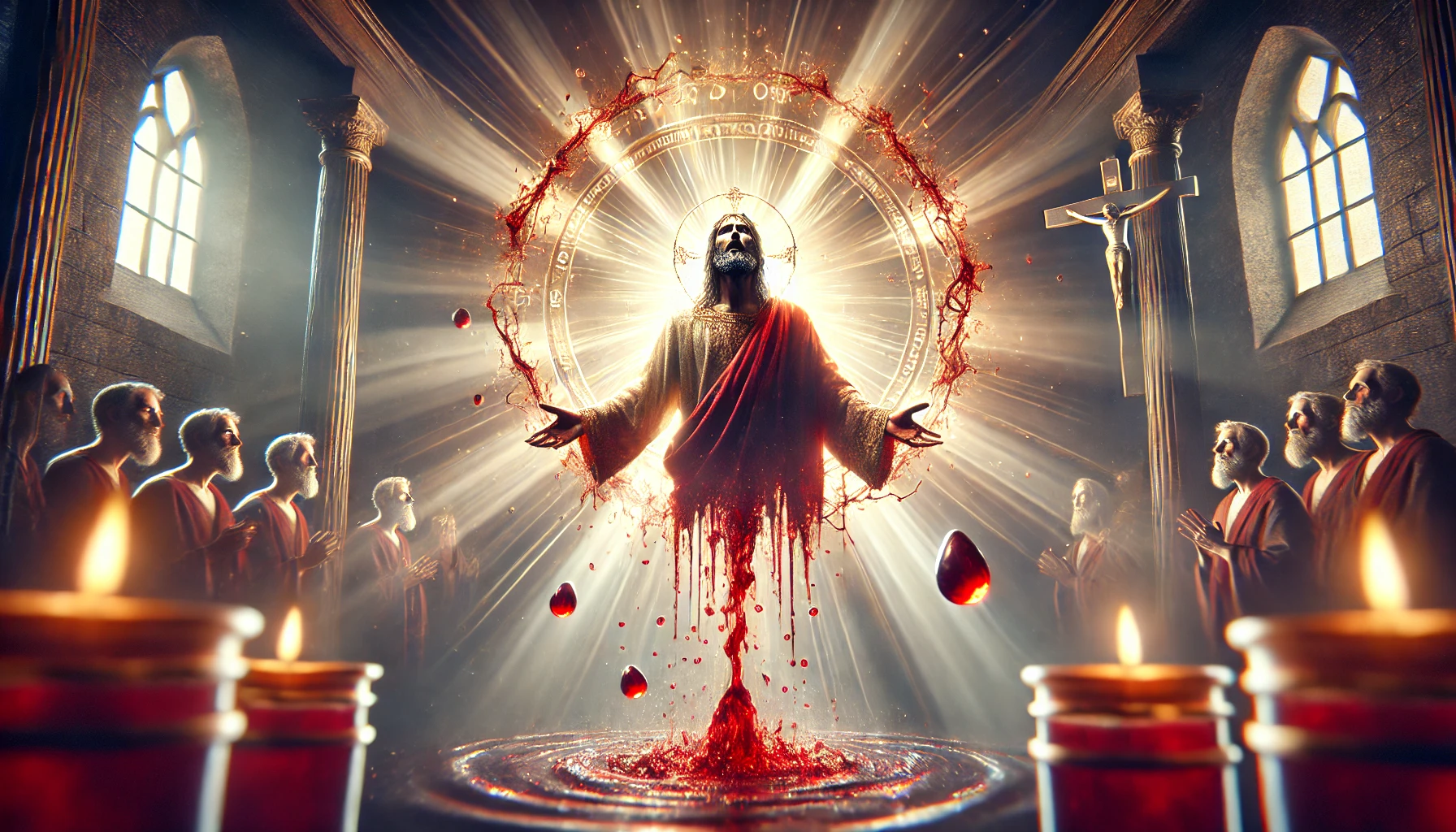
The blood sacrifices in the Old Testament were a shadow pointing to the reality of Jesus’ sacrifice, as the animal blood could not actually take away sins permanently. At his first coming, Jesus established a new covenant through shedding his blood to atone for sins, however, this atonement did not free people from continuing to sin. The full effect of Jesus’ blood to free people from sin itself will happen at the Second Coming when the kingdom of God arrives. Those present at the Second Coming who are part of the 144,000 and the great multitude will be freed from their sins, purchased from slavery to sin, have their robes washed in the blood, and overcome Satan by the blood and their testimony. This group will gather on Mount Zion to welcome God’s kingdom. They will form the new heaven and new earth, the 12 tribes of spiritual Israel, living in a sinless state. The urgency is to strive to be among those present at the Second Coming to experience the full atoning power of Jesus’ blood to be freed from sin permanently.
Today, we have an important lesson to cover. I pray that everyone’s hearts are open and ready to receive the seed of this message.
Remember the parable Jesus told about the four types of fields? It represents the odds for those hearing the secrets of the kingdom of heaven. Only 25% truly receive the word. Strive to be part of that 25% who hear these words and act on them. Satan’s goal is to stop you from progressing, using any means necessary – your thoughts, heart, children, work, finances, or health. His aim is to make you return to your old ways, not God’s way, so he can devour another person. Don’t let that be you.
Just because you’re hearing this word now, among others who haven’t, doesn’t mean you’ll be the only ones. Many more will hear these words after you. They’ll look at you and ask, “How did you believe before anyone else knew? How did you survive during that difficult time?” You’ll respond, “It was very hard, but I overcame not through my own strength, power, or understanding – for those led me nowhere in the past – but through God’s grace. That’s how I’m here, and that’s how you are here now.”
Maintain that mindset of determination and overcoming, whatever Satan might throw your way. We can do it.
We’ll learn more about Jesus’s blood and how it takes full effect in the time of the second coming.
This lesson will help us understand the fulfilment of prophecy and the true meaning of hope. It’s crucial to keep our hearts open and not be led astray by false teachings. As we study the word, we must be prepared to flee from lies and cling to what is true. This time, this era, is significant, and many things that were once sealed are now being opened to us.
The Effect of Jesus’ Blood That Atones Sin
Heb 10
Hebrews 10:1-18, serves as our main reference chapter today. This chapter is crucial for understanding the application of Jesus’s sacrifice to us and distinguishing it from pre-Jesus era sacrifices.
Daily lesson review and Memorization are essential practices. Memory verses help in better understanding God’s word, aid memorization, and improve retention. God’s word needs to be beyond Bible pages – it must be in our hearts and minds. This is fundamental to keeping the new covenant, which requires writing God’s law in our minds and hearts. It’s not busy work but a divine requirement to prevent forgetting His words.
When the Spirit helps retrieve exactly needed verses from our “storeroom” of memorized scripture, it creates beautiful moments. This happens through studying and memorizing the word, then the Spirit reminds us at the right time, allowing us to pull out the exact verse needed. However, if we don’t store God’s word within us, the Spirit finds an empty storeroom, leading us to speak from our own thoughts rather than God’s truth. This could mislead others instead of guiding them correctly.
Intermediate level is more profound than parables, requiring deeper understanding of God’s logic. Therefore, home blessings and reviews are not mere assignments or box-checking exercises, but essential covenant requirements.
Our hope is to be those purchased by Jesus’ blood at the time of the second coming.
Purchasing here means to be freed from sin, because we are enslaved to sin.
So in order to be bought from our slaver, which is Satan, who binds us in the chains of sin, Jesus’ blood is what breaks those chains and frees us from that. But at the time of the second coming, there will be people who will be permanently freed from their sins, meaning they will no longer sin. Because for the last 2,000 years, although Jesus’ blood washes and atones for our sin, we still sin.
And I’m sure we’ve wondered why that happens. Hey, I’ve accepted Jesus as my Lord and my Savior, yet I still struggle with sin. What’s going on?
I’m sure we’ve had that thought before. There’s a reason for that. We’ll talk about that today too.
1.- God’s Purpose
ONE – The Fall of Satan
God’s purpose truly began with the initial fall of the fallen angel. Ezekiel 28 and Isaiah 14 discuss Satan’s fall. God did not create the angel called the Morning Star, who was a guardian cherub, with the intention that he would fall or become evil. This misconception misleads people into thinking God has nefarious intentions, which is false. The appearance of this evil spirit prompts God’s work of redemption. The evil spirit’s main goal is to lead the world astray, pulling it away from God.
TWO – Restore What was Lost
The evil spirit starts by targeting God’s first pastor. To better understand this, sin was established or confirmed by the one to whom God had given the word. Although Eve ate the fruit first, Adam also ate it. Because God had given the word and covenant to Adam, we are in this position today.
After Adam’s sin, God’s mission became restoration, to restore what was lost. This is God’s purpose.
THREE – At the Second Coming
How will God accomplish this at the time of the second coming?
- Capture the dragon.
- The Holy City, New Jerusalem, will come to the new heaven and new earth for those waiting for him. (The new heaven and new earth represent the 12 tribes.)
- God will reign.
God’s reign means God’s rest, the Sabbath. For the last 6,000 years, God has been unable to rest. As Jesus said, “God has been at his work to this very day, and I too am working.”
How does God carry out this work? What tool does he use to proclaim and fulfill his work? He uses prophecy and fulfillment, which are detailed in the Bible.
Let’s not forget the basics: The Bible is the primary source for understanding God’s work.
John 1:1 | 2 Tim 3:16-17, 2 Pe 1:20-21
In the beginning was the Word, and the Word was with God, and the Word was God.
The Word and God, who is Spirit, are one and the same. There is no distinction between them. All Scripture is God-breathed and is useful for teaching, instructing, correcting, and training in righteousness.
Scripture did not come about by man’s own interpretation. Instead, men of God wrote as they were being guided by the Holy Spirit. The Word is God and comes from God.
There is no separation between the two. When you approach the true Word of God, you are approaching the true God. Wherever the Word is present, God is also present.
You cannot separate the Word from God. If the Word of God is not in a place, even if people there claim to have faith in God, God will not be present. This is because God is always with His Word.
God is always with His Word, not just with lip service. It is not about mere words spoken without true belief.
13 The Lord says: “These people come near to me with their mouth and honor me with their lips, but their hearts are far from me. Their worship of me is made up only of rules taught by men. 14 Therefore once more I will astound these people with wonder upon wonder; the wisdom of the wise will perish, the intelligence of the intelligent will vanish.”
Isaiah 29:13-14
God said, “They honor me with their mouth, with their lips, but their heart is far from me.” This means God is not with such people. Instead, He will astound them when the time comes.
The wisdom and intelligence established in that era will vanish. It will seem like pennies compared to the full wealth that God’s true Word will bring when these words are fulfilled. This prophecy was fulfilled at the time of Jesus’ first coming, as He constantly stunned people with His words.
People often became silent after Jesus spoke. Those who spoke boldly before Jesus would have nothing else to say and walk away. The same logic will apply at the second coming.
God will bring wonder upon wonder, shaming the wisdom and intelligence of the time by His grace. This is not to destroy people, but so that all can come to a knowledge of the truth together, united. God is tired of division.
Because we had fallen, God had to begin the work of atoning for our sins. Sin is so egregious to God that it is essentially death. They are one and the same: “The one whose spirit sins dies.”
Sin and death are tightly connected, just as God and His Word are tightly connected.
2.- Blood at the Old Testament
So, in order to atone for death-like sin, God needs something powerful, and that is the blood.
ONE – God first Establishes a Covenant (Law) → Leads to Atonament
5 Now if you obey me fully and keep my covenant, then out of all nations you will be my treasured possession. Although the whole earth is mine, 6 you will be for me a kingdom of priests and a holy nation.’ These are the words you are to speak to the Israelites.”
Exodus 19:5-6
To initiate atonement, God first establishes a covenant. Within this covenant, God provides specific instructions that the recipients must follow to achieve atonement.
Generally, a covenant leads to atonement because of the detailed requirements it contains. The covenant God gave was delivered through Moses. We recently learned about Moses’ role, which was similar to that of Jesus and New John. What was Moses’ role?
Moses was the advocate, the counselor in the Old Testament era. You could also call him a mediator.
This covenant was given through Moses to physical Israel. It detailed the specific actions the Israelites needed to perform for the atonement of their sins. Let’s examine Leviticus 9:3 to see the details God provided about what they needed to do.
Then say to the Israelites: ‘Take a male goat for a sin offering, a calf and a lamb—both a year old and without defect—for a burnt offering,
Leviticus 9:3, 8-11
It is important to take a male goat for a sin offering, along with a calf and a lamb. Both the calf and lamb should be a year old and without defect. This detail is significant.
When selecting a lamb or calf, ensure it is young, specifically one year of age. Additionally, it must be free from any defects. Remember this requirement.
Once you have chosen the appropriate lamb or goat, offer it as a burnt offering. The blood from this offering is to be used. Why is this necessary?
For the life of a creature is in the blood, and I have given it to you to make atonement for yourselves on the altar; it is the blood that makes atonement for one’s life.
Leviticus 17:11
The blood from the lamb was placed on the priest, his sons, and the altar. But why blood? Because the life of a creature is in the blood, and God has given it to make atonement for people on the altar.
It is the blood that makes atonement for one’s life. Amen.
What does sin equal? Death.
So what is needed to atone for death? Life.
The life is for the atonement of sin. Therefore, blood was required.
This was during the time of the Old Testament. This was the law that people had to keep and follow.
At the time of the first coming, were people still required to sacrifice a lamb? Are we as Christians today still required to sacrifice lambs? No.
Things change, and let’s understand why.
Reminder:
– Blood = Life (Lv 17:11) → Atonement of sin
– Sin = Death
TWO – Law is a shadow → Lead to Reality
The law is only a shadow of the good things that are coming—not the realities themselves. For this reason it can never, by the same sacrifices repeated endlessly year after year, make perfect those who draw near to worship. 2 If it could, would they not have stopped being offered? For the worshipers would have been cleansed once for all, and would no longer have felt guilty for their sins. 3 But those sacrifices are an annual reminder of sins, 4 because it is impossible for the blood of bulls and goats to take away sins.
Hebrews 10:1-4
The writer of Hebrews is a topic of debate among Christians. While many believe it to be Paul, there are those who suggest it might be John. Typically, books of the Bible identify their authors, often at the beginning, but this is not the case with Hebrews. However, the book contains subtle clues about the writer’s identity.
In Hebrews 5:12-14, we find an interesting passage: “In fact, though by this time you ought to be teachers, you need someone to teach you the elementary truths of God’s word all over again. You need milk, not solid food.”
Now, let’s consider 1 Corinthians 3, which we know was written by Paul. This connection raises an intriguing point about the possible authorship of Hebrews.
Brothers, I could not address you as spiritual but as worldly—mere infants in Christ. 2 I gave you milk, not solid food, for you were not yet ready for it. Indeed, you are still not ready.
1 Corinthians 3:1-2
Apostle Paul is considered the writer of Hebrews, as the same words and logic are used in both books. Moving forward, I will refer to the author as Apostle Paul instead of “the Hebrews.”
In Hebrews 10:1-4, Paul discusses important details. He begins by stating that the law is only a shadow, not the reality. This means that the actions required of the Israelites were not the actual means of achieving permanent atonement. Instead, these actions pointed to the real thing that would bring permanent atonement.
It doesn’t make sense for people to continue practicing these shadow-like rituals after the reality appears. Paul and the other apostles and disciples were trying to help people understand that the past practices pointed to Christ, who is the reality of what God asked them to do. These practices are no longer necessary.
The reason for this is that animal sacrifices could not atone for sins. They couldn’t take away sins, but God hid his plan of atonement within the physical acts he required. God’s plan of atonement was embedded in the law because he was thinking about the one he would send – someone equivalent to a young lamb without defect, whose blood would permanently atone for people’s sins.
However, since Jesus wouldn’t arrive for many years after the law was established, people needed to do something in the meantime. The law’s ultimate purpose was to serve as a yearly reminder of sins and the need for repentance. God had them perform these rituals year after year to remind them of their actions and their need to repent. The blood of the lamb was used as a reminder of how God would bring permanent atonement later.
Some people understood this at the time, but many couldn’t grasp it and continued with the rituals and practices of their ancestors without truly understanding why they were doing them in the first place.
Reminder:
– Law = Shadow (not reality)
– Sacrifice: Couldn’t take away sins
– God: Hide His plan of atonement in the law
– Reminder of sins!
3.- Blood at the First Coming
TREE – The Reality → Jesus
5 Therefore, when Christ came into the world, he said: “Sacrifice and offering you did not desire, but a body you prepared for me; 6 with burnt offerings and sin offerings you were not pleased. 7 Then I said, ‘Here I am—it is written about me in the scroll— I have come to do your will, O God.’”
Hebrews 10:5-7
The depth of this topic is significant. During the time of Jesus’ first coming, he spoke about himself in a specific way. In Hebrews 10:5-7, we find a reference to blood at the first coming.
The passage states, “Therefore, when Christ came into the world, he said…” Jesus was essentially quoting Psalms 40:6-8, as noted in the footnote of many Bibles.
Verse 5 continues: “Sacrifice and offerings you did not desire, but a body you prepared for me. With burnt offerings and sin offerings, you were not pleased. Then I said, here I am.”
It is written about Jesus in the scroll: “I have come to do your will, O Lord.” This refers to the sacrifice of the lamb.
The burnt offerings of that era were a shadow, a figurative representation. The prophecy in Psalms 40:6-8 foretells that just as lambs were prepared for sacrifice during the yearly atonement, a body would be prepared for the permanent sacrifice for all people.
Thus, we have the shadow (the lamb and burnt offering) prophesying about the reality. Jesus represents that reality, being the body prepared for fulfillment of the prophecy.
Passover | Ex 12:7-8,13, Jn 1:29, 1 Cor 5:7
Jesus represented the lamb in all ways it was used in the law. He symbolized the yearly sacrificial lamb for atonement and the lamb used to deliver people from Egypt. The initial Passover was also a symbol for Jesus and his future actions.
In Exodus chapter 12, instructions were given for the Passover to protect against the angel of death. People had to eat the lamb’s flesh and put its blood on their door frames to save their firstborn sons. These actions pointed to Jesus, who was the reality of that flesh and blood. At Jesus’ first coming, people were required to eat his flesh and blood, which were his words. Jesus is words of life.
Jesus was the bread from heaven. In every way a lamb was used in the Old Testament, Jesus represented the physical reality of those things. Or you could say the spiritual reality in physical form. The words of Jesus, who is life, were the flesh and blood people needed to eat.
People weren’t making this connection. When they looked at Jesus, they didn’t see the slain lamb. They just saw a person, a guy making claims. When he was on the cross, they mocked him, saying, “If you’re who you say you are, come down from that cross.” They didn’t know Jesus couldn’t, and that he was dying for them.
They had no clue and didn’t make the connection. But those with spiritual eyes could see that this was the lamb they were waiting for – the one to permanently take away the world’s sins. They saw him dying on the cross for them.
We’ll explore how this applies to the time of the second coming and the things Jesus did to set this up.
FOUR – Establishing something New
8 First he said, “Sacrifices and offerings, burnt offerings and sin offerings you did not desire, nor were you pleased with them” (although the law required them to be made). 9 Then he said, “Here I am, I have come to do your will.” He sets aside the first to establish the second. 10 And by that will, we have been made holy through the sacrifice of the body of Jesus Christ once for all. 11 Day after day every priest stands and performs his religious duties; again and again he offers the same sacrifices, which can never take away sins. 12 But when this priest had offered for all time one sacrifice for sins, he sat down at the right hand of God. 13 Since that time he waits for his enemies to be made his footstool, 14 because by one sacrifice he has made perfect forever those who are being made holy.
Hebrews 10:8-14
Let’s examine verses 8-14 in detail.
One, God was not pleased with the old sacrifices. Nevertheless, He required people to perform them to remember their sins, though these sacrifices couldn’t remove sins.
It was figurative. What did God do? He said, “Here I am. I have come to do your will.” He set aside the first to establish the second. By this will, we have been made holy through the sacrifice of Jesus’ body once for all.
How did Jesus establish His body? What covenant was used to set aside the first and establish the second?
Let’s delve deeper into this.
The first instructions people had to follow came from the first or old covenant. Jesus came to establish something new, as the first was set aside to establish the second.
In fact, it’s the new covenant that Jesus established in His blood that atones for sin. Jesus’ blood establishes our holiness.
There is no holiness apart from Jesus’ blood. His blood was far greater than the physical blood of a lamb, which was like the law or old covenant that could not atone for sins. The old covenant or the law couldn’t atone for sins, but Jesus’ blood could.
God was hoping His people would see this and realize what He asked them to do was ultimately fulfilled by Jesus. Paul ensured that people made the connection between who Jesus was and what He accomplished.
When was the new covenant, the second that surpassed the first, established? Luke 22:14-20 tells us it was on the night of Passover. It wasn’t an accident that Jesus waited until that time to establish His new covenant with His disciples. He wanted them to understand, without a doubt, the connection between the Passover from 1500 years prior and Himself as the Passover lamb.
Jesus establishes a new covenant for the permanent atonement of sin. In this covenant, established in His blood, we turn to Luke 22:20 to look at what Jesus said that’s so important.
In the same way, after the supper he took the cup, saying, “This cup is the new covenant in my blood, which is poured out for you.
Luke 22:20
“This cup is the new covenant in my blood, which is poured out for you.” This is what Jesus said.
Jesus’ blood establishes the new covenant. The new covenant and Jesus’ blood are closely connected.
Jesus also made some important statements about this covenant that we should consider.
16 For I tell you, I will not eat it again until it finds fulfillment in the kingdom of God.” 17 After taking the cup, he gave thanks and said, “Take this and divide it among you. 18 For I tell you I will not drink again of the fruit of the vine until the kingdom of God comes.”
Luke 22:16-18
Jesus said He would not drink of the fruit of the vine again until the kingdom of God comes. This represents an important prophecy.
PROMISE (Prophecy)
The prophecy states that Jesus won’t eat or drink until the kingdom of God comes. This gives us a clue that the fulfilment of Jesus’ sacrifice occurs at the time of the second coming.
The blood had to be spilled 2,000 years ago, but it is complete 2,000 years later when the kingdom of God comes, and Jesus is able to eat and drink again in the kingdom.
The kingdom of God is a critical part of all this coming together, referring to the blood of Jesus that could atone for sins and make us holy. Jesus’ blood takes full effect at the time of the second coming.
FULFILLMENT – Revelation is the New Covenant
The fulfilment happens in the second coming, which is detailed in the book of Revelation. Therefore, Revelation is the new covenant.
Jesus told his disciples, “I have much more to tell you, more than you can now bear, but a time will come when I will tell you. Though I’ve been speaking figuratively, a time is coming when I will no longer use this kind of language, but I will tell you plainly.” That time is the second coming, when the kingdom of God comes.
Let’s examine how the kingdom of God comes and how the blood applies then, at the time of the second coming.
FIVE – Take Part of the New Covenant
15 The Holy Spirit also testifies to us about this. First he says: 16 “This is the covenant I will make with them after that time, says the Lord. I will put my laws in their hearts, and I will write them on their minds.” 17 Then he adds: “Their sins and lawless acts I will remember no more.” 18 And where these have been forgiven, there is no longer any sacrifice for sin.
Hebrews 10:15-18
The Holy Spirit speaking here is God’s Spirit. We know this from Jeremiah 31, where it’s clearly God speaking.
God says, “I will put my law in their minds and write it on their hearts.” This refers not to the old law, but a new law—a new covenant.
Paul elaborates on this in Hebrews 8:10-13, explaining how the new covenant makes the old obsolete.
The repetition of this quote indicates it’s meant for a future time. When this law is put in people’s minds and hearts, they will become God’s people.
So, who are the ones that take part in this new covenant?
4.- Blood at the Second Coming
We will now focus on the time of Revelation.
We are going to read several important verses. However, before we delve into Revelation, we will first turn our attention to Hebrews 9:28. This verse will help us understand why these events must occur during the time of the second coming.
Take Away Sins
so Christ was sacrificed once to take away the sins of many people; and he will appear a second time, not to bear sin, but to bring salvation to those who are waiting for him.
Hebrews 9:28
- The first coming of Jesus had a specific job: for his blood to take away sins.
- The second coming also has a job: to bring salvation to those who are waiting.
This raises two important questions: Who are the ones who are waiting? And where are they waiting?
Salvation at the Second Coming
5 and from Jesus Christ, who is the faithful witness, the firstborn from the dead, and the ruler of the kings of the earth. To him who loves us and has freed us from our sins by his blood, 6 and has made us to be a kingdom and priests to serve his God and Father—to him be glory and power for ever and ever! Amen.
Revelation 1:5-6
To him who loved us and has freed us from our sins by his blood.
The blood of Jesus has many roles at the second coming:
1.- It will free from sins.
Who will be freed from their sins? The kingdom and priests.
At the second coming, those who are part of the kingdom and priests will be freed from their sins. While Jesus’ sacrifice at the first coming took away our sins, at the second coming, it will free us from our sins. Although these may seem similar, there is a distinction.
Taking away sins, as Paul mentioned in Hebrews 10, refers to the forgiveness of sins committed. Being free from sins, as described in Revelation, means no longer committing sins. At this time, people will cease to sin.
It’s noteworthy that in the early verses of Hebrews 10, Paul suggests that if it were possible for the sacrifice of lambs to take away sins and stop people from sinning, they wouldn’t need to continue offering sacrifices. However, this wasn’t possible then.
At the time of the second coming, when Jesus is able to eat and drink again in the kingdom of God, his flesh and blood – which represent his words, the open word – will make it possible for people to be freed from their sins.
2.- Purchases from their slavery to sin.
9 And they sang a new song: “You are worthy to take the scroll and to open its seals, because you were slain, and with your blood you purchased men for God from every tribe and language and people and nation. 10 You have made them to be a kingdom and priests to serve our God, and they will reign on the earth.”
Revelation 5:9-10
Hebrews 1:5-6 and Hebrews 5:9-10 are essentially the same verses. Hebrews 1:5-6 serves as a summary, while Hebrews 5:9-10 provides a more detailed explanation.
Jesus’ blood purchases a kingdom and priests, freeing them from their slavery to sin.
3.- Wash their robes with heart, actions and doctrines
What about those who wash their robes?
13 Then one of the elders asked me, “These in white robes—who are they, and where did they come from?” 14 I answered, “Sir, you know.” And he said, “These are they who have come out of the great tribulation; they have washed their robes and made them white in the blood of the Lamb.
Revelation 7:13-14
Those who become the great multitude, coming out of the great tribulation, will wash their robes with Jesus’ blood.
Robes represent heart, actions, and doctrines. These will be washed, as clothes symbolize in Revelation 19:8.
Heart, actions, and doctrines will be cleansed. However, to establish a kingdom and priests waiting for Christ’s return on Mount Zion, something must occur first. When the holy city, New Jerusalem, descends and reunites, and the kingdom of God arrives, they will be fully freed from sins, purchased, and have their robes washed.
Before this can happen, remember that Satan is still present, destroying things and leading people astray. Therefore, he must be fought and overcome.
4.- Overcome with the blood of the Lamb and the Word of Testimony
They overcame him by the blood of the Lamb and by the word of their testimony; they did not love their lives so much as to shrink from death.
Revelation 12:11
Satan and his group are overcome by the male child and his group, who are his brothers. They hold the iron scepter, and Michael in heaven is fighting alongside them in the same war.
They overcame with the blood of the Lamb, which is the word, and the word of testimony. This means, “This is what we have seen. This is what we have heard.”
It’s like saying, “This is what you did. This is who you are. This is how you did it according to Revelation.”
They are stating, “You are the reality of these people. You are the reality of these people.” We ask, “We? We are the betrayers? What do you mean they’re saying that we are the destroyers? You are the reality of these verses.”
Ah, it becomes clear. With the blood of the Lamb and the word of their testimony, they were able to overcome Satan and the dragon.
Exposing Satan
Overcoming means exposing. When we expose where Satan is working, he will no longer be effective in that place. This is what Jesus did when he said, “Take heart, for I have overcome the world” in John 16:33. Which world did he overcome? Satan and his Pharisees by exposing them.
In Matthew 23, Jesus demonstrated how he overcame them, and how we can overcome too. The people who overcome by the blood of the Lamb and the word of their testimony have an important job to do.
Building the New Heaven and New Earth
These overcomers have a crucial task: to build the New Heaven and New Earth, where heaven is coming to. They build it together with New John, who represents the male child. His brothers are those who witness the events with him and help build Mount Zion, the 12 tribes.
New John is the one who ate the open scroll and testified to what he saw and heard. This is how we eat these words:
- It starts with God.
- God gives it to Jesus.
- Jesus gives it to the mighty angel, the spirit of truth, the counselor.
- The angel gives that word to John, who eats it and testifies to the servants.
- Those servants come out of Babylon and gather on the mountain.
We should be excited to gather, as it’s not only Class hearing these words, but many people.
The blood of the Lamb is shed for those who gather at the second coming. It takes full effect for them, freeing them from sin. They will be the fulfillment of Revelation 1, 5, 7, and 12.
This gathering won’t be limited to a small group. All nations will gather – 144,000 and a great multitude. Those who have already died are rooting for us to come here, as their goal is to return. Don’t worry about the people of the past; God has a plan for them. Focus on us today.
We need to be at this place where these events are happening. Being fully freed from sin and never committing sin again, sounds awesome. Imagine a great multitude of people who no longer sin – consider the effect that would have on the world.
These sinless people will be able to do anything, including healing all nations. They will question past behaviors and promote better ways of living. It will be a beautiful time that no mind has seen and no ear has heard.
Memorization
5 and from Jesus Christ, who is the faithful witness, the firstborn from the dead, and the ruler of the kings of the earth. To him who loves us and has freed us from our sins by his blood, 6 and has made us to be a kingdom and priests to serve his God and Father—to him be glory and power for ever and ever! Amen.
Revelation 1:5-6
Let’s Us Discern
Analyzing SCJ Lesson 87: The Effect of Jesus’ Blood That Atones Sin
A Comprehensive Analysis Using “Testing Shincheonji’s Claims: Two Lenses, One Story”
Introduction: When Biblical Truth Becomes a Setup
Imagine sitting in a Bible study about Jesus’ blood—one of the most precious truths in Christianity. The instructor teaches about Old Testament sacrifices, explains Hebrews 10, and emphasizes the power of Christ’s atonement. Everything sounds orthodox, biblical, even worshipful.
But then, subtly, the lesson shifts:
- “For the last 2,000 years, although Jesus’ blood washes and atones for our sin, we still sin”
- “At the time of the second coming, there will be people who will be permanently freed from their sins, meaning they will no longer sin”
- “The Tree of Life remains at Second Coming: New John and 12 Tribes”
- “Our hope is to be those purchased by Jesus’ blood at the time of the second coming”
Wait—what just happened? We started with the finished work of Christ and ended with the implication that full salvation only comes through a second coming event involving “New John and 12 Tribes.”
This is SCJ Lesson 87, and it demonstrates what Chapter 8 of “Testing Shincheonji’s Claims: Two Lenses, One Story” calls “The Shifting Standards of Salvation”—taking biblical doctrine and subtly adding requirements that undermine the sufficiency of Christ’s work.
Let’s carefully examine this lesson, distinguishing biblical truth from organizational doctrine.
Part 1: The Solid Foundation – Jesus’ Blood and Atonement
What SCJ Says:
The lesson begins with excellent biblical teaching:
On the Old Testament sacrificial system:
“The blood from the lamb was placed on the priest, his sons, and the altar. But why blood? Because the life of a creature is in the blood, and God has given it to make atonement for people on the altar.”
On the shadow vs. reality:
“The law is only a shadow of the good things that are coming—not the realities themselves… Paul and the other apostles and disciples were trying to help people understand that the past practices pointed to Christ, who is the reality of what God asked them to do.”
The Two Lenses Analysis:
What’s Biblical:
- Blood represents life (Leviticus 17:11)
- OT sacrifices were required for atonement (Leviticus 16)
- The law was a shadow pointing to Christ (Hebrews 10:1)
- Jesus is the reality the shadows pointed to (Colossians 2:17)
- Christ’s sacrifice is superior to animal sacrifices (Hebrews 9:11-14)
What’s Being Set Up (The Subtle Shift):
- The emphasis on “at the time of the second coming” regarding full atonement
- The implication that Jesus’ blood hasn’t fully accomplished its purpose yet
- The setup that something more is needed beyond Christ’s finished work
Biblical Affirmation:
Yes, the Old Testament sacrificial system pointed to Christ. This is absolutely biblical.
Hebrews 9:11-14:
“But when Christ came as high priest of the good things that are now already here, he went through the greater and more perfect tabernacle that is not made with human hands, that is to say, is not a part of this creation. He did not enter by means of the blood of goats and calves; but he entered the Most Holy Place once for all by his own blood, thus obtaining eternal redemption. The blood of goats and bulls and the ashes of a heifer sprinkled on those who are ceremonially unclean sanctify them so that they are outwardly clean. How much more, then, will the blood of Christ, who through the eternal Spirit offered himself unblemished to God, cleanse our consciences from acts that lead to death, so that we may serve the living God!”
Key phrase: “once for all… thus obtaining eternal redemption.”
Hebrews 10:10:
“And by that will, we have been made holy through the sacrifice of the body of Jesus Christ once for all.”
Hebrews 10:14:
“For by one sacrifice he has made perfect forever those who are being made holy.”
This is the gospel: Jesus’ sacrifice was sufficient, complete, and final.
The Psychological Setup:
As Chapter 4 of “Testing Shincheonji’s Claims: Two Lenses, One Story” explains, this is “establishing an interpretive framework.” By starting with undeniable biblical truth (Jesus fulfilled OT sacrifices), the lesson creates credibility for what comes next—the suggestion that Jesus’ work needs completion at the second coming.
Part 2: The Problem Statement – “We Still Sin”
What SCJ Says:
“Our hope is to be those purchased by Jesus’ blood at the time of the second coming. Purchasing here means to be freed from sin, because we are enslaved to sin.”
“But at the time of the second coming, there will be people who will be permanently freed from their sins, meaning they will no longer sin. Because for the last 2,000 years, although Jesus’ blood washes and atones for our sin, we still sin.”
“And I’m sure we’ve wondered why that happens. Hey, I’ve accepted Jesus as my Lord and my Savior, yet I still struggle with sin. What’s going on? I’m sure we’ve had that thought before. There’s a reason for that. We’ll talk about that today too.”
The Two Lenses Analysis:
What’s Biblical:
- Christians do struggle with sin (Romans 7:14-25)
- We are in a process of sanctification (Philippians 1:6)
- We look forward to glorification when we’ll be free from sin’s presence (1 John 3:2)
What’s Uniquely SCJ:
- The implication that Jesus’ blood hasn’t fully accomplished redemption yet
- The suggestion that “permanent freedom from sin” only comes at the second coming through a specific event/organization
- The framing that current Christian experience is somehow deficient or incomplete
- The setup that there’s a “reason” for ongoing sin that requires special revelation to understand
Biblical Refutation:
Let’s address the question: “Why do Christians still sin if Jesus’ blood atones for sin?”
This is actually a profound theological question with a biblical answer that doesn’t require SCJ’s framework.
The Biblical Understanding of Salvation (Three Tenses):
1. JUSTIFICATION – We Have Been Saved (Past)
Romans 5:1:
“Therefore, since we have been justified through faith, we have peace with God through our Lord Jesus Christ.”
Ephesians 2:8-9:
“For it is by grace you have been saved, through faith—and this is not from yourselves, it is the gift of God—not by works, so that no one can boast.”
We are already saved from sin’s penalty. This is a completed work.
2. SANCTIFICATION – We Are Being Saved (Present)
Philippians 2:12-13:
“Therefore, my dear friends, as you have always obeyed—not only in my presence, but now much more in my absence—continue to work out your salvation with fear and trembling, for it is God who works in you to will and to act in order to fulfill his good purpose.”
2 Corinthians 3:18:
“And we all, who with unveiled faces contemplate the Lord’s glory, are being transformed into his image with ever-increasing glory, which comes from the Lord, who is the Spirit.”
We are being saved from sin’s power. This is an ongoing process.
3. GLORIFICATION – We Will Be Saved (Future)
Romans 8:23:
“Not only so, but we ourselves, who have the firstfruits of the Spirit, groan inwardly as we wait eagerly for our adoption to sonship, the redemption of our bodies.”
1 John 3:2:
“Dear friends, now we are children of God, and what we will be has not yet been made known. But we know that when Christ appears, we shall be like him, for we shall see him as he is.”
We will be saved from sin’s presence. This is our future hope.
Why Christians Still Sin:
Romans 7:18-25 (Paul’s own struggle):
“For I know that good itself does not dwell in me, that is, in my sinful nature. For I have the desire to do what is good, but I cannot carry it out. For I do not do the good I want to do, but the evil I do not want to do—this I keep on doing… What a wretched man I am! Who will rescue me from this body that is subject to death? Thanks be to God, who delivers me through Jesus Christ our Lord!”
Paul—an apostle!—struggled with sin. But notice his conclusion: “Thanks be to God, who delivers me through Jesus Christ our Lord!”
The answer to ongoing sin is not a second coming event or special organization—it’s Jesus Christ.
1 John 1:8-10:
“If we claim to be without sin, we deceive ourselves and the truth is not in us. If we confess our sins, he is faithful and just and will forgive us our sins and purify us from all unrighteousness. If we claim we have not sinned, we make him out to be a liar and his word is not in us.”
Christians sin because we still live in fallen bodies in a fallen world. But we have ongoing forgiveness through Christ’s blood.
1 John 2:1-2:
“My dear children, I write this to you so that you will not sin. But if anybody does sin, we have an advocate with the Father—Jesus Christ, the Righteous One. He is the atoning sacrifice for our sins, and not only for ours but also for the sins of the whole world.”
The Dangerous Implication:
By suggesting that “permanent freedom from sin” only comes at the second coming through their organization, SCJ:
- Undermines the sufficiency of Christ’s work – Implies His sacrifice wasn’t complete
- Creates ongoing spiritual anxiety – “Am I really saved if I still sin?”
- Establishes organizational dependency – “I need this group for full salvation”
- Sets up false hope – “If I join the right organization, I’ll stop sinning”
This is what Chapter 8 of “Testing Shincheonji’s Claims: Two Lenses, One Story” calls “The Shifting Standards of Salvation”—adding requirements beyond faith in Christ alone.
Part 3: The Tree of Life Returns – Organizational Salvation
What SCJ Says:
From the “Review” section:
“When Jesus arrived with his 12 disciples, they became the new Tree of Life at the first coming, as a tree ultimately represents both a person and an organization.”
“However, Jesus ascended to heaven, and his disciples passed away. Once again, the Tree of Life disappeared.”
“The Tree of Life is promised to return, and this time it will remain forever, not just for a short period.”
Reminder box states:
“Tree of Life remains at Second Coming: New John and 12 Tribes”
The Two Lenses Analysis:
What’s Biblical:
- Jesus is the way to eternal life (John 14:6)
- The tree of life appears in Genesis and Revelation (Genesis 2:9, Revelation 22:2)
- Jesus had 12 disciples
- Believers are called to bear fruit (John 15:5)
What’s Uniquely SCJ:
- The equation: Tree of Life = an organization (Jesus + 12 disciples)
- The claim that the Tree of Life “disappeared” after the apostles died
- The assertion that the Tree of Life “returns” as “New John and 12 Tribes” (SCJ organization)
- The implication that access to eternal life requires connection to this organization
Biblical Refutation:
This is one of SCJ’s most fundamental distortions. Let’s examine what Scripture actually teaches:
Jesus IS the Tree of Life:
John 14:6:
“Jesus answered, ‘I am the way and the truth and the life. No one comes to the Father except through me.'”
John 11:25-26:
“Jesus said to her, ‘I am the resurrection and the life. The one who believes in me will live, even though they die; and whoever lives by believing in me will never die.'”
John 6:47-51:
“Very truly I tell you, the one who believes has eternal life. I am the bread of life… I am the living bread that came down from heaven. Whoever eats this bread will live forever. This bread is my flesh, which I will give for the life of the world.”
Jesus doesn’t just lead to the tree of life—He IS eternal life.
Did the Tree of Life “Disappear”?
Matthew 28:20:
“And surely I am with you always, to the very end of the age.”
Jesus promised to be with His followers always. He didn’t disappear.
Hebrews 13:8:
“Jesus Christ is the same yesterday and today and forever.”
John 14:16-17:
“And I will ask the Father, and he will give you another advocate to help you and be with you forever—the Spirit of truth. The world cannot accept him, because it neither sees him nor knows him. But you know him, for he lives with you and will be in you.”
The Holy Spirit came at Pentecost and has been with the church ever since. The “tree of life” (access to God through Christ) never disappeared.
The Church – Christ’s Body:
Ephesians 1:22-23:
“And God placed all things under his feet and appointed him to be head over everything for the church, which is his body, the fullness of him who fills everything in every way.”
1 Corinthians 12:27:
“Now you are the body of Christ, and each one of you is a part of it.”
The church is all believers in Christ, not one specific organization. Jesus is the head; we are His body. This has been true since Pentecost and will continue until Christ returns.
Access to the Tree of Life:
Revelation 22:14:
“Blessed are those who wash their robes, that they may have the right to the tree of life and may go through the gates into the city.”
How do we wash our robes?
Revelation 7:14:
“These are they who have come out of the great tribulation; they have washed their robes and made them white in the blood of the Lamb.”
Access to the tree of life comes through the blood of Jesus, not through joining an organization.
The Organizational Equation:
SCJ’s framework:
- First Coming: Tree of Life = Jesus + 12 disciples (organization)
- After Apostles: Tree of Life disappeared
- Second Coming: Tree of Life = New John + 12 Tribes (SCJ organization)
Biblical framework:
- Jesus IS eternal life (John 14:6)
- Jesus is always present through the Holy Spirit (Matthew 28:20)
- The church is all believers in Christ (Ephesians 1:22-23)
- Salvation is through Christ alone, not organizational membership (Acts 4:12)
This is what Chapter 6 of “Testing Shincheonji’s Claims: Two Lenses, One Story” calls “Consistent Narrative vs. Selective Narrative”—creating a pattern that sounds logical but contradicts Scripture.
Part 4: God’s Purpose and the Second Coming Setup
What SCJ Says:
God’s Purpose:
- The Fall of Satan – “God’s purpose truly began with the initial fall of the fallen angel”
- Restore What was Lost – “After Adam’s sin, God’s mission became restoration”
- At the Second Coming:
- Capture the dragon
- The Holy City, New Jerusalem, will come to the new heaven and new earth (the 12 tribes)
- God will reign
The lesson states:
“God’s reign means God’s rest, the Sabbath. For the last 6,000 years, God has been unable to rest.”
The Two Lenses Analysis:
What’s Biblical:
- Satan did fall (Isaiah 14:12-15, Ezekiel 28:12-17)
- Adam’s sin brought death (Romans 5:12)
- God is working to redeem humanity (2 Peter 3:9)
- Satan will be defeated (Revelation 20:10)
- There will be a new heaven and new earth (Revelation 21:1)
- God will dwell with His people (Revelation 21:3)
What’s Uniquely SCJ:
- The parenthetical equation: “(The new heaven and new earth represent the 12 tribes)”
- The implication that God’s rest depends on a specific organizational structure
- The framework that God’s 6,000-year work culminates in SCJ’s “12 tribes”
- The subtle suggestion that God’s purpose is incomplete until SCJ’s organization is established
Biblical Refutation:
On Satan’s Defeat:
Colossians 2:15:
“And having disarmed the powers and authorities, he made a public spectacle of them, triumphing over them by the cross.”
Jesus already defeated Satan at the cross. Yes, Satan still operates (1 Peter 5:8), but his ultimate defeat is certain and was accomplished at Calvary.
1 John 3:8:
“The one who does what is sinful is of the devil, because the devil has been sinning from the beginning. The reason the Son of God appeared was to destroy the devil’s work.”
Jesus appeared to destroy the devil’s work—past tense, accomplished.
On God’s Rest:
Genesis 2:2-3:
“By the seventh day God had finished the work he had been doing; so on the seventh day he rested from all his work. Then God blessed the seventh day and made it holy, because on it he rested from all the work of creating that he had done.”
God rested after creation. The “rest” God offers isn’t about His own exhaustion—it’s about entering His rest through faith.
Hebrews 4:9-11:
“There remains, then, a Sabbath-rest for the people of God; for anyone who enters God’s rest also rests from their works, just as God did from his. Let us, therefore, make every effort to enter that rest, so that no one will perish by following their example of disobedience.”
God’s rest is available now to those who believe. It’s not waiting for an organizational structure to be established.
On the New Heaven and New Earth:
Revelation 21:1-4:
“Then I saw ‘a new heaven and a new earth,’ for the first heaven and the first earth had passed away, and there was no longer any sea. I saw the Holy City, the new Jerusalem, coming down out of heaven from God, prepared as a bride beautifully dressed for her husband. And I heard a loud voice from the throne saying, ‘Look! God’s dwelling place is now among the people, and he will dwell with them. They will be his people, and God himself will be with them and be their God. He will wipe every tear from their eyes. There will be no more death or mourning or crying or pain, for the old order of things has passed away.'”
Notice what this describes:
- A literal cosmic renewal – “the first heaven and the first earth had passed away”
- God dwelling with His people – Not an organizational structure
- No more death, mourning, crying, or pain – This hasn’t happened yet
To claim “the new heaven and new earth represent the 12 tribes” (meaning SCJ’s organizational structure) is to:
- Spiritualize what should be literal – The new creation is a real, future event
- Apply it to an organization – Making SCJ the fulfillment of cosmic renewal
- Claim it’s already here – When clearly death, mourning, crying, and pain still exist
This is what Chapter 26 of “Testing Shincheonji’s Claims: Two Lenses, One Story” addresses—“Reading Revelation Like a First-Century Christian” means understanding the original intent, not imposing modern organizational structures onto apocalyptic imagery.
Part 5: The “Purchased by Jesus’ Blood at the Second Coming” Framework
What SCJ Says:
“Our hope is to be those purchased by Jesus’ blood at the time of the second coming.”
“Purchasing here means to be freed from sin, because we are enslaved to sin. So in order to be bought from our slaver, which is Satan, who binds us in the chains of sin, Jesus’ blood is what breaks those chains and frees us from that.”
“But at the time of the second coming, there will be people who will be permanently freed from their sins, meaning they will no longer sin.”
The Two Lenses Analysis:
What’s Biblical:
- We were slaves to sin (Romans 6:17)
- Jesus’ blood redeems us (Ephesians 1:7)
- We are purchased/bought by Christ (1 Corinthians 6:20)
- We look forward to complete freedom from sin (Romans 8:23)
What’s Uniquely SCJ:
- The timing: “purchased by Jesus’ blood at the time of the second coming“
- The implication that redemption isn’t complete until the second coming event
- The suggestion that only certain people (“those purchased”) receive full freedom
- The framework that connects this to their organizational structure
Biblical Refutation:
When Were We Purchased?
1 Corinthians 6:19-20:
“Do you not know that your bodies are temples of the Holy Spirit, who is in you, whom you have received from God? You are not your own; you were bought at a price. Therefore honor God with your bodies.”
Past tense: “you were bought.” This already happened at the cross.
1 Peter 1:18-19:
“For you know that it was not with perishable things such as silver or gold that you were redeemed from the empty way of life handed down to you from your ancestors, but with the precious blood of Christ, a lamb without blemish or defect.”
We were redeemed by Christ’s blood—past tense, completed action.
Ephesians 1:7:
“In him we have redemption through his blood, the forgiveness of sins, in accordance with the riches of God’s grace.”
“We have redemption”—present possession, not future hope.
Colossians 1:13-14:
“For he has rescued us from the dominion of darkness and brought us into the kingdom of the Son he loves, in whom we have redemption, the forgiveness of sins.”
“He has rescued us” and “brought us”—past tense. This is accomplished.
The Already/Not Yet Tension:
Yes, there’s a biblical tension between what’s already true and what’s not yet fully realized:
Already:
- We are redeemed (Ephesians 1:7)
- We are justified (Romans 5:1)
- We are children of God (1 John 3:1)
- We have eternal life (John 5:24)
- We are seated with Christ in heavenly places (Ephesians 2:6)
Not Yet:
- We await the redemption of our bodies (Romans 8:23)
- We will be like Christ when He appears (1 John 3:2)
- We will receive glorified bodies (1 Corinthians 15:42-44)
- We will be completely free from sin’s presence (Revelation 21:4)
But notice: The “not yet” is about glorification at Christ’s return, not about joining an organization or receiving special knowledge.
Romans 8:29-30:
“For those God foreknew he also predestined to be conformed to the image of his Son, that he might be the firstborn among many brothers and sisters. And those he predestined, he also called; those he called, he also justified; those he justified, he also glorified.”
This is God’s work, from beginning to end. Not organizational membership.
Part 6: The Subtle Shift – From Christ’s Work to Organizational Necessity
How the Lesson Moves:
- Start with biblical truth – OT sacrifices pointed to Christ ✓
- Affirm Christ’s superiority – Jesus’ sacrifice is better than animals ✓
- Introduce a problem – “But we still sin” ✓
- Suggest incompleteness – Jesus’ blood hasn’t fully accomplished its purpose yet ✗
- Offer the solution – Full freedom comes at the second coming through “New John and 12 Tribes” ✗
The Psychological Technique:
As Chapter 4 of “Testing Shincheonji’s Claims: Two Lenses, One Story” explains, this is “The Impact of Interpretive Frameworks”:
- Create dissatisfaction – “You still sin, don’t you? Isn’t that frustrating?”
- Validate the struggle – “We’ve all wondered why this happens”
- Promise answers – “There’s a reason for that. We’ll talk about that today”
- Provide the solution – “At the second coming, through our organization, you’ll be permanently freed”
This creates:
- Spiritual anxiety – “Maybe I’m not really saved”
- Dependency – “I need this group to complete my salvation”
- Hope in the wrong place – “If I stay faithful to this organization, I’ll finally be free from sin”
The Biblical Response:
Philippians 1:6:
“Being confident of this, that he who began a good work in you will carry it on to completion until the day of Christ Jesus.”
God will complete the work He started. Not an organization. God.
Jude 24-25:
“To him who is able to keep you from stumbling and to present you before his glorious presence without fault and with great joy—to the only God our Savior be glory, majesty, power and authority, through Jesus Christ our Lord, before all ages, now and forevermore! Amen.”
Jesus is able to keep us from stumbling and present us faultless. We don’t need an organizational mediator.
1 Thessalonians 5:23-24:
“May God himself, the God of peace, sanctify you through and through. May your whole spirit, soul and body be kept blameless at the coming of our Lord Jesus Christ. The one who calls you is faithful, and he will do it.”
“He will do it.” Not we will do it by joining the right group. He will do it.
Part 7: The Word and God – A True Teaching Twisted
What SCJ Says:
“In the beginning was the Word, and the Word was with God, and the Word was God. The Word and God, who is Spirit, are one and the same. There is no distinction between them.”
“You cannot separate the Word from God. If the Word of God is not in a place, even if people there claim to have faith in God, God will not be present. This is because God is always with His Word.”
“God is always with His Word, not just with lip service. It is not about mere words spoken without true belief.”
The Two Lenses Analysis:
What’s Biblical:
- John 1:1 – The Word was God
- God’s word is powerful and active (Hebrews 4:12)
- God’s word accomplishes His purposes (Isaiah 55:11)
- We should not just hear the word but do it (James 1:22)
What’s Being Set Up:
- The implication that “where the Word is” means “where correct interpretation is”
- The suggestion that churches without SCJ’s teaching don’t have God’s presence
- The framework that God’s presence is tied to doctrinal precision (as defined by SCJ)
- The setup for claiming SCJ has the true “Word” while others have mere “lip service”
Biblical Refutation:
Yes, John 1:1 says “the Word was God.” But let’s read the full context:
John 1:1-5, 14:
“In the beginning was the Word, and the Word was with God, and the Word was God. He was with God in the beginning. Through him all things were made; without him nothing was made that has been made. In him was life, and that life was the light of all mankind. The light shines in the darkness, and the darkness has not overcome it… The Word became flesh and made his dwelling among us. We have seen his glory, the glory of the One and Only, who came from the Father, full of grace and truth.”
The Word is JESUS CHRIST, not a set of doctrines or interpretations.
Where is God Present?
Matthew 18:20:
“For where two or three gather in my name, there am I with them.”
God is present wherever believers gather in Jesus’ name, not exclusively where one organization’s interpretation is taught.
John 4:23-24:
“Yet a time is coming and has now come when the true worshipers will worship the Father in the Spirit and in truth, for they are the kind of worshipers the Father seeks. God is spirit, and his worshipers must worship in the Spirit and in truth.”
True worship is in Spirit and truth, not in organizational affiliation.
Colossians 1:27:
“To them God has chosen to make known among the Gentiles the glorious riches of this mystery, which is Christ in you, the hope of glory.”
Christ in you—not “correct interpretation in your organization.”
The Dangerous Implication:
By tying God’s presence to “the Word” (meaning their interpretation), SCJ creates a framework where:
- God is only present in SCJ – Other churches are just “lip service”
- Doctrinal precision = God’s presence – You must have the right interpretation
- Leaving SCJ = leaving God – If you leave, you lose God’s presence
- SCJ becomes the mediator – Access to God requires their teaching
This contradicts 1 Timothy 2:5:
“For there is one God and one mediator between God and mankind, the man Christ Jesus.”
Not one God and one organization. One mediator: Jesus Christ.
Part 8: The Memory Verse Emphasis – Control Through Information Overload
What SCJ Says:
“Daily lesson review and Memorization are essential practices. Memory verses help in better understanding God’s word, aid memorization, and improve retention.”
“God’s word needs to be beyond Bible pages – it must be in our hearts and minds. This is fundamental to keeping the new covenant, which requires writing God’s law in our minds and hearts.”
“When the Spirit helps retrieve exactly needed verses from our ‘storeroom’ of memorized scripture, it creates beautiful moments.”
“However, if we don’t store God’s word within us, the Spirit finds an empty storeroom, leading us to speak from our own thoughts rather than God’s truth.”
The Two Lenses Analysis:
What’s Biblical:
- Scripture memory is valuable (Psalm 119:11)
- God’s word should be in our hearts (Deuteronomy 6:6)
- The Holy Spirit brings Scripture to mind (John 14:26)
- We should meditate on God’s word (Joshua 1:8)
What’s Uniquely SCJ (The Control Mechanism):
- The pressure to memorize extensive material
- The implication that without their specific verses memorized, the Spirit can’t work
- The guilt if you don’t keep up with memorization requirements
- The information overload that prevents critical thinking
The Psychological Technique:
As Chapter 5 of “Testing Shincheonji’s Claims: Two Lenses, One Story” might explain, this is “thought reform through information control”:
- Overwhelming amount of material – Students must memorize verses, lessons, interpretations
- Constant review required – “Daily lesson review and memorization are essential”
- Guilt for not keeping up – “The Spirit finds an empty storeroom”
- No time for outside input – Too busy memorizing to research or question
This creates:
- Mental exhaustion – Too tired to think critically
- Dependency – “I need the class notes to understand”
- Isolation – No time for other Christian input
- Compliance – Easier to accept than to question
Biblical Balance:
Yes, Scripture memory is good. But notice what the Bible emphasizes:
Psalm 119:11:
“I have hidden your word in my heart that I might not sin against you.”
The purpose is holiness, not information accumulation.
Deuteronomy 6:6-9:
“These commandments that I give you today are to be on your hearts. Impress them on your children. Talk about them when you sit at home and when you walk along the road, when you lie down and when you get up. Tie them as symbols on your hands and bind them on your foreheads. Write them on the doorframes of your houses and on your gates.”
The emphasis is on living God’s word, not just memorizing it.
James 1:22-25:
“Do not merely listen to the word, and so deceive yourselves. Do what it says. Anyone who listens to the word but does not do what it says is like someone who looks at his face in a mirror and, after looking at himself, goes away and immediately forgets what he looks like. But whoever looks intently into the perfect law that gives freedom, and continues in it—not forgetting what they have heard, but doing it—they will be blessed in what they do.”
Doing the word is more important than memorizing interpretations.
The Warning:
2 Timothy 3:7:
“Always learning but never able to come to a knowledge of the truth.”
It’s possible to be constantly studying, memorizing, and learning, but never actually knowing the truth because you’re learning the wrong things or from the wrong source.
Part 9: Testing the Claims – Questions to Ask
As Chapter 27 of “Testing Shincheonji’s Claims: Two Lenses, One Story” emphasizes, “Your Investigation Begins” with asking good questions:
About Jesus’ Blood and Atonement:
- If Jesus said “It is finished” on the cross (John 19:30), what more needs to be accomplished?
- If we “have been made holy through the sacrifice of the body of Jesus Christ once for all” (Hebrews 10:10), why do we need a second coming event for full atonement?
- If “by one sacrifice he has made perfect forever those who are being made holy” (Hebrews 10:14), how can His work be incomplete?
About the Tree of Life:
- If Jesus said “I am with you always, to the very end of the age” (Matthew 28:20), how did the Tree of Life “disappear”?
- If Jesus IS the way, the truth, and the life (John 14:6), how can an organization be the Tree of Life?
- If access to the tree of life comes through washing robes in the blood of the Lamb (Revelation 7:14, 22:14), how does organizational membership provide access?
About Salvation and Sin:
- If “there is now no condemnation for those who are in Christ Jesus” (Romans 8:1), why the anxiety about still sinning?
- If “he who began a good work in you will carry it on to completion” (Philippians 1:6), why do we need an organization to complete it?
- If Christians throughout 2,000 years have been saved by faith in Christ, why is something more needed now?
About God’s Presence:
- If “where two or three gather in my name, there am I with them” (Matthew 18:20), why is God only present in one organization?
- If “Christ in you” is “the hope of glory” (Colossians 1:27), why do we need organizational membership for God’s presence?
- If the Holy Spirit indwells all believers (Romans 8:9), why must He work exclusively through one group?
Part 10: The Heart of the Gospel – Finished vs. Incomplete
What SCJ Presents:
A gospel where:
- Jesus’ blood atones, but not completely (yet)
- We’re saved, but not fully (until the second coming through their organization)
- The Tree of Life disappeared and returns (as SCJ)
- God’s rest awaits organizational completion
- Full freedom from sin requires the right group
What Scripture Presents:
IT IS FINISHED:
John 19:30:
“When he had received the drink, Jesus said, ‘It is finished.’ With that, he bowed his head and gave up his spirit.”
Hebrews 10:12-14:
“But when this priest had offered for all time one sacrifice for sins, he sat down at the right hand of God, and since that time he waits for his enemies to be made his footstool. For by one sacrifice he has made perfect forever those who are being made holy.”
He sat down – The work is complete.
WE ARE COMPLETE IN CHRIST:
Colossians 2:9-10:
“For in Christ all the fullness of the Deity lives in bodily form, and in Christ you have been brought to fullness. He is the head over every power and authority.”
Ephesians 1:3:
“Praise be to the God and Father of our Lord Jesus Christ, who has blessed us in the heavenly realms with every spiritual blessing in Christ.”
Every spiritual blessing – not some now, more later through an organization.
WE HAVE ETERNAL LIFE NOW:
John 5:24:
“Very truly I tell you, whoever hears my word and believes him who sent me has eternal life and will not be judged but has crossed over from death to life.”
1 John 5:11-13:
“And this is the testimony: God has given us eternal life, and this life is in his Son. Whoever has the Son has life; whoever does not have the Son of God does not have life. I write these things to you who believe in the name of the Son of God so that you may know that you have eternal life.”
“So that you may KNOW” – not wonder, not hope, not maybe if you join the right group – KNOW.
Conclusion: The Sufficiency of Christ
Lesson 87 starts with beautiful biblical truth about Jesus’ blood and atonement. But it subtly undermines that truth by suggesting:
- Jesus’ work isn’t complete yet
- Full salvation requires a second coming event through a specific organization
- Christians for 2,000 years have had incomplete redemption
- The Tree of Life disappeared and returns as SCJ
This is what the Apostle Paul warned about:
Galatians 3:1-3:
“You foolish Galatians! Who has bewitched you? Before your very eyes Jesus Christ was clearly portrayed as crucified. I would like to learn just one thing from you: Did you receive the Spirit by the works of the law, or by believing what you heard? Are you so foolish? After beginning by means of the Spirit, are you now trying to finish by means of the flesh?”
You began with Christ. Don’t try to finish with an organization.
Colossians 2:8:
“See to it that no one takes you captive through hollow and deceptive philosophy, which depends on human tradition and the elemental spiritual forces of this world rather than on Christ.”
As Chapter 21 of “Testing Shincheonji’s Claims: Two Lenses, One Story” beautifully articulates, “The Heart of God” is not a God who gives partial salvation, requiring organizational membership to complete it. It’s a God who:
Romans 8:32:
“He who did not spare his own Son, but gave him up for us all—how will he not also, along with him, graciously give us all things?”
If God gave us His Son, He’s given us everything.
For Those Studying with SCJ:
If you’re being taught that:
- Jesus’ blood hasn’t fully accomplished redemption yet
- You need organizational membership for complete salvation
- The Tree of Life is SCJ’s structure
- Christians for 2,000 years have been incomplete
Please consider:
- Jesus said “It is finished” – Not “It will be finished when you join the right organization”
- You are complete in Christ (Colossians 2:10) – Not incomplete until the second coming
- Eternal life is a present possession (1 John 5:13) – Not a future hope dependent on organizational affiliation
- Test everything (1 Thessalonians 5:21) – Including teachings that add requirements to the gospel
You don’t need an organization to complete what Christ finished. You need Jesus.
Hebrews 7:25:
“Therefore he is able to save completely those who come to God through him, because he always lives to intercede for them.”
Completely. Through Him. Always.
For Family and Friends:
If someone you love is being taught that Jesus’ work is incomplete without SCJ:
- Gently remind them of “It is finished” (John 19:30)
- Ask questions about what more Jesus needs to do
- Emphasize the sufficiency of Christ (Colossians 2:9-10)
- Share the assurance Scripture gives (1 John 5:13)
- Pray for them to see the completeness of Christ’s work
Chapter 28 of “Testing Shincheonji’s Claims: Two Lenses, One Story” provides detailed guidance for “Hope and Help – Guidance for Members, Families, Christians, and Pastors.”
Additional Resources:
For more detailed refutation of SCJ teaching on:
- The sufficiency of Christ’s atonement
- The Tree of Life imagery
- Salvation and sanctification
- The new covenant
Visit: https://closerlookinitiative.com/shincheonji-examination
The Shincheonji Examination section provides comprehensive resources for understanding and responding to Shincheonji’s teachings.
Final Thoughts:
The blood of Jesus is precious, powerful, and sufficient.
1 Peter 1:18-19:
“For you know that it was not with perishable things such as silver or gold that you were redeemed from the empty way of life handed down to you from your ancestors, but with the precious blood of Christ, a lamb without blemish or defect.”
Hebrews 9:14:
“How much more, then, will the blood of Christ, who through the eternal Spirit offered himself unblemished to God, cleanse our consciences from acts that lead to death, so that we may serve the living God!”
Revelation 1:5-6:
“To him who loves us and has freed us from our sins by his blood, and has made us to be a kingdom and priests to serve his God and Father—to him be glory and power for ever and ever! Amen.”
Has freed us – past tense, completed action.
Don’t let anyone tell you that Jesus’ blood needs organizational assistance to accomplish its purpose.
His blood is enough.
“Testing Shincheonji’s Claims: Two Lenses, One Story” – Available for those seeking to understand and respond to SCJ teaching with truth, love, and biblical clarity.
For more resources: https://closerlookinitiative.com/shincheonji-examination
Outline
Unlocking the Power of Jesus’ Blood: A Table of Contents
I. Introduction: The Urgency of Understanding
- This section sets the stage, emphasizing the importance of the lesson and the spiritual warfare believers face. It highlights the need to persevere and receive the word with open hearts.
- It introduces the main theme: the transformative effect of Jesus’ blood, particularly at the second coming.
II. Laying the Foundation: Biblical Context
- A. Review: The Two Trees and Their SignificanceBriefly revisits the previous lesson about the Tree of Life and the Tree of Knowledge of Good and Evil, their roles in biblical history, and their connection to Jesus and his disciples.
- B. God’s Purpose: A Threefold PlanOutlines God’s overarching plan:
- ONE: The Fall of Satan and the need for redemption.
- TWO: The mission to restore humanity to its original state.
- THREE: The culmination of God’s work at the second coming.
- C. The Power of God’s Word:Emphasizes the inseparability of God and His Word, highlighting its role in fulfilling prophecy and revealing truth.
- Warns against empty worship and emphasizes the importance of genuine faith rooted in God’s Word.
- D. Sin and Death: A Deadly ConnectionExplains the gravity of sin and its connection to death, setting the stage for the need for atonement.
III. The Blood in the Old Testament: A Shadow of Things to Come
- A. Establishing the Covenant: A Pathway to AtonementExplains how God established a covenant with His people through Moses, outlining specific requirements for atonement.
- Introduces Moses as a prefiguration of Jesus and New John, serving as a mediator and advocate.
- B. The Significance of Blood: Life for AtonementExplores the reason for blood sacrifices in the Old Testament, highlighting its connection to life and its role in atoning for sin (which equates to death).
- C. The Law as a Shadow: Pointing to RealityExplains the limitations of the law and animal sacrifices, emphasizing their symbolic nature as foreshadowing the ultimate atonement through Jesus.
- Highlights the law’s function as a yearly reminder of sin and the need for repentance.
IV. The Blood at the First Coming: Jesus, the Reality
- A. Jesus, the Fulfilled Prophecy:Presents Jesus as the fulfillment of Old Testament prophecies, particularly those relating to the sacrificial lamb.
- B. Passover and its Deeper Meaning:Connects the Passover lamb to Jesus, highlighting his role as the ultimate sacrifice for deliverance and atonement.
- Emphasizes the importance of consuming Jesus’ words (flesh and blood) for spiritual nourishment and life.
- C. Establishing the New Covenant: A Permanent AtonementExplains the transition from the old covenant to the new covenant established by Jesus through his blood.
- Highlights the new covenant’s power to make believers holy and permanently atone for their sins.
- D. The Promise and its Fulfillment:Unveils the prophecy of Jesus’ return and the establishment of the kingdom of God as the fulfillment of the new covenant.
- Identifies the book of Revelation as the detailed account of the new covenant’s fulfillment.
V. The Blood at the Second Coming: Full Effect and Ultimate Victory
- A. Taking Away Sins vs. Freedom from Sin:Distinguishes between the forgiveness of sins at the first coming and the complete liberation from sinning at the second coming.
- B. The Multifaceted Roles of Jesus’ Blood:Outlines the four key functions of Jesus’ blood at the second coming:
- 1. Freedom from Sin: Liberating believers from the power of sin.
- 2. Redemption from Slavery: Purchasing a kingdom and priests freed from sin’s bondage.
- 3. Cleansing and Purification: Washing robes (heart, actions, and doctrines) with Jesus’ blood.
- 4. Overcoming Satan: Exposing and conquering Satan through the blood of the Lamb and the word of testimony.
- C. Building the New Heaven and New Earth:Emphasizes the role of overcomers in constructing the New Jerusalem and establishing God’s kingdom.
- Details the process of receiving and sharing the open word, leading to the gathering of believers on Mount Zion.
- D. A Global Gathering and a Glorious Future:Describes the vastness of the gathering, encompassing a multitude of nations and including those who have passed away.
- Paints a picture of the transformative power of a sinless world and the hope for healing and unity.
VI. Conclusion: A Call to Action
- Re-emphasizes the importance of understanding the effect of Jesus’ blood, both historically and in its future fulfillment.
- Urges students to strive for inclusion in the gathering at the second coming, experiencing the fullness of Jesus’ atoning sacrifice and participating in the establishment of God’s eternal kingdom.
A Study Guide
Understanding the Atonement: A Study Guide
Short-Answer Questions
Instructions: Answer the following questions in 2-3 sentences each.
- Explain the significance of the Tree of Life and the Tree of the Knowledge of Good and Evil in the biblical narrative.
- What is the symbolic connection between Jesus, his disciples, and the Tree of Life?
- How does the blood of animals in Old Testament sacrifices relate to the atonement of sin?
- What is the difference between the “shadow” of the law and the “reality” it points to, according to Hebrews 10?
- How does the Passover lamb foreshadow the sacrifice of Jesus?
- What does it mean to “eat the flesh and blood” of Jesus?
- In what way does Jesus establish a new covenant, and how is it different from the old covenant?
- According to Hebrews 9:28, what is the purpose of Jesus’ second coming?
- How does the blood of Jesus “free from sins” at the second coming, as described in Revelation?
- What is the significance of washing robes in the blood of the Lamb, as mentioned in Revelation 7:14?
Short-Answer Key
- The Tree of Life represents eternal life and God’s presence, while the Tree of the Knowledge of Good and Evil represents choice, sin, and separation from God. The biblical narrative begins with Adam and Eve’s choice to eat from the Tree of Knowledge, causing their fall and the need for redemption.
- Jesus is represented as the “true vine,” the source of life, and his disciples are the “branches” connected to him. Together, they form a symbolic Tree of Life, spreading the word of God and offering life to those who believe.
- The blood of animals symbolizes life, and in Old Testament sacrifices, it served as a temporary atonement for sin. This was based on the principle that life is required to atone for sin, which is equated with death.
- The “shadow” of the law refers to the rituals and sacrifices prescribed in the Old Testament, which were symbolic representations of the true atonement to come. The “reality” they point to is Jesus Christ, whose sacrifice provides the complete and permanent atonement for sin.
- The Passover lamb, sacrificed to save the Israelites’ firstborn sons from the angel of death, foreshadows Jesus’ sacrifice. Just as the lamb’s blood protected the Israelites, Jesus’ blood saves those who believe from eternal death.
- To “eat the flesh and blood” of Jesus is to internalize his words and teachings, which are words of life. This act of spiritual consumption signifies accepting his sacrifice and receiving the life he offers.
- Jesus establishes a new covenant through his blood, symbolized by the cup of wine at the Last Supper. This new covenant is based on grace and forgiveness, written on the hearts of believers through the Holy Spirit. It surpasses the old covenant of law, which relied on external rituals and sacrifices.
- According to Hebrews 9:28, the purpose of Jesus’ second coming is to “bring salvation to those who are waiting for him.” This signifies a complete and permanent salvation, where believers are freed from sin and enter into eternal life with God.
- At the second coming, the blood of Jesus frees believers from sin by removing their inclination to sin. Through the power of the Holy Spirit and the revealed word of God, they will no longer be enslaved to sin but will live in perfect righteousness.
- Washing robes in the blood of the Lamb symbolizes cleansing from sin and being made righteous in God’s eyes. The robes represent a person’s heart, actions, and doctrines, all of which are purified through the atoning sacrifice of Jesus.
Additional Questions
1. Why do we need atonement for sin?
– Satan a fallen angel decieved Adam, who became a sinful being. We are born from the sinful seed of Adam.
2. What is God’s purpose for and plan?
– Capture and dragon (Satan) who deceives and leads the whole world astray.
– Re-Create God’s New kingdom and New People were the problem of Sin is resolved.
– Fulfil the world of Paradise were God comes and reigns forever.
3. What is the reality of the blood of Jesus?
– The words of Jesus who is life.
4. According to the book of Revelation, how can we receive atonement from the blood of Jesus?
– By keep the promises of the Book of Revelation.
Glossary of Key Terms
- Atonement: The act of making amends for sin or wrongdoing. In Christian theology, atonement refers to the reconciliation between God and humanity through the sacrifice of Jesus Christ.
- Blood of the Lamb: A metaphorical term referring to the sacrificial blood of Jesus, which cleanses believers from sin and brings them into a covenant relationship with God.
- Covenant: A binding agreement between two parties, often involving promises and obligations. In biblical context, a covenant is a sacred agreement between God and his people.
- First Coming: The incarnation of Jesus Christ as a human being, marked by his birth, life, ministry, death, and resurrection.
- Great Tribulation: A period of intense suffering and persecution predicted in the book of Revelation, believed to precede the second coming of Christ.
- Kingdom of God: The reign of God, both in the hearts of believers and in the future culmination of God’s plan for creation.
- New Covenant: The covenant established by Jesus through his blood, superseding the old covenant of the law and offering forgiveness of sins and the indwelling of the Holy Spirit.
- New Heaven and New Earth: The future dwelling place of believers, characterized by righteousness, peace, and the presence of God.
- Passover Lamb: The lamb sacrificed by the Israelites on the eve of their exodus from Egypt, its blood serving as a sign of protection from the angel of death. It prefigures the sacrifice of Jesus, the ultimate Passover Lamb.
- Second Coming: The future return of Jesus Christ to earth, marked by judgment, the establishment of God’s kingdom, and the culmination of salvation for believers.
- Shadow/Reality: A concept used in Hebrews to describe the relationship between the Old Testament law and the person of Jesus Christ. The law is seen as a “shadow” pointing to the “reality” of Christ’s atoning sacrifice.
- Tree of Life: A symbol of eternal life and the presence of God, appearing in both the Garden of Eden and the New Jerusalem.
- Tree of the Knowledge of Good and Evil: The tree in the Garden of Eden from which Adam and Eve were forbidden to eat. Eating its fruit represents the choice for sin and separation from God.
- Word of Testimony: The personal witness of believers to the truth of the Gospel and their experience of God’s grace. It is a powerful weapon against the lies of Satan and a vital part of overcoming spiritual battles.
Breakdown
Overview
Overview: The Effect of Jesus’ Blood That Atones Sin
Main Theme: This lesson explores the multifaceted role of Jesus’ blood in God’s plan for humanity, highlighting its power to atone for sins, liberate individuals from sin’s grip, and ultimately establish a sinless kingdom at the second coming.
Key Ideas & Facts:
1. God’s Purpose:
- God’s redemptive work is driven by Satan’s fall and humanity’s subsequent sin.
- God aims to restore what was lost through sin and establish His reign, achieving Sabbath rest.
- This will be accomplished through the fulfillment of prophecy, culminating in the second coming.
2. Blood in the Old Testament:
- The sacrificial system, using the blood of unblemished lambs, served as a foreshadowing of Jesus’ sacrifice.
- The law acted as a “shadow,” pointing to the reality of Christ’s atonement.
- “The law is only a shadow of the good things that are coming—not the realities themselves.” – Hebrews 10:1
- Animal sacrifices couldn’t truly erase sins but served as a yearly reminder of sin and the need for repentance.
3. Blood at the First Coming:
- Jesus, the “Lamb of God,” fulfilled the Old Testament prophecies.
- “Look, the Lamb of God, who takes away the sin of the world!” – John 1:29
- His sacrifice was the ultimate atonement for humanity’s sins.
- His flesh and blood, symbolized by his words, offer spiritual nourishment and life.
- He established a new covenant through his blood, superseding the old law.
- “This cup is the new covenant in my blood, which is poured out for you.” – Luke 22:20
4. Blood at the Second Coming:
- The full effect of Jesus’ blood will manifest at the second coming.
- “And from Jesus Christ, who is the faithful witness, the firstborn from the dead, and the ruler of the kings of the earth. To him who loves us and has freed us from our sins by his blood” – Revelation 1:5-6
- It will free those waiting for Him from the power of sin, enabling them to live sinless lives.
- His blood “purchased” a kingdom of priests who will reign on earth.
- “You have made them to be a kingdom and priests to serve our God, and they will reign on the earth.” – Revelation 5:10
- This kingdom will overcome Satan through the blood of the Lamb and the “word of their testimony.”
- “They overcame him by the blood of the Lamb and by the word of their testimony; they did not love their lives so much as to shrink from death.” – Revelation 12:11
- They will participate in building the New Heaven and New Earth.
5. The Call to Action:
- Urgency is emphasized in preparing for the second coming and joining the sinless kingdom.
- The lesson encourages believers to actively seek understanding and prepare themselves spiritually.
Quotes:
- “Scripture did not come about by man’s own interpretation. Instead, men of God wrote as they were being guided by the Holy Spirit.”
- “God is always with His Word, not just with lip service.”
- “Sin and death are tightly connected, just as God and His Word are tightly connected.”
- “The new covenant and Jesus’ blood are closely connected.”
- “The kingdom of God is a critical part of all this coming together, referring to the blood of Jesus that could atone for sins and make us holy.”
Conclusion:
This lesson emphasizes the centrality of Jesus’ blood in God’s plan, highlighting its past, present, and future significance. It urges believers to recognize the transformative power of Jesus’ sacrifice and strive to be part of the sinless kingdom established at the second coming.
Q&A
Q&A: The Atoning Power of Jesus’ Blood
1. What is the significance of Jesus’ blood in the Bible?
Jesus’ blood plays a central role in God’s plan for redemption. It represents His life given as a sacrifice to atone for the sins of humanity. While the Old Testament used animal sacrifices as a shadow or symbol, Jesus’ blood is the ultimate and permanent sacrifice, fulfilling the law and establishing a new covenant.
2. How does the Old Testament foreshadow the sacrifice of Jesus?
The Old Testament law required animal sacrifices, particularly the blood of a spotless lamb, as a yearly atonement for sins. This act, however, was a temporary solution and served primarily as a reminder of sin. These sacrifices foreshadowed Jesus, the ultimate Lamb of God, whose blood would provide permanent atonement.
3. What is the difference between Jesus taking away our sins and freeing us from sin?
Jesus’ sacrifice at the first coming took away our sins, meaning our past sins are forgiven through His blood. However, we still struggle with sin in our daily lives. At the second coming, Jesus’ blood will free us from sin, meaning we will no longer be enslaved to sin and will live a life completely free from it.
4. How does the new covenant established by Jesus differ from the old covenant?
The old covenant, represented by the law, relied on temporary animal sacrifices and external rituals. The new covenant, established through Jesus’ blood, provides a permanent solution through his sacrifice and the writing of God’s law on our hearts and minds. This new covenant empowers us to live a life pleasing to God, ultimately leading to complete freedom from sin.
5. What role does Revelation play in understanding the atoning power of Jesus’ blood?
Revelation reveals the fulfillment of the new covenant and the ultimate effects of Jesus’ blood. It describes a time when believers will be fully freed from sin, purchased from their slavery to sin, have their robes washed clean, and overcome Satan through the blood of the Lamb and the word of their testimony.
6. Who are those who will experience the full benefits of Jesus’ blood at the second coming?
Those who will experience the full benefits are those who have accepted Jesus as their savior, persevered in their faith, and are actively preparing for His return. This includes two main groups: the 144,000 sealed servants of God and a vast multitude from all nations who have washed their robes white in the blood of the Lamb.
7. How can we prepare ourselves to receive the full benefits of Jesus’ blood?
We prepare by studying God’s Word, deepening our relationship with Him, and striving to live a life of obedience and faithfulness. It’s crucial to understand the prophecies regarding the second coming and actively participate in fulfilling God’s plan, such as sharing the gospel and exposing the works of Satan.
8. What is the ultimate outcome of Jesus’ sacrifice and the shedding of his blood?
The ultimate outcome is the establishment of God’s kingdom on Earth, where sin and death will be eradicated. This kingdom will be populated by those who have been redeemed by Jesus’ blood and are now free to live in eternal peace, joy, and righteousness, fulfilling God’s original purpose for creation.