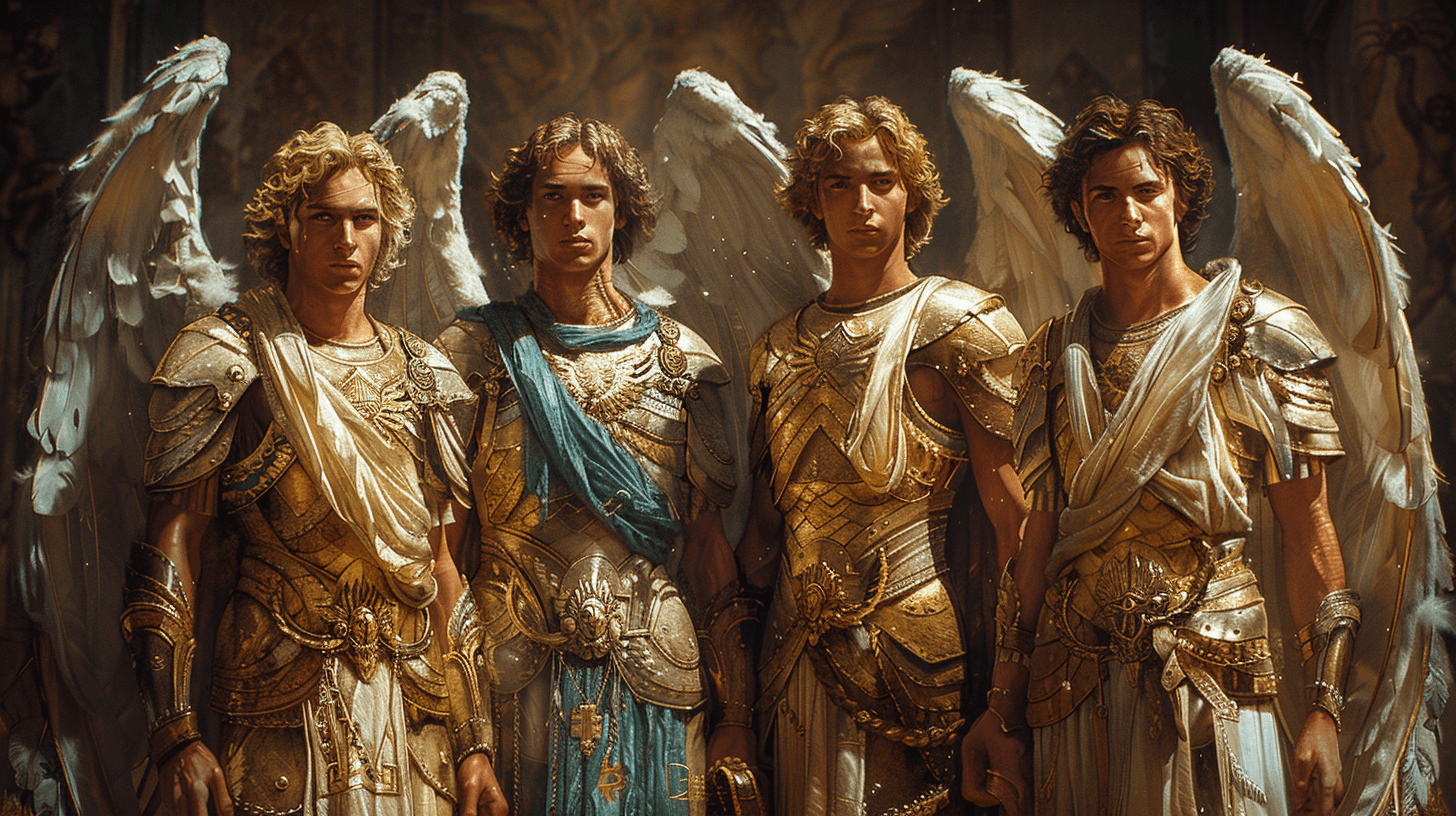
[Lesson 50] Figurative Living Creatures and Winds

by ichthus

The four living creatures represent the four archangels who are commanders in God’s army. They have four faces each – lion, ox, man, and eagle – symbolizing their different roles and duties. The winds represent angels and the judgment they carry out, able to manifest as gentle breezes or powerful storms. John was shown a vision of heaven, like Moses saw to build the tabernacle and Jesus established God’s kingdom, so John can build Mount Zion to mirror heaven with 24 elders, 4 living creatures, 7 lamps/spirits, and 12 gates. The living creatures command the other angels/winds to enact judgment like the sealing of the 144,000 and tribulation of the great multitude. After the sealing, the winds will be released again to bring a great tribulation, from which the multitude will emerge purified. Understanding these symbols is crucial to properly establish God’s kingdom on earth according to the heavenly pattern.

Report – Discernment Study Guide SCJ Bible Study

Shincheonji holds distinct theological views that differ from mainstream Christian denominations, yet it also shares some common teachings. This overlap can sometimes blur the lines between their beliefs and those of traditional Christianity. Therefore, it is essential to exercise critical thinking and discernment to differentiate between these shared elements and the unique doctrines they present.

While their interpretations warrant careful examination through a critical and biblical lens, it is equally important to approach these matters with an open yet discerning mindset.

The following notes were documented in person during Shincheonji’s 9-month Bible Study Seminar. They provide insight into the organization’s approach to introducing and explaining its beliefs to potential new members, often referred to as the ‘harvesting and sealing.’ This process is described as being ‘born again’ or ‘born of God’s seed,’ which involves uprooting the old beliefs and replanting new ones. This uprooting and replanting must occur continuously. By examining this process, we can gain a better understanding of the mindset and beliefs held by Shincheonji members.

Figurative meanings:

Four = Living Creatures: Four Archangels

Wind = Angeles /Judgement

Review with the Evangelist

Memorization

Psalm 119:172

May my tongue sing of your word, for all your commands are righteous.

Yeast of Heaven

God did not give the land of Cannan to those who came out of Egypt for free. What kind of people could enter? God gave that land to those who believed in the promise (Joshua and Caleb).


Our Hope: Let’s be sealed 100% and withstand with faith when winds blow!


Secrets of Heaven: Figurative Living Creatures and Winds

Today’s content is going to be profound and thought-provoking. That’s what we’ll explore today.


We have living creatures, which is parable number one. And we have winds, which is parable number two. These two are actually closely related, as we will examine and discuss today. We have here four living creatures because there are actually four of them.


Take note of the four living creatures, and let’s attempt to understand what the living creatures represent. And also, what do the winds symbolize? What are the living creatures, and what are the winds?


The four living creatures represent the four archangels, and the winds symbolize the angels and the judgment they bring. The term “arch” means leader. For instance, you may have heard of an archbishop, which means the bishop who is in charge of other bishops.


So, the term “arch” signifies a leader or head. Therefore, the four living creatures represent the four head or leader angels. And we’ll see how they have worked throughout the Bible.


Our hope for today is to be sealed 100%, not just 50%, 75%, or even 99%. Let’s strive to be completely sealed and withstand with faith when the winds blow. We’ll talk about that today. In the previous lesson, we looked at the figurative song.

Previous Lesson Review

Review

1. The figurative song represents the word of sermons or whenever someone is speaking from the pulpit or with a Bible in their hand. In a spiritual sense, they are singing God’s words and His laws. However, let us ensure they are singing the right song and discern it carefully.


There is the song of Moses and the song of the Lamb, right? The Old Testament and the New Testament. But there is also the new song.


2. The new song is the gospel of the fulfillment of prophecy, which can only be sung when things have taken place. What are we learning today? So, what should we be learning today?


3. The new song of today is the gospel of the fulfillment of the book of Revelation. The gospel of the fulfillment of the book of Revelation is the new song that we should be hearing in our time.


What does Heaven Look like?

We are about to engage in an enjoyable activity that will require a few minutes of your time. Please take out a separate sheet of paper. On this sheet, you will draw your personal interpretation of what heaven looks like.

You may approach this task from two perspectives: either relying on your own thoughts or adhering to what the Bible says. Which perspective should we prioritize?

Let us explore what the Bible reveals about this matter.

Revelation 4:1-8

1 After this I looked, and there before me was a door standing open in heaven. And the voice I had first heard speaking to me like a trumpet said, “Come up here, and I will show you what must take place after this.” 2 At once I was in the Spirit, and there before me was a throne in heaven with someone sitting on it. 3 And the one who sat there had the appearance of jasper and ruby. A rainbow that shone like an emerald encircled the throne. 4 Surrounding the throne were twenty-four other thrones, and seated on them were twenty-four elders. They were dressed in white and had crowns of gold on their heads. 5 From the throne came flashes of lightning, rumblings and peals of thunder. In front of the throne, seven lamps were blazing. These are the seven spirits[a] of God. 6 Also in front of the throne there was what looked like a sea of glass, clear as crystal.

In the center, around the throne, were four living creatures, and they were covered with eyes, in front and in back. 7 The first living creature was like a lion, the second was like an ox, the third had a face like a man, the fourth was like a flying eagle. 8 Each of the four living creatures had six wings and was covered with eyes all around, even under its wings. Day and night they never stop saying:

“‘Holy, holy, holy

is the Lord God Almighty,’

who was, and is, and is to come.”

Oh, interesting.


How many of us knew a detailed description of what heaven looks like was always in the Bible? Always been there. But because we avoid revelation, we didn’t know.

Or if we have read Revelation a few times, it didn’t come to mind. So by God’s grace, we’re studying revelation now.

So we’re seeing all of these important details. 

So let’s break down each thing that we saw verse by verse. So firstly, who was the one who was called up to see these things?  It was John.


So John goes up in the spirit and he sees this and he writes down a detailed account of what he saw. So what did he see? The first entity he saw was a being seated on a throne that had the appearance of Jasper and Carnelian.


And he had a rainbow encircling him, and that was God. In the next chapter, chapter five, he sees Jesus. We know that Jesus is at the right hand of God.


So God and Jesus are at the center. They are then surrounded by 24 elders wearing 24 crowns. Before the throne, seven lamps are blazing, the seven spirits of God.

There is also a sea of glass, as clear as crystal, flowing from the throne and from the lamp. 


We know water is the word, and the clear word is the sea of glass. And then around the throne are four living creatures, and there’s four of each, each surrounding the throne.


And in Revelation 21, which we’ll get into later, Revelation 21 gives more details about this place. And it mentions that there are 12 gates, 12 gates, three on the north, three on the east, three on the south, and three on the west. So we’ll look at why there are 12 gates in the future.


Very cool. So this is the vision that John saw of heaven. So let’s draw John on the side here.


Hopefully everyone is drawing this with us, right? Please draw this in the best detail that you can. And we see John, who was called up in the spirit, and he sees this.


John sees heaven in the spiritual world. But why is he shown heaven?


We know that God doesn’t do anything by accident, and that everything God does has an intention behind it. Everything God says and the way God says things has an intention behind it, right? So we see that John sees heaven in the spiritual world.


But let’s look at others in the Bible who were also shown heaven, and what God asked them to do. Because what God asked them to do is similar to what God will ask John to do. 


So let’s look at this in a little bit more detail.


Who did God’s will in each era?

Let’s turn to the first person who was shown heaven in the spiritual world. 


Old Testament

Exodus 25:8-9

8 “Then have them make a sanctuary for me, and I will dwell among them. 9 Make this tabernacle and all its furnishings exactly like the pattern I will show you.

ONE God instructed Moses, “You shall make the sanctuary for me.” Why? “So that I may dwell with them.” And what did God say in verse 9? He did not say, “You may make my sanctuary however you like, Moses.” No, he said, “Make it exactly as the pattern I will show you.”


Oh, so every element that Moses built in the Tabernacle has an important equivalent in heaven. For example, what did Moses build in the Tabernacle that had the job of illuminating during the night? A lamp. The lamp that Moses built had a very special look to it. It had branches.


And this is a question for the class. Any idea how many branches that lamp had? Seven. Is it an accident, class, that the lamp he had had seven branches? No, not an accident. Why? Because in heaven, in the spiritual world, there are seven lamps.


So when Moses saw heaven in the spiritual world, he built on earth what he saw. Like this: see, build. See, build. Are we understanding?


So, in Exodus 25:8-9, Moses built the Tabernacle of God so that on earth, there could be a mini replica of heaven, so that God would feel at home when he came to dwell with his people. Does that make sense? 


It’s like if you’re searching for an apartment, you search for weeks or even months to find the one that meets all your specifications.

It needs to have hardwood floors, a dishwasher, easy access to laundry, and someone at the door to collect your mail. And it needs to have this and that.

Or if you’re looking for a house, it needs to be this big with a front yard and a backyard in a neighborhood that’s like this, this close to this. You have very specific specifications. God too.


And God wanted his people to worship at a Tabernacle that was similar to his own. So Hebrews 8:5 says that they worshiped at a Tabernacle that was a copy and a shadow of what was in heaven. Are we understanding?


So that’s why God showed Moses heaven.

Fist Coming

TWO – At the time of Jesus’ first coming, He was the one who saw heaven and built on earth. Jesus had the role of being able to perceive the heavenly realm and establish its principles on the earthly plane. His teachings and actions represented a figurative fulfilment of ancient prophecies, often conveyed through parables. The word He brought was true, in contrast to the lies and false narratives of the world. Jesus offered hope, like a seed planted in fertile soil. His lessons were timely for that era, yet some remained open while others were sealed, awaiting future understanding.

John 5:17-19

17 In his defense Jesus said to them, “My Father is always at his work to this very day, and I too am working.” 18 For this reason they tried all the more to kill him; not only was he breaking the Sabbath, but he was even calling God his own Father, making himself equal with God.

19 Jesus gave them this answer: “Very truly I tell you, the Son can do nothing by himself; he can do only what he sees his Father doing, because whatever the Father does the Son also does.

So what did we see here in John chapter 5? Jesus said some key things here. He said in verse 17, the son can only do what he sees his father doing.


In verse 17, he says, my father is at his work, and I too am working. From the moment Adam sinned, God has been at work. And he has been working to this very day for the goal of the redemption of his creation.


So every person in the Bible has played a key role in getting us one step closer to God’s role of redemption for us. And of course, Jesus played the most important role. And what job did the son have to do?


He said, in verse 19, I tell you the truth, the son can do nothing by himself. He can only do what he sees his father doing, because whatever the father does, the son also does. So like in John 3, John the Baptist said, one who is from above is from above all, and he speaks as one from above.


So Jesus saw also heaven, and then he got to work. And he said things like, repent, for the kingdom of heaven is near. So he was the walking embodiment of heaven.


And so he was heaven on earth, and that’s why he would heal people, and he would speak and people would be changed. So what about the time of the second coming? 

Second Coming

THREE – The era of the second coming represents a figurative fulfilment of the prophecy and parable revealed in the word. Just as John, the apostle, saw a vision of heaven in the spiritual world and recorded it in great detail 2000 years ago, a new John must witness the actual reality of what was previously sealed. 


He must open his eyes to the true vision and not flee from the lies and false hope that the seed of this lesson has been planted. 


In this time, someone must see heaven’s reality and then do on earth what he saw, mirroring the experience of the original John.

Revelation 4:1-2

After this I looked, and there before me was a door standing open in heaven. And the voice I had first heard speaking to me like a trumpet said, “Come up here, and I will show you what must take place after this.” 2 At once I was in the Spirit, and there before me was a throne in heaven with someone sitting on it.

As we read from John’s perspective, he said, “I was taken up in the spirit, and I saw heaven in the spiritual world. And I saw one seated on the throne.”

But why did God show John heaven? Just like Moses and Jesus before him, he was shown so that he could do something with what he now had. How many times have we heard testimonies of someone seeing heaven?


Having a near-death experience and seeing heaven. But how often do their explanations of what they see line up with what we’ve been reading? They often talk about, “I saw light. It felt warm.” Like, okay. But just because someone sees light does not mean they’re seeing God.


Because we know that there is someone who masquerades as an angel of light. Why? Because he used to be one, and he knows how to do it.


So when we’re listening for explanations about heaven, what we need to do is cross-check it with scripture. “Did you see 24 elders? Oh, no? Hmm, okay. You didn’t see heaven then. Did you see four living creatures? Can you describe what they looked like? Oh, okay. Maybe you didn’t see heaven then,” right?


Details matter. That’s why the details are recorded. So why did John see heaven in the spiritual world? So that he could build what he saw on earth. Oh, and where must that work be done? At a place where the lamb also dwells, where people must gather.


And at this place where sealing happens, at this place where 144,000 are sealed and a great multitude gathers, there must be equivalence to what was seen in heaven. This place needs to have 24 elders. 


What is Mount Zion? Yeah, Mount Zion is a church. 


So at this place, there should also be 24 elders. At this place, there should be a replication of the four living creatures, the seven lamps, and the 12 gates, if that is a place that God and Jesus are returning to.


So it must look like heaven in the spiritual world at that place, just like Moses and just like Jesus before. 


Okay, we’ve covered quite a lot here, but now let’s actually get to the lesson because this was just an appetizer. This was just a teaser; we’re just getting started.


1. Physical Characteristics of a Living Creature

A living creature is alive, possessing breath. It is a being with life. Of course, spiritually, to have life, one must have the way, the truth, and the life. They need the word, for the word and the spirit are one. These are the essential characteristics of a living creature, both physically and spiritually.

2. Spiritual (True) Meaning of a Living Creature

Let us now explore the figurative, spiritual meaning that the living creature represents, and truly comprehend how the Bible maintains a consistent unity from beginning to end. We will witness the same concepts appearing throughout the scriptures, affirming its cohesive nature.


Despite having multiple writers, the Bible has one ultimate author.


Let us revisit Revelation chapter four and examine the description of the four living creatures.

Revelation 4:6-8

6 Also in front of the throne there was what looked like a sea of glass, clear as crystal.

In the center, around the throne, were four living creatures, and they were covered with eyes, in front and in back. 7 The first living creature was like a lion, the second was like an ox, the third had a face like a man, the fourth was like a flying eagle. 8 Each of the four living creatures had six wings and was covered with eyes all around, even under its wings. Day and night they never stop saying:

“‘Holy, holy, holy

is the Lord God Almighty,’[a]

who was, and is, and is to come.”

ONE – We observe the four living creatures, and they possess four faces each.

To clarify, each of the four living creatures has all four faces. It’s not a scenario where one creature has a lion’s face, another has a man’s face, another an ox’s face, and yet another an eagle’s face. Instead, each creature possesses all four faces: lion, ox, man, and eagle.

So, we discern a lion’s face, an ox’s face, a man’s face, and an eagle’s face on each of the four living creatures. Intriguing. What do these four faces represent?

Each of these four faces symbolizes the four roles fulfilled by these angels, their four distinct roles. The lion, being the king of the jungle, represents the role of judging beasts.


The ox plows the field, representing the role of labor and cultivation. The man symbolizes reason and intelligence. And the eagle, as the king of birds, represents the pinnacle of avian creatures.

We’ll delve deeper into the significance of these representations when we progress to the intermediate level. 


For now, remember that they symbolize the four duties undertaken by these angels or spirits. 


However, we are currently reading this account in the Book of Revelation, which describes what John witnessed.

We know that the Bible is a unified whole. So, if John witnessed this vision of heaven, shouldn’t there be similar accounts from others in the Bible, corroborating what John saw?

By God’s grace, that is indeed the case.


 Let’s examine another account from someone who lived hundreds of years prior, describing a comparable experience.

Ezekiel 1:4, 10

4 I looked, and I saw a windstorm coming out of the north—an immense cloud with flashing lightning and surrounded by brilliant light. The center of the fire looked like glowing metal,

10 Their faces looked like this: Each of the four had the face of a human being, and on the right side each had the face of a lion, and on the left the face of an ox; each also had the face of an eagle.

TWO – Ah, that’s an intriguing observation. The description you provided seems to align with what John witnessed, doesn’t it? 


Are you suggesting that he perceived the same spiritual entities that John beheld? Indeed, it appears so.

And what were the specific details mentioned? It stated that each of the four living creatures possessed all four faces.

The lion, the ox, the human, and the eagle.


So, John’s vision encompassed the same beings. He, too, witnessed the four living creatures. His experience mirrored that account.


Let us further examine how Ezekiel’s narration offers additional insights while still depicting those same spiritual presences.

Ezekiel 10:12-15

12 Their entire bodies, including their backs, their hands and their wings, were completely full of eyes, as were their four wheels. 13 I heard the wheels being called “the whirling wheels.” 14 Each of the cherubim had four faces: One face was that of a cherub, the second the face of a human being, the third the face of a lion, and the fourth the face of an eagle.

15 Then the cherubim rose upward. These were the living creatures I had seen by the Kebar River.

THREE – Ezekiel actually describes the same angels, referring to them as the living creatures. We now have an additional name for them – cherubs. Cherub is another term used for angels. In this case, they are archangels, as there are four of them.


We’ll examine this in more detail shortly. However, note that Ezekiel is witnessing the same spirits – the lion, the man, the cherub, and the eagle – as described earlier.


So, these beings are called cherubs, living creatures, and angels. Let’s now read an additional passage related to this.

Revelation 6:1-2 (1-8)

I watched as the Lamb opened the first of the seven seals. Then I heard one of the four living creatures say in a voice like thunder, “Come!” 2 I looked, and there before me was a white horse! Its rider held a bow, and he was given a crown, and he rode out as a conqueror bent on conquest.

FOUR – We see here that the four living creatures actually have a duty to fulfill. 

They say, and we only read the first of the four, but the other three also say the same thing. 

They say, “Come.” And then when they say “Come,” a rider on a horse appears, each holding a different thing.

So when they call, these riders appear. The archangels are actually like commanders in God’s army, for they have the ability or the duty to give commands, and the other angels follow.

A white horse appears, then a red horse, followed by a black horse, and finally, a pale horse appears. The reason for this is because God is at war. God has a structure, a hierarchy, an organization as well.


Each of the angels also has specific positions and duties. These four living creatures are like commanders. If we look at the book of Joshua 5:6, Joshua encounters one of these angels.


He asks, “Are you for us or for our enemies?” And the angel says, “Neither, but I am the commander of the Lord’s army.” Then Joshua fell with his face to the ground and worshipped, saying, “What does my Lord have to say to your servant?”


So he meets one of these commanders. Okay, now we’ve learned that they are called living creatures. They’re called cherubs.


They’re commanders. But they’re also called something else too.

Zechariah 6:1-5

I looked up again, and there before me were four chariots coming out from between two mountains—mountains of bronze. 2 The first chariot had red horses, the second black, 3 the third white, and the fourth dappled—all of them powerful. 4 I asked the angel who was speaking to me, “What are these, my lord?”

5 The angel answered me, “These are the four spirits[a] of heaven, going out from standing in the presence of the Lord of the whole world.

FIVE – Zechariah witnessed a vision similar to what Ezekiel and John had seen. It was the same vision.

He saw four chariots, and each chariot had horses resembling those described in Revelation 6. Despite being separated by hundreds of years, these prophets witnessed the same vision. Why? 


Because heaven is eternal and unchanging, and God is one and the same. Therefore, God reveals the same vision to His servants, maintaining consistency throughout the Bible.


The chariots mentioned represent horse-drawn carts used in battle and war, for God has been engaged in a prolonged conflict against Satan for 6,000 years. 


These chariots symbolize the commanders in God’s army, carrying out the battle and war on His behalf.


Quick Review

Quick Review

We have discussed the figurative living creatures and winds. In the first half, we talked about the living creatures, which represent the four archangels. 


These are angels with a special role or duty in heaven. They are commanders in God’s army, leading other angels and winds. However, you may have noticed that these angels are surrounded by and covered with something.


What are they surrounded by and covered with? Eyes. What do the eyes symbolize? You may have seen depictions on social media of what are claimed to be “biblically accurate angels,” showing monstrous creatures.


No, that is incorrect. Those are literal interpretations of what should be understood figuratively, because prophecy is often conveyed through parables.


It is also silly to take such interpretations literally, as in Ezekiel 1, Ezekiel states that they have the appearance of a man. This automatically rules out any monstrous depictions. They have a human-like appearance.


Now, let us explore what the eyes represent.

Revelation 5:6

Then I saw a Lamb, looking as if it had been slain, standing at the center of the throne, encircled by the four living creatures and the elders. The Lamb had seven horns and seven eyes, which are the seven spirits of God sent out into all the earth.

That makes sense. The seven eyes represent the seven spirits who are sent out into all the earth. 


These are the same seven spirits that are also called lamps. Lamps and eyes actually have similar duties. 


Remember when Jesus said the eye is the lamp of the body?


He compares the two together, figuratively. So it makes sense that they represent the same thing. Lamps give light.


And a functioning eye receives light and also has the job to observe and report. 


Remember in the book of Job, where angels would come before God and present themselves, even Satan appeared and did that. 


They present themselves and most likely are giving reports.


What have you done according to my word? There are so many deep things going on in the Bible. Just keep those things in mind.


In Revelation 5, eyes represent spirits. And that makes sense because archangels have other angels around them. So when they say come or go, they go and work.


Does that make sense, everyone? 


They are not monstrosities, but spirits that have the appearance of a man, yet give commands. Figurative language is so important.


If we don’t understand figurative language, then we think literally, and then we think of monsters when it’s actually spirits like that. Okay, so that was really important to mention. Let’s now look at winds.


So let’s first look at the connection between angels and winds.

Hebrews 1:7

In speaking of the angels he says,

“He makes his angels spirits, and his servants flames of fire.”

“He makes his angels winds or spirits, and his servants flames of fire.”


Let’s keep these two points in mind. Angels are likened to winds, and some versions refer to them as spirits. 


If we look at Psalms 1:4, which is quoted in the footnote, we’ll see the connection between angels and winds. And to further reinforce this connection, let’s revisit the book of Zechariah.


In Zechariah 6:5, where it mentions “four spirits,” there is a footnote that also translates it as “winds.”


So, angels are figuratively represented as winds. Why is this? Because they have a duty, a judgment to carry out.

Reminder:

Angels = Winds (Zechariah 6:5)


3. Physical Characteristics of Winds

1. Although you cannot visually perceive wind, you can feel its presence and witness its effects.

2. Winds have a cyclical nature; they blow for a period, and then they become still, ceasing their movement.

3. At times, winds can manifest as a gentle breeze, providing a refreshing and welcome respite on a warm summer day.

4. However, winds can also take the form of powerful storms, such as hurricanes, typhoons, or tornadoes. Much like fire, which can serve as a source of warmth and a means of cooking, but also has the potential to cause devastating destruction in its path.


Or like water, which we consume and utilize for cleansing purposes when contained in a cup, yet can also pose a drowning hazard if one is submerged in it. These natural elements possess dual purposes, capable of both benefiting and harming.


Thus, winds can manifest as either a soothing breeze or a formidable storm.


4. Spiritual (True) Meaning of Winds.

Let us examine the book of Jeremiah, chapter 4, where we will observe how winds are used figuratively to represent judgment. 

Jeremiah 4:11-13

11 At that time this people and Jerusalem will be told, “A scorching wind from the barren heights in the desert blows toward my people, but not to winnow or cleanse; 12 a wind too strong for that comes from me. Now I pronounce my judgments against them.”

13 Look! He advances like the clouds, his chariots come like a whirlwind,

his horses are swifter than eagles. Woe to us! We are ruined!

In the book of Jeremiah, chapter 4, God uses figurative language to represent his judgment upon his people as winds. Jeremiah was often referred to as the weeping prophet because his writings frequently conveyed words of lament.


He authored both the book of Jeremiah and the subsequent book of Lamentations. His writings consistently addressed the impending judgment upon the people, leading him to be known as the weeping prophet. This was due to God’s intense anger during that era.


Jeremiah’s writings foretold the woes that would befall the people. 


The winds symbolize judgment, and the angels are the ones who carry out this judgment.


Let us examine the work of the winds at the time of the second coming.

Reminder: 

Winds = Judgement


5. Work of the Winds at Second Coming

Revelation 6:12-14

12 I watched as he opened the sixth seal. There was a great earthquake. The sun turned black like sackcloth made of goat hair, the whole moon turned blood red, 13 and the stars in the sky fell to earth, as figs drop from a fig tree when shaken by a strong wind. 14 The heavens receded like a scroll being rolled up, and every mountain and island was removed from its place.

We see in the book of Revelation chapter 6, a chapter of judgment, that the sun, moon, and stars go dark and fall. This is similar to what we saw in Matthew 27.


This is actually the same event described in Matthew 24:29-31. The sun, moon, and stars go dark and fall.


The terminology used here is significant: “I watched as he opened the sixth seal, and there was a great earthquake. The sun turned black like sackcloth made of goat hair, and the moon turned blood red. All the stars fell to the earth.”


Pay attention to the key term in verse 13: “And the stars fell to the earth as late figs dropped from a fig tree shaken by a strong wind.”


The winds were blowing, which represents that the sun, moon, and stars were being judged, and as the winds were blowing, they fell from heaven where they were supposed to be.


Remember, when we read Revelation, we should not be thinking of monsters or things like that. 


We should be thinking of words and people, words and people. People, and we’ll look at this very soon.

The sun, moon, and stars represent people who betrayed and are now being judged. So the winds were blowing.


However, the winds don’t always blow in Revelation. There is a time when the winds are stilled.

Revelation 7:1-4

After this I saw four angels standing at the four corners of the earth, holding back the four winds of the earth to prevent any wind from blowing on the land or on the sea or on any tree. 2 Then I saw another angel coming up from the east, having the seal of the living God. He called out in a loud voice to the four angels who had been given power to harm the land and the sea: 3 “Do not harm the land or the sea or the trees until we put a seal on the foreheads of the servants of our God.” 4 Then I heard the number of those who were sealed: 144,000 from all the tribes of Israel.

In Revelation 7:1-4, we observe that the winds are held back, implying a temporary pause or halt. But why is this happening? 


The reason is to allow for the events described in Revelation 7:2-4 to unfold, enabling people to be sealed in a relatively peaceful environment.


As we study the open word, are we not currently experiencing the sealing process ourselves? This suggests that the sealing has already taken place because we are being sealed with the open word.


The winds were initially stopped to facilitate the sealing process, during which the angel with the seal of the living God placed a seal on the foreheads of God’s servants. 


However, the passage indicates that the winds will eventually be released once again. This raises the question: Why would God permit the winds to blow once more after the sealing has occurred?

Revelation 7:9, 13-14

9 After this I looked, and there before me was a great multitude that no one could count, from every nation, tribe, people and language, standing before the throne and before the Lamb. They were wearing white robes and were holding palm branches in their hands.

13 Then one of the elders asked me, “These in white robes—who are they, and where did they come from?”

14 I answered, “Sir, you know.”

And he said, “These are they who have come out of the great tribulation; they have washed their robes and made them white in the blood of the Lamb.

The text discusses a great multitude that emerges from a great tribulation. 


Tribulation figuratively represents judgment or a trial. This multitude comes from every people, nation, tribe, and language, or they come out of the churches. It is prophesied that the winds will blow once more.


We should prepare ourselves for a great tribulation that will take place. 

We must keep these things in mind because questions about the tribulation often arise. If we will be around to witness it, people need to come out of this place and gather at Mount Zion. 

However, we may not fully understand the process yet, and these are topics we will continue to study.

The winds are stopped for a time for sealing, but a great tribulation will also occur afterwards. 


After this happens, a great multitude that no one can count, from every tribe, people, language, and nation, will emerge by God’s grace. 


Let us get ready for this time and ensure that if it is happening, we are prepared.


Memorization

Hebrews 1:7

In speaking of the angels he says,

“He makes his angels spirits, and his servants flames of fire.”


Instructor Review

SUMMARY


We looked at the living creatures and winds. The four living creatures represent the four archangels. The winds represent angels and the judgment they bring. In the spiritual world, John sees heaven. Similar to the Lord’s prayer, “May your will be done on earth as it is in heaven.” The same must happen here. Like Moses saw heaven and built the tabernacle, and Jesus saw heaven and began the ultimate ministry, John sees heaven too, so that he can build Mount Zion on earth as he sees in heaven.

In heaven, we see four living creatures. Each of them has the face of a lion, ox, man, and eagle. One of these is also called a cherub in Ezekiel 10. They are all called cherubs, chariots, winds, and horses, referring to the same high-ranking angels, commanders in God’s army. We have another cherub who was once called the guardian cherub, who also had this role, but the keyword here is “had.” That’s why he’s a threat and was able to persuade many angels because he was in charge, and they were under him as an archangel.

These archangels have the job of saying, “come.” They are commanders and chariots, controlling when the winds blow and when they don’t, like in Revelation chapter 1. They can either hold it back or say, “it’s judgment time.” Then the winds blow, and judgment takes place. In Revelation 6, the sun, moon, and stars go dark and fall. But the winds are stopped for a time so that people can be sealed, yet a great tribulation will take place. From that great tribulation, many must come out from the peoples, nations, languages, and kings.

We know what those are – congregations, denominations, doctrines, and churches must all come out. Let’s be those who are ready for that to take place.

Let’s Us Discern

A Refutation of SCJ Lesson 50 Using “Testing Shincheonji’s Claims: Two Lenses, One Story”


Introduction: Following the Wrong Light

Imagine you’re hiking through unfamiliar terrain as darkness begins to fall. You’re not worried—you have a flashlight, and you know the general direction home. But then you meet someone on the trail who seems to know the area well. “That path leads to danger,” he warns, pointing to the route you were taking. “Follow my light instead. I know the way.”

Grateful for the help, you follow his flashlight. At first, the path seems reasonable. He explains the landscape, points out landmarks, and sounds knowledgeable. But gradually, you notice something unsettling: you’re moving away from familiar territory. When you mention this, he reassures you: “That’s normal. The right path often feels wrong at first because you’re used to darkness. Your discomfort actually proves we’re going the right way.”

Hours later, you realize you’re completely lost. The landmarks he pointed out weren’t what he claimed. The “dangerous path” you abandoned was actually the correct route home. And now you’re deep in unfamiliar territory, dependent on his light because you can no longer find your way back.

This is what happens in SCJ Lesson 50.

The lesson appears to be a straightforward Bible study about the four living creatures and winds mentioned in Revelation 4 and other prophetic passages. The instructor, Nate, walks students through Scripture passages, discusses the structure of heaven, and encourages them to become sealed and faithful. Everything seems biblical, educational, and spiritually enriching.

But beneath the surface, something else is happening. The lesson uses legitimate biblical imagery to build an interpretive framework that will eventually lead students far from orthodox Christianity. By the time students realize where this teaching is heading, they’ve already accepted the foundations: that complex biblical symbols require SCJ’s special interpretation, that understanding Revelation means accepting their “fulfillment” claims, that being “sealed” means loyalty to their organization, and that the “winds” of judgment are coming against everyone outside their group.

Lesson 50 sits strategically in the Intermediate Level curriculum—far enough in that students are deeply invested, but still positioned as preparatory teaching before the Advanced Level reveals the full Shincheonji doctrine. Students at this stage have already completed the Introductory Level (Parables), where they learned that the Bible is “sealed” and needs special interpretation. Now they’re learning the “Bible Logic” that will make SCJ’s later claims about Chairman Lee Man-hee seem reasonable. They’re following the light, unaware it’s leading them away from the true path.

Let’s examine how this lesson operates on two levels: what it appears to teach on the surface, and what it’s actually preparing students to accept.


Part 1: The Surface Teaching—What Students Hear

The Lesson’s Stated Goals

Lesson 50 opens with a clear agenda: to understand two parables—the four living creatures and the winds. Nate presents this as straightforward biblical education:

  • Parable 1: The four living creatures represent the four archangels
  • Parable 2: The winds symbolize angels and the judgment they bring
  • The Hope: “Let’s be sealed 100% and withstand with faith when winds blow!”

On the surface, this seems like responsible biblical teaching. The lesson references multiple Scripture passages, draws connections between Old and New Testament imagery, and encourages faithfulness. Students are asked to draw what heaven looks like based on Revelation 4, creating an engaging, interactive learning experience.

The instructor emphasizes that they’re learning “what the Bible says” rather than relying on human thoughts. This sounds commendable—after all, shouldn’t Bible study be based on Scripture rather than speculation?

The Biblical Foundation Presented

The lesson walks through Revelation 4:1-8, which describes John’s vision of heaven:

  • A throne with God seated on it
  • Twenty-four elders on twenty-four thrones
  • Seven lamps blazing (the seven spirits of God)
  • A sea of glass, clear as crystal
  • Four living creatures around the throne (lion, ox, man, eagle)

Nate then connects this vision to Moses’ construction of the Tabernacle in Exodus 25:8-9, where God told Moses to “make this tabernacle and all its furnishings exactly like the pattern I will show you.” The lesson presents this as a principle: God shows His servants the heavenly pattern, and they replicate it on earth.

This teaching about the Tabernacle as a copy of heavenly realities is actually biblically sound. Hebrews 8:5 does say that the priests “serve at a sanctuary that is a copy and shadow of what is in heaven.” So far, the lesson appears to be teaching legitimate biblical typology.

The Pattern Principle

The lesson establishes what it calls the “pattern principle”:

  1. Moses saw heaven and built the Tabernacle as a replica
  2. John saw heaven and wrote down what he saw in Revelation
  3. Therefore, someone today must build what John saw

This progression seems logical on the surface. If Moses built what he saw, and John wrote what he saw, then shouldn’t someone today create what John described? The lesson implies that just as the Tabernacle was a physical structure matching the heavenly pattern, so too must Revelation’s imagery find physical fulfillment in our time.

Students at this stage don’t yet know that SCJ claims Chairman Lee Man-hee is the one who has “built” what John saw—that the Tabernacle Temple (SCJ’s organization) is the fulfillment of Revelation’s prophecies. But the foundation is being laid for that claim.

The Four Living Creatures

The lesson identifies the four living creatures as “the four archangels”—the leader angels who have worked throughout biblical history. Nate explains that “arch” means “leader” (like an archbishop leads other bishops), so these are the four head angels.

The lesson then traces these four living creatures through Scripture:

  • They appear in Ezekiel’s vision (Ezekiel 1)
  • They surround God’s throne in Revelation 4
  • They’re associated with the four directions and the twelve gates of the New Jerusalem

This interpretation—that the living creatures are archangels—is presented as straightforward biblical fact, not as one possible interpretation among many. Students are not told that Christian scholars throughout history have understood these creatures in various ways, or that the text itself doesn’t explicitly identify them as archangels.

The Winds

The lesson then introduces the second parable: winds represent angels and judgment. Nate references passages where winds are associated with God’s messengers and divine action:

  • Psalm 104:4 – “He makes winds his messengers, flames of fire his servants”
  • Revelation 7:1 – Four angels holding back the four winds

The lesson explains that just as the four living creatures (archangels) are positioned at the four corners of heaven, so too are four angels positioned to release four winds of judgment on the earth. The implication is clear: judgment is coming, and only those who are “sealed” will be protected.

The Call to Be Sealed

Throughout the lesson, students are repeatedly urged to “be sealed 100%.” The lesson references Revelation 7, where 144,000 are sealed before the winds of judgment are released. The message is urgent: you must be completely sealed to withstand what’s coming.

At this stage, students don’t fully understand what “being sealed” means in SCJ theology. They assume it means being faithful to God, believing in Jesus, and understanding the Bible correctly. They don’t yet know that SCJ teaches the sealing happens exclusively within their organization, through their specific educational process, and that the 144,000 is a literal number of SCJ members who have completed their training.

But the emotional groundwork is being laid. Students are learning to feel anxious about whether they’re “sealed enough,” creating psychological dependence on the organization that claims to provide this sealing.


Part 2: The Hidden Framework—What’s Really Being Taught

Now let’s examine what’s happening beneath the surface of this lesson. Chapter 4 of “Testing Shincheonji’s Claims: Two Lenses, One Story” explains how interpretive frameworks shape our understanding of Scripture. The chapter warns: “The framework you use to interpret the Bible will determine what you see in it—and what you miss.”

SCJ Lesson 50 is not primarily teaching about living creatures and winds. It’s installing an interpretive framework that will make SCJ’s later doctrinal claims seem biblically inevitable.

Framework Element 1: Symbols Require Authoritative Decoding

The lesson begins by asking students to draw what heaven looks like, then provides Revelation 4 as the “biblical answer.” This seems like a helpful teaching method—showing that we should base our beliefs on Scripture rather than imagination.

But notice what’s actually happening: the lesson is training students to believe that biblical symbols have one correct interpretation that must be authoritatively provided by a teacher. Students aren’t encouraged to explore what Christian scholars throughout history have understood about these symbols, or to consider multiple valid interpretations. Instead, they’re told: “The four living creatures represent the four archangels” and “the winds symbolize angels and judgment.”

Chapter 5 of “Testing Shincheonji’s Claims: Two Lenses, One Story” addresses this pattern directly, explaining how SCJ uses “Divine Blueprint vs. The Cult Playbook.” The chapter notes: “Legitimate biblical teaching invites questions, provides context, and acknowledges the complexity of prophetic literature. Cultic teaching presents one interpretation as the only possible understanding, discouraging independent verification.”

The lesson’s approach to symbols follows the cult playbook, not the divine blueprint. Students are being trained to accept authoritative interpretations rather than to study Scripture in its historical and literary context.

Framework Element 2: Physical Fulfillment of Spiritual Realities

The lesson’s “pattern principle” contains a subtle but crucial error. Yes, Moses built a physical Tabernacle based on the heavenly pattern. But the lesson implies that John’s vision of heaven must likewise find physical fulfillment on earth today.

This misses the entire point of the book of Hebrews, which explains that the Old Testament Tabernacle was a temporary shadow pointing forward to Christ. Hebrews 9:11-12 says: “But when Christ came as high priest of the good things that are now already here, he went through the greater and more perfect tabernacle that is not made with human hands, that is to say, is not a part of this creation. He did not enter by means of the blood of goats and calves; but he entered the Most Holy Place once for all by his own blood, thus obtaining eternal redemption.”

The physical Tabernacle was replaced by a spiritual reality—Christ Himself and the church as His body. John’s vision of heaven in Revelation 4 is not a blueprint for a physical organization to be built on earth; it’s a revelation of spiritual realities that already exist in the heavenly realm.

But SCJ needs students to believe that Revelation’s imagery requires physical fulfillment through their organization. So the lesson establishes this principle early, using the legitimate example of Moses’ Tabernacle to justify an illegitimate application to John’s vision.

Chapter 20 of “Testing Shincheonji’s Claims: Two Lenses, One Story” warns about this tactic: “The Danger of Creative Fulfillment.” The chapter explains: “SCJ takes biblical imagery that was meant to be understood spiritually or symbolically and insists it must have physical, literal fulfillment—specifically through their organization and leader. This allows them to claim that ordinary events in their group’s history are the fulfillment of cosmic biblical prophecies.”

Framework Element 3: The Sealed vs. The Unsealed

The lesson’s repeated emphasis on being “sealed 100%” creates an insider/outsider dynamic. Students are learning that there are two categories of people: those who are sealed and will withstand the winds of judgment, and those who are unsealed and will be destroyed.

At this stage, students assume “being sealed” means having faith in Jesus and understanding the Bible. But SCJ is gradually narrowing the definition. By the Advanced Level, students will learn that:

  • The sealing happens only in SCJ’s organization
  • It requires completing their specific educational program
  • It involves accepting Chairman Lee Man-hee as the “promised pastor” of Revelation
  • The 144,000 is a literal number, and spaces are limited

Chapter 8 of “Testing Shincheonji’s Claims: Two Lenses, One Story” addresses “The Shifting Standards of Salvation.” The chapter explains: “SCJ begins by using biblical language about salvation, faith, and being sealed. But gradually, these terms are redefined to mean loyalty to SCJ’s organization and acceptance of their specific doctrines. By the time students realize the shift has occurred, they’ve already invested months of study and formed deep relationships within the group.”

The lesson’s emphasis on being “sealed 100%” is preparing students for this redefinition. They’re learning to feel anxious about their spiritual status, creating emotional vulnerability that SCJ will later exploit.

Framework Element 4: Urgency and Fear

The lesson creates a sense of urgency: winds of judgment are coming, and you must be sealed before they’re released. This isn’t presented as distant, theoretical theology—it’s imminent danger requiring immediate action.

Notice the lesson’s hope statement: “Let’s be sealed 100% and withstand with faith when winds blow!” The language assumes the winds will blow soon, and that students are currently in danger of not being sufficiently sealed.

This fear-based motivation is a classic cult tactic. Chapter 11 of “Testing Shincheonji’s Claims: Two Lenses, One Story” discusses “The Wisdom of Hiding: Deceive, Deny, Revise,” explaining how groups like SCJ use fear to maintain control: “When people are afraid—afraid of judgment, afraid of being left out, afraid of missing God’s plan—they become less likely to think critically and more likely to accept authoritative claims without verification.”

The biblical gospel, by contrast, is good news that casts out fear. 1 John 4:18 says, “There is no fear in love. But perfect love drives out fear, because fear has to do with punishment. The one who fears is not made perfect in love.” Jesus’ message was about grace, redemption, and peace with God through faith—not about anxiously trying to achieve “100% sealing” before judgment strikes.


Part 3: Biblical Analysis—What Does Scripture Actually Teach?

Now let’s examine what the Bible actually says about the four living creatures and winds, using proper biblical interpretation principles outlined in “Testing Shincheonji’s Claims: Two Lenses, One Story.”

The Four Living Creatures: A Biblical Examination

Chapter 26 of “Testing Shincheonji’s Claims: Two Lenses, One Story”—”Reading Revelation Like a First-Century Christian”—provides crucial context for understanding Revelation’s imagery. The chapter explains: “First-century Christians would have recognized Revelation’s symbols as drawing from Old Testament imagery, particularly from the prophets. They would have understood these symbols within their Jewish apocalyptic context, not as coded references to events 2,000 years in their future.”

When we examine the four living creatures with this understanding, a very different picture emerges than what SCJ presents.

Ezekiel’s Vision

The four living creatures first appear in Ezekiel 1:4-14. Ezekiel sees a storm coming from the north, and within it are four living creatures with four faces each—the face of a man, a lion, an ox, and an eagle. These creatures accompany the throne-chariot of God, representing God’s mobility and sovereignty over all creation.

In Ezekiel 10, these same creatures are explicitly identified as cherubim—not archangels, as SCJ claims, but cherubim. Ezekiel 10:20 states: “These were the living creatures I had seen beneath the God of Israel by the Kebar River, and I realized that they were cherubim.”

This is significant. Cherubim are not the same as archangels. In biblical angelology, cherubim are a specific order of angelic beings associated with God’s holiness and presence. They guarded the entrance to Eden after the Fall (Genesis 3:24), and their images were embroidered on the Tabernacle veil and placed on the Ark of the Covenant (Exodus 25:18-22). They represent God’s holiness and the barrier between sinful humanity and God’s presence—a barrier that was torn down when Jesus died and the Temple veil was torn in two (Matthew 27:51).

SCJ’s identification of these creatures as “the four archangels” contradicts the Bible’s own explanation. The text tells us what they are: cherubim.

Revelation’s Living Creatures

In Revelation 4:6-8, John sees four living creatures around God’s throne. Unlike Ezekiel’s creatures (which each had four faces), John’s creatures each have one face: one like a lion, one like an ox, one like a man, and one like a flying eagle. They are “covered with eyes, in front and in back,” and each has six wings. Day and night they never stop saying: “Holy, holy, holy is the Lord God Almighty, who was, and is, and is to come.”

Notice what these creatures are doing: they are worshiping God continuously, proclaiming His holiness. This is their function in Revelation—not to be “leader angels” who direct other angels, but to worship God and call all creation to worship Him.

Their song—”Holy, holy, holy”—echoes Isaiah 6:2-3, where seraphim (another order of angelic beings) surround God’s throne and call out the same words. This connection suggests that Revelation’s living creatures, like Isaiah’s seraphim and Ezekiel’s cherubim, represent the angelic worship that constantly surrounds God’s throne.

The Symbolic Meaning

Throughout church history, Christians have understood the four living creatures as symbolic of various aspects of God’s character and creation:

Early Church Interpretation: Church fathers like Irenaeus (2nd century) saw the four creatures as representing the four Gospels:

  • The lion represents Jesus’ kingship (emphasized in Matthew)
  • The ox represents Jesus’ sacrificial service (emphasized in Mark)
  • The man represents Jesus’ humanity (emphasized in Luke)
  • The eagle represents Jesus’ divinity (emphasized in John)

Creation Symbolism: Others have seen the four creatures as representing all of creation worshiping God:

  • The lion represents wild animals
  • The ox represents domesticated animals
  • The man represents humanity
  • The eagle represents birds

Divine Attributes: Still others see them as representing attributes of God:

  • The lion represents strength and majesty
  • The ox represents faithfulness and service
  • The man represents intelligence and relationship
  • The eagle represents swiftness and transcendence

What’s important to notice is that none of these traditional Christian interpretations require the living creatures to be literal individual archangels who will physically appear on earth. The imagery is symbolic, pointing to spiritual realities about God’s character, Christ’s nature, and creation’s worship.

Chapter 13 of “Testing Shincheonji’s Claims: Two Lenses, One Story”—”Evaluating Spiritual Claims and Evidence”—provides a helpful framework: “When someone claims to have the ‘true’ interpretation of a biblical symbol, ask: Does this interpretation fit the immediate context? Does it align with how the symbol is used elsewhere in Scripture? Does it match how Christians throughout history have understood it? Or does it require accepting a novel interpretation that only this group teaches?”

SCJ’s interpretation fails all three tests. The immediate context identifies the creatures as cherubim (in Ezekiel) and worshipers (in Revelation). The broader biblical context presents them as symbolic rather than as specific archangel individuals. And church history shows no support for SCJ’s interpretation—it’s a novel teaching unique to their organization.

The Winds: A Biblical Examination

Now let’s examine what Scripture actually teaches about winds.

Winds as Divine Agents

The lesson correctly notes that Scripture sometimes uses “wind” to represent God’s messengers or agents of His will. Psalm 104:4 says, “He makes winds his messengers, flames of fire his servants.” Hebrews 1:7 quotes this passage in reference to angels.

So there is biblical precedent for connecting winds with angels. However, this doesn’t mean that every mention of wind in Scripture is a coded reference to angels, or that “winds” is a technical term that always means the same thing.

Winds in Revelation 7

The lesson focuses on Revelation 7:1-3: “After this I saw four angels standing at the four corners of the earth, holding back the four winds of the earth to prevent any wind from blowing on the land or on the sea or on any tree. Then I saw another angel coming up from the east, having the seal of the living God. He called out in a loud voice to the four angels who had been given power to harm the land and the sea: ‘Do not harm the land or the sea or the trees until we put a seal on the foreheads of the servants of our God.'”

SCJ interprets this passage to mean that four specific archangels (the living creatures) are holding back four winds of judgment, and that people must be “sealed” by joining SCJ before these winds are released.

But let’s look at what the text actually says in context.

First, the passage doesn’t identify these four angels as the four living creatures. That’s an assumption SCJ adds to the text. The four angels holding back the winds are simply described as “four angels”—the text doesn’t connect them to the living creatures of Revelation 4.

Second, the “four winds” is likely an idiom meaning “from all directions” or “comprehensive judgment.” In ancient Near Eastern thought, the four winds represented the four cardinal directions—north, south, east, and west. To say “the four winds” was to say “from everywhere” or “complete.” We use similar language today when we say something came “from the four corners of the earth.”

Third, the sealing in Revelation 7 happens before the trumpets of judgment begin in Revelation 8. The 144,000 who are sealed are described as coming “from all the tribes of Israel”—12,000 from each of the twelve tribes. Immediately after this, John sees “a great multitude that no one could count, from every nation, tribe, people and language, standing before the throne and before the Lamb” (Revelation 7:9).

The question is: how should we interpret this sealing and these numbers?

Two Valid Interpretive Approaches

Christian scholars throughout history have understood Revelation 7 in two main ways:

Symbolic Interpretation: Many understand the 144,000 as symbolic of the complete people of God—the church made up of both Jewish and Gentile believers. The number 144,000 is 12 x 12 x 1,000, representing completeness (12 tribes, 12 apostles, multiplied by the large number 1,000). The “sealing” represents God’s protection and ownership of His people. The “great multitude that no one could count” represents the same group from a different perspective—they are numbered from God’s perspective (He knows each one) but countless from a human perspective.

Literal Interpretation: Others understand the 144,000 as literal Jewish believers who will come to faith during a future tribulation period, while the great multitude represents Gentile believers saved during the same period. In this view, the sealing provides special protection for these Jewish believers during a time of intense persecution.

Both interpretations have biblical support and have been held by faithful Christians. The key point is this: neither interpretation supports SCJ’s claim that the 144,000 is a literal number of SCJ members who must complete their educational program to be sealed.

Chapter 17 of “Testing Shincheonji’s Claims: Two Lenses, One Story”—”The Logical Contradiction”—addresses this issue: “SCJ claims to interpret Revelation literally, but they’re highly selective about which parts they literalize. The 144,000 is literal, they say, but it doesn’t actually mean 12,000 from each tribe of Israel—it means SCJ members from all nations. The sealing is literal, but it doesn’t mean God’s spiritual protection—it means completing SCJ’s educational program. This isn’t consistent literal interpretation; it’s using the appearance of literal interpretation to justify their predetermined conclusions.”

Winds Throughout Scripture

To understand what “winds” might symbolize in Revelation, we need to see how the image is used throughout Scripture:

Winds as God’s power and presence:

  • Exodus 14:21 – God drove back the Red Sea with a strong east wind
  • 1 Kings 19:11 – A great wind preceded God’s appearance to Elijah
  • Acts 2:2 – The Holy Spirit came like a violent wind at Pentecost

Winds as judgment:

  • Jeremiah 4:11-12 – “A scorching wind from the barren heights in the desert blows toward my people, but not to winnow or cleanse; a wind too strong for that comes from me”
  • Ezekiel 13:13 – “Therefore this is what the Sovereign Lord says: In my wrath I will unleash a violent wind”

Winds as change or upheaval:

  • Daniel 7:2 – “The four winds of heaven were churning up the great sea”
  • Ephesians 4:14 – “Tossed back and forth by the waves, and blown here and there by every wind of teaching”

Winds as something temporary or insubstantial:

  • Job 7:7 – “Remember, O God, that my life is but a breath [wind]”
  • Ecclesiastes 1:14 – “All of them are meaningless, a chasing after the wind”

The point is that “wind” is a flexible metaphor in Scripture, used in various ways depending on context. It’s not a technical code word that always means exactly the same thing.

In Revelation 7, the “four winds” being held back most likely represents comprehensive judgment that God is delaying until His people are sealed and protected. This fits the pattern throughout Revelation, where God’s judgments are precise and controlled, never harming His people (see Revelation 9:4, where the demonic locusts are told “not to harm the grass of the earth or any plant or tree, but only those people who did not have the seal of God on their foreheads”).

The Real Question: What Does It Mean to Be Sealed?

This brings us to the most important question raised by Lesson 50: What does it mean to be “sealed,” and how does one receive this sealing?

SCJ’s answer, which becomes clear in later lessons, is that sealing happens through completing their educational program and joining their organization. But what does the Bible actually teach?

Sealing in Ephesians

The clearest New Testament teaching about sealing comes from Ephesians 1:13-14: “And you also were included in Christ when you heard the message of truth, the gospel of your salvation. When you believed, you were marked in him with a seal, the promised Holy Spirit, who is a deposit guaranteeing our inheritance until the redemption of those who are God’s possession—to the praise of his glory.”

Notice the sequence:

  1. You heard the gospel
  2. You believed
  3. You were sealed with the Holy Spirit

The sealing happens at the moment of faith, and the seal is the Holy Spirit Himself. This isn’t something you earn through education or organizational loyalty—it’s God’s gift received through faith in Jesus Christ.

Paul repeats this teaching in Ephesians 4:30: “And do not grieve the Holy Spirit of God, with whom you were sealed for the day of redemption.”

Sealing in 2 Corinthians

2 Corinthians 1:21-22 provides similar teaching: “Now it is God who makes both us and you stand firm in Christ. He anointed us, set his seal of ownership on us, and put his Spirit in our hearts as a deposit, guaranteeing what is to come.”

Again, the seal is God’s Spirit, marking believers as His possession and guaranteeing their future redemption.

The Seal in Revelation

When we return to Revelation 7 with this understanding, we see that the sealing of the 144,000 represents God’s protection and ownership of His people during a time of judgment. Whether we understand the 144,000 symbolically (as representing all believers) or literally (as representing Jewish believers during the tribulation), the seal represents God’s protection, not membership in a particular organization.

Revelation 14:1 describes the 144,000 as having the Father’s name written on their foreheads—they belong to God. They are contrasted with those who receive the mark of the beast (Revelation 13:16-17), who belong to the world system opposed to God.

The seal, then, is about ownership and allegiance. Those who are sealed belong to God through faith in Christ. Those who are not sealed belong to the world system opposed to God.

Chapter 8 of “Testing Shincheonji’s Claims: Two Lenses, One Story”—”The Shifting Standards of Salvation”—explains how SCJ distorts this biblical teaching: “SCJ begins with biblical language about being sealed, but gradually redefines it to mean completing their program and accepting their leader. This allows them to claim biblical authority for their organizational requirements while actually contradicting what Scripture teaches about salvation by grace through faith.”


Part 4: The Pattern Principle—A Closer Look

One of Lesson 50’s central arguments is what it calls the “pattern principle”: God showed Moses heaven, and Moses built the Tabernacle; God showed John heaven, and John wrote it down; therefore, someone today must build what John saw. This principle is crucial to SCJ’s entire theological system, so we need to examine it carefully.

What the Bible Actually Teaches About the Tabernacle

The lesson correctly notes that God told Moses to build the Tabernacle “exactly like the pattern I will show you” (Exodus 25:9). And Hebrews 8:5 does say that the priests “serve at a sanctuary that is a copy and shadow of what is in heaven.”

But here’s what the lesson doesn’t tell students: the entire book of Hebrews explains that the Tabernacle system was temporary, pointing forward to Christ, and has now been fulfilled and replaced by Jesus’ once-for-all sacrifice.

Hebrews’ Teaching on the Tabernacle

Let’s look at what Hebrews actually teaches about the Tabernacle:

Hebrews 8:13 – “By calling this covenant ‘new,’ he has made the first one obsolete; and what is obsolete and outdated will soon disappear.”

The Old Covenant, with its Tabernacle system, is obsolete. It served its purpose, but that purpose is complete.

Hebrews 9:8-9 – “The Holy Spirit was showing by this that the way into the Most Holy Place had not yet been disclosed as long as the first tabernacle was still functioning. This is an illustration for the present time, indicating that the gifts and sacrifices being offered were not able to clear the conscience of the worshiper.”

The Tabernacle was an “illustration”—a teaching tool showing that the way to God was not yet open. It was meant to create longing for something better.

Hebrews 9:11-12 – “But when Christ came as high priest of the good things that are now already here, he went through the greater and more perfect tabernacle that is not made with human hands, that is to say, is not a part of this creation. He did not enter by means of the blood of goats and calves; but he entered the Most Holy Place once for all by his own blood, thus obtaining eternal redemption.”

Christ entered the true heavenly Tabernacle—not a copy made with human hands, but the reality in heaven itself. His sacrifice was once for all, never needing to be repeated.

Hebrews 10:19-20 – “Therefore, brothers and sisters, since we have confidence to enter the Most Holy Place by the blood of Jesus, by a new and living way opened for us through the curtain, that is, his body…”

The way into God’s presence is now open through Jesus. We don’t need an earthly Tabernacle anymore because we have direct access to the heavenly reality through Christ.

The Fatal Flaw in SCJ’s Pattern Principle

SCJ’s “pattern principle” makes a fundamental error: it assumes that because Moses built a physical copy of the heavenly Tabernacle, someone today must build a physical copy of John’s heavenly vision.

But this misses the entire trajectory of biblical revelation:

Stage 1 – The Physical Shadow (Old Testament): Moses built a physical Tabernacle as a copy of heavenly realities. This was necessary because the way to God was not yet open. The physical structure taught Israel about God’s holiness, the seriousness of sin, and the need for a mediator.

Stage 2 – The Reality Arrives (Jesus’ First Coming): Jesus came as the reality to which the Tabernacle pointed. He is the true temple (John 2:19-21), the true sacrifice (Hebrews 10:10), the true high priest (Hebrews 4:14), and the true way to God (John 14:6). The physical shadow is no longer needed because the reality has arrived.

Stage 3 – The Spiritual Temple (Church Age): Believers are now the temple of God. 1 Corinthians 3:16 says, “Don’t you know that you yourselves are God’s temple and that God’s Spirit dwells in your midst?” Ephesians 2:19-22 describes the church as “a holy temple in the Lord… a dwelling in which God lives by his Spirit.” The temple is no longer a physical building—it’s the community of believers indwelt by the Holy Spirit.

Stage 4 – The Eternal Reality (New Creation): Revelation 21:22 describes the New Jerusalem: “I did not see a temple in the city, because the Lord God Almighty and the Lamb are its temple.” In the eternal state, there will be no temple building because God’s presence will fill everything.

Do you see the progression? We move from physical shadow → to reality in Christ → to spiritual temple (the church) → to eternal presence without need for any temple building.

SCJ’s pattern principle tries to reverse this progression. They want to go backward from the spiritual reality (Christ and His church) to a physical structure (their organization as the “Tabernacle Temple”). This contradicts the entire movement of biblical revelation.

Chapter 20 of “Testing Shincheonji’s Claims: Two Lenses, One Story”—”The Danger of Creative Fulfillment”—addresses this exact error: “SCJ takes imagery that has already been fulfilled in Christ and claims it needs a second, physical fulfillment through their organization. This allows them to insert themselves into biblical prophecy and claim that joining their group is necessary for salvation. But Scripture teaches that Christ is the fulfillment of Old Testament shadows, and the church—all believers in Christ—is the temple of God. No additional physical fulfillment is needed or biblical.”

The Tabernacle Temple Deception

What students don’t know at Lesson 50 is that SCJ calls their organization the “Tabernacle Temple” and claims it’s the fulfillment of Revelation’s prophecies. They teach that:

  • The Tabernacle Temple was established by Chairman Lee Man-hee
  • It’s the physical fulfillment of what John saw in Revelation
  • It went through “betrayal” and “destruction” (internal conflicts in SCJ’s history)
  • It’s now in the “salvation” phase, gathering the 144,000

This teaching is addressed in the resource “The Real Reasons Behind the Tabernacle Temple’s Destruction and Sale,” which documents how SCJ reinterprets their own organizational conflicts as fulfillment of biblical prophecy. When leadership disputes and property sales occurred within SCJ, instead of acknowledging these as ordinary organizational problems, they claimed these events were the prophesied “betrayal” and “destruction” of Revelation.

This is a classic cult tactic: taking ordinary events and claiming they’re the fulfillment of cosmic biblical prophecies. It makes the group seem specially significant while actually revealing how they manipulate Scripture to fit their narrative.

Chapter 15 of “Testing Shincheonji’s Claims: Two Lenses, One Story”—”The Sealed Book That Was Never Sealed”—explains: “SCJ claims that Revelation was a sealed mystery until Chairman Lee witnessed its fulfillment. But Revelation was written to first-century churches to be read and understood by them (Revelation 1:3 pronounces a blessing on ‘the one who reads aloud the words of this prophecy, and blessed are those who hear it’). The book was meant to encourage persecuted Christians, not to be a coded message about events 2,000 years in the future.”

What Moses and John Actually Have in Common

There is a legitimate connection between Moses and John, but it’s not what SCJ teaches. Both Moses and John were shown heavenly realities and commissioned to communicate them to God’s people. But notice the difference:

Moses was told to build a physical structure. Why? Because the reality (Christ) had not yet come. The physical structure served as a teaching tool, a shadow pointing forward to the coming Messiah.

John was told to write what he saw. Why? Because the reality (Christ) had already come, died, risen, and ascended. John wasn’t told to build anything physical. He was told to write down his vision to encourage churches facing persecution, reminding them that God is sovereign, Christ is victorious, and those who remain faithful will be vindicated.

The parallel between Moses and John is not “see and build, see and build.” The parallel is “receive revelation and communicate it to God’s people.” Moses communicated through building a structure that taught about the coming Christ. John communicated through writing a book that revealed Christ’s ultimate victory.

Chapter 26 of “Testing Shincheonji’s Claims: Two Lenses, One Story”—”Reading Revelation Like a First-Century Christian”—provides crucial context: “When first-century Christians read Revelation, they would have understood it as addressing their immediate situation—persecution under Rome, pressure to worship the emperor, economic hardship for refusing to compromise. The imagery of beasts, Babylon, and judgment would have resonated with their experience. They didn’t read it as a coded message about events 2,000 years in the future; they read it as encouragement for their present trials and assurance of Christ’s ultimate victory.”

This resource draws on scholarly work documented in “How First-Century Christians Read Revelation Like a Political Cartoon,” which explains that Revelation’s original audience would have recognized its symbols as referring to the Roman Empire and emperor worship—the immediate threats they faced. The book was meant to be understood by its original readers, not to remain mysterious for 2,000 years until SCJ decoded it.


Part 5: The Psychological Tactics at Work

Now let’s examine the psychological and emotional manipulation happening in Lesson 50. Chapter 11 of “Testing Shincheonji’s Claims: Two Lenses, One Story”—”The Wisdom of Hiding: Deceive, Deny, Revise”—explains how groups like SCJ use deception and emotional manipulation to recruit and retain members. Lesson 50 employs several of these tactics.

Tactic 1: Creating Anxiety About Spiritual Status

Throughout the lesson, students are urged to “be sealed 100%.” The instructor emphasizes: “not just 50%, 75%, or even 99%.” This creates anxiety—how do you know if you’re sealed 100%? What if you’re only at 99%? What happens if the winds blow before you reach 100%?

This anxiety is intentional. It creates emotional dependence on the organization that claims to provide the sealing. Students begin to feel that their spiritual safety depends on their performance in the study program.

But this contradicts the biblical gospel. Ephesians 1:13-14 teaches that believers are sealed with the Holy Spirit when they believe, not after completing an educational program. The sealing is God’s work, not our achievement. Romans 8:38-39 assures believers: “For I am convinced that neither death nor life, neither angels nor demons, neither the present nor the future, nor any powers, neither height nor depth, nor anything else in all creation, will be able to separate us from the love of God that is in Christ Jesus our Lord.”

True biblical faith produces assurance and peace, not anxiety about whether you’re “sealed enough.” 1 John 5:13 says, “I write these things to you who believe in the name of the Son of God so that you may know that you have eternal life.” The gospel gives us confidence, not fear.

Chapter 8 of “Testing Shincheonji’s Claims: Two Lenses, One Story” explains: “SCJ creates anxiety about salvation, then positions themselves as the solution. They teach that understanding Revelation is necessary for salvation, that the 144,000 is a limited number, and that spaces are filling up. This creates urgency and fear, making students less likely to think critically and more likely to comply with organizational demands.”

Tactic 2: The Illusion of Biblical Authority

Lesson 50 appears to be thoroughly biblical. It quotes Scripture extensively, references multiple passages, and emphasizes that students should base their beliefs on “what the Bible says” rather than human opinion.

This creates an illusion that students are learning pure biblical truth. But notice what’s actually happening:

  • Students are given selected passages without their full context
  • Alternative interpretations are never mentioned
  • Church history and scholarly consensus are ignored
  • SCJ’s interpretation is presented as the only biblical option
  • Students are not encouraged to verify claims independently

Chapter 5 of “Testing Shincheonji’s Claims: Two Lenses, One Story”—”Divine Blueprint vs. The Cult Playbook”—contrasts legitimate biblical teaching with cultic manipulation:

Legitimate Biblical Teaching:

  • Provides historical and literary context
  • Acknowledges interpretive challenges
  • Presents multiple valid viewpoints
  • Encourages questions and independent study
  • Connects students with the broader Christian community
  • Points students to Christ, not to an organization or leader

Cultic Biblical Teaching:

  • Removes passages from context
  • Presents one interpretation as the only option
  • Discourages questions or outside verification
  • Isolates students from other Christians
  • Uses Scripture to build loyalty to the organization
  • Points students to a special leader or group as necessary for salvation

Lesson 50 follows the cult playbook while appearing to follow the divine blueprint. The extensive Scripture quotation creates an appearance of biblical authority, but the manipulative interpretation underneath contradicts Scripture’s actual teaching.

Tactic 3: Progressive Revelation of Doctrine

Notice what Lesson 50 doesn’t tell students:

  • They’re studying Shincheonji curriculum
  • The organization claims Chairman Lee Man-hee is the “promised pastor” of Revelation
  • The “Tabernacle Temple” refers to SCJ’s organization
  • The 144,000 is taught as a literal, limited number of SCJ members
  • “Being sealed” means completing SCJ’s program and accepting their doctrines

These crucial facts are withheld at this stage. Students are learning the interpretive framework that will make these claims seem reasonable, but they don’t yet know where the teaching is leading.

This is called “progressive revelation” or “milk before meat,” and SCJ uses it deliberately. Chapter 11 of “Testing Shincheonji’s Claims: Two Lenses, One Story” explains: “By revealing doctrine progressively, SCJ prevents students from making informed decisions about whether to continue. If students knew from the beginning that they were joining a group that claims its leader is the promised pastor of Revelation and the only one who can properly interpret Scripture, many would leave immediately. But by introducing these claims gradually, after months of study and relationship-building, SCJ makes it psychologically harder for students to reject the teaching.”

The lesson’s emphasis on the “pattern principle” is laying groundwork for later claims about the Tabernacle Temple. The teaching about living creatures and winds is preparing students to accept SCJ’s complex interpretive system. The urgency about being sealed is creating emotional investment. But students don’t yet see where this is leading.

Tactic 4: Redefining Biblical Terms

Lesson 50 uses biblical language—sealed, living creatures, winds, judgment, faithfulness—but gradually gives these terms specialized meanings that differ from their biblical usage.

“Sealed” starts meaning “marked by God through faith in Christ” but will eventually mean “completed SCJ’s program and joined their organization.”

“Living creatures” starts as a biblical symbol but becomes a technical term in SCJ’s interpretive system, connected to their organizational structure.

“Winds of judgment” starts as biblical imagery but becomes a threat against those outside SCJ.

“Faithfulness” starts meaning loyalty to Christ but will eventually mean loyalty to SCJ and Chairman Lee.

Chapter 8 of “Testing Shincheonji’s Claims: Two Lenses, One Story” warns: “One of SCJ’s most effective tactics is using biblical vocabulary while changing the definitions. Students hear familiar Christian terms and assume they mean what they’ve always meant. By the time they realize the definitions have shifted, they’ve already accepted the framework that makes SCJ’s claims seem reasonable.”

This tactic is particularly effective because it makes students feel like they’re learning deeper biblical truth rather than accepting a new theological system. “I always thought I understood what ‘sealed’ meant,” a student might think, “but now I’m learning what it really means.” The student doesn’t realize they’re not learning what Scripture teaches—they’re learning what SCJ teaches.


Part 6: The Progression of Indoctrination—Where Lesson 50 Fits

To fully understand what’s happening in Lesson 50, we need to see where it fits in SCJ’s overall indoctrination strategy. Students taking this lesson have already completed the Introductory Level (Parables) and are now in the Intermediate Level (Bible Logic). Let’s trace the progression.

Stage 1: The Introductory Level (Parables) – Lessons 1-49

By the time students reach Lesson 50, they’ve already been taught:

The Bible is “sealed” and incomprehensible without special interpretation (established in early parable lessons). Students learned that Jesus spoke in parables to hide meaning from outsiders, and that the entire Bible is written in “parables” requiring special decoding.

Symbols have fixed, authoritative meanings that must be taught by those who “know.” Students learned that “seed” always means “word,” “field” always means “heart” or “church,” “harvest” always means “end of the age,” etc.

Understanding prophecy is essential for salvation. Students learned that Jesus condemned the Pharisees for not recognizing the fulfillment of prophecy, and that the same mistake could cost them their salvation.

There’s a special group that will understand when others don’t. Through lessons on the wheat and tares, the wise and foolish virgins, and those who “have ears to hear,” students learned that only some will understand God’s truth in the last days.

Commitment and perseverance in study are signs of spiritual maturity. Students who have made it to Lesson 50 have invested months of time and have been repeatedly praised for their dedication.

Chapter 3 of “Testing Shincheonji’s Claims: Two Lenses, One Story”—”The Parable Trap: How Misunderstanding Jesus’ Teaching Method Opens the Door”—explains how the Introductory Level creates the foundation for everything that follows: “By teaching that the entire Bible is written in coded parables requiring special interpretation, SCJ creates dependence on their teaching system. Students come to believe they cannot understand Scripture on their own and need SCJ’s interpretive framework. This makes them vulnerable to accepting increasingly unusual interpretations as the study progresses.”

Stage 2: The Intermediate Level (Bible Logic) – Lessons 50-64

Lesson 50 is the first lesson of the Intermediate Level. This level is designed to teach students “Bible Logic”—the interpretive system that will make SCJ’s later doctrinal claims seem logically inevitable.

The Intermediate Level introduces:

Complex symbolic systems where multiple biblical images are interconnected in ways that require expert guidance to understand. Lesson 50’s teaching about living creatures, winds, sealing, and the structure of heaven is an example of this complexity.

The “pattern principle” that will justify SCJ’s claim that their organization is the fulfillment of Revelation’s prophecies.

Increased urgency about end-times events and the need to be properly prepared (sealed).

The concept of physical fulfillment of spiritual realities, preparing students to accept that SCJ’s organization is the “Tabernacle Temple” of Revelation.

Deeper organizational commitment through the emphasis on being “100% sealed” and withstanding when “winds blow.”

Chapter 12 of “Testing Shincheonji’s Claims: Two Lenses, One Story”—”The Psychological Journey: From Curiosity to Captivity”—describes this progression: “SCJ’s curriculum is carefully designed to move students from curiosity (Introductory Level) to commitment (Intermediate Level) to captivity (Advanced Level). Each stage builds on the previous one, making it psychologically harder to leave as students invest more time, accept more unusual teachings, and form deeper relationships within the group.”

Stage 3: The Advanced Level (Revelation) – Lessons 65-108

Students don’t yet know what’s coming in the Advanced Level, but Lesson 50 is preparing them for it. In the Advanced Level, students will learn:

Chairman Lee Man-hee is the “promised pastor” of Revelation, the one who has witnessed the fulfillment of all Revelation’s prophecies.

SCJ’s organizational history is the fulfillment of Revelation’s prophecies about the Tabernacle Temple, including the “betrayal, destruction, and salvation” sequence.

The 144,000 is a literal, limited number of SCJ members who have been properly sealed through completing the educational program.

Only those in SCJ will be saved because only SCJ has the “revealed word” that comes from the promised pastor who has witnessed Revelation’s fulfillment.

Students must commit to SCJ by being baptized into the organization, cutting ties with their previous churches, and beginning to recruit others.

The resource “Why Fulfillment of Prophecy is Absolutely Critical for Shincheonji” explains how SCJ’s entire theological system depends on their fulfillment claims: “SCJ teaches that prophecy is meaningless unless it’s fulfilled, and that understanding the fulfillment is necessary for salvation. This creates a logical chain: Revelation contains prophecies → these prophecies must be fulfilled → someone must witness the fulfillment → that person is Chairman Lee → understanding his testimony is necessary for salvation → therefore joining SCJ is necessary for salvation.”

But students at Lesson 50 don’t see this chain yet. They’re just learning about living creatures and winds, not realizing these teachings are links in a chain that will eventually bind them to SCJ’s organization.

The Psychological Investment

By Lesson 50, students have already invested significant time and emotional energy:

Time investment: Students have attended 50 lessons, typically meeting 2-3 times per week for 1-2 hours each session. That’s approximately 100-150 hours of study over 4-6 months.

Relationship investment: Students have formed friendships with their instructor and other students. These relationships feel genuine and supportive, creating emotional bonds to the group.

Intellectual investment: Students have learned a complex interpretive system and feel they’re gaining special knowledge. Walking away would mean admitting that all this learning was misguided.

Identity investment: Students have begun to see themselves as part of a special group that understands what others miss. This identity feels meaningful and important.

Spiritual investment: Students believe they’re growing closer to God and understanding His word more deeply. Leaving would feel like abandoning spiritual growth.

Chapter 12 of “Testing Shincheonji’s Claims: Two Lenses, One Story” explains the psychological trap: “The more students invest in SCJ’s study program, the harder it becomes to leave. This is due to a psychological principle called ‘escalation of commitment’ or ‘sunk cost fallacy.’ People tend to continue investing in something they’ve already invested in, even when evidence suggests they should stop, because walking away feels like wasting their previous investment. SCJ exploits this tendency by creating a long, progressive study program that requires increasing investment before revealing their most controversial teachings.”

The Social Pressure

Students at Lesson 50 are also experiencing social dynamics that make it harder to question or leave:

Positive reinforcement: Students who attend faithfully, participate actively, and show enthusiasm are praised and encouraged. This creates positive associations with compliance.

Subtle pressure: Students who miss classes, ask challenging questions, or express doubts may receive concerned messages, disappointed looks, or gentle correction. This creates negative associations with non-compliance.

Isolation from outside perspectives: Students are discouraged from discussing the study with their pastors, family members, or friends who might raise concerns. They’re told that others “won’t understand” because they haven’t studied like the student has.

Group identity: Students are developing an “us vs. them” mentality, seeing themselves as the enlightened few who understand while others remain in darkness.

Fear of missing out: The emphasis on being sealed before judgment comes creates fear that leaving the study might mean missing out on salvation.

Chapter 11 of “Testing Shincheonji’s Claims: Two Lenses, One Story” describes these tactics: “SCJ creates an environment where questioning feels dangerous and compliance feels safe. Students learn that doubts are signs of spiritual weakness, that outside perspectives are unreliable, and that their spiritual safety depends on staying in the study. This makes it psychologically difficult to step back and evaluate the teaching objectively.”


Part 7: What the Lesson Gets Right (And How It’s Misused)

It’s important to acknowledge that Lesson 50 isn’t entirely wrong. Some of its teaching is biblically accurate, which is precisely what makes it effective at deception. Let’s identify what’s true and how it’s being misused.

Truth 1: The Bible Uses Symbolic Language

What’s True: The Bible does use symbolic language, especially in prophetic and apocalyptic literature. Revelation is full of symbols—beasts, lampstands, living creatures, seals, trumpets, bowls. Understanding these symbols requires careful study of their biblical context and Old Testament background.

How It’s Misused: SCJ uses the legitimate fact that Revelation contains symbols to justify their claim that only they can interpret these symbols correctly. They present their interpretations as the only possible meanings, without acknowledging that faithful Christians throughout history have understood these symbols in various ways.

Chapter 13 of “Testing Shincheonji’s Claims: Two Lenses, One Story”—”Evaluating Spiritual Claims and Evidence”—provides guidance: “When someone claims to have the authoritative interpretation of biblical symbols, ask: Does this interpretation fit the historical and literary context? How have Christians throughout history understood this symbol? Are there other valid interpretations? Be wary of anyone who claims their interpretation is the only possible understanding and that salvation depends on accepting it.”

Truth 2: The Tabernacle Was Patterned After Heavenly Realities

What’s True: Exodus 25:9 does say that God showed Moses a pattern for the Tabernacle, and Hebrews 8:5 confirms that the earthly sanctuary was “a copy and shadow of what is in heaven.”

How It’s Misused: SCJ uses this truth to justify their claim that someone today must build a physical organization matching John’s vision of heaven. But this ignores the book of Hebrews’ teaching that the Tabernacle system was temporary and has been fulfilled in Christ. The progression is from physical shadow (Old Testament Tabernacle) to spiritual reality (Christ and His church), not from physical shadow to spiritual reality back to physical organization.

Truth 3: Believers Are Sealed by God

What’s True: Ephesians 1:13-14 and 2 Corinthians 1:21-22 teach that believers are sealed with the Holy Spirit as a guarantee of their inheritance. Revelation 7 describes the sealing of God’s servants before judgment comes.

How It’s Misused: SCJ uses this biblical truth to create anxiety about whether students are “sealed enough,” then positions their organization as the means of sealing. But Scripture teaches that the sealing happens when someone believes in Christ and receives the Holy Spirit—it’s not earned through educational programs or organizational membership.

Truth 4: God’s Judgment Is Real

What’s True: Scripture consistently teaches that God will judge sin and that those who reject Christ face eternal separation from God. Revelation depicts this judgment in vivid imagery.

How It’s Misused: SCJ uses the reality of judgment to create fear and urgency, implying that only those who join their organization will escape judgment. But Scripture teaches that salvation comes through faith in Christ alone (John 3:16, Romans 10:9-13, Ephesians 2:8-9), not through membership in any particular organization or completion of any educational program.

Chapter 8 of “Testing Shincheonji’s Claims: Two Lenses, One Story” warns: “SCJ takes biblical truths and adds one crucial element: themselves. Yes, believers are sealed—but only through SCJ. Yes, judgment is coming—but only SCJ members will escape. Yes, understanding Scripture is important—but only SCJ has the correct understanding. This pattern allows them to sound biblical while actually contradicting the gospel of salvation by grace through faith in Christ alone.”


Part 8: Red Flags Students Should Notice

Even at Lesson 50, there are warning signs that something is wrong with this teaching. Let’s identify red flags that should prompt students to pause and investigate further.

Red Flag 1: Interpretations Presented as Facts

Throughout the lesson, SCJ’s interpretations are presented as straightforward biblical facts:

  • “The four living creatures represent the four archangels” (stated as fact, not interpretation)
  • “The winds symbolize angels and judgment” (stated as fact, not interpretation)
  • “Moses saw heaven and built; John saw heaven and wrote; therefore someone today must build” (stated as logical necessity, not debatable interpretation)

The Problem: These are interpretive claims, not biblical facts. The Bible identifies the living creatures as cherubim (Ezekiel 10:20), not as “the four archangels.” The connection between winds and angels is more complex than SCJ presents. And the “pattern principle” is SCJ’s invention, not a biblical teaching.

What Students Should Ask: “How do I know this interpretation is correct? What do other Christians believe about these passages? What does the text itself actually say versus what this teacher is adding to it?”

Red Flag 2: No Mention of Church History or Alternative Views

The lesson presents SCJ’s interpretation as if it’s the only understanding Christians have ever had of these passages. There’s no mention of how the early church understood Revelation, how the Reformers interpreted it, or how contemporary scholars approach it.

The Problem: This creates the illusion that SCJ’s interpretation is obvious and universally accepted, when in fact it’s novel and contradicts mainstream Christian teaching.

What Students Should Ask: “What have Christians throughout history believed about this? Why am I only hearing one interpretation? What would my pastor or other Christian teachers say about this?”

Chapter 5 of “Testing Shincheonji’s Claims: Two Lenses, One Story” emphasizes: “Legitimate biblical teaching connects students with the broader Christian community and the wisdom of church history. Cultic teaching isolates students from other perspectives and presents novel interpretations as if they’re obvious biblical truth.”

Red Flag 3: Emphasis on Being “100% Sealed”

The repeated emphasis on being “sealed 100%” creates anxiety and suggests that salvation is based on performance or completeness of understanding rather than on God’s grace.

The Problem: This contradicts the biblical gospel. Ephesians 2:8-9 says, “For it is by grace you have been saved, through faith—and this is not from yourselves, it is the gift of God—not by works, so that no one can boast.” Salvation is not about achieving 100% of anything; it’s about trusting in Christ’s 100% complete work on the cross.

What Students Should Ask: “Why am I feeling anxious about whether I’m sealed enough? Does the gospel create fear or peace? What does the Bible say about assurance of salvation?”

Red Flag 4: Urgency and Fear Tactics

The lesson creates urgency: winds of judgment are coming, and you must be sealed before they’re released. This fear-based motivation is designed to prevent careful, critical thinking.

The Problem: While the Bible does teach about judgment, the gospel message is primarily good news that produces peace and assurance, not anxiety and fear. 1 John 4:18 says, “There is no fear in love. But perfect love drives out fear, because fear has to do with punishment.”

What Students Should Ask: “Why am I feeling afraid? Is this fear coming from the gospel or from this teaching? What does Scripture say about the assurance believers can have?”

Red Flag 5: Discouragement from Outside Verification

Students are subtly discouraged from discussing the study with pastors, family, or friends. They’re told that others “won’t understand” or that they should wait until they’ve completed the study before sharing it.

The Problem: This isolation prevents students from receiving outside perspectives that might reveal problems with the teaching. Legitimate biblical teaching welcomes scrutiny and outside verification.

What Students Should Ask: “Why am I being discouraged from talking about this study with people I trust? What would happen if I showed this material to my pastor? Why does this group want to keep the study private?”

Chapter 11 of “Testing Shincheonji’s Claims: Two Lenses, One Story” warns: “One of the clearest signs of cultic manipulation is isolation from outside perspectives. If a group discourages you from discussing their teaching with trusted advisors, that’s a major red flag. Truth welcomes examination; deception requires isolation.”

Red Flag 6: The Study’s Length and Complexity

By Lesson 50, students have invested months of time in an increasingly complex interpretive system. The sheer length and complexity of the study should raise questions.

The Problem: The gospel is simple enough for a child to understand (Matthew 18:3), yet SCJ requires 108 lessons over more than a year to explain their system. This complexity serves a purpose: it makes students dependent on SCJ’s teaching and creates the impression that they’re gaining special knowledge.

What Students Should Ask: “Why does understanding the gospel require such a long, complex study? Can I explain what I’m learning to someone else in simple terms? Does this teaching point me to Christ or to this organization’s interpretive system?”


Part 9: Connecting to the 30 Chapters—A Framework for Discernment

Now let’s apply the framework from “Testing Shincheonji’s Claims: Two Lenses, One Story” to evaluate Lesson 50’s teaching systematically. The book provides multiple lenses through which to examine SCJ’s claims. Let’s use several of them.

Lens 1: The Two Lenses Framework (Chapters 1-2)

The book’s central thesis is that there are two ways to read Scripture and evaluate spiritual claims:

Lens One: The Divine Blueprint

  • Scripture interprets Scripture
  • Christ is the center and fulfillment
  • The gospel is simple and accessible
  • Salvation is by grace through faith
  • The Holy Spirit guides all believers
  • The church universal is God’s people

Lens Two: The Cult Playbook

  • Special interpretation required
  • A human leader is essential
  • Complex, exclusive knowledge needed
  • Salvation requires organizational membership
  • Only select people can understand truth
  • One group exclusively represents God

Applying This to Lesson 50:

The lesson appears to use Lens One language—it quotes Scripture extensively, emphasizes “what the Bible says,” and seems to point students to biblical truth. But it’s actually operating through Lens Two:

  • Special interpretation required: The living creatures “represent” the four archangels (not stated in Scripture, but taught as necessary knowledge)
  • Complex, exclusive knowledge: Students need 108 lessons to understand what God is doing
  • Organizational membership implied: The emphasis on being “sealed 100%” will eventually mean joining SCJ
  • Select people understand: Only those who complete this study will understand these “secrets of heaven”

Chapter 2 warns: “The most effective deception uses the language of Lens One while operating through Lens Two. It sounds biblical, quotes Scripture, and appears to honor God’s word—but underneath, it’s building dependence on human interpretation, organizational membership, and exclusive knowledge.”

Lens 2: The Parable Trap (Chapter 3)

Chapter 3 explains how SCJ misuses Jesus’ parables to create a system where the entire Bible requires special decoding. By Lesson 50, students have already accepted this framework in the Introductory Level.

The Trap: Students learned that Jesus spoke in parables to hide truth from outsiders, and that the Bible is written in “parables” requiring special interpretation. This makes them dependent on SCJ’s interpretive system.

How It Applies to Lesson 50: The lesson treats the living creatures and winds as “parables” that need decoding. Students don’t question this approach because they’ve already accepted that biblical symbols require authoritative interpretation.

The Reality: While Jesus did use parables, He explained them to His disciples and expected them to understand. The parables weren’t meant to create permanent confusion requiring a special organization 2,000 years later to decode them. And Revelation, while symbolic, was written to be understood by its original readers (Revelation 1:3 pronounces a blessing on those who read and hear it).

Lens 3: Divine Blueprint vs. The Cult Playbook (Chapter 5)

Chapter 5 provides detailed contrasts between legitimate biblical teaching and cultic manipulation. Let’s apply several of these contrasts to Lesson 50:

Legitimate Teaching: Provides Context Legitimate biblical teaching explains the historical situation, literary genre, original audience, and how a passage fits into the Bible’s overall message.

Cultic Teaching: Removes Context Cultic teaching isolates passages from their context and imposes meanings that fit the group’s theology.

Lesson 50’s Approach: The lesson quotes Revelation 4, Ezekiel 1, and other passages but doesn’t explain:

  • Why John wrote Revelation (to encourage persecuted churches)
  • What Revelation’s original readers would have understood
  • How Ezekiel’s vision functioned in its historical context
  • How these passages relate to Christ and the gospel

Instead, the passages are treated as coded messages about SCJ’s organization and end-times scenario.


Legitimate Teaching: Acknowledges Interpretive Challenges Legitimate teaching admits when passages are difficult, when Christians disagree, and when multiple interpretations are possible.

Cultic Teaching: Presents One Interpretation as Obvious Cultic teaching presents the group’s interpretation as the only possible understanding and implies that disagreement indicates spiritual blindness.

Lesson 50’s Approach: The lesson states definitively: “The four living creatures represent the four archangels.” No mention that:

  • Ezekiel 10:20 identifies them as cherubim
  • Christian scholars have understood them in various ways
  • The text doesn’t explicitly call them archangels
  • This is an interpretive claim, not a biblical statement

Legitimate Teaching: Points to Christ Legitimate teaching shows how passages point to Christ, His work, and the gospel.

Cultic Teaching: Points to the Organization Cultic teaching uses Scripture to build loyalty to the group and its leader.

Lesson 50’s Approach: The lesson focuses on:

  • Understanding the structure of heaven (as preparation for accepting SCJ as the earthly copy)
  • Being sealed through the study program (as preparation for accepting SCJ membership as necessary)
  • The pattern principle (as preparation for accepting SCJ as the fulfillment of Revelation)

Christ is mentioned, but He’s not the focus. The focus is on understanding the system that will eventually point to SCJ’s organization.


Legitimate Teaching: Encourages Questions Legitimate teaching welcomes questions, provides resources for further study, and encourages students to verify claims.

Cultic Teaching: Discourages Questions Cultic teaching presents questioning as doubt, discourages outside verification, and creates pressure to accept what’s taught.

Lesson 50’s Approach: Students are not encouraged to:

  • Research what Christian scholars say about these passages
  • Ask their pastors about this interpretation
  • Study these passages in their broader biblical context
  • Consider alternative understandings

Instead, they’re taught to trust the instructor’s interpretation and continue through the program.

Lens 4: The Shifting Standards of Salvation (Chapter 8)

Chapter 8 explains how SCJ gradually redefines salvation from faith in Christ to membership in their organization. Lesson 50 is a key step in this process.

Biblical Salvation: Ephesians 2:8-9 teaches salvation by grace through faith in Christ, not by works or human effort.

SCJ’s Redefinition: Salvation requires:

  1. Understanding Revelation correctly (only possible through SCJ’s teaching)
  2. Being “sealed” (which means completing their program)
  3. Being part of the 144,000 (which means joining SCJ)
  4. Accepting Chairman Lee as the promised pastor (revealed in Advanced Level)

How Lesson 50 Advances This: The lesson’s emphasis on being “sealed 100%” creates anxiety about salvation that will eventually be resolved by joining SCJ. Students are learning that understanding these “secrets of heaven” is essential, preparing them to accept that only SCJ has this understanding.

Chapter 8 warns: “SCJ begins with biblical language about salvation but gradually adds requirements until salvation depends on organizational membership. By the time students realize what’s happened, they’ve already accepted the framework that makes these additions seem necessary.”

Lens 5: The Wisdom of Hiding (Chapter 11)

Chapter 11 exposes SCJ’s deceptive practices—how they hide their identity, deny their true teachings when confronted, and revise their claims when caught. Lesson 50 participates in this deception.

What’s Hidden at This Stage:

  • Students are studying Shincheonji curriculum (often not disclosed)
  • The organization claims Chairman Lee is the promised pastor of Revelation
  • The “Tabernacle Temple” refers to SCJ’s organization
  • The study will eventually require cutting ties with their church
  • The 144,000 is taught as a literal, limited number of SCJ members

Why It’s Hidden: If students knew these things at Lesson 50, many would leave immediately. The deception is strategic—reveal doctrine progressively so students are deeply invested before learning the most controversial claims.

Biblical Standard: Jesus said in John 18:20, “I have spoken openly to the world… I said nothing in secret.” Paul wrote in 2 Corinthians 4:2, “We have renounced secret and shameful ways; we do not use deception, nor do we distort the word of God.”

Chapter 11 emphasizes: “Truth doesn’t need to be hidden. If a group is hiding its identity, concealing its doctrines, or discouraging students from researching the organization, that’s a clear sign of deception. Legitimate Christian teaching is transparent and welcomes scrutiny.”

Lens 6: The Psychological Journey (Chapter 12)

Chapter 12 traces the psychological progression from curiosity to captivity. By Lesson 50, students are well along this journey:

Stage 1: Curiosity (Lessons 1-20) – “This is interesting Bible study” Stage 2: Commitment (Lessons 20-50) – “I’m learning things I never knew” ← Lesson 50 is here Stage 3: Investment (Lessons 50-80) – “I’ve invested too much to quit now” Stage 4: Identity (Lessons 80-108) – “This is who I am; this is my purpose” Stage 5: Captivity (Post-graduation) – “I can’t leave; my salvation depends on this”

Where Students Are at Lesson 50: Students have moved from curiosity to commitment and are entering the investment stage. They’ve spent months studying, formed relationships, and developed an identity as someone who understands what others miss. The psychological hooks are firmly set.

The Danger: The further students progress, the harder it becomes to leave. Time investment, relationship investment, intellectual investment, and identity investment all create psychological barriers to walking away.

What Students Should Do: Recognize that time already invested is a “sunk cost” that shouldn’t determine future decisions. The question isn’t “How much have I invested?” but “Is this teaching true?” If the teaching is false, the wise response is to leave immediately, regardless of time invested.

Lens 7: Evaluating Spiritual Claims (Chapter 13)

Chapter 13 provides a framework for evaluating spiritual claims and evidence. Let’s apply it to Lesson 50’s claims:

Claim 1: “The four living creatures represent the four archangels”

Evaluation Questions:

  • Does the text say this? No. Ezekiel 10:20 identifies them as cherubim.
  • Does this fit the context? Partially, but it’s more specific than the text warrants.
  • How have Christians historically understood this? Various ways, but not typically as “the four archangels.”
  • What evidence supports this claim? Only SCJ’s interpretive system, not the text itself.

Verdict: This is an interpretive claim presented as fact, contradicting the Bible’s own identification of these creatures as cherubim.


Claim 2: “Moses saw and built; John saw and wrote; therefore someone today must build”

Evaluation Questions:

  • Is this logical? Only if you assume Revelation requires physical fulfillment like the Tabernacle did.
  • Does this fit biblical theology? No. Hebrews teaches that the Tabernacle was temporary and fulfilled in Christ.
  • What’s the alternative explanation? John wrote to encourage first-century churches, not to provide a blueprint for a 21st-century organization.
  • What evidence supports this claim? Only SCJ’s assumption, not biblical teaching.

Verdict: This is a false parallel that ignores the progression of biblical revelation from physical shadow to spiritual reality in Christ.


Claim 3: “You must be sealed 100% to withstand when winds blow”

Evaluation Questions:

  • What does “sealed” mean biblically? Being marked by the Holy Spirit at the moment of faith (Ephesians 1:13-14).
  • What does “100% sealed” mean? This is SCJ’s addition, creating anxiety about completeness.
  • How does one become sealed? Through faith in Christ, not through educational programs.
  • What happens if you’re not “100% sealed”? The Bible doesn’t teach percentage-based sealing.

Verdict: This teaching creates unbiblical anxiety and will eventually be used to claim that only SCJ members are properly sealed.

Lens 8: The Sealed Book That Was Never Sealed (Chapter 15)

Chapter 15 addresses SCJ’s claim that Revelation was a sealed mystery until Chairman Lee witnessed its fulfillment. Lesson 50 is preparing students for this claim.

SCJ’s Coming Claim: Revelation was sealed and mysterious until Chairman Lee witnessed its fulfillment and can now explain it.

Biblical Reality: Revelation 1:3 pronounces a blessing on those who read and hear it, indicating it was meant to be understood by its original readers. Revelation 22:10 explicitly says, “Do not seal up the words of the prophecy of this scroll, because the time is near.”

How Lesson 50 Prepares for This: By presenting the living creatures, winds, and heavenly structure as mysteries requiring special interpretation, the lesson trains students to believe that Revelation needs expert decoding. This makes Chairman Lee’s claimed role as the one who can finally explain Revelation seem necessary and reasonable.

Chapter 15 warns: “If Revelation was meant to be sealed until the 21st century, why did Jesus tell John not to seal it? Why did He pronounce a blessing on first-century readers? Why would God give a book to encourage persecuted churches but make it incomprehensible to them? SCJ’s claim that Revelation was sealed contradicts the book’s own statements about its purpose and accessibility.”


Part 10: The Fulfillment Deception

One of SCJ’s core tactics, addressed throughout “Testing Shincheonji’s Claims: Two Lenses, One Story,” is claiming that ordinary events in their organizational history are the fulfillment of biblical prophecy. Lesson 50 lays groundwork for this deception.

The Pattern of False Fulfillment Claims

Chapter 20—”The Danger of Creative Fulfillment”—explains how SCJ operates:

  1. Take a biblical prophecy or symbol (e.g., the Tabernacle, the living creatures, the sealing)
  2. Claim it requires physical fulfillment in our time (ignoring that it’s already fulfilled in Christ or is symbolic)
  3. Point to events in SCJ’s history as the fulfillment (organizational conflicts become “betrayal,” property disputes become “destruction,” recruitment becomes “salvation”)
  4. Claim this fulfillment proves SCJ is God’s chosen organization and Chairman Lee is His messenger

How Lesson 50 Fits This Pattern:

The lesson’s “pattern principle” is establishing step 2: the claim that John’s vision requires physical fulfillment just as Moses’ vision did. Students don’t yet know that SCJ will claim their organization is this fulfillment, but the foundation is being laid.

When students later learn that SCJ calls itself the “Tabernacle Temple” and claims its history fulfills Revelation’s prophecies, the pattern principle will make this seem logical: “Of course someone had to build what John saw, just like Moses built what he saw. And SCJ is that fulfillment!”

The Problem with This Approach

Biblical Prophecy Has Already Been Fulfilled in Christ:

Luke 24:44-45 records Jesus’ words after His resurrection: “He said to them, ‘This is what I told you while I was still with you: Everything must be fulfilled that is written about me in the Law of Moses, the Prophets and the Psalms.’ Then he opened their minds so they could understand the Scriptures.”

The Old Testament prophecies find their fulfillment in Christ. The Tabernacle system pointed to Christ (Hebrews 9-10). The temple pointed to Christ (John 2:19-21). The sacrifices pointed to Christ (Hebrews 10:1-14). The promised kingdom came in Christ (Luke 17:21, Colossians 1:13).

Revelation Addresses First-Century Realities:

The resource “How First-Century Christians Read Revelation Like a Political Cartoon” (referenced in Chapter 26) explains that Revelation’s original readers would have understood its imagery as addressing their immediate situation:

  • The beast represented Rome and emperor worship
  • Babylon represented Rome’s economic and political system
  • The persecution depicted was what they were currently experiencing
  • The victory promised was Christ’s ultimate triumph over all earthly powers

The book wasn’t a sealed mystery about events 2,000 years in the future; it was an encouragement to persecuted churches facing immediate threats.

SCJ’s Fulfillment Claims Are Arbitrary:

When you examine SCJ’s specific fulfillment claims (detailed in resources like “The Real Reasons Behind the Tabernacle Temple’s Destruction and Sale”), you find they’re arbitrary and self-serving:

  • Internal leadership conflicts are claimed as the prophesied “betrayal”
  • Property disputes and organizational splits are claimed as the prophesied “destruction”
  • Recruitment and growth are claimed as the prophesied “salvation”
  • Chairman Lee’s experiences are claimed as the prophesied witness of Revelation

These are ordinary organizational events that happen in many groups, but SCJ claims they’re the fulfillment of cosmic biblical prophecies. This allows them to seem biblically significant while actually just describing their own history.

Chapter 20 warns: “When a group claims that ordinary events in their history are the fulfillment of biblical prophecy, ask: Could these same ‘fulfillments’ be claimed by any organization that experiences conflicts, growth, and leadership changes? Is there anything unique about these events that requires them to be prophetic fulfillment? Or is the group simply reinterpreting its history through a biblical lens to seem specially significant?”


Part 11: Practical Guidance for Students—What to Do Now

If you’re a student currently taking SCJ’s curriculum and you’ve reached Lesson 50, or if you’re someone concerned about a friend or family member in this study, this section provides practical guidance.

For Students Currently in the Study

Step 1: Recognize the Red Flags

You’ve now seen multiple warning signs that should concern you:

  • Interpretations presented as facts without acknowledging they’re debatable
  • No mention of church history or how Christians have traditionally understood these passages
  • Anxiety-producing teaching about being “sealed 100%” that contradicts the gospel’s peace
  • Progressive revelation of doctrine—you still don’t know the full teaching
  • Isolation from outside perspectives—you’ve been discouraged from discussing this with your pastor or family
  • Excessive time investment—50+ lessons over months, with many more to come

These are not characteristics of legitimate biblical teaching. They’re characteristics of cultic indoctrination.

Step 2: Ask the Questions You’ve Been Avoiding

It’s time to ask the questions that may have been nagging at you but that you’ve pushed aside:

“Who is teaching me?”

  • What organization created this curriculum?
  • What are their core beliefs?
  • Why haven’t they been transparent about their identity?

“What will I eventually be asked to believe?”

  • Where is this study leading?
  • What are the final conclusions I’ll be expected to accept?
  • Why is doctrine being revealed progressively instead of upfront?

“How does this compare to historic Christianity?”

  • What would my pastor say about this teaching?
  • How does this interpretation compare to what Christians have believed for 2,000 years?
  • Why am I being taught to distrust other Christians and their understanding?

“What does my gut tell me?”

  • Do I feel peace or anxiety?
  • Am I experiencing spiritual freedom or increasing control?
  • Does this teaching draw me closer to Christ or to an organization?

Chapter 13 of “Testing Shincheonji’s Claims: Two Lenses, One Story” emphasizes: “God gave you a mind to think critically and a conscience to sense when something is wrong. If you’re feeling uneasy, if questions keep arising, if you sense something is off—pay attention to those feelings. They may be the Holy Spirit warning you.”

Step 3: Do Independent Research

It’s time to break the isolation and do your own research:

Research the organization:

  • Search online for “Shincheonji” or “SCJ”
  • Read testimonies from former members
  • Look up news articles about the group
  • Check cult awareness websites

Consult trusted Christians:

  • Talk to your pastor about what you’ve been learning
  • Show the materials to mature Christians you trust
  • Ask them to evaluate the teaching biblically

Study the passages independently:

  • Read Revelation 4 and 7 in context, with a study Bible
  • Look up what Christian commentators say about these passages
  • Compare SCJ’s interpretation with mainstream Christian understanding

Read “Testing Shincheonji’s Claims: Two Lenses, One Story”:

  • This resource systematically examines SCJ’s teachings
  • It provides biblical, logical, and historical analysis
  • It will help you see the patterns of deception at work

Chapter 11 warns: “SCJ has told you not to research them, not to discuss the study with others, and not to trust outside sources. Ask yourself: why would truth need to be protected from examination? Why would a legitimate Christian organization discourage you from verifying their claims? Truth welcomes scrutiny; deception requires isolation.”

Step 4: Understand the Sunk Cost Fallacy

You’ve invested months of time, formed relationships, and learned a complex system. The thought of walking away feels like wasting all that investment. This is called the “sunk cost fallacy”—the tendency to continue investing in something because you’ve already invested so much, even when evidence suggests you should stop.

Recognize this psychological trap:

  • Time already spent is gone whether you continue or stop
  • Continuing in a false teaching doesn’t redeem the time already invested
  • The question isn’t “How much have I invested?” but “Is this true?”
  • Leaving now prevents further investment in something harmful

Biblical wisdom on sunk costs:

  • Philippians 3:7-8 – Paul considered his previous religious investments as “loss” compared to knowing Christ
  • Matthew 16:26 – “What good will it be for someone to gain the whole world, yet forfeit their soul?”
  • Proverbs 14:15 – “The simple believe anything, but the prudent give thought to their steps”

Chapter 12 explains: “SCJ counts on the sunk cost fallacy to keep students progressing through the program. They know that by Lesson 50, students have invested enough that leaving feels painful. But wise people cut their losses when they discover they’re on the wrong path. Don’t let past investment determine future decisions.”

Step 5: Prepare for Pushback

When you start asking questions or expressing doubts, you’ll likely experience pushback from your instructor and other students:

Common responses you might hear:

  • “You’re so close to understanding—don’t give up now!”
  • “Satan is attacking you because you’re learning the truth”
  • “Your doubts show you need to study more, not less”
  • “Outside sources are biased against us”
  • “Your pastor doesn’t understand because he hasn’t studied like you have”
  • “If you leave now, you’ll miss out on salvation”

How to respond:

  • Stand firm in your decision to verify claims independently
  • Don’t let emotional manipulation override your rational concerns
  • Remember that legitimate truth welcomes examination
  • Trust your conscience and the Holy Spirit’s guidance
  • Seek support from Christians outside the group

What the Bible says:

  • Acts 17:11 – The Bereans were commended for examining Paul’s teaching against Scripture
  • 1 Thessalonians 5:21 – “Test everything; hold fast what is good”
  • 1 John 4:1 – “Dear friends, do not believe every spirit, but test the spirits to see whether they are from God”

Step 6: Make a Decision

Based on your research and prayer, you need to make a decision:

If you determine this is SCJ and the teaching is false:

  • Stop attending immediately—don’t wait for a “good time” to leave
  • Block contact from instructors and students who will pressure you to return
  • Reconnect with your church and Christian community
  • Seek support from those who understand cultic manipulation
  • Don’t feel obligated to “give them a chance to explain”—you’ve already given them months

If you’re still uncertain:

  • At minimum, pause the study while you research
  • Insist on knowing the organization’s identity and full teachings upfront
  • Consult with your pastor and show them the materials
  • Set a deadline for making a decision—don’t let uncertainty keep you trapped
  • Remember that legitimate Christian teaching doesn’t require secrecy or isolation

Biblical guidance:

  • Joshua 24:15 – “Choose for yourselves this day whom you will serve”
  • 1 Kings 18:21 – “How long will you waver between two opinions?”
  • Matthew 6:24 – “No one can serve two masters”

For Friends and Family of Students

If someone you care about is involved in SCJ’s study program, here’s how you can help:

Do:

Maintain the relationship:

  • Don’t cut off contact or issue ultimatums
  • Show unconditional love even while opposing the teaching
  • Stay connected so you can continue to influence them

Ask questions rather than lecture:

  • “What organization created this curriculum?”
  • “What will you eventually be asked to believe?”
  • “Have you researched this group online?”
  • “What does your pastor think about this teaching?”

Provide resources:

  • Share “Testing Shincheonji’s Claims: Two Lenses, One Story”
  • Send articles from former members
  • Offer to study the Bible passages together using standard Christian resources

Pray consistently:

  • Pray for spiritual discernment and protection
  • Pray that deception would be exposed
  • Pray for opportunities to speak truth in love

Be patient:

  • Understand that leaving a cultic group is a process
  • Don’t expect immediate change
  • Celebrate small steps in the right direction

Don’t:

Don’t attack them personally:

  • Avoid saying “You’re stupid” or “How could you fall for this?”
  • Remember that intelligent, sincere people can be deceived
  • Focus on the teaching, not their character

Don’t give up:

  • Even if they initially reject your concerns, keep trying
  • Seeds of doubt may take time to grow
  • Your consistent presence matters

Don’t enable:

  • Don’t pretend the study is harmless to keep peace
  • Don’t financially support their involvement
  • Don’t help them recruit others

Don’t debate endlessly:

  • SCJ trains students in debate tactics
  • Focus on asking questions that prompt independent thinking
  • Know when to step back and let others speak into their life

Biblical model:

  • 2 Timothy 2:24-26 – “The Lord’s servant must not be quarrelsome but must be kind to everyone, able to teach, not resentful. Opponents must be gently instructed, in the hope that God will grant them repentance leading them to a knowledge of the truth, and that they will come to their senses and escape from the trap of the devil”

For Former Students Processing Their Experience

If you’ve already left SCJ or are in the process of leaving, here’s guidance for healing and recovery:

Acknowledge What Happened

You were deceived, not stupid:

  • SCJ uses sophisticated manipulation tactics
  • Many intelligent, sincere people have been deceived
  • Acknowledging deception is the first step to healing

It’s okay to feel angry:

  • Anger at being deceived is a healthy response
  • Anger at wasted time and broken trust is normal
  • Process these emotions rather than suppressing them

It’s okay to feel loss:

  • You formed real relationships, even if the context was manipulative
  • You invested significant time and energy
  • Grieving this loss is part of healing

Reconnect with Truth

Return to the gospel:

  • Salvation is by grace through faith in Christ alone (Ephesians 2:8-9)
  • You are sealed by the Holy Spirit when you believe (Ephesians 1:13-14)
  • Nothing can separate you from God’s love in Christ (Romans 8:38-39)
  • You don’t need special knowledge or organizational membership

Reconnect with Christian community:

  • Find a healthy church that teaches the Bible faithfully
  • Be honest with church leaders about your experience
  • Allow them to help you process and heal
  • Participate in community—worship, small groups, service

Relearn healthy Bible study:

  • Study Scripture in context with good resources
  • Learn about biblical interpretation principles
  • Discover the richness of church history and theology
  • Experience the freedom of studying without fear or manipulation

Help Others

Share your story:

  • Your testimony can help others recognize deception
  • Write about your experience online
  • Speak to churches and college groups about cultic manipulation
  • Support others who are leaving or considering leaving

Provide resources:

  • Share “Testing Shincheonji’s Claims: Two Lenses, One Story”
  • Direct people to cult awareness resources
  • Connect former members with each other for mutual support

Pray for current members:

  • Pray for those still trapped in deception
  • Pray for SCJ leaders to repent
  • Pray for the organization’s harmful influence to be exposed and stopped

Part 12: The Gospel Truth—What Lesson 50 Should Have Taught

Let’s conclude by examining what a biblical lesson on Revelation 4 and 7 should actually teach—what students would learn in a legitimate Christian Bible study rather than SCJ’s manipulative curriculum.

What Revelation 4 Actually Teaches

The Central Message: God is Sovereign and Worthy of Worship

Revelation 4 opens with John being called up to heaven to see “what must take place after this” (Revelation 4:1). What he sees is not primarily a blueprint for an earthly organization, but a vision of God’s throne room and the worship that surrounds it.

The Throne (4:2-3): The central focus is the throne and the One seated on it. The description emphasizes God’s glory, majesty, and holiness. The jasper and ruby colors, the rainbow like an emerald—these create an impression of overwhelming beauty and splendor.

The Twenty-Four Elders (4:4): These likely represent the people of God—perhaps the twelve tribes of Israel and the twelve apostles, symbolizing the unity of Old and New Testament believers. They are seated on thrones and wearing crowns, showing that believers share in Christ’s victory and reign with Him (Revelation 3:21, 2 Timothy 2:12).

The Seven Spirits (4:5): This likely refers to the Holy Spirit in His fullness (Isaiah 11:2 describes seven aspects of the Spirit). The imagery emphasizes the Spirit’s power and presence.

The Sea of Glass (4:6): This may echo the bronze sea in Solomon’s temple (1 Kings 7:23-26) or the Red Sea crossing, symbolizing purity, separation from the world, and God’s redemptive power.

The Four Living Creatures (4:6-8): As we’ve discussed, these are identified as cherubim in Ezekiel 10:20. They represent the angelic worship that constantly surrounds God’s throne. Their four faces (lion, ox, man, eagle) may represent all of creation—wild animals, domestic animals, humanity, and birds—all worshiping their Creator.

Their continuous worship—”Holy, holy, holy is the Lord God Almighty”—echoes Isaiah 6:3 and emphasizes God’s absolute holiness and worthiness.

The Point of the Vision: John is being shown that despite the persecution and suffering the churches are experiencing on earth, God is still on His throne. He is sovereign, holy, and worthy of all worship. The vision is meant to encourage believers to remain faithful, knowing that God is in control and will ultimately vindicate His people.

Application for Believers:

  • Worship God for who He is—sovereign, holy, glorious
  • Trust His control even when circumstances seem chaotic
  • Join the eternal worship that surrounds His throne
  • Remember that our present suffering is temporary; God’s glory is eternal

What It’s NOT:

  • A coded blueprint for an earthly organization
  • A mystery requiring 108 lessons to understand
  • A description of “four archangels” who will appear in Korea
  • Something that needs physical fulfillment through SCJ

What Revelation 7 Actually Teaches

The Central Message: God Protects His People Through Judgment

Revelation 7 comes between the opening of the sixth seal (Revelation 6:12-17) and the seventh seal (Revelation 8:1). It’s an interlude showing God’s protection of His people before judgment intensifies.

The Sealing (7:1-8): Four angels hold back the “four winds” (comprehensive judgment from all directions) until God’s servants are sealed. The 144,000 from the twelve tribes represent the complete people of God—either symbolically (all believers) or literally (Jewish believers during tribulation).

The key point is that God knows His people and protects them during judgment. The sealing marks them as belonging to God and guarantees their preservation.

The Great Multitude (7:9-17): John then sees “a great multitude that no one could count, from every nation, tribe, people and language” standing before the throne. These are identified as “those who have come out of the great tribulation; they have washed their robes and made them white in the blood of the Lamb” (7:14).

This vision shows the ultimate victory and vindication of God’s people. Despite persecution and suffering, they stand before God’s throne in victory, their robes washed white by Christ’s blood.

The Promise (7:15-17): God will dwell with them, they will never hunger or thirst, they will be sheltered from scorching heat, the Lamb will shepherd them, and God will wipe away every tear. This is the ultimate hope for believers—eternal presence with God, free from all suffering.

Application for Believers:

  • Trust that God knows and protects His people
  • Salvation comes through Christ’s blood, not human effort
  • Present suffering will give way to eternal joy
  • God’s people include believers from every nation—it’s not limited to one organization
  • Our hope is in God’s promises, not in our ability to achieve “100% sealing”

What It’s NOT:

  • A requirement to join a specific organization
  • A limited number of spaces that are filling up
  • Something achieved through educational programs
  • A source of anxiety about whether you’re “sealed enough”

The True Gospel

Let’s conclude by stating clearly what the Bible actually teaches about salvation, in contrast to what SCJ gradually teaches:

Salvation is by Grace Through Faith: “For it is by grace you have been saved, through faith—and this is not from yourselves, it is the gift of God—not by works, so that no one can boast” (Ephesians 2:8-9).

You are not saved by:

  • Understanding Revelation correctly
  • Completing 108 lessons
  • Joining a particular organization
  • Achieving “100% sealing”
  • Accepting a human leader as God’s special messenger

You are saved by grace—God’s undeserved favor—through faith in Jesus Christ.

Salvation is in Christ Alone: “Salvation is found in no one else, for there is no other name under heaven given to mankind by which we must be saved” (Acts 4:12).

Jesus said, “I am the way and the truth and the life. No one comes to the Father except through me” (John 14:6).

Salvation is not found in:

  • A special organization
  • A particular leader
  • Secret knowledge
  • Correct interpretation of symbols

Salvation is found in Christ alone.

Believers are Sealed by the Holy Spirit: “When you believed, you were marked in him with a seal, the promised Holy Spirit, who is a deposit guaranteeing our inheritance” (Ephesians 1:13-14).

The sealing happens:

  • When you believe in Christ
  • By the Holy Spirit Himself
  • As God’s guarantee of your salvation
  • Completely by God’s grace, not your effort

The sealing does NOT:

  • Require educational programs
  • Depend on organizational membership
  • Come in percentages (50%, 75%, 100%)
  • Create anxiety about whether you’re “sealed enough”

Believers Have Assurance: “I write these things to you who believe in the name of the Son of God so that you may know that you have eternal life” (1 John 5:13).

Biblical faith produces:

  • Confidence in God’s promises
  • Peace with God through Christ
  • Assurance of salvation
  • Freedom from fear of judgment

Biblical faith does NOT produce:

  • Anxiety about spiritual status
  • Dependence on human organizations
  • Fear of missing out on limited spaces
  • Need for constant verification of sealing

The Gospel is Simple and Accessible: Jesus said, “Let the little children come to me, and do not hinder them, for the kingdom of heaven belongs to such as these” (Matthew 19:14).

The gospel:

  • Can be understood by children
  • Is freely available to all
  • Doesn’t require years of study
  • Produces joy and freedom

The gospel is NOT:

  • So complex it requires 108 lessons
  • Hidden in coded symbols
  • Available only through one organization
  • Dependent on special knowledge

Conclusion: Choosing the Right Path

Remember the illustration we began with—the hiker following the wrong light, moving away from home while believing he was being guided correctly. Lesson 50 is a point along that wrong path where warning signs should be visible to those paying attention.

The lesson appears to be straightforward Bible study about living creatures and winds. But beneath the surface, it’s installing an interpretive framework that will lead students far from biblical truth. It’s creating anxiety that will be exploited, building dependence that will be manipulated, and laying foundations for claims that contradict the gospel.

If you’re currently in SCJ’s study program, you face a choice:

You can continue following their light, accepting their interpretations, trusting their system, and eventually accepting their claims about Chairman Lee and their organization. This path leads further from biblical truth, from Christian community, and from the simple gospel of grace.

Or you can stop, verify independently, consult with trusted Christians, and return to the true path—the gospel of Jesus Christ, salvation by grace through faith, and the freedom that comes from knowing Christ rather than depending on human organizations.

The choice is yours, but the time to choose is now.

Don’t wait until you’ve invested another 50 lessons. Don’t wait until you’ve been baptized into SCJ. Don’t wait until you’ve cut ties with your church and family. Don’t wait until you’re so deeply invested that leaving feels impossible.

Choose now. Research now. Verify now. Ask questions now.

“Choose for yourselves this day whom you will serve… But as for me and my household, we will serve the LORD” (Joshua 24:15).

The true light—Jesus Christ—is still calling you. He said, “I am the light of the world. Whoever follows me will never walk in darkness, but will have the light of life” (John 8:12).

Follow Him, not a human organization. Trust His word, not a manipulative interpretive system. Rest in His grace, not in anxious striving for “100% sealing.”

The path home is still there. It’s not too late to turn around.


Additional Resources

For Further Study:

  • “Testing Shincheonji’s Claims: Two Lenses, One Story” – Comprehensive analysis of SCJ’s theology and tactics
  • “The Real Reasons Behind the Tabernacle Temple’s Destruction and Sale” – Documentation of SCJ’s false fulfillment claims
  • “How First-Century Christians Read Revelation Like a Political Cartoon” – Understanding Revelation in its original context
  • “Why Fulfillment of Prophecy is Absolutely Critical for Shincheonji” – Exposing the logical foundation of SCJ’s system

For Support:

  • Reconnect with your local church and pastor
  • Seek counseling from those experienced in cult recovery
  • Connect with former SCJ members who understand your experience
  • Join online communities of former members for mutual support

For Biblical Truth:

  • Study the gospel accounts (Matthew, Mark, Luke, John) to see Jesus clearly
  • Read Romans and Ephesians to understand salvation by grace
  • Study Hebrews to see how Christ fulfills Old Testament shadows
  • Read Revelation with a good study Bible that provides historical context

Remember:

“So if the Son sets you free, you will be free indeed” (John 8:36).

True freedom is found in Christ alone. Not in an organization. Not in special knowledge. Not in completing a study program. In Christ alone.

May God grant you wisdom, discernment, and courage to choose the true path.

Outline

Understanding Figurative Language: Living Creatures and Winds


I. Introduction: Deciphering Parables

This section introduces the concept of interpreting biblical parables and emphasizes the importance of understanding figurative language, specifically in the book of Revelation. It sets the stage for exploring the symbolic meanings of “living creatures” and “winds.”

II. Review: The Song and the Vision of Heaven

A. The Figurative Song: This subsection revisits the concept of the “figurative song,” representing the word of God preached in sermons, emphasizing the importance of discerning the true message.

B. The New Song: It introduces the “new song” as the gospel of fulfilled prophecy, specifically the fulfillment of the book of Revelation.

C. What Does Heaven Look Like?: This part focuses on John’s vision of heaven in Revelation 4, highlighting key elements like the throne, the 24 elders, the seven lamps, the sea of glass, and the four living creatures. It stresses the importance of understanding these details as they relate to God’s plan for earth.

III. Building Heaven on Earth: Moses, Jesus, and John

A. One: Old Testament: This section examines Exodus 25:8-9, where God instructs Moses to build the Tabernacle according to the pattern shown to him in heaven. It emphasizes that the Tabernacle served as a replica of heaven on earth.

B. Two: First Coming: This subsection explores how Jesus, during his first coming, embodied heaven on earth through his teachings and actions. It highlights John 5:17-19, where Jesus states he can only do what he sees his Father doing.

C. Three: Second Coming: This part discusses the role of a new “John” at the second coming, who will witness the fulfillment of the sealed prophecies and establish a physical representation of heaven on earth, mirroring the original John’s experience.

IV. Decoding the Living Creatures

A. 1. Physical Characteristics of a Living Creature: This subsection describes the physical characteristics of a living creature, emphasizing its possession of life and breath, and drawing parallels to spiritual life through the word and spirit.

B. 2. Spiritual (True) Meaning of a Living Creature: This part delves into the figurative meaning of the four living creatures in Revelation 4:6-8 and Ezekiel 1:4, 10. It explains that each creature possesses four faces (lion, ox, man, and eagle) representing the four roles fulfilled by these angels.

C. Further Exploration of the Living Creatures: This subsection continues to examine the living creatures, highlighting additional details from Ezekiel 10:12-15, revealing that they are also called “cherubs,” another term for angels, specifically archangels in this context.

D. The Role of the Living Creatures: This part analyzes Revelation 6:1-8, showcasing the active role of the living creatures as commanders in God’s army, summoning riders on horses representing judgments. It draws a connection to Joshua 5:6, where Joshua encounters an angel identified as the commander of the Lord’s army.

E. Additional Insights from Zechariah: This subsection examines Zechariah 6:1-5, reinforcing the connection between the living creatures and God’s army. The four chariots with horses symbolize the commanders engaged in God’s ongoing battle against Satan.

F. Correcting Misinterpretations: This part addresses common misconceptions about the appearance of angels, emphasizing that they are not monstrous creatures. It clarifies that the eyes covering the living creatures in Revelation 5:6 represent the seven spirits of God, highlighting the figurative nature of biblical descriptions.

V. Understanding the Winds: Angels and Judgment

A. Connection Between Angels and Winds: This subsection establishes the link between angels and winds using Hebrews 1:7 and Zechariah 6:5. It explains that angels are figuratively represented as winds because of their role in carrying out judgment.

B. 3. Physical Characteristics of Winds: This part describes the physical characteristics of winds, focusing on their invisible yet powerful nature, cyclical patterns, and dual capacity to be both gentle and destructive.

C. 4. Spiritual (True) Meaning of Winds: This section examines Jeremiah 4:11-13, where God uses winds to represent his judgment upon his people. It explains that the winds symbolize judgment, and the angels are the agents of this judgment.

D. 5. Work of the Winds at the Second Coming: This subsection analyzes Revelation 6:12-14, where the winds are associated with the judgment of the sun, moon, and stars, representing people who have betrayed God. It clarifies that these celestial bodies represent individuals, highlighting the importance of understanding figurative language.

E. The Winds Held Back and Released: This part explores Revelation 7:1-4, where the winds are held back to allow for the sealing of God’s servants. It then examines Revelation 7:9, 13-14, which describes a great tribulation from which a multitude emerges, suggesting the winds will be released again to bring judgment.

VI. Summary: Preparing for the Winds of Judgment

This concluding section summarizes the key points: the living creatures represent the four archangels, the winds symbolize angels and judgment, and John’s vision of heaven serves as a blueprint for building Mount Zion on earth. It emphasizes the hierarchy within God’s army, the archangels’ role as commanders, and their control over the winds. Finally, it stresses the importance of understanding the figurative language in Revelation to prepare for the coming tribulation and the emergence of a great multitude.

A Study Guide

Study Guide: Figurative Living Creatures and Winds in the Book of Revelation

Key Concepts:

  • The four living creatures in Revelation symbolize the four archangels, high-ranking angels with specific duties in heaven.
  • These archangels are depicted with four faces: lion, ox, man, and eagle, representing their different roles and responsibilities.
  • Angels are also figuratively represented as winds, symbolizing judgment and the execution of God’s will.
  • Winds can be both gentle and destructive, reflecting the dual nature of judgment.
  • The sealing of God’s servants occurs during a period when the winds are held back.
  • A great tribulation is prophesied to occur after the sealing, during which the winds will be released again.

Quiz

Instructions: Answer the following questions in 2-3 sentences each.

  1. What do the four living creatures in Revelation represent, and what is their significance in God’s heavenly structure?
  2. Describe the four faces of each living creature and explain their symbolic meaning.
  3. What is the figurative connection between angels and winds in the Bible?
  4. Explain the dual nature of winds and how it relates to the concept of judgment.
  5. What is the purpose of holding back the winds in Revelation 7?
  6. What event is prophesied to occur after the sealing of God’s servants?
  7. Who are the “sun, moon, and stars” that fall to the earth in Revelation 6, and what does their fall represent?
  8. How does the vision of heaven seen by John relate to the actions of Moses and Jesus?
  9. What is the significance of the detailed descriptions of the living creatures and winds in Revelation?
  10. How does understanding figurative language help us interpret the Book of Revelation accurately?

Answer Key

  1. The four living creatures represent the four archangels, who are high-ranking angels serving as commanders in God’s army. They are responsible for carrying out God’s judgments and leading other angels.
  2. The lion represents judgment, the ox represents labor and cultivation, the man represents reason and intelligence, and the eagle represents the highest of creatures. These faces symbolize the various roles and duties of the archangels.
  3. Angels are often depicted as winds in the Bible because they both represent the unseen force of God’s power and judgment. Winds, like angels, can bring both blessings and destruction.
  4. Winds can be gentle breezes or powerful storms. This duality reflects how God’s judgment can be merciful and corrective or devastating and destructive, depending on the situation and the people involved.
  5. The winds are held back in Revelation 7 to allow for the sealing of God’s servants, providing a period of relative peace and protection during this crucial time.
  6. A great tribulation, a period of intense judgment and upheaval, is prophesied to occur after the sealing of God’s servants is complete.
  7. The “sun, moon, and stars” represent people, likely those in positions of authority or influence, who have betrayed God and are now subject to His judgment. Their fall signifies their loss of power and status.
  8. John’s vision of heaven, like the visions experienced by Moses and Jesus, serves as a blueprint for God’s will to be done on earth. Moses built the tabernacle, Jesus established his ministry, and John received the vision to establish Mount Zion, all based on their understanding of the heavenly realm.
  9. The detailed descriptions emphasize the reality and importance of these spiritual beings and events. The details help us understand the nature of God’s judgment and the orderliness of His heavenly structure.
  10. Understanding figurative language is crucial for interpreting Revelation accurately. By recognizing symbols and metaphors, we can avoid misinterpreting the text literally and gain a deeper understanding of its spiritual message.

Additional Questions:

1. What is the meaning of the Figurative living creatures and winds?

– Living creatures: four archangels
– winds: Angels/judgement

2. What do the winds judge in Revelation 6:12-14?

– Sun, Moon, and Stars

3. After the winds blow a second time, who comes out of the Great Tribulation in Revelation 7:9,13-14?

– The Great Multitude in White

Glossary of Key Terms:

  • Archangel: A high-ranking angel with specific responsibilities and authority in God’s heavenly hierarchy.
  • Cherub: Another term for an angel, often associated with guarding sacred places or objects.
  • Living Creature: A symbolic representation of an archangel in the book of Revelation, characterized by its four faces and numerous eyes.
  • Winds: A figurative representation of angels and the judgment they carry out.
  • Sealing: A spiritual mark of protection and ownership, placed on the foreheads of God’s servants.
  • Great Tribulation: A period of intense judgment and upheaval prophesied to occur before the end times.
  • Mount Zion: A symbolic representation of God’s dwelling place and the gathering of His people, both in heaven and on earth.
  • Figurative Language: The use of symbols, metaphors, and other literary devices to convey meaning beyond the literal interpretation.
  • Prophecy: A divinely inspired message or revelation about future events.
  • Parable: A short story or allegory used to teach a moral or spiritual lesson.

Breakdown

Timeline of Events

This lesson primarily focuses on interpreting symbolic imagery from the Book of Revelation and connecting it to broader biblical themes. It does not present a chronological narrative of events in a traditional sense. However, we can glean a general timeline based on the source’s interpretation of events:

Before Creation:

  • God exists as the “Lord God Almighty, who was, and is, and is to come.”

Creation – Fall of Man:

  • God is “at work” aiming for the redemption of his creation.

Old Testament Era:

  • God shows Moses a vision of heaven.
  • Moses builds the Tabernacle based on the heavenly pattern.

First Coming of Jesus:

  • Jesus, as the “walking embodiment of heaven,” performs miracles and teaches about the Kingdom of Heaven.

Writing of Revelation (circa 95 AD):

  • John receives a vision of heaven.
  • The vision includes four living creatures, seven lamps, a sea of glass, and twenty-four elders.

Present Era (interpreted through Revelation):

  • The sealing of the 144,000 is taking place.
  • The winds of judgment are being held back to allow for the sealing.

Future Events (interpreted through Revelation):

  • The winds of judgment will be released, bringing tribulation.
  • A great multitude will come out of the tribulation, washed clean by the blood of the Lamb.

End Times:

  • God and Jesus will return to a place that mirrors the heavenly vision.
  • This place is interpreted as “Mount Zion,” a symbolic representation of the true church.

Cast of Characters

God: The “Lord God Almighty,” the central figure on the heavenly throne, eternally working towards the redemption of his creation.

Jesus: The Lamb, seated at the right hand of God, representing the fulfillment of prophecy and the ultimate sacrifice for humanity.

John: The Apostle who received the vision of heaven recorded in the Book of Revelation. He is tasked with establishing a place on earth mirroring the heavenly vision.

Moses: The Old Testament prophet who saw a vision of heaven and built the Tabernacle according to the heavenly pattern.

Ezekiel: The Old Testament prophet who also had a vision of the four living creatures, referring to them as “cherubim.”

Zechariah: The Old Testament prophet who saw a vision of four chariots, interpreted as the four spirits or winds of heaven.

The Four Living Creatures:

  • These represent four archangels, commanders in God’s army.
  • Each has four faces: lion (judgment), ox (labor), man (reason), and eagle (superiority).
  • They are covered in eyes, symbolizing the presence of other angels, spirits, or winds under their command.

The Twenty-Four Elders: Seated on thrones around God and Jesus, representing the redeemed and glorified people of God.

Joshua: An Old Testament figure who encountered a commander of the Lord’s army, illustrating the hierarchy of angelic beings.

The Angel with the Seal of the Living God: The angel tasked with sealing the 144,000 from the tribes of Israel.

The Great Multitude: A vast number of people from all nations who come out of the great tribulation, cleansed by the blood of the Lamb.

Satan (implied): The former guardian cherub who rebelled against God, now masquerading as an angel of light and leading a force against God.

Overview

Overview: Figurative Living Creatures and Winds in Revelation


Main Themes:

  • Figurative language in Revelation: The lesson emphasizes the importance of understanding the symbolic nature of Revelation. Many elements, like living creatures, winds, and celestial bodies, represent spiritual concepts or human actors.
  • God’s Heavenly Structure: Revelation reveals a hierarchical structure in Heaven, with God and Jesus at the center, surrounded by elders and archangels. These archangels act as commanders in God’s army, leading other angels (represented as winds) to execute judgment.
  • The Purpose of Revelation: Just as Moses built the Tabernacle based on his vision of Heaven and Jesus brought Heaven to earth through his ministry, John’s vision of Heaven serves as a blueprint for establishing Mount Zion – a church mirroring the heavenly realm.
  • Judgment and Sealing: The lesson highlights the dual nature of winds representing both judgment and the temporary halting of judgment to allow for the sealing of God’s servants. This points to a period of tribulation followed by the emergence of a vast multitude redeemed through the blood of the Lamb.

Key Ideas/Facts:

  1. Four Living Creatures = Four Archangels:

“The four living creatures represent the four archangels.”

These archangels are high-ranking commanders in God’s army, each possessing four faces (lion, ox, man, eagle) symbolizing their distinct roles and responsibilities.

  1. Winds = Angels and Judgment:

“The winds symbolize the angels and the judgment they bring.”

Winds are a figurative representation of angels carrying out God’s judgment upon the earth.

  1. Purpose of John’s Vision:

“John sees heaven too, so that he can build Mount Zion on earth as he sees in heaven.”

John’s vision of Heaven serves as a blueprint for establishing a church that mirrors the heavenly realm, complete with 24 elders, representations of the four living creatures, and 12 gates.

  1. Archangels as Commanders:

“They are commanders and chariots, controlling when the winds blow and when they don’t.”

The archangels hold authority over the angels (winds), determining when and where judgment is executed.

  1. Sealing and Tribulation:

“The winds are stopped for a time so that people can be sealed, yet a great tribulation will take place.”

The halting of the winds allows for a period of sealing God’s servants. However, a period of tribulation will follow, ultimately leading to the redemption of a great multitude.

Important Quotes:

  • “Make this tabernacle and all its furnishings exactly like the pattern I will show you.” (Exodus 25:9) – highlighting the importance of mirroring the heavenly realm on earth.
  • “The Son can do nothing by himself; he can do only what he sees his Father doing, because whatever the Father does the Son also does.” (John 5:19) – emphasizing Jesus’ role in bringing Heaven to earth.
  • “These are the four spirits of heaven, going out from standing in the presence of the Lord of the whole world.” (Zechariah 6:5) – connecting spirits with the execution of God’s will.
  • “He makes his angels spirits, and his servants flames of fire.” (Hebrews 1:7) – linking angels to winds and judgment.

Concluding Remarks:

The lesson urges readers to understand the figurative language of Revelation and to prepare for the coming judgment and tribulation. It emphasizes the importance of being sealed with the open word and seeking refuge in Mount Zion – the church established according to the heavenly pattern.

Q&A

Q&A: Living Creatures and Winds in Revelation

What do the four living creatures in Revelation represent?

The four living creatures symbolize the four archangels, high-ranking angels who act as commanders in God’s army. This is supported by the fact that they are described as having authority and giving commands, such as “Come!”, which summons the riders on the horses of judgment. Each living creature possesses the faces of a lion, ox, man, and eagle, representing their different roles and duties in carrying out God’s will.

Are there other biblical accounts that corroborate John’s vision of the living creatures?

Yes, both Ezekiel and Zechariah had visions that align with John’s description. Ezekiel, in Ezekiel 1:10 and 10:12-15, describes the same four-faced beings, calling them “cherubim” and “living creatures.” Zechariah, in Zechariah 6:1-5, sees four chariots with horses, corresponding to the horses in Revelation 6, and refers to them as “four spirits of heaven,” which can also be translated as “winds.” These accounts demonstrate the consistency of biblical prophecy across different time periods.

What is the significance of the eyes that cover the living creatures?

The eyes symbolize the presence of spirits, specifically the angels who are under the command of the archangels. In Revelation 5:6, the seven eyes of the Lamb are identified as the “seven spirits of God sent out into all the earth,” further solidifying the connection between eyes and spirits. The eyes represent the ability to observe, report, and carry out God’s judgment.

What do the winds in Revelation symbolize?

The winds represent the angels and the judgment they bring upon the earth. This is supported by Hebrews 1:7, which likens angels to “spirits” and “flames of fire”, and Zechariah 6:5, where “spirits” are equated with “winds.” The winds act as a force of judgment, bringing about destruction and upheaval.

Why are the winds held back in Revelation 7?

The winds are temporarily held back to allow for the sealing of the 144,000 servants of God. This sealing process is taking place during our current time period through the study and understanding of the open word of God. The pause in judgment provides a period of relative peace for the sealing to be completed.

Will the winds blow again after the sealing is finished?

Yes, Revelation 7 indicates that the winds will be released once the sealing is complete. This signifies a future time of great tribulation, a period of intense judgment and trial, which will affect people from all nations, tribes, and languages.

Who are the people who come out of the great tribulation in Revelation 7:9?

The great multitude represents those who have endured and remained faithful through the great tribulation. They have come out of the churches and denominations, having their robes washed white in the blood of the Lamb, symbolizing their purification and redemption through faith in Jesus Christ.

What is the ultimate purpose of John’s vision of heaven?

John’s vision of heaven serves as a blueprint for building Mount Zion, a spiritual dwelling place for God’s people, on earth. Just as Moses built the Tabernacle based on his vision of heaven and Jesus established his ministry based on his heavenly knowledge, John is tasked with establishing a physical representation of the spiritual realm on earth. This mirrors the Lord’s Prayer: “May your will be done on earth as it is in heaven.”

You may also like

You cannot copy content of this page