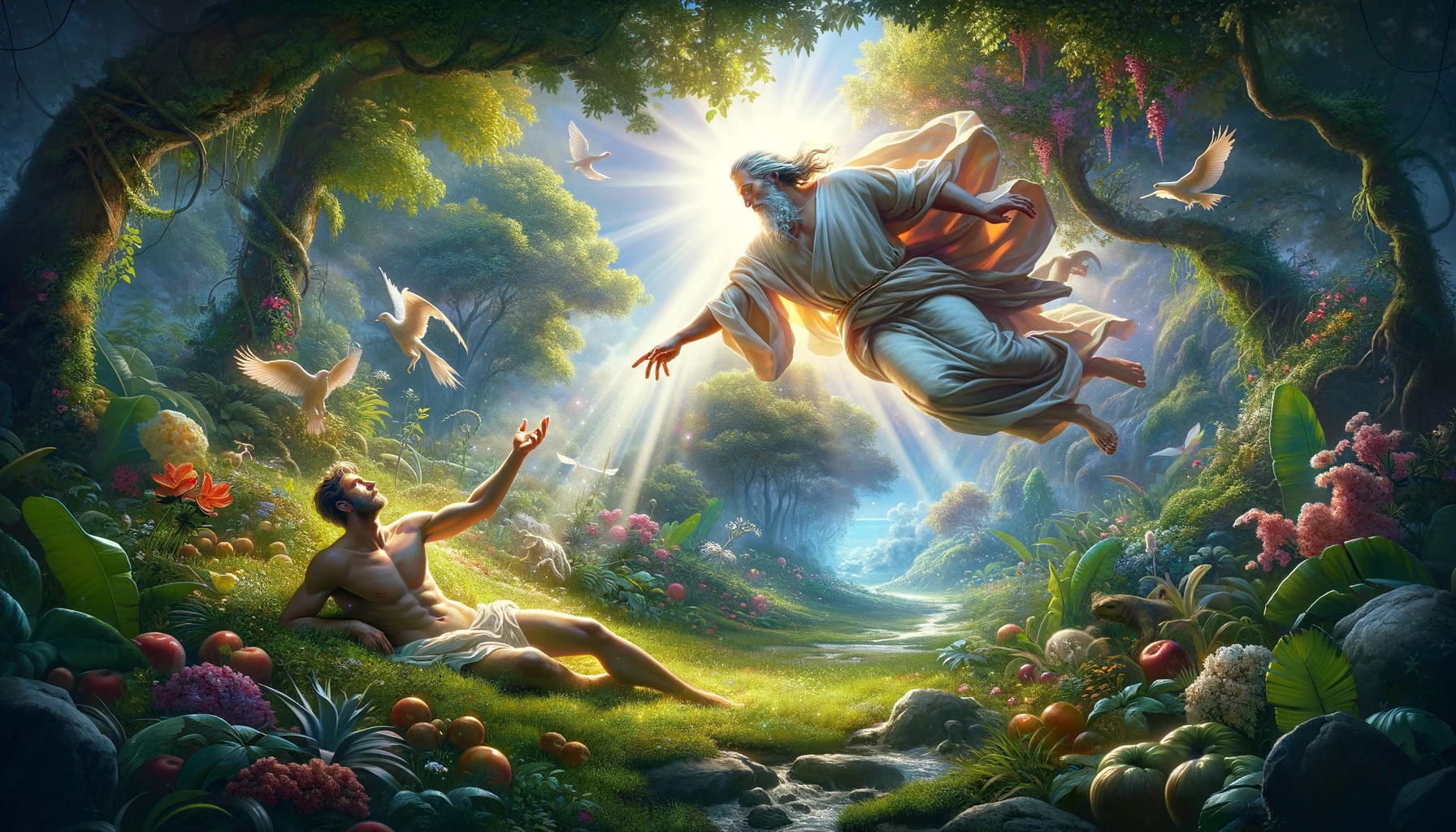
We’re examining the intermediate level, the 8 logical steps of creation and recreation. Looking at the key verses of Exodus 19:5-6, where God’s desire is to establish a kingdom of priests who will go out and help Him reclaim the world, meaning the hearts of people.
The process of the fulfilment of prophecy takes place through rebellion, destruction, and salvation. We looked at how that played out at the time of revelation. A people are established, they are destroyed by the beast, and people must flee once that realization is being spread.
God’s plan in both the past and the future involves parables. When God speaks about the past, He sometimes uses parables, just like when He speaks about the future. Jesus said, “Things have been hidden since the creation of the world.”
That’s why He speaks in parables. The beginning and the end are intimately connected. As we understand more about the end, we can now understand more about the beginning.
God’s plan of creation and recreation unfolds through 8 distinct steps that repeat throughout history until the end of Revelation.
First, God selects an individual to lead and guide His people. This leader then establishes a kingdom or community where God’s principles and laws are followed. God makes a covenant with the chosen people, promising to be their God and to guide them. However, sin and disobedience lead the people to break their covenant with God, resulting in judgment and destruction.
After the destruction, God elects a new leader to guide the people back to Him. God brings judgment upon the wicked and salvation to those who repent and turn to Him. A new kingdom is established, where God’s laws are followed and His people live in righteousness. Finally, God establishes a new covenant with His people, promising to forgive their sins and to dwell among them.
Understanding these eight steps provides a framework for interpreting the events of the Bible and comprehending God’s plan for the world. It reveals how God works through history to bring about His ultimate purpose of establishing a kingdom where He reigns supreme and His people live in peace and harmony.
The 8 Steps of the Logical Order of Creation and Recreation
Exodus 19:5-6, Isaiah 46:10, Genesis 2-3, Genesis 6 and Genesis 9
We’re going to delve into a profound lesson today. I know I often say that, but this time, it’s truly profound. I hope you are all prepared for the journey we will embark upon momentarily.
What are the crucial points we’ll be discussing today?
We’ll be examining the 8 logical steps of creation and recreation. What does this mean? When God creates and recreates, He always follows these steps. By understanding these steps, we will comprehend the roles and significance of the key figures who came before us in the Bible.
Our main reference chapters and verses are Exodus 19:5-6, which we know well: “If you obey me and keep my covenant, then you will be my treasured possession and a holy nation.” Isaiah 46:10 is a new one, and I’m excited to explore it. God essentially says, “I make known the end from the beginning.” Here, we have the beginning and end mentioned in Isaiah 46:10.
We’ll also be looking at Genesis 2 and 3, focusing on the time of Adam and some crucial understandings about him. Genesis 6 introduces Noah and the flood, while Genesis 9 concludes the matter.
So, those are the essential topics we’ll cover today: covenant, beginning and end, Adam, Noah, and covenant.
Our hope is to belong to the recreated kingdom at the time of the second coming.
1. Process of Rebellion —> Destruction —> Salvation
We’ll first start by looking at the process of rebellion, destruction, and salvation once more, and remind ourselves of how the prophecies of revelation must be fulfilled. It must happen in order. One thing we talked about in the last Q&A that I want us to remember or to mention for those who weren’t able to attend the Q&A is that fulfilment is not just one big event that happens, and then everything is over.
Actually, fulfilment is a process or a series of events. For example, we had Jesus’s birth. When Jesus was born, did he immediately die on the cross? No, he had to grow up, spend time in the temples, start his ministry, and then collect his 12 disciples. So there was his birth, and then one event was fulfilled, followed by another event being fulfilled, and he was fulfilling prophecy his entire life until he died on the cross. The fulfilment at the second coming also happens in this way.
Some of us might have thought earlier, “Well, none of revelation is fulfilled because Jesus isn’t here yet,” but that’s because we were thinking of the second coming as all collapsed into one thing when, in reality, the events of revelation play out over time. So there’s a process. Things can start being fulfilled, though Jesus is not clearly here yet, but we know that he’s getting closer because things are being fulfilled.
It’s like what Jesus said in Matthew 24, “You know the sign of the fig tree, that when its leaves become tender, you know that summer is coming, but you cannot discern the signs of the times.” So, Jesus goes on to explain the signs. You should be waiting for the abomination to enter the holy place. You should be waiting for the appearance of this and the appearance of that, and the fall of the sun, moon, and stars, right? These things are events that take place, which then cue us that, “Oh, it’s coming. It’s close.”
ONE – The Testimony of that Fulfillment, 5W1H
2 Thessalonians 2:1-3
Concerning the coming of our Lord Jesus Christ and our being gathered to him, we ask you, brothers, 2 not to become easily unsettled or alarmed by some prophecy, report or letter supposed to have come from us, saying that the day of the Lord has already come. 3 Don’t let anyone deceive you in any way, for that day will not come until the rebellion occurs and the man of lawlessness is revealed, the man doomed to destruction.
The Apostle Paul tells us the process that the fulfillment of revelation must follow. The testimony of that fulfillment, the who, what, when, where, why, and how of how things were fulfilled, must follow rebellion, destruction, and salvation. Salvation being the day of the Lord that we are waiting for, the day of the Lord. So first, there must be a rebellion or a betrayal.
Then, there must be destruction. After that, salvation. That’s the flow of events. Any testimony that does not follow this flow cannot be trusted as a true testimony. And as Paul says, do not be deceived by such a testimony. So what is the testimony we’ve been talking about regarding rebellion, destruction, and salvation?
Well, we talked about the introduction of the seven golden lampstands in Revelation 1:20. Jesus is holding the seven stars in his right hand and walking among the seven golden lampstands. He then writes letters to them, saying, “Repent, for you have forgotten or forsaken your first love,” but they do not repent. Unfortunately, because they do not repent, they get judged. We see that the beast with seven heads and ten horns invades this tabernacle.
Those who lived in what was once called heaven, not heaven in the spiritual world, but a heaven that became a physical world, the first heaven and first earth, are consumed by the beast. The beast causes them to eat food sacrificed to idols, worship idols, and commit spiritual sexual immorality, destroying them for a period of time. However, one person witnesses these events and is the first to flee to the mountain, saying to everyone, “Come out, or you will be destroyed like that.”
This provides a little more detail than we’ve covered in the past, but hopefully, it’s not feeling too new, as it’s content we’ve covered so far. But that’s the flow of Revelation, from Revelation 1 to 22.
The 8 steps we’ll be talking about today as we’re looking at Intermediate Bible logic are:
A key factor that I want us all to write down:
The steps of creation and recreation are just rebellion, destruction, and salvation in more detail.
Rebellion, destruction, and salvation have been happening in the Bible since the very beginning. It’s the process of how fulfillment ends up getting fulfilled and has been repeating over and over again throughout the Bible.
We’ll look at an example in the book of Genesis that follows rebellion, destruction, and salvation by breaking it into 8 steps, so we can see those steps very clearly. Is everyone following so far? Hope not lost. All right, here we go.
2. God’s Purpose and Will
Let’s start by reminding ourselves about God’s purpose and will.
ONE – To be a Kingdom of Priests (Holy Nation, Chosen People) to reclaim the world!
Exodus 19:5-6
5 Now if you obey me fully and keep my covenant, then out of all nations you will be my treasured possession. Although the whole earth is mine, 6 you will be for me a kingdom of priests and a holy nation.’ These are the words you are to speak to the Israelites.”
As a reminder, the world is in a fallen state because of what happened in the Garden of Eden. God needs people to choose him again. “Choose” being the optimal word, as God does not force or compel, but strongly encourages us to choose and obey him.
For the world to choose and obey God, he needs people to work through to spread the word about God – a word that either people have forgotten or have never heard before. God’s desire has and always will be for all to be saved and come to a knowledge of the truth. But to achieve this, God needs a kingdom and priests.
He needs a people who have cleansed themselves and can help others be cleansed. Those who handle the word of the Lord respectfully and with care, having studied to show themselves approved, right?
That’s what God needs – a holy nation. So that’s been his desire from almost the very beginning. And he needs those kingdom and priests to do a very special job – to reclaim the world and help him reclaim it. That is your job, your purpose, and your duty.
God establishes a chosen people, and those chosen people go out into the world. But if a chosen people struggle with step one, they cannot do step two.
When a people cannot do step one and ultimately cannot do step two, God starts over. The cycle repeats like that. A kingdom and priests are what God needs so that he can use those people to reclaim the world – people who will go out and testify to who God is and what he is doing in our time.
Now, let’s look at how God set this up and some secrets that God had laid since the very beginning. I’m telling you, if you really understand this part, it will unlock more parts of the Bible for you that previously you thought you had mastered, but probably didn’t realize that there’s way more to it than that. This content is so, so important. I’m going to take my time here on this one.
3. God’s plan, Past and Future
Let’s establish a common understanding about God. Does God age? Can He die? How long has He been around? How long will He be around? Forever. So, is a being like that bound by time? No. But we, as mortals, are bound by time. To us, the past and the future are totally inaccessible. But to God, they are completely accessible. And because God has that ability, because God has the ability to create, He can set His plan that will be fulfilled in the future and tell us about it in the present.
Let’s turn to Isaiah 46:10 to understand some clues about how God talks about both the past and the future.
ONE – God Tells the End from the Beginning
Isaiah 46:10
I make known the end from the beginning,
from ancient times, what is still to come.
I say: My purpose will stand,
and I will do all that I please.
This is God speaking. And what does He say? “I make known the end from the beginning.” Then God mentions two things: ancient times and what is yet to come. When someone says “what is yet to come,” another way of phrasing that is prophecy. And in what language is prophecy spoken? Parables.
How do we know? Hosea 12:10 comes to mind: “I spoke to the prophets, gave them many visions and told parables through them.”
So that’s how God talks about the future. But what are ancient times? History, aka the past. Ancient times or the past. But God says, “I make known the end from the beginning, from ancient times to what is yet to come.” He’s talking about these two things together.
Here’s a key concept we need to understand: When God speaks about the past, from the time the person is receiving and recording it, He sometimes includes prophecy. What does He also include when He talks about the past, similar to what He’s talking about in the future? Sometimes, He also speaks in parables about the past.
Let me give you an example. Moses was the writer of the book of Genesis, which spans 2,500 years. One book, 2,500 years. Was Moses around to see the events of Genesis? No. But yet he wrote about them in great detail, greater detail than can be passed down orally. So how did he do that? God gave him visions. Yeah, God showed him when he was on Mount Sinai, spending all that time with God. God was showing him the events of Genesis. And this was Moses, right? He was writing them down. “What? Abraham said this? Wait. Adam lived how long? We’re only living 70 to 80 years.” Psalms 90, right? So God showed Moses the past.
And some of what He showed Moses in the past was spoken in parables. So how do we understand this? The end and the beginning are intimately tied together. They speak to each other. And certain things that happen in the beginning cannot be fully understood until the end. And some things in the end cannot be fully understood until someone understands the beginning. They are intimately tied together, similar to how prophecy and fulfillment work.
The prophecy cannot be understood until it is fulfilled. Then everything makes sense. You’re like, “Oh, that’s what God was talking about.”
So what I’m trying to make very clear is that when God speaks about the past and when He speaks about the future, He uses the same language: parables. So there are parables spoken in the past. We often interpret the past literally in every situation, but that’s not actually the right way to look at it all the time. Let’s see how Jesus talks about this and how he makes that connection between the beginning and the end so clearly.
Reminder:
God Tells End from the Beginning:
1. What is still to come: Future
2. Ancient Times: Past
Both will be spoken in parables
TWO – Jesus spoke in Parables
Matthew 13:34-35
34 Jesus spoke all these things to the crowd in parables; he did not say anything to them without using a parable. 35 So was fulfilled what was spoken through the prophet:
“I will open my mouth in parables,
I will utter things hidden since the creation of the world.”
This is so important, what Jesus just said here.
Remember why Jesus spoke in parables? There were two reasons. What were those two reasons why Jesus spoke in parables?
1. To protect the secrets of heaven from the evil one.
2. To fulfill prophecies.
So here, Jesus is saying, “I spoke to the people in parables. I will utter things hidden since when?”
When was the creation of the world detailed? In the beginning, in Genesis.
So what does that mean about Genesis? What does it contain? Genesis contains parables.
Some of Genesis is moral teachings. Some of Genesis is history.
But also, some of Genesis is prophecy and fulfillment. All four contents exist throughout the Bible. So what we’re going to look at today is one of the bigger parables.
And it’s going to, or at least I hope that’s how the lesson is understood. Does everyone understand what we’re discussing here? Is everyone following?
Because if you don’t understand this, this lesson will not make sense. So I want to make sure everyone has got it. Let me review it one more time.
The end and the beginning are intimately connected to God. And he speaks the same language in both the end and the beginning.
And when you are blessed enough to exist at the end, there are things in the beginning that now make sense to you, which could not have made sense to people before you because they did not exist at the time of the end. So the end better explains the beginning. And then you’re looking from the beginning to the end, and the story looks completely different.
It’s kind of like in a movie, right? When you’re watching a movie, and the director focuses on a book for a few seconds, and then you don’t see that book again until the end of the movie. And then you’re looking at that book completely differently at the end of the movie because that book holds special significance.
So you saw it at the beginning, but you’re like, okay, that must be important. And then you kind of forget about it. And then at the end of the movie, the book is critically important because it contains a secret letter from the father or something, you know, insert movie here, right?
So at the end of the movie, the beginning makes sense. Really good movies do this well. And they’re really fun to rewatch too after you know the secret at the end, right?
So God does the same thing. So what we’re going to talk about today, you will not have heard before, but that’s because we now exist at the time of the end. So this explanation could not have existed before.
Let’s now look at the 8 steps of creation and recreation. Oh, I’m excited for you guys. I remember the first time I heard this, I was like, no way.
Let’s go over it today.
4. Eight Steps of Creation and Recreation
Creation: 4 Steps
Step 1 – Selection of a Pastor
Genesis 2:6-7
6 but streams came up from the earth and watered the whole surface of the ground— 7 the Lord God formed the man from the dust of the ground and breathed into his nostrils the breath of life, and the man became a living being.
So, God took some dust and formed it, then breathed into that man the breath of life.
This is a concept we have been familiar with for a long time. However, we have studied it further. What is the figurative representation of the breath of life?
The word of life.
We are reading about the past, which was spoken to Moses. So, God may be using figurative language here.
Why would God give someone the word? So that he can teach.
Let’s think about it. We talked about what it means to form a container, didn’t we?
Way back, I’m asking you to recall many months ago when we discussed the figurative container. What is the process to form a container?
What does it start as?
Clay, also known as dirt or dust.
Dust is just tiny clay particles. So, it starts as clay, and then you add water and mold it.
Then you fire it until it becomes a usable bowl. So, God took Adam, who was dust, and he gave him the breath of life. And then he became a living being.
But what came to life in Adam? What was he given by God? The word.
His spirit came to life. He became the first man who could understand the word of God.
Which means that Adam, in reality, was a priest. That’s right.
He was a pastor. God gave him the breath of life, which is the word of life. And Adam became a pastor.
But Adam can’t preach to no one. What’s the point of that? So, after God established his pastor, he now needed to give him a place to preach.
Reminder:
God: Breath (Word) of Life —-> Adam
Breath of Life = Word of Life
Adam = Pastor (King)
Step 2 – Creation of a Kingdom
What was Adam’s kingdom? The garden of Eden. And what did God tell Adam to do with that garden? He had to tend it, take care of it, water it, so that it could flourish. In that garden, there were many different types of animals and living creatures. And he was told to name them all.
Well, let’s understand this deeper, because we’ve also talked about the figurative garden, didn’t we?
Let’s turn to the book of Isaiah chapter 5. The title is “The Song of the Vineyard.” I want you to pay close attention to this passage as we read Isaiah 5:1-7.
Isaiah 5:1-7
I will sing for the one I love
a song about his vineyard:
My loved one had a vineyard
on a fertile hillside.
2 He dug it up and cleared it of stones
and planted it with the choicest vines.
He built a watchtower in it
and cut out a winepress as well.
Then he looked for a crop of good grapes,
but it yielded only bad fruit.
3 “Now you dwellers in Jerusalem and men of Judah,
judge between me and my vineyard.
4 What more could have been done for my vineyard
than I have done for it?
When I looked for good grapes,
why did it yield only bad?
5 Now I will tell you
what I am going to do to my vineyard:
I will take away its hedge,
and it will be destroyed;
I will break down its wall,
and it will be trampled.
6 I will make it a wasteland,
neither pruned nor cultivated,
and briers and thorns will grow there.
I will command the clouds
not to rain on it.”
7 The vineyard of the Lord Almighty
is the house of Israel,
and the men of Judah
are the garden of his delight.
And he looked for justice, but saw bloodshed;
for righteousness, but heard cries of distress.
The vineyard figuratively represents the house of Israel, which is a people. The same writer authored both Genesis and Isaiah, though different individuals physically put pen to paper. However, the author is the same.
God’s logic is consistent from Genesis to Revelation. When God refers to a garden as His people, He is also talking about the first garden. So, what does the garden represent? In one word, the garden equals the house of a chosen people, a church.
That makes sense.
God established Adam as a pastor and gave him the breath of life, which is His word. He also gave Adam a kingdom to tend and instructed him to name or assign positions, titles, and duties to the people in that place, taking care of them and imparting the very word God had given him.
However, the story unfortunately takes a turn at this point. Before the turn, God gives a warning, a covenant.
Reminder:
Kingdom = Garden of Eden
Garden = Church, the house of the chosen people.
Step 3 – Covenant with the Chosen People
Genesis 2:16-17
16 And the Lord God commanded the man, “You are free to eat from any tree in the garden; 17 but you must not eat from the tree of the knowledge of good and evil, for when you eat of it you will surely die.”
God said, “You may eat from any tree in the garden, except the tree of the knowledge of good and evil. For if you eat from this tree, you will surely die.”
Did God say, “You will surely be fine. It’s really not that big a deal”? No. What did God say? “You will die.”
If you eat from the tree of the knowledge of good and evil, it will not end well for you. This is the covenant. Hosea 6:7 says, “Like Adam, they have broken the covenant. They were unfaithful to me there.” Hosea 6:7 states, “Like Adam, they have broken the covenant.”
So, Adam received the covenant from God, and God takes His covenants quite seriously. However, Adam lived for a long time after this event, didn’t he? He lived up to 930 years, according to Genesis 5. But God said, “If you eat from this tree, you will surely die.” What is the explanation for that?
Adam’s spirit died immediately. The very spirit that God had just brought to life with His word was gone immediately. You can even notice this based on how Adam started to treat his wife. Instead of saying, “God, I repent. I’m sorry. Please forgive me,” what did he do?
He passed the blame, saying, “This woman you gave me did this.” And then the woman blamed the serpent, saying, “The serpent told me to do it.” Instead of taking responsibility and repenting, they did the opposite. You could tell they changed right away.
Instead of coming to God, they began to flee from God. Their spirit was gone. And when their spirit died, eventually their flesh also died, though they were supposed to live forever.
Reminder:
Eat from the Tree of Life, Don’t eat from the Tree of Knowledge of Good and Evil, this was a covenant.
Step 4 – Betrayal of the Covenant by the Chosen People and Destruction
Although the covenant was given to these people, there was a betrayal of that covenant.
So, step number four is the betrayal of the covenant by the chosen people and their destruction. Oh, are you starting to see rebellion and destruction? Since the very beginning, everybody. It has been happening since the start. And so, it started the whole thing – rebellion and destruction.
And since we’re going deep, might as well keep going deeper.
Was it a literal serpent that deceived Adam and Eve? A talking snake? No.
It represents a person who was like a snake being used by Satan. Who invaded their tabernacle and began to spread lies. A tree of the knowledge of good and evil.
We know what figurative tree is. John 15:1 says, “I am the true vine, and you, my disciples, are my branches.” Jesus had already told us that he was a tree of life. At the time of the first coming, the tree of knowledge of good and evil is also people who are being led by Satan, the ultimate serpent. And when Eve listened to the serpent saying things like, “You can be just like God, knowing good and evil,” they bought into what he was saying.
The way this is depicted oftentimes is with an apple, though Genesis 2 and 3 never mentioned any type of fruit. They just say “the fruit.” It does not mention an apple in the book, though it is commonly depicted as an apple.
But we know what a fruit really is. A spiritual fruit has two meanings. One meaning is what a person says. You can see and determine a tree by its fruit, as God was rebuking the Pharisees and Sadducees in Matthew 12. But also, a fruit can be people too, or connected to a physical or spiritual tree, like James 1:18 says, “He chose to give us birth through the word of truth, that we might be a kind of first fruits of all he created.”
So, a man’s heart and actions are like their fruit. For whatever is in a man will come out, Luke 6:45 states. So, whatever is in there will come out. Unfortunately, Adam and Eve listened to the serpent-like person who spread lies to them, and they broke the covenant that they had with God.
And what happened? Their nakedness was revealed. They were clothed in animal skin, and they were kicked out of the garden. And they lost access to the tree of life.
And what happened? Satan, sin, death, mourning, crime, pain – all of these horrible things then entered the world. And it began a vicious cycle of a need to create and to recreate – a cycle that will end in the time of revelation by God’s grace. We’re understanding creation before we move on to recreation.
Reminder:
– Adam and Eve broke the covenant (Eating from The Tree of Knowledge of Good and Evil)
– Satan, Sin, and Death entered
How is everyone’s heart doing? Who’s experiencing an internal earthquake? What? I happn to be experiencing one too, but trust me. I’m sure you’ll have many questions. We’ll go over those questions soon as well. I know you have questions, so just hang on to them for a moment.
Understand that in the process of creation, God picks a person and gives that person the word. That person is then given a kingdom, and they have to attend to that kingdom. To solidify this, God gives a covenant to those people.
But what is Satan’s job? To disrupt and destroy that covenant by causing the people to break it, because God will never break His covenant. God always keeps His promises, but it’s the people who break the covenant.
So when they broke the covenant, God had to pass them out. And then He told these things to Moses so that people are aware of what took place in the past. This way, they can learn from the mistakes of the past and do better in the future.
Recreation: 4 Steps
Step 5 – Selection of a New Pastor
Step number five is quite similar to step number one. What do you think step number five is? A new one. The selection of a pastor, the creation of a kingdom, and a covenant with those chosen people. But Satan invades and destroys, causing them to betray. Their hedge is gone, and they are destroyed. So God has to start again.
The selection of a new pastor. Who is the new pastor that God began to work with after Adam’s betrayal? Noah.
Genesis 6:5-9
5 The Lord saw how great man’s wickedness on the earth had become, and that every inclination of the thoughts of his heart was only evil all the time. 6 The Lord was grieved that he had made man on the earth, and his heart was filled with pain. 7 So the Lord said, “I will wipe mankind, whom I have created, from the face of the earth—men and animals, and creatures that move along the ground, and birds of the air—for I am grieved that I have made them.” 8 But Noah found favor in the eyes of the Lord.
9 This is the account of Noah.
Noah was a righteous man, blameless among the people of his time, and he walked with God.
After the betrayal of Adam and Eve, what began to happen to the world? It fell into corruption. Corruption in what kind of measure? Increasing. Evil and sin began to steeply increase, and God’s heart was grieved.
So what did God decide to do? “I’m going to wipe them away. But not everybody, because I need to work through a new people.”
But before starting with the people, God needed to start with one first. With that one, from him, God would build something new. So God came to a righteous man named Noah.
We know him quite well. God told Noah what he is and what he intends to do in the future because Noah walked with God. God had to wait a long time for Noah. Noah was the ninth generation descendant of Adam. It took God nine generations, almost a thousand years, to find someone who walked with him. A very long time.
So what did God want to do with this righteous man? “I’m going to build something new. But first, the old has got to go. The world, the old has to go.”
Let’s read a little bit more about Noah to understand his position as the new pastor.
2 Peter 2:5
if he did not spare the ancient world when he brought the flood on its ungodly people, but protected Noah, a preacher of righteousness, and seven others;
Noah, a preacher of righteousness. Because what was Noah doing during the 100 years it took him to build the ark? Oh my gosh, everybody. What was he doing? He was preaching. “Guys, a flood is coming. I’m building an ark. Get on it.” That’s what he was doing for 100 years. 100 years. It took him forever to build that ark. 100 years. He was preaching. But did people listen? Seven out of the rest of Adam’s world.
So when God decided to work through Noah, step number 6, out with the old, in with the new.
Reminder:
Noah was a righteous man, 9 generations from Adam
Step 6 – Judgement and Salvation
Based on the story of Noah, what was the judgment? The Flood.
And what represented salvation? The ark. Out with the old, in with the new.
So, judgment and salvation. God, through Noah, judged the old with the Flood, and Adam’s world came to an end—the world that had become sinful and corrupt. Only eight people, including Noah himself, got on the ark.
But with the new ones who got on the ark, what was God intending to do with them? Recreate. To start again. So with the new that was saved, the old world, Adam’s world, was judged. And the new was saved.
This concept of the new and the old makes its way throughout the Bible too. They often go by a number of names: Remnants, Survivors, or the Penitent—meaning the repentant ones. You see these terms, for example, quite often in the book of Isaiah. You see this terminology used: Remnants, Survivors, Penitent. It means those who came out of the old world and followed the one that God was currently using. We see this pattern over and over again.
What are some other names that this concept has gone by that we’ve studied so far? Babylon. What else? The sea, Egypt, The field, Sodom. You’re seeing the pattern? It’s the same pattern. Come out of this world and come into the new world that God is building. Same thing. Same pattern. It just repeats itself.
God takes a few survivors out of the old world and begins to build something new with them. But first, the old must be judged. For the sake of time, we won’t read the full story about the Flood. But a few key reminders here: God said, “Make yourself an ark. I’m going to bring floodwaters to wipe away the old world, the world that had become corrupt.” And now, with those who survived this event, God could build something new with them.
Reminder:
– Old World (Adam’s) is judged
– New is saved (Escapes judgment)
New = Remnant, Survivors and Penitent
Step 7 – Creation of a New Kingdom
Genesis 9:1-7
With those who survived the event of judgment, God builds a new kingdom. Like that.
After the event of judgment, those who survived became God’s new kingdom. Noah’s ark came to rest on Mount Ararat, as described in Genesis 9.
Noah’s family of eight became God’s new kingdom, and God began to work through them. God gave them a very specific instruction for his new kingdom.
Let’s turn to Genesis 9 and see this instruction that God gives them.
Genesis 9:7, “As for you, be fruitful and increase in number; multiply on the earth and increase upon it.”
God instructed them to multiply and increase in number. Why?
Why did they need to increase in number?
The kingdom needed people. The kingdom needed people who were like the survivors.
At that time, it was more physical, but the same logic applies spiritually today. What did Jesus tell his disciples in John 15?
When he said, “I am the vine, and you are the branches,” what was Jesus asking his disciples to do?
To make believers out of all nations.
That’s right. To evangelize. The logic is the same, both physically and spiritually.
Make others who are like you. It makes sense. Noah and his family were tasked with this by God.
And God confirmed this command with them by giving them a new covenant, sealing the deal and closing the cycle.
We’ve read this story dozens of times in church, but we didn’t understand it this deeply. And now you’re starting to understand God’s fingerprint, right?
That’s why Intermediate is sometimes, like when I talk to students who finish the course, Intermediate was my favorite. It was great. It explained so many things.
Glory to God. We just started. This is lesson three.
We just started, and we’re already going deep.
Reminder:
– Noah’s world (family) = New Kingdom
– Be fruitful and increase in numbers = John 15:1-5 —> Bear fruit (evangelize)
Step 8 – New Covenant
In Genesis chapter 9, God establishes a new covenant with Noah and his family. He tells them, “Be fruitful and multiply. And here is my covenant with you: Never again will I end the world with a flood.” God symbolizes this covenant with the rainbow.
The rainbow represents a signifier of God’s covenant with his chosen people.
What do you think God wants from this new covenant with the people? How does he want them to treat it? He wants them to keep it.
How can someone keep the covenant? By doing what God asks of them.
And how does one do what God asks? What must happen first? They have to hear it first.
Then what? They must believe it.
How does one believe something? It has to go into the heart, right? But can it leave the heart? No, it cannot. It must remain in the heart, right?
It must remain in the heart in order for someone to keep it. If it leaves the heart, you cannot keep it. It’s like working at a factory job. In your first two weeks, you’re given instructions on how to operate an important piece of equipment. Let’s say the next day, somehow, you forget how to operate that equipment. Will you be allowed to touch the equipment? No, because you’re likely to hurt yourself or someone else. You forgot how to operate the machinery, so you will not be allowed to keep that part of your job.
Similarly, as mentioned in Deuteronomy 6:5-9 and Hebrews 8:10-12, God is telling the people to put his law on their hearts and minds. This is what the Bible calls “sealing,” so that people can keep the covenant they have received.
Noah’s job was to seal that covenant on the hearts of his people, his sons and daughters, and his descendants.
Genesis 9:8-13
8 Then God said to Noah and to his sons with him: 9 “I now establish my covenant with you and with your descendants after you 10 and with every living creature that was with you—the birds, the livestock and all the wild animals, all those that came out of the ark with you—every living creature on earth. 11 I establish my covenant with you: Never again will all life be cut off by the waters of a flood; never again will there be a flood to destroy the earth.”
12 And God said, “This is the sign of the covenant I am making between me and you and every living creature with you, a covenant for all generations to come: 13 I have set my rainbow in the clouds, and it will be the sign of the covenant between me and the earth.
God established His covenant that He would no longer bring a flood, and it was signified by the rainbow.
Noah and his family were meant to be the people through whom God would work, living holy and good lives and teaching others to do the same.
However, we know that Satan was still present, waiting to cause problems. Satan thought, “Okay, how can I get to Noah’s family? How can I destroy them too?”
Did Satan succeed? Yes, unfortunately.
How? Everyone remembers the story of Ham, Noah’s second son. His first son was Shem, from whom Abraham descended. But Canaan, the land of Canaan, and all the “Ites” – the Hittites, the Jebusites, the Amorites – descended from Ham and his son Canaan.
What did Ham do, likely with his son? Noah tended a garden, very similar to his ancestor Adam. It was a vineyard, and he helped himself to its fruits, the fruits of his labor. He was naked in his tent. What happened then? Ham went in and saw his father. Instead of immediately covering him up and ending the matter, what did Ham do? He said, “Hey guys, guess what? Dad’s naked in the tent.” Shem and Japheth grabbed a blanket, walked backward, and covered their father without seeing his nakedness. When Noah heard about this, he said, “Cursed be Canaan, and you will be a servant to Shem.”
Oh, this starts the whole drama, doesn’t it? The splintering of families. Ham and Canaan went off, becoming the “Ites.” Shem led to Abraham, Isaac, and Jacob. And now they had to go. It’s a whole thing, which we’ll cover in a later lesson.
But just to show you that the cycle does what? It repeats, like that. Until which time? When does the cycle stop? In Revelation, when the cycle stops. So just note that Satan will continue to deceive God’s people until he is put away in the abyss, at least for a thousand years. So let’s be diligent and not let Satan grab us.
The logical order of creation and recreation has 8 steps. Are we understanding? Did the lesson make sense?
So really, you only have to remember 3 or 4 because the others are just new additions.
It’s not very hard. Pastor, kingdom, covenant, betrayal, pastor, judgment, salvation, kingdom, covenant. Done. Very easy. Remember, just think about the story of Adam and Noah, and it will make a lot of sense. Again, this process repeats itself throughout the Bible until the end of Revelation, when Revelation is fulfilled.
Memorization
Exodus 19:5-6
5 Now if you obey me fully and keep my covenant, then out of all nations you will be my treasured possession. Although the whole earth is mine, 6 you will be for me a kingdom of priests and a holy nation.’ These are the words you are to speak to the Israelites.”
Let’s Us Discern
Analyzing Shincheonji Lesson 69: “The 8 Steps of the Logical Order of Creation and Recreation”
A Critical Examination Using “Testing Shincheonji’s Claims: Two Lenses, One Story”
Introduction: The Master Template
Lesson 69 represents the crown jewel of Shincheonji’s indoctrination curriculum. This is where all the previous lessons converge into a comprehensive interpretive system that will govern how students understand all of Scripture—and ultimately, how they view SCJ’s claims.
The instructor is essentially saying: “I’m about to give you the secret decoder ring for the entire Bible.” This lesson presents what SCJ calls the “8 Steps of Creation and Recreation”—a pattern they claim repeats throughout Scripture and is currently being fulfilled through their organization.
As Chapter 3 of “Testing Shincheonji’s Claims: Two Lenses, One Story” warns, the lens through which we view Scripture determines everything we see. This lesson installs the most comprehensive lens yet—one that makes SCJ appear as the inevitable, prophesied fulfillment of a pattern established “since the creation of the world.”
The instructor’s stated goal is to help students “belong to the recreated kingdom at the time of the Second Coming.” But what’s actually happening is the construction of an elaborate interpretive framework that:
- Reinterprets Genesis as prophecy rather than history
- Creates a repeating pattern that requires SCJ for fulfillment
- Makes questioning this framework appear as rejecting God’s plan
This is sophisticated theological manipulation. Let’s examine it carefully.
For additional refutation resources, check CloserLookInitiative.com’s SCJ Examination section, which provides detailed analysis of SCJ’s interpretive methods.
Part 1: The Foundation – “End from the Beginning”
The Core Teaching
What the Lesson Says:
The instructor uses Isaiah 46:10 as the foundation:
“I make known the end from the beginning, from ancient times, what is still to come.”
He explains:
- “The end and the beginning are intimately tied together”
- “Certain things that happen in the beginning cannot be fully understood until the end”
- “When God speaks about the past and when He speaks about the future, He uses the same language: parables”
- “Genesis contains parables… some of Genesis is prophecy and fulfillment”
- “This explanation could not have existed before” because “we now exist at the time of the end”
Analysis:
This is the master key of SCJ’s interpretive system. The instructor is claiming that:
- Genesis is not just history—it’s prophecy in parable form
- This prophecy couldn’t be understood until now (SCJ’s time)
- The “8 steps” in Genesis are a pattern that repeats and is being fulfilled through SCJ
Chapter 4 of “Testing Shincheonji’s Claims” (“The Impact of Interpretive Frameworks”) warns about this exact technique: Once you accept that Genesis is primarily prophecy requiring SCJ’s interpretation, you’ve handed them the keys to reinterpret all of Scripture.
The Biblical Understanding of Isaiah 46:10
What Does Isaiah 46:10 Actually Teach?
Let’s read Isaiah 46:9-11 in context:
Isaiah 46:9-11: “Remember the former things, those of long ago; I am God, and there is no other; I am God, and there is none like me. I make known the end from the beginning, from ancient times, what is still to come. I say, ‘My purpose will stand, and I will do all that I please.’ From the east I summon a bird of prey; from a far-off land, a man to fulfill my purpose. What I have said, that I will bring about; what I have planned, that I will do.”
The Context:
Isaiah 46 is contrasting the true God with idols. The chapter begins:
Isaiah 46:1-2: “Bel bows down, Nebo stoops low; their idols are borne by beasts of burden. The images that are carried about are burdensome, a burden for the weary. They stoop and bow down together; unable to rescue the burden, they themselves go off into captivity.”
The Point:
God is saying: “Unlike idols, I can predict the future because I control history. My purposes will stand. What I plan, I accomplish.”
This is a declaration of God’s sovereignty and foreknowledge, not a statement that Genesis is coded prophecy requiring special interpretation 6,000 years later.
What “End from Beginning” Means:
1. God’s Purposes Are Consistent:
Ephesians 1:9-11: “He made known to us the mystery of his will according to his good pleasure, which he purposed in Christ, to be put into effect when the times reach their fulfillment—to bring unity to all things in heaven and on earth under Christ. In him we were also chosen, having been predestined according to the plan of him who works out everything in conformity with the purpose of his will.”
God’s plan from the beginning has been redemption through Christ. The “end” (Christ) was purposed from the “beginning” (creation).
2. God Announces His Plans in Advance:
Amos 3:7: “Surely the Sovereign Lord does nothing without revealing his plan to his servants the prophets.”
God does reveal His plans—but through clear prophetic revelation, not through hidden codes in historical narratives that can only be decoded by one organization.
3. Biblical Prophecy is Verifiable:
Deuteronomy 18:21-22: “You may say to yourselves, ‘How can we know when a message has not been spoken by the Lord?’ If what a prophet proclaims in the name of the Lord does not take place or come true, that is a message the Lord has not spoken.”
True prophecy can be tested and verified. If Genesis is prophecy, we should be able to verify its fulfillment objectively, not just through SCJ’s interpretive framework.
Chapter 19 of “Testing Shincheonji’s Claims” (“When Claims Cannot Be Tested”) addresses this: SCJ’s interpretations are structured to be unfalsifiable—you must accept their framework to “see” the fulfillment.
The “Genesis as Parable” Claim
What the Lesson Says:
The instructor uses Matthew 13:34-35:
“Jesus spoke all these things to the crowd in parables; he did not say anything to them without using a parable. So was fulfilled what was spoken through the prophet: ‘I will open my mouth in parables, I will utter things hidden since the creation of the world.'”
He concludes:
- “What does that mean about Genesis? What does it contain? Genesis contains parables”
- “Some of Genesis is moral teachings. Some of Genesis is history. But also, some of Genesis is prophecy and fulfillment”
Analysis:
This is a category error. The instructor is confusing:
- What Jesus taught (in parables)
- What Genesis records (historical narrative)
What Matthew 13:35 Actually Means:
Matthew 13:34-35 quotes Psalm 78:2:
Psalm 78:1-4: “My people, hear my teaching; listen to the words of my mouth. I will open my mouth with a parable; I will utter hidden things, things from of old—what we have heard and known, what our ancestors have told us. We will not hide them from their descendants; we will tell the next generation the praiseworthy deeds of the Lord, his power, and the wonders he has done.”
Psalm 78 is a historical recounting of Israel’s history (Exodus, wilderness, conquest) told in poetic form to teach spiritual lessons. The “hidden things” are spiritual truths illustrated through history, not coded prophecies.
Jesus’ Use:
When Matthew says Jesus fulfilled this psalm, he means Jesus used parables (stories with spiritual meanings) to teach, just as the psalmist used Israel’s history to teach spiritual lessons.
This does not mean Genesis itself is parable or prophecy. It means:
- Genesis records real history
- That history teaches spiritual truths
- Jesus used parables to teach spiritual truths
The Biblical Genre of Genesis:
Genesis presents itself as historical narrative:
Genesis 2:4: “This is the account of the heavens and the earth when they were created.”
Genesis 5:1: “This is the written account of Adam’s family line.”
Genesis 6:9: “This is the account of Noah and his family.”
The Hebrew word “toledot” (תּוֹלְדוֹת) means “generations” or “account.” Genesis uses this formula repeatedly to structure its historical narrative.
New Testament Treats Genesis as History:
Luke 3:23-38: Luke traces Jesus’ genealogy back to “Adam, the son of God”—treating Adam as a historical person.
Romans 5:12-14: “Therefore, just as sin entered the world through one man, and death through sin, and in this way death came to all people, because all sinned—To be sure, sin was in the world before the law was given, but sin is not charged against anyone’s account where there is no law. Nevertheless, death reigned from the time of Adam to the time of Moses, even over those who did not sin by breaking a command, as did Adam, who is a pattern of the one to come.”
Paul treats Adam as a historical person whose sin had real historical consequences.
1 Corinthians 15:45: “So it is written: ‘The first man Adam became a living being’; the last Adam, a life-giving spirit.”
Paul contrasts the historical Adam with Christ (the “last Adam”).
The Problem with SCJ’s Approach:
If Genesis is primarily parable/prophecy rather than history, then:
- Adam wasn’t a real person → Paul’s theology in Romans 5 collapses
- The Fall didn’t really happen → We don’t need redemption
- Abraham wasn’t real → God’s covenant promises are fiction
- The patriarchs weren’t real → Jesus’ genealogy is meaningless
Chapter 6 of “Testing Shincheonji’s Claims” (“Consistent vs. Selective Narrative”) exposes this: SCJ selectively reinterprets passages to fit their framework while ignoring how this undermines the biblical narrative.
For more detailed refutation of SCJ’s interpretive methods, see CloserLookInitiative.com’s SCJ Examination section.
Part 2: The “8 Steps” Framework
The Pattern SCJ Proposes
Creation (4 Steps):
- Selection of a Pastor
- Creation of a Kingdom
- Covenant with the Chosen People
- Betrayal of the Covenant
Recreation (4 Steps): 5. Destruction/Judgment 6. Salvation (New Pastor) 7. New Kingdom 8. New Covenant
The Claim:
This pattern:
- Was established in Genesis (Adam, Noah)
- Repeated in Exodus (Moses)
- Repeated at Jesus’ first coming
- Is being fulfilled now through SCJ (Lee Man-hee)
Analysis:
This is an imposed pattern, not a biblical one. Let’s examine each step.
Step 1: “Selection of a Pastor” – Adam
What the Lesson Says:
Genesis 2:6-7: “The Lord God formed the man from the dust of the ground and breathed into his nostrils the breath of life, and the man became a living being.”
The instructor explains:
- “Breath of life” = “Word of life”
- Adam received God’s word
- Therefore, “Adam was a pastor”
- “God gave him the breath of life, which is the word of life. And Adam became a pastor”
The Biblical Reality:
1. “Breath of Life” ≠ “Word of Life”
Genesis 2:7 describes physical creation, not ordination to ministry:
Genesis 7:22: “Everything on dry land that had the breath of life in its nostrils died.”
The same phrase (“breath of life”) is used for animals. Does this mean animals are “pastors”?
Job 33:4: “The Spirit of God has made me; the breath of the Almighty gives me life.”
The “breath of life” is what makes creatures physically alive, not what makes them pastors.
2. Adam Was Not a “Pastor”
The concept of “pastor” (shepherd/teacher) as a church office didn’t exist until after Christ:
Ephesians 4:11-12: “So Christ himself gave the apostles, the prophets, the evangelists, the pastors and teachers, to equip his people for works of service, so that the body of Christ may be built up.”
Pastors are a New Testament church office, not an Old Testament category.
What Was Adam?
Genesis 1:26-28: “Then God said, ‘Let us make mankind in our image, in our likeness, so that they may rule over the fish in the sea and the birds in the sky, over the livestock and all the wild animals, and over all the creatures that move along the ground.’ So God created mankind in his image, in the image of God he created them; male and female he created them. God blessed them and said to them, ‘Be fruitful and increase in number; fill the earth and subdue it. Rule over the fish in the sea and the birds in the sky and over every living creature that moves on the ground.'”
Adam was:
- Created in God’s image
- Given dominion over creation
- Called to be fruitful and multiply
He was the first human, not the first “pastor.”
3. The Theological Problem
By making Adam a “pastor,” SCJ is:
- Imposing a church office onto pre-fall creation
- Creating a pattern that requires “pastors” to be selected in each era
- Setting up Lee Man-hee as the “new Adam” (the current “pastor”)
Chapter 7 of “Testing Shincheonji’s Claims” (“The Hidden Savior: New John”) exposes this pattern: SCJ creates parallels between biblical figures and Lee Man-hee to make him appear essential to God’s plan.
Step 2: “Creation of a Kingdom” – Garden of Eden
What the Lesson Says:
The instructor uses Isaiah 5:1-7 (the vineyard) to argue:
- The vineyard = house of Israel = people
- Therefore, the Garden of Eden = church
- “Kingdom = Garden of Eden. Garden = Church, the house of the chosen people”
The Biblical Reality:
1. The Garden of Eden Was a Physical Place
Genesis 2:8-14: “Now the Lord God had planted a garden in the east, in Eden; and there he put the man he had formed. The Lord God made all kinds of trees grow out of the ground—trees that were pleasing to the eye and good for food. In the middle of the garden were the tree of life and the tree of the knowledge of good and evil. A river watering the garden flowed from Eden; from there it was separated into four headwaters. The name of the first is the Pishon; it winds through the entire land of Havilah, where there is gold… The name of the second river is the Gihon; it winds through the entire land of Cush. The name of the third river is the Tigris; it runs along the east side of Ashur. And the fourth river is the Euphrates.”
The text provides geographical details (four rivers, specific regions) indicating this was a real place, not a metaphor for “church.”
2. Isaiah 5’s Vineyard ≠ Garden of Eden
The instructor commits a logical fallacy:
- Isaiah 5 uses “vineyard” as a metaphor for Israel
- Therefore, all gardens/vineyards in Scripture are metaphors
- Therefore, Eden is a metaphor for church
This is false reasoning. Just because one passage uses vineyard metaphorically doesn’t mean all gardens are metaphors.
Context Determines Meaning:
- Isaiah 5: Clearly metaphorical (verse 7 explicitly states: “The vineyard of the Lord Almighty is the nation of Israel”)
- Genesis 2: Clearly historical (geographical details, narrative context)
3. The Church Didn’t Exist in Genesis
Matthew 16:18: “And I tell you that you are Peter, and on this rock I will build my church, and the gates of Hades will not overcome it.”
Jesus said “I will build” (future tense)—the church didn’t exist until after Christ.
Ephesians 3:4-6: “In reading this, then, you will be able to understand my insight into the mystery of Christ, which was not made known to people in other generations as it has now been revealed by the Spirit to God’s holy apostles and prophets. This mystery is that through the gospel the Gentiles are heirs together with Israel, members together of one body, and sharers together in the promise in Christ Jesus.”
The church (Jews and Gentiles united in Christ) was a mystery not revealed in Old Testament times.
The Problem:
By making Eden = church, SCJ is:
- Anachronistically imposing New Testament concepts onto Genesis
- Creating a pattern where each era needs a “kingdom” (organization)
- Setting up SCJ as the current “kingdom”
For more on SCJ’s misuse of typology, check CloserLookInitiative.com’s SCJ Examination section.
Step 3: “Covenant with the Chosen People”
What the Lesson Says:
Genesis 2:16-17: “You are free to eat from any tree in the garden; but you must not eat from the tree of the knowledge of good and evil, for when you eat from it you will surely die.”
The instructor correctly identifies this as a covenant.
What’s Biblical:
This is accurate. God did establish a covenant with Adam:
Hosea 6:7: “Like Adam, they have broken the covenant—they were unfaithful to me there.”
What’s Problematic:
The lesson emphasizes the conditional nature of the covenant to set up a pattern:
- Covenant given → Covenant broken → Judgment → New covenant
This creates a framework where:
- Every covenant is conditional
- Every covenant gets broken
- Every broken covenant requires a “new pastor” and “new kingdom”
- SCJ is the current “new kingdom” with the “new covenant”
The Biblical Balance:
Some Covenants Are Conditional:
- Mosaic Covenant (blessings for obedience, curses for disobedience)
Some Covenants Are Unconditional:
- Abrahamic Covenant (Genesis 15—God alone passes through the pieces)
- Davidic Covenant (2 Samuel 7—God promises an eternal kingdom)
- New Covenant (Jeremiah 31—based on Christ’s faithfulness, not ours)
The New Covenant is Eternal:
Hebrews 13:20: “Now may the God of peace, who through the blood of the eternal covenant brought back from the dead our Lord Jesus, that great Shepherd of the sheep…”
Hebrews 8:6: “But in fact the ministry Jesus has received is as superior to theirs as the covenant of which he is mediator is superior to the old one, since the new covenant is established on better promises.”
The New Covenant in Christ is final and eternal, not another step in a cycle.
Chapter 22 of “Testing Shincheonji’s Claims” (“When Satan Tried to Hijack God’s Plan”) addresses this: God’s plan doesn’t require endless cycles—it was completed in Christ.
Step 4: “Betrayal of the Covenant” – The Fall
What the Lesson Says:
The instructor will describe how Adam broke the covenant by eating from the forbidden tree, leading to the Fall.
What’s Biblical:
This is accurate. Genesis 3 records the Fall—a real historical event with real consequences.
Romans 5:12: “Therefore, just as sin entered the world through one man, and death through sin, and in this way death came to all people, because all sinned.”
What’s Manipulative:
By fitting the Fall into the “8 steps” pattern, SCJ is:
- Making the Fall appear as just one instance of a repeating cycle
- Minimizing the unique, catastrophic nature of the Fall
- Setting up the expectation that this pattern repeats (requiring SCJ)
The Biblical Reality:
The Fall Was Unique:
Romans 5:18-19: “Consequently, just as one trespass resulted in condemnation for all people, so also one righteous act resulted in justification and life for all people. For just as through the disobedience of the one man the many were made sinners, so also through the obedience of the one man the many will be made righteous.”
Paul presents two unique events:
- Adam’s sin (brought condemnation)
- Christ’s righteousness (brought justification)
This is not a repeating cycle. It’s a one-time problem (Fall) with a one-time solution (Christ).
Part 3: The Recreation Steps (5-8)
The Pattern Continues
The lesson will continue with:
Step 5: Destruction/Judgment (Flood) Step 6: Salvation (New Pastor) (Noah) Step 7: New Kingdom (Noah’s family) Step 8: New Covenant (Rainbow covenant)
Then the pattern repeats:
- Moses (Exodus)
- Jesus (First Coming)
- Lee Man-hee (Second Coming) ← This is where it’s headed
The Problem:
This pattern is imposed, not derived from Scripture. Let’s see why:
The Noah Example
What SCJ Will Teach:
- Step 5: Judgment (Flood destroys the wicked)
- Step 6: New Pastor (Noah selected)
- Step 7: New Kingdom (Noah’s family)
- Step 8: New Covenant (Rainbow, Genesis 9)
What’s Problematic:
1. Noah Was Not a “Pastor”
Genesis 6:9: “Noah was a righteous man, blameless among the people of his time, and he walked faithfully with God.”
Noah was:
- Righteous (right standing with God)
- Blameless (lived with integrity)
- Faithful (walked with God)
He was not called to teach or shepherd others. His role was to:
- Build the ark (Genesis 6:14-22)
- Preserve his family (Genesis 7:1)
- Repopulate the earth (Genesis 9:1)
2. Noah’s Family Was Not a “Kingdom”
A kingdom requires:
- A king
- Subjects
- Governance structure
- Territory
Noah’s family was simply a family—eight people surviving the Flood.
3. The Pattern Breaks Down
If we follow SCJ’s logic consistently:
After Noah:
- Who was the next “pastor”? (The pattern should repeat)
- When did Noah’s “kingdom” fall into “betrayal”?
- Where’s the next “destruction” and “new pastor”?
The pattern doesn’t actually repeat in the way SCJ claims. They’re selectively choosing examples that fit while ignoring the many that don’t.
Chapter 6 of “Testing Shincheonji’s Claims” warns about selective narratives: SCJ picks and chooses which biblical figures fit their pattern while ignoring the rest.
The Moses Example
What SCJ Will Teach:
- Step 1: New Pastor (Moses)
- Step 2: New Kingdom (Israel)
- Step 3: New Covenant (Law at Sinai)
- Step 4: Betrayal (Golden calf, wilderness rebellion)
- Step 5: Destruction (Exile to Babylon)
- Step 6: Salvation (Return from exile? Or jump to Jesus?)
The Problem:
1. The Timeline Doesn’t Work
From Moses to the Babylonian exile is ~800 years. If this is one “cycle,” the pattern isn’t consistent.
From Adam to Noah is ~1,600 years (per biblical genealogies).
The “cycles” are vastly different lengths, making this not really a pattern.
2. Multiple “Pastors” Exist Simultaneously
During Israel’s history, there were:
- Prophets (Isaiah, Jeremiah, Ezekiel, etc.)
- Priests (Levitical priesthood)
- Kings (David, Solomon, etc.)
- Judges (before the monarchy)
If the pattern requires one pastor per era, which one is it? The pattern breaks down.
3. God Never Abandoned Israel
Romans 11:1-2: “I ask then: Did God reject his people? By no means! I am an Israelite myself, a descendant of Abraham, from the tribe of Benjamin. God did not reject his people, whom he foreknew.”
Even during exile, God preserved a remnant. The pattern of “complete destruction → new start” doesn’t actually fit Israel’s history.
The Jesus Example
What SCJ Will Teach:
- Step 1: New Pastor (Jesus)
- Step 2: New Kingdom (Jesus + 12 disciples)
- Step 3: New Covenant (Last Supper)
- Step 4: Betrayal (Church falls away after apostles)
- Step 5: Destruction (Church in “darkness” for 2,000 years)
- Step 6: Salvation (Lee Man-hee)
- Step 7: New Kingdom (SCJ)
- Step 8: New Covenant (SCJ’s “sealing”)
The Problem:
1. Jesus is Unique
Hebrews 1:1-2: “In the past God spoke to our ancestors through the prophets at many times and in various ways, but in these last days he has spoken to us by his Son, whom he appointed heir of all things, and through whom also he made the universe.”
Jesus is not another in a series of “pastors.” He is God’s final word, the Son, the Creator.
2. The Church Did Not Fall
Matthew 16:18: “And I tell you that you are Peter, and on this rock I will build my church, and the gates of Hades will not overcome it.”
Jesus promised the church would prevail, not fall into complete darkness.
3. The New Covenant is Final
Hebrews 8:6: “But in fact the ministry Jesus has received is as superior to theirs as the covenant of which he is mediator is superior to the old one, since the new covenant is established on better promises.”
Hebrews 13:20: “Now may the God of peace, who through the blood of the eternal covenant brought back from the dead our Lord Jesus…”
The New Covenant is eternal, not another step in a cycle.
Chapter 24-25 of “Testing Shincheonji’s Claims” (“The Scarlet Thread Parts 1 & 2”) demonstrates that all biblical covenants point to and are fulfilled in Christ—there’s no need for another covenant through SCJ.
For detailed examination of SCJ’s covenant theology, see CloserLookInitiative.com’s SCJ Examination section.
Part 4: Psychological Manipulation Techniques
Technique #1: The “Secret Knowledge” Appeal
Examples from the Lesson:
- “I’m telling you, if you really understand this part, it will unlock more parts of the Bible for you”
- “This content is so, so important”
- “You will not have heard before, but that’s because we now exist at the time of the end”
- “This explanation could not have existed before”
- “I remember the first time I heard this, I was like, no way”
Analysis:
This creates:
- Sense of privilege (“You’re learning secrets others don’t know”)
- Dependence on the group (“Only here can I learn this”)
- Superiority over outsiders (“They can’t understand because they’re not at the end”)
- Excitement and emotional investment (“This is profound! Mind-blowing!”)
Chapter 11 of “Testing Shincheonji’s Claims” (“The Wisdom of Hiding”) documents how SCJ uses exclusive knowledge claims to control members.
Biblical Response:
Colossians 2:2-3: “My goal is that they may be encouraged in heart and united in love, so that they may have the full riches of complete understanding, in order that they may know the mystery of God, namely, Christ, in whom are hidden all the treasures of wisdom and knowledge.”
All treasures of wisdom and knowledge are in Christ, not in a secret interpretive system.
2 Corinthians 4:2: “Rather, we have renounced secret and shameful ways; we do not use deception, nor do we distort the word of God. On the contrary, by setting forth the truth plainly we commend ourselves to everyone’s conscience in the sight of God.”
Truth is plain, not hidden in secret patterns only one group can decode.
Technique #2: Redefining Biblical Terms
Examples from the Lesson:
- “Breath of life” = “Word of life”
- Adam = “Pastor”
- Garden of Eden = “Church”
- Kingdom = “Organization”
- Covenant = “Organizational membership”
Analysis:
This is linguistic hijacking. By redefining biblical terms with SCJ-specific meanings, the group:
- Makes their teaching sound biblical
- Prevents meaningful communication with outsiders
- Creates a private language that reinforces group identity
- Makes it harder to recognize manipulation
Chapter 4 of “Testing Shincheonji’s Claims” explains how interpretive frameworks shape everything we see. Once these redefinitions are accepted, students will “see” SCJ in every biblical passage.
Biblical Response:
Words have meanings determined by:
- Context (how the author uses the word)
- Grammar (Hebrew/Greek structure)
- Historical setting (cultural background)
- Canonical context (how the word is used elsewhere in Scripture)
We don’t get to redefine biblical terms to fit our theology. We must submit to what Scripture actually says.
Technique #3: Pattern Recognition
How It Works:
The lesson establishes a pattern:
- Present a framework (8 steps)
- Show it in Genesis (Adam, Noah)
- Show it in Exodus (Moses)
- Show it in Gospels (Jesus)
- Imply it’s happening now (SCJ)
Analysis:
Once this pattern is accepted, SCJ appears as the inevitable next step. Students feel they’ve “discovered” this through Bible study, not realizing the pattern was constructed to lead to this conclusion.
Chapter 4 of “Testing Shincheonji’s Claims” explains how interpretive frameworks work: The framework determines what you see.
The Problem:
This pattern is imposed, not derived:
- It requires redefining biblical terms
- It ignores examples that don’t fit
- It collapses vastly different time periods and contexts
- It contradicts explicit biblical teaching (e.g., New Covenant is eternal)
Technique #4: Urgency and Exclusivity
Examples:
- “Our hope is to belong to the recreated kingdom at the time of the second coming”
- “We now exist at the time of the end”
- “This explanation could not have existed before”
- “Things can start being fulfilled, though Jesus is not clearly here yet, but we know that he’s getting closer”
Analysis:
This creates:
- Urgency (“This is happening now!”)
- Exclusivity (“Only we understand this!”)
- Fear of missing out (“You need to be part of this!”)
- Time pressure (“The end is near!”)
Chapter 12 of “Testing Shincheonji’s Claims” warns about urgency tactics that prevent careful discernment.
Biblical Response:
2 Peter 3:9: “The Lord is not slow in keeping his promise, as some understand slowness. Instead he is patient with you, not wanting anyone to perish, but everyone to come to repentance.”
God is patient, not rushing people into decisions.
Acts 1:7: “He said to them: ‘It is not for you to know the times or dates the Father has set by his own authority.'”
We’re not supposed to calculate “the end” or create urgency based on timelines.
Technique #5: Incremental Commitment
The Pattern:
By Lesson 69, students have:
- Completed months of classes
- Taken multiple tests
- Memorized verses
- Invested significant time and energy
- Built relationships with SCJ members
- Distanced from family/church who express concerns
Analysis:
This is the sunk cost fallacy: “I’ve invested so much, I can’t stop now.”
The instructor even says: “You didn’t come this far to only come this far, right? Let’s finish. You’re on the way.”
Chapter 12 of “Testing Shincheonji’s Claims” addresses this: The longer you stay, the harder it becomes to leave—not because the teaching is true, but because you’ve invested so much.
Biblical Response:
Proverbs 14:15: “The simple believe anything, but the prudent give thought to their steps.”
Wisdom means being willing to change course when you discover you’re on the wrong path, regardless of how much you’ve invested.
Philippians 3:7-8: “But whatever were gains to me I now consider loss for the sake of Christ. What is more, I consider everything a loss because of the surpassing worth of knowing Christ Jesus my Lord, for whose sake I have lost all things. I consider them garbage, that I may gain Christ.”
Paul was willing to count his investments as loss when he discovered the truth in Christ.
Part 5: What the Lesson Gets Right (And How to Respond)
Legitimate Biblical Truths:
The lesson does reference some genuine biblical truths:
- God is sovereign over history (Isaiah 46:10) ✓
- God establishes covenants (Genesis 2:16-17, 9:8-17) ✓
- Sin has consequences (Genesis 3, 6) ✓
- God judges sin (The Flood) ✓
- God provides salvation (Noah’s ark) ✓
The Proper Response:
Use these same biblical truths to evaluate SCJ:
1. God is sovereign—and His plan doesn’t require SCJ:
Isaiah 46:10-11: “I make known the end from the beginning… What I have said, that I will bring about; what I have planned, that I will do.”
God’s plan is Christ, not SCJ.
Ephesians 1:9-10: “He made known to us the mystery of his will according to his good pleasure, which he purposed in Christ, to be put into effect when the times reach their fulfillment—to bring unity to all things in heaven and on earth under Christ.”
2. God establishes covenants—and the New Covenant is final:
Hebrews 8:6: “But in fact the ministry Jesus has received is as superior to theirs as the covenant of which he is mediator is superior to the old one, since the new covenant is established on better promises.”
There’s no need for another covenant through SCJ.
3. Sin has consequences—but Christ paid the penalty:
Romans 6:23: “For the wages of sin is death, but the gift of God is eternal life in Christ Jesus our Lord.”
1 Peter 3:18: “For Christ also suffered once for sins, the righteous for the unrighteous, to bring you to God.”
4. God judges sin—but believers are secure in Christ:
Romans 8:1: “Therefore, there is now no condemnation for those who are in Christ Jesus.”
John 5:24: “Very truly I tell you, whoever hears my word and believes him who sent me has eternal life and will not be judged but has crossed over from death to life.”
5. God provides salvation—and it’s complete in Christ:
Hebrews 7:25: “Therefore he is able to save completely those who come to God through him, because he always lives to intercede for them.”
John 19:30: “It is finished.”
Part 6: Red Flags in This Lesson
🚩 Red Flag #1: Reinterpreting History as Prophecy
What to Watch For:
- Claiming Genesis is primarily prophecy, not history
- Teaching that historical events are “parables” requiring special interpretation
- Arguing that these interpretations were impossible until now
Why It Matters:
If Genesis isn’t reliable history, then:
- Paul’s theology collapses (Romans 5 depends on historical Adam)
- Jesus’ genealogy is meaningless (Luke 3)
- God’s covenant promises are uncertain (Abraham, Isaac, Jacob)
Biblical Response:
Romans 5:12: “Therefore, just as sin entered the world through one man, and death through sin, and in this way death came to all people, because all sinned.”
Paul treats Adam as historical, not parabolic.
🚩 Red Flag #2: Creating Imposed Patterns
What to Watch For:
- Establishing patterns not explicitly taught in Scripture
- Requiring redefinition of biblical terms to make the pattern work
- Ignoring examples that don’t fit the pattern
Why It Matters:
Imposed patterns can make anything appear biblical if you redefine terms enough.
Biblical Response:
2 Timothy 2:15: “Do your best to present yourself to God as one approved, a worker who does not need to be ashamed and who correctly handles the word of truth.”
“Correctly handling” means respecting what Scripture actually says, not imposing patterns onto it.
🚩 Red Flag #3: Claiming Exclusive Understanding
What to Watch For:
- “This couldn’t be understood until now”
- “Only we can explain this”
- “You’re privileged to learn these secrets”
Why It Matters:
1 John 2:27: “As for you, the anointing you received from him remains in you, and you do not need anyone to teach you. But as his anointing teaches you about all things and as that anointing is real, not counterfeit—just as it has taught you, remain in him.”
All believers have the Holy Spirit to guide them. We don’t need one organization’s exclusive interpretation.
🚩 Red Flag #4: Minimizing Christ’s Uniqueness
What to Watch For:
- Treating Jesus as just another “pastor” in a series
- Implying His work needs completion through another figure
- Creating parallels between Jesus and Lee Man-hee
Why It Matters:
Hebrews 1:1-3: “In the past God spoke to our ancestors through the prophets at many times and in various ways, but in these last days he has spoken to us by his Son, whom he appointed heir of all things, and through whom also he made the universe. The Son is the radiance of God’s glory and the exact representation of his being, sustaining all things by his powerful word.”
Jesus is unique—God’s final word, not one in a series.
🚩 Red Flag #5: Creating Urgency and Pressure
What to Watch For:
- “We’re at the time of the end”
- “You’ve come so far, don’t stop now”
- “This is happening now”
Why It Matters:
Proverbs 19:2: “Desire without knowledge is not good—how much more will hasty feet miss the way!”
Urgency prevents careful discernment.
For more red flags and warning signs, check CloserLookInitiative.com’s SCJ Examination section.
Part 7: Questions for Reflection
If you’re studying with Shincheonji or considering their teaching, ask yourself:
About the Pattern:
- Does this “8 steps” pattern appear explicitly in Scripture, or is it imposed onto Scripture?
- Does the pattern require redefining biblical terms (breath of life, pastor, kingdom, etc.)?
- Are there biblical examples that don’t fit this pattern? If so, why are they ignored?
About Genesis:
- Does the New Testament treat Genesis as history (Romans 5, Luke 3) or as parable?
- If Genesis is primarily prophecy, what does that mean for the historical reliability of Scripture?
- Can I verify SCJ’s interpretation of Genesis with Christian scholars outside their organization?
About Christ:
- Does the Bible teach that Jesus is one in a series of “pastors,” or that He is unique (Hebrews 1:1-3)?
- Is the New Covenant eternal (Hebrews 13:20), or is it another step in a cycle?
- Does Christ’s work need completion through Lee Man-hee, or is it finished (John 19:30)?
About Testing:
- Am I encouraged to test these teachings with outside sources, or only within SCJ’s framework?
- Can I talk to pastors, former members, and Christian scholars about these claims?
- Am I being given time to carefully consider, or am I being pressured to continue?
Part 8: A Biblical Alternative
What the Bible Actually Teaches:
1. Genesis is Reliable History:
Luke 3:23-38: Luke traces Jesus’ genealogy to “Adam, the son of God”
Romans 5:12-19: Paul’s theology depends on historical Adam
1 Corinthians 15:45: “The first man Adam became a living being; the last Adam, a life-giving spirit”
2. God’s Plan is Consistent, Not Cyclical:
Ephesians 1:9-11: “He made known to us the mystery of his will according to his good pleasure, which he purposed in Christ, to be put into effect when the times reach their fulfillment—to bring unity to all things in heaven and on earth under Christ.”
God’s plan has always been Christ, not cycles of pastors and kingdoms.
3. Christ is Unique:
Hebrews 1:1-3: “In these last days he has spoken to us by his Son… The Son is the radiance of God’s glory and the exact representation of his being”
Jesus is not one in a series—He is God’s final word.
4. The New Covenant is Final:
Hebrews 8:6: “The ministry Jesus has received is as superior to theirs as the covenant of which he is mediator is superior to the old one, since the new covenant is established on better promises.”
Hebrews 13:20: “The God of peace… through the blood of the eternal covenant brought back from the dead our Lord Jesus”
5. Salvation is Complete in Christ:
John 19:30: “It is finished.”
Hebrews 10:14: “For by one sacrifice he has made perfect forever those who are being made holy.”
Colossians 2:10: “And in Christ you have been brought to fullness.”
Part 9: For Those Who Are Concerned
If You’re Studying with SCJ:
Take Time:
- Don’t let the “8 steps” pattern pressure you
- This is an imposed pattern, not a biblical one
- God is patient (2 Peter 3:9)
Seek Multiple Perspectives:
- Talk to trusted Christians outside SCJ
- Ask pastors about Genesis interpretation
- Read about biblical hermeneutics (interpretation principles)
- Research independently
Test the Claims:
- Does Genesis present itself as history or prophecy?
- Does the New Testament treat Genesis as history?
- Is there biblical basis for the “8 steps” pattern?
- Can this interpretation be verified outside SCJ?
Ask Questions:
- Why does this pattern require redefining biblical terms?
- Why are examples that don’t fit the pattern ignored?
- If Christ is unique (Hebrews 1:1-3), how can He be one in a series?
- Why couldn’t Christians understand this for 2,000 years if the Holy Spirit guides believers (John 16:13)?
Resources:
- Chapter 27 of “Testing Shincheonji’s Claims” (“Your Investigation Begins”)
- Chapter 28 (“Hope and Help”)
- CloserLookInitiative.com (especially the SCJ Examination section)
If Someone You Love is Involved:
Stay Connected:
- Don’t cut off relationship
- Express love and concern
- Ask questions about the “8 steps” teaching
Educate Yourself:
- Study Genesis in context
- Understand biblical interpretation principles
- Learn about the New Covenant’s finality
Pray:
- For wisdom in conversations
- For the Holy Spirit to reveal truth
- For protection from deception
Seek Support:
- Connect with other families
- Consider consulting with a pastor or Christian counselor
- Don’t handle this alone
Resources:
- Chapter 28 of “Testing Shincheonji’s Claims”
- CloserLookInitiative.com (SCJ Examination section)
- Local cult awareness resources
Conclusion: The Real Pattern
Lesson 69 presents the “8 Steps of Creation and Recreation” as the secret pattern governing all of Scripture. But the Bible presents a different pattern:
The Biblical Pattern:
Creation → Fall → Promise (Genesis 3:15) → Progressive Revelation → Christ → Consummation
This is linear, not cyclical:
- Creation: God creates all things good (Genesis 1-2)
- Fall: Humanity rebels, bringing sin and death (Genesis 3)
- Promise: God promises a Redeemer who will crush the serpent (Genesis 3:15)
- Progressive Revelation: God reveals His plan through covenants, prophets, and history
- Christ: The promised Redeemer comes, dies, rises, accomplishes redemption (Gospels)
- Consummation: Christ returns, judges, renews all things (Revelation 21-22)
This is not a cycle. It’s a story with a beginning, middle, and end—all centered on Christ.
Galatians 4:4-5: “But when the set time had fully come, God sent his Son, born of a woman, born under the law, to redeem those under the law, that we might receive adoption to sonship.”
Ephesians 1:9-10: “He made known to us the mystery of his will according to his good pleasure, which he purposed in Christ, to be put into effect when the times reach their fulfillment—to bring unity to all things in heaven and on earth under Christ.”
Hebrews 1:1-2: “In the past God spoke to our ancestors through the prophets at many times and in various ways, but in these last days he has spoken to us by his Son.”
A Final Word:
If you’re studying this lesson, you’re being told that understanding the Bible requires accepting the “8 steps” pattern. But the Bible presents a simpler, more beautiful truth:
All of Scripture points to Christ.
Luke 24:27: “And beginning with Moses and all the Prophets, he explained to them what was said in all the Scriptures concerning himself.”
John 5:39: “You study the Scriptures diligently because you think that in them you have eternal life. These are the very Scriptures that testify about me.”
You don’t need:
- Secret patterns
- Redefined terms
- Exclusive interpretations
- Organizational membership
You need Jesus.
Acts 4:12: “Salvation is found in no one else, for there is no other name under heaven given to mankind by which we must be saved.”
John 14:6: “Jesus answered, ‘I am the way and the truth and the life. No one comes to the Father except through me.'”
True freedom is found in Christ alone.
For additional resources and detailed refutation of SCJ’s interpretive methods, visit CloserLookInitiative.com’s SCJ Examination section.
May God grant you wisdom, discernment, and courage as you seek truth.
This analysis is provided in the spirit of Jude 22-23: “Be merciful to those who doubt; save others by snatching them from the fire; to others show mercy, mixed with fear—hating even the clothing stained by corrupted flesh.”
For more resources, see “Testing Shincheonji’s Claims: Two Lenses, One Story” (Chapters 1-30), CloserLookInitiative.com, and the SCJ Examination section.
Outline
Intermediate Bible Logic: The 8 Steps of Creation and Recreation
Introduction
- This lesson examines the 8 logical steps of creation and recreation, highlighting the recurring patterns of rebellion, destruction, and salvation throughout the Bible.
- Understanding these steps illuminates the roles and significance of key biblical figures like Adam and Noah.
Part I: Review & Foundation
- Review: God’s Will & ProcessGod’s will is to establish His kingdom on earth, mirroring the spiritual realm.
- God chooses individuals who have seen the heavenly pattern and tasks them with building it on earth, like Moses.
- This process culminates in the creation of the New Heaven and New Earth at the second coming.
- The Cycle: Rebellion, Destruction, SalvationProphecy fulfillment is a process, not a singular event, evidenced by Jesus’s life and the events in Revelation.
- This process follows a consistent pattern: rebellion, destruction, and then salvation, as outlined in 2 Thessalonians 2:1-3.
- The 8 Steps: An Expansion on the Core CycleThe 8 steps of creation and recreation provide a detailed breakdown of the rebellion, destruction, and salvation cycle.
Part II: God’s Purpose, Plan, and Parables
- God’s Purpose: A Kingdom of PriestsGod’s purpose, as stated in Exodus 19:5-6, is to establish a kingdom of priests, a holy nation, to reclaim the fallen world.
- This kingdom will spread God’s word and guide humanity towards salvation.
- God’s Plan: Past and FutureGod transcends time, possessing complete knowledge of both the past and the future, as stated in Isaiah 46:10.
- He uses parables to communicate both past events and future prophecies.
- Jesus and Parables: Unveiling Hidden TruthsJesus spoke in parables to protect heavenly secrets and fulfill prophecies, as stated in Matthew 13:34-35.
- This suggests that the book of Genesis, detailing the creation of the world, also contains parables, revealing hidden truths.
- The Beginning and the End: An Interconnected TapestryThe beginning and the end of God’s plan are interconnected, with understanding the end shedding light on the beginning.
- Events in the beginning gain deeper meaning when viewed from the perspective of the end.
Part III: The 8 Steps of Creation & Recreation
Creation: Steps 1-4
- Selection of a Pastor: God forms Adam from dust and imparts the breath of life (the word of God), establishing him as the first pastor.
- Creation of a Kingdom: God creates the Garden of Eden, representing the church, and entrusts it to Adam’s care.
- Covenant with the Chosen People: God establishes a covenant with Adam, prohibiting him from eating from the tree of the knowledge of good and evil.
- Betrayal of the Covenant & Destruction: Adam and Eve, deceived by the serpent (representing Satan’s influence), break the covenant, resulting in spiritual death, physical death, and expulsion from the garden.
Recreation: Steps 5-8
- Selection of a New Pastor: God chooses Noah, a righteous man, to be the new pastor, a preacher of righteousness.
- Judgment and Salvation: God judges the corrupt world with the Flood, representing destruction, while the ark, representing salvation, preserves Noah and his family.
- Creation of a New Kingdom: Noah and his family become God’s new kingdom, tasked with multiplying and increasing in number, symbolizing both physical and spiritual growth.
- New Covenant: God establishes a new covenant with Noah, promising never to destroy the world with a flood again, symbolized by the rainbow.
Conclusion
- The cycle of rebellion, destruction, and salvation, detailed in the 8 steps, repeats throughout the Bible, including within Noah’s family.
- This cycle will continue until its final resolution in the book of Revelation.
- The lesson emphasizes the importance of perseverance, overcoming attacks, and remaining steadfast in the word of God.
A Study Guide
The 8 Steps of Creation and Recreation: A Study Guide
Quiz
Instructions: Answer each question in 2-3 sentences.
- What is the main purpose of God establishing a chosen people, according to Exodus 19:5-6?
- How does Isaiah 46:10 suggest that God communicates about both the past and the future?
- According to the lesson, what is the figurative meaning of the “breath of life” given to Adam in Genesis 2:7?
- Explain the symbolism of the garden in Genesis 2 and how it connects to the concept of a chosen people.
- What is the covenant established in Genesis 2:16-17, and what are the consequences of breaking it?
- Who is identified as the “new pastor” chosen by God after Adam’s betrayal, and what is his role?
- What does 2 Peter 2:5 reveal about Noah’s actions during the time he built the ark?
- How does the story of Noah and the Flood illustrate the concept of judgment and salvation?
- What instruction does God give to Noah and his family in Genesis 9:7, and what is the significance of this command?
- What symbolic object represents God’s new covenant with Noah in Genesis 9, and what promise does it signify?
Answer Key
- God establishes a chosen people to serve as a kingdom of priests, a holy nation set apart to reclaim the world for Him and spread His word. They are to be a beacon of righteousness and lead others to knowledge of the truth.
- Isaiah 46:10 states that God makes known the end from the beginning, encompassing both ancient times (the past) and what is to come (the future). This suggests God communicates about both using a similar language, specifically parables.
- The “breath of life” is figuratively interpreted as the “word of life.” God giving Adam this breath signifies bestowing upon him the ability to understand and teach God’s word, effectively making Adam the first pastor.
- The garden in Genesis 2 represents the “house” of a chosen people, symbolizing a church. Adam, as the pastor, is tasked with tending to this garden, nurturing his people, imparting God’s word, and guiding them.
- The covenant in Genesis 2:16-17 forbids Adam and Eve from eating from the tree of knowledge of good and evil. The consequence of breaking this covenant is death, signifying a separation from God and the loss of spiritual life.
- Noah is the “new pastor” chosen by God. He is a righteous man chosen to lead and preach to the people, warning them of the impending judgment and offering them salvation through the ark.
- 2 Peter 2:5 refers to Noah as a “preacher of righteousness,” indicating that he actively preached to the people for the 100 years he spent building the ark, warning them of the coming flood and urging them to repent.
- The Flood represents God’s judgment upon a corrupt world. The ark, built by Noah under God’s guidance, provides salvation for those who believe and choose to enter it, symbolizing a separation from the doomed world and a new beginning.
- God instructs Noah and his family to “be fruitful and increase in number,” emphasizing the need for the new kingdom to grow and expand. This parallels the Great Commission given to Jesus’ disciples, highlighting the ongoing mission to spread the word and make disciples of all nations.
- The rainbow symbolizes God’s new covenant with Noah and all living creatures. It signifies the promise that God will never again destroy the world with a flood, representing His mercy and faithfulness to His covenants.
Additional Questions
1. What is God’s purpose and will?
– Kingdom and Priest (Holy Nation)
– To reclaim the word
2. What is God’s plan; past and future?
– Tells end from the beginning (in parables)
– Hidden things (since creation of the world) in parables
3. What are the 8 steps of the logical order of creation and recreation?
1. Selection of a pastor
2. Creation of a kingdom
3. Covenant with the chosen people
4. Betrayal of the covenant by the chosen people and destruction
5. Selection of a new pastor
6. Judgement and salvation
7. Creation of a new kingdom
8. New Covenant
Glossary of Key Terms
- Chosen People: A group of people selected by God to represent Him and carry out His purpose, often tasked with spreading His word and leading others to Him.
- Covenant: A binding agreement between God and His people, often involving promises and obligations from both parties.
- Pastor: In this context, a spiritual leader chosen by God to guide, teach, and shepherd His people, often entrusted with the word of God.
- Kingdom: A realm or community under God’s rule, often symbolized by a garden or a specific group of people united under His authority.
- Rebellion: The act of defying or disobeying God’s will, often leading to consequences and separation from Him.
- Destruction: The consequence of sin and rebellion, often manifested as physical or spiritual devastation and judgment.
- Salvation: Deliverance from sin and its consequences through God’s grace, often associated with repentance, faith, and a new beginning.
- Parable: A story or figurative language used to convey spiritual truths and principles, often requiring interpretation to uncover the deeper meaning.
- Judgment: God’s act of holding humanity accountable for their actions, often resulting in consequences for sin and rebellion.
- Remnant/Survivors/Penitent: Those who remain faithful to God amidst widespread corruption and judgment, representing a new beginning and a continuation of His plan.
- Sealing: The act of firmly establishing God’s word in the hearts and minds of His people, enabling them to understand, believe, and live according to His will.
Breakdown
Timeline of Events:
Pre-Creation:
- God exists outside of time and conceives of His plan for creation and recreation.
Creation – Adam’s World:
- Selection of a Pastor: God creates Adam from dust and gives him the breath of life (word of God), establishing him as the first pastor.
- Creation of a Kingdom: God creates the Garden of Eden, a church and kingdom for Adam to tend and rule over.
- Covenant with the Chosen People: God establishes a covenant with Adam, forbidding him from eating from the Tree of Knowledge of Good and Evil.
- Betrayal of the Covenant and Destruction: A serpent-like figure (representing Satan) tempts Adam and Eve to break the covenant, leading to spiritual death and the introduction of sin and death into the world.
Recreation – Noah’s World:
- Selection of a New Pastor: God chooses Noah, a righteous man, to be the new pastor and preacher of righteousness.
- Judgement and Salvation: God judges the corrupt world with the Flood, saving Noah and his family in the ark, symbolizing salvation and a new beginning.
- Creation of a New Kingdom: Noah and his family become the new kingdom, tasked with multiplying and spreading God’s word.
- New Covenant: God establishes a new covenant with Noah, promising never to destroy the world with a flood again, symbolized by the rainbow. However, Satan continues to tempt and deceive, leading to further challenges and a repeating cycle of rebellion, destruction, and the need for recreation.
The Cycle Continues:
- The pattern of rebellion, destruction, and recreation continues throughout biblical history, with God establishing new chosen people and covenants, facing betrayal and the need to start anew.
- This cycle will ultimately end with the fulfillment of Revelation and the establishment of a new heaven and new earth.
Cast of Characters:
God: The eternal creator who exists outside of time, establishes covenants, and orchestrates the plan of creation and recreation. He seeks a kingdom of priests to reclaim the world for Him.
Adam: The first man and pastor, created from dust and given the breath of life (word of God). He is given dominion over the Garden of Eden but fails to keep God’s covenant, leading to the introduction of sin and death.
Eve: Adam’s wife, created from Adam’s rib. She is also tempted by the serpent-like figure and partakes in breaking the covenant.
Serpent-like Figure: A parable representing Satan or a person influenced by him, who tempts Adam and Eve to break the covenant.
Noah: A righteous man chosen by God to be the new pastor after the corruption of Adam’s world. He preaches righteousness and builds the ark, saving himself and his family from the Flood.
Ham: Noah’s son who disrespects his father, leading to a curse upon his descendants and further division among the chosen people.
Shem and Japheth: Noah’s other sons who act righteously by covering their father’s nakedness. Abraham descends from the line of Shem.
Jesus: Mentioned as the true vine and the tree of life, indicating the continuity of God’s plan and the connection between the Old and New Testaments. He is the ultimate fulfillment of God’s plan for salvation and recreation.
Evangelists: The speakers sharing their testimonies and highlighting the importance of perseverance and understanding God’s word in the face of challenges and attacks from Satan.
Overview
Overview: The 8 Steps of Creation and Recreation
Main Theme: This class explores the cyclical pattern of creation, rebellion, destruction, and recreation that runs throughout the Bible, using the examples of Adam and Noah. It highlights the importance of understanding biblical parables and God’s consistent logic from Genesis to Revelation.
Most Important Ideas/Facts:
1. God’s Purpose and Will:
- God desires to establish a “kingdom of priests” (Exodus 19:5-6) who will help Him reclaim the hearts of people and restore the fallen world.
- This purpose requires a chosen people who are cleansed and equipped to spread God’s word.
2. God’s Plan, Past and Future:
- God is not bound by time and can speak of the future from the beginning (Isaiah 46:10).
- God uses parables to communicate both past and future events, hiding truths until their appointed time (Matthew 13:34-35).
- The beginning and the end are interconnected, each shedding light on the other.
3. The 8 Steps of Creation and Recreation:
- Creation:
- Step One: Selection of a Pastor: God selects an individual (Adam) and gives him the “breath of life” (word of God) to become a pastor.
- Step Two: Creation of a Kingdom: God creates a space (Garden of Eden) representing the church, for the pastor to lead and nurture.
- Step Three: Covenant with the Chosen People: God establishes a covenant with His people (don’t eat from the Tree of Knowledge) to guide their actions and ensure their well-being.
- Step Four: Betrayal of the Covenant and Destruction: The chosen people (Adam and Eve) are tempted by Satan (represented by the serpent), break the covenant, and experience spiritual and physical death.
- Recreation:
- Step Five: Selection of a New Pastor: God selects a new righteous individual (Noah) to lead a new generation.
- Step Six: Judgment and Salvation: God judges the old world (the Flood) while providing salvation for the chosen (the Ark).
- Step Seven: Creation of a New Kingdom: God establishes a new kingdom (Noah’s family) and instructs them to multiply and spread righteousness.
- Step Eight: New Covenant: God establishes a new covenant (never again a flood) signified by the rainbow.
4. Cycle of Rebellion and Recreation:
- The pattern of creation, rebellion, and recreation repeats throughout the Bible, including Noah’s family (Ham’s betrayal) and beyond.
- Satan continuously attempts to disrupt God’s plan and deceive His people.
- This cycle will finally end with the fulfillment of Revelation and the ultimate victory over Satan.
Important Quotes:
- “I make known the end from the beginning, from ancient times, what is still to come. I say: My purpose will stand, and I will do all that I please.” – Isaiah 46:10
- “Jesus spoke all these things to the crowd in parables; he did not say anything to them without using a parable… “I will open my mouth in parables, I will utter things hidden since the creation of the world.” – Matthew 13:34-35
- “And the Lord God commanded the man, “You are free to eat from any tree in the garden; but you must not eat from the tree of the knowledge of good and evil, for when you eat of it you will surely die.” – Genesis 2:16-17
- “Like Adam, they have broken the covenant. They were unfaithful to me there.” – Hosea 6:7
- “if he did not spare the ancient world when he brought the flood on its ungodly people, but protected Noah, a preacher of righteousness, and seven others” – 2 Peter 2:5
Key Takeaways:
- Understanding the 8 steps reveals a recurring pattern in God’s plan throughout history.
- Biblical parables contain hidden truths that become clearer as we approach the end times.
- God is faithful to his covenants, while humans struggle with obedience and betrayal.
- We must be vigilant against Satan’s deceptions and strive to remain in God’s word.
- The ultimate hope is the fulfillment of Revelation and the establishment of God’s eternal kingdom.
Q&A
Q&A
1. What is the overarching theme of the 8 steps of creation and recreation?
The 8 steps of creation and recreation illustrate the cyclical pattern of rebellion, destruction, and salvation that repeats throughout the Bible. God establishes a covenant with His chosen people, they betray the covenant, leading to destruction, and God raises a new pastor and establishes a new covenant, starting the cycle anew. This pattern highlights God’s enduring purpose to build a kingdom of priests who will help reclaim the world for Him.
2. How does God communicate His plan across time?
God, unbound by time, communicates His plan using parables, both when revealing future prophecies and narrating past events. This means some historical accounts in the Bible, particularly Genesis, contain deeper symbolic meanings that can only be fully understood at the time of the end.
3. What are the first four steps of creation, as illustrated by the story of Adam?
- Step 1: Selection of a Pastor: God chooses Adam and gives him the “breath of life,” symbolizing the Word of God. Adam becomes the first pastor, tasked with spreading God’s Word.
- Step 2: Creation of a Kingdom: God creates the Garden of Eden, representing the Church, as Adam’s kingdom. Adam is to tend to this kingdom and name its inhabitants, signifying assigning roles and responsibilities within the Church.
- Step 3: Covenant with the Chosen People: God establishes a covenant with Adam, forbidding him from eating from the Tree of Knowledge of Good and Evil. This covenant represents the agreement between God and His people.
- Step 4: Betrayal and Destruction: Adam and Eve succumb to temptation and eat from the forbidden tree, betraying the covenant. This leads to spiritual death and expulsion from the Garden, symbolizing the entry of sin and separation from God.
4. How does the story of Noah demonstrate the four steps of recreation?
- Step 5: Selection of a New Pastor: God chooses Noah, a righteous man, to lead a new generation after the corruption of Adam’s world. Noah acts as a preacher, warning people of the impending judgment and offering salvation.
- Step 6: Judgment and Salvation: God judges the old world through the Flood, representing destruction. Noah and his family, saved in the ark, represent the faithful remnant who escape judgment.
- Step 7: Creation of a New Kingdom: Noah’s family, saved from destruction, becomes the foundation for a new kingdom. God instructs them to be fruitful and multiply, signifying the expansion of the Church and the spreading of God’s Word.
- Step 8: New Covenant: God establishes a new covenant with Noah, promising never to destroy the world with a flood again. This covenant is symbolized by the rainbow, representing God’s faithfulness and the continuation of His plan.
5. How does Satan attempt to disrupt God’s plan?
Satan consistently seeks to disrupt God’s plan by tempting God’s chosen people into betraying the covenant. In the Garden of Eden, he uses a serpent to deceive Adam and Eve. Similarly, he instigates division and sin within Noah’s family through Ham’s actions, highlighting the ongoing spiritual battle between good and evil.
6. Why is understanding the 8 steps important for believers today?
Understanding the 8 steps helps believers recognize God’s consistent pattern of working throughout history and provides a framework for understanding biblical narratives. It emphasizes the importance of remaining faithful to the covenant, resisting temptation, and actively participating in the mission of expanding God’s kingdom.
7. What is the ultimate outcome of the cycle of creation and recreation?
The cycle culminates in the book of Revelation, where God’s ultimate plan for salvation is fully realized. This final stage marks the end of rebellion, destruction, and the establishment of a new heaven and new earth, signifying the complete restoration of God’s kingdom.
8. How can we apply the lessons from the 8 steps to our lives today?
We can apply these lessons by:
- Hearing and believing God’s Word: Just as Adam and Noah received instructions from God, we must actively engage with Scripture and internalize its teachings.
- Keeping the covenant: We must strive to live according to God’s will and resist temptations that lead to betrayal.
- Participating in God’s kingdom: We must actively contribute to the expansion of God’s kingdom through evangelism, discipleship, and service.
- Standing firm against spiritual attacks: Recognizing Satan’s ongoing attempts to deceive and discourage, we must remain steadfast in our faith, relying on God’s strength and guidance.