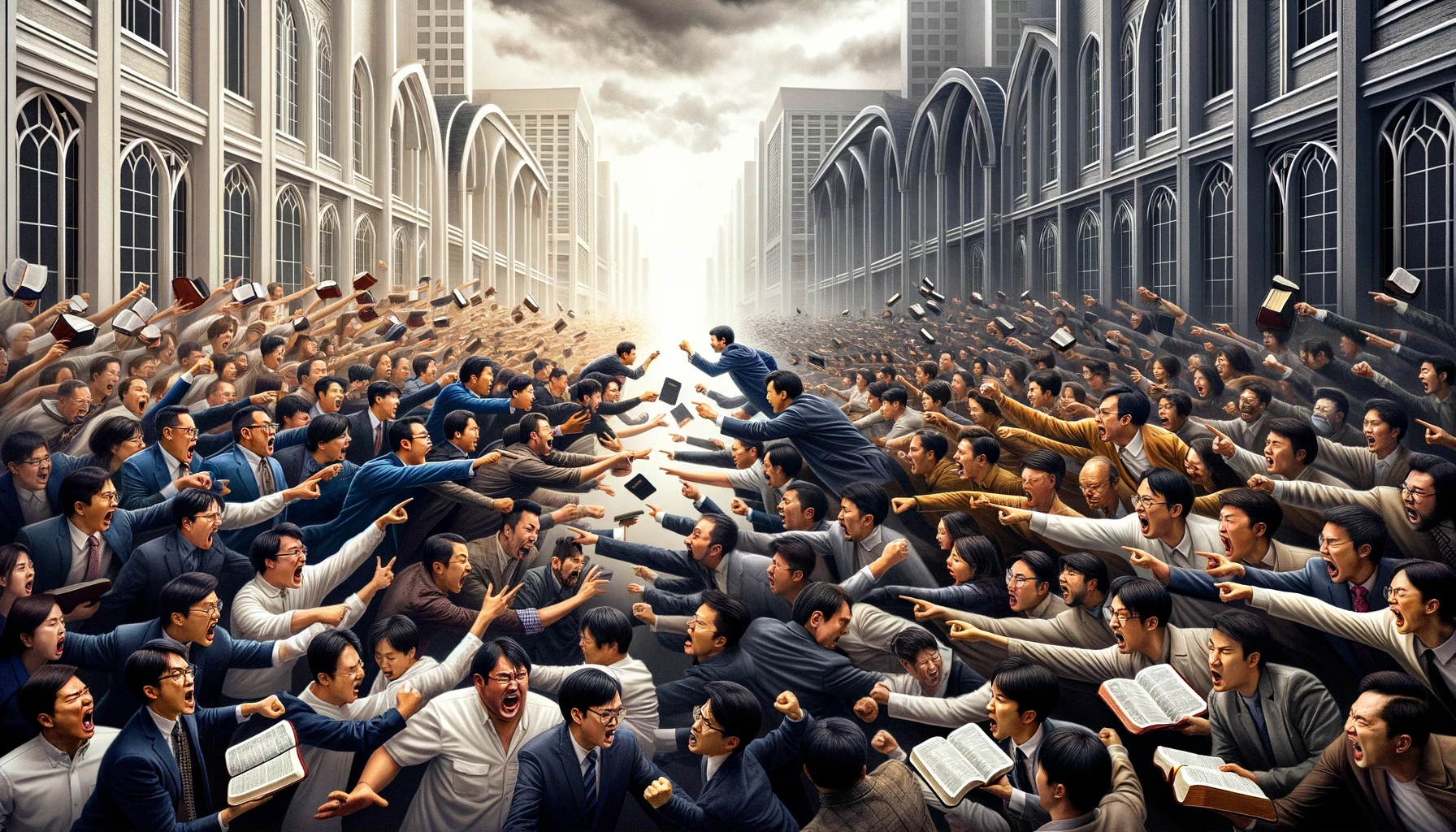
[Lesson 55] Figurative War Between Jerusalem and Babylon

by ichthus

The lesson discusses the figurative war between Jerusalem (representing God’s chosen people/church) and Babylon (representing the church influenced by demons/gentiles) prophesied to occur at the time of the Second Coming. This is not a physical war with weapons, but a war of doctrines and words, where the “weapon” to win is the word of testimony confirming the fulfillment of prophecies. Historically, physical Jerusalem broke their covenant with God, allowing Babylon to destroy them – foreshadowing the spiritual war to come. In Revelation, three wars are described: 1) The 7 churches lose to the beast/Babylon 2) God’s chosen “male child” overcomes the dragon/Satan with the blood of the Lamb and testimony 3) God’s kingdom wages war against Satan’s kingdom. The goal is to be part of the faithful “New Jerusalem/Mount Zion” by keeping the covenant, rather than being destroyed like unfaithful historical Jerusalem was by Babylon. The main focus is on understanding the spiritual/figurative meanings behind places like Jerusalem and Babylon in order to identify the participants and dynamics of this prophesied doctrinal war surrounding Christ’s return.


Study Guide SCJ Bible Study

Shincheonji holds distinct theological views that differ from mainstream Christian denominations, yet it also shares some common teachings. This overlap can sometimes blur the lines between their beliefs and those of traditional Christianity. Therefore, it is essential to exercise critical thinking and discernment to differentiate between these shared elements and the unique doctrines they present.

While their interpretations warrant careful examination through a critical and biblical lens, it is equally important to approach these matters with an open yet discerning mindset.

The following notes were documented in person during Shincheonji’s 9-month Bible Study Seminar. They provide insight into the organization’s approach to introducing and explaining its beliefs to potential new members, often referred to as the ‘harvesting and sealing.’ This process is described as being ‘born again’ or ‘born of God’s seed,’ which involves uprooting the old beliefs and replanting new ones. This uprooting and replanting must occur continuously. By examining this process, we can gain a better understanding of the mindset and beliefs held by Shincheonji members.

Figurative meanings:

War: War of doctrines    |   Weapon: Word of testimony

Jerusalem = Denomination (Church) of the Chosen People

Babylon = Denomination (Church) of the gentile, where demons swell

Review with the Evangelist

Memorization

Galatians 4:19

My dear children, for whom I am again in the pains of childbirth until Christ is formed in you,

Yeast of Heaven

Jesus answered, “The work of God is this: to believe in the one he has sent” John 6:29


Our Hope: Let’s belong to New Jerusalem, Mount Zion and become God’s Army of Hope!


Secrets of Heaven: Figurative War between Jerusalem and Babylon

I pray that everyone is excited about encountering the word. As we know, it’s always an exciting time when we’re able to learn something new in God’s word. And I pray that today will really help give us some context as to what we should be expecting in our time and evaluate or expand on the way God uses figurative language so that we aren’t confused or looking in the wrong direction from where things are happening.


So, what do we mean by figurative war? What do we mean by figurative Jerusalem? And what do we mean by figurative Babylon? That’s what we’ll be discussing today.

Let’s look at the type of war it is and the weapons that are used in that war. Jerusalem and Babylon, what do these represent?


Jerusalem represents the denomination or church of the chosen people. 

Babylon represents the denomination or church of the Gentiles where demons dwell, according to Revelation 18.


What is the figurative war? It is not a war fought with guns, bullets, swords, shields, arrows, and bombs – not that kind of war. Instead, it is a war of words, a war of doctrines that is fought at the time of the second coming.


As you’re considering this, you should already be thinking that you should not be looking at physical wars as evidence that things are happening. We’ll look into that as we study further, and what are the weapons that are fought with?


Of course, the weapons used in a war of doctrines are words, and the word that is used as a weapon on the good side is the word of testimony. This war is special because it is a testimony that ends arguments. Why? Because the details of who, what, when, where, why, and how are given.


That’s the weapon to win in a war of doctrines. When some are saying it may be like this and others are saying no, it may be like this, the word that says it is this supersedes them all. This is what we should be waiting for. This is what was fulfilled according to scripture, not what may be like, but what it was, what happened.


Does that make sense? So, at the time of the first coming, if someone said no, the virgin may be this person, everyone would say no, it was definitely Mary, it was definitely Mary and Jesus, and there’s no one arguing as to who the virgin and child is today. A very small group of people may still be arguing over something like that, but that has already been confirmed.


Does that make sense? That argument’s over, that war is done, we know. So, for revelation’s fulfillment, the same thing needs to happen as well. Keep in mind with Jerusalem and Babylon, you might be thinking, but there’s a place called Jerusalem today, and there was a place called Babylon in history.


Remember how prophecies work: Objects, People, Animals, Geographic locations, and Historic events (OPAGH). Geographic locations are also used figuratively in prophecy, and we’ll see that as well today.


Our hope should be to belong to New Jerusalem, also known as Mount Zion, and become God’s army of hope. A thing that is sorely lacking in our world today is hope, as there are many things that seem grim. People talk about the climate, the wars happening today, the economy. Many people feel like there is no cause for hope in our time, that it seems like things are falling apart all around us. And guess what? They are, because like we learned in the past lessons recently, an entity has been over this world, making our lives awful. That entity has been making our lives very difficult.


So, what does God want people to know? That He is still at work, that He is not asleep, that He is doing things today. And when people come to this understanding, their hearts quicken, and they get excited. I hope that’s how all of us have been feeling as we’ve been learning the open word so far. We’re getting excited. Oh my goodness, things are already taking place. This is not a time of waiting anymore but a time of doing, a time of running, a time of fleeing. So, let’s be those who can even spread that hope to other people as it is being spread to us.

Previous Lesson Review

Review

In the previous lesson, we learned about the figurative representations of the groom, bride, widow, and orphan. We understood that the groom is a spirit, and this spirit gives the seed to the flesh. The flesh then takes that seed and bears children with it. These children receive the seed, are born, and need to mature with that seed, coming to a complete understanding of it. This allows them to become brides themselves and bear more fruit, being fruitful and multiplying, just as the command worked physically in Genesis but also spiritually.


The brides are those who, like during the time of the first coming, follow the example set by Jesus, who was the promised bride in Hosea and the representative bride. Jesus taught others how to prepare themselves to be brides as well. Similarly, at the time of the second coming, as mentioned in Revelation, the spirit and the singular bride will train the other brides, just as the Apostle Paul says in 2 Corinthians 11:2, “I am jealous for you to become a pure and perfect virgin for Christ who is coming.” Everyone is a potential bride, but they need to learn from the representative bride who will teach them in the proper era when the master is returning.


Widows represent those who teach falsehoods, having betrayed the Holy Spirit, which is no longer with them. The congregation belonging to that betraying pastor also lacks the Holy Spirit and is fatherless, becoming spiritual orphans. This is what Jesus meant spiritually when he told us to take care of the widows and orphans in Matthew 25, in addition to the physical sense. We should help those whom the Holy Spirit has left due to betrayal, even if they do not realize they have betrayed, thinking, “God is our God. We follow the Bible. We follow the Word,” just like the people at the first coming.


Now, let’s discuss what it truly means to believe in Jesus, a topic often debated among Christians regarding the standard of belief. We should aim for a complete understanding, where every verse is accounted for in our explanation of believing in Jesus. We tend to oversimplify and focus on one verse while ignoring others, which is a mistake. Our explanation should fit and match all relevant verses, forming a single, cohesive understanding. Does the importance of this make sense?


About the Test

Question 9: Give the three conditions people must meet for their sins to be forgiven.


And the answers:

  1. We must drink the blood of Jesus (Matthew 26:28; John 6:53-57).
  2. We must understand the parables (Mark 4:10-12).
  3. We must keep the new covenant (Hebrews 8:10-12).


Now, I pray that as we’re going through the test, we’re not just memorizing the answers and moving on, but we’re going through and reading the verses as well, really trying to understand why the answer is the answer. This is what I mean about having a complete understanding where every single verse matches, and it makes sense. Believing in Jesus is much more than believing that he existed.


That’s the floor. That’s the ground. That’s the foundation. Believing that he existed is the smallest, lowest bar to jump over. Most people stop here, “I believe that he existed, but I don’t know much about him. What?


The demons believe that he existed. They believe in him and God. Is our standard the demons?

James 2:19 

You believe that there is one God. Good! Even the demons believe that—and shudder.

The demons also believe in God’s existence and tremble, right? So obviously, believing in God’s existence is the first requirement.


However, the demons merely believe that God exists; they do not submit to Him or have a relationship with Him. They chose separation from God. So how can we, as humans, do better than the demons? Believing in God’s existence is the starting point, but we must go beyond that by choosing to have a relationship with Him and submit to His will, rather than separating ourselves from Him like the demons have done.

Romans 10:6-10

6 But the righteousness that is by faith says: “Do not say in your heart, ‘Who will ascend into heaven?’” (that is, to bring Christ down) 7 “or ‘Who will descend into the deep?’” (that is, to bring Christ up from the dead). 8 But what does it say? “The word is near you; it is in your mouth and in your heart,” that is, the message concerning faith that we proclaim: 9 If you declare with your mouth, “Jesus is Lord,” and believe in your heart that God raised him from the dead, you will be saved. 10 For it is with your heart that you believe and are justified, and it is with your mouth that you profess your faith and are saved.

.

The passage mentions “the word” in verse 8. Some versions might use the term “word” instead of “message.” It states that “the word is near you.” The question then arises: What is it that people are to confess? How can one confess “the word” concerning Christ? According to verse 17, there is a prerequisite for a person to be able to confess “the word.”

Romans 10:17

Consequently, faith comes from hearing the message, and the message is heard through the word about Christ.

You must hear the word first before it is even possible to have faith, before it is even possible to confess. You must hear the word first, then when someone hears that word, the hearing of that word builds faith, and then a person can confess that Christ is the Lord. Well, if we look back at the test question, what is the test question really explaining? Can we confess? Let’s go back to the test question.


Let me go back to the test question. What is number one: We must drink the blood of Jesus. What is the blood of Jesus, everyone? Okay, what does it mean to understand the parables? Where are the parables taught in detail? Oh, got it. What about number three: We must keep the new covenant. Where is the new covenant detailed, everyone? So, we’re understanding in more detail.


We’re breaking it down. We need to understand all of Jesus’s words – what he said, what he did, what he promised, what are we waiting for? That’s what we need to believe in, not a faith that is flimsy. Many people, all it takes is a small trial, and their faith is gone because it’s not based on something solid – an understanding of the word and an understanding of who Jesus is and what he came to do. That’s what people need to hear and understand. And in our time, Jesus’s words are coming to life, so things will be a little bit different for us than those for which 2,000 years passed before Jesus’s words came to pass.


God and Jesus are going to hold us to a slightly different standard, as if we lived at the time of Noah, for example. The people at that time needed to get on the ark – that was their standard of salvation. You don’t get on the ark, you die. If you were in Egypt, put the blood on your doorframes and quickly exit Egypt, eat the lamb. If you don’t, your son dies, and then you die with Egypt. Get to the promised land, or you die in the desert. What are God’s instructions for us today? That’s our focus in the course. Are we understanding? Not different, more detail. This is important to talk about so that we are not confused.

Main Reference

Luke 21:20-21

20 “When you see Jerusalem being surrounded by armies, you will know that its desolation is near. 21 Then let those who are in Judea flee to the mountains, let those in the city get out, and let those in the country not enter the city.

When you see Luke 21, you should think, “Oh, that sounds very familiar. It’s the same story as Matthew 24.” Luke 21 and Matthew 24 share a similar narrative. In this story, what did it say the people should do when they see armies surrounding Jerusalem? It said they should flee to the mountains.


This sounds familiar, just like Matthew 24:15-16, where the abomination enters the holy place. It’s the same armies, the same abomination, and the same destination they’re instructed to flee to – the mountains. Let’s break down the Jerusalem that people need to flee from and the Jerusalem they need to flee to.


Before we proceed, I want to quickly review a description from the Book of Revelation that will help us understand how geography is often used figuratively in prophecy.

Revelation 11:8

Their bodies will lie in the public square of the great city—which is figuratively called Sodom and Egypt—where also their Lord was crucified.

The passage in Revelation 11 mentions the two witnesses being killed in the ‘great city,’ which is figuratively called Sodom, Egypt, and the place where their Lord was crucified (Golgotha). These locations are not geographically close or even from the same time period. Therefore, the ‘great city’ in Revelation 11, and the Book of Revelation in general, must be understood figuratively or symbolically, rather than literally.


The ‘great city’ represents characteristics similar to Sodom, Egypt, and Golgotha in their spiritual or moral nature, rather than their physical locations. Just as places like Jerusalem, Israel, Mount Zion, and Babylon have distinct characteristics, the ‘great city’ mentioned in the prophecy will manifest the same characteristics as these historical places during the time of fulfillment.


This means we should not focus on identifying literal places with the same names today, as they may not embody the characteristics God intended when making the prophecy. To understand the figurative meaning of ‘Jerusalem,’ we need to examine its historical context and spiritual significance.


Figurative Jerusalem

1. Physical Jerusalem

We will examine the historical and physical Jerusalem, and draw connections to understand the spiritual significance that Jerusalem figuratively represents. 

2 Samuel 5:4-10

4 David was thirty years old when he became king, and he reigned forty years. 5 In Hebron he reigned over Judah seven years and six months, and in Jerusalem he reigned over all Israel and Judah thirty-three years.

6 The king and his men marched to Jerusalem to attack the Jebusites, who lived there. The Jebusites said to David, “You will not get in here; even the blind and the lame can ward you off.” They thought, “David cannot get in here.” 7 Nevertheless, David captured the fortress of Zion—which is the City of David.

8 On that day David had said, “Anyone who conquers the Jebusites will have to use the water shaft to reach those ‘lame and blind’ who are David’s enemies.” That is why they say, “The ‘blind and lame’ will not enter the palace.”

9 David then took up residence in the fortress and called it the City of David. He built up the area around it, from the terraces inward. 10 And he became more and more powerful, because the Lord God Almighty was with him.

Wow, how awesome David was! When God is with someone, that person is unstoppable. David helped establish and take back parts of the promised land from the Gentiles, and he established them as cities of David, also known as the city of God. This is where the chosen people gathered and placed their stand – that’s the history. However, Israel went through many changes and quite a bit of strife over their history. Many things happened to this nation of chosen people, who also go by a few different names figuratively in prophecy. 


When looking figuratively, when you see Israel, Judah, Jerusalem, or Zion, think of the chosen people or God’s dwelling place. Wherever God’s current chosen people are, there He is among them. Those who have His covenant become His chosen people. So the covenant must be established between them, and that place is called Jerusalem, His chosen people. This was the history, but let’s now look at Jerusalem spiritually.


2. Spiritual Jerusalem

Jeremiah 3:17

At that time they will call Jerusalem The Throne of the Lord, and all nations will gather in Jerusalem to honor the name of the Lord. No longer will they follow the stubbornness of their evil hearts.

ONE – The verse starts with a famous phrase from that era, indicating we are reading a prophecy. This means figurative language is being used. Jerusalem is referred to as the throne of God, representing wherever God’s presence resides, rather than the physical geographical location bearing that name. 

The real Jerusalem, from God’s perspective, is the place where His throne currently dwells. Importantly, people often do not realize that God’s throne can move to those who are obeying His covenant. Let us now examine the book of Zechariah.

Zachariah 8:3

This is what the Lord says: “I will return to Zion and dwell in Jerusalem. Then Jerusalem will be called the Faithful City, and the mountain of the Lord Almighty will be called the Holy Mountain.”

TWO – Then God will return to Zion, return to Jerusalem, and that place will be called the city of truth, the mountain. God is using a lot of figurative language that we’ve studied, isn’t He? Who is it that God returned to? Was it everyone, including those that shunned and killed His Son? 

He certainly tried, but He came to that which was His own, but His own did not receive Him. So, who did He come to instead? 


Those who did, those who accepted His Son who appeared, those who decided, “I’m going to keep my covenant with God.” That’s who God wants to establish as a city of truth. This is the reason why Jesus said to His disciples in Matthew 5, “A city on a hill is not easily hidden, why? 


Because it’s on a hill, similar to a mountain. Is that an accident? No, of course not, like a mountain, so God’s dwelling place becomes His Jerusalem, very important. Let’s see how God also describes another special kind of Jerusalem in the book of Revelation.

Revelation 21:1-2

Then I saw “a new heaven and a new earth,”[a] for the first heaven and the first earth had passed away, and there was no longer any sea. 2 I saw the Holy City, the new Jerusalem, coming down out of heaven from God, prepared as a bride beautifully dressed for her husband.

Then I saw the holy city, the new Jerusalem. Pay attention, the holy city, new Jerusalem, is coming down out of heaven from God, and it will come to the place where the Lamb is, Revelation 14, Mount Zion. So the Jerusalem up there, God’s holy city, will join the Jerusalem down here, and they will become one. That’s God’s intention. Are you understanding the logic? Is it making sense? I don’t see any hands, so we’ll keep going. Okay, what about Babylon? Let’s look at Babylon, its history, and its spiritual meaning in Revelation.


Figurative Babylon

We know that Babylon is not a good place. The word ‘Babel’ or ‘Babylon’ means ‘mixed’ or ‘confusion.’ This should remind us of the time of Genesis, where the story of the Tower of Babel represents the confusion of languages. In Revelation 17:5, we see that a person gains the title of ‘mother of prostitutes’ and is also called ‘Babylon.’ 


This figurative language represents the fulfilment of the prophecy and parable of Babylon, which symbolizes confusion and mixing of truth with lies and false hope. The word ‘Babylon’ here serves as a lesson, pointing back to the era of Genesis and the open rebellion against God, now sealed in the form of this symbolic ‘mother of prostitutes.’

Revelation 17:5

The name written on her forehead was a mystery:

babylon the great

the mother of prostitutes

and of the abominations of the earth.

The title ‘prostitute’ was given to represent Babylon. Let’s understand why this figurative title was given and what it represents for us. The prostitute represents Babylon, although she is called a ‘mother,’ which means that she gives birth to children who also become part of Babylon. So, how can we avoid the Babylon that is prophesied to appear at the time of the second coming? We can avoid it by understanding why it’s called that. Let’s now look at the historical, physical Babylon from that time era.


1. Physical Babylon from history

2 Kings 24:10-14

10 At that time the officers of Nebuchadnezzar king of Babylon advanced on Jerusalem and laid siege to it, 11 and Nebuchadnezzar himself came up to the city while his officers were besieging it. 12 Jehoiachin king of Judah, his mother, his attendants, his nobles and his officials all surrendered to him.

In the eighth year of the reign of the king of Babylon, he took Jehoiachin prisoner. 13 As the Lord had declared, Nebuchadnezzar removed the treasures from the temple of the Lord and from the royal palace, and cut up the gold articles that Solomon king of Israel had made for the temple of the Lord. 14 He carried all Jerusalem into exile: all the officers and fighting men, and all the skilled workers and artisans—a total of ten thousand. Only the poorest people of the land were left.

A tragedy took place with the people of Israel, and something must have happened for God to allow this to happen to them. What happened to the people of Israel that God allowed gentile nations to consume them? They were not worshipping gentile gods outside of Israel in a different country; instead, they brought those gentile gods into Israel and built temples for them within Israel. This happened during the time of Solomon, as mentioned in 1 Kings 11. God was very upset because they broke the first commandment: “Do not worship any other gods before me.” The first rule of the law, the covenant, was broken in a significant way, not just with the golden calf incident long ago, but by bringing those gods into Israel. God was not happy.


So, what happened to Israel after the betrayal mentioned in 1 Kings 11? Consider the sea, the water on the west, and the north at the top. Israel is in the north, and Judah is in the south. After Solomon’s betrayal, God split the nation into two: northern Israel took 11 of the 12 tribes, and southern Judah was, of course, the tribe of Judah. Jerusalem is actually located in the south.


Interestingly, in the north, we had places like Samaria and Galilee. We should start thinking about the time of Jesus, as there was strife between those in the south in Jerusalem and elsewhere, wondering, “Why is Christ up there with those gentile people?” There was a lot of strife.


Israel was split into two: northern Israel and southern Judah. What happened next? Babylon and other gentile nations invaded the two. The primary gentile nations that invaded were Babylon and Assyria. Babylon invaded the south, as we read in 2 Kings 24, and the nation of Assyria invaded the north. Those in the north, the 11 tribes, were much more likely to intermarry with the gentile nations that invaded them. By the time of Jesus, people in Samaria were not seen as true Jews, which is why they didn’t talk to each other. Those who considered themselves true Jews went to the south, while everyone else stayed in the north. There was so much historical drama.


What are we understanding here? When they broke the covenant, betrayal of the covenant, God allowed them to be destroyed. Babylon, in history, was one of the nations that destroyed God’s chosen people. Of course, spiritual Babylon in the book of Revelation will do a similar thing, but this time spiritually.


You can read about Assyria’s invasion of the north in 2 Kings 17.


2. Spiritual Babylon

Revelation 18:2-4

2 With a mighty voice he shouted:

“‘Fallen! Fallen is Babylon the Great!’[a]

    She has become a dwelling for demons

and a haunt for every impure spirit,

    a haunt for every unclean bird,

    a haunt for every unclean and detestable animal.

3 For all the nations have drunk

    the maddening wine of her adulteries.

The kings of the earth committed adultery with her,

    and the merchants of the earth grew rich from her excessive luxuries.”

4 Then I heard another voice from heaven say:

“‘Come out of her, my people,’

    so that you will not share in her sins,

    so that you will not receive any of her plagues;

At the time of the second coming, a place called Babylon appears. This Babylon is a home for demons and a haunt for every evil spirit. As we read in verse 4, this place captures God’s people, just like the historical Babylon captured God’s chosen people at the time of the revelation’s fulfillment. Just as the historical Babylon did the same thing, God says in verse 4, “Come out of her, my people, so that you will not share in her sins.

Quick Review

Quick Review

What we’ve covered so far is the figurative war between Jerusalem and Babylon. We’re looking at how Jerusalem, in the Revelation’s time, represents a denomination or church of the chosen people, and Babylon represents the denomination or church of the Gentiles, the home of demons, the place that God and Jesus are calling people out of. The war that is going to be fought is not a war of guns and bullets but a war of doctrines, a war of words, and the weapon to win is the word of testimony. 


The main reference we looked at is Luke 21:20-21, which is the same as Matthew 24, where Jesus was asked about the signs of His coming and the end of the age. Jesus gives a similar explanation: the armies or the abomination invades Jerusalem or the holy place, Judea, and those who are there need to flee to the mountains. We know that geographic locations are also used figuratively in prophecy to explain that a place must appear that has similar characteristics to the place in the past, so we can learn about the past to understand and identify the current correctly.


Figurative Jerusalem, if we look at the physical Jerusalem in history, was the place of God’s chosen people, those who received God’s covenant, but they broke His covenant. We’ll talk about that in just a moment. There’s also a spiritual Jerusalem that has been promised to appear, the place that is the throne of God, His city of truth, the mountain, and even in Revelation’s time, a spiritual Jerusalem is talked about – the holy city, new Jerusalem, that is heaven in the spiritual world, promised to come down (Revelation 21).


What about Babylon that destroys Jerusalem? Babylon is called the prostitute but is also the prostitute’s children as well. The physical Babylon in history was one of the Gentile nations that destroyed God’s chosen people after their betrayal of God. Assyria was another one of those nations. Spiritual Babylon from Revelation 18 will do a similar thing, destroying God’s chosen people, and people will then need to come out in order for the salvation that Jesus promised to take place. So, let’s understand how this war will shape out.


Figurative War

We know that the biblical wars take place on two fronts: the spiritual realm above and the physical realm below. Those who belong to Satan fight against those who belong to God.


In this war and battle, they use words spiritually. From God’s perspective, the place that belongs to God is called Israel, Jerusalem, Zion, or Judah. However, the place that does not belong to God is figuratively called Babylon, Egypt, or Syria. As we look in the book of Revelation, we should think not of a physical nation that is part of the United Nations, but rather a chosen people that God decides Satan tries to destroy.


Now, let’s examine the type of war being fought.

Matthew 24:6-8

6 You will hear of wars and rumors of wars, but see to it that you are not alarmed. Such things must happen, but the end is still to come. 7 Nation will rise against nation, and kingdom against kingdom. There will be famines and earthquakes in various places. 8 All these are the beginning of birth pains.

The mention of birth pains is found in another similar place, referring to the same concept. In Matthew 24:6-8, it is prophesied that there will be wars and rumors of wars, and nation will go against nation. This has often been interpreted literally.


However, consider this: these words are 2,000 years old. How many wars have been fought in the last 2,000 years? It’s an innumerable amount of wars, so much so that even historians argue with each other about the exact number of physical wars that have taken place over the last 2,000 years. It’s a vast number of wars, and people of that time, when a war was happening, would often equate the great war they were experiencing physically with the coming of Christ. Yet, Christ did not come. World War I was thought to represent the coming of Christ, but still waiting. World War II was thought to represent the coming of Christ, but still waiting. Certainly, any current war today is thought to represent the coming of Christ, but still waiting. So, is this a physical representation? What was Matthew 24 compared to? It was a mini revelation, and Jesus was prophesying about what would come at the sign of his second coming.


Hear this well, everyone: no one knows, not the angels of heaven, and not the Son of Man, as Jesus said, but only God in heaven. This means we cannot predict the exact date that it will take place. Anyone who claims it will happen on a specific date will definitely be wrong, most certainly wrong. But what did Jesus say? You will notice the signs and know that it is near, meaning when things start to be fulfilled, that should ring in your head, “Oh, the coming is near.” Have things begun to be fulfilled? Yes.


So, what should that mean for us? It’s time to get to work. We must sow. Which nations are going to war spiritually? Jerusalem and Babylon are going to war, but which Jerusalem and which Babylon? And what type of war will be waged between these two spiritual nations, not physical nations, but spiritual nations? And what is a spiritual nation?


A spiritual nation is like a denomination or a church, and a nation is often ruled by a leader like a kingdom, and the king is like a pastor. So, this war is not against nations of the UN or any specific country, but a people who believe they belong to God. They go to war, and it’s not a war of bullets and guns but a war of words, a fierce and furious battle of words. 

Okay, so how do we understand this in a little bit more detail? Let’s look at how Paul describes the war that must take place, the war that we are waged in, for it is not the same as the way the world wages its wars.

Ephesians 6:10-12

10 Finally, be strong in the Lord and in his mighty power. 11 Put on the full armor of God, so that you can take your stand against the devil’s schemes. 12 For our struggle is not against flesh and blood, but against the rulers, against the authorities, against the powers of this dark world and against the spiritual forces of evil in the heavenly realms.


2 Corinthians 10:3-6

3 For though we live in the world, we do not wage war as the world does. 4 The weapons we fight with are not the weapons of the world. On the contrary, they have divine power to demolish strongholds. 5 We demolish arguments and every pretension that sets itself up against the knowledge of God, and we take captive every thought to make it obedient to Christ. 6 And we will be ready to punish every act of disobedience, once your obedience is complete.

What kind of war are we waging? Everyone, it is a spiritual war. This is the reason we need to be armored, as mentioned in Ephesians 6. And what is our sword in that war? Verse 17 states that our sword is the word of God. Of course, and we use the word of God to do what? To demolish arguments and demolish falsehood with the truth. We understand, and we make every thought obedient to Christ, like that. 


Oh, I realize this is not correct; throw it out. No, thank you, no more. Oh, but I thought it was like this. Oh, but the word says this. Let me take the word and do this: throw it out so that I can be right with the word and right with Christ, and be part of God’s army of hope, not the ones fighting against God because I didn’t understand, but fighting with God in that battle. There is certainly a battle that takes place at the time of revelation. In the book of Revelation, three wars are detailed.


Three Wars in Revelation


There are really two main wars discussed, but the second and third are very similar and can be seen as continuations of each other. So, we’ll consider them as three distinct wars.


ONE – The notes seem to be raising the question: “What is the first war and what plays out in this first war?” 

It then indicates that we will examine the combatants involved in this war by looking at Revelation 1:20, which likely identifies “the ones that this war is fought between.”

Revelation 1:20

The mystery of the seven stars that you saw in my right hand and of the seven golden lampstands is this: The seven stars are the angels of the seven churches, and the seven lampstands are the seven churches.

Jesus is holding in his right hand the seven stars, also known as the seven lampstands, representing the seven churches. We’ll understand this in more detail as we continue to study, but keep this in mind: the seven stars were the ones that Jesus was initially working with. However, something happened to these seven stars. In Revelation 2 and Revelation 3, Jesus breaks down what they did well and what they did not do well. 


The reason why the letters were written is that Jesus said things like, “I know your deeds, I know your hard work and your perseverance, yet I hold this against you: you have forsaken your first love. Repent and do the things you did at first.” 


What does that sound like? Remember the three events of revelation: rebellion, betrayal. That’s what happens to these people, and when that happens, like Israel of the past, their veil of protection goes down like this (goes down). 


When they refuse to repent, then who comes in to destroy them? Babylon. Are we understanding? Does that make sense? So, the first war is fought between the seven stars. Unfortunately, they betray, and who comes in to destroy them? The beast with seven heads and ten horns.

Revelation 13:6-7

6 It opened its mouth to blaspheme God, and to slander his name and his dwelling place and those who live in heaven. 7 It was given power to wage war against God’s holy people and to conquer them. And it was given authority over every tribe, people, language and nation.

The beast with seven heads and ten horns enters a place called heaven (verse 6). He opened his mouth to blaspheme God and to slander His name, His dwelling place Jerusalem, and those who live in heaven. These people are unable to overcome the beast, for they said in verse 8, “All the inhabitants of the earth will worship the beast, all whose names have not been written in the book of life belonging to the Lamb that was slain from the creation of the world.” Even in verse 4, it says, “Who is like this beast? Who can make war against him?” They lose who wins in the first battle: Satan.


They lose that first war. What about the second war that plays out in Revelation?


TWO – God does not take it lightly when His chosen people are destroyed. God avenges and extracts those few who are holy, so that He can fight and defeat Satan. This happens in the second war.

In Revelation 12, we are quickly introduced to those who are fighting in this war. 

Revelation 12:3-5

3 Then another sign appeared in heaven: an enormous red dragon with seven heads and ten horns and seven crowns on its heads. 4 Its tail swept a third of the stars out of the sky and flung them to the earth. The dragon stood in front of the woman who was about to give birth, so that it might devour her child the moment he was born. 5 She gave birth to a son, a male child, who “will rule all the nations with an iron scepter.” And her child was snatched up to God and to his throne.

In verse 3, it mentions an enormous red dragon with seven heads and ten horns, which must be the same beast from Revelation 13. This dragon with seven heads and ten horns tries to destroy a special individual. 


Let’s read about this special individual in verses 4 and 5. The dragon’s tail swept a third of the stars out of the sky and flung them to the earth. The dragon stood in front of the woman who was about to give birth, so that he might devour the child the moment it was born. This sounds familiar, doesn’t it? Satan doesn’t change his tactics; he has been doing the same thing for thousands of years – kill it before it can destroy me, kill it when it’s a baby. He has been doing the same thing from the beginning.


Verse 5 states that the woman gave birth to a son, a male child who will rule all the nations with an iron scepter. This is interesting; the iron scepter should ring a bell, and we should be thinking of something else, another place where we heard about an iron scepter, as we have studied, so that we can identify who the male child actually is. Who is this male child that receives an iron scepter?


Revelation 12 introduces those who are fighting in this war.

Revelation 2:26-27

26 To the one who is victorious and does my will to the end, I will give authority over the nations— 27 that one ‘will rule them with an iron scepter and will dash them to pieces like pottery’—just as I have received authority from my Father.

This provides evidence to help us understand who the one who overcomes is. Is it one who overcomes, or is it those that overcome? Is it multiple people, or is it one? One way we can identify and know for sure is what was given both to the male child and the one who overcomes – the iron scepter. This represents that it is actually one who overcomes.


Like a male child, he then fights against the dragon. We see this war take place in Revelation 12, and by God’s grace, the male child is not alone in this war. The dragon, of course, is in the spiritual world, but we should be thinking of it as a figurative representation with seven heads and ten horns. However, the male child is not alone either.


So, let’s go back to Revelation 12 and see who else is helping the male child.

Revelation 12:10-11

10 Then I heard a loud voice in heaven say:

“Now have come the salvation and the power

    and the kingdom of our God,

    and the authority of his Messiah.

For the accuser of our brothers and sisters,

    who accuses them before our God day and night,

    has been hurled down.

11 They triumphed over him

    by the blood of the Lamb

    and by the word of their testimony;

they did not love their lives so much

    as to shrink from death.

Glory to God, they overcame the dragon’s group by the blood of the lamb, which represents everyone, and the word (Bible) and the word of their testimony. We keep saying “word” and “testimony,” so it must be important. It must be the weapon to win in the war, as mentioned in Revelation 12:11. Please note this and make it a big point in your notes: the weapon to win in this fight of Revelation is the blood of the lamb plus the word of testimony.


The blood of the lamb and the word of testimony, that’s the weapon to win. You are the reality of the beast with seven heads and ten horns. You invaded and destroyed God’s chosen people. The chosen people are the ones being destroyed. Wake up! That’s what the testimony sounds like, so people can realize, “Wait a minute, am I this verse right here? Huh? Am I this verse?” Their actions identify who they are.


THREE – The third war that is fought is mentioned in Revelation 16. In Revelation 12, when Satan loses, he gets angry and stands on the seashore, gathering up the armies of the world to go against God and His chosen people – the new chosen people that God establishes. They will make war against the Lamb, but they will not overcome the Lamb. This third war is detailed in Revelation 16 and Revelation 17:14, where God’s kingdom, the Kingdom of God, goes to war against the kingdom of the devil, the Kingdom of the Dragon, in Revelation chapters 16 and 17.


We have covered a lot of new content today, and we will revisit this content many more times as we continue to study.


Memorization

Revelation 12:11 

They triumphed over him by the blood of the Lamb and by the word of their testimony; they did not love their lives so much as to shrink from death.

Instructor Review

SUMMARY


The figurative war between Jerusalem and Babylon represents the conflict between the denomination of the church of God’s chosen people (Jerusalem) and the denomination of the church of the gentiles, influenced by demons (Babylon). Historically, Jerusalem stood for God’s chosen people who had received His covenant but unfortunately did not keep it. As a result, God allowed them to be destroyed by Babylon. This historical event was noted by God and used prophetically to foreshadow what would happen at the second coming of Christ, as Jesus himself prophesied in Matthew 24 and Luke 21, saying that “nation will go against nation, kingdom against kingdom.” This war would not be fought with physical weapons but with words of doctrine.

In the first war, the betrayers (Jerusalem) lost to the destroyers (Babylon). However, in the second war, the destroyers will lose to those whom God and Jesus are working through, those who do the work of salvation. They will overcome with the blood of the Lamb and the word of their testimony. Therefore, we should strive to be part of Mount Zion in this war, as Satan is intensifying his efforts to destroy anyone who hears this word now. We pray that Satan will not destroy you.

Let’s Us Discern

A Refutation Using “Testing Shincheonji’s Claims: Two Lenses, One Story”

SCJ Intermediate Level – Lesson 55: “Secrets of Heaven: Figurative War between Jerusalem and Babylon”


Introduction: The War You Didn’t Know You Were Fighting

Imagine you’re watching the evening news with a friend. The headlines scroll past: conflicts in the Middle East, political tensions, economic uncertainty. Your friend turns to you and says, “You know, none of that matters. The real war isn’t what you’re seeing on TV.”

“What do you mean?” you ask.

“There’s a spiritual war happening right now,” he explains, “but it’s not the kind most Christians think. It’s not about prayer and spiritual warfare like your church teaches. It’s a war of doctrines—a battle between two churches, Jerusalem and Babylon. And most Christians don’t even know which side they’re on.”

This sounds intriguing. After all, the Bible does talk about spiritual warfare, and Revelation does mention Babylon. Your friend continues: “The weapons in this war aren’t guns or bombs—they’re words. Specifically, testimony. Not just any testimony, but testimony that gives the who, what, when, where, why, and how of prophecy fulfillment. That’s the weapon that ends all arguments.”

At first, this seems to make sense. The Bible does emphasize the importance of testimony. Revelation 12:11 says believers “triumphed over him by the blood of the Lamb and by the word of their testimony.” And you’ve often wondered about the specific details of how prophecy is fulfilled. Maybe your friend is onto something.

But then he adds: “The problem is, most Christians are looking at physical wars as signs of the end times. They’re looking in the wrong direction. They don’t understand that Jerusalem and Babylon aren’t physical places—they’re churches. Jerusalem is the church of the chosen people, and Babylon is the church where demons dwell. And right now, this war is happening, but you can’t see it unless you understand the figurative language.”

You feel a slight unease. This doesn’t quite match what you’ve learned about Revelation, but you can’t articulate why. Your friend seems so confident, so knowledgeable. And he’s using Bible verses. Surely he must be right?

This is what happens in SCJ Intermediate Level – Lesson 55: “Secrets of Heaven: Figurative War between Jerusalem and Babylon.”

The lesson appears to be a straightforward Bible study about spiritual warfare, using biblical language about Jerusalem and Babylon. The instructor, Nate, walks students through Scripture passages, discusses figurative language, and encourages them to understand prophecy correctly so they won’t be “looking in the wrong direction.” Everything seems biblical, thoughtful, and spiritually mature.

But beneath the surface, something else is happening. This lesson is strategically positioned in the Intermediate Level curriculum—a critical juncture where students have already completed the Introductory Level (Parables) and are now being prepared for the Advanced Level (Revelation). By Lesson 55, students have invested months of study. They’ve accepted foundational SCJ premises: that the Bible was “sealed,” that parables require special interpretation, that figurative language needs expert explanation, and that most Christians misunderstand prophecy.

Now, in Lesson 55, SCJ introduces a framework that will become central to their entire theological system: the war between Jerusalem and Babylon. This isn’t just about understanding symbolism—it’s about redefining reality itself. Students are being taught that the real spiritual battle isn’t what they see in the world or experience in prayer. It’s a doctrinal war between two organizations, and the “weapon” that wins is SCJ’s specific testimony about how Revelation was fulfilled in their organization.

By the time students realize where this teaching leads—to the claim that Shincheonji is “Jerusalem” and all other churches are “Babylon”—they’ve already accepted the framework. They’ve learned to distrust their own discernment (“you’re looking in the wrong direction”), to dismiss physical evidence (“this isn’t about physical wars”), and to believe that detailed testimony about specific fulfillment is the ultimate proof of truth.

The war metaphor is particularly powerful because it creates urgency, sides, and stakes. Wars have winners and losers. Wars require choosing a side. And in SCJ’s framework, choosing the wrong side means being in “Babylon”—the church where demons dwell.

But is this framework biblical? Does Scripture actually teach that there’s a current “war of doctrines” between two churches called Jerusalem and Babylon? Does the Bible say that detailed testimony about who, what, when, where, why, and how is the weapon that ends all arguments? And most importantly, should Christians be looking for this kind of war at all?

Let’s examine Lesson 55 through the Two Lenses framework from “Testing Shincheonji’s Claims: Two Lenses, One Story”—using both the Reflectional Lens (understanding how this teaching affects students psychologically and spiritually) and the Discernment Lens (testing whether this teaching aligns with Scripture and sound doctrine). We’ll see how SCJ takes legitimate biblical concepts—spiritual warfare, Jerusalem, Babylon, testimony—and subtly reshapes them into a framework that serves their organization’s claims while leading students away from orthodox Christian faith.


Part 1: The Reflectional Lens—Understanding the Psychological Framework

The Strategic Positioning of Lesson 55

As Chapter 3 of “Testing Shincheonji’s Claims: Two Lenses, One Story” explains, SCJ’s curriculum is carefully designed to build layer upon layer of indoctrination. Lesson 55 sits at a critical juncture in this process. Students have completed the Introductory Level, where they learned that:

  • The Bible was “sealed” and incomprehensible without special interpretation (Parables lessons)
  • Figurative language requires expert explanation (OPAGH framework)
  • Most Christians misunderstand Scripture because they read “literally”
  • There’s a special group who understands the “open word”

Now, in the Intermediate Level, students are being prepared for the Advanced Level (Revelation), where they’ll learn that Shincheonji is the fulfillment of biblical prophecy. But students can’t be told this directly yet. They need a framework—a way of thinking about reality—that will make SCJ’s claims seem logical when they’re finally revealed.

This is where the “Figurative War between Jerusalem and Babylon” comes in.

The War Metaphor: Creating Urgency and Binary Thinking

Notice how Lesson 55 opens with a prayer: “I pray that everyone is excited about encountering the word… And I pray that today will really help give us some context as to what we should be expecting in our time and evaluate or expand on the way God uses figurative language so that we aren’t confused or looking in the wrong direction from where things are happening.”

This introduction does several things simultaneously:

  1. Creates anticipation: “Encountering the word” sounds spiritual and exciting
  2. Promises clarity: Students will learn “what to expect in our time”
  3. Introduces doubt: Students might be “confused or looking in the wrong direction”
  4. Positions the instructor as guide: Nate will help them avoid looking in the wrong direction

As Chapter 12 of “Testing Shincheonji’s Claims: Two Lenses, One Story” explains in the section on “The Language of Certainty,” SCJ instructors use confident, authoritative language to create the impression that they possess special knowledge. The phrase “what we should be expecting in our time” implies that Nate knows what’s happening right now in God’s prophetic timeline—a claim that should immediately raise questions, but students have been conditioned to trust the instructor’s expertise.

The war metaphor itself is psychologically powerful. Wars create:

  • Urgency: Wars are happening now, requiring immediate response
  • Binary thinking: You’re either on one side or the other; neutrality isn’t an option
  • Group identity: Wars unite people on the same side against a common enemy
  • Moral clarity: One side is right, the other is wrong; one is good, the other is evil
  • Existential stakes: Losing a war has catastrophic consequences

By framing Christianity as a “war between Jerusalem and Babylon,” SCJ transforms faith from a relationship with God into a battle between organizations. This shift is subtle but profound. Students begin to think in terms of “which church is Jerusalem?” and “which church is Babylon?” rather than “am I following Jesus?”

The Redefinition Strategy: Taking Biblical Terms and Changing Their Meaning

Chapter 8 of “Testing Shincheonji’s Claims: Two Lenses, One Story” discusses how SCJ uses “The Redefinition Strategy”—taking familiar biblical terms and gradually changing their meaning. Lesson 55 is a masterclass in this technique.

Consider how the lesson redefines these terms:

Jerusalem: In the Bible, Jerusalem is a physical city with deep theological significance—the place where God’s temple stood, where Jesus was crucified and resurrected, and a symbol of God’s dwelling with His people. In Revelation, “New Jerusalem” represents the consummated kingdom of God, the bride of Christ, the eternal city where God dwells with His redeemed people (Revelation 21-22).

SCJ’s redefinition: “Jerusalem represents the denomination or church of the chosen people.”

Notice what happened. Jerusalem went from being a city with theological significance to being a “denomination or church.” This redefinition is crucial because later, students will be taught that Shincheonji is this “Jerusalem”—the church of the chosen people.

Babylon: In the Bible, Babylon is also a physical city that becomes a symbol of human pride, rebellion against God, and opposition to God’s people. In Revelation, “Babylon the Great” represents the world system opposed to God—a system characterized by idolatry, immorality, economic exploitation, and persecution of believers (Revelation 17-18).

SCJ’s redefinition: “Babylon represents the denomination or church of the Gentiles where demons dwell, according to Revelation 18.”

Again, notice the shift. Babylon went from being a symbol of the world system opposed to God to being “the denomination or church of the Gentiles.” This redefinition sets up a devastating conclusion: if Babylon is “the church of the Gentiles where demons dwell,” and if Shincheonji is “Jerusalem,” then what does that make all other churches? They become “Babylon”—places where demons dwell.

This redefinition strategy is particularly insidious because it uses biblical language while completely changing biblical meaning. Students hear “Jerusalem” and “Babylon” and think they’re learning about biblical concepts, but they’re actually being taught an organizational framework that will later be used to claim that Shincheonji is the only true church and all others are demonic.

The “Looking in the Wrong Direction” Technique

One of the most psychologically effective elements of Lesson 55 is the repeated emphasis that Christians are “looking in the wrong direction.” Notice these statements:

  • “You should already be thinking that you should not be looking at physical wars as evidence that things are happening.”
  • “Keep in mind with Jerusalem and Babylon, you might be thinking, but there’s a place called Jerusalem today, and there was a place called Babylon in history.”
  • “Geographic locations are also used figuratively in prophecy, and we’ll see that as well today.”

This technique serves multiple purposes:

1. It invalidates students’ existing understanding: If you’ve been taught that Jerusalem is a real city with prophetic significance, you’re now told you’re “looking in the wrong direction.” If you think physical wars might be signs of the times (as Jesus discussed in Matthew 24), you’re wrong.

2. It creates dependence on the instructor: If your natural understanding is wrong, you need someone to tell you the right direction to look. That someone is Nate and, by extension, Shincheonji.

3. It prepares students to dismiss evidence: When students later learn that Shincheonji claims to be “Jerusalem” and might think, “But that doesn’t make sense—Jerusalem is a real place,” they’ve already been taught that thinking about physical locations means they’re “looking in the wrong direction.”

Chapter 15 of “Testing Shincheonji’s Claims: Two Lenses, One Story” discusses “The Testimony Trap,” explaining how SCJ teaches students to distrust their own discernment and rely entirely on SCJ’s testimony. The “looking in the wrong direction” technique is a key part of this trap. Students learn that their instincts, their previous biblical knowledge, and their common sense are all unreliable. Only SCJ’s interpretation shows them the “right direction.”

The Hope Manipulation

Notice how the lesson manipulates the concept of hope:

“Our hope should be to belong to New Jerusalem, also known as Mount Zion, and become God’s army of hope. A thing that is sorely lacking in our world today is hope, as there are many things that seem grim. People talk about the climate, the wars happening today, the economy. Many people feel like there is no cause for hope in our time, that it seems like things are falling apart all around us. And guess what? They are, because like we learned in the past lessons recently, an entity has been over this world, making our lives awful.”

This paragraph is carefully constructed to:

1. Identify a real need: People genuinely do struggle with hopelessness in our world 2. Validate that feeling: “Things are falling apart all around us… They are” 3. Provide an explanation: An “entity” (Satan) has been making life awful 4. Offer a solution: Belonging to “New Jerusalem” (which will later be revealed as Shincheonji)

The manipulation lies in how hope is redefined. Biblical hope is confidence in God’s character, promises, and ultimate victory through Christ (Romans 5:1-5, 1 Peter 1:3-9). It’s rooted in what God has already done in Christ and what He promises to do in the future. This hope sustains believers through suffering because it’s anchored in God Himself, not in circumstances.

SCJ’s “hope” is different. It’s hope that comes from belonging to the right organization (“New Jerusalem”), from having the right knowledge (understanding the “open word”), and from being on the winning side of a doctrinal war. This hope is conditional and organizational rather than relational and Christ-centered.

The lesson continues: “So, what does God want people to know? That He is still at work, that He is not asleep, that He is doing things today. And when people come to this understanding, their hearts quicken, and they get excited.”

Again, this sounds biblical. Christians should believe that God is at work today. But notice the subtle shift: the excitement comes from “understanding” what God is doing—specifically, understanding SCJ’s interpretation of prophecy fulfillment. Hope becomes dependent on having the right knowledge rather than knowing the right Person (Jesus).

Chapter 28 of “Testing Shincheonji’s Claims: Two Lenses, One Story,” titled “Hope and Help—Guidance for Those Affected by Shincheonji,” addresses how SCJ’s false hope leaves people devastated when they realize the organization’s claims are false. True biblical hope can never be shaken because it’s rooted in Christ’s finished work, not in an organization’s claims about itself.


Part 2: The Discernment Lens—Testing the Biblical Claims

Claim 1: “Jerusalem represents the denomination or church of the chosen people”

Let’s test this claim against Scripture. Does the Bible teach that “Jerusalem” in prophecy represents a denomination or church?

What the Bible Actually Teaches:

In the Old Testament, Jerusalem was the physical capital of Israel, the location of God’s temple, and the center of Jewish worship. Prophetically, Jerusalem represented God’s dwelling place with His people and the focal point of His redemptive plan.

In the New Testament, Jerusalem continues to have physical and theological significance:

  • Jesus ministered in Jerusalem, was crucified there, rose from the dead there, and ascended to heaven from the Mount of Olives near Jerusalem
  • The early church began in Jerusalem at Pentecost (Acts 2)
  • Paul brought financial support to the Jerusalem church (Romans 15:25-27)
  • The Jerusalem Council addressed doctrinal questions (Acts 15)

When the New Testament uses Jerusalem figuratively, it has specific meanings:

Galatians 4:25-26: “Now Hagar stands for Mount Sinai in Arabia and corresponds to the present city of Jerusalem, because she is in slavery with her children. But the Jerusalem that is above is free, and she is our mother.”

Paul contrasts two Jerusalems: the present earthly Jerusalem (representing the old covenant and slavery to the law) and the “Jerusalem above” (representing the new covenant and freedom in Christ). The “Jerusalem above” isn’t a denomination—it’s the heavenly reality of being in Christ, part of God’s family through faith.

Hebrews 12:22-24: “But you have come to Mount Zion, to the city of the living God, the heavenly Jerusalem. You have come to thousands upon thousands of angels in joyful assembly, to the church of the firstborn, whose names are written in heaven. You have come to God, the Judge of all, to the spirits of the righteous made perfect, to Jesus the mediator of a new covenant, and to the sprinkled blood that speaks a better word than the blood of Abel.”

Here, “heavenly Jerusalem” represents the ultimate spiritual reality that believers have already entered through Christ. It’s not a future denomination but a present spiritual reality—we have already come to this heavenly Jerusalem through faith in Christ.

Revelation 21:2, 9-10: “I saw the Holy City, the new Jerusalem, coming down out of heaven from God, prepared as a bride beautifully dressed for her husband… One of the seven angels who had the seven bowls full of the seven last plagues came and said to me, ‘Come, I will show you the bride, the wife of the Lamb.’ And he carried me away in the Spirit to a mountain great and high, and showed me the Holy City, Jerusalem, coming down out of heaven from God.”

In Revelation, the New Jerusalem is explicitly identified as “the bride, the wife of the Lamb.” This isn’t a denomination or organization—it’s the totality of God’s redeemed people from all ages, united to Christ, dwelling with God forever in the new creation.

The Biblical Pattern:

When Scripture uses Jerusalem figuratively, it represents:

  1. The old covenant system (earthly Jerusalem in Galatians 4)
  2. The spiritual reality believers enter through Christ (heavenly Jerusalem in Hebrews 12)
  3. The consummated kingdom of God in the new creation (New Jerusalem in Revelation 21-22)

Never does Scripture use “Jerusalem” to mean “a denomination or church of chosen people” in the sense SCJ teaches. The idea that “Jerusalem” represents one specific organization among many Christian denominations is completely foreign to biblical usage.

Why This Matters:

SCJ’s redefinition of Jerusalem sets up their later claim that Shincheonji is this “Jerusalem”—the church of the chosen people. But if the Bible doesn’t use Jerusalem this way, then SCJ’s entire framework collapses. They’re not interpreting biblical symbolism; they’re creating a new symbolic system and claiming it’s biblical.

As Chapter 19 of “Testing Shincheonji’s Claims: Two Lenses, One Story” explains in “Testing the Claims—The Verification Framework,” we must ask: “Does this interpretation align with how Scripture itself uses this term?” In this case, the answer is clearly no.


Claim 2: “Babylon represents the denomination or church of the Gentiles where demons dwell”

Let’s test this claim against Scripture as well.

What the Bible Actually Teaches:

Babylon in Scripture has both historical and symbolic significance. Historically, Babylon was the empire that conquered Judah, destroyed Jerusalem and the temple, and took God’s people into exile (2 Kings 24-25). This traumatic event shaped Jewish identity and theology for centuries.

Prophetically, Babylon became a symbol of human pride, rebellion against God, and opposition to God’s people:

Isaiah 13-14: Prophecies against Babylon, describing both the historical city and using it as a symbol of all human pride that opposes God

Jeremiah 50-51: Extensive prophecies about Babylon’s judgment, with language that goes beyond the historical city to represent all opposition to God

In the New Testament, Babylon appears symbolically:

1 Peter 5:13: “She who is in Babylon, chosen together with you, sends you her greetings, and so does my son Mark.”

Most scholars understand “Babylon” here as a coded reference to Rome, the imperial power persecuting Christians. Peter uses “Babylon” as a symbol of the oppressive world system, just as the historical Babylon had oppressed God’s people.

Revelation 17-18: The most extensive New Testament treatment of Babylon

Let’s look carefully at how Revelation describes Babylon:

Revelation 17:1-2, 5: “One of the seven angels who had the seven bowls came and said to me, ‘Come, I will show you the punishment of the great prostitute, who sits by many waters. With her the kings of the earth committed adultery, and the inhabitants of the earth were intoxicated with the wine of her adulteries.’… The name written on her forehead was a mystery: BABYLON THE GREAT, THE MOTHER OF PROSTITUTES AND OF THE ABOMINATIONS OF THE EARTH.”

Revelation 18:2-3: “With a mighty voice he shouted: ‘Fallen! Fallen is Babylon the Great!’ She has become a dwelling for demons and a haunt for every impure spirit, a haunt for every unclean bird, a haunt for every unclean and detestable animal. For all the nations have drunk the maddening wine of her adulteries. The kings of the earth committed adultery with her, and the merchants of the earth grew rich from her excessive luxuries.”

What Babylon Represents in Revelation:

Revelation describes Babylon as:

  1. A “great prostitute” who commits adultery with kings (political power)
  2. A system that intoxicates the world with her immorality
  3. A place of excessive luxury and economic exploitation
  4. A persecutor of God’s people (Revelation 17:6)
  5. A dwelling for demons after her fall

The scholarly consensus, reflected in resources like “How First-Century Christians Read Revelation Like a Political Cartoon,” is that Babylon in Revelation primarily symbolizes Rome—the imperial system that persecuted Christians, demanded worship of the emperor, and represented the world system opposed to God. More broadly, Babylon represents any manifestation of the world system characterized by:

  • Idolatry (worship of false gods/powers)
  • Immorality (sexual and ethical corruption)
  • Economic exploitation (getting rich through injustice)
  • Political oppression (partnership with earthly powers)
  • Persecution of believers

The Critical Difference:

Notice what Babylon is NOT in Revelation: it’s not described as “the church of the Gentiles” or as Christian churches where demons dwell. Babylon is the world system opposed to God, not churches that claim to follow Christ.

In fact, Revelation makes a clear distinction between:

  • Babylon (the world system opposed to God)
  • The beast and false prophet (political and religious powers that deceive)
  • Compromised churches (like Thyatira and Laodicea, which receive correction but aren’t called Babylon)
  • The bride (the true church, faithful to Christ)

SCJ conflates these categories by claiming that “Babylon” means “Christian churches where demons dwell.” This conflation serves their agenda: if all other churches are “Babylon,” then only Shincheonji can be “Jerusalem.”

Biblical Evidence Against SCJ’s Interpretation:

1. Revelation’s letters to the seven churches (Revelation 2-3): Jesus addresses seven actual churches in Asia Minor. Some are faithful (Smyrna, Philadelphia), some are compromised (Thyatira, Laodicea), and some have lost their first love (Ephesus). But none of them are called “Babylon.” Jesus corrects them, warns them, and calls them to repentance—but He doesn’t label them as the demonic world system. This shows that even compromised churches are not equivalent to “Babylon.”

2. Revelation 18:4: “Then I heard another voice from heaven say: ‘Come out of her, my people, so that you will not share in her sins, so that you will not receive any of her plagues.'”

This verse is crucial. God calls “my people” to come out of Babylon. This implies that some of God’s people are in Babylon—but Babylon itself is not a church. It’s the world system that God’s people must leave. The call is to separate from the world’s values, practices, and systems, not to leave Christian churches and join a specific organization.

SCJ misuses this verse to claim that Christians must leave their churches (“Babylon”) and join Shincheonji (“Jerusalem”). But this interpretation ignores:

  • The historical context (Rome’s persecution and corruption)
  • The symbolic nature of Babylon (world system, not churches)
  • The nature of the call (separation from worldly values, not organizational transfer)

3. The characteristics don’t match: Revelation describes Babylon as wealthy, politically powerful, economically dominant, and persecuting believers. This describes Rome (and by extension, oppressive world systems) far better than it describes Christian churches. Most churches are not wealthy, politically powerful, or persecuting believers. SCJ’s interpretation requires ignoring most of what Revelation actually says about Babylon.

As the resource “SCJ’s Fulfillment of Revelation Part 1” explains, Shincheonji systematically misinterprets Revelation’s symbols to fit their organizational narrative. The Babylon/Jerusalem framework is central to this misinterpretation.


Claim 3: “The figurative war is a war of doctrines fought with words, specifically testimony that gives who, what, when, where, why, and how”

This claim sounds reasonable at first. After all, Christians do engage in theological discussions, and testimony is important in Scripture. But let’s examine whether this is actually what the Bible teaches about spiritual warfare.

What the Bible Teaches About Spiritual Warfare:

Ephesians 6:12-17: “For our struggle is not against flesh and blood, but against the rulers, against the authorities, against the powers of this dark world and against the spiritual forces of evil in the heavenly realms. Therefore put on the full armor of God, so that when the day of evil comes, you may be able to stand your ground, and after you have done everything, to stand. Stand firm then, with the belt of truth buckled around your waist, with the breastplate of righteousness in place, and with your feet fitted with the readiness that comes from the gospel of peace. In addition to all this, take up the shield of faith, with which you can extinguish all the flaming arrows of the evil one. Take the helmet of salvation and the sword of the Spirit, which is the word of God.”

Paul describes spiritual warfare as:

  1. Not against flesh and blood: The battle isn’t against other people or organizations
  2. Against spiritual forces of evil: The real enemy is Satan and demonic powers
  3. Defensive in nature: The armor is primarily for standing firm and defending against attacks
  4. Centered on gospel virtues: Truth, righteousness, peace, faith, salvation, and God’s Word

Notice what’s absent: there’s no mention of a war between two churches, no emphasis on detailed testimony about prophetic fulfillment, no framework of Jerusalem vs. Babylon as organizations.

2 Corinthians 10:3-5: “For though we live in the world, we do not wage war as the world does. The weapons we fight with are not the weapons of the world. On the contrary, they have divine power to demolish strongholds. We demolish arguments and every pretension that sets itself up against the knowledge of God, and we take captive every thought to make it obedient to Christ.”

Paul does mention demolishing arguments and pretensions against God’s knowledge. This could be understood as doctrinal warfare in a sense. But notice:

  1. The goal is making thoughts obedient to Christ, not winning organizational allegiance
  2. The weapons have “divine power”—they’re spiritual, not merely informational
  3. The focus is on false ideas that oppose God, not on competing churches

Revelation 12:11: “They triumphed over him by the blood of the Lamb and by the word of their testimony; they did not love their lives so much as to shrink from death.”

SCJ emphasizes this verse to support their claim that “testimony” is the weapon in spiritual warfare. But look at the full context:

Revelation 12:7-11: “Then war broke out in heaven. Michael and his angels fought against the dragon, and the dragon and his angels fought back. But he was not strong enough, and they lost their place in heaven. The great dragon was hurled down—that ancient serpent called the devil, or Satan, who leads the whole world astray. He was hurled to the earth, and his angels with him. Then I heard a loud voice in heaven say: ‘Now have come the salvation and the power and the kingdom of our God, and the authority of his Messiah. For the accuser of our brothers and sisters, who accuses them before our God day and night, has been hurled down. They triumphed over him by the blood of the Lamb and by the word of their testimony; they did not love their lives so much as to shrink from death.'”

The context is crucial:

  1. This is a war in heaven between Michael’s angels and Satan
  2. Believers triumph over Satan (the accuser) by the blood of the Lamb (Christ’s atoning death)
  3. The “word of their testimony” is their faithful witness to Christ, even unto death
  4. This is about martyrs who remained faithful to Christ despite persecution

The “testimony” here is not detailed information about who, what, when, where, why, and how prophecy was fulfilled. It’s faithful witness to Jesus Christ, maintained even at the cost of one’s life. The primary weapon is “the blood of the Lamb”—Christ’s finished work on the cross—not human testimony about prophetic fulfillment.

The Fundamental Misunderstanding:

SCJ’s framework fundamentally misunderstands the nature of spiritual warfare. Biblical spiritual warfare is:

  • Christ-centered: Victory comes through Christ’s finished work, not human knowledge
  • Against Satan and evil: The enemy is spiritual forces of evil, not other churches
  • Defensive and faithful: The call is to stand firm in faith, not to win doctrinal debates
  • Gospel-focused: The message is the good news of salvation in Christ, not organizational claims

SCJ’s “war of doctrines” framework is:

  • Organization-centered: Victory comes from belonging to the right church (SCJ)
  • Against other churches: The enemy is “Babylon” (other Christian churches)
  • Offensive and competitive: The call is to win arguments with superior testimony
  • Fulfillment-focused: The message is about SCJ’s claims to fulfill prophecy

These are fundamentally different visions of spiritual warfare.


Part 3: The Indoctrination Progression—How Lesson 55 Builds the Framework

Understanding Where Students Are in the Journey

By the time students reach Lesson 55 in the Intermediate Level, they’ve been in SCJ’s study program for many months. Chapter 11 of “Testing Shincheonji’s Claims: Two Lenses, One Story,” titled “The Deception Tactics—How Shincheonji Gradually Leads People Astray,” explains that SCJ’s curriculum is carefully sequenced to build acceptance layer by layer. Let’s trace how students arrived at Lesson 55 and where this lesson is taking them.

The Foundation: Introductory Level (Parables)

In the Introductory Level, students learned:

1. The Bible was “sealed”: Using passages like Daniel 12:4, 9 and Revelation 5:1-5, students were taught that the Bible has been a sealed book that no one could understand until now. This creates the premise that special revelation is needed to understand Scripture.

2. Parables require special interpretation: Using Matthew 13:10-11 (“The knowledge of the secrets of the kingdom of heaven has been given to you, but not to them”), students learned that Jesus spoke in parables to hide truth from outsiders. This establishes that there’s an “in-group” with special knowledge and an “out-group” without it.

3. Everything is figurative (OPAGH): Students learned that Objects, People, Animals, Geographic locations, and Historic events in the Bible are all figurative and require interpretation. This framework, while containing some truth (the Bible does use symbolism), is applied so broadly that students lose confidence in their ability to understand Scripture plainly.

4. The “harvest” is now: Using parables about harvest, students learned that we’re living in the time of harvest—the end times when prophecy is being fulfilled. This creates urgency and the sense that something special is happening right now.

By the end of the Introductory Level, students have accepted these foundational premises without knowing they’re in Shincheonji or where the teaching is heading. They think they’re just learning better Bible interpretation methods.

The Transition: Intermediate Level (Bible Logic)

The Intermediate Level, where Lesson 55 is located, serves as a bridge between the foundational concepts and the explicit Revelation claims. This level introduces:

1. Spiritual genealogy and betrayal: Students learn about “spiritual families”—how believers are born again through the word, how pastors are spiritual parents, and how betrayal happens when pastors turn away from truth. This prepares students for SCJ’s later claim that mainstream Christianity has betrayed God.

2. The figurative nature of everything: Lessons expand on OPAGH, teaching students to see everything figuratively. “Yeast” means doctrine, “wine” means word, “marriage” means covenant, “war” means doctrinal conflict. By Lesson 55, students have been so thoroughly trained in figurative interpretation that they automatically dismiss literal meanings.

3. The Jerusalem vs. Babylon framework: Lesson 55 introduces this explicitly, but earlier lessons have been building toward it. Students have learned about “true” and “false” teachings, about churches that have the Holy Spirit and those that don’t, about the need to “come out” of false teaching. Now, in Lesson 55, these concepts are crystallized into the Jerusalem/Babylon dichotomy.

4. The importance of testimony: Students are taught that detailed testimony about fulfillment is the ultimate proof of truth. This prepares them for the Advanced Level, where they’ll hear SCJ’s testimony about how Revelation was fulfilled in their organization.

The Strategic Purpose of Lesson 55

Lesson 55 serves several strategic purposes in SCJ’s indoctrination process:

Purpose 1: Reframe Reality

By teaching that the real spiritual war is between two churches (Jerusalem and Babylon) rather than between God’s people and spiritual forces of evil, Lesson 55 reframes how students understand reality. They begin to see Christianity not as a faith centered on Christ but as a competition between organizations. This organizational focus is essential for SCJ’s later claims.

Purpose 2: Create In-Group/Out-Group Dynamics

The Jerusalem/Babylon framework creates a stark binary: you’re either in Jerusalem (good, chosen, where God dwells) or Babylon (evil, demonic, destined for judgment). There’s no middle ground, no spectrum, no room for the complexity of real Christian experience. This binary thinking is characteristic of cultic groups, as Chapter 14 of “Testing Shincheonji’s Claims: Two Lenses, One Story” explains in “The Authority Test—Examining Leadership Claims.”

Purpose 3: Prepare for the Revelation

Students don’t yet know that SCJ will claim to be “Jerusalem.” But by teaching them to think in terms of Jerusalem vs. Babylon, Lesson 55 prepares their minds for this claim. When they later learn that SCJ is “the church of the chosen people” and that all other churches are “Babylon where demons dwell,” the framework is already in place. The claim will seem like a logical conclusion rather than a shocking assertion.

Purpose 4: Invalidate External Criticism

By teaching that most Christians are “looking in the wrong direction” and don’t understand figurative language, Lesson 55 preemptively dismisses any criticism students might hear from family, friends, or pastors. If someone warns them about Shincheonji, students can think, “They don’t understand. They’re looking at physical things instead of spiritual realities. They’re probably part of Babylon.”

The Progression of Deceptive Logic

Let’s trace how SCJ builds their argument through a series of seemingly logical steps, each of which contains a subtle error:

Step 1: “The Bible uses figurative language.”

  • Truth: Yes, the Bible does use metaphors, symbols, and figurative language.
  • Error: SCJ applies this so broadly that plain meanings are dismissed.

Step 2: “Geographic locations in the Bible are used figuratively.”

  • Truth: Sometimes geographic locations have symbolic significance (e.g., “Egypt” can represent bondage).
  • Error: SCJ concludes that geographic locations are always figurative and never refer to actual places.

Step 3: “Jerusalem in prophecy doesn’t mean the physical city.”

  • Truth: Sometimes “Jerusalem” has theological significance beyond geography.
  • Error: SCJ concludes that “Jerusalem” in Revelation never refers to the actual city but always means “a church.”

Step 4: “Jerusalem represents the church of the chosen people.”

  • Truth: God does have a chosen people (believers in Christ).
  • Error: SCJ defines “Jerusalem” as one specific organization among many churches.

Step 5: “Babylon represents churches where demons dwell.”

  • Truth: Revelation does describe Babylon as a dwelling for demons (after its fall).
  • Error: SCJ identifies Babylon as Christian churches rather than the world system.

Step 6: “There’s a war between Jerusalem and Babylon happening now.”

  • Truth: There is spiritual warfare between God’s kingdom and Satan’s.
  • Error: SCJ redefines this as a war between two organizations, with “testimony” as the weapon.

Step 7 (not yet revealed in Lesson 55, but coming): “Shincheonji is Jerusalem, and all other churches are Babylon.”

  • Truth: None—this is the false conclusion the entire framework has been building toward.

Each step seems reasonable if you’ve accepted the previous step. This is how deceptive teaching works—not through obvious lies, but through a series of small distortions that lead to a false conclusion. Chapter 5 of “Testing Shincheonji’s Claims: Two Lenses, One Story,” “The Verification Process—How to Test What You’re Being Taught,” provides tools for identifying these subtle progressions.

The Emotional and Social Reinforcement

Lesson 55 doesn’t just teach concepts—it creates emotional and social bonds that reinforce the teaching:

Emotional Reinforcement:

Notice the language throughout the lesson:

  • “I pray that everyone is excited about encountering the word”
  • “It’s always an exciting time when we’re able to learn something new”
  • “When people come to this understanding, their hearts quicken, and they get excited”
  • “I hope that’s how all of us have been feeling”

The lesson associates learning SCJ’s framework with positive emotions: excitement, hope, enlightenment. Students feel good when they’re in class, learning these “secrets of heaven.” This emotional high becomes addictive—students want to keep experiencing the excitement of “discovering” new truths.

Conversely, the lesson associates not understanding with negative emotions:

  • Confusion (“so that we aren’t confused”)
  • Misdirection (“looking in the wrong direction”)
  • Hopelessness (“Many people feel like there is no cause for hope”)
  • Being left out (“things are happening” but you might miss them)

Students learn to associate SCJ’s teaching with clarity, direction, hope, and inclusion—while associating life outside SCJ with confusion, misdirection, hopelessness, and exclusion.

Social Reinforcement:

The lesson uses collective language throughout:

  • “We should be expecting”
  • “Our hope”
  • “All of us have been feeling”
  • “Let’s be those who can spread that hope”

This language creates a sense of shared identity and purpose. Students aren’t just individuals learning—they’re part of a “we,” a group with shared understanding and mission. This group identity becomes increasingly important as students invest more time and emotional energy into the study.

Chapter 16 of “Testing Shincheonji’s Claims: Two Lenses, One Story,” “The Testimony Vault—Collecting Stories of Those Who Left,” includes accounts from former members who describe how this group identity made it difficult to leave even when they had doubts. Leaving meant losing not just a belief system but a community, an identity, and a sense of purpose.

The Review Section: Reinforcing False Premises

The review section of Lesson 55 is particularly important for understanding SCJ’s indoctrination method:

“In the previous lesson, we learned about the figurative representations of the groom, bride, widow, and orphan. We understood that the groom is a spirit, and this spirit gives the seed to the flesh. The flesh then takes that seed and bears children with it. These children receive the seed, are born, and need to mature with that seed, coming to a complete understanding of it.”

Let’s examine what’s happening here:

1. Building on previous distortions: The review assumes students have accepted the previous lesson’s framework—that “groom” means “spirit,” “bride” means “flesh that receives seed,” etc. Each lesson builds on the distortions of previous lessons, creating a cumulative effect.

2. Using biblical language for non-biblical concepts: The review uses terms like “seed,” “born again,” and “mature,” which are biblical. But it’s using them in SCJ’s specialized sense, not in their biblical meaning. Students hear familiar words and assume they’re learning biblical truth, but they’re actually learning SCJ’s system.

3. Creating a comprehensive worldview: By connecting lessons together (groom/bride/widow/orphan in the previous lesson, Jerusalem/Babylon in this lesson), SCJ creates a comprehensive interpretive framework. Students begin to see everything through this lens.

The Biblical Concept of Being Born Again:

Let’s compare SCJ’s teaching with what the Bible actually says about being born again:

John 3:3-8: “Jesus replied, ‘Very truly I tell you, no one can see the kingdom of God unless they are born again.’ ‘How can someone be born when they are old?’ Nicodemus asked. ‘Surely they cannot enter a second time into their mother’s womb to be born!’ Jesus answered, ‘Very truly I tell you, no one can enter the kingdom of God unless they are born of water and the Spirit. Flesh gives birth to flesh, but the Spirit gives birth to spirit. You should not be surprised at my saying, “You must be born again.” The wind blows wherever it pleases. You hear its sound, but you cannot tell where it comes from or where it is going. So it is with everyone born of the Spirit.'”

Jesus teaches that being born again is:

  1. A work of the Spirit: “The Spirit gives birth to spirit”
  2. Mysterious and sovereign: Like wind, you can’t control or fully understand it
  3. Necessary to see/enter God’s kingdom: It’s about relationship with God, not organizational membership
  4. Distinct from physical birth: “Flesh gives birth to flesh, but the Spirit gives birth to spirit”

1 Peter 1:23: “For you have been born again, not of perishable seed, but of imperishable, through the living and enduring word of God.”

Peter teaches that:

  1. The “seed” is the word of God (the gospel message)
  2. Being born again happens through this word
  3. It’s imperishable—it can’t be lost or destroyed

James 1:18: “He chose to give us birth through the word of truth, that we might be a kind of firstfruits of all he created.”

James emphasizes:

  1. God initiates the new birth (“He chose”)
  2. It happens through “the word of truth” (the gospel)
  3. Believers become “firstfruits”—the beginning of God’s new creation

The Biblical Pattern:

Being born again in Scripture is:

  • A spiritual rebirth initiated by God through the Holy Spirit
  • Accomplished through hearing and believing the gospel (the word of truth)
  • Results in becoming a child of God and entering His kingdom
  • A one-time event that results in a new nature and relationship with God

SCJ’s Distortion:

SCJ’s teaching about being born again, as referenced in the review, distorts this by:

  • Making it about receiving “seed” (SCJ’s teaching) from a “groom” (spirit/pastor)
  • Emphasizing the role of human teachers (“the flesh”) in giving birth to spiritual children
  • Focusing on “maturing” through complete understanding of SCJ’s teaching
  • Making it a process dependent on organizational membership and teaching

This distortion is subtle but significant. SCJ uses biblical language (“born again,” “seed,” “word”) but redefines these terms to fit their system. Students think they’re learning biblical truth, but they’re actually being taught that spiritual life comes through SCJ’s organization and teaching rather than through the Holy Spirit’s work in response to the gospel.

The Widow and Orphan Distortion

The review continues: “Widows represent those who teach falsehoods, having betrayed the Holy Spirit, which is no longer with them. The congregation belonging to that betraying pastor also lacks the Holy Spirit and is fatherless, becoming spiritual orphans.”

This teaching is particularly harmful because it:

1. Redefines biblical terms: In Scripture, caring for widows and orphans is about caring for vulnerable people (James 1:27, Matthew 25:31-46). SCJ turns this into a metaphor for their organizational claims.

2. Creates fear and control: If leaving your church makes you a “spiritual orphan” without the Holy Spirit, students become afraid to leave or question. This is a classic cult control tactic—making members believe that leaving means losing God’s presence.

3. Demonizes other churches: By teaching that pastors who don’t accept SCJ’s teaching have “betrayed the Holy Spirit,” SCJ preemptively discredits any Christian leader who might warn students about the group.

4. Sets up SCJ as the solution: If other churches are full of “widows and orphans” without the Holy Spirit, then students need to find the church that does have the Holy Spirit—which will be revealed as Shincheonji.

What the Bible Actually Teaches:

James 1:27: “Religion that God our Father accepts as pure and faultless is this: to look after orphans and widows in their distress and to keep oneself from being polluted by the world.”

James is talking about literal orphans and widows—people who are vulnerable and need care. The application is about practical compassion, not about organizational membership.

Matthew 25:31-46: Jesus’ parable about the sheep and goats emphasizes caring for “the least of these”—the hungry, thirsty, stranger, naked, sick, and imprisoned. Again, this is about practical care for vulnerable people, not about recruiting people out of “false churches.”

While there can be spiritual applications of caring for those who are spiritually vulnerable, SCJ’s interpretation completely reverses the biblical emphasis. Instead of calling students to care for the vulnerable, SCJ uses “widow and orphan” language to create fear about being in the wrong organization.

The “Complete Understanding” Trap

The review states: “These children receive the seed, are born, and need to mature with that seed, coming to a complete understanding of it.”

This phrase—”complete understanding”—is crucial to SCJ’s system. Notice how it appears throughout the lesson:

  • “We should aim for a complete understanding, where every verse is accounted for”
  • “Having a complete understanding where every single verse matches”
  • Students must reach “complete understanding” to become “brides themselves”

The “complete understanding” concept serves several purposes:

1. It creates an impossible standard: No human can have “complete understanding” of all Scripture. Even mature Christians acknowledge mystery and areas where they’re still learning. By setting “complete understanding” as the goal, SCJ ensures students always feel inadequate and dependent on more teaching.

2. It makes SCJ’s teaching seem necessary: If “complete understanding” is required, and if SCJ claims to provide this understanding, then students need SCJ. They can’t mature without it.

3. It redefines spiritual maturity: In the Bible, spiritual maturity is about Christlikeness—growing in love, faith, hope, patience, kindness, etc. (Galatians 5:22-23, 2 Peter 1:5-8). SCJ redefines maturity as having complete doctrinal understanding of their system.

4. It justifies endless study: If students must reach “complete understanding,” they need to keep attending lessons indefinitely. This creates dependency and makes it harder to leave—there’s always more to learn, always another level of understanding to reach.

What the Bible Actually Teaches About Understanding:

1 Corinthians 13:9-12: “For we know in part and we prophesy in part, but when completeness comes, what is in part disappears. When I was a child, I talked like a child, I thought like a child, I reasoned like a child. When I became a man, I put the ways of childhood behind me. For now we see only a reflection as in a mirror; then we shall see face to face. Now I know in part; then I shall know fully, even as I am fully known.”

Paul acknowledges that our current understanding is partial. “Complete” understanding won’t come until we see Christ face to face. This should create humility, not the arrogant certainty that SCJ displays.

Deuteronomy 29:29: “The secret things belong to the LORD our God, but the things revealed belong to us and to our children forever, that we may follow all the words of this law.”

God has revealed what we need to know to follow Him. There are “secret things” that belong to God alone. We don’t need exhaustive knowledge of every prophetic detail—we need to know and obey what God has revealed.

2 Timothy 3:16-17: “All Scripture is God-breathed and is useful for teaching, rebuking, correcting and training in righteousness, so that the servant of God may be thoroughly equipped for every good work.”

Scripture’s purpose is to equip us for godly living and good works, not to provide exhaustive prophetic details about organizational fulfillment. If we can read Scripture, understand the gospel, and live according to God’s will, we have what we need.

The biblical emphasis is on knowing Christ (Philippians 3:8-10), not on having complete doctrinal understanding of every prophetic detail. SCJ’s emphasis on “complete understanding” shifts focus from relationship with Christ to mastery of their interpretive system.


Part 4: The OPAGH Framework Manipulation

How SCJ Uses OPAGH to Control Interpretation

In Lesson 55, the instructor states: “Keep in mind with Jerusalem and Babylon, you might be thinking, but there’s a place called Jerusalem today, and there was a place called Babylon in history. Remember how prophecies work: Objects, People, Animals, Geographic locations, and Historic events (OPAGH). Geographic locations are also used figuratively in prophecy, and we’ll see that as well today.”

The OPAGH framework (Objects, People, Animals, Geographic locations, Historic events) is one of SCJ’s most effective tools for controlling biblical interpretation. Let’s examine how this framework works and why it’s problematic.

The Kernel of Truth

Like most effective deception, OPAGH contains a kernel of truth: the Bible does use figurative language. Scripture employs:

  • Objects symbolically: The lampstand represents churches (Revelation 1:20), bread represents Jesus’ body (John 6:35)
  • People typologically: Adam is a type of Christ (Romans 5:14), Melchizedek prefigures Christ’s priesthood (Hebrews 7)
  • Animals symbolically: The Lamb represents Christ (John 1:29, Revelation 5:6), the serpent represents Satan (Revelation 12:9)
  • Geographic locations with theological significance: Egypt represents bondage, the Promised Land represents God’s blessing
  • Historic events as patterns: The Exodus prefigures salvation, the wilderness wandering teaches spiritual lessons

So when SCJ teaches that the Bible uses these things figuratively, they’re not entirely wrong. The problem is how they apply this principle.

The Distortion: From “Sometimes” to “Always”

SCJ takes the true principle that “the Bible sometimes uses things figuratively” and distorts it into “the Bible always uses these things figuratively, and they never mean what they plainly say.”

Notice the instructor’s logic: “You might be thinking, but there’s a place called Jerusalem today, and there was a place called Babylon in history.” The instructor anticipates that students will think about the actual cities—which is a reasonable, normal response. But then he dismisses this: “Remember how prophecies work: Objects, People, Animals, Geographic locations, and Historic events (OPAGH). Geographic locations are also used figuratively in prophecy.”

The implication is clear: if you’re thinking about actual geographic locations, you’re wrong. You need to think figuratively. This creates a framework where:

  1. Plain meanings are automatically suspect: If your first instinct is to take something literally, you’re probably wrong
  2. Figurative meanings are automatically preferred: The “spiritual” or “symbolic” meaning is always deeper and truer than the plain meaning
  3. SCJ’s interpretations are authoritative: Since figurative meanings aren’t obvious, you need an expert (SCJ) to tell you what things really mean

The Biblical Balance: Both/And, Not Either/Or

The Bible itself uses a both/and approach to literal and figurative meanings, not SCJ’s either/or approach. Consider these examples:

Example 1: The Temple

The physical temple in Jerusalem was a real building where God’s presence dwelt in a unique way (1 Kings 8:10-11). But the temple also had figurative significance:

  • Jesus spoke of His body as a temple (John 2:19-21)
  • Paul teaches that believers’ bodies are temples of the Holy Spirit (1 Corinthians 6:19)
  • The church corporately is God’s temple (1 Corinthians 3:16-17, Ephesians 2:21-22)

The figurative meanings don’t negate the literal temple—they build on it. The physical reality provides the foundation for understanding the spiritual reality.

Example 2: Jerusalem

Jerusalem is a real city with ongoing significance in God’s plan. But Jerusalem also has theological meanings:

  • The “Jerusalem above” represents the new covenant reality (Galatians 4:26)
  • The “heavenly Jerusalem” represents the spiritual reality believers have entered (Hebrews 12:22)
  • The “New Jerusalem” represents the consummated kingdom (Revelation 21-22)

Again, the figurative meanings don’t replace the literal city—they build on its historical and theological significance. You don’t have to choose between “Jerusalem is a real city” and “Jerusalem has spiritual meaning.” Both are true.

Example 3: The Exodus

The Exodus was a real historical event—God actually delivered Israel from slavery in Egypt. But the Exodus also has typological significance:

  • It prefigures salvation from sin (1 Corinthians 10:1-4)
  • It teaches spiritual lessons about God’s faithfulness (Psalm 78)
  • It provides language for describing redemption (Revelation 15:3)

The historical reality is the foundation for the spiritual application. If the Exodus didn’t really happen, the spiritual lessons would be meaningless.

SCJ’s Hermeneutical Error

SCJ’s OPAGH framework commits a fundamental hermeneutical error: it assumes that if something has figurative meaning, it cannot also have literal meaning. This creates several problems:

Problem 1: It disconnects symbols from their referents

Symbols work because they point to something real. A “lamb” can symbolize Christ because real lambs were actually sacrificed in the temple. “Exodus” can symbolize salvation because God actually delivered Israel from Egypt. “Jerusalem” can have spiritual significance because it was actually the city where God dwelt with His people.

When SCJ teaches that “Jerusalem” in prophecy doesn’t mean the actual city but means “a church organization,” they’ve disconnected the symbol from its referent. The symbol no longer points to something real—it becomes an empty container that SCJ can fill with whatever meaning serves their purpose.

Problem 2: It makes interpretation arbitrary

If geographic locations are “always” figurative and “never” literal, how do you know what they mean? The answer: whoever has authority to interpret tells you. This is why OPAGH is such an effective control tool—it makes students dependent on SCJ’s interpretation.

Consider: Why does “Jerusalem” mean “the church of the chosen people” rather than, say, “the place where God dwells” or “the faithful remnant” or “heaven”? The Bible uses Jerusalem in all these ways. But SCJ chooses the interpretation that serves their organizational claims: if Jerusalem means “the church of the chosen people,” then SCJ can claim to be Jerusalem.

Problem 3: It ignores context

Sound biblical interpretation requires attention to context—literary context (what comes before and after), historical context (when and why it was written), and canonical context (how it fits with the rest of Scripture). SCJ’s OPAGH framework ignores all of this.

For example, when Revelation mentions “Babylon,” the context is crucial:

  • Literary context: Revelation is written in the genre of apocalyptic literature, which uses vivid symbolism to describe spiritual realities
  • Historical context: Revelation was written to Christians suffering under Roman persecution
  • Canonical context: “Babylon” throughout Scripture represents opposition to God, culminating in the historical Babylon that destroyed Jerusalem

Taking this context into account, most biblical scholars understand “Babylon” in Revelation as primarily referring to Rome (the persecuting power) and more broadly to any manifestation of the world system opposed to God. SCJ’s interpretation—that Babylon means “Christian churches”—ignores all of this context.

Problem 4: It creates false certainty

By claiming that OPAGH is “how prophecies work,” SCJ creates the impression that their interpretive method is objective and reliable. But OPAGH isn’t a biblical principle—it’s a framework SCJ invented. The Bible never says, “When you see a geographic location in prophecy, it’s always figurative and never literal.”

This false certainty is dangerous because it prevents students from questioning SCJ’s interpretations. If you question whether “Jerusalem” really means “a church organization,” you’re told you don’t understand “how prophecies work.” The framework itself becomes unchallengeable.

A Better Hermeneutical Approach

Instead of SCJ’s OPAGH framework, Christians should use sound hermeneutical principles:

1. Start with the plain meaning: Unless there’s clear indication otherwise, take the text at face value. If it talks about Jerusalem, start by assuming it means Jerusalem.

2. Look for contextual clues: Does the context indicate symbolic meaning? For example, when Revelation says “the seven lampstands are the seven churches” (Revelation 1:20), the text explicitly tells you the symbolic meaning.

3. Consider the genre: Apocalyptic literature (like Revelation) uses more symbolism than historical narrative (like Acts). Adjust your reading accordingly, but don’t assume everything is symbolic.

4. Check the rest of Scripture: How does the Bible use this term elsewhere? What patterns emerge? Let Scripture interpret Scripture.

5. Recognize both/and possibilities: Something can have both literal and figurative significance. You don’t have to choose.

6. Maintain humility: Acknowledge that some things are unclear and that godly scholars disagree on interpretations. Avoid the false certainty that characterizes SCJ’s teaching.

7. Focus on the main point: What is the passage’s primary message? Don’t get so focused on symbolic details that you miss the main point. Revelation’s main message is clear: Christ wins, His people are vindicated, evil is judged, and God dwells with His people forever. Don’t let debates about symbolic details obscure this central message.

As the resource “Prophecy and Fulfillment” explains, Shincheonji’s obsession with detailed prophetic fulfillment causes them to miss the forest for the trees. They become so focused on claiming that specific verses refer to specific events in their organization that they miss the grand narrative of God’s redemptive work in Christ.


Part 5: The “War of Doctrines” Framework—A Deeper Analysis

What SCJ Teaches About the War

Let’s examine more carefully what Lesson 55 teaches about this “figurative war”:

“What is the figurative war? It is not a war fought with guns, bullets, swords, shields, arrows, and bombs – not that kind of war. Instead, it is a war of words, a war of doctrines that is fought at the time of the second coming.”

“Of course, the weapons used in a war of doctrines are words, and the word that is used as a weapon on the good side is the word of testimony. This war is special because it is a testimony that ends arguments. Why? Because the details of who, what, when, where, why, and how are given.”

“That’s the weapon to win in a war of doctrines. When some are saying it may be like this and others are saying no, it may be like this, the word that says it is this supersedes them all. This is what we should be waiting for. This is what was fulfilled according to scripture, not what may be like, but what it was, what happened.”

This teaching contains several problematic elements that need careful examination.

The Epistemological Claim: Certainty Through Detailed Testimony

SCJ is making an epistemological claim—a claim about how we know truth. They’re arguing that:

  1. Uncertainty is the problem: Christians are uncertain about prophecy (“some are saying it may be like this and others are saying no, it may be like this”)
  2. Detailed testimony provides certainty: The solution is testimony that gives specific details (who, what, when, where, why, how)
  3. This testimony ends all arguments: Once you have detailed testimony, debate is over—”it is this” supersedes all other views

This sounds appealing. Who wouldn’t want certainty instead of uncertainty? Who wouldn’t want clear answers instead of ongoing debates? But this epistemological framework has serious problems.

Problem 1: It confuses certainty with truth

Just because someone speaks with certainty doesn’t mean they’re speaking truth. False teachers throughout history have spoken with absolute confidence. The 9/11 hijackers were certain they were doing God’s will. Jim Jones was certain about his teachings. Certainty is not a reliable indicator of truth.

The Bible warns about false confidence:

Proverbs 14:12: “There is a way that appears to be right, but in the end it leads to death.”

2 Corinthians 11:13-15: “For such people are false apostles, deceitful workers, masquerading as apostles of Christ. And no wonder, for Satan himself masquerades as an angel of light. It is not surprising, then, if his servants also masquerade as servants of righteousness.”

False teachers don’t announce themselves as false. They speak with confidence, use biblical language, and claim special revelation. Paul warns that they “masquerade as servants of righteousness.” Certainty and confident testimony are not sufficient proof of truth.

Problem 2: It misunderstands the nature of faith

The Bible presents faith not as certainty about prophetic details but as trust in God’s character and promises despite uncertainty about details.

Hebrews 11:1: “Now faith is confidence in what we hope for and assurance about what we do not see.”

Faith involves “what we do not see”—there’s an element of trust beyond complete knowledge. Abraham didn’t know all the details of how God would fulfill His promises, but he trusted God (Hebrews 11:8-12). Moses didn’t know exactly how the Exodus would unfold, but he trusted God (Hebrews 11:23-29).

2 Corinthians 5:7: “For we live by faith, not by sight.”

Paul contrasts faith with sight—with having everything visible and certain. Faith involves trusting God when we don’t have all the answers.

SCJ’s emphasis on detailed testimony that “ends arguments” actually undermines faith. It replaces trust in God with confidence in human testimony. It shifts the foundation from God’s character to SCJ’s claims.

Problem 3: It creates a false standard for truth

SCJ argues that detailed testimony (who, what, when, where, why, how) is the ultimate proof of truth. But this standard is problematic for several reasons:

First, it can be fabricated. Anyone can make up detailed testimony. Cult leaders throughout history have provided detailed accounts of prophetic fulfillment. The Book of Mormon contains detailed testimony about supposed historical events. Detail doesn’t prove truth.

Second, it’s not the biblical standard. The Bible tests truth by:

  • Consistency with previous revelation (Deuteronomy 13:1-5, Galatians 1:8-9)
  • Fruit in people’s lives (Matthew 7:15-20)
  • Confession of Christ (1 John 4:1-3)
  • Love for God and others (1 John 4:7-8)
  • Alignment with apostolic teaching (2 Thessalonians 2:15)

Nowhere does Scripture say that detailed testimony about who, what, when, where, why, and how is the ultimate test of truth.

Third, it privileges insiders. Only people who were present for the supposed fulfillment can provide detailed testimony. This makes truth verification impossible for outsiders. You either accept SCJ’s testimony or you don’t—there’s no way to independently verify their claims. This is exactly how cults maintain control.

The First Coming Analogy: A Flawed Comparison

The lesson uses an analogy to the first coming to support its claims:

“So, at the time of the first coming, if someone said no, the virgin may be this person, everyone would say no, it was definitely Mary, it was definitely Mary and Jesus, and there’s no one arguing as to who the virgin and child is today. A very small group of people may still be arguing over something like that, but that has already been confirmed.”

“Does that make sense? That argument’s over, that war is done, we know. So, for revelation’s fulfillment, the same thing needs to happen as well.”

This analogy is flawed in several ways:

Flaw 1: It misrepresents how people recognized Jesus

The analogy suggests that people at the first coming immediately recognized Jesus because of detailed testimony about prophetic fulfillment. But this isn’t what happened. Most people, including religious leaders who knew prophecy well, rejected Jesus. The recognition came through:

  • The testimony of John the Baptist (John 1:29-34)
  • Jesus’ teachings and miracles (John 10:37-38)
  • The Holy Spirit’s revelation (Matthew 16:16-17)
  • The resurrection (Romans 1:4)

Even after the resurrection, recognition wasn’t universal. People had to choose whether to believe the testimony of the apostles. The “argument” wasn’t “over” in the sense that everyone agreed—many continued to reject Jesus.

Flaw 2: It assumes the same pattern must repeat

The analogy assumes that Revelation’s fulfillment must follow the same pattern as the first coming—detailed testimony that ends arguments. But this assumption isn’t biblical. The first coming and second coming have important differences:

  • The first coming was largely unexpected in its manner (a suffering servant rather than a conquering king)
  • The second coming will be unmistakable—”every eye will see him” (Revelation 1:7)
  • The first coming required faith to recognize Jesus as Messiah
  • The second coming will be obvious to all—”as lightning that comes from the east is visible even in the west” (Matthew 24:27)

The Bible doesn’t teach that we need detailed human testimony to recognize the second coming. Jesus taught that His return would be unmistakable.

Flaw 3: It sets up SCJ’s claims

The analogy is designed to make SCJ’s later claims seem reasonable. The logic goes:

  1. At the first coming, detailed testimony confirmed who fulfilled prophecy
  2. At the second coming, the same thing must happen
  3. SCJ provides detailed testimony about Revelation’s fulfillment
  4. Therefore, SCJ’s testimony should be accepted just as testimony about Jesus was accepted

But this logic only works if you accept the flawed premises. If the first coming didn’t work the way SCJ claims, and if the second coming doesn’t require the same pattern, then SCJ’s testimony doesn’t have the authority they claim.

The Dangerous Implications

The “war of doctrines” framework has dangerous implications that become clearer as students progress through SCJ’s curriculum:

Implication 1: Christianity becomes about winning arguments

By framing faith as a “war of doctrines” where the goal is to “end arguments” with superior testimony, SCJ transforms Christianity from a relationship with Christ into an intellectual competition. The focus shifts from knowing Jesus to knowing the right interpretations.

This contradicts Jesus’ emphasis:

John 17:3: “Now this is eternal life: that they know you, the only true God, and Jesus Christ, whom you have sent.”

Eternal life is knowing God and Jesus Christ—a relational knowledge, not merely intellectual knowledge about prophetic fulfillment.

Implication 2: Other Christians become the enemy

If there’s a war between Jerusalem and Babylon, and if Babylon represents churches where demons dwell, then other Christians become the enemy. This explains why SCJ members often become hostile toward their former churches and Christian friends. They’ve been taught that these are “Babylon”—the enemy in a spiritual war.

This contradicts Jesus’ teaching:

John 13:34-35: “A new command I give you: Love one another. As I have loved you, so you must love one another. By this everyone will know that you are my disciples, if you love one another.”

The mark of Jesus’ disciples is love for one another, not doctrinal superiority or organizational allegiance.

Implication 3: Humility becomes impossible

If SCJ has the testimony that “ends arguments,” if they know exactly who, what, when, where, why, and how prophecy was fulfilled, then humility becomes impossible. They can’t say “we might be wrong” or “let’s consider other perspectives” because that would undermine their entire epistemological framework.

This contradicts biblical wisdom:

Proverbs 11:2: “When pride comes, then comes disgrace, but with humility comes wisdom.”

James 4:6: “God opposes the proud but shows favor to the humble.”

The confidence SCJ displays isn’t faith—it’s pride. They claim to have knowledge that no one else has, understanding that supersedes all other interpretations. This is the opposite of the humility Scripture commends.

Implication 4: Verification becomes impossible

If the “weapon” in this war is testimony about events that supposedly happened within SCJ’s organization, how can outsiders verify these claims? They can’t. You either accept SCJ’s testimony or you don’t. This makes the claims unfalsifiable—there’s no way to test them.

This contradicts biblical practice:

Acts 17:11: “Now the Berean Jews were of more noble character than those in Thessalonica, for they received the message with great eagerness and examined the Scriptures every day to see if what Paul said was true.”

The Bereans were commended for testing Paul’s teaching against Scripture. They didn’t just accept his testimony—they verified it. SCJ’s framework makes this kind of verification impossible.


Part 6: The Test Questions—What Students Must Memorize and Why

The Strategic Purpose of Testing

The lesson references a test question from a previous lesson:

“Question 9: Give the three conditions people must meet for their sins to be forgiven.

And the answers:

  1. We must drink the blood of Jesus (Matthew 26:28; John 6:53-57).
  2. We must understand the parables (Mark 4:10-12).
  3. We must keep the new covenant (Hebrew 8:10-12).”

The instructor then says: “Now, I pray that as we’re going through the test, we’re not just memorizing the answers and moving on, but we’re going through and reading the verses as well, really trying to understand why the answer is the answer.”

This seems like good educational practice—encouraging understanding rather than mere memorization. But let’s examine what’s actually happening through the lens of indoctrination.

The Hidden Curriculum: What Students Are Really Learning

Chapter 13 of “Testing Shincheonji’s Claims: Two Lenses, One Story,” titled “The Pressure Tactics—How Control Is Maintained,” explains how SCJ uses testing as a control mechanism. Tests serve multiple purposes beyond assessing knowledge:

Purpose 1: Reinforcing false premises

By requiring students to memorize specific answers to test questions, SCJ embeds their interpretations as “the” answers. Students learn that there’s one correct answer (SCJ’s), not multiple valid perspectives. This creates the impression that SCJ’s interpretations are objective truth rather than one group’s claims.

Purpose 2: Creating investment

Tests require students to invest time studying, memorizing, and preparing. This investment creates psychological commitment—the more time and effort students invest, the harder it becomes to walk away. Behavioral psychologists call this the “sunk cost fallacy”—people continue investing in something because they’ve already invested so much, even when it’s not beneficial.

Purpose 3: Measuring compliance

Tests measure whether students are accepting SCJ’s teaching. Students who struggle with tests or question answers may be identified as “not understanding” or “resisting the word.” This creates pressure to conform and accept what’s being taught.

Purpose 4: Preparing for advancement

Students must pass tests to advance to the next level. This creates a gatekeeping system where only those who fully accept SCJ’s teaching progress. By the time students reach the Advanced Level, they’ve demonstrated complete acceptance of SCJ’s framework through multiple tests.

Analyzing Question 9: “Three Conditions for Forgiveness”

Let’s examine this test question more carefully. The question asks for “three conditions people must meet for their sins to be forgiven,” with the answers being:

  1. Drink the blood of Jesus
  2. Understand the parables
  3. Keep the new covenant

This question is theologically problematic in multiple ways.

Problem 1: It adds conditions to grace

The biblical gospel is that salvation is by grace through faith, not by meeting conditions or performing works:

Ephesians 2:8-9: “For it is by grace you have been saved, through faith—and this is not from yourselves, it is the gift of God—not by works, so that no one can boast.”

Romans 3:23-24: “For all have sinned and fall short of the glory of God, and all are justified freely by his grace through the redemption that came by Christ Jesus.”

Salvation is God’s gift, received through faith in Christ. While faith produces obedience and transformation, salvation itself is not earned by meeting conditions. SCJ’s question subtly shifts from grace to works by listing “conditions people must meet.”

Problem 2: It misuses Scripture

Let’s examine each of the three “conditions” and the verses cited:

Condition 1: “We must drink the blood of Jesus (Matthew 26:28; John 6:53-57)”

Matthew 26:28: “This is my blood of the covenant, which is poured out for many for the forgiveness of sins.”

Jesus spoke these words at the Last Supper, instituting communion. “Drinking the blood” refers to participating in communion and, more broadly, to receiving by faith the benefits of Christ’s sacrificial death. It’s not a literal condition but a metaphor for faith in Christ’s atoning work.

John 6:53-57: “Jesus said to them, ‘Very truly I tell you, unless you eat the flesh of the Son of Man and drink his blood, you have no life in you. Whoever eats my flesh and drinks my blood has eternal life, and I will raise them up at the last day. For my flesh is real food and my blood is real drink. Whoever eats my flesh and drinks my blood remains in me, and I in them. Just as the living Father sent me and I live because of the Father, so the one who feeds on me will live because of me.'”

This passage comes from Jesus’ “Bread of Life” discourse. The context shows that “eating flesh” and “drinking blood” are metaphors for believing in Jesus:

John 6:35: “Then Jesus declared, ‘I am the bread of life. Whoever comes to me will never go hungry, and whoever believes in me will never be thirsty.'”

John 6:40: “For my Father’s will is that everyone who looks to the Son and believes in him shall have eternal life, and I will raise them up at the last day.”

Jesus equates “eating” and “drinking” with “coming to” and “believing in” Him. This is about faith, not about meeting a literal condition.

Condition 2: “We must understand the parables (Mark 4:10-12)”

Mark 4:10-12: “When he was alone, the Twelve and the others around him asked him about the parables. He told them, ‘The secret of the kingdom of God has been given to you. But to those on the outside everything is said in parables so that, “they may be ever seeing but never perceiving, and ever hearing but never understanding; otherwise they might turn and be forgiven!”‘”

This is one of SCJ’s most misused passages. They interpret it to mean that understanding parables is a condition for forgiveness. But this completely misreads the passage. Let’s look at the context:

Jesus had just told the parable of the sower (Mark 4:1-9). The disciples asked Him about it privately, and He explained that parables serve different purposes for different audiences:

  • For disciples: Parables reveal truth about God’s kingdom
  • For hard-hearted outsiders: Parables conceal truth, confirming their rejection

The passage is describing a reality (hard-hearted people don’t understand), not prescribing a condition (you must understand parables to be forgiven). Jesus is explaining why He uses parables, not setting up understanding as a requirement for salvation.

Moreover, the passage quotes Isaiah 6:9-10, where God tells Isaiah that his message will fall on deaf ears—not because understanding is a condition, but because the people’s hearts are hard. The problem isn’t lack of understanding; it’s hardness of heart.

The correct understanding: Forgiveness produces understanding, not the other way around. When people come to Christ in faith, the Holy Spirit opens their eyes to understand spiritual truth (1 Corinthians 2:14-16). Understanding is a result of salvation, not a condition for it.

SCJ inverts this: they teach that understanding (specifically, understanding their interpretation of parables) is necessary for forgiveness. This makes salvation dependent on intellectual comprehension of SCJ’s teaching rather than on faith in Christ.

Condition 3: “We must keep the new covenant (Hebrews 8:10-12)”

Hebrews 8:10-12: “This is the covenant I will establish with the people of Israel after that time, declares the Lord. I will put my laws in their minds and write them on their hearts. I will be their God, and they will be my people. No longer will they teach their neighbor, or say to one another, ‘Know the Lord,’ because they will all know me, from the least of them to the greatest. For I will forgive their wickedness and will remember their sins no more.”

This passage describes the new covenant that God establishes. Notice the order:

  1. God acts: “I will put my laws in their minds and write them on their hearts”
  2. Relationship results: “I will be their God, and they will be my people”
  3. Knowledge follows: “They will all know me”
  4. Forgiveness is given: “I will forgive their wickedness and will remember their sins no more”

God is the actor throughout. He establishes the covenant, writes His law on hearts, creates the relationship, gives knowledge, and provides forgiveness. This is grace from beginning to end.

SCJ’s question inverts this by making “keeping the new covenant” a condition people must meet. But the passage shows that God establishes and maintains the new covenant. Our part is to receive it by faith, not to keep it as a condition for forgiveness.

The Theological Problem

By presenting these three items as “conditions people must meet for their sins to be forgiven,” SCJ subtly shifts from the biblical gospel of grace to a works-based system. Students learn that forgiveness depends on:

  1. Participating in communion (or whatever SCJ means by “drinking blood”)
  2. Understanding parables (i.e., accepting SCJ’s interpretation)
  3. Keeping the covenant (i.e., following SCJ’s requirements)

This is not the biblical gospel. The biblical gospel is:

Acts 16:30-31: “He then brought them out and asked, ‘Sirs, what must I do to be saved?’ They replied, ‘Believe in the Lord Jesus, and you will be saved—you and your household.'”

Romans 10:9: “If you declare with your mouth, ‘Jesus is Lord,’ and believe in your heart that God raised him from the dead, you will be saved.”

John 3:16: “For God so loved the world that he gave his one and only Son, that whoever believes in him shall not perish but have eternal life.”

The consistent biblical message is that salvation comes through faith in Jesus Christ. While genuine faith produces transformation and obedience, salvation itself is received by faith, not earned by meeting conditions.

The Progression of Distortion

Notice how SCJ’s test question builds on previous distortions:

Stage 1 (Introductory Level): Students learn that parables are sealed and require special interpretation. This creates dependence on SCJ’s teaching.

Stage 2 (Intermediate Level): Students learn that understanding parables is a condition for forgiveness. This makes salvation dependent on SCJ’s teaching.

Stage 3 (Advanced Level, coming later): Students learn that SCJ has the only correct understanding of parables. This makes SCJ necessary for salvation.

The logical progression is: If understanding parables is necessary for forgiveness, and if only SCJ correctly understands parables, then only those who accept SCJ’s teaching can be forgiven. This is how SCJ creates exclusivity and control.

The Romans 10 Manipulation

The lesson continues with an extended discussion of Romans 10:6-10, which is worth examining:

“Romans 10:6-10: But the righteousness that is by faith says: ‘Do not say in your heart, “Who will ascend into heaven?”‘ (that is, to bring Christ down) ‘or “Who will descend into the deep?”‘ (that is, to bring Christ up from the dead). But what does it say? ‘The word is near you; it is in your mouth and in your heart,’ that is, the message concerning faith that we proclaim: If you declare with your mouth, ‘Jesus is Lord,’ and believe in your heart that God raised him from the dead, you will be saved. For it is with your heart that you believe and are justified, and it is with your mouth that you profess your faith and are saved.”

The lesson then states: “The passage mentions ‘the word is near you; it is in your mouth and in your heart.’ This word is the message concerning faith—the gospel message that must be proclaimed and believed.”

So far, this is correct. But watch what happens next in SCJ’s typical teaching pattern (based on their curriculum structure): they will redefine what “the word” means and what “believing in your heart” means, gradually shifting from the biblical gospel to SCJ’s system.

In SCJ’s framework:

  • “The word” becomes SCJ’s teaching about Revelation fulfillment
  • “Believing in your heart” becomes accepting SCJ’s testimony
  • “Declaring with your mouth” becomes recruiting others to SCJ
  • “The message concerning faith” becomes SCJ’s specific doctrines

This is the redefinition strategy in action. SCJ takes a clear biblical passage about salvation by faith in Christ and gradually reinterprets it to be about accepting SCJ’s teaching.

The Demons Believe: A Misused Argument

The lesson includes this section:

“Believing in Jesus is much more than believing that he existed. That’s the floor. That’s the ground. That’s the foundation. Believing that he existed is the smallest, lowest bar to jump over. Most people stop here, ‘I believe that he existed, but I don’t know much about him.’ What?

The demons believe that he existed. They believe in him and God. Is our standard the demons?

James 2:19: ‘You believe that there is one God. Good! Even the demons believe that—and shudder.’

The demons also believe in God’s existence and tremble, right? So obviously, believing in God’s existence is the first requirement. However, the demons merely believe that God exists; they do not submit to Him or have a relationship with Him. They chose separation from God. So how can we, as humans, do better than the demons? Believing in God’s existence is the starting point, but we must go beyond that by choosing to have a relationship with Him and submit to His will, rather than separating ourselves from Him like the demons have done.”

This argument sounds reasonable, but it’s being used to set up a false dichotomy. Let’s examine what’s happening:

The True Part:

It’s true that genuine faith is more than intellectual assent. James 2:19 makes this point—mere belief that God exists isn’t saving faith. Saving faith involves trust, commitment, and relationship with God through Christ.

The Distortion:

SCJ uses this true principle to argue that “believing in Jesus” must mean something more than Christians typically understand. The implication is that most Christians have only “demon-level faith”—they believe Jesus existed but don’t really believe in Him properly.

This sets up SCJ’s later claim: “Real belief in Jesus means accepting the testimony about Revelation’s fulfillment in SCJ.” In other words, you haven’t truly believed in Jesus unless you accept SCJ’s teaching.

The Biblical Reality:

James 2:19 is part of a larger argument about faith and works:

James 2:14-17: “What good is it, my brothers and sisters, if someone claims to have faith but has no deeds? Can such faith save them? Suppose a brother or a sister is without clothes and daily food. If one of you says to them, ‘Go in peace; keep warm and well fed,’ but does nothing about their needs, what good is it? In the same way, faith by itself, if it is not accompanied by action, is dead.”

James is addressing people who claim to have faith but show no evidence of it in their lives. His point is that genuine faith produces works—not that works earn salvation, but that real faith is demonstrated by how we live.

James 2:18: “But someone will say, ‘You have faith; I have deeds.’ Show me your faith without deeds, and I will show you my faith by my deeds.”

The “works” James emphasizes are practical expressions of love—caring for the poor, living righteously, showing mercy. He’s not talking about intellectual understanding of prophetic fulfillment.

The Test of Real Faith:

The New Testament gives clear tests for genuine faith:

1 John 4:2-3: “This is how you can recognize the Spirit of God: Every spirit that acknowledges that Jesus Christ has come in the flesh is from God, but every spirit that does not acknowledge Jesus is not from God.”

1 John 4:7-8: “Dear friends, let us love one another, for love comes from God. Everyone who loves has been born of God and knows God. Whoever does not love does not know God, because God is love.”

1 John 5:1: “Everyone who believes that Jesus is the Christ is born of God, and everyone who loves the father loves his child as well.”

The tests are:

  1. Confession of Christ: Acknowledging Jesus as Lord and Savior
  2. Love for others: Genuine love demonstrates God’s presence
  3. Obedience to God’s commands: Living according to God’s will
  4. Fruit of the Spirit: Evidence of transformation (Galatians 5:22-23)

Nowhere does Scripture say that accepting detailed testimony about prophetic fulfillment is the test of genuine faith. SCJ creates a false standard that serves their organizational claims.

The Subtle Shift from Christ to Knowledge

Throughout the test questions and review sections, notice a subtle but crucial shift: the focus moves from Christ Himself to knowledge about prophetic fulfillment.

Biblical Christianity: Salvation comes through relationship with Christ, received by faith, resulting in transformation and obedience.

SCJ’s system: Salvation comes through correct understanding of prophecy, received through SCJ’s teaching, resulting in organizational allegiance.

This shift is gradual and subtle. Students don’t notice it happening because SCJ uses biblical language throughout. But by the time students complete the curriculum, their faith is no longer centered on Christ but on SCJ’s claims about itself.

Chapter 22 of “Testing Shincheonji’s Claims: Two Lenses, One Story,” titled “The Scarlet Thread—Tracing God’s Redemptive Plan,” emphasizes that the Bible’s central message is Christ—His person, work, and glory. Every part of Scripture points to Him. When teaching shifts focus from Christ to an organization’s claims about itself, it has departed from biblical Christianity, regardless of how much biblical language it uses.


Part 7: The Hope Manipulation—A Deeper Analysis

How SCJ Weaponizes Hope

Earlier we touched on how Lesson 55 manipulates hope. Let’s examine this more deeply because it reveals one of SCJ’s most effective psychological tactics.

The lesson states:

“Our hope should be to belong to New Jerusalem, also known as Mount Zion, and become God’s army of hope. A thing that is sorely lacking in our world today is hope, as there are many things that seem grim. People talk about the climate, the wars happening today, the economy. Many people feel like there is no cause for hope in our time, that it seems like things are falling apart all around us. And guess what? They are, because like we learned in the past lessons recently, an entity has been over this world, making our lives awful. That entity has been making our lives very difficult.

So, what does God want people to know? That He is still at work, that He is not asleep, that He is doing things today. And when people come to this understanding, their hearts quicken, and they get excited. I hope that’s how all of us have been feeling as we’ve been learning the open word so far. We’re getting excited. Oh my goodness, things are already taking place. This is not a time of waiting anymore but a time of doing, a time of running, a time of fleeing. So, let’s be those who can even spread that hope to other people as it is being spread to us.”

This paragraph is masterfully constructed to manipulate emotions and create dependency. Let’s break down the psychological techniques:

Technique 1: Validate Real Feelings

“A thing that is sorely lacking in our world today is hope, as there are many things that seem grim. People talk about the climate, the wars happening today, the economy.”

SCJ starts by validating real feelings of anxiety and hopelessness that many people experience. This creates rapport—students feel understood. The instructor isn’t dismissing their concerns but acknowledging them.

This is effective because:

  1. It makes students feel heard
  2. It establishes the instructor as empathetic and realistic
  3. It creates an emotional need that SCJ will then claim to fill

Technique 2: Confirm the Worst Fears

“Many people feel like there is no cause for hope in our time, that it seems like things are falling apart all around us. And guess what? They are.”

After validating feelings, SCJ confirms them: “You’re right to feel hopeless. Things ARE falling apart.” This intensifies the emotional need. If things really are falling apart, the need for hope becomes desperate.

Technique 3: Provide an Explanation

“Because like we learned in the past lessons recently, an entity has been over this world, making our lives awful. That entity has been making our lives very difficult.”

SCJ provides an explanation for the hopelessness: an “entity” (Satan) has been controlling the world. This explanation does several things:

  1. Externalizes the problem: It’s not your fault you feel hopeless; there’s a cosmic reason
  2. References previous teaching: This builds on earlier lessons, creating coherence
  3. Implies a solution: If an entity is the problem, removing that entity is the solution

Technique 4: Offer the Solution

“So, what does God want people to know? That He is still at work, that He is not asleep, that He is doing things today.”

Now comes the solution: God is at work right now. This creates hope—but notice it’s hope based on God doing something specific “today,” not general hope in God’s character and promises.

“And when people come to this understanding, their hearts quicken, and they get excited.”

Hope is explicitly linked to “understanding”—specifically, understanding what God is doing today. This makes hope dependent on knowledge, and since SCJ claims to have this knowledge, hope becomes dependent on SCJ.

Technique 6: Create Urgency

“Oh my goodness, things are already taking place. This is not a time of waiting anymore but a time of doing, a time of running, a time of fleeing.”

The language shifts to urgency: “already taking place,” “not a time of waiting,” “time of running,” “time of fleeing.” This creates pressure to act immediately. Students feel they can’t afford to be passive or skeptical—they must respond now.

The word “fleeing” is particularly significant. It evokes Revelation 18:4 (“Come out of her, my people”), which SCJ will later use to tell students they must leave their churches. The language is preparing students emotionally for this demand.

Technique 7: Recruit Students as Spreaders

“So, let’s be those who can even spread that hope to other people as it is being spread to us.”

Finally, students are enlisted to spread this hope to others. This serves multiple purposes:

  1. It makes students active participants, increasing commitment
  2. It spreads SCJ’s message through personal networks
  3. It creates cognitive dissonance—once you’ve recruited others, it’s harder to admit you were wrong
  4. It isolates students from non-SCJ relationships (people don’t appreciate being recruited)

The Contrast with Biblical Hope

Let’s contrast SCJ’s hope with biblical hope:

Biblical Hope:

Romans 5:1-5: “Therefore, since we have been justified through faith, we have peace with God through our Lord Jesus Christ, through whom we have gained access by faith into this grace in which we now stand. And we boast in the hope of the glory of God. Not only so, but we also glory in our sufferings, because we know that suffering produces perseverance; perseverance, character; and character, hope. And hope does not put us to shame, because God’s love has been poured out into our hearts through the Holy Spirit, who has been given to us.”

Biblical hope:

  • Is rooted in justification through faith in Christ
  • Gives peace with God regardless of circumstances
  • Sustains through suffering (doesn’t promise to remove it)
  • Produces perseverance and character
  • Is grounded in God’s love poured out through the Holy Spirit
  • Cannot disappoint because it’s based on God’s character, not circumstances

1 Peter 1:3-9: “Praise be to the God and Father of our Lord Jesus Christ! In his great mercy he has given us new birth into a living hope through the resurrection of Jesus Christ from the dead, and into an inheritance that can never perish, spoil or fade. This inheritance is kept in heaven for you, who through faith are shielded by God’s power until the coming of the salvation that is ready to be revealed in the last time. In all this you greatly rejoice, though now for a little while you may have had to suffer grief in all kinds of trials. These have come so that the proven genuineness of your faith—of greater worth than gold, which perishes even though refined by fire—may result in praise, glory and honor when Jesus Christ is revealed. Though you have not seen him, you love him; and even though you do not see him now, you believe in him and are filled with an inexpressible and glorious joy, for you are receiving the end result of your faith, the salvation of your souls.”

Biblical hope:

  • Comes through Christ’s resurrection
  • Is a “living hope”—active and life-giving
  • Is focused on an eternal inheritance, not temporal circumstances
  • Sustains through trials (doesn’t promise to remove them)
  • Produces joy even without seeing Christ physically
  • Is received through faith, not through understanding prophetic details

Hebrews 6:19-20: “We have this hope as an anchor for the soul, firm and secure. It enters the inner sanctuary behind the curtain, where our forerunner, Jesus, has entered on our behalf.”

Biblical hope:

  • Is an anchor—stable and secure
  • Is grounded in Christ’s finished work (He has already entered the heavenly sanctuary)
  • Doesn’t depend on current circumstances or understanding of prophecy

The Key Differences:

Biblical Hope SCJ’s Hope
Rooted in Christ’s finished work Rooted in understanding current fulfillment
Based on God’s unchanging character Based on SCJ’s claims about itself
Sustains through suffering Promises to explain why suffering exists
Produces perseverance and character Produces urgency and action
Available to all who believe in Christ Available only to those who accept SCJ’s teaching
Cannot be shaken (anchored in Christ) Can be shaken (dependent on SCJ’s claims being true)
Focused on eternal realities Focused on temporal fulfillment

The Devastating Consequences

The difference between biblical hope and SCJ’s hope has devastating consequences when SCJ’s claims prove false.

When biblical hope is tested: Christians may struggle, doubt, and question, but the hope itself remains because it’s anchored in Christ’s resurrection and God’s character. Even if circumstances don’t improve, even if suffering continues, even if questions remain unanswered, the hope endures because it’s not based on circumstances.

When SCJ’s hope is tested: If SCJ’s claims about being Jerusalem, about Revelation being fulfilled in their organization, about having the testimony that ends arguments—if these claims prove false, the entire hope collapses. Because the hope was built on SCJ’s claims, not on Christ Himself.

Chapter 28 of “Testing Shincheonji’s Claims: Two Lenses, One Story,” titled “Hope and Help—Guidance for Those Affected by Shincheonji,” documents the devastating impact on former members when they realize SCJ’s claims are false. Many describe feeling completely hopeless, having built their entire sense of meaning and purpose on SCJ’s teaching. Some struggle with faith in God altogether because their “faith” was actually faith in SCJ’s claims.

This is why the hope manipulation is so dangerous. SCJ doesn’t just teach false doctrine—they replace biblical hope (which is unshakeable) with organizational hope (which collapses when the organization’s claims fail).

The “Time of Fleeing” Language

Notice the specific language: “This is not a time of waiting anymore but a time of doing, a time of running, a time of fleeing.”

This language is preparing students for a specific action: leaving their churches. Later in the curriculum, students will be taught explicitly that they must “come out of Babylon” (leave their churches) and join “Jerusalem” (Shincheonji).

The “time of fleeing” language creates urgency and frames leaving one’s church not as abandonment but as obedience. Students are being psychologically prepared to:

  1. Act quickly without careful consideration
  2. See leaving their church as a spiritual necessity
  3. Overcome natural reluctance to leave their community
  4. Dismiss concerns from family and friends (who will try to stop them from “fleeing”)

This is classic cult manipulation. By creating urgency (“time of fleeing”), SCJ short-circuits careful discernment. Students feel they must act now, can’t afford to wait, can’t take time to carefully evaluate. This urgency prevents the kind of careful examination that would reveal SCJ’s errors.

Biblical Contrast:

The Bible does call believers to “come out” from the world’s system:

2 Corinthians 6:17: “Therefore, ‘Come out from them and be separate, says the Lord. Touch no unclean thing, and I will receive you.'”

Revelation 18:4: “Then I heard another voice from heaven say: ‘Come out of her, my people, so that you will not share in her sins, so that you will not receive any of her plagues.'”

But these passages are about separating from worldly values and practices, not about leaving Christian churches to join a specific organization. The call is to holiness and faithfulness to Christ, not to organizational transfer.

Moreover, when the Bible does call for urgent action, it provides clear, verifiable reasons. When Jesus warned His disciples to flee Jerusalem (Matthew 24:15-20), He gave a specific sign (“when you see the abomination of desolation”) and a clear reason (Jerusalem’s coming destruction, which happened in AD 70). The urgency was based on historical reality, not on organizational claims.

SCJ’s “time of fleeing” creates urgency without providing verifiable reasons. Students are told to act urgently based on SCJ’s claims about themselves, which cannot be independently verified.


Part 8: Biblical Alternatives—What Christians Should Actually Believe

Having examined what SCJ teaches and why it’s problematic, let’s articulate what Christians should actually believe about the topics Lesson 55 addresses.

About Jerusalem in Prophecy

What Christians Should Believe:

Jerusalem in biblical prophecy has multiple layers of meaning, all centered on God’s presence with His people:

1. Historical Jerusalem: The physical city where God’s temple stood, where Jesus ministered, died, and rose again. This city has ongoing significance in God’s plan (Romans 11:25-26).

2. Heavenly Jerusalem: The spiritual reality that believers have already entered through Christ (Hebrews 12:22-24, Galatians 4:26). This represents the new covenant community of all believers.

3. New Jerusalem: The consummated kingdom in the new creation, where God will dwell with His people forever (Revelation 21-22). This is the ultimate fulfillment of God’s promise to be with His people.

Key Principle: Jerusalem represents God’s presence with His people. It’s not about organizational membership but about relationship with God through Christ.

Application: Christians don’t need to identify which organization is “Jerusalem.” We are already part of the heavenly Jerusalem through faith in Christ. Our hope is the New Jerusalem—the eternal city where God will dwell with His redeemed people from all nations.

About Babylon in Prophecy

What Christians Should Believe:

Babylon in biblical prophecy represents opposition to God and His people:

1. Historical Babylon: The empire that destroyed Jerusalem and took God’s people into exile. This historical reality provides the foundation for symbolic usage.

2. Rome: In Revelation, “Babylon” primarily symbolizes Rome—the persecuting imperial power that demanded worship and opposed God’s people. Early Christians would have understood this immediately.

3. The World System: More broadly, Babylon represents any manifestation of human civilization organized in opposition to God—characterized by idolatry, immorality, economic exploitation, and persecution of believers.

Key Principle: Babylon represents the world system opposed to God, not Christian churches. The call to “come out of Babylon” is a call to separate from worldly values and practices, not to leave Christian churches.

Application: Christians should examine their lives for worldly values and practices that oppose God—materialism, sexual immorality, pride, injustice, etc. We should “come out” of these things, living as holy people set apart for God. This is about personal holiness and faithfulness to Christ, not about organizational membership.

About Spiritual Warfare

What Christians Should Believe:

Spiritual warfare is real, but it’s not what SCJ teaches:

1. The Enemy: Our struggle is against Satan and spiritual forces of evil, not against other Christians or churches (Ephesians 6:12).

2. The Victory: Christ has already won the decisive victory through His death and resurrection (Colossians 2:15, 1 John 3:8). We fight from victory, not for victory.

3. The Weapons: Our weapons are spiritual—prayer, faith, truth, righteousness, the gospel, God’s Word, and the Holy Spirit’s power (Ephesians 6:14-18, 2 Corinthians 10:3-5). The ultimate weapon is “the blood of the Lamb”—Christ’s atoning death (Revelation 12:11).

4. The Strategy: We stand firm in faith, resist the devil, and live in obedience to Christ (James 4:7, 1 Peter 5:8-9). We don’t attack other believers or compete with other churches.

5. The Goal: The goal is faithfulness to Christ and the advance of His kingdom, not winning doctrinal arguments or proving organizational superiority.

Key Principle: Spiritual warfare is about remaining faithful to Christ in the face of spiritual opposition, not about competing with other Christian groups.

Application: Christians should put on the full armor of God (Ephesians 6:14-17), pray regularly, resist temptation, stand firm in faith, and support other believers. We should see other Christians as fellow soldiers, not as enemies.

About Testimony and Truth

What Christians Should Believe:

Testimony is important in Scripture, but not in the way SCJ teaches:

1. The Primary Testimony: The most important testimony is about Jesus Christ—His life, death, resurrection, and lordship (Acts 1:8, 1 John 1:1-3). This is the apostolic testimony recorded in Scripture.

2. Personal Testimony: Believers testify to what Christ has done in their lives—how He saved them, transformed them, and sustains them (Revelation 12:11, Acts 26:12-23). This is powerful because it’s personal and verifiable in changed lives.

3. The Test of Testimony: Testimony must be tested against Scripture (Acts 17:11, 1 John 4:1). Detailed claims don’t prove truth—consistency with God’s revealed Word does.

4. The Limits of Testimony: Human testimony is fallible. Even sincere people can be deceived or mistaken. This is why we test everything against Scripture and why we maintain humility.

Key Principle: Testimony about Christ and His work is central to Christian faith. Testimony about organizational claims must be carefully tested.

Application: Christians should share their testimony of what Christ has done in their lives. We should listen to others’ testimonies with discernment, testing them against Scripture. We should be skeptical of claims that cannot be verified and that require accepting one group’s testimony without independent confirmation.

About Hope

What Christians Should Believe:

Christian hope is unshakeable because it’s rooted in Christ:

1. The Foundation: Hope is grounded in Christ’s resurrection (1 Peter 1:3), which guarantees our future resurrection and eternal life.

2. The Object: Hope is focused on Christ Himself and the eternal inheritance He has secured for us (Colossians 1:27, Titus 2:13), not on temporal circumstances or organizational claims.

3. The Nature: Hope is a “living hope” (1 Peter 1:3) and an “anchor for the soul” (Hebrews 6:19)—it’s active, life-giving, and stable regardless of circumstances.

4. The Effect: Hope produces perseverance through suffering (Romans 5:3-5), joy in trials (1 Peter 1:6-8), and purification of life (1 John 3:3).

5. The Availability: Hope is available to all who believe in Christ (Romans 15:13), not just to those with special knowledge or organizational membership.

Key Principle: Christian hope is anchored in Christ’s finished work and God’s unchanging character, not in understanding current prophetic fulfillment.

Application: Christians can have hope even in difficult circumstances because our hope doesn’t depend on circumstances. We can face uncertainty about the future because our hope is in Christ, who is the same yesterday, today, and forever (Hebrews 13:8). We don’t need to know exactly how or when prophecy will be fulfilled—we need to know Christ, who holds the future.

About Salvation and Forgiveness

What Christians Should Believe:

Salvation is by grace through faith in Christ alone:

1. The Basis: Salvation is based on Christ’s atoning death and resurrection, not on our works or understanding (Ephesians 2:8-9, Romans 3:21-26).

2. The Means: Salvation is received through faith in Jesus Christ (John 3:16, Acts 16:31, Romans 10:9), not through understanding parables or accepting organizational claims.

3. The Evidence: Genuine faith produces transformation and obedience (James 2:14-26, 1 John 2:3-6), but these are evidence of salvation, not conditions for it.

4. The Assurance: Assurance of salvation comes from trusting Christ’s promises and the Holy Spirit’s witness (Romans 8:16, 1 John 5:11-13), not from organizational membership.

5. The Simplicity: The gospel is simple enough for a child to understand (Matthew 18:3), though its implications are profound. Salvation doesn’t require exhaustive knowledge of prophetic details.

Key Principle: Salvation is a gift received through faith in Christ, not a reward earned through correct understanding or organizational affiliation.

Application: Christians should trust in Christ alone for salvation, not in their own understanding or in any organization’s claims. We should share the simple gospel message—that Christ died for our sins and rose again, and that whoever believes in Him has eternal life. We should be suspicious of any teaching that makes salvation more complicated than this or that adds conditions beyond faith in Christ.


Part 9: Recognizing and Responding to SCJ’s Tactics

For Those Currently in SCJ Studies

If you’re currently taking SCJ’s Bible studies, here are warning signs that should concern you:

Warning Sign 1: Increasing Secrecy

If you’re being told not to tell family or friends about the study, or if you’re given reasons why others “wouldn’t understand,” this is a major red flag. Truth doesn’t require secrecy. Jesus taught openly (John 18:20).

Warning Sign 2: Isolation from Other Christians

If the teaching increasingly criticizes other churches and pastors, suggesting they’re all wrong or deceived, be very concerned. This is preparation for separating you from your Christian community.

Warning Sign 3: Dependence on the Instructor

If you’re being taught that you can’t understand the Bible without the instructor’s explanation, that your own reading might lead you astray, or that questioning the teaching shows spiritual immaturity, these are cult control tactics.

Warning Sign 4: Organizational Focus

If the teaching increasingly focuses on a specific organization’s claims about itself rather than on Christ, this is a departure from biblical Christianity. The gospel is about Jesus, not about any human organization.

Warning Sign 5: Pressure and Urgency

If you feel pressured to make decisions quickly, to commit before you’re ready, or to act with urgency based on claims you can’t verify, slow down. God doesn’t pressure people into decisions they’re not ready to make.

What to Do:

  1. Talk to someone you trust: Share what you’re learning with a pastor, mature Christian friend, or family member. Get outside perspective.
  2. Test what you’re being taught: Use the verification framework from Chapter 5 of “Testing Shincheonji’s Claims: Two Lenses, One Story.” Does the teaching align with Scripture? Does it pass the authority tests?
  3. Research Shincheonji: Look up information about the group. If your instructors haven’t told you you’re studying with Shincheonji, ask directly: “Is this Shincheonji?” Their answer will be revealing.
  4. Take a break: You can always resume studies later if you decide to. Taking time to think and pray is wisdom, not weakness.
  5. Visit closerlookinitiative.com/shincheonji-examination: This resource provides detailed examination of SCJ’s claims and teaching methods.

For Family and Friends of Those in SCJ

If someone you care about is involved in SCJ studies, here’s how to help:

Do:

  1. Maintain relationship: Don’t cut off contact or issue ultimatums. SCJ teaches that opposition proves they’re right. Stay connected and loving.
  2. Ask questions: Use gentle questions to encourage critical thinking: “How do you know that’s true?” “What would it look like if that claim were false?” “Have you researched other perspectives?”
  3. Express concern without attacking: “I’m concerned because…” rather than “You’re being deceived by a cult.” Focus on specific behaviors or teachings that concern you.
  4. Provide resources: Share information about SCJ, but don’t force it. Make resources available and let them read when ready.
  5. Pray: Pray for spiritual discernment, for truth to be revealed, and for your loved one’s protection.

Don’t:

  1. Don’t attack their faith: They believe they’re growing spiritually. Attacking their faith will push them away.
  2. Don’t give ultimatums: “It’s SCJ or me” will likely result in them choosing SCJ, at least temporarily.
  3. Don’t argue doctrine: SCJ has trained them to defend their teachings. Doctrinal arguments often strengthen their commitment.
  4. Don’t lose hope: Many people leave SCJ eventually. Your consistent love and presence matter.

For Former SCJ Members

If you’ve left SCJ, you may be experiencing:

1. Confusion about what to believe: SCJ’s teaching was so comprehensive that leaving it can feel like losing your entire framework for understanding Scripture. This is normal. Take time to rebuild your understanding, working with a trusted pastor or mentor.

2. Anger at being deceived: This is a natural response. Allow yourself to feel it, but don’t let it consume you. Healing takes time.

3. Difficulty trusting: After being deceived, it’s hard to trust anyone’s teaching. This is understandable. Rebuild trust slowly, with people who have proven trustworthy.

4. Shame about recruiting others: Many former members feel terrible about bringing others into SCJ. Remember that you were deceived too. Make amends where possible, but don’t let shame paralyze you.

5. Questions about faith: Some former members struggle with faith in God altogether. Remember that SCJ’s false claims don’t invalidate Christianity. God is real even though SCJ’s claims about Him were false.

Resources for Recovery:

Chapter 28 of “Testing Shincheonji’s Claims: Two Lenses, One Story” provides detailed guidance for recovery. Key steps include:

  1. Find a healthy church: Look for a church that teaches Scripture faithfully, focuses on Christ, and provides genuine community.
  2. Work with a counselor: Consider finding a counselor familiar with spiritual abuse and cult recovery.
  3. Read Scripture fresh: Approach the Bible without SCJ’s framework. Let it speak for itself.
  4. Connect with other former members: You’re not alone. Others have walked this path and can provide understanding and support.
  5. Be patient with yourself: Recovery takes time. Don’t expect to immediately have everything figured out.

Conclusion: The Path Forward

The Core Issue

Lesson 55, like all of SCJ’s teaching, contains a mixture of biblical truth and subtle distortion. The lesson uses legitimate biblical concepts—Jerusalem, Babylon, spiritual warfare, testimony, hope—but redefines them to serve SCJ’s organizational claims.

The core issue is this: SCJ replaces Christ-centered faith with organization-centered faith. Instead of hope anchored in Christ’s finished work, SCJ offers hope based on understanding their claims. Instead of salvation by grace through faith in Christ, SCJ teaches salvation through correct understanding of their interpretation. Instead of spiritual warfare against Satan, SCJ teaches warfare against other churches.

This shift is gradual and subtle, which makes it effective. Students don’t realize they’re being led away from biblical Christianity because they’re using biblical language and studying biblical passages throughout. But by the time they complete the curriculum, their faith is no longer in Christ but in Shincheonji’s claims about itself.

The Test of Truth

Chapter 19 of “Testing Shincheonji’s Claims: Two Lenses, One Story,” titled “Testing the Claims—The Verification Framework,” provides clear tests for evaluating any teaching:

1. The Scripture Test: Does it align with Scripture, interpreted in context?

  • SCJ’s Jerusalem/Babylon framework does not align with how Scripture uses these terms

2. The Christ Test: Does it exalt Christ or an organization?

  • SCJ’s teaching increasingly focuses on their organization’s claims rather than on Christ

3. The Fruit Test: Does it produce Christlike character or organizational loyalty?

  • SCJ produces loyalty to the organization, often at the expense of relationships with family and previous Christian community

4. The Authority Test: Does it point to Scripture’s authority or to human leaders’ authority?

  • SCJ makes students dependent on their instructors’ interpretations rather than on Scripture itself

5. The Gospel Test: Does it proclaim salvation by grace through faith in Christ alone?

  • SCJ adds conditions (understanding parables, accepting their testimony) to the simple gospel

6. The Love Test: Does it produce love for God and others?

  • SCJ often produces division from family, friends, and previous church community

7. The Humility Test: Does it display appropriate humility or arrogant certainty?

  • SCJ claims to have the only correct understanding, the testimony that ends all arguments

Lesson 55 fails these tests. While it uses biblical language and addresses biblical topics, it distorts biblical truth to serve organizational claims.

The Invitation

For those in SCJ studies: You were drawn to these studies because you wanted to know God better, to understand His Word more deeply, to grow spiritually. These are good desires. But SCJ cannot fulfill them because their teaching leads away from Christ, not toward Him.

The good news is that you can know God, understand His Word, and grow spiritually without SCJ. In fact, you can do these things better without SCJ because you won’t have their distorted framework obscuring the truth.

The Bible is not sealed. You don’t need special interpretation to understand it. The Holy Spirit, who lives in every believer, guides us into truth (John 16:13). Christian community, sound teaching, and careful study help us understand Scripture more deeply, but the basic message is clear: God loves us, Christ died for us, and whoever believes in Him has eternal life.

You don’t need to belong to “Jerusalem” (SCJ) to have hope. You already have access to the heavenly Jerusalem through faith in Christ (Hebrews 12:22-24). Your hope is not in an organization but in Christ Himself, who died and rose again and is coming back.

You don’t need detailed testimony about prophetic fulfillment to have assurance. You have the testimony of Scripture, the witness of the Holy Spirit, and the evidence of Christ’s work in your life. These are sufficient.

The True Hope

The lesson asks: “What does God want people to know? That He is still at work, that He is not asleep, that He is doing things today.”

This is actually true—but not in the way SCJ means it. God is at work today, but not primarily through one organization’s claims about itself. God is at work:

  • In salvation: Drawing people to Christ, transforming lives, building His church (John 6:44, Philippians 1:6)
  • In sanctification: Making believers more like Christ through the Spirit’s work (2 Corinthians 3:18, Philippians 2:13)
  • In providence: Sovereignly working all things for the good of those who love Him (Romans 8:28)
  • In mission: Spreading the gospel to all nations through His people (Matthew 28:18-20)
  • In preparation: Preparing a place for His people and preparing His people for that place (John 14:2-3, 1 Thessalonians 5:23-24)

God is not asleep. He is faithful to His promises. He is bringing history to its appointed conclusion. And when Christ returns, it will be unmistakable—every eye will see Him (Revelation 1:7).

We don’t need to anxiously search for fulfillment in obscure organizations. We don’t need to flee from our churches to join a group claiming to be “Jerusalem.” We need to remain faithful to Christ, grow in grace and knowledge of Him, love one another, and share the gospel.

This is the true hope—not hope in understanding prophetic details, but hope in Christ Himself:

1 John 3:2-3: “Dear friends, now we are children of God, and what we will be has not yet been made known. But we know that when Christ appears, we shall be like him, for we shall see him as he is. All who have this hope in him purify themselves, just as he is pure.”

Our hope is that when Christ appears, we will see Him and be like Him. This hope purifies us now, motivating us to live holy lives. This hope cannot be shaken because it’s anchored in Christ’s finished work and God’s unchanging promises.

This is the hope SCJ cannot give because it’s not based on organizational claims but on Christ Himself. And this hope is available to everyone who believes in Jesus—not just those who accept one group’s testimony, but all who trust in Christ for salvation.

Revelation 22:17: “The Spirit and the bride say, ‘Come!’ And let the one who hears say, ‘Come!’ Let the one who is thirsty come; and let the one who wishes take the free gift of the water of life.”

The invitation is open. The water of life is free. You don’t need to belong to “Jerusalem” to receive it. You need only to come to Christ in faith.


Final Thoughts

Lesson 55 sits at a strategic point in SCJ’s curriculum—far enough in that students are invested, but not so far that they know where it’s all heading. The Jerusalem/Babylon framework introduced in this lesson will become central to SCJ’s claims about themselves.

But as we’ve seen through careful analysis using the Two Lenses framework from “Testing Shincheonji’s Claims: Two Lenses, One Story,” this framework is not biblical. It distorts Scripture, manipulates emotions, creates false hope, and leads students away from Christ-centered faith toward organization-centered faith.

The good news is that truth is knowable, deception can be recognized, and freedom is possible. Whether you’re currently in SCJ studies, concerned about a loved one, or recovering from involvement, there is hope—not the conditional, organizational hope SCJ offers, but the unshakeable hope found in Christ alone.

For more detailed examination of SCJ’s claims and teaching methods, visit closerlookinitiative.com/shincheonji-examination, where you’ll find comprehensive resources for understanding and responding to Shincheonji’s teachings.

May God grant wisdom, discernment, and grace to all who seek truth.

Outline

Secrets of Heaven: Figurative War Between Jerusalem and Babylon

Introduction

  • Figurative Language in Prophecy: An introduction to the concept of figurative language in biblical prophecy, emphasizing its importance in understanding end-times events.
  • The Nature of the War: Explanation of the concept of “figurative war” as a battle of doctrines and words, not physical conflict.
  • The Weapons of War: Identification of the primary weapons in this war: words and testimonies based on a comprehensive understanding of scripture.
  • Hope Amidst Chaos: Emphasis on the hope found in God’s ongoing work and the call to action for believers to spread this hope.

Review of Previous Lessons

  • Figurative Representations: Review of the groom, bride, widow, and orphan symbolism and their spiritual meanings.
  • The Standard of Belief: Discussion on the true meaning of believing in Jesus, emphasizing the need for complete understanding based on all relevant scriptures.
  • About the Test: Explanation of the three conditions for forgiveness of sins: drinking the blood of Jesus, understanding the parables, and keeping the new covenant.
  • Going Beyond Basic Belief: The need to move beyond merely acknowledging Jesus’s existence and towards a deeper understanding and relationship with Him.
  • The Importance of Hearing the Word: Highlighting the importance of hearing and understanding God’s word as a foundation for faith and confession.
  • The Standard of Salvation: Connecting the three conditions for forgiveness to the concept of the standard of salvation and the need for detailed understanding of Jesus’s words and actions.
  • The Urgency of the Time: Emphasis on the urgency of the present time and the need for action, comparing it to the times of Noah and the Exodus.

Main Reference: Luke 21:20-21

  • The Call to Flee: Connecting Luke 21:20-21 to Matthew 24, highlighting the instruction to flee to the mountains upon seeing Jerusalem surrounded by armies.
  • Figurative Geography in Prophecy: Explanation of how geographical locations are used figuratively in prophecy, using Revelation 11:8 as an example.
  • Identifying Figurative Locations: Emphasis on understanding the characteristics associated with prophetic locations rather than focusing on literal places.

Figurative Jerusalem

  • 1. Physical Jerusalem: Historical overview of the establishment of physical Jerusalem as the city of God and the dwelling place of the chosen people.
  • Figurative Meaning of Israel, Judah, Jerusalem, and Zion: Explanation that these terms represent God’s chosen people and His dwelling place, emphasizing the covenant relationship.
  • 2. Spiritual Jerusalem:Jeremiah 3:17: Interpretation of Jerusalem as the throne of God, representing wherever His presence resides.
  • Zechariah 8:3: God’s return to Zion and Jerusalem as the Faithful City and Holy Mountain.
  • Rejection and Acceptance: Reflection on the rejection of Jesus by His own people and the establishment of a new chosen people through those who accept Him.
  • Revelation 21:1-2: The descent of the New Jerusalem from heaven to Mount Zion, signifying the unification of the heavenly and earthly dwelling places of God.

Figurative Babylon

  • The Meaning of Babel/Babylon: Explanation of the meaning of “Babel” and “Babylon” as “mixed” or “confusion,” linking it to the Tower of Babel story.
  • Babylon as the Mother of Prostitutes: Interpretation of Revelation 17:5, explaining the figurative meaning of “prostitute” as representing confusion and the mixing of truth with lies.
  • 1. Physical Babylon in History:2 Kings 24:10-14: Historical account of the invasion and destruction of Jerusalem by Babylon.
  • The Reason for Israel’s Destruction: Explanation of God’s judgment on Israel due to their violation of the covenant, particularly the first commandment.
  • The Split of Israel and Judah: Overview of the division of Israel into northern Israel and southern Judah after Solomon’s betrayal.
  • Babylon and Assyria’s Invasions: Summary of the invasions of Israel and Judah by Babylon and Assyria, respectively.
  • 2. Spiritual Babylon:Revelation 18:2-4: Description of Babylon as a dwelling place for demons and a place of spiritual captivity for God’s people.
  • The Call to Come Out: God’s call to His people to separate themselves from Babylon to avoid sharing in its sins and judgment.

Quick Review

  • The Figurative War: Recap of the figurative war between Jerusalem (God’s chosen people) and Babylon (the Gentile church influenced by demons).
  • The Nature of the War: Reiteration of the war as a battle of doctrines and words, not physical conflict.
  • The Weapons of War: Reminder of the weapon being the word of testimony based on a complete understanding of scripture.
  • The Importance of Figurative Language: Re-emphasis on the use of figurative language in prophecy and the need to understand the characteristics associated with locations rather than literal places.
  • Historical and Spiritual Babylon: Brief summary of the historical and spiritual significance of Babylon as a destroyer of God’s people.

Figurative War

  • Spiritual and Physical Fronts: Explanation of biblical wars being fought on both spiritual and physical levels, involving those who belong to God and Satan.
  • Spiritual Warfare Through Words: Emphasis on the use of words as spiritual weapons in the battle between God’s chosen people (Jerusalem) and those opposed to Him (Babylon).
  • Matthew 24:6-8: Analysis of the prophecy about wars and rumors of wars, highlighting the need to interpret it figuratively rather than literally.
  • The Impossibility of Predicting the Exact Time: Reminder that no one can predict the exact date of Christ’s return and the importance of recognizing the signs of His coming.
  • The Call to Action: Emphasis on the urgency to prepare and “get to work” based on the fulfillment of prophecy.
  • Identifying the Spiritual Nations: The need to understand the figurative identities of Jerusalem and Babylon as spiritual nations, denominations, or churches.
  • Ephesians 6:10-12 and 2 Corinthians 10:3-6: Explanation of the Christian warfare as spiritual, requiring spiritual armor and the weapon of God’s word.
  • Demolishing Falsehood with Truth: The purpose of using the word of God to demolish false arguments and bring thoughts into obedience to Christ.
  • The Battle in Revelation: Introduction to the three wars detailed in the book of Revelation.

1. Three Wars in Revelation

  • ONE:
  • The Combatants: Introduction to the first war and the identification of the combatants as the seven stars (angels of the seven churches) represented by the seven lampstands.
  • Revelation 1:20: Explanation of the seven stars as the angels of the seven churches, initially working with Jesus.
  • Revelation 2 and 3: Summary of Jesus’s messages to the seven churches, highlighting their strengths and weaknesses, particularly their forsaking of their first love.
  • The Fall of the Seven Stars: Connection between the churches’ betrayal and the loss of God’s protection, leading to their destruction by Babylon.
  • Revelation 13:6-7: Description of the beast with seven heads and ten horns blaspheming God and waging war against His holy people.
  • The Defeat of the Seven Churches: Explanation of the churches’ inability to overcome the beast due to their compromise and the victory of Satan in the first war.
  • TWO:
  • God’s Vengeance and the Second War: God’s intervention to avenge the destruction of His chosen people and extract the faithful to fight against Satan.
  • Revelation 12:3-5: Introduction to the combatants in the second war: the dragon (beast) and the woman giving birth to a male child.
  • The Dragon’s Attempt to Destroy the Child: The dragon’s attempt to devour the child, highlighting Satan’s tactic of destroying God’s chosen ones from the beginning.
  • The Male Child and the Iron Scepter: Identification of the male child as the one who overcomes, based on the shared symbol of the iron scepter mentioned in Revelation 2:26-27.
  • Revelation 12:10-11: Description of the victory over the dragon through the blood of the Lamb and the word of testimony.
  • The Weapon of Victory: Emphasis on the blood of the Lamb and the word of testimony as the weapons to win in the spiritual battle.
  • THREE:
  • Revelation 16 and 17:14: Brief overview of the third war, where Satan gathers the armies of the world to fight against God and His chosen people, ultimately resulting in the defeat of the dragon’s forces.

Summary

  • The Figurative War and its Significance: Recap of the figurative war between Jerusalem (God’s chosen people) and Babylon (the Gentile church influenced by demons), highlighting the historical and prophetic implications.
  • The Nature of the War and its Weapons: Reiteration of the war as a battle of doctrines and words, with the blood of the Lamb and the word of testimony as the weapons of victory.
  • The Call to Action and the Hope of Victory: Final call to action for believers to be part of Mount Zion and fight against Satan’s efforts, emphasizing the hope of victory through God’s power and the faithfulness of His chosen people.

A Study Guide

Unveiling the Spiritual Battlefield: A Study Guide on the Figurative War Between Jerusalem and Babylon

Quiz

Instructions: Answer the following questions in 2-3 sentences each.

  1. What is the primary difference between the figurative war described in the source and traditional warfare?
  2. According to the source, how is the geographical use of “Jerusalem” in Revelation different from its historical counterpart?
  3. Explain the symbolic meaning of “Babylon” as presented in the source material.
  4. What is the significance of the “blood of the lamb” and the “word of testimony” in the context of the figurative war?
  5. According to the source, why should contemporary events like wars or natural disasters not be interpreted as the fulfillment of biblical prophecies about the end times?
  6. How does the source material define a “spiritual nation”?
  7. What event led to the historical division of Israel into the northern and southern kingdoms?
  8. What is the connection between the “Tower of Babel” and the concept of “Babylon” in the source?
  9. Why were the letters to the seven churches in Revelation 2 and 3 written, and what was their ultimate consequence?
  10. Describe the outcome of the first war in Revelation as presented in the source material.

Answer Key

  1. The figurative war is fought with words and doctrines, focusing on spiritual conflict rather than physical battles using weapons like guns and bombs.
  2. In Revelation, “Jerusalem” represents the church or denomination of God’s chosen people, wherever they may be, rather than the specific geographical location.
  3. “Babylon” symbolizes confusion, the mixing of truth with lies, and the denomination or church of those influenced by demonic forces.
  4. The “blood of the lamb” represents the sacrifice of Jesus, while the “word of testimony” signifies the truthful proclamation of God’s word, both crucial weapons for overcoming spiritual enemies.
  5. The source emphasizes that the fulfillment of end-times prophecies will involve specific spiritual events and battles rather than general worldly conflicts or natural occurrences.
  6. A “spiritual nation” is defined as a denomination or church, often led by a pastor likened to a king, representing a group of people who believe they belong to God.
  7. King Solomon’s betrayal of God by incorporating gentile gods into Israel led to the division of the nation into the northern kingdom of Israel and the southern kingdom of Judah.
  8. The “Tower of Babel” represents the confusion of languages and rebellion against God, similar to the concept of “Babylon,” which symbolizes the mixing of truth and falsehood and spiritual confusion.
  9. The letters were written to address the shortcomings and deviations of the seven churches. Their refusal to repent led to their vulnerability to the destructive influence of Babylon.
  10. The first war in Revelation ends with the beast, representing satanic forces, defeating the seven churches due to their betrayal and lack of repentance.

Additional Questions

1. What is the meaning of the Figurative war, Jerusalem, and Babylon?

– War: War of doctrines
– Jerusalem: Demomination of the Chosen People
– Babylon: Denomination of the gentiles, demons

2. How many wars are in Revelation and what are they?

– 1st: 7 stars (Revelation 1:20) vs Beast with 7 heads + 10 horns (Revlation 13:6-7)
– 2nd: Group of dragon (Revelation 12:3) vs One Who Overcomes (Male Child) + brothers (Revelation 2:26-27, Revelation 12:10-11)
– 3rd: Kingdom of Devil vs Kingdom of God (Revelation 16, Revelation 17:14)

3. What is the wean used to overcome?

– Blood of the Lamb and the Word of Testimony (Revelation 12:11)

Glossary of Key Terms

  • Figurative War: A spiritual battle fought with words and doctrines, representing the conflict between truth and falsehood, and the forces of good and evil.
  • Jerusalem: In Revelation, it symbolizes the church or denomination of God’s chosen people, characterized by faithfulness and adherence to His covenant.
  • Babylon: Represents confusion, the blending of truth with lies, and the denomination or church influenced by demonic forces, symbolizing spiritual captivity and destruction.
  • Blood of the Lamb: Refers to the sacrifice of Jesus Christ, signifying atonement for sin and a source of spiritual strength and victory.
  • Word of Testimony: The truthful proclamation and application of God’s word, used to counter falsehood, strengthen faith, and participate in spiritual warfare.
  • Spiritual Nation: A denomination or church, often led by a pastor likened to a king, representing a group of people united by their belief in God.
  • Seven Churches: The recipients of letters in Revelation 2 and 3, representing different states and challenges within the early Christian church, highlighting the need for faithfulness and perseverance.
  • Beast with Seven Heads and Ten Horns: A symbol of satanic power and opposition to God, depicted as a destructive force waging war against God’s chosen people.
  • Iron Scepter: A symbol of authority and power, given to the male child (representing the overcoming believer) to rule and judge with righteousness.
  • Mount Zion: A symbolic representation of God’s dwelling place, often associated with the New Jerusalem and the gathering of God’s faithful people.

Breakdown

Timeline of Events

This timeline is based on the interpretation of biblical prophecy presented in the provided lesson.

Past Events:

  • Genesis: The Tower of Babel incident, representing the confusion of languages and human rebellion against God. This event establishes the symbolic meaning of “Babylon” as a place of confusion and mixing of truth and falsehood.
  • Time of Solomon (1 Kings 11): King Solomon’s betrayal of God by allowing the worship of gentile gods within Israel. This leads to…
  • Division of Israel: God divides the nation into northern Israel (11 tribes) and southern Judah (tribe of Judah). Jerusalem is located in Judah.
  • Invasion and Exile:Assyria invades and conquers northern Israel (2 Kings 17).
  • Babylon invades and conquers southern Judah, including Jerusalem, and exiles its people (2 Kings 24). This establishes the historical context for Babylon as a destroyer of God’s chosen people.
  • First Coming of Jesus: Jesus is born, fulfilling prophecies but rejected by many of his own people. He establishes a new covenant and teaches his followers how to become spiritual brides.

Events at the Second Coming (Prophetic):

  • First War:The seven churches (represented by seven stars/lampstands) initially work with Jesus but eventually betray their “first love” (Revelation 2-3).
  • The beast with seven heads and ten horns, representing Satan’s forces, enters “heaven” (likely a symbolic representation of the spiritual realm or the church).
  • The beast blasphemes God, slanders his name and dwelling place (Jerusalem), and wages war against God’s holy people (Revelation 13).
  • The beast conquers the seven churches, signifying Satan’s victory in this initial battle.
  • Second War:A woman gives birth to a male child who will rule with an “iron scepter” (Revelation 12). This child is interpreted as the one who overcomes (Revelation 2), likely a symbolic representation of Jesus or a chosen leader.
  • The dragon (identified as the same beast from Revelation 13) attempts to devour the child but fails.
  • The male child and those who follow him fight against the dragon and his forces.
  • They triumph through the blood of the Lamb (representing Jesus’s sacrifice) and the word of their testimony.
  • Third War:Enraged by his defeat, Satan gathers the armies of the world on the seashore to fight against God and his newly established chosen people.
  • This represents a final battle between the Kingdom of God and the Kingdom of Satan (Revelation 16, 17:14).

Unclear Timing:

  • Flight to the Mountains: Based on interpretations of Matthew 24 and Luke 21, believers are instructed to flee to the mountains when armies surround Jerusalem (symbolically representing the true church) or when the “abomination” enters the holy place. It is not clear in the source when this event occurs within the three wars outlined above.
  • Descent of New Jerusalem: Revelation 21 describes a new Jerusalem, a holy city, descending from heaven to unite with the earthly Jerusalem (representing God’s faithful people). The timing of this event in relation to the wars is not explicitly stated.

Cast of Characters

Principle Figures:

  • God: The ultimate authority and source of truth. He establishes covenants with his chosen people and fights against those who rebel against him.
  • Jesus: The Son of God, both the groom and the representative bride. He came to earth at the first coming, establishing a new covenant, and will return at the second coming. He is the Lamb whose blood provides salvation, and he empowers his followers to overcome through their testimony.
  • Holy Spirit: The spirit of God that guides and empowers believers. Those who betray the Holy Spirit become spiritual widows and orphans.

Symbolic Entities:

  • Jerusalem: Represents the true church or denomination of God’s chosen people. It is the dwelling place of God and characterized by truth and faithfulness.
  • Babylon: Represents the false church or denomination influenced by demons. It is a place of confusion, mixing of truth and falsehood, and destruction of God’s people.
  • The Beast with Seven Heads and Ten Horns: Represents Satan and his forces. It wages war against God’s people and initially triumphs but is ultimately defeated.
  • The Woman and the Male Child (Revelation 12): The woman may symbolize God’s faithful people, and the male child, who rules with an iron scepter, likely represents Jesus or a chosen leader empowered by God.

Other Key Groups:

  • Seven Churches (Seven Stars/Lampstands): Represent the initial followers of Jesus who, though they initially did well, eventually betrayed their “first love” and were defeated by the beast.
  • God’s Chosen People: Those who have entered into a covenant with God and strive to obey his will. They are the targets of Satan’s attacks but are ultimately victorious through faith in Jesus and the power of their testimony.
  • Gentiles: Historically, those who were not part of the Israelite nation. In a spiritual sense, they can represent those who are outside of God’s covenant or follow false beliefs.

Important Note: This cast of characters is based on the symbolic interpretations presented in the provided lesson. Different interpretations of biblical prophecy may exist.

Overview

Overview: Figurative War Between Jerusalem and Babylon


Main Themes:

  • The ongoing spiritual war between good and evil, represented by Jerusalem and Babylon.
  • The importance of understanding biblical prophecy figuratively.
  • The role of testimony and adherence to the word of God as weapons in this spiritual battle.

Key Ideas and Facts:

1. Figurative Language in Prophecy:

  • Geographic locations in biblical prophecy hold symbolic meanings, reflecting spiritual or moral characteristics rather than literal places.
  • “The ‘great city’ represents characteristics similar to Sodom, Egypt, and Golgotha in their spiritual or moral nature, rather than their physical locations.”
  • This principle applies to Jerusalem and Babylon, representing opposing forces in the spiritual realm.
  • “Jerusalem represents the denomination or church of the chosen people.”
  • “Babylon represents the denomination or church of the Gentiles where demons dwell, according to Revelation 18.”

2. Nature of the Spiritual War:

  • This war is fought with words and doctrines, not physical weapons.
  • “It is a war of words, a war of doctrines that is fought at the time of the second coming.”
  • The weapon for victory is the word of God and personal testimony based on a deep understanding of scripture.
  • “The weapons we fight with are not the weapons of the world. On the contrary, they have divine power to demolish strongholds.” (2 Corinthians 10:4)
  • “They triumphed over him by the blood of the Lamb and by the word of their testimony” (Revelation 12:11)

3. The Three Wars in Revelation:

  • First War: The seven churches (represented by stars) face betrayal and fall to the beast (symbolic of evil).
  • Second War: A male child (symbolizing a chosen individual or group) emerges, wielding the iron scepter of authority, and defeats the dragon (Satan) with the help of others who hold fast to the word of God.
  • Third War: Satan, enraged by defeat, gathers armies for a final assault against God’s chosen people, but ultimately fails.

4. The Importance of True Belief:

  • Simply believing in Jesus’ existence is insufficient. True faith requires deep understanding and obedience to His teachings.
  • “Believing in Jesus is much more than believing that he existed…The demons believe that he existed. They believe in him and God. Is our standard the demons?”
  • This understanding is gained through studying scripture and correctly interpreting parables and the new covenant.
  • “We must drink the blood of Jesus (Matthew 26:28; John 6:53-57). We must understand the parables (Mark 4:10-12). We must keep the new covenant (Hebrew 8:10-12).”

5. Call to Action:

  • The source emphasizes the urgency of recognizing the signs of the times and actively participating in this spiritual battle.
  • “This is not a time of waiting anymore but a time of doing, a time of running, a time of fleeing. So, let’s be those who can even spread that hope to other people as it is being spread to us.”
  • Individuals must discern true teachings from false ones (Babylon) and align themselves with God’s chosen people (Jerusalem).
  • “Come out of her, my people, so that you will not share in her sins” (Revelation 18:4)

Conclusion:

The lesson underscores the ongoing spiritual conflict and the need for believers to be vigilant, informed, and actively engaged in the fight against evil. It calls for a deeper understanding of scripture, reliance on the word of God, and bold testimony as the means to overcome the deceptive forces of Babylon and stand with the victorious forces of Jerusalem.

Q&A

Q&A: Figurative War Between Jerusalem and Babylon

1. What is the figurative war between Jerusalem and Babylon?

The figurative war between Jerusalem and Babylon represents a spiritual conflict between two groups of people at the time of the Second Coming: those who belong to God and those who belong to Satan. This war is fought with words and doctrines rather than physical weapons.

2. What do Jerusalem and Babylon represent in this figurative war?

Jerusalem symbolizes the denomination or church of God’s chosen people, while Babylon represents the denomination or church of the Gentiles, a place where demons dwell and false teachings prevail.

3. How is the figurative war fought, and what is the key weapon?

The war is waged through words and doctrines, with the most potent weapon being the “word of testimony.” This testimony involves a clear and detailed understanding of God’s word, providing irrefutable evidence of truth and exposing the falsehoods propagated by Babylon.

4. What is the significance of the blood of the Lamb and the word of testimony?

The blood of the Lamb symbolizes the sacrifice of Jesus and the salvation offered to all. Combined with the word of testimony, it represents the power of faith and knowledge of God’s word to overcome the deception and attacks of Babylon.

5. What are the three wars mentioned in the Book of Revelation?

  • The first war involves the seven churches initially working with Jesus, who ultimately betray and are defeated by the beast with seven heads and ten horns.
  • The second war features the male child (representing the one who overcomes) and his allies battling against the dragon (Satan) and his forces. They triumph through the blood of the Lamb and the word of their testimony.
  • The third war depicts the final confrontation between the Kingdom of God and the kingdom of the devil, culminating in the ultimate victory of God’s chosen people.

6. What can we learn from the historical account of Babylon’s destruction of Jerusalem?

The historical destruction of Jerusalem by Babylon serves as a warning and foreshadowing of the spiritual destruction that can befall those who betray God’s covenant and embrace false teachings. It emphasizes the importance of remaining faithful to God’s word and resisting the allure of Babylon.

7. How can we avoid becoming part of Babylon and ensure our place in New Jerusalem?

We can avoid Babylon by diligently studying and understanding God’s word, developing a strong personal relationship with God, and discerning truth from falsehood. By aligning ourselves with God’s will and resisting the deceptive teachings of Babylon, we can secure our place in the New Jerusalem, the ultimate dwelling place of God’s faithful followers.

8. Why is understanding the figurative nature of this war important for believers today?

Understanding the figurative nature of the war between Jerusalem and Babylon is crucial for believers today because it helps us avoid misinterpreting prophecies and looking for fulfillment in literal, physical events. Instead, it directs our focus to the spiritual realm, encouraging us to strengthen our faith, discern truth, and actively participate in the ongoing battle against deception and falsehood.

You may also like

You cannot copy content of this page