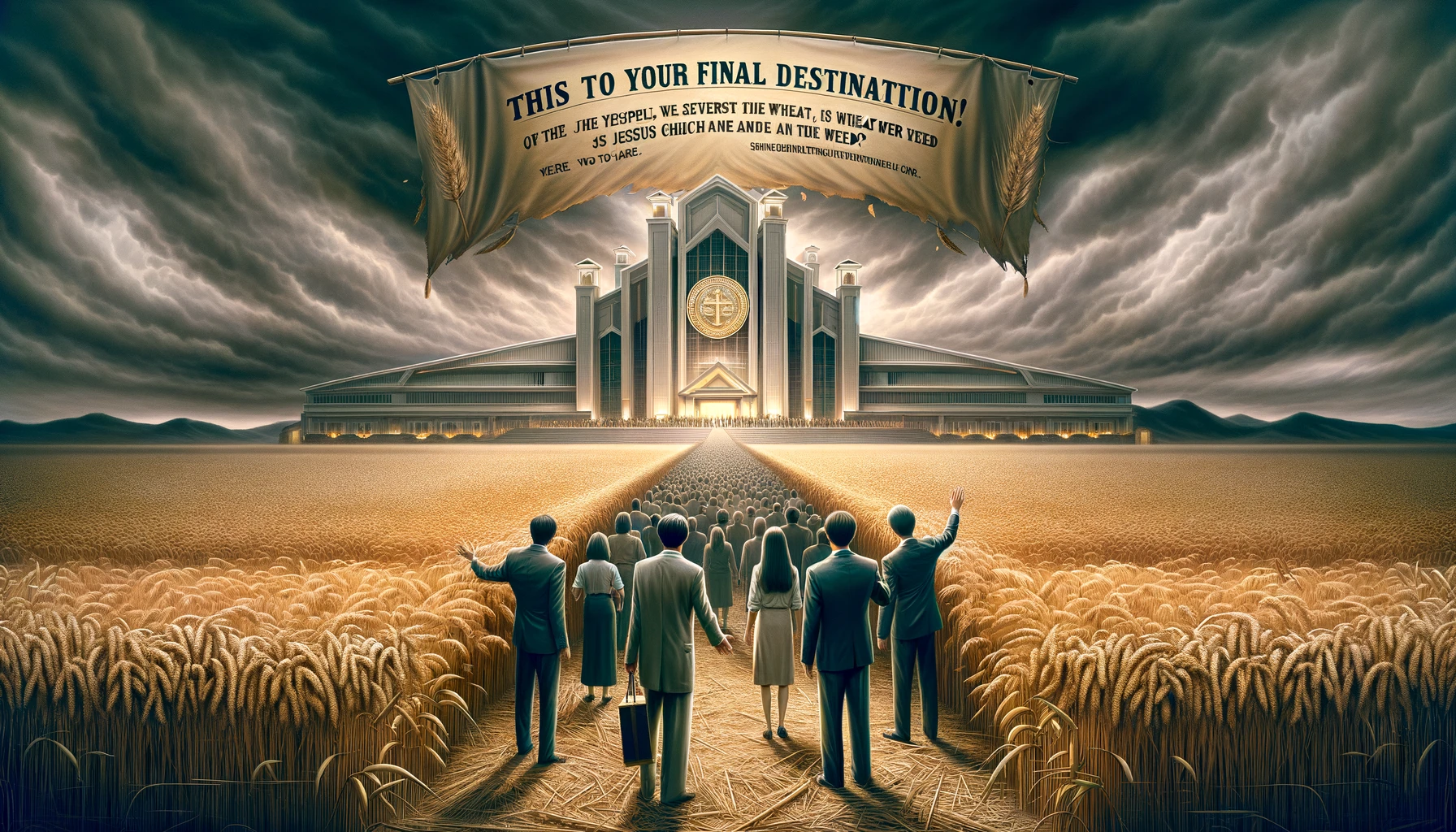
The lesson covered the parable of the sower and the four types of soil, representing how people receive the message about the kingdom of heaven. It traced the biblical history of God giving the covenant to Israel which they broke, leading to the promise through Jeremiah of a “new thing” – sowing two seeds (truth and lies) and establishing a new covenant. Jesus fulfilled this at His first coming by sowing the good seed while Satan sowed bad seed/lies among it in the world. At the second coming, there will be a harvest where angels separate the “sons of the kingdom” (good seed) from the “sons of the evil one” (bad seed), with the good being brought into the “barn” representing Mount Zion/New Jerusalem. God’s ultimate purposes are binding Satan, establishing New Jerusalem on the new earth, and reigning as the supreme “all in all.” Being harvested as good soil and entering the barn is critically important, requiring daily perseverance to produce a crop until the final harvest separation.
How is your heart doing?
It’s always crucial to check on our heart’s condition because it significantly determines how we react to things. If one’s heart is closed or hurt, it becomes very challenging to focus on the Word. One of the things I encourage students to do before engaging with the Word is to pray for God to help their heart, especially if they’ve gone through a tragedy or something difficult.
Praying for God to soften the heart is always a really good prayer. I’m sure it was a prayer that many uttered during the time of the first coming when Jesus was speaking, and they were earnestly asking God to help them understand His words because they truly wanted to believe Him.
You know, our world is very quick to point out falsehood, right? “This is false. This is false. This is false.” But people are very reluctant and slow to point out that something is true. People don’t like saying the truth. They’d rather just say, “I’ll just kind of wait and see because I don’t want to make a decision.” But let’s be those who say this is true, like Peter in John 6:68: “Where else can I go? You have the words of eternal life. There’s nowhere else for me to go. You are the truth.”
Very few were able to say, “You are the truth, Jesus.” Everyone else was very quick to say, “You are not the truth.” It’s easy to say something is not true, but it’s difficult to say something is true. So let’s be so sure in the Word that we’re receiving that we can say, “Yes, this is, in fact, true.” And not be nervous or scared to embrace the truth.
Does that make sense, what I’m saying? So let’s be those who are able to say, “Yeah, definitely this right here.” But that requires study, patience, and lots of prayer. So please be sure to increase your prayer life as we continue to study.
We’re going to be going over a very important topic, but one that we are familiar with. We’re going to be going over a lot of things we’ve heard before today, but on a slightly deeper level, so that we make sure we understand them deeply.
Secret of the Kingdom of Heaven, Two Kinds of Seed and the Harvest
Mt 13, Rv 14
In the previous section of the course, we studied the secrets of the kingdom of heaven through the parables. Today, however, we will focus on the significance of the parables and what Jesus truly meant when he spoke them. We will also explore how these parables find their fulfilment through the seeds and the harvest at the time of the second coming. A significant portion of our discussion will revolve around the second coming.
Our main reference chapters are Revelation 14 and Matthew 13. Matthew 13, of course, is the chapter where Jesus narrated the parables, including the parable of the sower and the four types of fields, as well as five other parables that figuratively represent the kingdom of heaven.
Revelation 14, on the other hand, discusses those who are sealed and the harvest at the end of the age, where an angel wields a sickle to reap the earth.
We will delve into these topics today, exploring their true meaning and significance.
Our hope is to be the harvested ripe grains that are brought into the barn at the second coming, fulfilling the prophecy and lesson conveyed through the parables, the word of God.
1.- The 4 Fields
Mt 13:1-9, 18-23 (v19)
We are now going to examine the secrets of the kingdom of heaven and how they play out with the two types of seed in the harvest. We will really spend time on this. And remember, we are really diving into the new thing, talking about Jeremiah 31 in detail.
Soon, we will also look at the new covenant in a similar level of detail, but first, we are focusing on the two types of seed.
If we turn to Matthew 13:1-9, we will go over the four fields again, but this time, we will really dive into specific details so that we can apply it to ourselves more closely.
That same day Jesus went out of the house and sat by the lake. 2 Such large crowds gathered around him that he got into a boat and sat in it, while all the people stood on the shore. 3 Then he told them many things in parables, saying: “A farmer went out to sow his seed. 4 As he was scattering the seed, some fell along the path, and the birds came and ate it up. 5 Some fell on rocky places, where it did not have much soil. It sprang up quickly, because the soil was shallow. 6 But when the sun came up, the plants were scorched, and they withered because they had no root. 7 Other seed fell among thorns, which grew up and choked the plants. 8 Still other seed fell on good soil, where it produced a crop—a hundred, sixty or thirty times what was sown. 9 He who has ears, let him hear.”
Matthew 13:1-9
Sowing Seeds in the Field
Jesus often ended his phrases with, “he who has ears, let him hear.” What did Jesus mean by this? He wasn’t talking about physical deafness, implying that those who can’t hear won’t understand. No, he was speaking spiritually.
He meant, “he who has spiritual ears, let him understand what I’m actually saying.” But how is it possible to receive spiritual ears to hear?
We’re talking about the person here, because Jesus said, “let he who has an ear, let him hear.” And of course, one has to be able to pray in order to receive eyes that can see and ears that can hear, according to Deuteronomy 29. But there’s one more condition that one needs to meet to receive eyes that can see and ears that can hear.
What is that condition? What do they need? A humble heart. So when one has a humble heart, they will ask, “Jesus, what do you mean by this?” And then they will receive the explanation, aka eyes that can see and ears that can hear. This is not something that someone can just intellectually analyze.
What’s amazing about God’s parables is that they’re simple and confounding at the same time. They seem so simple. Of course, “seed” represents “the word.” And when it’s sown in the heart, it bears fruit. But before we heard the explanation of the open word, that’s not the conclusion we came to.
Of course, “fire” represents “the word” and the fire that refines the heart that accepts it and judges the heart that does not. But that’s not the conclusion we came to on our own. We had to hear the explanation first. Then it clicked. Both simple and complex at the same time. That’s how God works.
The open word is not about teaching us to be good people. The open word is not about reading from the Bible and saying “amen.” That’s not what the open word is. The open word is not about reading Matthew 13 in church today. That does not mean that grace has the open word.
The open word is the explanation of prophecy and its fulfillment. Meaning who, what, when, where, why, and how. If these details are not discussed, that is not the open word. And what Jesus was trying to help the people understand is really what it means for the seed to be sown. And when it’s possible for it to be sown. And what that seed really is.
So we just read Matthew 13:1-9. And it says in verse 3, “Then he told them many things in parables.” And then he told the parable of the farmer. And he talked about the four fields. The Path, The Rocky, The Thorny, and The Good Soil. Nothing new, we’ve seen these a thousand times, but let’s dive into detail. Let’s really see them well.
So first, let’s talk about the seed that is sown in detail. Now we know that the seed represents the word, as Luke 8:11 states. But Matthew 13 actually phrases it in a really deep way. And let’s look at that once more, Matthew 13:10-11, 34-35.
ONE – Path | Hears the Word → Lacks Understanding (Lk 8:12)
Matthew 13:19
When anyone hears the message about the kingdom and does not understand it, the evil one comes and snatches away what was sown in his heart. This is the seed sown along the path.
The seed generally represents the word, but in the parable, the seed Jesus is talking about is the message about the kingdom of heaven. Interesting observation.
Which kingdom of heaven is being referred to here? If you ask someone in Babylon about the kingdom of heaven, they would simply point upwards, unaware of the multiple types of kingdoms of heaven.
We need to start putting things together. Which kingdom of heaven is Jesus talking about when he says, “When anyone hears the message about the kingdom of heaven”? It’s a thought-provoking question. One might assume it’s the New Jerusalem.
Interesting point. Amen. But that’s not the only one. The strict interpretation is that Jesus is referring to multiple kingdoms of heaven, particularly the two that become one.
The Holy City, New Jerusalem, comes down to the new heaven and new earth. When does this happen? In Revelation, at the second coming, that’s correct.
So, in Matthew 13, Jesus is essentially saying, “When someone hears the explanation about how the kingdom of heaven comes to be.” And this is possible now. Right now, it is possible to be the path, the thorny and rocky ground, or the good soil, because this is what we are hearing today – the message about the kingdom of heaven.
And we are able to understand the parables, which are explained when the kingdom of heaven is near. When someone hears the open word but does not understand it, the message about the kingdom of heaven sits on top of their heart and does not go in. Then, Satan comes and takes it away from them.
That person cannot mature spiritually because their lack of understanding takes away whatever word they would have received. This is why we emphasize the importance of asking questions and being persistent in asking them. Sometimes the answer is given at the proper time, but you should still ask your question.
When you ask questions, it helps us know how much you are understanding and where we need to spend more time with you so that you can comprehend better. If you don’t ask questions, we can’t know how to help you perceive more.
If there is a lack of understanding and a person persists in it, they will never mature spiritually. The path hears the word but lacks understanding, and Satan takes that word away. The birds of the air, which are not good birds but evil spirits, come and take the word.
Other ways a person can be the path include not paying attention during class, multitasking, cooking, cleaning, driving during class, not taking notes, or not doing the home blessings. We don’t ask you to do these things for power; we ask you to help you perceive the word. Otherwise, you will not retain it.
Being engaged is critically important.
TWO – Rocky Field | Hears Word with Joy → Persecution (Lk 8:13)
Then there is the rocky field. The rocky field represents those who are starting to perceive the word.
The word has actually gone in a little bit. And so, as they are receiving the word, they become excited, thinking, “Wow, this makes a lot of sense. This is starting to click for me. Wow, glory to God. Thank you, Lord, for this.”
And then, in their excitement, they bring persecution upon themselves by telling everybody, “I’m studying the open word.” People respond, “What’s that? You don’t need to study. You’re good. You already believe you’re fine. Why are you studying so much?”
And then they receive a little bit of persecution. And because the word has just taken a little bit of root, they wither away. The persecution kills their spirit.
So, though they started with joy, they wither away because of persecution. And persecution can come from anyone. And it is most effective from loved ones.
I’m sure some of you can relate already, which is why we talked about the importance of being wise with your words and protecting the word within your heart so that it cannot be snuffed out by the enemy, using even people you love.
THREE – The Thorny Field | Hears Word → Worries, pleasures, wealth (Lk 8:14)
The thorny field, which is full of thorns, represents a concerning situation. We know what these thorns figuratively represent.
The thorny field is actually the field that I worry about the most. Because these thorns affect everybody. They represent the worries of the world, the pleasures of the world, and the deceitfulness of wealth in the world. All of these things are so pervasive in our world.
And it seems like our country makes it even harder to flee from these things because they are everywhere. Everyone is worried about bills, food, rising prices, and conflicts in different places. There are thousands of things to worry about.
And so we’re trying to seek little bits of pleasure here and there, our favorite TV show, movie, music, maybe going outside and getting some sun, eating healthy, or maybe exercising a little bit. We’re trying to seek any little pleasures to alleviate the worries of this life. And in the meantime, we’re striving for wealth, finances, and riches.
That’s the reality for the majority of the world. So we’re always surrounded by this. And it’s hard to be spiritual when everyone else is not. It’s actually a struggle. Someone who is not able to overcome this within themselves will never mature spiritually either. The word, the true message, cannot take root.
You must overcome these things. It’s not an option.
FOUR – Good Soil | Hears Word → Retain, persevere and produce crop; Overcoming (Lk 8:15)
We then come to the field that actually produces fruit, the field that we want to be, the good soil. The good soil, too, here’s the word. It does not mean they don’t receive persecution. It does not mean they don’t sometimes misunderstand something. It does not mean that they don’t also have worries and issues. But it means that they retain the word they receive, and they persevere, and they produce a crop.
Despite all these things, they are still able to overcome. So, the good soil represents overcomers. And overcoming is God’s characteristic.
Satan wants us to give up. Giving up is actually Satan’s characteristic. As it says in Proverbs 24, a righteous person falls seven times but rises again. It’s the rising again that God wants people to do. It’s the returning to God and repenting that God wants people to do. What Satan wants us to do is feel like we’re too far gone, that it’s too late for us, that it’s too difficult, that we can’t change, that we’ve tried. Satan wants us to sit and wallow in failure, like Adam and Eve, who instead of returning to God right away and repenting, they hid and then blamed each other. They were not able to overcome. So, we should instead overcome, and we overcome with the word. And we bear fruit with the word too, becoming trees of our own. Beautiful.
Who here has invited someone to study or is in the process of doing so? How does it feel to bring someone to the word? Don’t you feel a sense of responsibility? Doesn’t it scare you a little bit? Well, what you’re feeling when that happens is you’re actually feeling God’s heart. Because God’s heart is for everyone to come to the truth, and God knows how difficult it is and how precious everyone who’s hearing his word is. So, you’re starting to feel a little bit of what God feels. But God feels it on the scale of the entire world, while you’re feeling a little bit of it when you invite someone to study.
And you realize that you have to level yourself up a little bit more because maybe they’ll ask you a question, and you want to be ready to answer it. So now you’re studying a little bit harder because someone else is studying. It’s a really cool process. So please invite many to study. It actually levels you up too in God’s word, a little bit of responsibility.
So why did Jesus speak in parables? The two reasons are:
- To hide secrets
- To fulfill prophecy
Those are the two reasons that Jesus spoke in parables. And when the explanation comes, we’re able to understand these deeper things too. So all of this was reviewed.
But I hope that we were able to self-reflect a little bit more now that we’re becoming more mature. We’re seeing the pitfalls that happen to all who are studying the open word that Jesus warned us about. So avoid the pitfalls. Don’t fall into them willingly and let Satan defeat us.
Now, let’s start talking about the two types of seed and the harvest and how they come to be. We’re going to look at the flow of the Bible once more, and I’m going to encourage you to draw the pictures along with me. No matter your artistic ability, you want to draw these. And this is basically a summary of the whole Bible, essentially, that we’re about to go through. So as we’re going through each section, leave yourself plenty of space for this. When we’re actually going to draw, the rest of the lesson is going to be two big pictures, two really big pictures. So have plenty of space on your notes for these two pictures.
2.- Bible History
OLD TESTAMENT ERA
PHASE ONE – Covenant Given
After the fall of Adam and Eve, and God starting over with Noah, God promised many descendants and a covenant to Abraham. Subsequently, God came to Moses, who was leading the chosen people out of Egypt and towards the promised land.
God gave them His word through His law, which included the Ten Commandments and various other aspects that can be found in Exodus through Deuteronomy. The Israelites were required to keep numerous aspects of the law, not just the Ten Commandments.
The Ten Commandments were the first ten out of many commandments. During the Old Testament era, God came down to Moses and gave him the covenant.
1.- In Exodus 19:5-6, God set a condition: if they kept this covenant, they would receive many blessings. The word “if” is crucial as it establishes a conditional statement.
2.- Another important instruction God gave them during this time was to worship no other gods, as stated in Exodus 20:3. God’s desire, as mentioned in Exodus 19:5-6, was for them to become a kingdom of priests.
God wanted to save the world, and He needed a people through whom He could work to reach out to the world. However, before they could go out, they needed to make themselves holy in God’s eyes by keeping the covenant, following the law, and doing it well.
Despite their efforts, they always had setbacks and were never able to reach the point where they could go out into the world themselves. Instead, by the time Jesus came, they had become quite insular, with only a few Gentiles becoming believers in God.
God had envisioned a kingdom of priests, hoping they would be able to fulfill that role.
PHASE TWO – Covenant Broken
We know what happened next. During the time of Solomon, due to his many wives and advancing age, he became weaker and allowed his wives to sway his heart, leading to the introduction of idols and the worship of different gods in Israel, breaking the first and most important part of the covenant God had established with them – worshiping no other gods.
1.- The covenant that was given was then broken, and there were many consequences for this, consequences that God upheld. Let’s read these consequences once more, as we usually discuss them at a high level, but I want us to see them with our own eyes.
9 The Lord became angry with Solomon because his heart had turned away from the Lord, the God of Israel, who had appeared to him twice. 10 Although he had forbidden Solomon to follow other gods, Solomon did not keep the Lord’s command. 11 So the Lord said to Solomon, “Since this is your attitude and you have not kept my covenant and my decrees, which I commanded you, I will most certainly tear the kingdom away from you and give it to one of your subordinates. 12 Nevertheless, for the sake of David your father, I will not do it during your lifetime. I will tear it out of the hand of your son. 13 Yet I will not tear the whole kingdom from him, but will give him one tribe for the sake of David my servant and for the sake of Jerusalem, which I have chosen.”
1 Kings 11:9-13
1.- Due to Solomon’s breach of the covenant and failure to obey God’s command, God decided to tear the kingdom away from him. Consequently, shortly after this, Israel split into two kingdoms.
2.- There was the Northern Kingdom of Israel and the Southern Kingdom of Judah. The Southern Kingdom of Judah contained the city of Jerusalem. They were divided into two separate kingdoms.
After this division, the Gentile nations of Assyria and Babylon invaded and destroyed them because they broke the covenant, just like Adam did, as stated in Hosea 6:7. As a result, God was left without a kingdom and priests.
The Southern Kingdom of Judah contained Jerusalem, while the Northern Kingdom of Israel encompassed regions like Samaria, Galilee, and Cana, where Jesus began his ministry. We’ll discuss the significance of this later. But Israel was divided into two kingdoms, the Northern and Southern, and then both were destroyed after this event took place.
With God now lacking a kingdom and people, He had to start over.
PHASE THREE – Prophecy of New Thing
God comes to Jeremiah and gives him a prophecy of a new thing.
In Jeremiah 31, what did he call it? A prophecy of a new thing.
Two main things are promised at the coming of this new thing.
- A New Covenant
- The sowing of two seeds
This is mentioned in Jeremiah 31:27 and Jeremiah 31:31, so that we can seal it.
The new thing is introduced in Jeremiah 31:22. And then Jeremiah 31:27 and Jeremiah 31:31 provide the details of that new thing.
God says, “A time is coming when I will sow the seed or the offspring of man and of animals in the house of Judah.” And God said, “I will establish a new covenant with them. And it will not be like the old one with their ancestors when I led them out of Egypt during that time. But a new one that will be established in the future.” So it will be different in nature. These are prophecies about the details of the new thing.
In Jeremiah 31:22, it mentions, “A woman will surround the man.” We talked about how that figuratively represents Jesus, who was in the womb of his mother, Mary. And so it is the job of Jesus to make sure that the seed is sown and to establish a new covenant.
NEW TESTAMENT ERA – FIRST COMING
PHASE FOUR – Fulfillment of New Thing
Let’s discuss this now. During the time of Jesus’ first coming, he was born, fulfilling the prophecy in Jeremiah 31:22. Then, Jesus knew he had two primary tasks to accomplish.
Everything he did can be summarized in these two main jobs. All of his work, no matter how extensive it was, can be encapsulated within these two points. The gospels record only the most significant events of what Jesus was doing, as it would be impossible to document everything he did.
However, all his actions can be summarized into these two main points, representing the fulfillment of the new era and the beginning of the new era.
1.- It starts with Jesus sowing the good seed, or the seed of man. But we know that the enemy also sowed the weeds, or the seed of animals.
2.- Jesus established the new covenant with his blood. As described in Luke 22:14-20, Jesus sat down with his disciples and broke bread with them, giving them wine. He said, “This bread represents my body, and this wine, this cup, represents my blood, which is the new covenant.” He further stated, “I will not eat or drink of this again until it finds fulfillment in the kingdom of God.” Today, we will focus on the seed.
In Matthew 13:24-30, Jesus prophesied about the sowing of the good seed through a parable. He referred to himself as the farmer or the sower of the son of man, who sows good seed in his field. He knew that his field must then be harvested, as the seeds that were sown must grow and be harvested when the time is right, which happens at the second coming.
REVELATION ERA – SECOND COMING
PHASE FIVE – Fulfillment of Harvest
Jeremiah 31 is truly our origin.
God had been thinking about us for 2600 years. Jeremiah lived approximately 600 years before Jesus. So it took a long time for this new thing to be fully realized.
The fulfillment of the harvest represents the fulfillment of the promise from Jeremiah 31. It started at Jesus’ first coming and was completed at his second coming. So, what are the details of the fulfillment of the harvest?
1.- Harvesting those born of God’s seed.
2.- And harvesting them from the field. This means the field is not our permanent dwelling place. The field is just a temporary holding place for us to grow and mature. But we know that the field is not perfect, and there are issues with the field.
We’re going to break down the field and the two seeds in detail once again, referring to Matthew 13:37-39 and Revelation 14:14-16.
So we can really make sure we understand it and seal it in our minds. The best way to know if you’ve truly understood is to give a speech on it. If you can confidently speak these words, then you’ve mastered them. But if you can kind of understand the concept, but it doesn’t come out of your mouth easily, it means you still have some work to do. So maybe we should start practicing speeches again.
3.- The Harvest
Let’s look at that harvest in more detail.
24 Jesus told them another parable: “The kingdom of heaven is like a man who sowed good seed in his field. 25 But while everyone was sleeping, his enemy came and sowed weeds among the wheat, and went away. 26 When the wheat sprouted and formed heads, then the weeds also appeared. 27 “The owner’s servants came to him and said, ‘Sir, didn’t you sow good seed in your field? Where then did the weeds come from?’ 28 “‘An enemy did this,’ he replied. “The servants asked him, ‘Do you want us to go and pull them up?’ 29 “‘No,’ he answered, ‘because while you are pulling the weeds, you may root up the wheat with them. 30 Let both grow together until the harvest. At that time I will tell the harvesters: First collect the weeds and tie them in bundles to be burned; then gather the wheat and bring it into my barn.’”
Matthew 13:24-31
We’ll pause there for a moment to digest what is discussed here.
In the First Coming – Sowing the seeds:
We have the farmer, and the farmer sows good seed into his field. This is the farmer’s field. As this good seed, which is the word about the kingdom of heaven, the truth, is being sown into the field, an enemy comes at night and sows weeds, or lies, among the wheat in the same field.
So now, both good and evil are growing together in the farmer’s field at the same time. This is what Satan likes to do. When you think about it, Satan himself is the very embodiment of what the field became.
Evil is a mixture. Good and evil coexisting makes it 100% evil from God’s eyes. God was saying to Adam and Eve, “I have given you good. Embrace only the good I have given you. Do not accept the good and evil of that tree because it is a mixture. It has been corrupted, not in a 100% way that would be obvious, but slightly corrupted so that it still looks good to eat.”
That’s how Satan works. He doesn’t come to believers of God and say God does not exist. Instead, he says, “You can become like God.”
Satan himself is a mixture of good and evil, for he once was an angel but became corrupted. So what did he want to do with Adam, who was all good? Corrupt him so that he could be just like Satan.
That’s why God said in Genesis 3:23, “Man has become like one,” not the collective one, which is often interpreted that way, but the singular one. He has become like one who was once one of us – Satan, knowing good and evil, mixed.
Are you understanding? Satan wants the field to resemble the farmer’s field, even though his lies are there, and people don’t realize it. So they think everything is good, everything is pure, and that’s how we operate.
“I can go into any field and be okay. I can go into this one on the corner, that one on the corner, this one on the corner, everything is fine. Everyone believes in Jesus,” but even the disciples had to fight off falsehood within their ranks.
From the moment Jesus ascended, it was an issue because Satan works fast, and he started to sow lies in the same place where the truth was grown, and the night that Jesus promised in John chapter 9 fell, and it had fallen a long time ago. It has been night for a long time.
So words developed in a time of night I ignore, and we should too. This is the condition of the field for 2,000 years. For 2,000 years, the field has been like this, but Jesus has a plan, and the farmer is wise and knows how to take care of his field.
What does the farmer suggest the workers do? He said, “Let both of them grow together until the time of the harvest, then I will separate them, and we will separate the weeds from the wheat. First, we will take the weeds, we will tie them in bundles, and what’s the end for the weeds?”
We don’t want to be burned. No, we don’t want this.
Instead, of course, we want to be harvested. The goal is to be in the barn.
37 He answered, “The one who sowed the good seed is the Son of Man. 38 The field is the world, and the good seed stands for the sons of the kingdom. The weeds are the sons of the evil one, 39 and the enemy who sows them is the devil. The harvest is the end of the age, and the harvesters are angels.
Matthew 13:37-39
Jesus explained the parable he had just given, providing more details. The wheat represents the sons of the kingdom. And the weeds represent the sons of the evil one. Is it possible to transition seeds? Yes, in both directions. Those who are born of this seed should definitely strive to come out when they realize it, but they can’t until they realize it. However, those who are sons of the kingdom can also go backwards.
From dust you were, and to dust you will return. It’s possible to go backwards, and we don’t want to go backwards. Let’s only go forwards.
The wheat and the weeds represent people who will be distinguished or separated at the time of the second coming, as Jesus said in many different ways and many different times. Good fish, bad fish, wise virgins, foolish virgins, sheep and goats, right? He said it many different times.
Five talents and two talents versus the one talent. So we need to be sons of the kingdom, but we can only know which is which at the end of the age when the harvest is near, when it’s time to be harvested. So who does the harvesting? The angels do.
So what are the angels looking for in one that is going to be harvested? What are they looking for? The angels are looking for this person, as stated in Luke 8:15: “The good soil is the one with a noble and good heart, who hears the word, retains the word, and by persevering, produces a crop.” That’s what the angels are looking for. So the angels are weighing you.
They’re actually weighing you right now, at this very moment. How am I doing? That’s what I used to say when I first learned this. I was like, okay, is my angel on this side or this side? Are you taking notes? How am I doing? It’s the angels that weigh us, but spirits work through flesh. So they send helpers too.
So it is the angels that are the harvesters, as stated in Revelation 14:14-16. And they intend to bring those who they deem ready to be harvested into a location. What is that location they intend to bring them? The barn.
How can we understand the barn on a deeper level today? What is the barn? The barn is Mount Zion.
A connection, of course, we did not make before the open word, which means that the field is what? What is the field? Babylon, the world. Many different ways to say the same thing.
What is Jesus’s field? What is his world? The church. Right. So we cannot stay here, Church, Farmer’s field. We need to transition. We need to be harvested because the field is Jesus’s world, aka the church. That’s where Jesus preached. And that’s where lives were sown too. And both had been growing together for 2000 years.
So we must be harvested and brought into the barn, which goes by many names: Mount Zion (Revelation 14), New Heaven and New Earth (Revelation 21), The basket (Matthew 13), and of course, the barn as well. Zion, New Spiritual Israel, Twelve tribes. Many ways to say the same thing.
So this place is the first heaven and first earth that passes away, Jesus’ world or church. And this place is the new heaven and new earth that comes to be, the Barn, Mount Zion. And there is one place that represents the place of the betrayers. And we’ll learn about them very soon. We’re getting closer and closer.
So we don’t want the end goal, the opposite. Those who hear this word and say, “Nah, it doesn’t end well.” And if you notice, they’re tied in bundles, which means when they make that decision, it becomes even harder to escape. They’re tied even tighter by the places that had kept them in that way. So the result is not good.
But let’s read about the result of those who come out, those who are like the first fruits, like James 1:18 and Revelation 14:1. Let’s go to Revelation 14, everyone. And let’s read about that harvest at the end of the age that Jesus promised.
In the Second Coming – It now time to Harvest
14 I looked, and there before me was a white cloud, and seated on the cloud was one “like a son of man” with a crown of gold on his head and a sharp sickle in his hand. 15 Then another angel came out of the temple and called in a loud voice to him who was sitting on the cloud, “Take your sickle and reap, because the time to reap has come, for the harvest of the earth is ripe.” 16 So he who was seated on the cloud swung his sickle over the earth, and the earth was harvested.
Revelation 14:14-16
Whoa. Just as Jesus had promised, there must be a harvest of the earth.
When Revelation 14 and the entire book of Revelation begin to be fulfilled, it represents enough time has passed for the wheat to grow. Logically thinking, when the seed was initially sown 2,000 years ago, the field was very small, comprising only a couple dozen people. That was it.
Tiny. It wasn’t ready yet to be harvested. It was too soon.
But over 2,000 years, how many people call Jesus Lord today? Over two billion. That sounds ripe to me. So now the harvest has to take place.
So where are we on this journey, class? Where are we now? I’m going to draw another small picture.
So where are we, class? Which one? Are we in the basket? You better be. But are some of us still in the field?
Let’s be in the basket so that we can eventually get to the barn. We have to flee this place first, the field, though. We cannot remain.
4.- God’s Purpose and Will
God’s purpose and will can be summarized into three things at the fulfillment of Revelation.
God’s purpose and will at the time of Revelation.
Revelation 21:1-4 talks about the conclusion of things.
However, there is one thing that has to happen first before Revelation 21:1-4 can take place. And that thing is actually discussed in Revelation chapter 20.
nd I saw an angel coming down out of heaven, having the key to the Abyss and holding in his hand a great chain. 2 He seized the dragon, that ancient serpent, who is the devil, or Satan, and bound him for a thousand years. 3 He threw him into the Abyss, and locked and sealed it over him, to keep him from deceiving the nations anymore until the thousand years were ended. After that, he must be set free for a short time.
Revelation 20:1-3
1.- Firstly, Satan needs to be bound to prevent him from deceiving people further. God’s primary objective is to restrain Satan. Through the sacrifice of His son Jesus on the cross 2000 years ago, God has already conquered sin.
This was the first part of the mission.
The second part involves capturing the dragon, symbolizing Satan, so that he can no longer deceive. However, even after the devil is captured, his mindset and influence still linger in the world today.
Therefore, the work of undoing his deception in people’s hearts, one by one, still needs to be accomplished. This is why the thousand years are necessary. But after the dragon is captured,
2.- God desires the holy city, New Jerusalem, to descend from the spiritual realm to the new heaven and new earth, uniting the spiritual and physical realms.
It is akin to the perishable being clothed by the imperishable, as described in 1 Corinthians 15.
3.- And God will reign supreme, becoming “all in all” once again, which is His ultimate desire.
This summarizes God’s will as revealed in the Book of Revelation. There is still much work to be done to achieve this goal.
However, a significant portion of this work has already been accomplished, as we have learned. We are merely gaining an understanding of it. Nevertheless, there is still work to be done.
Let us be part of the remaining work to be done, and we will gain more understanding as we continue to study. But know that being harvested is critically important.
Memorization
So he who was seated on the cloud swung his sickle over the earth, and the earth was harvested.
Revelation 14:16
Let’s Us Discern
Analyzing Shincheonji Lesson 76: “Secret of the Kingdom of Heaven, Two Kinds of Seed and the Harvest”
A Critical Examination Using “Testing Shincheonji’s Claims: Two Lenses, One Story”
Introduction: The Harvest Deception
Lesson 76 represents a pivotal moment in Shincheonji’s curriculum where the instructor takes familiar biblical parables and reinterprets them to create a framework that makes SCJ appear as the exclusive fulfillment of Jesus’ teaching. Having hijacked the Lord’s Prayer in the previous lesson, the instructor now does the same with the Parable of the Sower and related harvest imagery.
The instructor is essentially saying: “Jesus’ parables about seeds and harvest are prophecies about the second coming. The ‘good soil’ represents SCJ members. The ‘harvest’ is happening now through SCJ. You must be part of this harvest or be left behind.” By the end of this lesson, students will have learned that:
- The Parable of the Sower is prophecy about the second coming (not just teaching)
- The “message about the kingdom” is SCJ’s specific teachings
- The “harvest” is happening now through SCJ’s organization
- Only those who join SCJ are the “good soil” being harvested
As Chapter 20 of “Testing Shincheonji’s Claims: Two Lenses, One Story” warns, this is “The Danger of Creative Fulfillment”—taking prophecies that have already been fulfilled (or are straightforward teachings) and claiming they’re being fulfilled through SCJ, thereby stripping them of their true meaning.
The instructor’s stated goal is to help students “be the harvested ripe grains that are brought into the barn at the second coming!” But what’s actually happening is the manipulation of familiar parables to:
- Make SCJ appear as the fulfillment of Jesus’ teaching
- Create urgency (“the harvest is happening now”)
- Create fear (“if you’re not part of SCJ, you’re not being harvested”)
- Make students feel they’ve discovered the “true meaning” others miss
This is sophisticated spiritual manipulation through reinterpretation of familiar Scripture. Let’s examine it carefully.
For additional refutation resources, check CloserLookInitiative.com’s SCJ Examination section, which provides detailed analysis of SCJ’s harvest theology.
Part 1: The Setup – Reinforcing Previous Teachings
The Review Section
What the Lesson Says:
The instructor reviews the Lord’s Prayer reinterpretation from Lesson 75:
- “Our Father in heaven” = Must have God’s seed (the word)
- “Your kingdom come” = God will build a new temple and new saints at the second coming
- “Give us today our daily bread” = Spiritual manna (hidden manna in Revelation 2:17)
- “Forgive us our debts” = Must forgive others
- “Deliver us from the evil one” = The king of Babylon, where nations are drunk on wine of adultery
The instructor emphasizes:
- “If we are in a place that does not talk about this at all, that is not the place we need to be waiting in”
- “When we say the Lord’s Prayer, you should keep these deeper things in mind”
Analysis:
This reinforces the previous lesson’s manipulation:
- Makes students feel they now understand the “deeper meaning”
- Creates obligation to stay in SCJ (“if your church doesn’t teach this, leave”)
- Makes leaving SCJ appear as abandoning the “true meaning” of prayer
- Creates emotional investment in SCJ’s interpretive framework
Chapter 4 of “Testing Shincheonji’s Claims” (“The Impact of Interpretive Frameworks”) explains: Once you accept a framework, it shapes everything you see. Each lesson reinforces the previous one, making the framework harder to question.
The Pressure to “Say This is True”
What the Lesson Says:
The instructor creates pressure:
- “People are very reluctant and slow to point out that something is true”
- “People don’t like saying the truth. They’d rather just say, ‘I’ll just kind of wait and see because I don’t want to make a decision'”
- “Let’s be those who say this is true, like Peter in John 6:68: ‘Where else can I go? You have the words of eternal life'”
- “It’s easy to say something is not true, but it’s difficult to say something is true”
- “So let’s be so sure in the Word that we’re receiving that we can say, ‘Yes, this is, in fact, true'”
Analysis:
This is psychological pressure to:
- Commit to SCJ’s teachings without full evaluation
- Feel cowardly if you “wait and see”
- Feel courageous if you declare SCJ’s teachings true
- Compare yourself to Peter (faithful disciple) vs. those who left Jesus
The Manipulation:
The instructor uses John 6:68 (Peter’s statement to Jesus) to pressure students to commit to SCJ’s teachings. But there’s a critical difference:
Peter was responding to Jesus Christ Himself:
- Jesus had just performed miracles (feeding 5,000, walking on water)
- Jesus was teaching with divine authority
- Peter recognized Jesus as the Holy One of God
Students are being pressured to commit to:
- Human interpretations of Scripture
- Organizational claims that cannot be objectively verified
- A system that demands they cut off other Christian voices
These are not the same.
Chapter 10 of “Testing Shincheonji’s Claims” (“Why Truth Welcomes Examination”) addresses this: True teaching welcomes careful evaluation, not rushed commitment.
Biblical Response:
Acts 17:11: “Now the Berean Jews were of more noble character than those in Thessalonica, for they received the message with great eagerness and examined the Scriptures every day to see if what Paul said was true.”
The Bereans tested Paul’s teaching carefully. This was commended, not condemned.
1 Thessalonians 5:21: “Test everything; hold fast what is good.”
We are commanded to test, not to rush to commitment.
For more on this pressure tactic, check CloserLookInitiative.com’s SCJ Examination section.
Part 2: The Parable of the Sower – Reinterpreted
The Core Teaching
What the Lesson Says:
Matthew 13:1-9 (Parable of the Sower):
- Farmer sows seed
- Four types of soil: Path, Rocky, Thorny, Good Soil
- Only good soil produces a crop
The instructor explains:
1. The “Seed” is the “Message About the Kingdom”:
Matthew 13:19: “When anyone hears the message about the kingdom and does not understand it, the evil one comes and snatches away what was sown in his heart. This is the seed sown along the path.”
The instructor emphasizes:
- “The seed generally represents the word, but in the parable, the seed Jesus is talking about is the message about the kingdom of heaven”
- “Which kingdom of heaven is this?” (implying it’s about SCJ’s specific teachings)
2. The “Open Word” is Explanation of Prophecy and Fulfillment:
- “The open word is not about teaching us to be good people”
- “The open word is not about reading from the Bible and saying ‘amen'”
- “The open word is the explanation of prophecy and its fulfillment. Meaning who, what, when, where, why, and how”
- “If these details are not discussed, that is not the open word”
3. The Four Fields Represent Responses to SCJ’s Message:
Path: Hears the word but lacks understanding (Luke 8:12) Rocky: Receives with joy but has no root (persecution comes) Thorny: Hears but worries and wealth choke it Good Soil: Hears, understands, and produces a crop
Analysis:
This reinterprets the parable to make it about SCJ:
- The “message about the kingdom” = SCJ’s specific teachings
- The “open word” = SCJ’s explanation of prophecy
- The “good soil” = Those who accept SCJ’s teachings
- The “harvest” = SCJ’s organizational growth
Chapter 20 of “Testing Shincheonji’s Claims” warns: This strips the parable of its true meaning to make it about one organization.
The Biblical Reality
1. The Parable of the Sower is About Responses to the Gospel:
Matthew 13:18-23 (Jesus’ own explanation):
Matthew 13:18-19: “Listen then to what the parable of the sower means: When anyone hears the message about the kingdom and does not understand it, the evil one comes and snatches away what was sown in their heart. This is the seed sown along the path.”
What is “the message about the kingdom”?
The gospel of Jesus Christ:
Matthew 4:23: “Jesus went throughout Galilee, teaching in their synagogues, proclaiming the good news of the kingdom, and healing every disease and sickness among the people.”
Matthew 9:35: “Jesus went through all the towns and villages, teaching in their synagogues, proclaiming the good news of the kingdom and healing every disease and sickness.”
Mark 1:14-15: “After John was put in prison, Jesus went into Galilee, proclaiming the good news of God. ‘The time has come,’ he said. ‘The kingdom of God has come near. Repent and believe the good news!'”
The “message about the kingdom” is:
- The gospel (good news) of Jesus Christ
- The announcement that God’s kingdom has come near in Jesus
- The call to repent and believe in Jesus
This is not SCJ’s specific interpretive system. It’s the gospel of Jesus Christ.
2. The Four Soils Represent Different Responses to the Gospel:
Path (Matthew 13:19):
- Hears the gospel but doesn’t understand it
- The evil one snatches it away
- No response to the gospel
Rocky (Matthew 13:20-21):
- Receives the gospel with joy
- But has no root (shallow faith)
- When trouble or persecution comes, falls away
Thorny (Matthew 13:22):
- Hears the gospel
- But worries of life and deceitfulness of wealth choke it
- Unfruitful
Good Soil (Matthew 13:23):
- Hears the gospel and understands it
- Produces a crop (fruit of the Spirit, good works, spiritual growth)
- Yields thirty, sixty, or a hundred times what was sown
The point:
- Different people respond differently to the gospel
- Only those who truly receive the gospel bear fruit
- Persecution, worries, and wealth can cause people to fall away
This is not about accepting SCJ’s teachings. It’s about receiving the gospel of Jesus Christ.
3. This Parable Was Fulfilled in Jesus’ Ministry:
The parable describes what Jesus was experiencing in His ministry:
Path: Many heard Jesus but didn’t understand (Matthew 13:13-15) Rocky: Some followed Jesus initially but fell away when it got hard (John 6:66) Thorny: Some were interested but loved wealth more (rich young ruler – Matthew 19:16-22) Good Soil: The disciples and others who truly believed and followed Jesus
This was fulfilled in the first century, not through SCJ in the 21st century.
4. The Parable Applies to All Gospel Proclamation:
The principle applies whenever the gospel is preached:
- Some reject it
- Some receive it shallowly
- Some are distracted by worldly concerns
- Some truly believe and bear fruit
This is not unique to SCJ. It’s the universal pattern of gospel response.
Chapter 20 of “Testing Shincheonji’s Claims” addresses this: SCJ strips prophecies and parables of their true fulfillment to claim they’re being fulfilled through their organization.
For detailed refutation of SCJ’s interpretation of the Parable of the Sower, check CloserLookInitiative.com’s SCJ Examination section.
Part 3: The “Open Word” Manipulation
The Teaching
What the Lesson Says:
The instructor defines the “open word”:
- “The open word is not about teaching us to be good people”
- “The open word is not about reading from the Bible and saying ‘amen'”
- “That does not mean that grace has the open word”
- “The open word is the explanation of prophecy and its fulfillment. Meaning who, what, when, where, why, and how”
- “If these details are not discussed, that is not the open word”
Analysis:
This creates a false definition of “open word” that:
- Delegitimizes all other Christian teaching (“they don’t have the open word”)
- Makes SCJ appear exclusive (“only we explain prophecy and fulfillment”)
- Creates dependence on SCJ (“you need us to understand”)
- Makes leaving SCJ appear as losing access to the “open word”
Chapter 11 of “Testing Shincheonji’s Claims” (“The Wisdom of Hiding”) documents this pattern: Creating exclusive knowledge claims to control members.
The Biblical Reality
1. The “Word” is the Gospel of Jesus Christ:
John 1:1, 14: “In the beginning was the Word, and the Word was with God, and the Word was God… The Word became flesh and made his dwelling among us. We have seen his glory, the glory of the one and only Son, who came from the Father, full of grace and truth.”
The “Word” is Jesus Christ Himself.
2. The “Word of God” is Scripture:
2 Timothy 3:16-17: “All Scripture is God-breathed and is useful for teaching, rebuking, correcting and training in righteousness, so that the servant of God may be thoroughly equipped for every good work.”
Hebrews 4:12: “For the word of God is alive and active. Sharper than any double-edged sword, it penetrates even to dividing soul and spirit, joints and marrow; it judges the thoughts and attitudes of the heart.”
The “word of God” is Scripture, which is sufficient to equip believers.
3. The “Word” is the Gospel Message:
1 Peter 1:23-25: “For you have been born again, not of perishable seed, but of imperishable, through the living and enduring word of God. For, ‘All people are like grass, and all their glory is like the flowers of the field; the grass withers and the flowers fall, but the word of the Lord endures forever.’ And this is the word that was preached to you.”
The “word” is the gospel that was preached to believers.
4. The Holy Spirit “Opens” the Word:
Luke 24:45: “Then he opened their minds so they could understand the Scriptures.”
John 16:13: “But when he, the Spirit of truth, comes, he will guide you into all the truth. He will not speak on his own; he will speak only what he hears, and he will tell you what is yet to come.”
1 John 2:27: “As for you, the anointing you received from him remains in you, and you do not need anyone to teach you. But as his anointing teaches you about all things and as that anointing is real, not counterfeit—just as it has taught you, remain in him.”
The Holy Spirit guides all believers into truth. We don’t need one organization to “open” the word.
5. Scripture is Clear Enough for Believers to Understand:
Psalm 119:105: “Your word is a lamp for my feet, a light on my path.”
Psalm 119:130: “The unfolding of your words gives light; it gives understanding to the simple.”
2 Peter 1:19: “We also have the prophetic message as something completely reliable, and you will do well to pay attention to it, as to a light shining in a dark place, until the day dawns and the morning star rises in your hearts.”
Scripture is clear enough to guide believers. We don’t need SCJ’s “explanation of prophecy and fulfillment.”
The Irony:
SCJ claims to have the “open word” (explanation of prophecy), but:
- Their interpretations contradict clear Scripture
- They allegorize everything to fit their narrative
- They isolate members from other biblical teaching
- They create dependence on human interpretation
True “opening” of the word comes through the Holy Spirit, not through organizational control.
Chapter 30 of “Testing Shincheonji’s Claims” (“How Does God Actually Speak to You?”) addresses this: God speaks through Scripture, the Holy Spirit, the community of believers, and circumstances—not through one exclusive organization.
For more on the “open word” claim, check CloserLookInitiative.com’s SCJ Examination section.
Part 4: The “Harvest” Teaching
The Core Teaching
What the Lesson Says:
The instructor connects the Parable of the Sower to the “harvest”:
- Revelation 14 discusses “those who are sealed and the harvest at the end of the age”
- “An angel wields a sickle to reap the earth”
- “Our hope is to be the harvested ripe grains that are brought into the barn at the second coming”
Analysis:
This sets up the claim that:
- The “harvest” prophesied in Revelation is happening now through SCJ
- SCJ members are the “ripe grains” being harvested
- Those outside SCJ are not being harvested
- You must join/stay in SCJ to be part of the harvest
Chapter 19 of “Testing Shincheonji’s Claims” (“When Claims Cannot Be Tested”) addresses this: SCJ creates urgency through unfalsifiable claims about “fulfillment.”
The Biblical Reality
1. The “Harvest” in Matthew 13 is the Final Judgment:
Matthew 13:24-30 (Parable of the Weeds):
Matthew 13:30: “Let both grow together until the harvest. At that time I will tell the harvesters: First collect the weeds and tie them in bundles to be burned; then gather the wheat and bring it into my barn.”
Matthew 13:39-43 (Jesus’ explanation):
Matthew 13:39-43: “The harvest is the end of the age, and the harvesters are angels. As the weeds are pulled up and burned in the fire, so it will be at the end of the age. The Son of Man will send out his angels, and they will weed out of his kingdom everything that causes sin and all who do evil. They will throw them into the blazing furnace, where there will be weeping and gnashing of teeth. Then the righteous will shine like the sun in the kingdom of their Father. Whoever has ears, let them hear.”
The “harvest” is:
- The end of the age (final judgment)
- Performed by angels (not humans)
- Separates righteous from wicked
- Results in eternal destinies (kingdom or furnace)
This is not about SCJ’s organizational growth. It’s about the final judgment when Christ returns.
2. The “Harvest” in Revelation 14 is Also Final Judgment:
Revelation 14:14-20:
Revelation 14:14-16: “I looked, and there before me was a white cloud, and seated on the cloud was one like a son of man with a crown of gold on his head and a sharp sickle in his hand. Then another angel came out of the temple and called in a loud voice to him who was sitting on the cloud, ‘Take your sickle and reap, because the time to reap has come, for the harvest of the earth is ripe.’ So he who was seated on the cloud swung his sickle over the earth, and the earth was harvested.”
Revelation 14:17-20: “Another angel came out of the temple in heaven, and he too had a sharp sickle. Still another angel, who had charge of the fire, came from the altar and called in a loud voice to him who had the sharp sickle, ‘Take your sharp sickle and gather the clusters of grapes from the earth’s vine, because its grapes are ripe.’ The angel swung his sickle on the earth, gathered its grapes and threw them into the great winepress of God’s wrath. They were trampled in the winepress outside the city, and blood flowed out of the press, rising as high as the horses’ bridles for a distance of 1,600 stadia.”
The “harvest” in Revelation 14:
- Is performed by “one like a son of man” (Jesus) and angels
- Includes the harvest of grapes thrown into the winepress of God’s wrath
- Results in judgment (blood flowing)
This is the final judgment, not SCJ’s recruitment efforts.
3. The “Harvest” Imagery is About Judgment, Not Organizational Growth:
Joel 3:13: “Swing the sickle, for the harvest is ripe. Come, trample the grapes, for the winepress is full and the vats overflow—so great is their wickedness!”
Context: Judgment on the nations
Jeremiah 51:33: “This is what the Lord Almighty, the God of Israel, says: ‘Daughter Babylon is like a threshing floor at the time it is trampled; the time to harvest her will soon come.'”
Context: Judgment on Babylon
The “harvest” imagery in Scripture typically refers to judgment, not to one organization’s growth.
4. The Church Has Been “Harvesting” Since Pentecost:
John 4:35-38: “Don’t you have a saying, ‘It’s still four months until harvest’? I tell you, open your eyes and look at the fields! They are ripe for harvest. Even now the one who reaps draws a wage and harvests a crop for eternal life, so that the sower and the reaper may be glad together. Thus the saying ‘One sows and another reaps’ is true. I sent you to reap what you have not worked for. Others have done the hard work, and you have reaped the benefits of their labor.”
Context: Jesus speaking to His disciples about evangelism
The “harvest” of souls has been ongoing since Jesus’ ministry. It’s not unique to SCJ.
Matthew 9:37-38: “Then he said to his disciples, ‘The harvest is plentiful but the workers are few. Ask the Lord of the harvest, therefore, to send out workers into his harvest field.'”
The “harvest” is the work of evangelism that all Christians participate in.
Chapter 22 of “Testing Shincheonji’s Claims” (“When Satan Tried to Hijack God’s Plan”) addresses this: The church has been faithfully proclaiming the gospel and “harvesting” souls for 2,000 years.
For detailed refutation of SCJ’s “harvest” teaching, check CloserLookInitiative.com’s SCJ Examination section.
Part 5: Psychological Manipulation Techniques
Technique #1: Redefining Familiar Terms
Examples:
- “Open word” = SCJ’s explanation of prophecy (not Scripture or the gospel)
- “Message about the kingdom” = SCJ’s teachings (not the gospel)
- “Harvest” = SCJ’s organizational growth (not final judgment or evangelism)
- “Good soil” = Those who accept SCJ (not all who believe the gospel)
Analysis:
By redefining familiar biblical terms, SCJ:
- Makes their teachings appear biblical
- Creates confusion about what Scripture actually says
- Makes leaving SCJ appear as rejecting biblical truth
- Creates dependence on SCJ’s definitions
Chapter 4 of “Testing Shincheonji’s Claims” warns: Interpretive frameworks that redefine terms control how you understand everything.
Technique #2: Creating Urgency
Examples:
- “The harvest is happening now”
- “You must be part of this harvest”
- “If you’re not in a place that teaches these things, leave”
- “Be the harvested ripe grains at the second coming”
Analysis:
This creates pressure to:
- Commit to SCJ immediately
- Leave your current church
- Stay in SCJ (or miss the harvest)
- Fear being left behind
Chapter 19 of “Testing Shincheonji’s Claims” addresses this: Urgency prevents careful evaluation.
Technique #3: Delegitimizing All Other Teaching
Examples:
- “The open word is not about teaching us to be good people”
- “The open word is not about reading from the Bible and saying ‘amen'”
- “That does not mean that grace has the open word”
- “If these details are not discussed, that is not the open word”
Analysis:
This delegitimizes:
- Traditional Christian teaching (“not the open word”)
- Churches that preach the gospel (“they don’t have it”)
- Biblical scholarship (“they don’t explain prophecy and fulfillment”)
Chapter 11 of “Testing Shincheonji’s Claims” documents this pattern: Systematically undermining all other voices to create dependence.
Technique #4: Comparing Students to Faithful Disciples
Examples:
- “Let’s be those who say this is true, like Peter in John 6:68”
- “Very few were able to say, ‘You are the truth, Jesus'”
- “Let’s be those who are able to say, ‘Yeah, definitely this right here'”
Analysis:
This creates emotional pressure to:
- See yourself as Peter (faithful) vs. those who left Jesus (unfaithful)
- Feel courageous if you commit to SCJ
- Feel cowardly if you question or delay
The Manipulation:
Peter was responding to Jesus Christ Himself, not to human interpretations. This comparison is false and manipulative.
Technique #5: The “Humble Heart” Requirement
What the Lesson Says:
- “How is it possible to receive spiritual ears to hear?”
- “One has to be able to pray… But there’s one more condition”
- “What is that condition? A humble heart”
- “When one has a humble heart, they will ask, ‘Jesus, what do you mean by this?’ And then they will receive the explanation”
Analysis:
This creates a catch-22:
- If you accept SCJ’s teaching = you have a “humble heart”
- If you question SCJ’s teaching = you lack a “humble heart”
- Questioning is reframed as pride
- Accepting is reframed as humility
The Irony:
True humility involves:
- Testing all teaching (Acts 17:11)
- Seeking multiple perspectives (Proverbs 11:14)
- Admitting when you don’t know
- Being willing to be corrected
Blind acceptance is not humility. It’s gullibility.
Chapter 10 of “Testing Shincheonji’s Claims” addresses this: True teaching welcomes questions, not labels them as pride.
For more on manipulation tactics, check CloserLookInitiative.com’s SCJ Examination section.
Part 6: What the Lesson Gets Right (And How to Respond)
Legitimate Biblical Truths:
The lesson does reference some genuine biblical truths:
- The Parable of the Sower is important teaching ✓
- Different people respond differently to God’s word ✓
- Only those who truly receive the word bear fruit ✓
- There will be a final “harvest” (judgment) ✓
- We should have humble hearts ✓
The Proper Response:
Use these same biblical truths to evaluate SCJ:
1. The Parable of the Sower is important—and means what Jesus said:
Matthew 13:18-23 is Jesus’ own explanation:
- The seed is the gospel (message about the kingdom)
- Different soils represent different responses to the gospel
- Good soil bears fruit (spiritual growth, good works)
This is not about accepting SCJ’s interpretive system. It’s about receiving the gospel of Jesus Christ.
2. Different people respond differently—this applies to all gospel proclamation:
The principle has been true since Jesus’ ministry:
- Some reject the gospel
- Some receive it shallowly
- Some are distracted by worldly concerns
- Some truly believe and bear fruit
This is not unique to SCJ. It’s the universal pattern.
3. True believers bear fruit—but fruit is defined biblically:
Galatians 5:22-23: “But the fruit of the Spirit is love, joy, peace, forbearance, kindness, goodness, faithfulness, gentleness and self-control.”
John 15:8: “This is to my Father’s glory, that you bear much fruit, showing yourselves to be my disciples.”
Fruit is character transformation and love, not organizational membership.
4. There will be a final harvest—at Christ’s return:
Matthew 13:39-43: “The harvest is the end of the age, and the harvesters are angels… The Son of Man will send out his angels, and they will weed out of his kingdom everything that causes sin and all who do evil.”
The harvest is the final judgment when Christ returns visibly, not SCJ’s organizational growth.
5. We should have humble hearts—which means testing all teaching:
Acts 17:11: “Now the Berean Jews were of more noble character… for they received the message with great eagerness and examined the Scriptures every day to see if what Paul said was true.”
1 Thessalonians 5:21: “Test everything; hold fast what is good.”
True humility tests teaching against Scripture, not accepts it blindly.
Part 7: Red Flags in This Lesson
🚩 Red Flag #1: Redefining Biblical Terms
What to Watch For:
- “Open word” = SCJ’s explanation (not Scripture)
- “Message about the kingdom” = SCJ’s teachings (not the gospel)
- “Harvest” = SCJ’s growth (not final judgment)
Why It Matters:
Redefining terms creates confusion and control.
Biblical Response:
2 Corinthians 4:2: “Rather, we have renounced secret and shameful ways; we do not use deception, nor do we distort the word of God. On the contrary, by setting forth the truth plainly we commend ourselves to everyone’s conscience in the sight of God.”
🚩 Red Flag #2: Delegitimizing All Other Teaching
What to Watch For:
- “The open word is not about teaching us to be good people”
- “That does not mean that grace has the open word”
- “If these details are not discussed, that is not the open word”
Why It Matters:
This isolates students from all other Christian voices.
Biblical Response:
Proverbs 11:14: “For lack of guidance a nation falls, but victory is won through many advisers.”
🚩 Red Flag #3: Creating Urgency
What to Watch For:
- “The harvest is happening now”
- “If you’re not in a place that teaches these things, leave”
- “Be the harvested ripe grains at the second coming”
Why It Matters:
Urgency prevents careful evaluation.
Biblical Response:
2 Peter 3:9: “The Lord is not slow in keeping his promise, as some understand slowness. Instead he is patient with you, not wanting anyone to perish, but everyone to come to repentance.”
🚩 Red Flag #4: Pressure to Commit Without Full Information
What to Watch For:
- “Let’s be those who say this is true”
- “People don’t like saying the truth”
- “It’s difficult to say something is true”
- Comparing students to Peter
Why It Matters:
True teaching doesn’t pressure rushed commitment.
Biblical Response:
Acts 17:11: “Now the Berean Jews were of more noble character… for they received the message with great eagerness and examined the Scriptures every day to see if what Paul said was true.”
🚩 Red Flag #5: The “Humble Heart” Catch-22
What to Watch For:
- Accepting = humble
- Questioning = prideful
- “One more condition… a humble heart”
Why It Matters:
This labels questioning as sin.
Biblical Response:
1 Thessalonians 5:21: “Test everything; hold fast what is good.”
For more red flags, check CloserLookInitiative.com’s SCJ Examination section.
Part 8: Questions for Reflection
If you’re studying with Shincheonji or considering their teaching, ask yourself:
About the Parable of the Sower:
- Did Jesus explain this parable Himself (Matthew 13:18-23)?
- Is the “message about the kingdom” the gospel of Jesus Christ or SCJ’s interpretive system?
- Does the parable describe responses to the gospel in all times, or is it specifically about SCJ?
About the “Open Word”:
- Does the Bible teach that only one organization has the “open word”?
- Does the Holy Spirit guide all believers (John 16:13, 1 John 2:27)?
- Is Scripture sufficient to equip believers (2 Timothy 3:16-17)?
About the “Harvest”:
- Is the “harvest” in Matthew 13 the final judgment or SCJ’s organizational growth?
- Is the “harvest” in Revelation 14 performed by Jesus and angels or by SCJ?
- Has the church been “harvesting” souls since Pentecost (John 4:35-38)?
About Testing:
- Am I encouraged to test these interpretations with outside sources?
- Can I discuss concerns about redefining biblical terms openly?
- Am I being pressured to commit without full evaluation?
Part 9: A Biblical Alternative
How to Understand the Parable of the Sower:
1. It’s About Responses to the Gospel:
Matthew 13:18-23 (Jesus’ explanation):
- Path: Hears but doesn’t understand → no response
- Rocky: Receives with joy but no root → falls away under persecution
- Thorny: Hears but worries/wealth choke it → unfruitful
- Good Soil: Hears, understands, and bears fruit → spiritual growth
2. The “Message About the Kingdom” is the Gospel:
Mark 1:14-15: “After John was put in prison, Jesus went into Galilee, proclaiming the good news of God. ‘The time has come,’ he said. ‘The kingdom of God has come near. Repent and believe the good news!'”
3. The “Harvest” is Final Judgment:
Matthew 13:39-43: “The harvest is the end of the age, and the harvesters are angels… The Son of Man will send out his angels, and they will weed out of his kingdom everything that causes sin and all who do evil.”
4. The Church Participates in “Harvesting” Through Evangelism:
John 4:35-38: “I tell you, open your eyes and look at the fields! They are ripe for harvest. Even now the one who reaps draws a wage and harvests a crop for eternal life.”
5. All Believers Have Access to God’s Word:
John 16:13: “But when he, the Spirit of truth, comes, he will guide you into all the truth.”
1 John 2:27: “As for you, the anointing you received from him remains in you, and you do not need anyone to teach you.”
Part 10: For Those Who Are Concerned
If You’re Studying with SCJ:
Take Time:
- Don’t let pressure to “say this is true” rush you
- Don’t let fear of missing the “harvest” control you
- God is patient (2 Peter 3:9)
Seek Multiple Perspectives:
- Talk to trusted Christians outside SCJ
- Ask pastors about the Parable of the Sower
- Read commentaries on Matthew 13 from multiple scholars
- Research independently
Test the Claims:
- Did Jesus explain the parable Himself?
- Is the “message about the kingdom” the gospel or SCJ’s system?
- Is the “harvest” final judgment or organizational growth?
- Can SCJ’s interpretations be verified?
Ask Questions:
- Why are familiar biblical terms being redefined?
- If the Holy Spirit guides all believers (John 16:13), why do I need SCJ?
- Can I discuss this openly with people outside SCJ?
- Am I being pressured to commit without full information?
Resources:
- Chapter 27 of “Testing Shincheonji’s Claims” (“Your Investigation Begins”)
- Chapter 28 (“Hope and Help”)
- CloserLookInitiative.com (especially the SCJ Examination section)
If Someone You Love is Involved:
Stay Connected:
- Don’t cut off relationship
- Express love and concern
- Ask questions about the parable reinterpretation
Educate Yourself:
- Study Matthew 13 in context
- Understand Jesus’ own explanation of the parable
- Learn about the “harvest” imagery in Scripture
Pray:
- For wisdom in conversations
- For the Holy Spirit to reveal truth
- For protection from manipulation
Seek Support:
- Connect with other families
- Consider consulting with a pastor
- Don’t handle this alone
Resources:
- Chapter 28 of “Testing Shincheonji’s Claims”
- CloserLookInitiative.com (SCJ Examination section)
- Local cult awareness resources
Conclusion: The Real Harvest
Lesson 76 reinterprets the Parable of the Sower and harvest imagery to make them about SCJ. But the Bible presents the true meaning:
The Parable is About Receiving the Gospel:
Matthew 13:23: “But the seed falling on good soil refers to someone who hears the word and understands it. This is the one who produces a crop, yielding a hundred, sixty or thirty times what was sown.”
The “word” is the gospel of Jesus Christ. Good soil receives it and bears fruit.
The Harvest is Final Judgment:
Matthew 13:39-43: “The harvest is the end of the age, and the harvesters are angels. As the weeds are pulled up and burned in the fire, so it will be at the end of the age. The Son of Man will send out his angels, and they will weed out of his kingdom everything that causes sin and all who do evil.”
The harvest is when Christ returns to judge the world.
You Are Secure in Christ:
John 10:28-29: “I give them eternal life, and they shall never perish; no one will snatch them out of my hand. My Father, who has given them to me, is greater than all; no one can snatch them out of my Father’s hand.”
Romans 8:38-39: “For I am convinced that neither death nor life… nor anything else in all creation, will be able to separate us from the love of God that is in Christ Jesus our Lord.”
You don’t need:
- SCJ’s redefined terms
- Fear of missing the “harvest”
- Organizational membership to be “good soil”
- One organization’s “explanation of prophecy”
You need Jesus:
John 14:6: “Jesus answered, ‘I am the way and the truth and the life. No one comes to the Father except through me.'”
Acts 4:12: “Salvation is found in no one else, for there is no other name under heaven given to mankind by which we must be saved.”
Romans 10:9: “If you declare with your mouth, ‘Jesus is Lord,’ and believe in your heart that God raised him from the dead, you will be saved.”
True freedom is found in Christ alone.
For additional resources and detailed refutation of SCJ’s harvest theology, visit CloserLookInitiative.com’s SCJ Examination section.
May God grant you wisdom, discernment, and courage as you seek truth.
This analysis is provided in the spirit of Jude 22-23: “Be merciful to those who doubt; save others by snatching them from the fire; to others show mercy, mixed with fear—hating even the clothing stained by corrupted flesh.”
For more resources, see “Testing Shincheonji’s Claims: Two Lenses, One Story” (Chapters 1-30), CloserLookInitiative.com, and the SCJ Examination section.
Outline
Secrets of the Kingdom of Heaven: Two Kinds of Seed and the Harvest
Introduction: Preparing the Heart
- This section emphasizes the importance of a receptive heart for understanding God’s word, advocating for prayer and a sincere desire to embrace the truth.
Overview
- This section introduces the central theme of the lecture: the secrets of the kingdom of heaven as revealed through the parables, their fulfillment in the two seeds and the harvest, and the significance of the second coming.
- Key biblical texts: Matthew 13, Revelation 14
Review: Deeper Understanding of the Lord’s Prayer
- This section reinterprets the Lord’s Prayer as a prophetic declaration revealing deeper spiritual truths.
- Key takeaways:
- “Our Father in Heaven”: Only those with God’s seed (His word) can call Him Father.
- “Your Kingdom Come”: Prophetic of the coming of the New Jerusalem to the new heaven and new earth at the second coming.
- “Give us this day our daily bread”: Spiritual sustenance, shifting from physical manna to Jesus’ words at the first coming and to the hidden manna in Revelation at the second coming.
- “Forgive us our debts”: The critical importance of forgiveness for receiving forgiveness.
- “Lead us not into temptation”: Overcoming the trials and judgments associated with Babylon and the destroyers.
- “Deliver us from the evil one”: Overcoming the influence of the king of Babylon and his deceitful ways.
1. The 4 Fields: A Detailed Examination
- This section provides an in-depth analysis of the parable of the sower, highlighting the characteristics and outcomes of each type of soil.
- Key takeaways:
- The Path: Represents those who hear the word but lack understanding, leaving them vulnerable to Satan snatching it away.
- The Rocky Field: Represents those who receive the word with initial joy but wither away due to persecution.
- The Thorny Field: Represents those whose spiritual growth is hindered by worldly worries, pleasures, and the pursuit of wealth.
- The Good Soil: Represents overcomers who retain the word, persevere through challenges, and produce fruit.
2. Bible History: The Flow of the Covenant
- This section offers a comprehensive overview of biblical history, tracing the covenant from its establishment to its fulfillment.
- Key stages:
- Old Testament Era
- Phase One – Covenant Given: God establishes a conditional covenant with Abraham and his descendants, promising blessings for obedience (Exodus 19:5-6).
- Phase Two – Covenant Broken: Solomon’s idolatry leads to the division and eventual destruction of Israel, leaving God without a kingdom and priests.
- Phase Three – Prophecy of New Thing: God reveals a prophecy of a new thing to Jeremiah, promising a new covenant and the sowing of two seeds (Jeremiah 31).
- New Testament Era – First Coming
- Phase Four – Fulfillment of New Thing: Jesus fulfills the prophecy of the new thing, sowing the good seed and establishing the new covenant with his blood.
- Revelation Era – Second Coming
- Phase Five – Fulfillment of Harvest: The harvest at the end of the age will separate those born of God’s seed from the sons of the evil one.
3. The Harvest: Separation and Destination
- This section explores the parable of the wheat and the weeds, explaining the harvest as the separation of the righteous from the wicked at the second coming.
- Key points:
- The field represents the world (Babylon) where good and evil coexist.
- The wheat represents the sons of the kingdom, while the weeds symbolize the sons of the evil one.
- The angels act as harvesters, separating the wheat for the barn (Mount Zion) and bundling the weeds for burning.
4. God’s Purpose and Will: The Ultimate Goal
- This section outlines God’s ultimate purpose and will as revealed in Revelation.
- Key objectives:
- Binding Satan to prevent further deception (Revelation 20:1-3).
- The descent of the Holy City, New Jerusalem, uniting the spiritual and physical realms (Revelation 21:1-4).
- God reigning supreme, becoming “all in all”.
Conclusion: The Call to Action
- This section reiterates the importance of being harvested and encourages listeners to actively participate in fulfilling God’s purpose.
- Key takeaways:
- The choice to be harvested lies with each individual.
- The angels are actively examining individuals for readiness.
- Evangelists play a crucial role as “sickles” in the harvest process.
- Constant vigilance and perseverance are necessary to overcome challenges and be counted among the sons of the kingdom.
A Study Guide
The Secret of the Kingdom of Heaven: Two Kinds of Seed and the Harvest – A Study Guide
I. Summary of Key Points
This lesson focuses on the parables of Jesus, specifically the parable of the sower and the four types of fields, and their connection to the harvest at the end of the age as prophesied in Revelation. The main points are:
- The Four Fields:
- Path: Hears the word but lacks understanding, allowing Satan to snatch it away.
- Rocky: Receives the word with joy but withers under persecution due to shallow roots.
- Thorny: Hears the word but is choked by worldly worries, pleasures, and deceitfulness of wealth.
- Good Soil: Hears, retains, and perseveres with the word, producing fruit despite challenges.
- Bible History:
- Old Testament: Covenant given, broken, and the prophecy of a new thing (Jeremiah 31).
- New Testament: Fulfillment of the new thing through Jesus: sowing good seed, establishing a new covenant.
- Revelation: Fulfillment of the harvest, separating the sons of the kingdom (wheat) from the sons of the evil one (weeds).
- The Harvest:
- Sowing (First Coming): Jesus (the farmer) sows good seed, but the enemy (Satan) sows weeds amongst it. Both grow together until the harvest.
- Reaping (Second Coming): Angels, guided by Jesus, harvest the ripe wheat (sons of the kingdom) into the barn (Mount Zion) and burn the weeds (sons of the evil one).
- God’s Purpose and Will:
- To bind Satan and prevent further deception.
- To bring down the Holy City, New Jerusalem, uniting the spiritual and physical realms.
- To reign supreme, becoming “all in all”.
II. Short Answer Quiz
Instructions: Answer the following questions in 2-3 sentences each.
- What does Jesus mean when he says, “He who has ears, let him hear”?
- What is the key difference between the rocky field and the good soil in the parable of the sower?
- What specific events mark the “Covenant Given” and “Covenant Broken” phases in the Old Testament?
- What are the two main elements of the “new thing” prophesied in Jeremiah 31?
- How does the parable of the wheat and the weeds relate to the events of the first and second coming of Jesus?
- Who is the farmer, the enemy, and the harvesters in the parable of the wheat and the weeds? What do they represent?
- What is the significance of the barn in the parable of the wheat and the weeds? What are its other symbolic names?
- According to the lesson, what are the three key aspects of God’s purpose and will at the time of Revelation?
- What role do evangelists play in the harvest, according to the lesson?
- Based on the four fields, what are three practical steps you can take to ensure you are the “good soil” and prepared for the harvest?
III. Short Answer Quiz Answer Key
- Jesus is referring to spiritual hearing, meaning the ability to understand the deeper meaning behind his words. This requires a humble heart and a willingness to seek understanding through prayer and study.
- Both the rocky and good soil initially receive the word, but the rocky soil lacks deep roots. When persecution arises, their faith withers away. The good soil, however, perseveres and produces fruit despite challenges.
- The “Covenant Given” is marked by God giving the law to Moses and the Israelites at Mount Sinai (Exodus 19-20). The “Covenant Broken” occurs when Solomon, influenced by his foreign wives, allows idol worship in Israel, breaking the commandment to have no other gods before God (1 Kings 11).
- The “new thing” prophesied in Jeremiah 31 includes a new covenant, different from the one made at Sinai, and the sowing of two seeds, representing the offspring of man and animals.
- The sowing of the good seed in the parable represents Jesus’ ministry and the spreading of his teachings during his first coming. The harvest represents the separation of the righteous from the wicked at the end of the age, coinciding with the second coming.
- The farmer is Jesus, representing God. The enemy is Satan, who sows the weeds. The harvesters are angels, acting as God’s agents in the final judgment.
- The barn represents the place where the righteous are gathered after the harvest, symbolizing salvation and eternal life. Other names for it include Mount Zion, the New Heaven and New Earth, and the basket.
- God’s purpose and will in Revelation are: to bind Satan and end his deception, to bring down the Holy City, New Jerusalem, uniting heaven and earth, and to reign supreme, restoring his perfect rule over creation.
- Evangelists act as “sickles” in the hands of the angels, helping to gather the harvest by spreading the word and leading people to accept Jesus Christ. They are essential for preparing people for the coming judgment.
- To be the “good soil”: cultivate a humble heart that seeks understanding, persevere through challenges and persecution, and resist the temptations of worldly worries, pleasures, and the pursuit of wealth.
IV. Additional Questions
1. What are the 4 fields? What do they represent?
– The Path : One who does bot have understanding.
– Rocky Field: One who’s excited, but the word does not take root.
– The Thorny Field: One who was worried about life and anxiety.
– The Good Soil: One that keeps the seed, retains it and produces a crop through perseverance.
2. What did God promise in Jeremiah 22, 27, and 31?
– A New Thing in verse 22
– The Sowing of 2 seeds in verse 27
– New Covenant in verse 31
3. When is the fulfillment of the new thing, the planting of the 2 seeds and the new covenant?
– At the First Coming
4. Who are the harvesters in the second coming?
– The angels, Matthew 13:39
V. Glossary of Key Terms
- Covenant: A binding agreement between God and humanity, often involving promises and conditions.
- The Field: Represents the world, specifically the church, where the seed of God’s word is sown.
- Good Seed: Represents the word of God, the truth about the Kingdom of Heaven.
- The Harvest: The separation of the righteous from the wicked at the end of the age.
- Mount Zion: The symbolic location of God’s dwelling place, representing salvation and the New Jerusalem.
- New Covenant: The covenant established by Jesus Christ through his sacrifice, offering forgiveness and eternal life.
- Open Word: The revealed and explained truth of God’s word, particularly prophetic fulfillment.
- Parable: A story with a deeper spiritual meaning, used by Jesus to teach about the Kingdom of God.
- Seed of Man: Represents the offspring of God, those who are born again through faith in Jesus Christ.
- Seed of Animals: Represents those who follow the ways of the world and are under the influence of Satan.
- The Weeds: Represent those who reject God’s word and are destined for judgment.
- The Wheat: Represent those who accept God’s word and are destined for salvation.
Breakdown
Timeline of Events:
Old Testament Era:
- Pre-Covenant: Adam and Eve’s fall, God starts over with Noah.
- Covenant Given: God promises Abraham many descendants and a covenant. God gives Moses the law, including the Ten Commandments, and establishes a conditional covenant with the Israelites (Exodus 19:5-6). God’s desire is for them to become a kingdom of priests (Exodus 19:5-6, Exodus 20:3).
- Covenant Broken: Solomon allows idols and the worship of other gods into Israel, breaking the covenant (1 Kings 11:9-13).
- Kingdom Divided: Israel splits into the Northern Kingdom of Israel and the Southern Kingdom of Judah.
- Destruction: Assyria and Babylon invade and destroy both kingdoms (Hosea 6:7).
- Prophecy of New Thing: God reveals a new covenant and the sowing of two seeds to Jeremiah (Jeremiah 31).
New Testament Era – First Coming:
- Fulfillment of Prophecy: Jesus is born, fulfilling the prophecy in Jeremiah 31:22.
- Sowing of Seeds: Jesus sows the good seed (the word about the kingdom of heaven) while the enemy sows weeds (lies) (Matthew 13:24-30).
- Establishment of the New Covenant: Jesus establishes the new covenant with his blood (Luke 22:14-20).
Revelation Era – Second Coming:
- Harvest: The harvest of the earth takes place, separating the wheat (sons of the kingdom) from the weeds (sons of the evil one) (Matthew 13:37-39, Revelation 14:14-16).
- Binding of Satan: Satan is bound for a thousand years to prevent him from deceiving the nations (Revelation 20:1-3).
- Descent of New Jerusalem: The holy city descends to the new heaven and new earth (Revelation 21:1-4).
- God Reigns Supreme: God becomes “all in all.”
Cast of Characters:
God: The central figure. Establishes covenants, gives prophecy, sends his Son, and ultimately seeks to reign supreme.
Adam and Eve: Their fall from grace necessitates a new covenant.
Noah: God starts anew with Noah after the flood.
Abraham: God promises Abraham many descendants and a covenant.
Moses: Receives the law from God, including the Ten Commandments. Leads the Israelites out of Egypt.
Solomon: Breaks the covenant by allowing the worship of other gods into Israel.
Jeremiah: Receives the prophecy of the new covenant and the sowing of two seeds.
Jesus:
- Son of Man: Sows the good seed and establishes the new covenant with his blood.
- Farmer: Represents Jesus in the parable of the wheat and the weeds.
- Harvester: Will separate the righteous from the wicked at the end of the age.
Satan (the Devil, the Dragon, the Ancient Serpent): The enemy who sows weeds amongst the wheat. Represents evil and deception. Will be bound for a thousand years.
Angels: Act as harvesters at the end of the age, separating the wheat from the weeds.
The Israelites: God’s chosen people. They struggle to keep the covenant, leading to the kingdom’s division and destruction.
Sons of the Kingdom (the Wheat): Those who hear the word, retain it, and persevere, producing a crop. They will be harvested and brought into the barn (Mount Zion, New Heaven and New Earth).
Sons of the Evil One (the Weeds): Those who do not understand or accept the word. They will be bundled and burned.
Evangelists (the Sickles): Sharp and knowledgeable in the word, they assist the angels in the harvest.
Overview
Briefing Doc: Secrets of the Kingdom of Heaven, Two Kinds of Seed, and the Harvest
Main Themes:
- Spiritual Understanding: Emphasizes the need to develop “spiritual ears” to understand the true meaning of Jesus’ teachings, particularly the parables about the kingdom of heaven.
- The Two Seeds: Focuses on the concept of two seeds being sown – the good seed representing God’s word and the weed representing Satan’s lies. This duality exists within individuals and within the church itself.
- The Harvest: Highlights the coming harvest at the end of the age, where angels will separate the wheat (those who have embraced God’s word) from the weeds (those who have succumbed to deception).
- Personal Responsibility: Underscores the individual’s role in choosing to nurture the good seed and overcome worldly distractions, emphasizing perseverance and spiritual growth.
- God’s Ultimate Will: Summarizes God’s ultimate goal – to bind Satan, establish the New Jerusalem, and reign supreme, emphasizing the believer’s role in this grand narrative.
Most Important Ideas/Facts:
- The Lord’s Prayer as Prophecy: The Lord’s Prayer isn’t merely a prayer but a prophetic blueprint outlining the coming kingdom of God, culminating in His ultimate reign.
- The Four Fields: The parable of the sower and the four fields serves as a guide for self-reflection, encouraging believers to identify their current spiritual state (path, rocky, thorny, or good soil) and strive for continuous growth.
- The New Thing: God, through Jeremiah, prophesied a new thing, encompassing a new covenant and the sowing of two seeds, setting the stage for Jesus’ ministry and the coming harvest.
- Jesus’ Dual Mission: To sow the good seed (the word of God) and establish the new covenant through his sacrifice.
- The Barn as Mount Zion: The “barn” where the harvested wheat is gathered represents Mount Zion, the New Jerusalem, and the new heaven and new earth – the ultimate destination for believers.
- The Angels as Harvesters: Angels will be the harvesters, separating the wheat from the weeds based on individuals’ spiritual maturity and their ability to retain and live by God’s word.
Key Quotes:
- On Spiritual Understanding: “He meant, ‘he who has spiritual ears, let him understand what I’m actually saying.’ But how is it possible to receive spiritual ears to hear?”
- On the Two Seeds: “The wheat represents the sons of the kingdom. And the weeds represent the sons of the evil one.”
- On the Harvest: “So now the harvest has to take place… Let’s be in the basket so that we can eventually get to the barn. We have to flee this place first, the field, though. We cannot remain.”
- On God’s Purpose: “Firstly, Satan needs to be bound to prevent him from deceiving people further…Secondly, God desires the holy city, New Jerusalem, to descend…Thirdly, God will reign supreme.”
- On Personal Responsibility: “But those who hear, retain, and persevere, meaning overcome, they can produce a crop. They are the ones that will be harvested. It’s actually a choice, not something predetermined for each person. It’s up to you.”
Call to Action:
The lesson encourages readers to:
- Develop spiritual discernment to understand God’s word.
- Actively cultivate the good seed within themselves through prayer, study, and perseverance.
- Participate in the harvest by spreading the word and inviting others to study.
- Strive to be found worthy of being gathered into the barn at the end of the age.
Q&A
Q&A: Secrets of the Kingdom of Heaven, Two Kinds of Seed, and the Harvest
1. What are the four fields in the parable of the sower, and what do they represent?
The four fields represent different types of people who hear the word of God:
- The Path: People who hear the word but lack understanding. Satan takes the word away from them before it can take root.
- The Rocky Field: People who initially hear the word with joy, but quickly wither away under persecution because their faith is shallow.
- The Thorny Field: People who hear the word, but are choked by the worries of the world, the deceitfulness of wealth, and the desire for pleasures.
- The Good Soil: People who hear the word, retain it, persevere through trials, and produce a crop. They are the overcomers who will be harvested.
2. What is the meaning of the two seeds in the Bible?
The two seeds represent two lineages:
- The Good Seed: Represents the sons of the kingdom, those who are born of God’s word and will inherit eternal life.
- The Weeds: Represents the sons of the evil one, those who follow Satan and will face judgment.
3. What is the significance of the harvest in the Bible?
The harvest represents the end of the age and the separation of the righteous from the wicked. The angels will be the harvesters, gathering the sons of the kingdom into the barn (Mount Zion, New Heaven and New Earth) and throwing the sons of the evil one into the fire.
4. What is the barn in the parable of the wheat and the weeds?
The barn represents the final destination of the sons of the kingdom, a place of eternal security and joy. It is associated with Mount Zion, the New Heaven and New Earth, and the basket in Matthew 13.
5. Why did Jesus speak in parables?
Jesus used parables for two main reasons:
- To hide secrets from those who were not ready to receive them: The parables concealed deeper spiritual truths that would only be revealed to those who genuinely sought understanding.
- To fulfill prophecy: The use of parables was foretold in the Old Testament, and Jesus’ teaching method served as a fulfillment of scripture.
6. What is God’s ultimate purpose and will?
God’s purpose and will are ultimately to:
- Bind Satan: Prevent him from deceiving the nations any longer.
- Establish the New Jerusalem: Bring down the holy city from heaven to unite the spiritual and physical realms.
- Reign Supreme: Become “all in all” and restore humanity to a state of perfect harmony with Him.
7. What is the role of evangelists in God’s plan?
Evangelists are likened to sharp sickles in God’s harvest. They are responsible for spreading the word of God and helping others to understand and accept the truth, preparing them to be harvested.
8. How can I make sure I am part of the harvest?
To be part of the harvest, you must:
- Be the good soil: Hear the word, retain it, persevere through trials, and produce a crop.
- Overcome the influences of the world: Resist the temptations of wealth, pleasure, and worry.
- Strive to be a son of the kingdom: Be born again through faith in Jesus Christ and live a life that reflects His teachings.