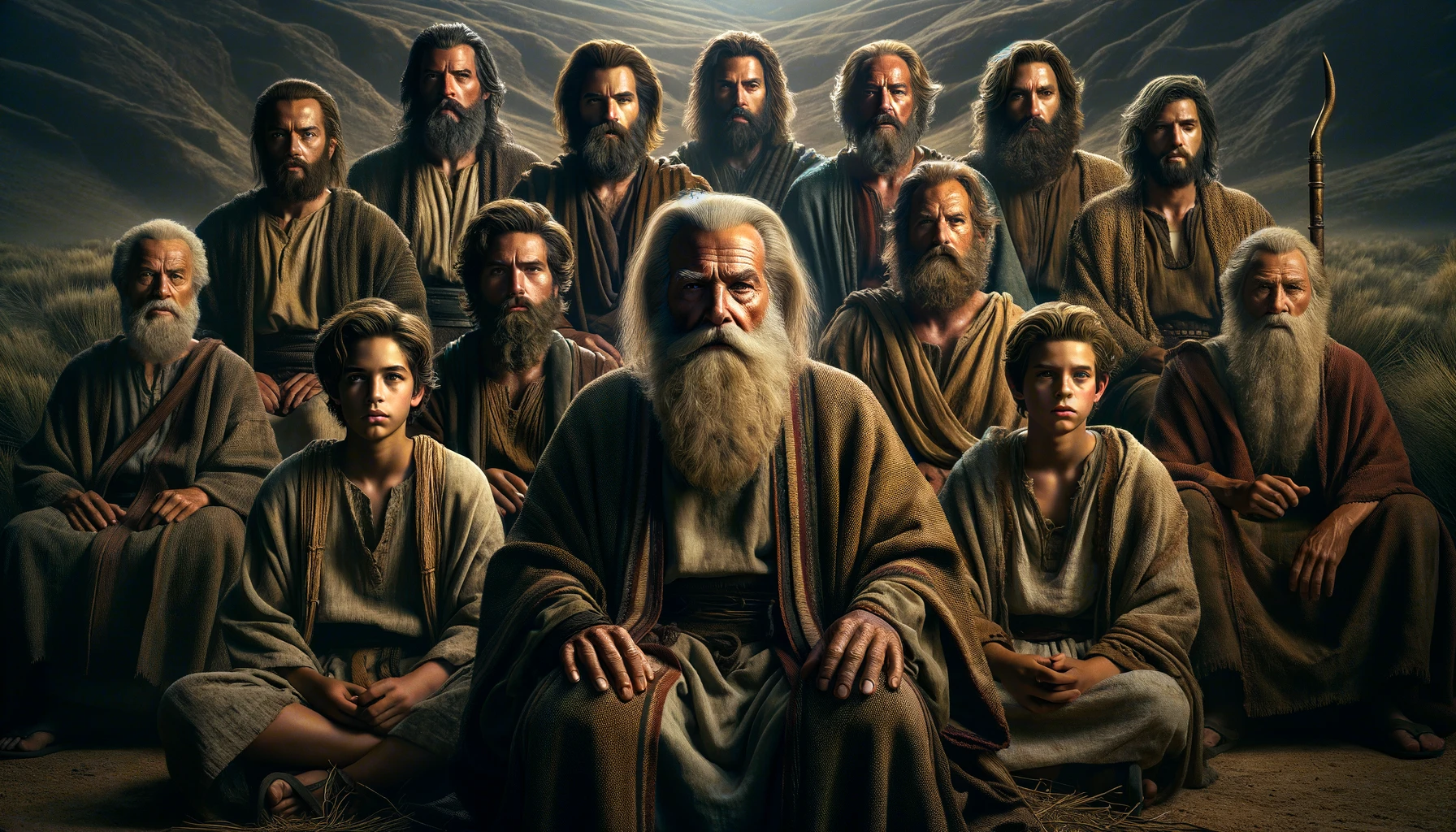
[Lesson 60] Figurative 3 Types of Israel

by ichthus

The Bible speaks of three types of Israel – physical Israel in the Old Testament, spiritual Israel in the New Testament, and new spiritual Israel in the book of Revelation. The name “Israel” means “one who overcomes” or “struggles with God and overcomes.” Physical Israel began with Jacob whose 12 sons became the 12 tribes, but they eventually broke God’s covenant. At his first coming, Jesus became the new “overcomer” or “Israel” and chose 12 disciples as his spiritual “sons” to start spiritual Israel consisting of those born again by believing in him. However, spiritual Israel also fell away and was conquered by the beast as prophesied. So at the Second Coming, Christ as the overcomer must establish a new spiritual Israel that will never end by harvesting the faithful from spiritual Israel and sealing the 144,000. The pattern repeats of the overcomer establishing 12 tribes as a new covenant people of God. Understanding these patterns is crucial to recognize what is happening in our current era as we strive to be part of the final, everlasting new spiritual Israel.


Study Guide SCJ Bible Study

Shincheonji holds distinct theological views that differ from mainstream Christian denominations, yet it also shares some common teachings. This overlap can sometimes blur the lines between their beliefs and those of traditional Christianity. Therefore, it is essential to exercise critical thinking and discernment to differentiate between these shared elements and the unique doctrines they present.

While their interpretations warrant careful examination through a critical and biblical lens, it is equally important to approach these matters with an open yet discerning mindset.

The following notes were documented in person during Shincheonji’s 9-month Bible Study Seminar. They provide insight into the organization’s approach to introducing and explaining its beliefs to potential new members, often referred to as the ‘harvesting and sealing.’ This process is described as being ‘born again’ or ‘born of God’s seed,’ which involves uprooting the old beliefs and replanting new ones. This uprooting and replanting must occur continuously. By examining this process, we can gain a better understanding of the mindset and beliefs held by Shincheonji members.

Figurative meanings:

Israel: One Who Overcomes, Chosen People

3 Types: Physical Israel, Spiritual Israel, New Spiritual Israel

Dark and Fall = Betrayal, losing position in Heaven

what is the standard for one to gain the title of Israel? They must be an overcomer, one who has overcome something. So we have one who overcomes. And from that overcomer, what must come
12 tribes.

Review with the Evangelist

Memorization

James 1:21

Therefore, get rid of all moral filth and the evil that is so prevalent and humbly accept the word planted in you, which can save you.

Yeast of Heaven:

God did not give the land of Cannan to those who came out of Egypt for free. What kind of people could enter?

God gave that land to those who believed in the promise (Joshua and Caleb)

Our Hope: To belong to the 12 Tribes of the New Spiritual Israel at the Second Coming!


Secrets of Heaven: Figurative 3 Types of Israel

As we go through this lesson, let’s keep a few important things in mind.

We need to understand the distinction between the physical and the spiritual. That’s the focus of our discussion today. It’s a crucial distinction regarding God’s people that we’ll be exploring.

Figurative Israel has two meanings. It represents those who overcome, and it also signifies the chosen people.

There are three types of Israel. There is physical Israel, which is the only one most people are aware of and discuss.

There is spiritual Israel, which was developed and formed at the first coming, and there is new spiritual Israel, which is developed at the second coming.

So we have physical Israel, spiritual Israel, and new spiritual Israel in the time of revelation.

Our hope is to belong to the 12 tribes of the new spiritual Israel at the second coming.

Today, we will delve deeply into this topic, and it is our hope that this will be an exciting lesson for us.

Previous Lesson Review

Review

In the previous lesson, we explored the significance of the sun, moon, and stars. 

ONE – The sun represents the pastor. When we discuss heaven in the context of it being a tabernacle for the chosen people, within that tabernacle called heaven, there should be the one who provides the light. That person is the pastor.

TWO – In that place, the pastor trains evangelists who will then go out into the night and shine the light given to them by the pastor. This is done during a time of darkness or night, representing a time when people do not have the true word.

The evangelists go out and shine that light at night, figuratively speaking. 

THREE – The stars represent the saints or the congregation members. There are many of them in a tabernacle, and they differ in brightness or splendor, like 1 Corinthians 15:39-41.

However, know that the saints are there, and their role is to shine brightly and lead many people to the time of day. This is when heaven is referred to as a dwelling place of God, essentially. Heaven, or the tabernacle of the chosen people.

This place should be considered as heaven when things are going well. But we know that it is prophesied that the sun, moon, and stars go dark and fall, not just once, but many times during the eras of the Bible. So in the time of the Old Testament, Jacob’s family, in Genesis chapter 37:9-11, was called the sun, moon, and stars.

Joseph had a dream, and he saw the sun, which was his father, the moon, which was his mother, and 11 stars, which represented his 11 brothers, bow down before him. We know that the vision he received at that time came to fulfilment when his family came to Egypt begging to be saved from the seven years of famine, something that God had been preparing him for. Even through the hardships he experienced and the things his family had put him through, Joseph was still able to save them because he remained diligent.

Let us be like Joseph. No matter what is happening around us, let us be the saviors of those around us. God can use us to be a blessing to everyone connected to us. Don’t give up on them. Though they might be difficult at certain periods, though they might bring you much heartache and tears, when someone remains diligent, God can use you to help that person.

So let us be like that.

FOUR – We know that Jacob’s family becomes the 12 tribes of Israel who become physical Israel. However, the Bible states in Joel 2 that the sun will go dark, the moon will turn blood red, and the stars will not give their light.

So what happens to the original sun, moon, and stars? They go dark and they fall. But a new sun, moon, and stars are established during the time of Jesus.

Those who believed in Jesus became the new chosen people. Yet, even at that time, Jesus promised that the sun, moon, and stars will go dark and fall once again, as mentioned in Matthew 24:29-31. This prophecy was fulfilled in Revelation 6:12-19.

We need to understand the deeper meaning of these events and be able to recognize and overcome them in our time. Today, we will explore the three kinds of Israel, which is very similar.

To summarize, when we say “dark and fall,” it means betrayal and losing position in heaven. A sun, moon, and stars are supposed to be in heaven, but if they’re falling, it means they’ve lost their position in God’s eyes, not necessarily in the eyes of the world.

Often, those who lose their position don’t realize it for a long time, just like King Saul remained in power for quite a while after God had left him, as described in 1 Samuel 15 and 16. 

The Israelites were unaware that the appearance of Christ represented the end of their era. Judgment eventually comes, but the loss of position is first spiritual, before it becomes apparent.

FIVE – One key thing to remember from the previous lesson was the concept of the representative.

The representative, meaning the greatest figure of a particular era, represents the best of the people. However, what typically happens to the representative is also representative of what happens to everyone else. And the representative of the original sun, moon, and stars to the physical Israelites was someone who prepared the way for the Lord. Who was that representative?

John the Baptist.

Luke 16:16

“The Law and the Prophets were proclaimed until John. Since that time, the good news of the kingdom of God is being preached, and everyone is forcing his way into it.

The law and the prophets were prophesied until John, meaning John the Baptist, not Apostle John. These are two different people.

Until John the Baptist. And then something new happened or a new era began. Did you catch that?

Since that time, the good news of the kingdom of God is being preached by whom? Jesus and His disciples.

So from the end of John the Baptist’s ministry, Jesus and His disciples ushered in a new era. The era of the teaching of the kingdom of God, which was not something that was being taught in the previous era. 

The coming of the kingdom of God was not something the Pharisees, Sadducees, teachers of the law, and the scribes were teaching, which is why what Jesus said was so new and fresh to people.

Like in Mark 1:27, when it says, “What is this? A new teaching with authority,” right? Brand new.

Everything Jesus was saying represented a new era. So up to John the Baptist was the old era, and then Jesus represented a new era. Does that make sense?

This cycle of a new era superseding an old era has been repeating in the Bible since Noah, a long time of God doing something new and taking away the old and starting something new. And there are a few things I want us to keep in mind for ourselves, so we are not those who are swept away in the flood of the clearing out of the old era.

And that all pertains to how we receive the word or don’t receive the word. It’s like receiving the warning ahead of time and heeding that warning versus not hearing the warning at all, or hearing the warning and saying, “Nah,” right? Which people did, for example, at the time of Noah.

So what does it mean for us? How are we understanding the time that we are living in today?

It is through understanding the words we’re receiving now. But what if we miss lessons? What if we don’t make those lessons up?

There is something or there’s a way that we are described as God’s people that is related to buildings. 

What are we often called when related to a structure spiritually? A temple.

Do temples appear right away? Like someone has an idea and then a temple appears just like that. No.

But what has to happen for a temple to appear? What needs to take place?

You’ve got to build it. First, before a single stone is placed, what must happen?

You’ve got to lay a foundation. And what happens before the foundation?

There has to be a plan. There has to be a detailed plan, often in two dimensions, right? That must be detailed by an architect or a builder or a designer.

That’s step number one. So what is the blueprint that the temple of ourselves should be fashioned towards? There must first be a blueprint.

And that blueprint is the Word. And with the Word as our blueprint, the temple of our hearts can begin to be built properly.

Let’s turn to the book of Proverbs.

Proverbs 24:3-4

3  By wisdom a house is built,  and through understanding it is established;  4  through knowledge its rooms are filled with rare and beautiful treasures.

The building of a temple requires a few key elements. The three things that were mentioned are:

Wisdom, knowledge, and understanding represent the bricks used in someone’s house. 

These bricks symbolize the wisdom, knowledge, and understanding of the Word. 

However, what happens if there is a word that someone doesn’t understand? This represents a missing brick in their temple.

If there are missing bricks, the structure becomes weak or even non-existent. When there are bricks missing in somebody’s structure, their temple becomes unstable and lacks structure.

So if we are learning the open Word, and the open Word is building us into a new temple, how stable will our structure be if we are missing parts of the open Word?

We know that life is full of unexpected events – family emergencies, work emergencies, transportation emergencies, and so on. When these things happen, it’s important to make a plan to make up the missed lesson so that our bricks (our understanding) are not missing. Imagine how difficult it would be to understand today’s lesson if you had missed the previous lessons about the figurative stars or heaven and earth. Those foundational lessons are crucial for comprehending the current one.

If you’ve missed any lessons, please reach out to your evangelist and make them up right away, so that our temple can be fully built. 

We want to be a beautiful temple where God says, “Yes, this is my desired dwelling place.” After all, 1 Corinthians 3:9,16 tells us that we are God’s temple, so let’s strive to be a good temple for God.

Now, let’s dive into the content we wanted to cover today, which involves the three different eras of Israel. Let’s first understand the meaning of Israel in the Bible, as it is a concept that we may grasp in one place, but there is much more to explore.


Beginning and end of the eras of Israel

Old Testament

1. The era of physical Israel or the chosen people of the Old Testament

We’ll examine the beginning of these groups and what it means that they came to an end. Let me explain what I mean by this.

When I say an era or a people comes to an end, that does not mean it’s impossible for them to receive salvation. That’s not what I’m referring to. Consider it on two levels.

There are the groups of people that are prophesied about. And then there are the individual people within those groups. There is always hope for individual people, no matter which group they belong to.

What we’re saying comes to an end is the standard or status of the group of people. Do you understand? So there’s a difference between, for example, a Jewish person today who believes in Jesus versus a Jewish person today who does not.

What I mean is that both, though they may have physically been part of the original covenant, the original covenant is no longer what makes them considered part of God’s people, because the standard has changed. But those individual people can decide, “I desire to believe in and follow Christ.” Then they become part of the next group of people.

So the physical lineage going forward is not what’s important. It’s about belief. And someone can enter and exit a group of chosen people at any time in the new eras.

This is the key point I’m discussing today. We’re not talking about individual people. Individual people always have a chance with God.

Keep that in mind. So physical Israel was the first era.


ONE. Beginning

So let’s first look at the beginning of physical Israel.

Genesis 32:22-30

22 That night Jacob got up and took his two wives, his two maidservants and his eleven sons and crossed the ford of the Jabbok. 23 After he had sent them across the stream, he sent over all his possessions. 24 So Jacob was left alone, and a man wrestled with him till daybreak. 25 When the man saw that he could not overpower him, he touched the socket of Jacob’s hip so that his hip was wrenched as he wrestled with the man. 26 Then the man said, “Let me go, for it is daybreak.”

But Jacob replied, “I will not let you go unless you bless me.”

27 The man asked him, “What is your name?”

“Jacob,” he answered.

28 Then the man said, “Your name will no longer be Jacob, but Israel, because you have struggled with God and with men and have overcome.”

29 Jacob said, “Please tell me your name.”

But he replied, “Why do you ask my name?” Then he blessed him there.

30 So Jacob called the place Peniel, saying, “It is because I saw God face to face, and yet my life was spared.”

How many of us knew that Israel was originally the name of Jacob?

Hopefully, most of us were aware of this, but for some, it might be new information. Israel is a title with two meanings. If we look at verse 28, it states, “Then the man said, ‘Your name will no longer be Jacob, but Israel, because you have struggled with God and with men and have overcome.'”

So, what is the standard for one to gain the title of Israel? They must be an overcomer, one who has overcome something. If you look at the footnote of your Bible, the meaning of Israel is only half correct. The footnote for verse 28 states that Israel means “he struggles with God.” Yes, he struggles with God, and then what? And then he overcomes.

Let’s be like Jacob. How was Jacob when he encountered the angel of God? He said, “I’m not letting you go until you bless me.” Wow. And so, God is saying, “My promise is starting to take place, and the key people I need for my mission to be fulfilled are coming into being and they’re maturing into the people I need them to be.” Because Jacob, whose father was Isaac, whose father was Abraham, had a promise to fulfill.

We know that Jacob went through a lot of drama in his life. His family’s story was basically like a telenovela, with the drama involving his brother Esau and his two wives. All this drama was necessary for God’s word to be fulfilled through him. Nothing is an accident in the Bible. So, let’s keep reading about how Jacob and his family became the physical Israel.

Genesis 35:22-26

22 While Israel was living in that region, Reuben went in and slept with his father’s concubine Bilhah, and Israel heard of it.

Jacob had twelve sons:

23 The sons of Leah:Reuben the firstborn of Jacob,Simeon, Levi, Judah, Issachar and Zebulun.

24 The sons of Rachel:Joseph and Benjamin.

25 The sons of Rachel’s maidservant Bilhah:Dan and Naphtali.

26 The sons of Leah’s maidservant Zilpah:Gad and Asher.

These were the sons of Jacob, who were born to him in Paddan Aram.

The drama in Jacob’s life was not without purpose. All that he experienced was so that Jacob could have what he needed – 12 sons. It would have been challenging for one person to have 12 children, but it was important that Jacob ended up with 12 sons, and it was not an accident.

Jacob, whose name was changed to Israel, meaning “overcomer” or “one who overcomes,” had 12 sons. Through his physical seed, he produced these 12 sons. And these 12 sons ended up becoming what?

Genesis 49:28

All these are the twelve tribes of Israel, and this is what their father said to them when he blessed them, giving each the blessing appropriate to him.

Throughout the entire chapter 49, which I highly recommend you read, we see that Jacob’s 12 sons form the 12 tribes, each son having a tribe of his own, as they matured and their families grew.

So we have one who overcomes. And from that overcomer, what must come?

12 tribes.

That is the logic of God. From the overcomer must come 12 tribes. Keep that logic in mind.

We will see it again. From the overcomer comes 12 tribes. And the same family, do not forget, is also called the sun, moon, and stars, as we talked about last time.

Sun, moon, and stars, just like in Genesis 37.

Now these sun, moon, and stars receive something from God. After they have gone to Egypt, suffered in Egypt for 400 years, and now have escaped Egypt and are in the desert, several hundred years after this event.

During this time, God gives these chosen people, physical Israel, something special. And we are going to read now Exodus 19:5-6.

Hopefully, by now, you already have in your mind what we are about to read. Does anyone remember what Exodus 19:5-6 talks about? It is so important.

Something that God gives the people of Israel. The covenant.

Exodus 19:5-6

5 Now if you obey me fully and keep my covenant, then out of all nations you will be my treasured possession. Although the whole earth is mine, 6 you will be for me a kingdom of priests and a holy nation.’ These are the words you are to speak to the Israelites.”

God always establishes a covenant with his chosen people. This is his pattern. The people of Israel are the descendants of Jacob. When we refer to the “people of Israel,” we are referring to the descendants of the man who was given the title “Israel.” 

The country was named after the father who gave them birth. But the name “Israel” really means “the people of the original overcomer.”

From the people of Israel, God has chosen a people for this time. He gives them a covenant, and this covenant is conditional. The term “if” is used – if the covenant is kept, there will be blessings. They will become a holy nation, a kingdom of priests, and God’s treasured possession.

Things were going well at first, but then they started to struggle. Just a few chapters later in Exodus 32, when Moses was away on the mountain for a long time, the people grew restless and made an idol, the golden calf.

This went against the first covenant, which stated, “I am the Lord your God, you shall have no other gods before me.It is difficult to keep the covenant because there are always temptations, and Satan, the ultimate enemy, knows this and uses it to exploit the people. Eventually, God said, “No more.”

TWO. End

So we talked about the beginning, but now unfortunately we have to talk about the end. 

1 Kings 11:7-13

7 On a hill east of Jerusalem, Solomon built a high place for Chemosh the detestable god of Moab, and for Molech the detestable god of the Ammonites. 8 He did the same for all his foreign wives, who burned incense and offered sacrifices to their gods.

9 The Lord became angry with Solomon because his heart had turned away from the Lord, the God of Israel, who had appeared to him twice. 10 Although he had forbidden Solomon to follow other gods, Solomon did not keep the Lord’s command. 11 So the Lord said to Solomon, “Since this is your attitude and you have not kept my covenant and my decrees, which I commanded you, I will most certainly tear the kingdom away from you and give it to one of your subordinates. 12 Nevertheless, for the sake of David your father, I will not do it during your lifetime. I will tear it out of the hand of your son. 13 Yet I will not tear the whole kingdom from him, but will give him one tribe for the sake of David my servant and for the sake of Jerusalem, which I have chosen.”

In the past, we see that Solomon built temples to different gods, not outside of Israel, but inside. And the many wives he had from different nations pulled his heart away from God. 

Solomon broke the covenant in a significant way. And remember, he was the king. So whatever the king does, the people of Israel would also do.

God was not happy with this. In verse 11, God said, “Since this is your attitude and you have not kept my covenant and my decrees, which I have commanded you, I will most certainly tear the kingdom away from you and give it to one of your subordinates. But because David was a man after my own heart, I will not tear everything away from you, but I will leave you one tribe, Judah, the rest.”

We know what happened after this – Assyria took the North, and Babylon took the South for 70 years.

At this time, God started to speak to the prophets – Isaiah, Jeremiah, Ezekiel, Daniel, Hosea, Joel, Amos. He told them to convey His message to His people who had become adulterers, idol worshipers, and rebels.

The prophets’ messages were clear – God’s people would come to an end, but a few survivors would be taken, and God would build something new with them.

In Luke 16:16, it is stated that “the law and the prophets were testified until John.” John the Baptist represented the end of that era, the end of physical Israel, as he was their representative.

In Matthew 11, we can see how Jesus described John the Baptist.

Matthew 11:11-12

11 I tell you the truth: Among those born of women there has not risen anyone greater than John the Baptist; yet he who is least in the kingdom of heaven is greater than he. 12 From the days of John the Baptist until now, the kingdom of heaven has been forcefully advancing, and forceful men lay hold of it.

Let’s delve a little deeper into this statement.

This is a profound statement, and it’s easy to misinterpret. In verse 11, it says, “I tell you the truth. Among those born of women” – meaning everyone, except for him, right?

Of those born of women, there has not risen anyone greater than John the Baptist. This means that until John the Baptist, he represents the pinnacle, the greatest. But then, what does Jesus say?

What does “yet” imply? “Yet he who is least in the kingdom of heaven is” what?

“Greater than he.” Hmm. What does Jesus mean by this?

Which heaven is he talking about here in verse 11? Which heaven is he discussing?

Remember, there are two types of physical heaven. Which type is he talking about in verse 11?

He who is least in the kingdom of heaven is greater than John the Baptist. So let’s take a step back. What are the two physical heavens?

Think of Revelation 21. It describes both of them. “Then I saw a new heaven and a new earth.” For the “first heaven and the first earth” has passed away. So there’s a new heaven and a new earth, and the first heaven and first earth appear first and are then superseded by the new heaven and new earth.

This pattern has been repeating in the Bible. So John the Baptist and all of physical Israel represented the first heaven and the first earth, the first tabernacle of the chosen people.

So there are two heavens described in Matthew 11:11-12. The first one was Jesus’s heaven, the new heaven and a new earth. So let’s read the verse again with that understanding.

Verse 11 says, “I tell you the truth. Among those born of women, there has not risen anyone greater than John the Baptist. Yet he who is least in the kingdom of the new heaven is greater than John because John never joined the new heaven. John never joined Jesus.”

He maintained his own disciples up until his death, which is strange, given that he knew who Jesus was. He said, “Look, the Lamb of God who has come to take the sins of the world,” and he baptized Jesus, seeing heaven open and a dove light on him. Yet, this same John the Baptist is now doubting Jesus.

And Jesus said, “He who is least in my kingdom is greater than John,” the greatest of all these people. Do we understand this now?

John the Baptist was their representative (Old Testament era), but he failed in the end. What did Jesus say about him in verse 12

Let’s read about the first heaven and the first earth, and what happened to it.

Verse 12 states that from the days of John the Baptist until now, the kingdom of heaven, the first heaven, has been forcefully advancing. And what happened? Forceful men have been laying hold of it.

Who were these forceful men? The Pharisees and the Sadducees. And they consumed his kingdom. Oh no!

Why? Because John was doing something new. He was like a lamp.

As Jesus said in John 5, it was total darkness at the first coming. There was no truth, no light. No one had the truth.

So when John appeared, just a little lamp, super bright, people took notice. There’s this guy in the desert baptizing people. Let’s go check it out.

And so the Pharisees showed up. “Who are you? What is your name? What do you do?” A lamp in the darkness is going to get noticed.

And so the Pharisees, like destroyers, came. Let’s turn to another example of what happened here. Let’s quickly go to a bit of a side tangent in Matthew 17, but it’s really important.

In Matthew 17:10, the disciples asked Jesus, “Why then do the teachers of the law say that Elijah must come first?”

Jesus replied, “To be sure, Elijah comes and will restore all things. But I tell you, Elijah has already come, and they did not recognize him, but have done to him everything they wished. In the same way, the Son of Man is going to suffer at their hands.”

Then the disciples understood that he was talking to them about John the Baptist. So what happened? The Pharisees invaded and destroyed him, causing him to doubt Jesus and filling his mind with foolishness.

Unfortunately, John the Baptist bought into it. This is why he asked the question in Matthew 11, “Are you the one who is to come, or should we expect someone else?” Someone who has no doubt will not ask such a question.

So John the Baptist represented the end of this era, and Jesus was telling the people what would happen to them because they refused to accept him.

Matthew 21:43

“Therefore I tell you that the kingdom of God will be taken away from you and given to a people who will produce its fruit.

Jesus is speaking to the people in rebuke, and what does he say? “Therefore, I tell you that the kingdom of God will be taken away from you and given to a people who will produce its fruit.”

This is referring to the people of Israel and the kingdom of God. The kingdom will be given to those who will produce fruit. And we know what it means to produce fruit, right? This is not talking about the fruits of the Spirit, although those are important – love, joy, peace, and so on. 

No, what this means is those who will be fruitful and multiply, those who will bring others to hear the words of God, which come from Jesus, his words. Producing fruit means evangelism, as seen in John chapter 15. 

This is really what it’s talking about here, because the Israelites were not actively going out and doing that kind of work, like the disciples did. The disciples went out, spreading the gospel to different countries and nations.

God and Jesus were saying that this is what needs to happen at this time, but the Israelites were not doing it. They had rejected the one who was sent, and were staying in their own country. God needed people who were willing to go out and tell others about him and his Son. This represented the end of physical Israel from God’s perspective.

So, we’ll look at the time of Jesus’s first coming, what he and his disciples represented, and how Jesus’s promises about a new Israel come about.

Quick Review

Quick Review

Israel represents two meanings – the one who overcomes or the person who receives the title of Israel because they overcame, and then the chosen people who come from that person. That’s what Israel means. There are three types of Israel.

There’s physical Israel, which we just discussed. Now we’ll be talking about spiritual Israel. And then, of course, we’ll end with the new spiritual Israel.

We’re looking at the beginning and end of the previous eras of Israel. One thing to note here is that at the beginning, it started with someone – a person who struggled with God and with man and overcame because he wanted to be blessed. And he gained the title of Israel because of that.

Jacob then had 12 sons who became the 12 tribes, each son representing a different tribe. And God established a covenant with these tribes, meaning that if you keep my covenant, you will receive many different blessings. But there are also consequences for not keeping that covenant.

Unfortunately, we see those consequences in 1 Kings 11. And also then what took place at the time of the first coming, where the best of them was consumed by bad company. That’s why 1 Corinthians 15:33 is so important – it says, “Do not be deceived: ‘Bad company corrupts good character.'” That verse is very true.

So we really need to pay attention to those we spend time with. Are they giving us life? Are they feeding our spirit? Are they giving us the open word? Or is there nothing there? Or are they only talking about worldly issues – news events, the stock market, real estate, and so on – with nothing that ultimately gives life?

The more time we spend with those who don’t give life, the more our spirit gets weighed down. That’s why when we come to class, we always feel joyful, because we’re understanding the life-giving word.

The First Coming


2. Spiritual Israel or the chosen people of the New Testament

ONE. Beginning

To understand their beginning, we need to first comprehend who was the one that overcame and gained the title of Israel.

Who overcame at the first coming? Jesus.

John 16:33

“I have told you these things, so that in me you may have peace. In this world you will have trouble. But take heart! I have overcome the world.”

In this world, you will face troubles, but take heart, for I have overcome the world. Jesus overcame Satan and Satan’s world, becoming the overcomer.

If you’d like to see a glimpse of this, look at Hosea 11:1, which is referenced in the test for coming out of Egypt. Pay attention to how God refers to the one he calls out of Egypt. It says, “When Israel was a child, I loved him, and out of Egypt, I called my son.” This passage is then quoted in Matthew 2, referring to Joseph, Mary, and the young Jesus having to escape to Egypt until Herod’s death.

In that prophecy, God calls him Israel. So, Jesus overcame the world, gaining the title of the overcomer. What did he do then?

Did he simply stay by himself? No, when Jesus began his ministry, he said, “I need 12 sons.” He went out and found the 12 disciples, establishing each one of them as his sons. He even calls them his children at times.

John 1:11-13

11 He came to that which was his own, but his own did not receive him. 12 Yet to all who received him, to those who believed in his name, he gave the right to become children of God— 13 children born not of natural descent, nor of human decision or a husband’s will, but born of God.

This is a very important passage for understanding the origin of Christians. What is it saying?

The text indicates that the children are born not through human decision or a husband’s will. Instead, they are born not of natural descent, but they are born of God, which means their nature is now spiritual, rather than solely physical.

The standard is no longer based on bloodline or physical lineage. This is further emphasized in a crucial passage from Romans 2:28-29.

Romans 2:28-29

28 A man is not a Jew if he is only one outwardly, nor is circumcision merely outward and physical. 29 No, a man is a Jew if he is one inwardly; and circumcision is circumcision of the heart, by the Spirit, not by the written code. Such a man’s praise is not from men, but from God.

This is a very important passage. It holds great significance.

The apostle Paul is discussing a crucial perspective here – not the outward, superficial one, but God’s perspective, the only one that truly matters.

God is looking down at the people to whom He originally gave the covenant, and He expresses His dissatisfaction: “I don’t like what I see.” So, He decides to start anew. Those who accept His Son will be born of God and become spiritual Jews, becoming part of His original promise to Abraham.

This is a deep topic, and we will discuss it further soon. This applies to you and me.

Glory to God! This refers to everyone who accepts Jesus as the Son of God, listens to, and understands His words. It is a vital matter.

Let us now consider how Jesus establishes spiritual Israel, as He must do many things similar to what Jacob did, but in a spiritual sense this time.

Let us turn to Matthew 13. As we do so, let us keep in mind what Jesus is doing in this chapter, which is very similar to what Jacob did all those years ago.

Matthew 13:24, 37

13 Jesus told them another parable: “The kingdom of heaven is like a man who sowed good seed in his field.

37 He answered, “The one who sowed the good seed is the Son of Man.

The kingdom of heaven is like a man who sowed good seed in his field. Seed.

Oh, interesting. What does the seed represent?

The word. The farmer who sowed good seed in his field. Why?

What did Jesus want to create? A new crop. A new people who were born of the word of God.

Of course. So not a physical seed that needed to be sown, but a spiritual seed. The word.

And those who accepted those words were then subsequently born of God’s seed and they became God’s children. And when Jesus did this, of course, he had workers in the field, right? Who were the workers that Jesus had established first?

The first to be born of God’s seed. Twelve disciples. And why did there have to be twelve?

Because Jacob had twelve sons. So Jesus’s spiritual seed, twelve disciples.

Because Jesus became Israel. Jesus became the one who overcomes. So he needed twelve sons. And guess what?

His twelve sons went out into the world to preach. And so if you happened to be in the area that, for example, Thaddeus went to, then you would have belonged to the tribe of Thaddeus, essentially. Or if you were in a place where Philip went to, then you would belong to the tribe of Philip or Thomas.

You would belong to the tribe of Thomas because Thomas was your spiritual father like that. Of course, Jesus is the father. But you heard that word through Thomas or Simon or Bartholomew.

These men would go out and testify the gospel that the Christ had come. And so you were listening to the words of even Paul, too. And you kind of belong to that tribe like that.

So it was very important that the word was delivered in this way. And that Jesus’s word was disseminating because some very important things had to happen. First, this had to come to an end and it’s not going to come to end on its own.

It needs to be judged. Right. So judgment took place at that time.

And Jesus, while he was on the mountain, Mount Zion, because he was called Zion and his 12 disciples. They testified the word, the word of testimony that the Old Testament has been fulfilled. They testified that to the people of Israel.

The goal was that people from Israel would come out and become part of the new spiritual Israel belonging to Jesus and even his 12 tribes that was established. So the word would go out and people would hear that word in the original Israel, physical Israel, and they would have a decision to make. Do I stay with what I’ve always known or do I testify or believe in what is being testified to me now and move over or cross over from death to life.

But not many people were willing to make this decision. Twelve initially and some after that, but of course, by God’s grace, this began to grow as the gospel began to go out. But even Jesus testified about the end of this era too.

TWO. End

I want to share something very important that we need to understand. Jesus sowed good seed in his field. And in verse 37, it states that the field represents the world, Jesus’s world.

This world, as we discussed earlier in the class, is his church, the realm of Christianity. That’s where Jesus sowed his word. However, we know that at the end times, the field must then be harvested, and the good seed must be taken out, while whatever remains, which are weeds, will be burned.

This means that the field is not the final destination. The barn is. So the destination for those who believe in Christ is not the field in which they grew up.

The goal is to be harvested. That’s the objective. So at the time of the second coming, Jesus promised that the sun, moon, and stars will go dark and fall.

When this takes place, Jesus and the angels will come and begin to harvest the elect. The sun, moon, and stars will go dark and fall. And when this happens, then there must be an extraction of the elect.

Let’s explore a bit more about how this unfolded.

Revelation 13:6-7

6 He opened his mouth to blaspheme God, and to slander his name and his dwelling place and those who live in heaven. 7 He was given power to make war against the saints and to conquer them. And he was given authority over every tribe, people, language and nation.

A Terrible Event Unfolds

There is a tabernacle that is being referred to as heaven. This is one of the physical heavens, not the new heaven and new earth, but the first heaven and first earth. Unfortunately, at this place called heaven, a betrayal occurs.

Due to this betrayal, the beast that emerged from the sea is allowed to invade and destroy the inhabitants of this heavenly place. This is why the sun, moon, and stars became dark and fell, or at least part of the reason for their downfall. These people, like John the Baptist, were meant to be a light, but now they are being judged.

In Revelation 1:20, Jesus refers to these people as the seven stars, seven messengers, or the seven churches, indicating that their purpose was to shine light. Initially, they did so, but in Revelation chapters 2 and 3, Jesus calls them to repent, remember their former glory, and return to their initial works. He warns that if they do not, He will remove their lampstand from its place.

This prophecy is now being fulfilled, as described in Revelation 6:12-17, where the sun, moon, and stars go dark and fall. The representatives of spiritual Israel, who were meant to be a light in the darkness, have themselves fallen into darkness, and spiritual Israel has come to an end.

Now, the question arises: What must God and Jesus do, now that the place they had established has been snuffed out?

Make a new one. 

The Second Coming

3. New spiritual Israel has no end

Glory to God. The chosen people of the second coming will have no end, and we’ll briefly discuss how they came about. Of course, we will be spending a lot of time on this in the days and classes to come. Let’s start by talking about their beginning.

ONE. Beginning

The appearance of an overcomer is necessary for the establishment of a new Israel. This is a crucial prerequisite before a new Israel can emerge. 

Revelation 12:5, 9-11

5 She gave birth to a son, a male child, who will rule all the nations with an iron scepter. And her child was snatched up to God and to his throne.

9 The great dragon was hurled down—that ancient serpent called the devil, or Satan, who leads the whole world astray. He was hurled to the earth, and his angels with him.

10 Then I heard a loud voice in heaven say:

“Now have come the salvation and the power and the kingdom of our God,

    and the authority of his Christ.

For the accuser of our brothers,

    who accuses them before our God day and night,

    has been hurled down.

11 They overcame him

    by the blood of the Lamb

    and by the word of their testimony;

they did not love their lives so much

    as to shrink from death.

And they overcame him by the blood of the Lamb and the word of their testimony.

Pay close attention to what the overcomer receives. He is holding an iron scepter, the very same iron scepter we see in Revelation 2:27, which is given to the one who overcomes.

Revelation 2:26-27

26 To the one who is victorious and does my will to the end, I will give authority over the nations— 27 that one ‘will rule them with an iron scepter and will dash them to pieces like pottery’—just as I have received authority from my Father.

Just as I have received authority from my Father, the one who overcomes will also receive the same authority with the iron scepter. Therefore, the male child and the overcomer are the same person.

In the book of Revelation, the same person who fights and overcomes the dragon, the group of the dragon, and those that the dragon is working through, they go to war against each other. So, what do these people do after they defeat the dragon?

They must establish something new. And first, there must be the work of the harvest.

Revelation 14:14-16

14 I looked, and there before me was a white cloud, and seated on the cloud was one “like a son of man” with a crown of gold on his head and a sharp sickle in his hand. 15 Then another angel came out of the temple and called in a loud voice to him who was sitting on the cloud, “Take your sickle and reap, because the time to reap has come, for the harvest of the earth is ripe.” 16 So he who was seated on the cloud swung his sickle over the earth, and the earth was harvested.

We see the fulfillment of the prophecy that Jesus gave 2,000 years ago. Jesus sowed the seed in the field, and now, 2,000 years later, an angel comes as Jesus promised to do the work of the harvest.

We know that the field represents the church, and the good seed produces wheat, which are the people with God’s word of truth within them. So the angel is coming to gather God’s true chosen people, taking them out of the field that will eventually be burned, so that they can be brought into the barn that was promised. All the prophecies are linked together.

They are not separate things; it’s talking about the same thing. So the angel comes and does the work of the harvest, and who are the ones that are harvested?

We’ll draw a mountain and 12 people under that mountain, each person representing a tribe. We’ll draw the one who overcomes at the top, and the one who overcomes must give a testimony, the word of testimony, the same one they overcame with by the blood of the Lamb and the word of testimony, which is the New Testament fulfillment.

This testimony must go out to spiritual Israel, those who are in the field, who are hearing these words and need to come out. “Come out of her, my people.” They need to be harvested and they need to be sealed, as we looked at in Revelation chapter 7.

Those who come out of the field will become the new 12 tribes, and from those 12 tribes, 144,000 will be called and sealed to fulfill a particular purpose, an important purpose that we’ll explore in the classes to come. They become the new spiritual Israel, which will never end by God’s grace.

Do we understand the logic here? How God and Jesus repeat themselves and have been repeating themselves all this time? We just didn’t know it. Why didn’t we know it before? There were parables, and the parables had not yet been opened, which means they had not yet been fulfilled. What does that mean about our time now, about our time today? It means that things are taking place, things are happening.

So our desire should be, “God, let me be harvested.” That should be our desire, not, “God, let me stay in the place I currently am because it’s comfortable, because I know the people here.” Instead, our number one mission now should be, “I want that angel in Revelation 14 to get me too. I don’t want to be left in the field, which is going to be burned, as it says in Matthew 13.


Memorization

Revelation 7:4

Then I heard the number of those who were sealed: 144,000 from all the tribes of Israel.

Watching a Video


We’re going to be playing a video, and I’m going to explain the video before and after, and this will be in place of small group for tonight. Please watch the video carefully and note that this video is old.

We’ve been playing it for years, so it is not related to current events that are taking place. So please do not equate the two things. They are not related.

So they’re not related to the current things taking place. I’ll say that again. So if we can go ahead and play the video now, please watch it carefully and note the mindset of these people and note what this mindset means to God and Jesus.

Okay. So let’s go ahead and play that video, and then I’ll talk about after the video.


Video

Yakir, Tel Aviv

Street Person 1

[Interviewer]

Who is Jesus according to Judaism? What status does he have?

[ An Orthodox Jew]

Jesus was born to a Jewish mother, so in principle, he was a Jew. And the Christians took him as their leader. They claim he wasn’t born from a mother ….

[Interviewer]

You mean a father. They say his father was God. Her husband name was Joseph.
I assume they are asking because they want to know why we don’t believe Jesus is the Messiah.

Can you speak to that? That Jesus is the Messiah

[ An Orthodox Jew]

Why should we? Why would we believe? What is the explanation that he is the Messiah?

I don’t know. I am not Christian. I can’t tell you.

[Interviewer]

But what are the reasons he can’t be the Messiah? What needs to happen for him to be the Messiah?

[ An Orthodox Jew]

He is not the Messiah.

They say he is the Messiah, maybe because he wasn’t born from a father.

[Interviewer]

I know Jesus came from Bethlehem from the family of Jesse (King David’s family)

[ An Orthodox Jew]

But other than that I don’t know. But for Judaism, that is not the Messiah.

[Interviewer]

So who could be the Messiah?

[ An Orthodox Jew]

No one knows

[Interviewer]

What does that mean?

[ An Orthodox Jew]

He who knows, doesn’t say

[Interviewer]

But as Jew, I always thought there were signs …

That the Messiah has to be X, Y, Z …

[ An Orthodox Jew]

No. No one knows.

Street Person 2

[Interviewer]

Who is Jesus from the Jewish perspective?

[A Jewish Man]

There is a part of the Gmara about Jesus ??? That he was a student of the Rabbis but he was a heretic. He believed that the Messianic period had arrived. Even though the Messianic period has not arrived.

[Interviewer]

Anything to add? Why don’t Jews believe that Jesus is the Messiah?

[A Jewish Man]

Because the redemption hasn’t arrived. But Judaism says that we still need to fulfill the commandments because no one here lives in total joy, so it is clear the redemption hasn’t come yet.

Street Person 3

[Interviewer]

Who is Jesus for Jews?

[A Jewish Woman]

He is part of Christianity. He is not connected to us at all. He is not connected to us. We believe in the Torah. We have our own laws given to us. They live in a fantasy that he walked on water. He believed in the cross. We believe in the Torah that God gave us at Mount Sinai. We don’t believe in Jesus. He has nothing to do with us. We have no connection to Jesus. We have the Torah to believe in. The laws, everything is in the Torah.

End of the Video.

The importance of understanding the word properly is crucial. Christians also believe in the Torah, which encompasses the books of Genesis through Deuteronomy. They also believe in the promises of the Old Testament and the law established by God, just as Jesus did.

However, there is a misunderstanding about who Jesus was and what he did. Jesus did not become a Christian, nor did he believe in the cross. Christianity was formed from the belief in Jesus. It is truly unfortunate that even after 2,000 years of teaching about Jesus, people still misunderstand who he was and why he came.

If people understood what is being learned here, they would have a much more complex and deeper conversation. They would realize that the messianic period, which they claimed had already come, is actually about to come again. They are still waiting for the Messiah to come for the first time, and this wait will go on forever.

Instead of thinking of “those silly people,” we should look at ourselves and examine our own beliefs and expectations. What is the equivalent for us as Christians that may be causing us to wait forever for something that has already taken place? Do we truly understand the promises ourselves, or will we also be saying, “No, no, no, it hasn’t happened yet. It’s going to happen like this,” while ignoring the events that have already taken place?

We should use the example of those people to reflect on ourselves and avoid making the same mistakes in our time. This is not related to current events; the video is old, and these points should be considered separately from any recent occurrences.

Instructor Review

SUMMARY


We have learned about the three types of Israel in the Bible. Israel is primarily a title, which means “one who overcomes” or “one who struggles and overcomes.”

Jacob was the first to struggle and gain this title, and his 12 sons became the 12 tribes. God established a covenant with them, but unfortunately, they broke that covenant and came to an end. Even at the first coming of Jesus, they did not realize that they had reached the end.

Their great representative, Jesus, had to do something new. He became the overcomer, overcoming Satan, the world, the Pharisees, and the Sadducees. He judged them all with the words of God and established a new people, those born not of physical descent, but of God’s spiritual seed, which is the word. Jesus sowed this good seed in his field, knowing that an enemy would come and sow weeds as well.

Jesus testified this word to the physical Israelites, hoping that many of them would come out of their captivity and become part of what he was building in their time. However, Jesus knew that this was only for a time and was not meant to be permanent.

This is why he prophesied about the sun, moon, and stars going dark and falling. When they went dark and fell, they were invaded by the beast. The people that Jesus and God had established as a lamp, shining in a time of darkness, were also snuffed out by the beast.

Jesus then said, “Now I need to build something new, new, something new, new at the time of the second coming.” He will establish a new overcomer in the time of the second coming, who Jesus and God will work through to fulfill the book of Revelation. These overcomers will overcome with the blood of the Lamb and the word of their testimony, those that Satan is using. Working with heaven, they will do the work of a harvest, calling many people out of the field so that they can gather on the mountain where God and Jesus will be. This is the three types of Israel.

Let’s Us Discern

Testing Shincheonji’s Claims: Two Lenses, One Story

A Refutation of SCJ Lesson 60: “Figurative 3 Types of Israel”


Introduction: The Map That Leads Nowhere

Imagine you’re planning a road trip across the country. You’ve studied maps, marked your route, and know the major highways that will get you home. But then you meet someone at a rest stop who seems like a seasoned traveler. “Those maps are outdated,” he tells you confidently. “The roads have changed. Most people don’t know this, but there are three different highway systems now—the old physical highways, the spiritual highways from a hundred years ago, and the new spiritual highways that only opened recently. If you want to reach your real destination, you need to understand all three.”

Intrigued, you listen as he explains. The old highways represented one era of travel. Then new highways were built that superseded the old ones. And now, in our time, there’s a third system—the newest highways—that most travelers don’t even know exist. “Your old map won’t help you anymore,” he warns. “You need new understanding for this new era.”

It sounds reasonable. After all, roads do change. Infrastructure gets updated. Maybe you have been using outdated information. So you set aside your reliable map and follow his directions instead.

But here’s what you don’t realize: the “three highway systems” don’t actually exist. The original roads are still the correct routes. This traveler has created an elaborate fiction—using real place names, referencing actual landmarks, and speaking with authority—to convince you that the straightforward path home is obsolete. By the time you realize his “new highways” lead nowhere, you’ve driven hours in the wrong direction, burned through your gas, and can barely remember how to get back to the route you abandoned.

This is what happens in SCJ Lesson 60: “Figurative 3 Types of Israel.”

The lesson appears to be a thoughtful Bible study exploring God’s chosen people throughout history. The instructor, Nate, walks students through Scripture, discusses the transition from Old Testament Israel to the New Testament church, and encourages students to hope for belonging to God’s people. Everything seems biblical, historically grounded, and theologically sound.

But beneath the surface, something else is happening. This lesson introduces a framework that will fundamentally reshape how students understand salvation, the church, and their place in God’s plan. By presenting “three types of Israel”—Physical Israel, Spiritual Israel, and New Spiritual Israel—SCJ creates a paradigm that sounds biblical but actually contradicts the core message of the New Testament. The lesson uses legitimate biblical concepts (Israel, the church, covenant transitions) to build an interpretive structure that will eventually lead students to believe that salvation today requires joining a specific organization in South Korea led by a man named Lee Man-hee.

The brilliance of this lesson is its subtlety. Students at this point—Lesson 60 of the Introductory Level—have been studying for months. They’ve learned about parables, symbols, the Tabernacle, prophecy and fulfillment, and the sun, moon, and stars. They trust their instructor. They’ve invested significant time. And now they’re being introduced to a concept that seems like the natural next step in their biblical education: understanding the different phases of God’s people throughout history.

What they don’t realize is that this “three types of Israel” framework is not standard Christian theology. It’s not how the apostles understood the relationship between Israel and the church. It’s not what two thousand years of Christian interpretation has taught. Instead, it’s a unique SCJ construction designed to create theological space for their central claim: that a third era has begun, a “new spiritual Israel” has been established, and students must join this new entity to be saved.

As Chapter 12 of Testing Shincheonji’s Claims: Two Lenses, One Story explains, SCJ’s teaching method involves “building a theological foundation brick by brick, where each lesson seems reasonable in isolation but collectively constructs a worldview that diverges dramatically from biblical Christianity.” Lesson 60 is one of those critical bricks. It takes the biblical reality of covenant transition (from Old Covenant to New Covenant) and extends it illegitimately to create a “second transition” (from New Covenant to “Newer Covenant”) that the Bible never teaches.

By the time students finish this lesson, they will have accepted several dangerous premises:

  1. That God’s work happens in distinct “eras” that completely supersede previous eras
  2. That “Spiritual Israel” (the New Testament church) has ended, just as Physical Israel ended
  3. That a “New Spiritual Israel” has been established at Christ’s second coming
  4. That their hope should be to “belong to the 12 tribes of the new spiritual Israel”
  5. That understanding these distinctions is essential for salvation

None of these premises are biblical. But students won’t realize that yet. They’re following the light, trusting the guide, and abandoning the clear map of Scripture for a complex system that sounds sophisticated but leads them away from the gospel.

Let’s examine how this lesson constructs its framework, what it gets wrong, and what the Bible actually teaches about Israel, the church, and God’s people.


Part 1: The Setup—Reviewing the Sun, Moon, and Stars

What SCJ Teaches

Lesson 60 begins with a review of the previous lesson about the sun, moon, and stars. According to Nate’s teaching:

  • The sun represents the pastor
  • The moon represents evangelists who reflect the pastor’s light
  • The stars represent the congregation members
  • These celestial bodies represent the “tabernacle” or “heaven” where God’s chosen people dwell
  • Throughout biblical history, the sun, moon, and stars “go dark and fall,” representing betrayal and loss of position
  • When this happens, God establishes new sun, moon, and stars—a new chosen people

The lesson traces this pattern:

  1. Old Testament: Jacob’s family (Genesis 37:9-11) were the sun, moon, and stars who became the 12 tribes of Physical Israel
  2. Joel’s Prophecy: Joel 2 prophesied these would go dark
  3. First Coming: Jesus established new sun, moon, and stars—Spiritual Israel (the church)
  4. Jesus’ Prophecy: Matthew 24:29-31 prophesied these would also go dark and fall
  5. Revelation: Revelation 6:12-17 shows this prophecy being fulfilled
  6. Second Coming: God establishes new sun, moon, and stars again—New Spiritual Israel

Nate emphasizes: “To summarize, when we say ‘dark and fall,’ it means betrayal and losing position in heaven… Often, those who lose their position don’t realize it for a long time, just like King Saul remained in power for quite a while after God had left him.”

The Indoctrination Tactic

This review serves several strategic purposes:

First, it reinforces the interpretive framework students have been learning for months. By Lesson 60, students have been conditioned to read the Bible through SCJ’s symbolic lens. When they see “sun, moon, and stars” in Scripture, they automatically think “pastor, evangelists, and congregation members” rather than considering the passages in their original contexts.

Second, it normalizes the concept of complete replacement. The lesson presents a pattern: God’s people in one era are completely replaced by God’s people in the next era. Physical Israel was replaced by Spiritual Israel. And—here’s the implication that will be made explicit—Spiritual Israel is now being replaced by New Spiritual Israel. This creates the theological framework for SCJ’s central claim: that the Christian church age has ended and a new era has begun.

Third, it introduces the idea of invisible spiritual judgment. The statement that “those who lose their position don’t realize it for a long time” is particularly insidious. It plants the seed that religious leaders and churches today might have already lost God’s approval without knowing it—just as King Saul continued as king after God rejected him, and just as the Pharisees continued their religious activities after Jesus announced the kingdom of God. This prepares students to accept that mainstream Christianity might be spiritually “dark and fallen” even though it appears to be functioning normally.

Fourth, it establishes John the Baptist as the “representative” of the old era. The lesson emphasizes Luke 16:16: “The Law and the Prophets were proclaimed until John. Since that time, the good news of the kingdom of God is being preached.” This verse is used to show a clear break between eras. John represented the end of Physical Israel; Jesus began Spiritual Israel. This pattern will later be applied to the present: someone represents the end of Spiritual Israel (the Christian church), and Lee Man-hee represents the beginning of New Spiritual Israel (SCJ).

What the Bible Actually Teaches

The problems with this framework are numerous, but let’s start with the most fundamental issue: the New Testament never teaches that the church age will end and be replaced by a “newer” covenant or a “new spiritual Israel.”

The Eternal Nature of the New Covenant

When the book of Hebrews discusses the transition from the Old Covenant to the New Covenant, it uses very specific language:

Hebrews 8:6-7, 13 “But in fact the ministry Jesus has received is as superior to theirs as the covenant of which he is mediator is superior to the old one, since the new covenant is established on better promises. For if there had been nothing wrong with that first covenant, no place would have been sought for another… By calling this covenant ‘new,’ he has made the first one obsolete; and what is obsolete and outdated will soon disappear.”

Notice what Hebrews says: The Old Covenant had something “wrong” with it—not because God’s law was bad, but because it couldn’t transform human hearts (Hebrews 8:8-12). That’s why a “new” covenant was needed. But the New Covenant is established on “better promises” and is mediated by Jesus, whose priesthood is permanent.

Hebrews 7:24-25 makes this explicit: “but because Jesus lives forever, he has a permanent priesthood. Therefore he is able to save completely those who come to God through him, because he always lives to intercede for them.”

The New Covenant doesn’t have an expiration date. Jesus’ priesthood is “permanent” (Greek: aparabatos, meaning “unchangeable, not passing away”). His ability to save is complete and ongoing—”he always lives to intercede.” There is no hint in Hebrews, or anywhere else in the New Testament, that this covenant will be replaced by yet another covenant.

The Church as the Fulfillment, Not a Temporary Phase

SCJ’s framework treats “Spiritual Israel” (the church) as a temporary phase between Physical Israel and New Spiritual Israel. But the New Testament presents the church as the fulfillment of God’s plan, not a middle stage.

Ephesians 3:10-11 “His intent was that now, through the church, the manifold wisdom of God should be made known to the rulers and authorities in the heavenly realms, according to his eternal purpose that he accomplished in Christ Jesus our Lord.”

The church exists according to God’s “eternal purpose.” It’s not a temporary arrangement waiting to be superseded. It’s the revelation of God’s wisdom to the spiritual realm.

Ephesians 1:22-23 “And God placed all things under his feet and appointed him to be head over everything for the church, which is his body, the fullness of him who fills everything in every way.”

The church is Christ’s body—”the fullness of him who fills everything.” How can something that is Christ’s body and fullness be replaced or superseded? The church isn’t a phase; it’s the organic connection between Christ and his people.

One People, Not Three Peoples

Perhaps most importantly, the New Testament consistently teaches that there is now one people of God, not multiple successive peoples.

Ephesians 2:14-16 “For he himself is our peace, who has made the two groups one and has destroyed the barrier, the dividing wall of hostility, by setting aside in his flesh the law with its commands and regulations. His purpose was to create in himself one new humanity out of the two, thus making peace, and in one body to reconcile both of them to God through the cross, by which he put to death their hostility.”

Jesus didn’t create “Spiritual Israel” as a replacement for Physical Israel. He created “one new humanity” by bringing Jews and Gentiles together. The dividing wall has been destroyed. There aren’t three separate Israels; there’s one unified people of God in Christ.

Galatians 3:28-29 “There is neither Jew nor Gentile, neither slave nor free, nor is there male and female, for you are all one in Christ Jesus. If you belong to Christ, then you are Abraham’s seed, and heirs according to the promise.”

All who belong to Christ—regardless of ethnic background—are “Abraham’s seed.” They’re heirs of the promise. The promise wasn’t given to Physical Israel, then to Spiritual Israel, then to New Spiritual Israel. The promise was always about Christ, and all who are in Christ inherit it.

Romans 11:17-24 uses the metaphor of an olive tree to describe the relationship between Jewish believers and Gentile believers. Some natural branches (unbelieving Jews) were broken off, and wild branches (Gentile believers) were grafted in. But it’s the same tree. There’s continuity, not complete replacement. And Paul holds out hope that the natural branches can be grafted back in if they believe.

This is very different from SCJ’s model of complete replacement where Physical Israel ends, Spiritual Israel begins and ends, and New Spiritual Israel begins. The biblical model is one tree with branches being removed and added based on faith in Christ.

The Misuse of Luke 16:16

The lesson heavily emphasizes Luke 16:16: “The Law and the Prophets were proclaimed until John. Since that time, the good news of the kingdom of God is being preached.”

SCJ uses this verse to establish a pattern of complete era replacement: the era of Law and Prophets ended with John the Baptist, and the era of the kingdom of God began with Jesus. By extension, they’ll argue that the era of the kingdom/church ends with someone (their “John the Baptist figure”), and a new era begins with Lee Man-hee.

But this misunderstands what Luke 16:16 is actually saying. Jesus isn’t teaching that God completely abandons one group and starts over with a new group. He’s teaching that the kingdom of God has arrived and is now being proclaimed. The Law and Prophets weren’t wrong or obsolete in the sense of being discarded; they were fulfilled.

Matthew 5:17-18 “Do not think that I have come to abolish the Law or the Prophets; I have not come to abolish them but to fulfill them. For truly I tell you, until heaven and earth disappear, not the smallest letter, not the least stroke of a pen, will by any means disappear from the Law until everything is accomplished.”

Jesus fulfills the Law and Prophets. He doesn’t replace them with something unrelated. The kingdom of God isn’t a completely different system; it’s the fulfillment of what the Law and Prophets were pointing toward all along.

Furthermore, Luke 16:16 doesn’t say “the people of God changed from one group to another.” It says the message being proclaimed changed—from Law and Prophets to the good news of the kingdom. This is about the content of proclamation, not about God abandoning one chosen people and selecting a completely different chosen people.

The Problem with the “Representative” Concept

The lesson introduces the idea that John the Baptist was the “representative” of Physical Israel—”the greatest figure of a particular era” whose fate represents what happens to everyone else.

This concept will become important later in SCJ teaching when they identify their “John the Baptist figure” (the pastor of the Tabernacle Temple who allegedly betrayed) and their “Jesus figure” (Lee Man-hee). But the concept itself is problematic.

Yes, John the Baptist was significant. Jesus called him the greatest born of women (Matthew 11:11). But John wasn’t the “representative” of Physical Israel in the sense that his ministry ending meant Physical Israel ended. John was the forerunner who prepared the way for the Messiah. His role was to point to Jesus, which he did successfully.

John 3:30 “He must become greater; I must become less.”

John understood his role. He wasn’t representing an era that would end; he was preparing for a Person who would come. And when Jesus came, John’s preparatory work was complete. But that doesn’t mean everyone John represented was “replaced.” Many of John’s disciples became Jesus’ disciples. There was continuity, not complete replacement.

Moreover, the idea that “what happens to the representative happens to everyone else” is not a biblical principle. Abraham was a representative figure, but not everything that happened to Abraham happened to all his descendants. Moses was a representative, but his specific experiences (seeing God face to face, striking the rock, being denied entry to Canaan) weren’t replicated in every Israelite. David was a representative king, but not every Israelite experienced what David experienced.

Representatives in Scripture often foreshadow or typify something, but the rigid formula SCJ applies—”the representative’s fate = everyone’s fate”—is an oversimplification that serves their theological agenda rather than reflecting biblical teaching.


Part 2: The Three Types of Israel

What SCJ Teaches

The core of Lesson 60 is the introduction of three distinct types of Israel:

1. Physical Israel

  • Jacob’s family who became the 12 tribes
  • The people of the Old Testament
  • Represented by the sun, moon, and stars in Genesis 37
  • This Israel “went dark and fell” as prophesied in Joel 2

2. Spiritual Israel

  • Established at Jesus’ first coming
  • Those who believed in Jesus became the “new chosen people”
  • Represented by new sun, moon, and stars
  • This Israel also “went dark and fell” as prophesied in Matthew 24:29-31 and fulfilled in Revelation 6:12-17

3. New Spiritual Israel

  • Established at Jesus’ second coming
  • The 12 tribes mentioned in Revelation 7
  • The current chosen people
  • “Our hope is to belong to the 12 tribes of the new spiritual Israel at the second coming”

Nate emphasizes: “There are three types of Israel. There is physical Israel, which is the only one most people are aware of and discuss. There is spiritual Israel, which was developed and formed at the first coming, and there is new spiritual Israel, which is developed at the second coming.”

The lesson presents this as a straightforward biblical framework that most Christians simply don’t know about. The implication is clear: if you want to be part of God’s people today, you need to understand and join the “new spiritual Israel.”

The Indoctrination Tactic

This “three types” framework is the theological foundation for everything SCJ teaches. It’s the lens through which they interpret all of Scripture and the justification for their organization’s existence. Let’s examine how this lesson uses subtle tactics to make this framework seem biblical and necessary:

First, it exploits a real biblical transition to justify a fictional one. There genuinely was a transition from the Old Covenant (Physical Israel under the Law) to the New Covenant (the church, including both Jews and Gentiles, under grace). This is clearly taught in the New Testament. By starting with this real transition, the lesson makes the second alleged transition (from Spiritual Israel to New Spiritual Israel) seem like the same kind of thing. “If God did it once, why wouldn’t He do it again?” The problem is that the Bible teaches the first transition but never teaches or hints at a second one.

Second, it uses the language of “most people don’t know this” to make students feel they’re receiving special knowledge. The statement “physical Israel, which is the only one most people are aware of and discuss” implies that ordinary Christians are ignorant of these distinctions. Students who accept this framework feel they’re part of an enlightened group who understand what others miss. This creates intellectual pride and makes students less likely to listen to Christians who challenge SCJ’s teaching—after all, those Christians are among the “most people” who don’t understand.

Third, it redefines “hope” in a way that subtly shifts the gospel. The lesson states: “Our hope is to belong to the 12 tribes of the new spiritual Israel at the second coming.” This sounds spiritual and biblical. But notice what it’s actually saying: your hope isn’t simply to be saved by grace through faith in Jesus Christ. Your hope is to belong to a specific organizational structure (the 12 tribes of new spiritual Israel) that is being formed right now. This prepares students to believe that salvation requires membership in SCJ.

Fourth, it uses the phrase “at the second coming” ambiguously. Students at this point don’t yet know that SCJ teaches Jesus has already returned (spiritually, invisibly) in 1966-1967. When they hear “new spiritual Israel at the second coming,” they think this is something future. Only later will they learn that SCJ believes the second coming has occurred, the new spiritual Israel has been established, and it’s their organization. This is a classic bait-and-switch tactic.

Fifth, it frames disagreement as spiritual blindness. By comparing those who “lose their position” to King Saul (who didn’t realize God had left him) and the Pharisees (who didn’t recognize Jesus), the lesson creates a psychological trap. If someone challenges this teaching, students can dismiss them as spiritually blind people who don’t realize they’ve lost God’s approval—just like Saul and the Pharisees.

What the Bible Actually Teaches

The “three types of Israel” framework is not found in Scripture. Let’s examine what the Bible actually teaches about Israel and the church:

The Biblical Understanding of Israel

In the Old Testament, “Israel” refers to:

  1. Jacob himself (whose name was changed to Israel in Genesis 32:28)
  2. Jacob’s descendants (the 12 tribes)
  3. The northern kingdom (after the split from Judah)
  4. God’s covenant people (the nation in relationship with YHWH)

In the New Testament, the term “Israel” is used in several ways:

1. Ethnic/National Israel This refers to the Jewish people as an ethnic and national group.

Romans 9:3-4 “For I could wish that I myself were cursed and cut off from Christ for the sake of my people, those of my own race, the people of Israel. Theirs is the adoption to sonship; theirs the divine glory, the covenants, the receiving of the law, the temple worship and the promises.”

Paul clearly identifies ethnic Israel and acknowledges their special place in salvation history.

2. Believing Israel This refers to Jews who have faith in Christ.

Romans 11:5 “So too, at the present time there is a remnant chosen by grace.”

Not all ethnic Israelites believe, but there is always a faithful remnant.

3. “True Israel” or “Israel of God” This is more controversial, but some passages suggest that those who have faith (whether Jew or Gentile) are the true fulfillment of what Israel was meant to be.

Romans 9:6-8 “For not all who are descended from Israel are Israel. Nor because they are his descendants are they all Abraham’s children… In other words, it is not the children by physical descent who are God’s children, but it is the children of the promise who are regarded as Abraham’s offspring.”

Galatians 6:16 “Peace and mercy to all who follow this rule—to the Israel of God.”

Philippians 3:3 “For it is we who are the circumcision, we who serve God by his Spirit, who boast in Christ Jesus, and who put no confidence in the flesh.”

These passages teach that true Israelite identity is determined by faith, not merely physical descent. But—and this is crucial—they never teach that there are three separate, successive Israels. Instead, they teach that:

  • Physical descent from Abraham doesn’t guarantee salvation
  • Faith in Christ is what makes someone a true child of Abraham
  • The church (including both Jewish and Gentile believers) is the fulfillment of God’s promises to Israel
  • There is continuity between Old Testament believers and New Testament believers—they’re part of the same family of faith

One Olive Tree, Not Three Separate Trees

Romans 11:17-24 is crucial for understanding the relationship between Israel and the church. Paul uses the metaphor of an olive tree:

“If some of the branches have been broken off, and you, though a wild olive shoot, have been grafted in among the others and now share in the nourishing sap from the olive root, do not consider yourself to be superior to those other branches. If you do, consider this: You do not support the root, but the root supports you.”

Notice several key points:

  1. There’s one olive tree, not multiple trees. The tree represents God’s people throughout history.
  2. Some branches were broken off (unbelieving Jews), but the tree itself continues.
  3. Wild branches were grafted in (Gentile believers), but they’re added to the existing tree, not planted as a new tree.
  4. The root remains the same—the patriarchs, the promises, the covenant foundations.
  5. Natural branches can be grafted back in (Romans 11:23)—Jewish people who come to faith in Christ are restored to the tree.

This is completely incompatible with SCJ’s model of three separate, successive Israels. The biblical model is one continuous people of God, with membership determined by faith in Christ, not by belonging to a particular era or organization.

The Church as the Body of Christ

The New Testament’s primary metaphor for God’s people is not “New Israel” or “Spiritual Israel” but “the body of Christ.”

1 Corinthians 12:12-13, 27 “Just as a body, though one, has many parts, but all its many parts form one body, so it is with Christ. For we were all baptized by one Spirit so as to form one body—whether Jews or Gentiles, slave or free—and we were all given the one Spirit to drink… Now you are the body of Christ, and each one of you is a part of it.”

Colossians 1:18 “And he is the head of the body, the church; he is the beginning and the firstborn from among the dead, so that in everything he might have the supremacy.”

The church isn’t a temporary phase or a middle stage. It’s Christ’s body—organically connected to Him. How can Christ’s body be replaced or superseded? The church exists as long as Christ exists, which is forever.

No “New Spiritual Israel” in Revelation

SCJ teaches that Revelation 7 describes the formation of “new spiritual Israel”—the 12 tribes sealed at the second coming. But Revelation 7 doesn’t teach this.

Revelation 7:4-8 lists 144,000 sealed from the 12 tribes of Israel. There are several interpretive approaches to this passage:

1. Symbolic of the complete church Many interpreters see the 144,000 as a symbolic number (12 x 12 x 1000) representing the complete people of God—the church in its fullness. The 12 tribes represent continuity with Old Testament Israel, and the large number represents completeness.

2. Literal Jewish believers Some interpreters see this as 144,000 literal Jewish people who come to faith in Christ during the tribulation period. They’re sealed for protection during God’s judgment.

3. Symbolic of Jewish believers Some see this as representing all Jewish believers throughout history or during a particular period.

What’s notable is that none of these interpretations support SCJ’s view that this is a “new spiritual Israel” separate from and superseding the church. The passage is either describing the church itself (using Israel imagery) or describing a subset of believers (Jewish Christians), but it’s not describing a third, separate chosen people that replaces the church.

Furthermore, the context of Revelation 7 doesn’t support SCJ’s interpretation. Immediately after the 144,000 are mentioned, John sees “a great multitude that no one could count, from every nation, tribe, people and language” (Revelation 7:9). These are described as those “who have come out of the great tribulation; they have washed their robes and made them white in the blood of the Lamb” (Revelation 7:14).

If the 144,000 represent a “new spiritual Israel” that supersedes the church, what does the countless multitude represent? And why are both groups described as being before God’s throne? The passage makes much more sense if the 144,000 and the great multitude are two ways of describing the same reality—God’s redeemed people—rather than separate successive groups.

The Eternal Nature of What Christ Established

Perhaps the strongest biblical argument against SCJ’s “three types of Israel” framework is the New Testament’s consistent teaching that what Christ established is eternal and unchanging.

Matthew 16:18 “And I tell you that you are Peter, and on this rock I will build my church, and the gates of Hades will not overcome it.”

Jesus promises that His church will not be overcome. How can something that cannot be overcome be replaced or superseded?

Hebrews 12:28 “Therefore, since we are receiving a kingdom that cannot be shaken, let us be thankful, and so worship God acceptably with reverence and awe.”

The kingdom we receive through Christ “cannot be shaken.” It’s not a temporary phase waiting to be replaced by a “new” kingdom.

1 Peter 2:9-10 “But you are a chosen people, a royal priesthood, a holy nation, God’s special possession, that you may declare the praises of him who called you out of darkness into his wonderful light. Once you were not a people, but now you are the people of God; once you had not received mercy, but now you have received mercy.”

Notice the language: “you ARE a chosen people” (present tense, ongoing reality), “a royal priesthood” (the priesthood of Christ is eternal), “a holy nation” (set apart for God), “God’s special possession” (belonging to God). There’s no hint that this status is temporary or will be superseded by a “newer” chosen people.

Revelation 1:6 “and has made us to be a kingdom and priests to serve his God and Father—to him be glory and power for ever and ever! Amen.”

Christ has made us a kingdom and priests. This is a completed action with ongoing results. The glory and power belong to God “for ever and ever”—not for an age until a new age replaces it.

The Theological Problem: Denying the Sufficiency of Christ’s Work

At its core, SCJ’s “three types of Israel” framework denies the sufficiency and finality of what Christ accomplished.

The book of Hebrews was written to address a similar problem—Jewish Christians who were tempted to return to Old Covenant practices because they didn’t fully grasp the superiority and finality of Christ’s work. Hebrews repeatedly emphasizes that Christ’s sacrifice was “once for all” (Hebrews 7:27, 9:12, 9:26, 10:10).

Hebrews 10:11-14 “Day after day every priest stands and performs his religious duties; again and again he offers the same sacrifices, which can never take away sins. But when this priest had offered for all time one sacrifice for sins, he sat down at the right hand of God, and since that time he waits for his enemies to be made his footstool. For by one sacrifice he has made perfect forever those who are being made holy.”

Christ’s sacrifice was “for all time.” By one sacrifice, He “has made perfect forever” those who are being sanctified. There’s no room in this theology for a “new spiritual Israel” that supersedes what Christ established. His work is complete, final, and eternal.

When SCJ teaches that “Spiritual Israel” (the church) has “gone dark and fallen” and must be replaced by “New Spiritual Israel,” they’re implicitly teaching that Christ’s work was insufficient—that what He established at His first coming wasn’t permanent, that His covenant wasn’t truly “new” but merely “newer than the old,” and that another work is needed to truly accomplish God’s purposes.

This is a fundamental denial of the gospel.


Part 3: Building the Temple—The Blueprint Analogy

What SCJ Teaches

After establishing the “three types of Israel” framework, Lesson 60 shifts to a building metaphor. Nate asks students to consider how temples are constructed:

The lesson explains:

  • Temples don’t appear instantly; they must be built
  • Before building, there must be a foundation
  • Before the foundation, there must be a detailed blueprint
  • The Word is the blueprint for building the temple of our hearts
  • Students must attend lessons consistently to build properly

Proverbs 24:3-4 is quoted: “By wisdom a house is built, and through understanding it is established; through knowledge its rooms are filled with rare and beautiful treasures.”

The lesson emphasizes: “What is the blueprint that the temple of ourselves should be fashioned towards? There must first be a blueprint. And that blueprint is the Word. And with the Word as our blueprint, the temple of our hearts can begin to be built properly.”

Nate warns students: “But what if we miss lessons? What if we don’t make those lessons up? There is something or there’s a way that we are described as God’s people that is related to buildings.”

The implication is clear: missing lessons means failing to build the temple properly. Students must be diligent in attending every class and absorbing every teaching.

The Indoctrination Tactic

This section employs several psychological manipulation techniques:

First, it creates anxiety about missing lessons. By comparing spiritual growth to building construction—where missing steps leads to structural failure—the lesson makes students feel that missing even one class could jeopardize their spiritual standing. This increases commitment and attendance, making it harder for students to step back and evaluate what they’re learning critically.

Second, it equates “the Word” with SCJ’s teaching. The lesson says the blueprint is “the Word,” which sounds biblical. But in practice, what’s being built in students’ hearts isn’t biblical understanding—it’s SCJ’s interpretive framework. The “Word” students are receiving is filtered through SCJ’s lens, with SCJ’s meanings attached to biblical terms. By the time students realize this, they’ve already built a substantial mental structure based on SCJ’s blueprint rather than Scripture itself.

Third, it uses the temple metaphor to prepare for later teachings. In SCJ theology, the “temple” that gets destroyed in Revelation is a literal church organization (the Tabernacle Temple in South Korea). By introducing the temple-building metaphor here, the lesson prepares students to think of churches as physical/organizational entities rather than as the universal body of believers. This will become important when SCJ later teaches that “the temple” (a specific church building) was destroyed, fulfilling Revelation’s prophecies.

Fourth, it creates a sense of personal responsibility for spiritual construction. The lesson emphasizes that students must build the temple of their hearts through diligent study. This sounds like good spiritual discipline, but it subtly shifts the focus from what Christ has done to what students must do. Instead of resting in Christ’s finished work, students are taught they must construct their own spiritual temple through consistent attendance at SCJ lessons.

Fifth, it uses wisdom literature (Proverbs) out of context. Proverbs 24:3-4 is about building a household through wisdom, understanding, and knowledge—general principles for life. It’s not specifically about spiritual formation or church membership. But by applying it to “building the temple of our hearts” through SCJ lessons, the passage is made to support SCJ’s program of indoctrination.

What the Bible Actually Teaches

The Bible does use building and temple metaphors for God’s people, but in ways very different from SCJ’s application.

God Builds His Temple, Not Us

The most important distinction is that in Scripture, God is the builder, not us.

Psalm 127:1 “Unless the LORD builds the house, the builders labor in vain. Unless the LORD watches over the city, the guards stand watch in vain.”

This psalm, written by Solomon (who built the physical temple), emphasizes that human effort is futile unless God is the one doing the building. We don’t construct our own spiritual temples through diligent study; God builds His temple through His Spirit.

1 Corinthians 3:9-11 “For we are co-workers in God’s service; you are God’s field, God’s building. By the grace God has given me, I laid a foundation as a wise builder, and someone else is building on it. But each one should build with care. For no one can lay any foundation other than the one already laid, which is Jesus Christ.”

Notice several key points:

  1. We are God’s building—He is the owner and primary builder
  2. The foundation is already laid—it’s Jesus Christ
  3. Human builders must build carefully on this foundation
  4. The foundation cannot be changed—it’s Christ alone

SCJ’s teaching subtly shifts the foundation from Christ to their interpretive system. Students think they’re building on the foundation of “the Word,” but they’re actually building on SCJ’s interpretation of the Word, which is a different foundation entirely.

Matthew 16:18 “And I tell you that you are Peter, and on this rock I will build my church, and the gates of Hades will not overcome it.”

Jesus says “I will build my church.” He’s the builder. Our role is to be built by Him, not to construct ourselves through human effort or study programs.

We Are the Temple—Already

The New Testament teaches that believers are already God’s temple, not that we must build ourselves into temples through diligent study.

1 Corinthians 3:16-17 “Don’t you know that you yourselves are God’s temple and that God’s Spirit dwells in your midst? If anyone destroys God’s temple, God will destroy that person; for God’s temple is sacred, and you together are that temple.”

Paul addresses believers as those who already are God’s temple. This is a present reality based on the indwelling Holy Spirit, not a future goal to be achieved through study.

1 Corinthians 6:19-20 “Do you not know that your bodies are temples of the Holy Spirit, who is in you, whom you have received from God? You are not your own; you were bought at a price. Therefore honor God with your bodies.”

Again, believers are temples of the Holy Spirit. This is stated as a fact, not as something to be constructed. The temple status comes from the Holy Spirit’s presence, which is given when someone believes in Christ (Ephesians 1:13-14), not when they complete a study program.

Ephesians 2:19-22 “Consequently, you are no longer foreigners and strangers, but fellow citizens with God’s people and also members of his household, built on the foundation of the apostles and prophets, with Christ Jesus himself as the chief cornerstone. In him the whole building is joined together and rises to become a holy temple in the Lord. And in him you too are being built together to become a dwelling in which God lives by his Spirit.”

This passage is rich with building imagery, but notice what it teaches:

  1. The foundation is the apostles and prophets—the original witnesses and their teaching (the New Testament)
  2. Christ is the chief cornerstone—the most important structural element
  3. The building is joined together in Him—Christ is the unifying element
  4. We are being built together—it’s a corporate, communal reality, not individual construction
  5. God lives in us by His Spirit—the temple status comes from God’s presence

There’s no suggestion that believers must attend a specific study program to become God’s temple. The temple is being built by God as believers are united to Christ and to one another.

The True Blueprint: The Apostolic Teaching

SCJ claims “the Word” is the blueprint, but in practice, they mean their interpretation of the Word. The true blueprint for Christian life and faith is the apostolic teaching preserved in the New Testament.

Acts 2:42 “They devoted themselves to the apostles’ teaching and to fellowship, to the breaking of bread and to prayer.”

The early church’s foundation was the apostles’ teaching—the eyewitness testimony about Jesus and the Spirit-inspired interpretation of His life, death, and resurrection. This teaching is now preserved in the New Testament.

2 Timothy 3:16-17 “All Scripture is God-breathed and is useful for teaching, rebuking, correcting and training in righteousness, so that the servant of God may be thoroughly equipped for every good work.”

Scripture itself—not a particular organization’s interpretation of Scripture—is sufficient to thoroughly equip believers for every good work. We don’t need SCJ’s “blueprint” added to Scripture; Scripture is the complete blueprint.

Jude 3 “Dear friends, although I was very eager to write to you about the salvation we share, I felt compelled to write and urge you to contend for the faith that was once for all entrusted to God’s holy people.”

The faith was “once for all entrusted” to the saints. It’s complete. There’s no “new blueprint” being revealed in the 21st century through Lee Man-hee or SCJ. The blueprint was delivered in the first century through the apostles.

The Danger of Missing the Foundation

SCJ’s emphasis on not missing lessons creates anxiety and dependence on their program. But the New Testament teaches something very different about spiritual growth.

Colossians 2:6-7 “So then, just as you received Christ Jesus as Lord, continue to live your lives in him, rooted and built up in him, strengthened in the faith as you were taught, and overflowing with thankfulness.”

Spiritual growth happens as we continue in Christ—rooted in Him, built up in Him. It’s relational, not primarily educational. While teaching is important (as the phrase “as you were taught” indicates), the focus is on living in Christ, not on completing a study program.

2 Peter 1:3-4 “His divine power has given us everything we need for a godly life through our knowledge of him who called us by his own glory and goodness. Through these he has given us his very great and precious promises, so that through them you may participate in the divine nature, having escaped the corruption in the world caused by evil desires.”

God’s divine power has already given us everything we need for a godly life. We don’t lack some secret knowledge that SCJ must provide. What we need comes through knowing Christ and His promises—which are revealed in Scripture and accessible to all believers.

Philippians 1:6 “being confident of this, that he who began a good work in you will carry it on to completion until the day of Christ Jesus.”

God completes the work He begins in believers. Our spiritual construction isn’t dependent on perfect attendance at a study program. God is faithful to complete what He starts, even when we’re imperfect and inconsistent.

The Real Purpose of the Temple Metaphor

As Chapter 15 of Testing Shincheonji’s Claims: Two Lenses, One Story explains, SCJ uses the temple metaphor strategically throughout their teaching. By Lesson 60, students have been conditioned to think of “the temple” as a specific organization or building rather than as the universal body of believers.

This prepares students for later teachings where SCJ claims:

  • The “Tabernacle Temple” in South Korea was God’s temple
  • This temple was “destroyed” when it was sold
  • This destruction fulfilled Revelation’s prophecies about the temple being trampled
  • A new temple (SCJ) has been established to replace it

But this entire framework misunderstands what the New Testament teaches about the temple. The temple is not a building or organization that can be destroyed and rebuilt. The temple is the people of God—all believers united to Christ by the Holy Spirit. This temple cannot be destroyed because it’s built by God, founded on Christ, and sustained by the Spirit.

John 2:19-21 “Jesus answered them, ‘Destroy this temple, and I will raise it again in three days.’ They replied, ‘It has taken forty-six years to build this temple, and you are going to raise it in three days?’ But the temple he had spoken of was his body.”

Jesus redefined the temple as His body. And the church is now Christ’s body (Ephesians 1:22-23). The temple isn’t a physical building in Jerusalem or South Korea; it’s the living body of Christ—all believers throughout the world.

When SCJ teaches that “the temple” was destroyed and a new temple established, they’re returning to an Old Covenant understanding that the New Testament explicitly moves beyond. The physical temple in Jerusalem was destroyed in AD 70, and it was never rebuilt—because it didn’t need to be. Christ is the temple, and believers are incorporated into Him.


Part 4: The Pattern of Eras—Normalizing Replacement

What SCJ Teaches

Lesson 60 emphasizes that God’s pattern throughout Scripture is to end old eras and begin new ones:

“This cycle of a new era superseding an old era has been repeating in the Bible since Noah, a long time of God doing something new and taking away the old and starting something new.”

The lesson warns: “And there are a few things I want us to keep in mind for ourselves, so we are not those who are swept away in the flood of the clearing out of the old era.”

The key question posed to students: “How are we understanding the time that we are living in today? It is through understanding the words we’re receiving now.”

The lesson compares the current time to Noah’s flood—those who heed the warning (SCJ’s teaching) will be saved, while those who ignore it will be swept away.

The Indoctrination Tactic

This section employs several sophisticated manipulation techniques:

First, it creates urgency and fear. By comparing the present time to Noah’s flood—where everyone except Noah’s family perished—the lesson implies that those who don’t accept SCJ’s teaching will face spiritual destruction. This fear motivates students to commit more deeply and makes them less likely to question or leave.

Second, it normalizes the concept of complete replacement. By claiming this pattern has been “repeating since Noah,” the lesson makes it seem natural and expected that God would completely replace one group of chosen people with another. This prepares students to accept that the Christian church has been replaced by SCJ.

Third, it positions SCJ’s teaching as the “warning” that must be heeded. Just as Noah warned people about the coming flood, SCJ is warning people about the current transition of eras. Those who listen to SCJ are like Noah’s family; those who don’t are like those who perished in the flood. This creates an us-versus-them mentality and makes students feel privileged to have received this warning.

Fourth, it makes questioning seem spiritually dangerous. If we’re living in a time comparable to Noah’s flood, then questioning SCJ’s teaching isn’t just intellectual disagreement—it’s potentially fatal spiritual blindness. Students who have doubts are made to feel they’re like those who ignored Noah’s warning.

Fifth, it subtly shifts authority from Scripture to SCJ’s interpretation. The lesson asks, “How are we understanding the time that we are living in today?” and answers, “It is through understanding the words we’re receiving now.” The “words we’re receiving now” refers to SCJ’s teaching. So understanding our time requires accepting SCJ’s interpretation, not just reading Scripture for ourselves.

What the Bible Actually Teaches

The Bible does describe different eras or ages in God’s dealing with humanity, but not in the way SCJ presents them.

Covenant Progression, Not Covenant Replacement

Throughout Scripture, God’s covenants build upon and fulfill previous covenants rather than simply replacing them.

The Noahic Covenant (Genesis 9:8-17) established God’s commitment to preserve creation and never again destroy the earth with a flood. This covenant wasn’t replaced by later covenants; it remains in effect.

The Abrahamic Covenant (Genesis 12:1-3, 15:1-21, 17:1-27) promised that Abraham would be the father of many nations, that his descendants would inherit the land, and that all nations would be blessed through him. This covenant wasn’t replaced by the Mosaic Covenant; rather, the Mosaic Covenant provided the framework for Abraham’s descendants to live as God’s people until the ultimate fulfillment came through Christ.

Galatians 3:17-18 “What I mean is this: The law, introduced 430 years later, does not set aside the covenant previously established by God and thus do away with the promise. For if the inheritance depends on the law, then it no longer depends on the promise; but God gave it to Abraham through a promise.”

Paul explicitly teaches that the Mosaic Law didn’t nullify or replace the Abrahamic Covenant. The promise to Abraham remained valid and was ultimately fulfilled in Christ.

The Mosaic Covenant (Exodus 19-24) established Israel as God’s people with specific laws and worship practices. This covenant was always intended to be temporary—a guardian until Christ came (Galatians 3:24-25). But even this covenant wasn’t simply discarded; it was fulfilled in Christ.

The Davidic Covenant (2 Samuel 7:8-16) promised that David’s descendant would reign forever. This covenant wasn’t replaced; it was fulfilled in Jesus, the Son of David, whose kingdom has no end (Luke 1:32-33).

The New Covenant (Jeremiah 31:31-34, fulfilled in Christ) doesn’t replace these previous covenants but fulfills them. Jesus is the seed of Abraham through whom all nations are blessed. He is the Prophet like Moses who delivers God’s people. He is the Son of David who reigns forever. He is the ultimate sacrifice to which the Mosaic sacrificial system pointed.

Hebrews 8:6 “But in fact the ministry Jesus has received is as superior to theirs as the covenant of which he is mediator is superior to the old one, since the new covenant is established on better promises.”

The New Covenant is “superior” and “better,” not because it’s unrelated to the old covenant, but because it accomplishes what the old covenant could not—the transformation of human hearts and the permanent forgiveness of sins.

One Story, Not Disconnected Eras

As the title Testing Shincheonji’s Claims: Two Lenses, One Story suggests, Scripture tells one unified story, not a series of disconnected eras where God completely abandons one group and starts over with another.

Luke 24:44-47 “He said to them, ‘This is what I told you while I was still with you: Everything must be fulfilled that is written about me in the Law of Moses, the Prophets and the Psalms.’ Then he opened their minds so they could understand the Scriptures. He told them, ‘This is what is written: The Messiah will suffer and rise from the dead on the third day, and repentance for the forgiveness of sins will be preached in his name to all nations, beginning at Jerusalem.'”

Jesus teaches that the Old Testament Scriptures are about Him. They’re not a separate, obsolete era; they’re the first part of one continuous story that finds its fulfillment in Christ.

Romans 15:8-9 “For I tell you that Christ has become a servant of the Jews on behalf of God’s truth, so that the promises made to the patriarchs might be confirmed and, moreover, that the Gentiles might glorify God for his mercy.”

Christ came to confirm the promises made to the patriarchs, not to replace them with entirely new promises. The inclusion of Gentiles wasn’t a replacement of Israel but an expansion of God’s people to include all nations—which was always God’s plan (Genesis 12:3).

Ephesians 3:4-6 “In reading this, then, you will be able to understand my insight into the mystery of Christ, which was not made known to people in other generations as it has now been revealed by the Spirit to God’s holy apostles and prophets. This mystery is that through the gospel the Gentiles are heirs together with Israel, members together of one body, and sharers together in the promise in Christ Jesus.”

The “mystery” Paul reveals is not that God replaced Israel with a new people, but that Gentiles are heirs together with Israel, members together of one body, sharers together in the promise. It’s inclusion and unity, not replacement and separation.

The Noah Comparison Misapplied

SCJ uses Noah’s flood as an analogy for the current time—those who heed SCJ’s warning will be saved; those who don’t will be swept away. But this misapplies the Noah account in several ways.

First, Noah’s flood was a unique, unrepeatable event. God explicitly promised never again to destroy the earth with a flood (Genesis 9:11). Using the flood as a pattern for recurring “clearings out of old eras” contradicts God’s covenant promise.

Second, Noah’s message was about moral corruption, not about joining a new organization. Noah was “a preacher of righteousness” (2 Peter 2:5). His message was about repentance from wickedness, not about understanding symbolic interpretations of Scripture or joining a specific group.

Third, salvation in Noah’s time was by grace through faith, just as it is now. Noah “found favor in the eyes of the LORD” (Genesis 6:8) and “by faith… built an ark to save his family” (Hebrews 11:7). He wasn’t saved by special knowledge or by belonging to a particular organization, but by trusting God’s warning and acting on it.

Fourth, the New Testament uses the flood as a warning about Christ’s return, not about joining a particular church.

Matthew 24:37-39 “As it was in the days of Noah, so it will be at the coming of the Son of Man. For in the days before the flood, people were eating and drinking, marrying and giving in marriage, up to the day Noah entered the ark; and they knew nothing about what would happen until the flood came and took them all away. That is how it will be at the coming of the Son of Man.”

Jesus uses the flood to illustrate that His return will be sudden and unexpected. The warning is to be ready—not by joining SCJ, but by living faithfully and watching for Christ’s return.

2 Peter 3:3-7 “Above all, you must understand that in the last days scoffers will come, scoffing and following their own evil desires. They will say, ‘Where is this “coming” he promised? Ever since our ancestors died, everything goes on as it has since the beginning of creation.’ But they deliberately forget that long ago by God’s word the heavens came into being and the earth was formed out of water and by water. By these waters also the world of that time was deluged and destroyed. By the same word the present heavens and earth are reserved for fire, being kept for the day of judgment and destruction of the ungodly.”

Peter uses the flood to assure believers that God will indeed judge the world, despite scoffers who deny it. The application is about God’s faithfulness to His promises and the certainty of final judgment, not about joining a particular organization to escape spiritual destruction.

The Real Warning

The Bible does warn about false teachers and deception in the last days, but the warning is very different from what SCJ presents.

Matthew 24:4-5, 11, 24 “Jesus answered: ‘Watch out that no one deceives you. For many will come in my name, claiming, “I am the Messiah,” and will deceive many… and many false prophets will appear and deceive many people… For false messiahs and false prophets will appear and perform great signs and wonders to deceive, if possible, even the elect.'”

Jesus warns about those who claim to be the Messiah or who claim special prophetic authority. SCJ teaches that Lee Man-hee is “the promised pastor” who fulfills Jesus’ role at the second coming—exactly the kind of claim Jesus warned about.

2 Timothy 4:3-4 “For the time will come when people will not put up with sound doctrine. Instead, to suit their own desires, they will gather around them a great number of teachers to say what their itching ears want to hear. They will turn their ears away from the truth and turn aside to myths.”

Paul warns about turning from sound doctrine to myths. SCJ’s teaching that there are three types of Israel, that the church age has ended, and that salvation requires joining their organization—these are the kinds of myths believers should avoid.

1 John 4:1 “Dear friends, do not believe every spirit, but test the spirits to see whether they are from God, because many false prophets have gone out into the world.”

John instructs believers to test teaching to see if it’s from God. The test he provides is christological: “Every spirit that acknowledges that Jesus Christ has come in the flesh is from God” (1 John 4:2). While SCJ would claim to acknowledge this, their teaching that Lee Man-hee is “the one who overcomes” and fulfills Christ’s role at the second coming effectively elevates a human to Christ’s position—a failure of the christological test.


Part 5: The Spiritual vs. Physical Distinction

What SCJ Teaches

Throughout Lesson 60, there’s a repeated emphasis on distinguishing between “the physical and the spiritual.” This distinction is presented as crucial for understanding Scripture and God’s work throughout history.

The lesson states: “We need to understand the distinction between the physical and the spiritual. That’s the focus of our discussion today. It’s a crucial distinction regarding God’s people that we’ll be exploring.”

This distinction is applied to Israel:

  • Physical Israel = the literal descendants of Jacob
  • Spiritual Israel = those who believed in Jesus at the first coming
  • New Spiritual Israel = those who join SCJ at the second coming

The implication is that most Christians are stuck thinking “physically” (about ethnic Israel) when they should be thinking “spiritually” (about the symbolic meaning of Israel as God’s chosen people).

The Indoctrination Tactic

The physical/spiritual distinction is one of SCJ’s most powerful indoctrination tools. Here’s how it works:

First, it creates a sense of intellectual superiority. Students who learn to interpret everything “spiritually” feel they’ve moved beyond the simple, literal understanding of ordinary Christians. They’re thinking on a higher level, seeing deeper meanings, understanding what others miss.

Second, it allows SCJ to redefine any biblical term to mean whatever they want. Once students accept that biblical terms should be understood “spiritually” rather than “physically,” SCJ can assign their own meanings to those terms. “Israel” doesn’t mean Israel; it means God’s chosen people (which SCJ claims to be). “Jerusalem” doesn’t mean Jerusalem; it means the place where God’s people gather (which is SCJ). “The temple” doesn’t mean the temple; it means the organization where God dwells (which is SCJ).

Third, it makes it difficult to challenge SCJ’s interpretations. If someone points out that SCJ’s interpretation doesn’t match the plain meaning of the text, SCJ can respond: “You’re thinking physically, not spiritually. You need to understand the deeper meaning.” This dismisses objections without actually addressing them.

Fourth, it creates a two-tier system of understanding. There’s the “physical” understanding (what the text plainly says) and the “spiritual” understanding (what SCJ says it means). Students are taught that the spiritual understanding is always superior and that clinging to the physical understanding shows spiritual immaturity.

Fifth, it prepares students to accept increasingly bizarre interpretations. Once students have accepted that “Israel” doesn’t mean Israel and “temple” doesn’t mean temple, they’re primed to accept that “Babylon” means Protestant churches, “the beast” means a specific pastor in Korea, and “144,000” means SCJ members.

What the Bible Actually Teaches

The Bible does sometimes use physical things to represent spiritual realities, but not in the way SCJ applies this principle.

Typology vs. Allegory

There’s an important distinction between typology (where a historical person, event, or institution foreshadows or points to a future fulfillment) and allegory (where the historical reality is denied or ignored in favor of symbolic meaning).

Typology is biblical. For example:

  • Adam is a “type” of Christ (Romans 5:14)—a historical person whose role foreshadows Christ’s role
  • The Passover lamb is a “type” of Christ (1 Corinthians 5:7)—a historical practice that pointed forward to Christ’s sacrifice
  • The bronze serpent is a “type” of Christ (John 3:14-15)—a historical event that illustrated how Christ would be lifted up

In each case, the historical reality is affirmed, and the typological meaning is added. Adam was a real person, and he also foreshadows Christ. The Passover was a real event, and it also points to Christ’s sacrifice.

Allegory, on the other hand, tends to ignore or deny the historical reality in favor of symbolic meaning. This was a common interpretive method in the early church (particularly in Alexandria), but it often led to fanciful interpretations disconnected from the text’s actual meaning.

SCJ’s method is essentially allegorical. They take biblical terms and assign them new meanings without regard for the historical or contextual meaning. “Israel” becomes “any chosen people,” “Jerusalem” becomes “wherever God’s people are,” and “temple” becomes “any organization where God dwells.” The historical realities are replaced by symbolic meanings that serve SCJ’s theological agenda.

The New Testament’s Use of “Spiritual”

When the New Testament uses the term “spiritual,” it doesn’t mean “symbolic” or “allegorical.” It typically means “pertaining to the Holy Spirit” or “pertaining to spiritual realities as opposed to earthly/fleshly realities.”

1 Corinthians 2:13-14 “This is what we speak, not in words taught us by human wisdom but in words taught by the Spirit, explaining spiritual realities with Spirit-taught words. The person without the Spirit does not accept the things that come from the Spirit of God but considers them foolishness, and cannot understand them because they are discerned spiritually.”

“Spiritual realities” here refers to truths revealed by the Holy Spirit, not to symbolic interpretations of biblical terms. The contrast is between human wisdom and Spirit-revealed truth, not between literal and symbolic meanings.

1 Corinthians 15:44-46 “it is sown a natural body, it is raised a spiritual body. If there is a natural body, there is also a spiritual body. So it is written: ‘The first man Adam became a living being’; the last Adam, a life-giving spirit. The spiritual did not come first, but the natural, and after that the spiritual.”

Here, “spiritual body” refers to the resurrection body empowered by the Spirit, not to a symbolic or allegorical body. Paul is contrasting the current physical body with the future resurrection body, both of which are real—one is “natural” (animated by natural life), the other is “spiritual” (animated by the Spirit).

Romans 7:14 “We know that the law is spiritual; but I am unspiritual, sold as a slave to sin.”

The law is “spiritual” in that it comes from God and reflects His character, not in that it should be interpreted symbolically rather than literally.

Israel Means Israel

One of SCJ’s most significant distortions is claiming that “Israel” should be understood “spiritually” to mean any chosen people rather than the actual nation of Israel. But the New Testament consistently uses “Israel” to refer to ethnic/national Israel.

Romans 9:3-4 “For I could wish that I myself were cursed and cut off from Christ for the sake of my people, those of my own race, the people of Israel.”

Paul clearly identifies Israel as his ethnic people, his “own race.”

Romans 11:25-26 “I do not want you to be ignorant of this mystery, brothers and sisters, so that you may not be conceited: Israel has experienced a hardening in part until the full number of the Gentiles has come in, and in this way all Israel will be saved.”

Paul distinguishes between “Israel” and “the Gentiles,” indicating these are different groups. “All Israel will be saved” refers to a future salvation of ethnic Israel, not to a symbolic “spiritual Israel.”

Acts 1:6 “Then they gathered around him and asked him, ‘Lord, are you at this time going to restore the kingdom to Israel?'”

The disciples ask about restoring the kingdom to Israel—clearly referring to the nation. Jesus doesn’t correct them by saying, “You’re thinking physically; Israel now means something spiritual.” Instead, He tells them the timing is not for them to know (Acts 1:7).

When the New Testament wants to speak about Gentiles being included in God’s people, it uses clear language:

Ephesians 2:11-13 “Therefore, remember that formerly you who are Gentiles by birth and called ‘uncircumcised’ by those who call themselves ‘the circumcision’ (which is done in the body by human hands)—remember that at that time you were separate from Christ, excluded from citizenship in Israel and foreigners to the covenants of the promise, without hope and without God in the world. But now in Christ Jesus you who once were far away have been brought near by the blood of Christ.”

Paul doesn’t say, “You Gentiles are now the new Israel.” He says you were “excluded from citizenship in Israel” but have now been “brought near” through Christ. The language is about inclusion and unity, not about Gentiles replacing Israel or becoming a “new Israel.”

The Danger of Spiritualizing Everything

When every biblical term can be “spiritualized” to mean something other than what it plainly says, Scripture loses its objective meaning and becomes a blank canvas on which interpreters can paint whatever they wish.

This is exactly what has happened in SCJ. By “spiritualizing” biblical terms, they’ve created an entire alternative theology:

  • “Israel” = SCJ
  • “Jerusalem” = SCJ’s location
  • “The temple” = the Tabernacle Temple (and later SCJ)
  • “Babylon” = Protestant churches
  • “The beast” = a specific pastor
  • “The false prophet” = another specific pastor
  • “144,000” = SCJ members
  • “The first resurrection” = joining SCJ
  • “The wedding banquet” = an SCJ ceremony

None of these interpretations come from careful exegesis of Scripture in context. They come from SCJ’s allegorical method where biblical terms are assigned meanings that serve SCJ’s agenda.

2 Peter 1:20-21 “Above all, you must understand that no prophecy of Scripture came about by the prophet’s own interpretation of things. For prophecy never had its origin in the human will, but prophets, though human, spoke from God as they were carried along by the Holy Spirit.”

Scripture didn’t originate from human interpretation, and it shouldn’t be subject to arbitrary human reinterpretation. The Holy Spirit inspired the biblical authors to write specific things with specific meanings. Our job is to understand what they meant, not to assign new “spiritual” meanings that suit our purposes.


Part 6: The Representative and the Pattern of Betrayal

What SCJ Teaches

Lesson 60 introduces a crucial concept that will become central to SCJ’s theology: the idea of “the representative.”

The lesson explains:

“One key thing to remember from the previous lesson was the concept of the representative. The representative, meaning the greatest figure of a particular era, represents the best of the people. However, what typically happens to the representative is also representative of what happens to everyone else.”

The lesson identifies John the Baptist as the representative of Physical Israel:

“And the representative of the original sun, moon, and stars to the physical Israelites was someone who prepared the way for the Lord. Who was that representative? John the Baptist.”

The lesson then quotes Luke 16:16: “The Law and the Prophets were proclaimed until John. Since that time, the good news of the kingdom of God is being preached, and everyone is forcing his way into it.”

The conclusion: “Up to John the Baptist was the old era, and then Jesus represented a new era.”

The lesson also emphasizes the pattern of betrayal and “going dark”:

“To summarize, when we say ‘dark and fall,’ it means betrayal and losing position in heaven… Often, those who lose their position don’t realize it for a long time, just like King Saul remained in power for quite a while after God had left him, as described in 1 Samuel 15 and 16. The Israelites were unaware that the appearance of Christ represented the end of their era.”

The Indoctrination Tactic

This section is strategically critical because it establishes the framework SCJ will use to introduce Lee Man-hee as the central figure of their theology. Here’s how the manipulation works:

First, it establishes a pattern that can be applied to the present. By teaching that John the Baptist was the “representative” whose ministry marked the end of one era and the beginning of another, SCJ creates a template:

  • Old Era → Representative Figure → New Era
  • Physical Israel → John the Baptist → Spiritual Israel
  • Spiritual Israel → ??? → New Spiritual Israel

Students don’t yet know who the “???” is, but the pattern has been established. Later, they’ll learn that the “representative” of Spiritual Israel (the church age) was a pastor in Korea whose ministry ended, and the new era began with Lee Man-hee.

Second, it normalizes the idea that God’s people can “lose their position” without realizing it. The comparison to King Saul is particularly insidious. Saul continued as king for years after God rejected him. The Pharisees continued their religious activities after Jesus announced the kingdom. The implication: mainstream Christianity might have already lost God’s approval without knowing it. This prepares students to accept that the Christian church age has ended, even though churches appear to be functioning normally.

Third, it creates anxiety about being on the wrong side of a transition. The lesson asks students to keep things in mind “so we are not those who are swept away in the flood of the clearing out of the old era.” This creates fear: What if I’m part of the old era that’s being cleared out? What if I don’t recognize the transition that’s happening? This fear motivates students to stay committed to SCJ’s teaching—they don’t want to be like those who missed Jesus’ coming.

Fourth, it introduces the concept of betrayal as a necessary part of God’s plan. The phrase “dark and fall” is defined as “betrayal and losing position.” This prepares students for SCJ’s later teaching about the “betrayal” that occurred in Korea—a pastor who allegedly betrayed God’s work. By framing betrayal as a predictable, even necessary part of the prophetic pattern, SCJ makes their narrative seem biblically grounded.

Fifth, it subtly elevates the importance of recognizing the “representative.” If the representative marks the transition between eras, then recognizing who the representative is becomes essential for salvation. Students who accept this framework will later feel compelled to accept Lee Man-hee as the new representative—otherwise, they’ll be like those who rejected Jesus.

What the Bible Actually Teaches

The concept of “the representative” as SCJ presents it is not a biblical principle. Let’s examine what Scripture actually teaches about John the Baptist and about transitions in God’s work.

John the Baptist’s True Role

John the Baptist was indeed significant, but not in the way SCJ presents him.

Matthew 11:11 “Truly I tell you, among those born of women there has not risen anyone greater than John the Baptist; yet whoever is least in the kingdom of heaven is greater than he.”

Jesus affirms John’s greatness, but notice the second part: even the least in the kingdom is greater than John. Why? Because John stood at the threshold of the kingdom but didn’t enter it in the same way believers after Pentecost would. John’s greatness was in his role as forerunner, not as a “representative” whose fate determined everyone else’s fate.

John 1:6-8, 19-23 “There was a man sent from God whose name was John. He came as a witness to testify concerning that light, so that through him all might believe. He himself was not the light; he came only as a witness to the light… Now this was John’s testimony when the Jewish leaders in Jerusalem sent priests and Levites to ask him who he was. He did not fail to confess, but confessed freely, ‘I am not the Messiah.’ They asked him, ‘Then who are you? Are you Elijah?’ He said, ‘I am not.’ ‘Are you the Prophet?’ He answered, ‘No.’ Finally they said, ‘Who are you? Give us an answer to take back to those who sent us. What do you say about yourself?’ John replied in the words of Isaiah the prophet, ‘I am the voice of one calling in the wilderness, “Make straight the way for the Lord.”‘”

John’s role was clear: he was a witness to the light, not the light itself. He was a voice preparing the way, not the destination. He explicitly denied being the Messiah, Elijah returned, or the Prophet. His entire ministry was about pointing to Jesus.

John 3:27-30 “To this John replied, ‘A person can receive only what is given them from heaven. You yourselves can testify that I said, “I am not the Messiah but am sent ahead of him.” The bride belongs to the bridegroom. The friend who attends the bridegroom waits and listens for him, and is full of joy when he hears the bridegroom’s voice. That joy is mine, and it is now complete. He must become greater; I must become less.'”

John understood that his role was temporary and preparatory. He was the friend of the bridegroom, not the bridegroom. His joy was in hearing Jesus’ voice and seeing Jesus’ ministry increase while his own decreased. This is the opposite of being a “representative” whose fate determines everyone else’s fate.

Luke 16:16 in Context

SCJ heavily emphasizes Luke 16:16, but they ignore its context. Let’s look at the broader passage:

Luke 16:14-18 “The Pharisees, who loved money, heard all this and were sneering at Jesus. He said to them, ‘You are the ones who justify yourselves in the eyes of others, but God knows your hearts. What people value highly is detestable in God’s sight. The Law and the Prophets were proclaimed until John. Since that time, the good news of the kingdom of God is being preached, and everyone is forcing their way into it. It is easier for heaven and earth to disappear than for the least stroke of a pen to drop out of the Law. Anyone who divorces his wife and marries another woman commits adultery, and the man who marries a divorced woman commits adultery.'”

Several important points emerge from the context:

First, Jesus is addressing the Pharisees who were sneering at His teaching about money and possessions. This isn’t a theological discourse about eras of salvation history; it’s a confrontation with religious leaders who rejected His message.

Second, Jesus says the kingdom is being preached and people are “forcing their way into it.” This doesn’t mean the old era ended and everyone in it was rejected. It means the kingdom has arrived and people are eagerly entering it. The Greek word biazetai (translated “forcing their way”) suggests urgency and determination—people are pressing in to enter the kingdom.

Third, Jesus immediately affirms the permanence of the Law: “It is easier for heaven and earth to disappear than for the least stroke of a pen to drop out of the Law.” This contradicts SCJ’s interpretation that the Law and Prophets era ended and was replaced. Jesus is saying the Law remains valid; it’s being fulfilled, not discarded.

Fourth, Jesus gives an example of the Law’s continuing validity—the teaching about divorce and adultery. He’s showing that the kingdom doesn’t abolish the Law’s moral standards; it upholds and deepens them.

The passage is about the arrival of the kingdom, not about one group of people being completely replaced by another group. The kingdom was proclaimed in the Law and Prophets (in promise and type), and now it’s being proclaimed by Jesus (in fulfillment and reality). There’s continuity, not complete replacement.

The Misunderstanding of “Until”

SCJ interprets “The Law and the Prophets were proclaimed until John” to mean that everything before John ended and was replaced. But the word “until” (Greek: mechri) doesn’t necessarily mean “and then it stopped completely.” It often means “up to this point, and then something new was added.”

For example:

Matthew 28:20 “And surely I am with you always, to the very end of the age.”

The phrase “to the very end of the age” uses similar language. Does this mean Jesus’ presence stops at the end of the age? No, it means His presence continues through the entire age up to its end (and beyond into eternity).

1 Timothy 4:13 “Until I come, devote yourself to the public reading of Scripture, to preaching and to teaching.”

Does this mean Timothy should stop reading Scripture, preaching, and teaching after Paul arrives? Of course not. It means he should continue these activities up to Paul’s arrival (and presumably after as well).

Similarly, “The Law and the Prophets were proclaimed until John” means that the era of promise and preparation continued up to John, and then the era of fulfillment began with Jesus. But this doesn’t mean the Law and Prophets became irrelevant or that everyone associated with that era was rejected.

The Pattern That Doesn’t Exist

SCJ claims there’s a repeating biblical pattern: God establishes a chosen people, they betray Him, He replaces them with a new chosen people, and the cycle repeats. But this pattern isn’t actually found in Scripture.

Noah’s era: God judged the world for wickedness and preserved Noah’s family. But God didn’t establish a “new chosen people” after the flood. Noah’s descendants became all of humanity. The flood was judgment on wickedness, not the replacement of one chosen people with another.

Abraham’s era: God called Abraham and made covenant promises to him. But this wasn’t a replacement of a previous chosen people. It was the beginning of God’s plan to create a people through whom all nations would be blessed.

Moses’ era: God delivered Israel from Egypt and established them as His covenant people. But this wasn’t a replacement of Abraham’s family; it was the fulfillment of God’s promise to Abraham that his descendants would become a great nation.

Jesus’ era: Jesus came as the fulfillment of God’s promises to Israel. He didn’t replace Israel with a completely different people. He fulfilled what Israel was meant to be and opened the way for Gentiles to be included in God’s people. As we’ve seen, the New Testament describes this as one olive tree with branches removed and added, not as one tree being cut down and a new tree planted.

The supposed “third era”: SCJ claims there’s now a third era where Spiritual Israel (the church) has been replaced by New Spiritual Israel (SCJ). But Scripture never teaches or hints at this. The New Covenant is described as eternal, Christ’s priesthood as permanent, and His church as something the gates of hell cannot overcome.

The pattern SCJ claims to see is actually a pattern they’ve invented to justify their organization’s existence.

The Real Meaning of “Losing Position”

SCJ teaches that people can “lose their position in heaven” without realizing it, using King Saul and the Pharisees as examples. But these examples don’t support SCJ’s theology.

King Saul lost God’s favor because of disobedience—specifically, failing to completely destroy the Amalekites as God commanded and offering a sacrifice that only priests should offer (1 Samuel 13, 15). God rejected Saul as king, but this was an individual judgment on Saul’s disobedience, not a judgment on all of Israel. The nation continued, and God raised up David as the next king. There was no “replacement of Israel” because of Saul’s failure.

The Pharisees rejected Jesus and were condemned for their hypocrisy and hardness of heart. But again, this was not a judgment on all of Israel or on everyone associated with the old covenant. Many Pharisees did believe in Jesus (Nicodemus, Joseph of Arimathea, Paul). The issue wasn’t that they were part of an “old era” that was being replaced; it was that they personally rejected the Messiah when He came.

The biblical principle is that individuals and groups can reject God and face judgment for their unbelief or disobedience. But this is very different from SCJ’s teaching that entire eras of God’s people are replaced by new eras, and that those who don’t recognize the transition are automatically “swept away.”

Romans 11:20-22 “Granted. But they were broken off because of unbelief, and you stand by faith. Do not be arrogant, but tremble. For if God did not spare the natural branches, he will not spare you either. Consider therefore the kindness and sternness of God: sternness to those who fell, but kindness to you, provided that you continue in his kindness. Otherwise, you also will be cut off.”

Paul teaches that branches are broken off because of unbelief and that others stand by faith. The issue is always faith versus unbelief, not recognizing which “era” you’re in or which organization to join. And Paul warns Gentile believers not to be arrogant—they too can be cut off if they don’t continue in faith. The principle is consistent: faith in Christ saves; unbelief condemns. There’s no “era replacement” theology here.


Part 7: The Psychological Manipulation—Building Dependence

What SCJ Teaches

Throughout Lesson 60, there are subtle psychological tactics designed to increase students’ dependence on SCJ and decrease their confidence in their own understanding or in other Christian sources.

The lesson emphasizes:

1. The danger of missing lessons: “But what if we miss lessons? What if we don’t make those lessons up?”

2. The need for consistent study: “There must first be a blueprint. And that blueprint is the Word. And with the Word as our blueprint, the temple of our hearts can begin to be built properly.”

3. The warning about being swept away: “And there are a few things I want us to keep in mind for ourselves, so we are not those who are swept away in the flood of the clearing out of the old era.”

4. The importance of receiving “the words we’re receiving now”: “How are we understanding the time that we are living in today? It is through understanding the words we’re receiving now.”

5. The call to be like Joseph: “Let us be like Joseph. No matter what is happening around us, let us be the saviors of those around us.”

The Indoctrination Tactic

These statements work together to create a psychological environment that makes it difficult for students to question, leave, or think independently. Let’s analyze the tactics:

First, creating anxiety about missing lessons. By suggesting that missing lessons is spiritually dangerous (like failing to build a temple properly), SCJ makes students feel they must attend every class. This serves several purposes:

  • It increases time investment, making students less likely to quit (sunk cost fallacy)
  • It prevents students from having time to reflect critically on what they’re learning
  • It isolates students from other activities and relationships that might challenge SCJ’s teaching
  • It creates guilt if students do miss a lesson, making them more compliant

Second, equating SCJ’s teaching with “the Word.” When the lesson says “the Word” is the blueprint, students think this means the Bible. But in practice, “the Word” means SCJ’s interpretation of the Bible. Students are building their understanding on SCJ’s framework, not on Scripture itself. By the time they realize this distinction, they’ve already internalized SCJ’s interpretive system.

Third, using fear to motivate commitment. The warning about being “swept away in the flood” creates existential anxiety. Students fear that if they don’t fully commit to SCJ’s teaching, they’ll face spiritual destruction. This fear overrides rational evaluation—students stop asking “Is this teaching true?” and start asking “What if it’s true and I reject it?”

Fourth, creating urgency about “the time we’re living in.” By emphasizing that we’re living in a unique moment of transition (the second coming, the establishment of new spiritual Israel), SCJ makes students feel they must act now. This urgency prevents careful reflection and makes students more likely to make hasty commitments.

Fifth, using positive examples to manipulate behavior. The call to “be like Joseph” sounds inspirational, but notice what it’s actually saying: “No matter what is happening around us, let us be the saviors of those around us.” This is preparing students to recruit others into SCJ. Joseph saved his family from famine; students should “save” their friends and family by bringing them to SCJ. The comparison is emotionally powerful but theologically flawed (we don’t save anyone; Christ saves).

Sixth, isolating students from other sources of truth. By teaching that “most people” don’t understand these things, that the church age has ended, and that mainstream Christianity has “gone dark,” SCJ isolates students from other Christians who might challenge their teaching. Students come to see SCJ as the only reliable source of truth.

What the Bible Actually Teaches

The New Testament presents a very different picture of spiritual growth, community, and truth.

The Role of Teaching in Spiritual Growth

The Bible does emphasize the importance of teaching, but not in the way SCJ applies it.

2 Timothy 3:16-17 “All Scripture is God-breathed and is useful for teaching, rebuking, correcting and training in righteousness, so that the servant of God may be thoroughly equipped for every good work.”

Scripture itself—not a particular organization’s study program—is sufficient to thoroughly equip believers. We don’t need SCJ’s lessons to be equipped; we need Scripture.

Acts 17:11 “Now the Berean Jews were of more noble character than those in Thessalonica, for they received the message with great eagerness and examined the Scriptures every day to see if what Paul said was true.”

The Bereans are commended for testing Paul’s teaching against Scripture. They didn’t simply accept what they were told; they verified it. This is the opposite of SCJ’s approach, which discourages questioning and creates anxiety about missing lessons.

1 Thessalonians 5:21 “but test them all; hold on to what is good.”

Believers are instructed to test teaching, not to accept it uncritically out of fear of being “swept away.”

The Nature of Spiritual Growth

Spiritual growth in the New Testament is organic and relational, not primarily educational.

2 Peter 3:18 “But grow in the grace and knowledge of our Lord and Savior Jesus Christ. To him be glory both now and forever! Amen.”

Growth is “in the grace and knowledge of our Lord Jesus Christ”—it’s about deepening relationship with Christ, not about completing a study program.

Colossians 2:6-7 “So then, just as you received Christ Jesus as Lord, continue to live your lives in him, rooted and built up in him, strengthened in the faith as you were taught, and overflowing with thankfulness.”

The focus is on living “in him”—in Christ. We’re rooted in Him, built up in Him, strengthened in the faith. Teaching is mentioned (“as you were taught”), but it’s not the primary focus. The primary focus is relationship with Christ.

Ephesians 4:14-15 “Then we will no longer be infants, tossed back and forth by the waves, and blown here and there by every wind of teaching and by the cunning and craftiness of people in their deceitful scheming. Instead, speaking the truth in love, we will grow to become in every respect the mature body of him who is the head, that is, Christ.”

Maturity involves not being “blown here and there by every wind of teaching.” Ironically, SCJ’s students are being blown by a wind of teaching—SCJ’s unique doctrines that contradict historic Christianity. True maturity comes from growing into Christ, who is the head of the body.

The Security of Believers

SCJ creates anxiety by suggesting that believers can “lose their position” without realizing it. But the New Testament teaches the security of those who are in Christ.

John 10:27-29 “My sheep listen to my voice; I know them, and they follow me. I give them eternal life, and they shall never perish; no one will snatch them out of my hand. My Father, who has given them to me, is greater than all; no one can snatch them out of my Father’s hand.”

Jesus promises that His sheep will never perish and that no one can snatch them from His hand or the Father’s hand. This doesn’t mean believers can’t fall away through unbelief (Hebrews 3:12), but it does mean that those who truly belong to Christ are secure in Him. There’s no suggestion that an entire era of believers could “lose their position” because they didn’t recognize a new organizational structure.

Romans 8:38-39 “For I am convinced that neither death nor life, neither angels nor demons, neither the present nor the future, nor any powers, neither height nor depth, nor anything else in all creation, will be able to separate us from the love of God that is in Christ Jesus our Lord.”

Nothing can separate believers from God’s love in Christ. Not death, not life, not the future—and certainly not failing to recognize that a new “era” has begun or failing to join a particular organization.

Philippians 1:6 “being confident of this, that he who began a good work in you will carry it on to completion until the day of Christ Jesus.”

God completes the work He begins in believers. Our spiritual growth isn’t dependent on perfect attendance at a study program; it’s dependent on God’s faithfulness.

The Nature of Salvation

SCJ’s teaching subtly shifts salvation from being by grace through faith in Christ to being by knowledge and organizational membership. But the New Testament is clear about how people are saved.

Ephesians 2:8-9 “For it is by grace you have been saved, through faith—and this is not from yourselves, it is the gift of God—not by works, so that no one can boast.”

Salvation is by grace through faith, not by completing a study program or joining a particular organization.

Acts 16:30-31 “He then brought them out and asked, ‘Sirs, what must I do to be saved?’ They replied, ‘Believe in the Lord Jesus, and you will be saved—you and your household.'”

The answer to “What must I do to be saved?” is simple: “Believe in the Lord Jesus.” Not “Understand the three types of Israel,” not “Join the new spiritual Israel,” not “Complete our study program.” Simply believe in Jesus.

Romans 10:9-10 “If you declare with your mouth, ‘Jesus is Lord,’ and believe in your heart that God raised him from the dead, you will be saved. For it is with your heart that you believe and are justified, and it is with your mouth that you profess your faith and are saved.”

Salvation comes through believing in Jesus and confessing Him as Lord. There’s no mention of needing special knowledge about eras, representatives, or organizational structures.

The Role of the Church Community

SCJ creates dependence on their organization, but the New Testament presents the church as a diverse, Spirit-led community, not a hierarchical organization with secret knowledge.

1 Corinthians 12:12-27 “Just as a body, though one, has many parts, but all its many parts form one body, so it is with Christ. For we were all baptized by one Spirit so as to form one body—whether Jews or Gentiles, slave or free—and we were all given the one Spirit to drink… Now you are the body of Christ, and each one of you is a part of it.”

The church is Christ’s body, with many members who have different gifts and functions. There’s no suggestion of a hierarchical system where knowledge flows from the top down and members must attend every lesson to remain in good standing.

Hebrews 10:24-25 “And let us consider how we may spur one another on toward love and good deeds, not giving up meeting together, as some are in the habit of doing, but encouraging one another—and all the more as you see the Day approaching.”

Believers are encouraged to meet together, but the purpose is mutual encouragement toward love and good deeds, not to receive secret knowledge from a hierarchical organization.

1 John 2:27 “As for you, the anointing you received from him remains in you, and you do not need anyone to teach you. But as his anointing teaches you about all things and as that anointing is real, not counterfeit—just as it has taught you, remain in him.”

John tells believers they have an anointing from the Holy Spirit and “do not need anyone to teach you.” This doesn’t mean teaching is unnecessary (John himself is teaching through this letter), but it means believers have direct access to God through the Spirit. They’re not dependent on a human organization to mediate truth to them.


Part 8: The Implicit Claims—What’s Coming Next

What SCJ Is Preparing Students For

By Lesson 60, students have been studying for months. They don’t yet know they’re in Shincheonji, and they don’t yet know the full extent of SCJ’s claims. But this lesson is preparing them for revelations that will come in later lessons:

1. That Jesus has already returned (spiritually/invisibly) in 1966-1967

2. That a specific pastor in Korea (the pastor of the Tabernacle Temple) was the “representative” of Spiritual Israel whose betrayal marked the end of the church age

3. That Lee Man-hee is “the one who overcomes” mentioned in Revelation, the “promised pastor,” and the one who fulfills Jesus’ role at the second coming

4. That SCJ is the “new spiritual Israel”, the 144,000, the fulfillment of Revelation’s prophecies

5. That salvation requires joining SCJ and being “sealed” as one of the 144,000

6. That mainstream Christianity has “gone dark and fallen” and is now “Babylon” that must be fled

7. That students must recruit others into SCJ to participate in God’s work

Students at Lesson 60 don’t know these claims are coming, but the lesson is laying the groundwork for accepting them. Let’s examine how:

The Groundwork Being Laid

1. The “Three Types of Israel” framework creates theological space for SCJ’s existence. If there’s Physical Israel (Old Testament), Spiritual Israel (church age), and New Spiritual Israel (now), then students are primed to believe that a new organization is needed for this new era.

2. The emphasis on “representatives” prepares students to accept that specific individuals mark transitions between eras. Later, they’ll learn about the Korean pastor who allegedly “betrayed” (marking the end of Spiritual Israel) and Lee Man-hee (marking the beginning of New Spiritual Israel).

3. The teaching that people can “lose their position without realizing it” prepares students to believe that mainstream Christianity has lost God’s approval even though churches appear to be functioning normally.

4. The physical/spiritual distinction prepares students to accept increasingly allegorical interpretations where biblical terms mean whatever SCJ says they mean.

5. The emphasis on not missing lessons creates dependence and prevents students from having time to critically evaluate what they’re learning.

6. The warning about being “swept away” creates fear that motivates continued commitment even when students have doubts.

7. The call to be “saviors” prepares students for their future role as recruiters who will bring others into SCJ.

What Students Don’t Yet Know

At Lesson 60, students are still in the Introductory Level (Parables). They have several more months of study before they’ll learn the full extent of SCJ’s claims. Here’s what’s still hidden from them:

They don’t know they’re in Shincheonji. The organization has been presented as a Bible study group, not as a specific religious movement with a human leader who claims special authority.

They don’t know about Lee Man-hee. The “promised pastor” hasn’t been introduced yet. Students are learning the theological framework that will later be used to elevate Lee Man-hee, but they don’t yet know this is where the teaching is heading.

They don’t know about the Tabernacle Temple. The specific events in Korea that SCJ claims fulfill Revelation’s prophecies haven’t been revealed. Students are learning about “betrayal” and “destruction” in general terms, but they don’t yet know SCJ will claim these prophecies were fulfilled in a specific church in Korea in the 1960s-1980s.

They don’t know salvation requires joining SCJ. The teaching so far has sounded like general Christian teaching about being part of God’s people. Students don’t yet realize that “belonging to the 12 tribes of new spiritual Israel” means joining SCJ specifically.

They don’t know they’ll be expected to recruit. The call to be “saviors” sounds like general Christian witness, but students don’t yet know they’ll be expected to bring friends and family into the same deceptive study program they’re currently in.

They don’t know they’re being deceived. The instructors seem knowledgeable and sincere. The teaching seems biblical. Students trust that they’re receiving legitimate Christian education, not realizing they’re being systematically indoctrinated into a cult.

The Deceptive Nature of the Process

What makes SCJ’s method particularly deceptive is that each individual lesson seems reasonable. Lesson 60, taken in isolation, sounds like a Bible study about Israel and God’s people throughout history. The problems only become apparent when you:

  1. Examine the lesson in light of the full biblical context (which students aren’t equipped to do because they’ve been conditioned to accept SCJ’s interpretive framework)
  2. Understand where the teaching is ultimately heading (which students don’t know at this point)
  3. Recognize the psychological manipulation tactics being employed (which students don’t notice because they’re subtle and gradual)
  4. Compare the teaching to historic Christian theology (which students are discouraged from doing because they’ve been taught that mainstream Christianity doesn’t understand these things)

This is why Chapter 8 of Testing Shincheonji’s Claims: Two Lenses, One Story emphasizes the importance of understanding SCJ’s entire system rather than evaluating individual teachings in isolation. Each lesson builds on previous lessons, and the full picture only emerges after months of study—by which time students have invested significant time, formed relationships within the group, and internalized SCJ’s interpretive framework.

The Bait-and-Switch

SCJ’s method is essentially a sophisticated bait-and-switch:

The Bait:

  • “We’re just studying the Bible”
  • “We’re learning what the symbols mean”
  • “We’re understanding God’s plan throughout history”
  • “We’re becoming part of God’s people”

The Switch:

  • “The Bible can only be understood through our interpretation”
  • “The symbols mean what we say they mean”
  • “God’s plan culminates in our organization”
  • “Being part of God’s people means joining Shincheonji”

But the switch happens so gradually that students don’t notice. By the time they realize what they’ve committed to, they’ve already:

  • Invested months of time
  • Formed close relationships within the group
  • Internalized SCJ’s interpretive framework
  • Distanced themselves from Christians who might challenge the teaching
  • Made commitments they feel obligated to keep

This is why early intervention is so important. Once students progress through the Intermediate and Advanced levels, it becomes much harder to help them see the deception.


Part 9: Biblical Refutation—The Gospel vs. SCJ’s System

The Core Issue: Two Different Gospels

At its heart, SCJ’s teaching presents a different gospel than the one found in the New Testament. Let’s compare:

The Biblical Gospel

The Problem: All people are sinners separated from God (Romans 3:23)

The Solution: Jesus Christ died for our sins and rose from the dead (1 Corinthians 15:3-4)

The Response: We are saved by grace through faith in Christ (Ephesians 2:8-9)

The Result: We are justified, adopted as God’s children, and given eternal life (Romans 5:1, Galatians 4:5, John 3:16)

The Assurance: Nothing can separate us from God’s love in Christ (Romans 8:38-39)

The Community: All believers are united in Christ as one body (1 Corinthians 12:12-13)

The Mission: We proclaim Christ and make disciples (Matthew 28:19-20)

SCJ’s Gospel

The Problem: People don’t understand the Bible’s symbolic meanings

The Solution: Lee Man-hee has received the revelation of Revelation and can explain what the Bible means

The Response: We must complete SCJ’s study program and join their organization

The Result: We become part of the 144,000 “new spiritual Israel” and receive salvation

The Assurance: We must remain in SCJ and not question the teaching

The Community: Only SCJ members are truly God’s people; mainstream Christianity has “gone dark”

The Mission: We recruit others into SCJ’s study program

These are fundamentally different messages. One is about what Christ has done; the other is about what we must understand and which organization we must join. One offers assurance based on Christ’s finished work; the other creates anxiety about whether we have the right knowledge and organizational membership.

The Test of a True Gospel

The Apostle Paul provides a clear test for evaluating any gospel message:

Galatians 1:6-9 “I am astonished that you are so quickly deserting the one who called you to live in the grace of Christ and are turning to a different gospel—which is really no gospel at all. Evidently some people are throwing you into confusion and are trying to pervert the gospel of Christ. But even if we or an angel from heaven should preach a gospel other than the one we preached to you, let them be under God’s curse! As we have already said, so now I say again: If anybody is preaching to you a gospel other than what you accepted, let them be under God’s curse!”

Paul’s language is strong because the issue is serious. A “different gospel” isn’t just a minor theological disagreement—it’s a perversion that leads people away from Christ.

What was the “different gospel” in Galatia? It was the teaching that Gentile believers needed to be circumcised and follow the Mosaic Law to be saved (Acts 15:1, Galatians 5:2-6). In other words, it was the teaching that faith in Christ alone is not sufficient—something else is required.

This is exactly what SCJ teaches. They would affirm that Jesus is important, but they add requirements:

  • You must understand the symbolic meanings (as interpreted by SCJ)
  • You must recognize that we’re in a new era (the second coming)
  • You must join the new spiritual Israel (SCJ)
  • You must be sealed as one of the 144,000 (through SCJ’s process)

These additions fundamentally change the gospel. It’s no longer salvation by grace through faith in Christ alone; it’s salvation by knowledge and organizational membership.

The Sufficiency of Christ

The book of Hebrews was written to Jewish Christians who were tempted to return to Old Covenant practices. The author repeatedly emphasizes that Christ is sufficient—nothing needs to be added to what He has accomplished.

Hebrews 1:1-3 “In the past God spoke to our ancestors through the prophets at many times and in various ways, but in these last days he has spoken to us by his Son, whom he appointed heir of all things, and through whom also he made the universe. The Son is the radiance of God’s glory and the exact representation of his being, sustaining all things by his powerful word. After he had provided purification for sins, he sat down at the right hand of the Majesty in heaven.”

God’s final and complete revelation is in His Son. There’s no “new revelation” coming through Lee Man-hee or anyone else. Jesus is “the exact representation” of God’s being—you can’t get more complete than that.

Hebrews 7:25 “Therefore he is able to save completely those who come to God through him, because he always lives to intercede for them.”

Jesus saves completely. Not partially, not temporarily, not incompletely. Completely. There’s no need for a “new spiritual Israel” to complete what Jesus began.

Hebrews 10:14 “For by one sacrifice he has made perfect forever those who are being made holy.”

By one sacrifice, Jesus has made perfect forever those who are being sanctified. Not “until the next era,” not “until a new organization is established.” Forever.

Colossians 2:9-10 “For in Christ all the fullness of the Deity lives in bodily form, and in Christ you have been brought to fullness. He is the head over every power and authority.”

In Christ, we have been brought to fullness. We’re not lacking anything that needs to be supplied by SCJ or any other organization.

The Unity of God’s People

SCJ’s “three types of Israel” framework divides God’s people into separate, successive groups. But the New Testament consistently emphasizes the unity of God’s people across time and ethnicity.

Ephesians 2:14-22 “For he himself is our peace, who has made the two groups one and has destroyed the barrier, the dividing wall of hostility, by setting aside in his flesh the law with its commands and regulations. His purpose was to create in himself one new humanity out of the two, thus making peace, and in one body to reconcile both of them to God through the cross, by which he put to death their hostility. He came and preached peace to you who were far away and peace to those who were near. For through him we both have access to the Father by one Spirit. Consequently, you are no longer foreigners and strangers, but fellow citizens with God’s people and also members of his household, built on the foundation of the apostles and prophets, with Christ Jesus himself as the chief cornerstone. In him the whole building is joined together and rises to become a holy temple in the Lord. And in him you too are being built together to become a dwelling in which God lives by his Spirit.”

This passage teaches:

  • Christ has made Jews and Gentiles one
  • He created one new humanity, not multiple successive humanities
  • Both groups are reconciled in one body
  • Both have access to the Father by one Spirit
  • All believers are fellow citizens and members of his household
  • The building is joined together in Christ
  • All believers together become a dwelling for God’s Spirit

There’s no room in this theology for “Physical Israel” being replaced by “Spiritual Israel” being replaced by “New Spiritual Israel.” There’s one people of God, united in Christ, built on the foundation of the apostles and prophets, with Christ as the cornerstone.

Galatians 3:26-29 “So in Christ Jesus you are all children of God through faith, for all of you who were baptized into Christ have clothed yourselves with Christ. There is neither Jew nor Gentile, neither slave nor free, nor is there male and female, for you are all one in Christ Jesus. If you belong to Christ, then you are Abraham’s seed, and heirs according to the promise.”

All who belong to Christ are:

  • Children of God through faith
  • Clothed with Christ
  • One in Christ Jesus
  • Abraham’s seed
  • Heirs according to the promise

The promise wasn’t given to Physical Israel, then to Spiritual Israel, then to New Spiritual Israel. The promise was always about Christ, and all who are in Christ—regardless of when or where they live—inherit the promise.

The Nature of the Church

SCJ teaches that “Spiritual Israel” (the church) has “gone dark and fallen” and must be replaced. But the New Testament teaches that the church is Christ’s body and bride, sustained by His presence and protected by His power.

Matthew 16:18 “And I tell you that you are Peter, and on this rock I will build my church, and the gates of Hades will not overcome it.”

Jesus promises that His church will not be overcome. How can something that cannot be overcome “go dark and fall” and need to be replaced?

Ephesians 5:25-27 “Husbands, love your wives, just as Christ loved the church and gave himself up for her to make her holy, cleansing her by the washing with water through the word, and to present her to himself as a radiant church, without stain or wrinkle or any other blemish, but holy and blameless.”

Christ gave Himself for the church. He is making her holy, cleansing her, and will present her to Himself as radiant, without stain or wrinkle. This is Christ’s ongoing work in His church. The church isn’t abandoned or replaced; she’s being prepared for her bridegroom.

Ephesians 1:22-23 “And God placed all things under his feet and appointed him to be head over everything for the church, which is his body, the fullness of him who fills everything in every way.”

The church is Christ’s body—”the fullness of him who fills everything in every way.” How can Christ’s body and fullness be replaced by something else?

Colossians 1:18 “And he is the head of the body, the church; he is the beginning and the firstborn from among the dead, so that in everything he might have the supremacy.”

Christ is the head of the body, the church. A body doesn’t get replaced while the head remains. Christ and His church are organically connected.

The Danger of Adding to the Gospel

Throughout church history, various groups have tried to add requirements to the simple gospel of grace. The Judaizers added circumcision and law-keeping. The Gnostics added secret knowledge. Medieval Catholicism added works and indulgences. And now SCJ adds their interpretive system and organizational membership.

But the New Testament is clear: adding anything to the gospel of grace perverts it.

Galatians 2:16 “know that a person is not justified by the works of the law, but by faith in Jesus Christ. So we, too, have put our faith in Christ Jesus that we may be justified by faith in Christ and not by the works of the law, because by the works of the law no one will be justified.”

We’re justified by faith in Christ, not by works. And completing SCJ’s study program, understanding their symbolic interpretations, and joining their organization are all works—human efforts added to faith.

Galatians 3:1-3 “You foolish Galatians! Who has bewitched you? Before your very eyes Jesus Christ was clearly portrayed as crucified. I would like to learn just one thing from you: Did you receive the Spirit by the works of the law, or by believing what you heard? Are you so foolish? After beginning by means of the Spirit, are you now trying to finish by means of the flesh?”

Paul’s question to the Galatians applies to SCJ’s students: Did you receive the Spirit by completing a study program and joining an organization, or by believing the gospel? If you began by faith, why are you now trying to finish by human effort (understanding symbols, joining the right group)?

Colossians 2:20-23 “Since you died with Christ to the elemental spiritual forces of this world, why, as though you still belonged to the world, do you submit to its rules: ‘Do not handle! Do not taste! Do not touch!’? These rules, which have to do with things that are all destined to perish with use, are based on merely human commands and teachings. Such regulations indeed have an appearance of wisdom, with their self-imposed worship, their false humility and their harsh treatment of the body, but they lack any value in restraining sensual indulgence.”

Human-made religious rules “have an appearance of wisdom” but lack real value. SCJ’s system—with its complex symbolic interpretations, its emphasis on attending every lesson, its warnings about being “swept away”—has an appearance of wisdom. But it’s based on human teaching, not on the gospel of grace.


Part 10: Practical Application—How to Respond

For Those Currently in SCJ’s Study Program

If you’re currently taking SCJ’s Bible study and you’re reading this refutation, here are some important questions to consider:

1. Have you been told the full truth about the organization?

  • Do you know you’re studying with Shincheonji?
  • Do you know about Lee Man-hee and his claims?
  • Do you know where this teaching is ultimately heading?

If the answer to any of these is “no,” you’re being deceived. A legitimate Bible study would be transparent about its identity and beliefs from the beginning.

2. Are you being encouraged to test the teaching against Scripture?

  • Can you question interpretations without being told you’re “thinking physically”?
  • Are you encouraged to consult other Christian sources?
  • Are you free to disagree without being made to feel spiritually deficient?

If the answer to any of these is “no,” you’re in a controlling environment, not a healthy Christian community.

3. Is the teaching creating fear or freedom?

  • Do you feel anxious about missing lessons?
  • Do you fear being “swept away” if you don’t fully commit?
  • Do you worry that questioning the teaching means you’re spiritually blind?

The gospel creates freedom, not fear. “There is no fear in love. But perfect love drives out fear” (1 John 4:18). If the teaching is creating anxiety and fear, it’s not the gospel.

4. Is Christ sufficient, or is something else required?

  • Is faith in Christ alone enough for salvation, or must you also understand symbols, recognize the era, and join the organization?
  • Is the focus on what Christ has done, or on what you must do/understand/join?

The gospel is about Christ’s sufficiency. Any teaching that adds requirements to faith in Christ is a different gospel.

5. Are you being isolated from other Christians?

  • Have you been taught that mainstream Christianity has “gone dark”?
  • Are you discouraged from attending church or talking to Christian friends/family about what you’re learning?
  • Do you feel that only this study group truly understands the Bible?

Isolation is a classic cult tactic. Healthy Christian teaching encourages connection with the broader body of Christ, not isolation from it.

For Friends and Family of Those in SCJ

If someone you care about is involved in SCJ’s study program, here’s how you can help:

1. Don’t panic or attack. Aggressive confrontation often pushes people deeper into the group. Instead, ask gentle questions that encourage critical thinking.

2. Ask about transparency. “Have they told you the name of the organization? Do you know who founded it? What are the leader’s claims?” Help them see that the lack of transparency is a red flag.

3. Focus on the gospel. Remind them of the simple gospel: salvation by grace through faith in Christ alone. Ask how SCJ’s teaching compares to this.

4. Encourage Scripture reading. Suggest reading books of the Bible together (like Galatians, Ephesians, or Hebrews) without SCJ’s interpretive framework. Let Scripture speak for itself.

5. Maintain relationship. Even if they continue in SCJ for a time, keep the relationship open. Many people eventually leave, and they need to know they have somewhere to return to.

6. Pray. Ultimately, only God can open blind eyes and free people from deception. Pray for wisdom, for opportunities to speak truth, and for the Holy Spirit to work.

7. Get informed. Visit closerlookinitiative.com/shincheonji-examination for detailed information about SCJ’s teachings and tactics. The more you understand their system, the better equipped you’ll be to help.

For Church Leaders

If you’re a pastor or church leader, here’s how you can protect your congregation from SCJ:

1. Teach sound doctrine. The best defense against false teaching is a solid foundation in biblical truth. Regularly teach about:

  • The sufficiency of Christ
  • Salvation by grace through faith alone
  • The nature of the church as Christ’s body
  • How to interpret Scripture in context
  • The warning signs of false teaching

2. Warn about deceptive tactics. Help your congregation recognize common cult tactics:

  • Lack of transparency about identity
  • Gradual revelation of beliefs
  • Symbolic interpretation that assigns new meanings to biblical terms
  • Creating fear and urgency
  • Isolating members from other Christians
  • Adding requirements to the gospel

3. Create a welcoming environment for questions. Make sure people feel free to ask questions and express doubts without fear of judgment. SCJ targets people who feel they can’t ask questions in their churches.

4. Build genuine community. SCJ attracts people who are lonely or looking for meaningful relationships. If your church provides genuine biblical community, people will be less vulnerable to SCJ’s recruitment.

5. Be available. When someone comes to you with concerns about a “Bible study” they or a friend is attending, take it seriously. Don’t dismiss it as “just a Bible study.” Investigate and provide guidance.

6. Use resources. Share resources like Testing Shincheonji’s Claims: Two Lenses, One Story and closerlookinitiative.com with your congregation. Education is protection.

For Former SCJ Members

If you’ve left SCJ, you may be experiencing:

  • Confusion about what you believed and why
  • Guilt about time invested or people you recruited
  • Anger at being deceived
  • Difficulty trusting Christian teaching
  • Isolation from the community you were part of
  • Questions about your faith

These are all normal responses to spiritual abuse. Here’s what can help:

1. Give yourself grace. You were deceived by a sophisticated system designed to manipulate. That doesn’t make you foolish or weak; it makes you human. Many intelligent, sincere people have been caught in similar systems.

2. Reconnect with the gospel. Spend time in books like Romans, Galatians, and Ephesians, reading about the simple gospel of grace. Let the truth of Christ’s finished work wash over you.

3. Find a healthy church. Not all churches are like SCJ. Look for a church that:

  • Is transparent about its beliefs and leadership
  • Preaches the gospel of grace
  • Encourages questions and critical thinking
  • Provides genuine community
  • Focuses on Christ, not on a human leader

4. Get counseling if needed. Spiritual abuse is real trauma. If you’re struggling, consider talking to a counselor who understands religious trauma.

5. Be patient with yourself. Recovering from spiritual abuse takes time. You may need to relearn how to read the Bible, how to trust Christian leaders, and how to engage in Christian community. That’s okay. Healing is a process.

6. Use your experience to help others. When you’re ready, your story can help others avoid or escape similar deception. Many former members have found healing through helping others.


Conclusion: Two Lenses, One Story

The title of the series refuting SCJ’s teaching is Testing Shincheonji’s Claims: Two Lenses, One Story. This title captures an important truth:

Two Lenses:

  • We can read Scripture through SCJ’s lens (symbolic interpretation, three types of Israel, era replacement, organizational salvation)
  • Or we can read Scripture through the biblical lens (Christ-centered, grace-focused, church as Christ’s body, salvation by faith alone)

One Story:

  • Despite SCJ’s claim that there are three separate Israels and three separate eras, Scripture tells one unified story
  • It’s the story of God’s plan to redeem humanity through Jesus Christ
  • From Genesis to Revelation, it’s one story of one Savior creating one people for His glory

SCJ Lesson 60 tries to convince students that there are three separate stories—Physical Israel’s story, Spiritual Israel’s story, and New Spiritual Israel’s story. But this is a distortion of Scripture’s unified narrative.

The true story is this:

God created humanity in His image for relationship with Him (Genesis 1-2).

Humanity rebelled, bringing sin and death into the world (Genesis 3).

God promised a Redeemer who would crush the serpent’s head (Genesis 3:15).

God called Abraham and promised that through his offspring all nations would be blessed (Genesis 12:3).

God delivered Israel from Egypt and made them His covenant people, giving them the Law to show them how to live and the sacrificial system to point them to the coming Redeemer (Exodus-Deuteronomy).

God sent prophets to call His people back to faithfulness and to promise a new covenant where the law would be written on hearts (Jeremiah 31:31-34).

God sent His Son, Jesus Christ, who fulfilled the Law, died for our sins, and rose from the dead (the Gospels).

Jesus established His church, sending the Holy Spirit to indwell believers and empower them for witness (Acts).

The apostles taught that all who believe in Christ—Jew or Gentile—are one in Him, saved by grace through faith, and part of His body the church (the Epistles).

Jesus will return to judge the living and the dead, to resurrect believers, and to establish the new heavens and new earth where God will dwell with His people forever (Revelation).

This is one story, with one Savior, leading to one eternal destiny for one people of God.

SCJ’s “three types of Israel” framework fractures this unified story into disconnected pieces, creating theological space for their organization to claim a role that belongs to Christ alone.

But the truth is simpler and more beautiful:

Christ is sufficient. His work is complete. His church is His body. His gospel is by grace through faith. His people are all who believe in Him.

No organization, no special knowledge, no human leader can add to what Christ has accomplished. As the hymn says:

“Jesus paid it all, All to Him I owe; Sin had left a crimson stain, He washed it white as snow.”

That’s the gospel. That’s the one story. And that’s the truth that sets people free.


Final Encouragement

If you’re reading this as someone involved in SCJ’s study program, please know:

You are loved. God loves you, and He doesn’t want you trapped in a system of fear and control.

You can leave. Many people have left SCJ and found freedom in Christ. You can too.

The gospel is simple. You don’t need to understand complex symbolic systems or join a specific organization. You need only to believe in Jesus Christ, who died for your sins and rose from the dead.

There is a community waiting for you. The body of Christ is vast and diverse. There are churches and Christians who will welcome you, answer your questions, and walk with you in genuine faith.

It’s not too late. No matter how long you’ve been involved, no matter how much time you’ve invested, no matter how many people you’ve recruited—it’s not too late to turn to Christ and experience the freedom of the gospel.

Romans 8:1-2 “Therefore, there is now no condemnation for those who are in Christ Jesus, because through Christ Jesus the law of the Spirit who gives life has set you free from the law of sin and death.”

In Christ, there is no condemnation. Only freedom. Only life. Only grace.

That’s the gospel. That’s the truth. And that truth will set you free.


For more information and resources:

  • Visit closerlookinitiative.com/shincheonji-examination for detailed analysis of SCJ’s teachings
  • Read the full series Testing Shincheonji’s Claims: Two Lenses, One Story for comprehensive refutation of SCJ’s theology
  • Consult the resources Betrayal, Destruction, Salvation – A Christian ResponseHow First-Century Christians Read Revelation Like a Political CartoonProphecy and FulfillmentSCJ’s Fulfillment of Revelation Parts 1 & 2, and other materials that provide biblical and historical context for understanding Revelation and refuting SCJ’s interpretations

Outline

Unveiling the Three Israels: A Journey Through Physical and Spiritual Lineages

I. Introduction: Physical vs. Spiritual

This exploration delves into the crucial distinction between physical and spiritual realities, focusing on the evolving concept of God’s chosen people, Israel.

II. The Three Israels

  • Physical Israel: The commonly recognized group descended from Jacob.
  • Spiritual Israel: The community formed at Jesus’s first coming, encompassing those who believed in him.
  • New Spiritual Israel: A group emerging at the second coming, representing a culmination of spiritual lineage.

III. Review: Sun, Moon, and Stars

  • Recalling the symbolism of the celestial bodies as representatives of spiritual authority and the chosen people.
  • Sun: The pastor.
  • Moon: Evangelists who spread the light of truth.
  • Stars: The saints or congregation members.
  • Examining instances of their darkening and falling, signifying betrayal and loss of spiritual position.

IV. The Representative and the New Era

  • Understanding the representative figure of an era embodies the best of their people and foreshadows their fate.
  • Identifying John the Baptist as the representative of physical Israel, marking the transition to a new era.
  • Recognizing Jesus and his disciples as inaugurating the era of the Kingdom of God, a departure from previous teachings.

V. The Temple as a Metaphor for Spiritual Growth

  • Exploring the analogy of a temple under construction to illustrate spiritual development.
  • Blueprint: The Word of God.
  • Bricks: Wisdom, knowledge, and understanding derived from the Word.
  • Emphasizing the importance of consistently studying the Word to ensure a solid spiritual foundation.

VI. The Eras of Israel: Beginning and End

A. Physical Israel (Old Testament)

1. Beginning

  • Genesis 32:22-30: Jacob wrestles with God and receives the name “Israel,” signifying an overcomer.
  • Genesis 35:22-26: Jacob’s twelve sons form the twelve tribes of physical Israel.
  • Genesis 49:28: Jacob blesses his sons, formally establishing the twelve tribes.
  • Exodus 19:5-6: God establishes a conditional covenant with physical Israel, promising blessings for obedience.

2. End

  • Exodus 32: The people’s idolatry with the golden calf marks the beginning of their struggle with the covenant.
  • 1 Kings 11:7-13: Solomon’s idolatry leads to God’s judgment and the division of the kingdom.
  • Prophets warn of the impending end of physical Israel due to disobedience.
  • Luke 16:16: John the Baptist’s ministry signals the end of the era of physical Israel.
  • Matthew 11:11-12: Jesus acknowledges John the Baptist’s greatness but points to a new era where even the least are greater, indicating a shift in spiritual authority.
  • Matthew 21:43: Jesus declares the Kingdom of God will be given to those who bear fruit, signifying a shift towards those who actively spread the Word.

B. Spiritual Israel (New Testament)

1. Beginning

  • John 16:33: Jesus declares victory over the world, establishing himself as the overcomer.
  • Hosea 11:1 & Matthew 2: Jesus is identified as the “son called out of Egypt,” linking him to the prophetic figure of Israel.
  • John 1:11-13: Believers in Jesus become children of God, marking a shift from physical lineage to spiritual rebirth.
  • Romans 2:28-29: True Jewishness is defined by inward transformation through the Spirit, not physical lineage.
  • Matthew 13:24, 37: Jesus sows the “good seed” of the Word, giving birth to a new spiritual Israel.
  • Jesus chooses twelve disciples, mirroring Jacob’s twelve sons, to spread the Word and form the foundation of spiritual tribes.

2. End

  • Revelation 13:6-7: The beast emerges and conquers the saints, signifying a betrayal within the church.
  • Revelation 1:20 & Revelation 2-3: Jesus addresses the seven churches, warning of judgment if they fail to repent and maintain their light.
  • Revelation 6:12-17: The sun, moon, and stars go dark and fall, symbolizing the downfall of spiritual Israel due to internal corruption.

C. New Spiritual Israel (Second Coming)

1. Beginning

  • Revelation 12:5, 9-11: The male child, representing the overcomer, defeats the dragon and establishes God’s kingdom.
  • Revelation 2:26-27: The overcomer is granted authority over the nations, wielding an iron scepter symbolic of power and judgment.
  • Revelation 14:14-16: An angel gathers the harvest, separating the faithful from those who will face judgment.
  • Revelation 7:4: The 144,000 sealed from the twelve tribes represent the new spiritual Israel.
  • A new overcomer emerges and calls forth the new spiritual Israel, culminating in a faithful community gathered on the mountain with God.

VII. A Call to Reflection

  • Recognizing the parallels between the rejection of Jesus by physical Israel and potential blind spots within Christianity.
  • Emphasizing the need to actively seek understanding and avoid complacency in spiritual matters.
  • Recognizing the urgency of the present time and the importance of being ready for the harvest.

VIII. Conclusion: The Enduring Legacy of Israel

  • Understanding the concept of Israel transcends physical lineage and encompasses spiritual transformation and faithfulness.
  • Recognizing the cyclical nature of God’s work, establishing and refining his chosen people throughout history.
  • Embracing the hope of belonging to the new spiritual Israel, a community marked by unwavering faith and enduring purpose.

A Study Guide

Three Types of Israel: A Study Guide

Short-Answer Quiz

Instructions: Answer the following questions in 2-3 sentences.

  1. What are the two meanings of the title “Israel”?
  2. Explain the difference between physical Israel and spiritual Israel.
  3. What event marks the beginning of spiritual Israel?
  4. How did the sun, moon, and stars “go dark and fall” during the era of physical Israel?
  5. How did the sun, moon, and stars “go dark and fall” during the era of spiritual Israel?
  6. What does it mean to “produce fruit” in the context of Matthew 21:43?
  7. Explain the significance of the number twelve in relation to the different eras of Israel.
  8. What is the “seed” that Jesus sows in Matthew 13, and what does it represent?
  9. Describe the “harvest” in Revelation 14, and what it signifies.
  10. What is the ultimate fate of the “field” where Jesus sowed his seed?

Short-Answer Quiz Answer Key

  1. “Israel” refers to both the individual who overcomes struggles with God and man and the chosen people descended from that overcomer.
  2. Physical Israel refers to the descendants of Jacob, bound by a physical covenant. Spiritual Israel refers to those who are born again through faith in Jesus Christ, forming a spiritual lineage.
  3. The beginning of spiritual Israel is marked by Jesus overcoming the world, becoming the “overcomer” and gathering his twelve disciples, his spiritual sons.
  4. The sun, moon, and stars of physical Israel “went dark and fall” when they broke God’s covenant through idolatry and disobedience, leading to their exile and loss of status as God’s chosen people.
  5. The sun, moon, and stars of spiritual Israel, represented by the seven churches, “went dark and fall” when they succumbed to complacency, false teachings, and worldliness, losing their position as a beacon of light.
  6. “Producing fruit” in Matthew 21:43 refers to bearing the fruit of evangelism, spreading the word of God and bringing others to believe in Jesus Christ.
  7. The number twelve symbolizes the completeness and foundation of God’s chosen people. Jacob had twelve sons who formed the twelve tribes, and Jesus chose twelve disciples as the foundation of spiritual Israel. This pattern is repeated in the new spiritual Israel, where twelve tribes are formed from those who are harvested.
  8. The “seed” that Jesus sows in Matthew 13 is the word of God. It represents the truth of the gospel that, when planted in receptive hearts, leads to spiritual life and growth.
  9. The “harvest” in Revelation 14 is the gathering of the elect from the “field” of the world, separating them from the wicked before judgment. This signifies the completion of God’s plan and the beginning of the new spiritual Israel.
  10. The “field” where Jesus sowed his seed, representing the world and the church, will ultimately be burned, symbolizing God’s judgment on the wicked and the purification of creation.

Additional Questions

1. What is the meaning of Israel?

– The one who overcomes / chosen people

2. What are the 3 kinds of Israel?

– Physical Israel
– Spiritual Israel
– New Spiritual Israel

3. Who establishes Israel on the Old Testament, First Coming and Second Coming?

– Old Testament: Jacob —-> 12 Sons
– First Coming: Jesus —> 12 disciples
– Second Coming: New John —> 12 tribes

4. What are the requirements of being Israel?

– One must overcome
– Establish 12 Tribes

5. Who should believers strive to be today?
New Spiritual Israel (Mount Zion)

Glossary of Key Terms

  • Physical Israel: The descendants of Jacob (Israel), bound by a physical covenant with God and comprising the twelve tribes.
  • Spiritual Israel: Those who are born again through faith in Jesus Christ, forming a spiritual lineage based on belief rather than physical descent.
  • New Spiritual Israel: The chosen people of the second coming, formed through the “harvest” of believers from the world and established as the everlasting kingdom of God.
  • Overcomer: An individual who struggles with God and man and ultimately triumphs, receiving God’s blessing and becoming the foundation of a new era.
  • Covenant: A sacred agreement between God and his chosen people, outlining the terms of their relationship, including blessings for obedience and consequences for disobedience.
  • Sun, Moon, and Stars: Figurative representations of spiritual leadership and authority within God’s chosen people, often symbolizing pastors, evangelists, and saints.
  • Going Dark and Falling: The loss of spiritual position and authority due to betrayal, unfaithfulness, and succumbing to worldly influences.
  • Spiritual Seed: The word of God, which, when planted in receptive hearts, leads to spiritual life and growth.
  • Born of God: Experiencing spiritual rebirth through faith in Jesus Christ, resulting in a transformed nature and inclusion in God’s family.
  • Harvest: The gathering of the elect from the world, separating them from the wicked before judgment and ushering them into God’s eternal kingdom.
  • Field: A symbolic representation of the world and the church, where the “seed” of God’s word is sown and where both wheat (believers) and weeds (unbelievers) grow together.

Breakdown

Timeline of Events in “Secrets of Heaven: Figurative 3 Types of Israel”

This timeline presents events both chronologically and in the order discussed in the lesson, as the text frequently jumps between different eras.

Old Testament Era (Physical Israel)

  • Pre-History: God establishes a pattern of creating covenants with His chosen people.
  • ~2000 BC: Jacob wrestles with God, overcomes, and is renamed Israel, becoming the figurative “overcomer.”
  • ~2000 BC: Jacob/Israel has twelve sons who form the twelve tribes of Israel.
  • ~1500 BC: God gives the Israelites a covenant at Mount Sinai, promising blessings if they obey.
  • ~1500 BC: The Israelites break the covenant by worshipping the golden calf.
  • ~1000 BC: King Solomon builds temples to other gods, breaking the covenant and leading to the division of the kingdom.
  • ~722 BC: The northern kingdom of Israel is conquered by Assyria.
  • ~586 BC: The southern kingdom of Judah is conquered by Babylon and the people are exiled for 70 years.
  • ~6th-4th Century BC: Prophets like Isaiah, Jeremiah, Ezekiel, and Daniel foretell the end of physical Israel and the coming of a new era.

New Testament Era (Spiritual Israel)

  • 1st Century AD: John the Baptist, the last prophet of the Old Testament era, prepares the way for Jesus.
  • ~30 AD: Jesus Christ, through his life, death, and resurrection, overcomes the world and becomes the new “overcomer,” fulfilling the title of Israel.
  • ~30 AD: Jesus selects twelve disciples, forming a new spiritual Israel with Jesus as the head.
  • ~30-70 AD: Jesus and his disciples preach the Gospel, calling people to become part of spiritual Israel.
  • ~70 AD: The destruction of the Second Temple in Jerusalem marks a significant judgment on physical Israel.
  • 1st-4th Century AD: The Gospel spreads, and the early Church, representing spiritual Israel, grows.

End Times/Second Coming (New Spiritual Israel)

  • Unspecified Future: The sun, moon, and stars go dark and fall, signifying the betrayal and judgment of spiritual Israel.
  • Unspecified Future: The beast emerges and attacks those in the fallen “heaven,” representing the corrupt Church.
  • Unspecified Future: A male child (the overcomer) appears, overcomes the dragon (Satan), and receives the iron scepter of authority.
  • Unspecified Future: An angel conducts the harvest, gathering the elect (those with God’s word) from the “field” (the corrupt Church)
  • Unspecified Future: The 144,000, representing the new twelve tribes of Israel, are sealed and gather on the mountain with God and Jesus.

Cast of Characters

Old Testament Figures:

  • Jacob/Israel: Patriarch of the Israelites. He wrestled with God, overcame, and was renamed Israel. His twelve sons became the progenitors of the twelve tribes of Israel.
  • The Twelve Sons of Jacob: Reuben, Simeon, Levi, Judah, Issachar, Zebulun, Joseph, Benjamin, Dan, Naphtali, Gad, and Asher. They became the heads of the twelve tribes of Israel.
  • Moses: Led the Israelites out of Egypt and received the covenant from God at Mount Sinai.
  • King Solomon: Initially a wise and righteous king, he later built temples to foreign gods, leading to the division of the kingdom and God’s judgment.
  • Prophets (Isaiah, Jeremiah, Ezekiel, Daniel, Hosea, Joel, Amos): Spoke God’s word, warning of judgment on Israel and foretelling the coming of a new era.

New Testament Figures:

  • John the Baptist: The last prophet of the Old Testament era. He prepared the way for Jesus and represents the end of physical Israel’s dominance.
  • Jesus Christ: The central figure of the Christian faith. He is the ultimate “overcomer,” defeating Satan and the world through his life, death, and resurrection. He establishes spiritual Israel, a new covenant open to all who believe in him.
  • The Twelve Disciples: Chosen by Jesus to be his closest followers. They represent the new twelve tribes of spiritual Israel and spread the Gospel after Jesus’s ascension.
  • Apostle Paul: A key figure in the early Church. He wrote many letters explaining the new covenant and the meaning of spiritual Israel, emphasizing belief over physical lineage.

End Times Figures:

  • The Male Child/Overcomer: A mysterious figure who overcomes the dragon (Satan) and receives authority over the nations. Likely represents a group or individuals who are faithful to God during the end times.
  • The Angel with the Sickle: Carries out the harvest, separating the faithful (“wheat”) from the unfaithful (“weeds”) in the “field” representing the corrupt Church.

Other Figures:

  • The Beast: A symbolic representation of evil and the antichrist. It attacks those in the fallen “heaven” (corrupt Church).
  • The Dragon/Satan: The ultimate source of evil. He is defeated by the male child/overcomer.

Note: The lesson emphasizes that the identity of the overcomer in the end times is not definitively revealed. It could be a single individual, a group of people, or even a symbolic representation of the faithful remnant.

Overview

Overview: Figurative 3 Types of Israel


Main Theme: This lesson explores the concept of Israel throughout the Bible, highlighting its evolution from physical lineage to a spiritual designation based on faith and overcoming. The lesson emphasizes three distinct eras of Israel: Physical Israel, Spiritual Israel, and New Spiritual Israel.

Key Ideas:

  1. Dual Meaning of Israel:
  • “Israel” represents both the overcomer and the chosen people.
  • This title was first given to Jacob after he wrestled with God and overcame.
  • “Your name will no longer be Jacob, but Israel, because you have struggled with God and with men and have overcome.” (Genesis 32:28)
  • Each era of Israel features an overcomer who establishes a group of chosen people.
  1. Three Eras of Israel:
  • Physical Israel (Old Testament): Descended from Jacob’s 12 sons, forming the 12 tribes. They were bound to God by a covenant promising blessings for obedience and consequences for disobedience. This era ended with their failure to keep the covenant and their rejection of Jesus.
  • Spiritual Israel (New Testament): Established by Jesus, the overcomer who defeated Satan and the world. Membership is determined by faith in Jesus and being “born of God” through his word. This era is symbolized by the sowing of good seed in the field (the world/church).
  • New Spiritual Israel (Second Coming): Characterized by the harvest of the good seed from the field, representing those who have remained faithful and accepted God’s word. This group will be led by a new overcomer, will overcome the forces of evil, and will never end.
  1. End of Eras and the Importance of Overcoming:
  • Each era of Israel ends due to the failure of the chosen people to uphold the covenant or maintain their faith.
  • The end of an era doesn’t preclude individual salvation; individual faith in Christ allows people to transition into the next era.
  • A new era begins with a new overcomer who establishes a new group of chosen people.
  1. The Importance of Testimony and Right Company:
  • Overcoming is achieved through the blood of the Lamb (Jesus) and the word of their testimony (spreading the gospel).
  • “They overcame him by the blood of the Lamb and by the word of their testimony; they did not love their lives so much as to shrink from death.” (Revelation 12:11)
  • This highlights the importance of sharing one’s faith and actively engaging in evangelism.
  • The lesson warns against bad company, emphasizing the importance of surrounding oneself with those who nurture faith and spiritual growth.
  1. Parallels between Eras:
  • The lesson emphasizes the parallels between the eras of Israel: each begins with an overcomer, involves the establishment of 12 tribes, and requires the spreading of God’s word.
  • This repetition emphasizes God’s consistent pattern throughout history and highlights the urgency for believers to recognize the signs of the times and prepare for the harvest.
  1. Application to the Present Day:
  • The lesson urges believers to reflect on their own faith, avoid complacency, and actively seek to be part of the New Spiritual Israel.
  • The video featuring interviews with Jewish individuals who misunderstand Jesus’s role and the concept of the Messiah serves as a cautionary tale. It warns against misinterpreting scripture and clinging to outdated beliefs, encouraging self-reflection and a renewed focus on understanding God’s word and plan.

Conclusion: The lesson urges believers to strive to be “harvested” into the New Spiritual Israel by actively engaging in their faith, spreading the gospel, and preparing for the second coming of Christ. It emphasizes the importance of recognizing God’s consistent pattern of establishing a chosen people through an overcomer and emphasizes the urgency of understanding and heeding his word in the present day.

Q&A

Q&A: The Three Israels

1. What are the two meanings of the term “Israel” in the Bible?

The term “Israel” holds a dual significance in the Bible:

  • The Overcomer: It represents an individual who has wrestled with challenges, both spiritual and worldly, and emerged victorious. Jacob’s name was changed to Israel after his struggle with God, signifying this meaning.
  • The Chosen People: It refers to the descendants of the overcomer, forming a distinct group chosen by God for a specific purpose. In Jacob’s case, his twelve sons became the progenitors of the twelve tribes of Israel.

2. What are the three types of Israel mentioned in these teachings?

The teachings outline three distinct eras of Israel:

  • Physical Israel: This refers to the descendants of Jacob, who received the covenant at Mount Sinai. Their era spanned the Old Testament period, culminating in their rejection of Jesus as the Messiah.
  • Spiritual Israel: This era began with Jesus, the ultimate overcomer, who established a new covenant based on faith and spiritual rebirth. It encompasses the New Testament period and the formation of the Christian Church.
  • New Spiritual Israel: This future era will be inaugurated at the Second Coming. It will consist of those harvested from the corrupted “field” of the Church, who have remained true to God’s word and overcome the influence of the “beast.”

3. How did each era of Israel come to an end?

Each era faced a turning point that marked its conclusion:

  • Physical Israel: Their repeated failure to uphold the covenant and their descent into idolatry led to their rejection by God. Their final rejection of Jesus as the Messiah sealed their fate.
  • Spiritual Israel: Despite its promising beginning, spiritual Israel (the Church) gradually became corrupted by worldly influences and false teachings. This corruption paves the way for its judgment and the need for a new spiritual Israel.

4. What is the significance of the number twelve in relation to Israel?

The number twelve holds symbolic weight in the context of Israel, representing completeness and God’s divine order:

  • Jacob’s twelve sons: They formed the foundation of the twelve tribes of physical Israel.
  • Jesus’ twelve disciples: They represent the spiritual sons of Jesus, chosen to spread the Gospel and establish the foundations of spiritual Israel.
  • The 144,000: In the new spiritual Israel, 12,000 from each of the twelve tribes will be sealed and protected, signifying the completion of God’s chosen people.

5. What is the meaning of “overcoming” in the context of Israel?

“Overcoming” signifies more than just facing challenges; it implies a spiritual victory:

  • Wrestling with God: Jacob’s wrestling with God represents the inner struggle to align oneself with God’s will and purpose.
  • Overcoming the world: Jesus overcame the temptations of the world and the power of Satan, establishing himself as the ultimate victor and model for all believers.
  • Enduring persecution: The new spiritual Israel will overcome the trials and persecutions of the end times, standing firm in their faith and testimony.

6. What is the significance of the “harvest” mentioned in Revelation 14?

The harvest imagery in Revelation 14 depicts a separation and judgment:

  • The field: It symbolizes the world or the visible Church, where both true believers (wheat) and those who have rejected God (weeds) coexist.
  • The harvest: It represents the Second Coming, where Jesus, as the harvester, will separate the true believers from the false, gathering them into God’s kingdom.
  • The barn: It signifies the safe and eternal dwelling place prepared for those who have overcome and remained faithful.

7. What lesson can we learn from the Jewish people’s continued rejection of Jesus?

The Jewish people’s ongoing refusal to accept Jesus as the Messiah serves as a cautionary tale:

  • Blindness to truth: It highlights the danger of clinging to tradition and rejecting new revelations, even when they fulfill prophecies.
  • Self-reflection: It prompts us to examine our own beliefs and ensure we are not clinging to outdated interpretations or missing the signs of God’s present work.
  • Urgency of the harvest: It emphasizes the importance of understanding and embracing the truth in our time, so we are prepared for the coming harvest and judgment.

8. What is the ultimate hope for those who strive to be part of the new spiritual Israel?

Those who aspire to belong to the new spiritual Israel look forward to:

  • Eternal life: They anticipate a future free from suffering and death, dwelling in the presence of God.
  • Intimacy with God: They will experience a deeper relationship with God, based on understanding and obedience to His word.
  • Reigning with Christ: They will share in Christ’s victory and authority, participating in the establishment of His eternal kingdom.

You may also like

You cannot copy content of this page