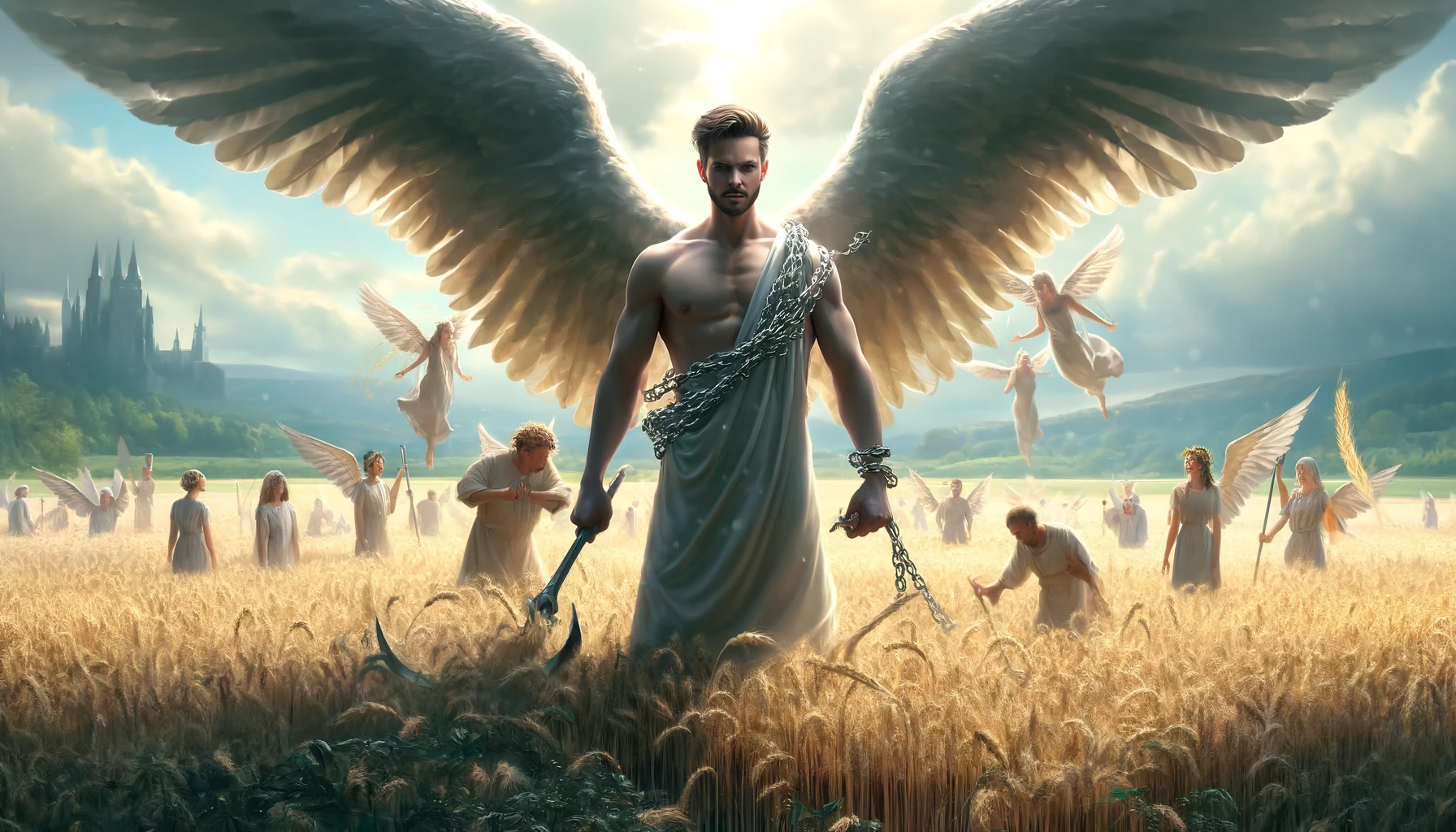
The detailed lesson conveyed God’s purpose of restoring what was lost after the fall so He can reside with His people again. This involves major events like binding Satan by exposing deceptions through the word of testimony, the wedding banquet of the Lamb uniting spirit and flesh, the first resurrection clothing the perishable with the imperishable, allowing God to then reign over the new kingdom and new people. The process entails separating the “wheat” from “weeds” at the harvest, an overcoming group emerging victorious against Satan’s forces, pouring out judgment on Babylon, establishing the tabernacle of testimony to call people out of Babylon into the new kingdom (12 tribes) and new people (from every nation) to dwell with God. Crucially, we must examine ourselves – are we positioning to be part of this new creation, or at risk of being left behind as weeds/part of fallen Babylon? Understanding the big picture of God’s redemptive plan while examining our role in this great unfolding event is paramount.
God’s Purpose (Objective)
Jer 31, Mt 13, Lk 22, Rv 7, Rv 19, Rv 21
We should remember, or the verses and reference chapters should instantly be familiar to us all. Why is Jeremiah 31 important? It represents the origin of those who will keep the new covenant, the start of a new thing, and the new covenant.
What about Matthew 13?
It is the parables chapter. The parable of the sower is related to Jeremiah 31. In Luke 22, Jesus said that he will not eat and drink again of the Passover meal until the kingdom of God comes, when it finds fulfillment. So that was a prophecy, and that is coming true in our time.
What happens in Revelation 7?
The opening of seals was paused in Revelation 7 and continued in Revelation 8:1. We’ll talk about why later on.
In Revelation 7, the 144,000 are introduced, and they are sealed, and there is the gathering and washing of the great multitude. What about Revelation 19? We went over this lesson recently.
The wedding banquet of the Lamb happens in Revelation 19. And then in Revelation 21, we have the First Heaven and the First Earth, and the new heaven and new earth. And then, the Holy City of New Jerusalem comes down.
So these chapters summarize God’s purpose and objective. They summarized the objective, but let’s go over it in detail today.
OBJECTIVE
Let’s take part in God’s Purpose: The creation of a New Kingdom, New People, The Wedding of Spirit and Flesh, and the First Resurrection!
It is essentially the same as writing about a new heaven and a new earth. Because what does the figurative heaven represent?
People should be there. But what is the heaven that they gather in? The Church.
A church or tabernacle, a temple.
And then, what does this earth represent? Flesh. People.
So, a new kingdom and new people. It’s the same as saying a new heaven and a new earth. To take part in God’s purpose is the creation of a new kingdom and new people.
The wedding banquet, or the wedding of the spirits and flesh, and the first resurrection. These things must take place at the time of the fulfillment of the prophecy in Revelation.
1.- Situation
Let’s now delve into the content for the lesson. We will first look at the situation that took place.
These chapters, Genesis 1, Genesis 2:16-17, Genesis 3, and Genesis 6:3, should provide insight into what is happening now, which we are about to see.
What are we about to see concerning these chapters? In Genesis 1, God creates. In Genesis 2, we witness the beginning of the fall, but not the fall itself. The fall occurs in Genesis 3. In Genesis 2, God gives the warning and assigns duties. He instructs, “You are to tend the garden that I have given you, but take note, do not eat from there.” So, the duty and the warning were given. In Genesis 3, the warning is not heeded. And in Genesis 6:3, God leaves.
Let’s draw the diagram.
Adam and Eve were in the garden that God created, and God put Adam in charge, instructing him to tend to it. We now understand Adam’s true role, now that we have the open word. What was Adam’s true role? What was his job? He was a pastor. He received the breath, and his spirit became a living spirit. Adam became a living being, the first man that God decided to work with.
Please don’t misunderstand. Adam is the first man from God’s perspective. Everyone else was considered a beast. Adam was made a man, meaning he could now convene with the Almighty through the word. Quite the level up. And God’s desire was for all of them to become like them.
God said, “Tend my garden. But avoid those over there who are spreading lies. Don’t eat from their tree. Eat from the trees that belong to me, as well as me. Don’t eat from the trees over there. Don’t accept the words that they have, which are corrupting words.”
Unfortunately, they attacked the weaker of the two, not because of some worldly thing, but just because God had given the word to Adam, and it was Adam’s job to teach her well, to overcome. But unfortunately, that did not fully happen. So she gave in, and then Adam gave in. Matthew 23:33
And now, sin and death have entered the world. Let’s turn to Genesis chapter 3 once more. I want us to truly understand what happened to Adam and Eve, and why God kicked them out of the garden.
And the Lord God said, “The man has now become like one of us, knowing good and evil. He must not be allowed to reach out his hand and take also from the tree of life and eat, and live forever.”
Genesis 3:22
Man has become like one of us, knowing good and evil. Who is the one that God is referring to here? Satan.
Man has become like Satan, meaning that he has been born, but in the wrong way, the wrong direction. So God will not allow man to eat from the tree of life and live forever as a corrupted being.
Now begins God’s work of redemption to redeem man, whom He had made, back to the way they should have been from the beginning. When man became mortal, knowing good and evil, it’s not about knowing what is good and what is bad.
Knowing good and evil means being mixed because God is only good. But Satan became the first mixed being, one who was good and now has corrupt thoughts within him, a mixture. So what did Satan do? He made Adam and Eve just like him, ultimately making us mixtures as well. What God wants to do is purify us, take the evil out, so that only good remains. That’s what it truly means.
But because man had become corrupt, God’s spirit had to leave. As stated in Genesis 6:3, “I will not contend with man forever because he has become mortal. His days will now be 120 years.”
So, what is God’s purpose since this took place? God’s purpose is to restore what was lost, which means He desires to come back. That’s His desire – to return to the place that He created.
Now begins God’s 6,000-year mission, and every person along the path of God’s work was integral for God’s final mission to take place. We are the ones blessed enough to be born at the 11th hour when these things are taking place. There were many righteous men who longed to see what is now possible to be seen in our time, but they could not see it. It wasn’t time for them. So they lived their whole lives hoping and knowing that they would see it after they died, thinking it might have been their time, but it wasn’t.
Now they’re waiting in eager expectation for these things to take place. “Oh my goodness, it’s going to happen soon,” they say. “We’ve been waiting 2,000 years, 3,000 years, 4,000 years – waiting a long time. Now it’s finally starting to happen. I hope the people at that time are ready.”
2.- God’s Objective
Let’s break down God’s objective into more detail. What does it mean to restore?
Here’s what it means to restore. God’s objective, as mentioned in Revelation 7 and Revelation 14, talks about the 12 tribes, the 144,000, and the great multitude, all of whom will be alive here on earth. To be clear, no one is going up for a period and then coming back down. No.
Everyone alive will be here when the events take place. When they take place, several things need to happen, as described in Revelation 19 to Revelation 21.
ONE – Capture Satan with the word of testimony.
Somebody needs to flee.
Who’s that? Who needs to flee? Satan.
Satan represents one who needs to be bound. What does it mean for Satan to be bound? Let’s first see why he needs to be bound, what his duty is. Let’s see what he has been trying to do for the last 6,000 years and how he intensifies his efforts even now that the time is getting closer.
The great dragon was hurled down—that ancient serpent called the devil, or Satan, who leads the whole world astray. He was hurled to the earth, and his angels with him.
Revelation 12:9
Satan’s goal is to lead the world astray, meaning to pull the world away from God. That’s his duty. If God wants to come back, Satan’s job needs to be paused, it needs to stop for a time so that the work of healing can actually take place. But how is Satan locked up? How is he captured?
Let’s think about this logically. How does Satan work? What does he do? He works through people to deceive them by twisting God’s words. He doesn’t say to a believer that God doesn’t exist because a believer believes that God exists. It would be an ineffective tactic for most people. What he’s going to say is, “God is like this” or “God is like that.” So that people say, “Oh, okay, that’s how God is like.” Just like he did with Eve. In order for someone to know where Satan is working, Satan needs to be exposed. Have you heard the saying, “A plan known is a plan blown”?
What do I mean by this? Let’s use a sports analogy. Let’s say a team’s plays are known by the other team, and they know what play they’re going to do next. How effective is that team’s play going to be if the opposing team knows the play? It’s not going to play out. They’re going to blow that play up right away because they know it. What Satan has been doing is running plays that no one knows about. So we’ve all been falling for his plays. They’ve been successful for the last 6,000 years, minus when Jesus was here. So the job of heaven is to expose Satan’s plays so that you can finally see them. “I didn’t notice it before, but that’s Satan at work. It looks just like God is working, but it’s actually Satan.”
That’s what Jesus did at his first coming. That’s why he said, “Woe to you Pharisees.” And then he went on, in Matthew 23, to expose where Satan was working so that people could see the Pharisees for who they really were and leave them. Before Jesus showed up, the Pharisees looked like any other normal, righteous person that should be followed. You would go to their synagogue as normal, make the offerings, and follow the traditions, just doing the same thing you’ve always been doing. But when Jesus came, he was able to show the people, “Actually, these people are the ones that Satan is using. These people are the children of the devil. These people put traditions above the work of God. These people are hypocrites. Be aware of their yeast. They are whitewashed tombs.” And now people could see where Satan was working and leave that place. Now Satan was exposed and ineffective.
Does that make sense? So what is it that exposes Satan today? What is it that exposes him? The truth. His lies. What is the truth? The word of God. And? Prophecy and fulfillment, which can also be called the word of God. And? It’s often paired with something else: Testimony. The word and testimony. That’s the key that exposes Satan. And when the world finds out, he will no longer be effective. And people will come out of Babylon, but not one at a time or 40 at a time, but thousands at a time will come out. Oh, glory to God. That’ll be a wonderful time. May it come quickly. So when Satan is captured, number one, Satan must be captured with the word of testimony, so he is no longer effective at deceiving the nations.
TWO – The wedding banquet of the Lamb must take place.
God desires the spirits of heaven and the flesh who are alive and have overcome the beast’s image and the number of his name.
What does He want them to do? How does He want them to become? What needs to happen between the spirits of heaven and the flesh on earth?
The wedding banquet of the Lamb must take place. Now, what does it mean that they marry?
It does not mean that you get your own personal spirit, saying, “OK, here’s my personal spirit. How’s it going?”
No, what it means is that the two work together in the same accord, and their thoughts and words become the same. Whenever someone opens their mouth, the words of heaven will come out, and people will be astonished. They will say, “Wow, I’ve never heard the word like that before.”
And it will be similar to what Peter, James, and John saw in Matthew 17 when Jesus transfigured Himself, and then Moses and Elijah appeared, and they could see them. “Oh, my goodness, that’s Moses. Oh, my goodness, that’s Elijah.”
They had been dead for thousands of years, yet they were standing in front of them. So when heaven comes down, that’s what will take place. And it will be even better than that description.
Way better. For no eye has seen, and no ear has heard.
THREE – The First Resurrection
After the wedding banquet of the lamb, something happens in Revelation chapter 20. It’s called the first resurrection. The first resurrection takes place.
And then those who take part in the first resurrection, the imperishable clothes with the imperishable. In 1 Corinthians 15, starting from verse 35 until the end of the chapter, Paul describes these details. The spirits who are imperishable clothe the perishable people, and death becomes the older order of things. It passes away.
FOUR – God’s Reigns
When this takes place, God reigns. God’s reigning is synonymous with resting. God is finally able to rest as the devil has been captured, and now it is time for the healing of the nations because God wants all to be saved and all to come to a knowledge of the truth. That’s God’s objective: restoration.
Now that we know God’s objective, what leads up to these events taking place? Because there’s a lot that happens between Genesis and Revelation, let’s talk about the events that take place in between those chapters.
3.- Bible History
So, how do we reach this point? What needs to happen before? We’ll quickly, and I mean quickly, go through Bible history again.
The reason I repeat these things is so that we have a commanding grasp of these contents. So much so that we’re able to testify ourselves, where the words come out freely from us.
Until that happens, we’ll hear it again and again. So please take this as if you’re seeing it for the first time. And if you see it like that, you’ll see new things that we didn’t catch before.
Old Testament
Era of Moises – Covenant Given | Ex 19:5-6, Ex 20:3
The Bible recounts historical events. God came to Moses and gave him the law and the covenant that they were supposed to keep. An essential part of that covenant was to worship no other gods besides God. This was the number one commandment. It was really important to God. Unfortunately, they broke this covenant. Even during that time period, other things were happening.
Reminder:
- If Keep
- No other gods
Era of Solomon – Covenant Broken | 1 Kgs 11, Hos 6:7
Throughout many years, they had really struggled to keep the covenant. Oftentimes, God would have to send people to save them. For example, the judges would have to come and deliver the people oftentimes.
And then they wanted kings. God didn’t want them to have kings, but eventually, they had kings. Saul did not do a very good job as a king.
David did a good job, but he too had flaws. Solomon started very strong as a king, but by the end of his life, his faith got weak, and he let his wives pull his heart away from God.
Because the covenant was broken and they worshipped idols, God split up the kingdom. And they were destroyed by Gentiles. Gentile figuratively represents one who was not Jewish physically, but it could also apply spiritually as well.
Reminder:
1.- Israel splits in 2
2.- Destroyed by Gentiles
Era of Jeremiah – Promise of New Thing | Jer 31:27, Jer 31:31
We have talked about who is a spiritual Gentile versus a spiritual Jew before. So, for what needs to happen, God began to make new promises. One of these new promises came through the prophet Jeremiah.
There was the promise of the new thing, which represents the sowing of the two seeds, man and animal, and the establishment of a new covenant with God’s chosen people.
Reminder:
1.-Sow 2 Seeds
2.- Establishing New Covenant
Fist Coming
Era of Jesus – Fulfillment of New Thing | Mt 13:24-30, Lk 22:14-20
This prophecy was fulfilled at the time of Jesus’ first coming, where he primarily performed these two tasks. His entire ministry can be summarized in these two things.
Sowing the good seed figuratively represents him preaching, which he did. And establishing a new covenant in his blood refers to him breaking the bread and sharing the wine with his disciples. His disciples were like the heads of the gospel, as the gospel truly originated from their efforts and testimony. So, Jesus preached the word, and then he established the new covenant with his disciples.
Reminder:
- Sow Good Seed (preached)
- Establishing New Covenant in blood (New Covenant with his disciples)
Era of the Disciples – Gospel | Mt 24:14
And then this took place after Jesus said this.
And this gospel of the kingdom will be preached in the whole world as a testimony to all nations, and then the end will come.
Matthew 24:14
The gospel is preached to all nations, and then when the gospel has reached the whole world, the end comes. It took approximately 2,000 years for the gospel to make its way around the world. This process was primarily slow because the speed of information depended on someone walking, traveling by horseback, or the fastest mode being by ship.
It took a long time for the gospel to spread across the world and become the most dominant religion. Christianity is now the most populous religion, closely followed by Islam as the second most populous. Over 2 billion people today call Jesus their Lord and Savior. The seed that was sown has led to a vast number of people, over 2 billion, accepting Jesus as their Lord and Savior.
There is a lot of work that needs to be done with the harvest, which is part of the reason why Jesus said, “The harvest is plentiful, but the workers are few.” This statement was true 2,000 years ago when the harvest was not nearly as large as it is now. With the harvest being even bigger today, a lot of work needs to be done at the time of the second coming to call people out of Babylon.
The disciples’ job was to go out and spread the gospel. Their disciples went out and spread the gospel further, and their disciples’ disciples continued this process. The greatest success of the last 2,000 years is the sheer number of people who have come to know about Jesus through this continuous effort of spreading the gospel.
Reminder:
1.- Preached to nation
2.- End comes
Second Coming
Current Era – Fulfillment of Harvest | Mt 13:37-39, Rv 14:14-16
That was a huge success. However, there were other things that people struggled with over the last 2,000 years, which Jesus warned us about. And this explains the need for a separation, for a harvest to happen.
During that 1,000 years, both the good seed and the weeds were growing together in the same field. This is why there was so much strife in the church and so many divisions and issues arose. The reason why no one seemed to agree on fundamental themes was that both were growing in the same field, and we didn’t truly realize this deeply.
People branched off and did their own thing, not knowing that they were contributing to an issue that had been flourishing since the first coming. Then came the fulfillment of the harvest, or rather, it is coming now. The fulfillment of the harvest takes place at the end of the age, the time we are living in, which is why we can testify about this so clearly now.
So what must happen at the fulfillment of the harvest? The wheat, representing the sons of the kingdom born of God’s seed, must be brought into the barn. And the weeds, representing those who refuse to be harvested, remain in the field and are burned.
We do not want to be the weeds. The field is not the destination; it is only a temporary holding place.
Reminder
- Wheat → Barn
- Weeds → Field (Burned)
The Second Coming
Let’s explore further the division between those remaining in the field and those who flee or come out. How can we gain a deeper understanding of this concept?
37 He answered, “The one who sowed the good seed is the Son of Man. 38 The field is the world, and the good seed stands for the sons of the kingdom. The weeds are the sons of the evil one, 39 and the enemy who sows them is the devil. The harvest is the end of the age, and the harvesters are angels. 40 “As the weeds are pulled up and burned in the fire, so it will be at the end of the age. 41 The Son of Man will send out his angels, and they will weed out of his kingdom everything that causes sin and all who do evil. 42 They will throw them into the fiery furnace, where there will be weeping and gnashing of teeth. 43 Then the righteous will shine like the sun in the kingdom of their Father. He who has ears, let him hear.
Matthew 13:37-43
There’s Jesus’ famous line: “He who has ears, let him hear.”
And as we discussed previously, it is simply not possible to fully comprehend what he means until the events actually take place. It’s not possible to know completely, unless you are one of Jesus’ disciples to whom he explained in more detail. When this took place, even the first coming, also known as the second coming, then they can be separated. And we saw what it said, what Jesus said starting from verse 40. Did you catch what he said there? As the weeds are pulled up and burned in the fire, so it will be at the end of the age, the Son of Man will send out his angels, and they will weed out from where?
His kingdom. If you want any more confirmation that the field represents the church, it’s a place that’s supposed to be his kingdom. But the weeds will be taken out.
And the weeds represent the same as saying goats, foolish virgins, one-talent persons, or bad fish. Jesus told parables related to all of these things to tell us the details about those who will be taken out and ensure and help us know we cannot be one of these types of people. Instead, we must be those who are harvested.
So Jesus and the angels will come, but they’re in what form? They’re spirits.
So how do spirits work? Through people.
In Revelation 14:14-16, it mentions that the angel’s hand is holding a sickle. What is a sickle? It’s a harvesting tool. So how will spirits work?
What is a tool? Someone that is being used by a spirit. A person!
The spirits will use people to do the work of harvest. But a sickle can also be used as a weapon and often was, depending on the culture that was using them at that time. A sickle is like a sword, almost.
Having a sharp end for which to cut. What is a sword? Or a sharp tool?
What’s a weapon? The word.
For what is it that perks up the ears of the good seed? If it is not the word.
And the word that is in the hands of a person who themselves has been harvested. Ephesians 6:17, Hebrews 4:12. The word is living and active, sharper than any double-edged sword.
It penetrates even to dividing soul and spirit, joints and marrow. It judges the thoughts and attitudes of the heart. And this is part of the reason why you see Proverbs 27:17, which says, “As iron sharpens iron, so one person sharpens another.” And did you know that the sharpening happens in both ways? Do you think it was only the evangelist sharpening you?
No, you’ve been sharpening us, too, by your questions. That’s why we have you ask questions. It makes us sharper, because we have to be able to answer them, and not answer them from up here, in our heads.
Answer them from the scriptures, otherwise you won’t be satisfied with the answer. Good. I want to see the scripture.
Wonderful. Do you make us sharp, too? That’s why we love what we do.
The sickles that are used to harvest are people, and it is the spirits that help. This one’s ready, this one’s ready, this one’s ready. Say something to them.
Open your mouth so that we can work. Have you studied the Bible before? What are your thoughts about Revelation?
I find Revelation scary, but it’s something I’ve been wanting to understand. This one’s ready. Like that.
That’s how harvest takes place. One person at a time, but soon many people at a time. Who are the ones that are harvested and the ones that disappear?
We’re going to draw a chart. Draw this chart nice and big on your paper. The chart is going to have these three columns:
Land that disappears, recreated land, and related verses. And there’s going to be four rows, including that top row.
ROW ONE – 1H1E → NHNE | Rv 21:1
The first row represents the land that disappears, which is the first heaven and the first earth, as mentioned in Revelation 21:1. We know that heaven figuratively represents the temple, as stated in Hebrews 8:5 and Exodus 25:8-9. Earth, on the other hand, represents people, as illustrated in the parables of the four fields in Luke 8, Matthew 13, and Mark 4, as well as the statement “you are God’s field, God’s building” in 1 Corinthians 3:9-16.
So, the first tabernacle (heaven) and the first people (earth) pass away, but they are replaced by a new tabernacle and a new people who appear at the second coming. They are the ones who are recreated or harvested from the field.
ROW TWO – Traditional Churches → 12 Tribes of NKNP | Rv 6,7
Another way to look at it is traditional churches versus the 12 tribes of the new kingdom and the new people, as mentioned in Revelation 6 and 7.
Traditional churches are represented by Revelation 6, just as John the Baptist was a representative of all Israelites. John the Baptist represents or symbolizes them, which is why Jesus called him the greatest among those born, as stated in Matthew 11.
In Revelation 6, it speaks of the sun, moon, and stars that Jesus prophesied would fall, as mentioned in Matthew 24. The sun, moon, and stars figuratively represent God’s chosen people. Jesus foretold that they would go dark and fall. At the second coming, a place appears that represents spiritual Israel, a place that received a little light from heaven and began to share what they had received. They too become dark and fall, as seen in Revelation 6.
ROW THREE – Subjects of the Kingdom → NSEW | Mt 8:11-12
In Revelation 7, it mentions the subjects of the kingdom, those who are thrown out, and those who come from the north, south, east, and west to take their seat in the kingdom of heaven, as stated in Matthew 8:11-12.
Let us hope to be among those who come from the four directions to take their seat in the kingdom.
5.- How the Harvest Takes Place
There are still some things that need to occur between now and the harvest. There is still some trouble that needs to take place, some battles that must be fought before we can get from where we are to our final destination.
So let’s discuss the things that have to happen.
The fights or the wars that happen in Revelation. How the harvest takes place.
ONE – Revelation 12:5-12 → Revelation 13
Let’s go to Revelation 12:5-12, but before we go there, I want to talk about the battle that happened first, before Revelation chapter 12.
Revelation 13
In the next chapter, chapter 13, which is a little confusing, we’ll get to that later. This first battle takes place between the beast with seven heads and ten horns and those who live in heaven. This is detailed in Revelation chapter 13.
In this battle, the victor is the dragon. The dragon wins this battle, and the tabernacle is destroyed.
The place that was called heaven, where those who live in heaven resided, is no more. God needs redemption.
God needs his people to have a victory.
5 She gave birth to a son, a male child, who will rule all the nations with an iron scepter. And her child was snatched up to God and to his throne. 6 The woman fled into the desert to a place prepared for her by God, where she might be taken care of for 1,260 days. 7 And there was war in heaven. Michael and his angels fought against the dragon, and the dragon and his angels fought back. 8 But he was not strong enough, and they lost their place in heaven. 9 The great dragon was hurled down—that ancient serpent called the devil, or Satan, who leads the whole world astray. He was hurled to the earth, and his angels with him. 10 Then I heard a loud voice in heaven say: “Now have come the salvation and the power and the kingdom of our God, and the authority of his Christ. For the accuser of our brothers, who accuses them before our God day and night, has been hurled down. 11 They overcame him by the blood of the Lamb and by the word of their testimony; they did not love their lives so much as to shrink from death. 12 Therefore rejoice, you heavens and you who dwell in them! But woe to the earth and the sea, because the devil has gone down to you! He is filled with fury, because he knows that his time is short.”
Revelation 12:5-12
Let’s examine the battle that takes place on two fronts.
Heaven was once working with this location, the tabernacle temple, and when they were defeated, heaven goes over here for the battle that will take place both in the spiritual world and the physical world. In the spiritual world, we have one of the archangels who received the name Michael, and the other spirits behind him, and they’re fighting against the dragon in that epic battle.
But that same battle is taking place in the physical world, and we have the male child who has been given the iron scepter, representing iron authority to rule. The authority that was given to Jesus by God, he now gives it to the one who overcomes, which we now know is new John, and he has brothers.
Those who heard his testimony and came out first now work together with him, and they overcame with something. What was their weapon? What did they fight with?
The blood of the lamb and the word of their testimony. That was their weapon. And what happens?
They overcome, meaning they defeat the group of the dragon. They become victorious. The brothers become two. So we have two groups: the one who overcomes and those who overcome, or those who are victorious. And they win in this fight.
And now God intends to continue the work of salvation using them, those who were victorious.
TWO – Rv 15,16
Let’s examine Revelation chapter 15 to understand the task that will be assigned to them. Importantly, take note of their number – seven. This number is not accidental or coincidental. It holds significance. Pay close attention to the recurrence of the number seven.
I saw in heaven another great and marvelous sign: seven angels with the seven last plagues —last, because with them God’s wrath is completed. 2 And I saw what looked like a sea of glass glowing with fire and, standing beside the sea, those who had been victorious over the beast and its image and over the number of its name. They held harps given them by God 3 and sang the song of God’s servant Moses and of the Lamb: “Great and marvelous are your deeds, Lord God Almighty. Just and true are your ways, King of the nations.[A] 4 Who will not fear you, Lord, and bring glory to your name? For you alone are holy. All nations will come and worship before you, for your righteous acts have been revealed.”[B] 5 After this I looked, and I saw in heaven the temple —that is, the tabernacle of the covenant law —and it was opened. 6 Out of the temple came the seven angels with the seven plagues. They were dressed in clean, shining linen and wore golden sashes around their chests. 7 Then one of the four living creatures gave to the seven angels seven golden bowls filled with the wrath of God, who lives for ever and ever. 8 And the temple was filled with smoke from the glory of God and from his power, and no one could enter the temple until the seven plagues of the seven angels were completed.
Revelation 15
In Revelation 15, many interesting things occur. We have the seven angels, each of whom was given seven bowls. What are these seven bowls they were given? They represent the male child and his brothers.
And did you catch the confirmation of who they were? If we look at verse 2, it says, “And I saw what looked like a sea of glass mixed with fire and standing beside the sea, those who had been victorious over the beast and his image and the number of his name.” When were they victorious? It was in Revelation 12.
Are we making the connection? Are we seeing that? Those who were victorious become the seven bowls. So what is God going to do with them in Revelation 16? What’s the title of Revelation 16, if your Bible has section titles? It is “Seven Bowls of God’s Wrath.”
They begin to pour out God’s wrath. They become God’s vessels of judgment.
Acts 9:15 refers to Paul as God’s chosen vessel.
Another really cool verse that talks about a person being a vessel and them not being able to contain what they need to pour out is found in Jeremiah chapter 6. Let’s turn there for a moment and see another example.
Jeremiah 6:11 says, “And this is Jeremiah speaking. But of what Jeremiah saw, Jesus lived out.”
But I am full of the wrath of the Lord, and I cannot hold it in. “Pour it out on the children in the street and on the young men gathered together; both husband and wife will be caught in it, and the old, those weighed down with years.
Jeremiah 6:11
So Jeremiah said, “I am filled with the wrath of God, and I cannot hold it in.” What does he do?
He pours it out on the people. Of course, what he means here is to speak the words that have been given to him, the words that had been put into his mouth to be spoken to the people.
The reality, of course, was Jesus speaking to the Israelites, pouring out the wrath of God because He was so displeased with them. At the time of the second coming, those who overcome need to pour out the wrath on the tabernacle that was once called heaven but whose sun, moon, and stars became dark and fell. The sun, moon, and stars become dark and fall.
What does that mean? The betrayers and the destroyers became one by the time we get to Revelation 16. Betrayers and destroyers are equals, one.
So they are judged together because the destroyers had taken over the temple. They had consumed or assimilated them. At this time, they were separate, but by Revelation 16, they are one.
So they need to be judged together. After the judgment of this takes place, then the tabernacle can be fully established and entered.
THREE – Rv 19, 20, 21, 22 → Tabernacle, representative of Babylon
In Revelation 19, 20, and 21, we see the temple and the tabernacle of the testimony. This represents the place where all people must come out from or come to, as we saw in verse 4 of Revelation chapter 15, which states that all must come out.
Additionally, there is one more thing that happens in Revelation 18 that I want us to note. Of course, verse 4 says, “Come out of her, my people, so that you will not share in her sins, so that you will not receive any of her plagues.” And in verse 8, we see how God intends to judge Babylon, which had become representative of Babylon over all of Babylon that also appears. God judges with fire.
After hearing the testimony about what has taken place, people will gather on the mountain from the north, south, east, and west. They will take their seat in the kingdom of heaven, becoming part of the twelve tribes where God, the Holy City, New Jerusalem, and Jesus will be. This is the place where the tree of life will appear once again, and the leaves of that tree will be for the healing of the nations.
That’s it. That’s how God’s plan comes to fruition. Wow. Many new things today, huh? You need to take time to digest this. This shouldn’t be the one and only time you’re seeing this.
Of course, we’ll go over this content many times in the class. But throughout this week, you should be coming back to this and reading all the passages we were only able to skim by. Read them now with new fresh eyes that you’ve received, and see the through line of God’s fulfillment as more and more details are revealed.
Memorization
And I saw an angel coming down out of heaven, having the key to the Abyss and holding in his hand a great chain. 2 He seized the dragon, that ancient serpent, who is the devil, or Satan, and bound him for a thousand years.
Revelation 20:1-2
Instructor Review
SUMMARY
This lesson is truly great for seeing the full context of things. However, it’s really important to see the bigger picture before getting stuck in the details. What we often tend to do is read the verses and then get caught up in the specifics, forgetting the overall perspective. The bigger picture.
So, let’s start with the bigger picture. Now you can zoom in on the details while still understanding the overall context. What happens?
Sin. During Adam’s time, God begins his work of redemption. He establishes his covenant with the first chosen people. They break the covenant, so he establishes a new covenant. Through that new covenant, Jesus sows the seed and establishes that new covenant with his disciples.
And then they go out into the world and spread the gospel, so that people know that Jesus came for the first time and understand that he promises to come again. So, people are to hear, believe, and wait. This has happened for the last 2,000 years. But now it’s the time of the harvest.
When the two types of seed that were sown in the same field are distinguished, the weeds are taken out, and the wheat is placed in the barn. Unfortunately, the weeds are burned. We don’t want to be a weed, the land that disappears or the land that burns.
First heaven and first earth represent traditional churches and subjects of the kingdom. The recreated land, the new heaven and new earth, represents the 12 tribes of the new kingdom and the new people. And those who come from every direction – north, south, east, and west – take their seats.
For this to happen, there must be an event of overcoming. There must be a war that is fought, and there must be victors in that war. The first war takes place, and the people in the first war are defeated. Then the second war takes place, and the people of God in this war are victorious. And so they become God’s bowls of wrath, pouring out on the betrayers and the destroyers who have now become one, assimilated, representing all of Babylon.
When this happens, those who are victorious establish a temple of the tabernacle of the testimony, and they call many people out with the word of testimony. These are the events that have been fulfilled, the events that have taken place according to scripture. “Come out of Babylon.” Now is the time, so that God’s objective can be completed.
Review with the Evangelist
Let’s Us Discern
Analysis of Shincheonji Bible Study Lesson 81: “God’s Purpose (Objective)”
A Critical Examination Using “Testing Shincheonji’s Claims: Two Lenses, One Story”
Introduction
Shincheonji Church of Jesus (SCJ) Lesson 81 presents what appears to be a comprehensive overview of biblical history and God’s redemptive plan. The lesson traces a narrative from Genesis through Revelation, claiming to reveal “God’s purpose” for the end times. While containing some biblical truth, this lesson demonstrates SCJ’s sophisticated method of weaving their unique doctrines into what seems like orthodox Christian teaching.
This analysis will use principles from “Testing Shincheonji’s Claims: Two Lenses, One Story” to distinguish biblical truth from SCJ’s distinctive interpretations, examining the lesson through biblical, theological, and psychological lenses.
For comprehensive refutation of SCJ teachings and additional resources, please visit closerlookinitiative.com and check their SCJ Examination section.
Part 1: The Opening Statement – A Red Flag
What the Lesson Says:
“The Bible must become me and I must become the Bible. We have nowhere else to go. The only place we must go to is to the Father God and The Father God’s kingdom.”
Analysis:
This opening statement sounds spiritual but contains problematic theology that sets the tone for the entire lesson.
From “Testing Shincheonji’s Claims: Two Lenses, One Story” Chapter 22: SCJ uses spiritually-sounding language to introduce concepts that subtly shift focus from Christ to their organization.
The Problem:
- “The Bible must become me” – This confuses our relationship with Scripture. We don’t “become” the Bible; we are transformed by the living Word (Jesus) through the written Word (Scripture).
- “We have nowhere else to go” – This creates a sense of desperation and exclusivity, implying that outside of this teaching, there is no hope.
- Subtle pressure – The statement creates anxiety about being in the “right place” to reach God’s kingdom.
Biblical Response:
- John 14:6: “Jesus answered, ‘I am the way and the truth and the life. No one comes to the Father except through me.'” – We come to the Father through Jesus, not through becoming the Bible.
- 2 Corinthians 3:18: “And we all, who with unveiled faces contemplate the Lord’s glory, are being transformed into his image with ever-increasing glory” – We are transformed into Christ’s image, not into the Bible itself.
- Romans 12:2: “Do not conform to the pattern of this world, but be transformed by the renewing of your mind. Then you will be able to test and approve what God’s will is” – Transformation comes through mind renewal by the Holy Spirit.
- Colossians 3:16: “Let the message of Christ dwell among you richly” – The Word dwells in us; we don’t become it.
The Correct Understanding:
We are to be shaped and transformed by God’s Word, allowing it to dwell richly in us, but we remain distinct persons being conformed to the image of Christ (Romans 8:29), not becoming Scripture itself.
Part 2: The Framework – Biblical History Reinterpreted
SCJ’s Narrative Structure:
The lesson presents a timeline:
- Adam’s Fall → Sin enters
- Moses → Covenant given and broken
- Jeremiah → Promise of new thing
- Jesus (First Coming) → Fulfillment of new thing
- Disciples → Gospel spreads
- Second Coming → Harvest happens NOW through SCJ
What’s Biblical vs. What’s SCJ:
Biblical Elements:
- Adam and Eve sinned (Genesis 3) ✓
- God gave the Law through Moses (Exodus 19-20) ✓
- Israel broke the covenant (1 Kings 11) ✓
- Jeremiah prophesied a new covenant (Jeremiah 31) ✓
- Jesus established the new covenant (Luke 22) ✓
- The gospel was preached to all nations (Matthew 24:14) ✓
SCJ’s Additions and Distortions:
- The “new thing” in Jeremiah 31 is specifically about sowing two seeds ✗
- The harvest is happening NOW through a specific organization ✗
- Traditional churches are the “first heaven and first earth” that must pass away ✗
- The “barn” is a physical organization (SCJ’s 12 tribes) ✗
Part 3: Major Theological Distortions
Distortion #1: The Fall and Adam’s Role
What the Lesson Says:
“Adam and Eve were in the garden that God created, and God put Adam in charge, instructing him to tend to it. We now understand Adam’s true role, now that we have the open word. What was Adam’s true role? What was his job? He was a pastor.”
Analysis from “Testing Shincheonji’s Claims”:
Chapter 6 discusses how SCJ redefines biblical terms. Here, “pastor” is anachronistically applied to Adam, creating a pattern that will later be applied to Lee Man-hee.
The Problems:
- Anachronism: The concept of “pastor” as a church office didn’t exist in Genesis. This is reading New Testament church structure back into creation.
- Pattern Creation: By calling Adam a “pastor,” SCJ creates a template: God works through one man as a pastor in each era.
- Preparation for Later Claims: This sets up the idea that God needs a “pastor” in our era (Lee Man-hee).
Biblical Response:
- Genesis 2:15: “The Lord God took the man and put him in the Garden of Eden to work it and take care of it” – Adam was a gardener/caretaker, not a pastor.
- Genesis 1:26-28: Adam and Eve were given dominion over creation, not pastoral authority over a congregation.
- Ephesians 4:11-12: The office of pastor is a New Covenant gift: “So Christ himself gave the apostles, the prophets, the evangelists, the pastors and teachers, to equip his people for works of service” – This came after Christ’s ascension, not in Genesis.
- 1 Peter 2:25: “For ‘you were like sheep going astray,’ but now you have returned to the Shepherd and Overseer of your souls” – Jesus is THE Shepherd/Pastor.
Additional Issue – The “Open Word” Claim:
“We now understand Adam’s true role, now that we have the open word.”
This implies that without SCJ’s interpretation (the “open word”), we cannot understand Genesis correctly. This is addressed in Chapter 3 of “Testing Shincheonji’s Claims: Two Lenses, One Story” regarding exclusive revelation claims.
Biblical Response:
- Psalm 119:130: “The unfolding of your words gives light; it gives understanding to the simple” – God’s Word gives understanding to all who seek it, not just one group.
- 2 Timothy 3:16-17: “All Scripture is God-breathed and is useful for teaching, rebuking, correcting and training in righteousness, so that the servant of God may be thoroughly equipped” – Scripture is sufficient and accessible.
Distortion #2: “Knowing Good and Evil”
What the Lesson Says:
“When man became mortal, knowing good and evil, it’s not about knowing what is good and what is bad. Knowing good and evil means being mixed because God is only good. But Satan became the first mixed being, one who was good and now has corrupt thoughts within him, a mixture.”
Analysis:
This is a creative reinterpretation that isn’t supported by Scripture. While attempting to explain the Fall, it creates confusion about the nature of sin and knowledge.
The Problems:
- Redefines “knowing good and evil” as “being mixed” rather than moral awareness
- Implies Satan was once good (which is debatable – we don’t know Satan’s full origin story)
- Suggests the problem is mixture rather than rebellion and sin
Biblical Understanding:
- Genesis 3:22: “And the Lord God said, ‘The man has now become like one of us, knowing good and evil'” – This refers to experiential knowledge of good and evil through disobedience.
- Genesis 3:5: The serpent said, “For God knows that when you eat from it your eyes will be opened, and you will be like God, knowing good and evil” – The temptation was to have God-like knowledge independently.
- Romans 5:12: “Therefore, just as sin entered the world through one man, and death through sin, and in this way death came to all people, because all sinned” – The problem is sin and death, not “mixture.”
- James 1:14-15: “Each person is tempted when they are dragged away by their own evil desire and enticed. Then, after desire has conceived, it gives birth to sin; and sin, when it is full-grown, gives birth to death” – Sin is rebellion, not mixture.
The Real Issue:
Adam and Eve’s sin was disobedience and the desire to be autonomous from God. They wanted to determine good and evil for themselves rather than trusting God’s definition. The consequence was spiritual death and separation from God.
Distortion #3: The “First Heaven and First Earth”
What the Lesson Says:
“At the time of Revelation’s fulfillment, the first heaven and first earth are the traditional churches, the subjects of the kingdom, that pass away like in Revelation 6, and the new heaven and new earth are the place created like in Rev 7, 14, and 15 after the first things pass away.”
Analysis from “Testing Shincheonji’s Claims”:
Chapter 12 examines how SCJ identifies their organization with biblical promises while casting traditional Christianity as that which must be destroyed.
The Problems:
- Spiritualizes cosmic language: What the Bible describes as cosmic renewal becomes organizational replacement
- Creates us-vs-them mentality: Traditional churches = bad/old; SCJ = good/new
- Contradicts biblical context: Revelation 21 describes a literal new creation, not a new religious organization
Biblical Response:
Revelation 21:1-5:
“Then I saw ‘a new heaven and a new earth,’ for the first heaven and the first earth had passed away, and there was no longer any sea. I saw the Holy City, the new Jerusalem, coming down out of heaven from God, prepared as a bride beautifully dressed for her husband. And I heard a loud voice from the throne saying, ‘Look! God’s dwelling place is now among the people, and he will dwell with them. They will be his people, and God himself will be with them and be their God. He will wipe every tear from their eyes. There will be no more death or mourning or crying or pain, for the old order of things has passed away.’ He who was seated on the throne said, ‘I am making everything new!'”
Context Clues This Is Cosmic, Not Organizational:
- “No longer any sea” (v.1) – The sea represents chaos and evil in Jewish thought; its removal indicates cosmic transformation
- “No more death” (v.4) – Death still exists in our world; this is future
- “No more mourning or crying or pain” (v.4) – These still exist; this is future
- “I am making everything new” (v.5) – God remakes all creation, not just reorganizes churches
Additional Verses:
- 2 Peter 3:10-13: “But the day of the Lord will come like a thief. The heavens will disappear with a roar; the elements will be destroyed by fire, and the earth and everything done in it will be laid bare… That day will bring about the destruction of the heavens by fire, and the elements will melt in the heat. But in keeping with his promise we are looking forward to a new heaven and a new earth, where righteousness dwells.”
- This describes literal cosmic destruction and renewal, not church reorganization
- Isaiah 65:17: “See, I will create new heavens and a new earth. The former things will not be remembered, nor will they come to mind.”
- God Himself creates the new heavens and earth
- Romans 8:19-22: “For the creation waits in eager expectation for the children of God to be revealed… in hope that the creation itself will be liberated from its bondage to decay and brought into the freedom and glory of the children of God.”
- All creation groans for renewal, not just churches
The Chart in the Lesson:
The lesson presents a chart:
| Land that Disappears | Recreated Land | Verses |
|---|---|---|
| 1st Heaven & 1st Earth | New Heaven & New Earth | Rev 21:1 |
| Traditional Churches | 12 Tribes of NKNP | Rev 6,7 |
| Subjects of Kingdom | NSEW (North/South/East/West) | Mt 8:11-12 |
The Problem with This Chart:
This creates a false equivalence between cosmic renewal and organizational change. It’s eisegesis (reading into the text) rather than exegesis (drawing meaning from the text).
Distortion #4: The Harvest Doctrine
What the Lesson Says:
“During that 1,000 years, both the good seed and the weeds were growing together in the same field. This is why there was so much strife in the church and so many divisions and issues arose… Then came the fulfillment of the harvest, or rather, it is coming now.”
Analysis from “Testing Shincheonji’s Claims”:
Chapter 13 addresses SCJ’s harvest doctrine and how it’s used to recruit from other churches.
The Problems:
- Misidentifies the timing: Jesus said the harvest is “the end of the age” (Matthew 13:39), not a period within history
- Misidentifies the harvesters: Jesus said angels harvest (Matthew 13:39), not a human organization
- Misidentifies the field: The field is “the world” (Matthew 13:38), not “the church”
- Creates justification for sheep-stealing: If traditional churches are “the field,” then recruiting from them becomes “harvesting”
Biblical Response:
Matthew 13:37-43 (Jesus’ own interpretation):
“He answered, ‘The one who sowed the good seed is the Son of Man. The field is the world, and the good seed stands for the people of the kingdom. The weeds are the people of the evil one, and the enemy who sows them is the devil. The harvest is the end of the age, and the harvesters are angels. As the weeds are pulled up and burned in the fire, so it will be at the end of the age. The Son of Man will send out his angels, and they will weed out of his kingdom everything that causes sin and all who do evil. They will throw them into the blazing furnace, where there will be weeping and gnashing of teeth. Then the righteous will shine like the sun in the kingdom of their Father. Whoever has ears, let them hear.'”
Key Points from Jesus’ Interpretation:
- The field = the world (v.38) – Not the church, but the entire world
- The harvest = the end of the age (v.39) – A future eschatological event, not a present organizational movement
- The harvesters = angels (v.39) – Not human recruiters
- The Son of Man sends the angels (v.41) – Jesus Himself orchestrates this, not a human leader
Additional Verses:
- Matthew 13:49-50: “This is how it will be at the end of the age. The angels will come and separate the wicked from the righteous and throw them into the blazing furnace”
- Again, angels do the separating at the end of the age
- Revelation 14:14-16: “I looked, and there before me was a white cloud, and seated on the cloud was one like a son of man with a crown of gold on his head and a sharp sickle in his hand. Then another angel came out of the temple and called in a loud voice to him who was sitting on the cloud, ‘Take your sickle and reap, because the time to reap has come, for the harvest of the earth is ripe.’ So he who was seated on the cloud swung his sickle over the earth, and the earth was harvested.”
- The “one like a son of man” (Jesus) does the harvesting, not a human organization
The Lesson’s Misapplication:
The lesson says:
“The spirits will use people to do the work of harvest… The sickles that are used to harvest are people, and it is the spirits that help.”
This reinterprets the clear biblical teaching that angels harvest to mean that SCJ members are the harvesters. This is eisegesis that serves their recruitment purposes.
Distortion #5: The Wars in Revelation
What the Lesson Says:
The lesson describes two wars:
War #1 (Revelation 13):
“This first battle takes place between the beast with seven heads and ten horns and those who live in heaven… In this battle, the victor is the dragon. The dragon wins this battle, and the tabernacle is destroyed.”
War #2 (Revelation 12):
“We have the male child who has been given the iron scepter… and he has brothers. Those who heard his testimony and came out first now work together with him, and they overcame with something. What was their weapon? The blood of the lamb and the word of their testimony.”
Analysis from “Testing Shincheonji’s Claims”:
Chapter 9 examines how SCJ interprets Revelation as a literal, sequential playbook of events that have already occurred within their organization.
The Problems:
- Chronological confusion: Revelation 12 comes before Revelation 13 in the text, but the lesson reverses this order
- Organizational identification: The “male child” is identified as “new John” (Lee Man-hee) and his “brothers” are early SCJ leaders
- Historical claims: These wars supposedly already happened within SCJ’s history
- Verifiability issues: These interpretations cannot be verified and require accepting SCJ’s claims about their own history
Biblical Understanding of Revelation 12:
Revelation 12:1-6, 13-17: The chapter describes:
- A woman (often interpreted as Israel or the faithful people of God)
- A dragon (Satan)
- A male child who will rule with an iron scepter (Jesus Christ)
- War in heaven between Michael and the dragon
Traditional Christian Interpretation:
- The male child = Jesus Christ
- Revelation 12:5: “She gave birth to a son, a male child, who ‘will rule all the nations with an iron scepter'”
- This quotes Psalm 2:9, a messianic psalm about the Messiah’s rule
- Revelation 19:15 applies this same description to Jesus: “Coming out of his mouth is a sharp sword with which to strike down the nations. ‘He will rule them with an iron scepter'”
- The child “snatched up to God” = Jesus’ ascension
- Revelation 12:5: “And her child was snatched up to God and to his throne”
- Acts 1:9: “He was taken up before their very eyes, and a cloud hid him from their sight”
- The war in heaven = Satan’s defeat through Christ’s work
- Revelation 12:10-11: “Now have come the salvation and the power and the kingdom of our God, and the authority of his Messiah. For the accuser of our brothers and sisters, who accuses them before our God day and night, has been hurled down. They triumphed over him by the blood of the Lamb and by the word of their testimony”
- This describes what Christ accomplished, not a future organizational battle
Biblical Response:
- Revelation 1:5: Jesus is “the ruler of the kings of the earth” – He already has the iron scepter authority
- Colossians 2:15: “And having disarmed the powers and authorities, he made a public spectacle of them, triumphing over them by the cross” – Christ already defeated Satan
- John 12:31: Jesus said, “Now is the time for judgment on this world; now the prince of this world will be driven out” – Satan’s defeat happened at the cross
- Luke 10:18: Jesus said, “I saw Satan fall like lightning from heaven” – Jesus witnessed Satan’s defeat
The Problem with SCJ’s Interpretation:
By identifying the “male child” as Lee Man-hee rather than Jesus Christ, SCJ:
- Diminishes Christ’s unique role
- Elevates their leader to messianic status
- Claims their organizational history fulfills cosmic biblical prophecy
- Creates unverifiable claims that require blind acceptance
Part 4: Psychological Manipulation Techniques
Technique #1: Creating Urgency and FOMO (Fear of Missing Out)
What the Lesson Does:
“We are the ones blessed enough to be born at the 11th hour when these things are taking place. There were many righteous men who longed to see what is now possible to be seen in our time, but they could not see it.”
Analysis from “Testing Shincheonji’s Claims”:
Chapter 19 discusses how SCJ creates urgency around their teachings, suggesting students are living in a unique, privileged moment in history.
The Manipulation:
- Privilege: “You are blessed to be alive now”
- Exclusivity: “Others longed to see this but couldn’t”
- Urgency: “This is the 11th hour”
- Pressure: If you don’t act now, you’ll miss this unique opportunity
The Effect:
Students feel they must commit fully or risk missing out on something previous generations longed for. This creates anxiety and pressure to accept SCJ’s teachings without critical examination.
Biblical Response:
- Hebrews 13:8: “Jesus Christ is the same yesterday and today and forever” – God’s truth doesn’t change based on era
- Acts 17:26-27: “From one man he made all the nations, that they should inhabit the whole earth; and he marked out their appointed times in history and the boundaries of their lands. God did this so that they would seek him and perhaps reach out for him and find him, though he is not far from any one of us” – God places people in their times for His purposes
- Ecclesiastes 3:11: “He has made everything beautiful in its time. He has also set eternity in the human heart; yet no one can fathom what God has done from beginning to end” – Every generation has its place in God’s plan
The Truth:
Every generation of believers has been called to faithfulness in their time. We are not more privileged than previous generations; we simply have different opportunities and challenges. The gospel message remains the same across all ages.
Technique #2: Redefining “Seeing the Kingdom”
What the Lesson Says:
“So ‘seeing the kingdom of heaven’ can mean literally seeing it with your eyes because you’re there, but it could also mean seeing the person through whom heaven is working… Jesus was hoping that Nicodemus would be able to see that heaven was there in front of him, but he could not.”
Analysis from “Testing Shincheonji’s Claims”:
Chapter 10 examines how SCJ prepares students to “see” their organization and leader as the kingdom of heaven.
The Setup:
- Redefines “seeing the kingdom” as recognizing a person/organization
- Creates a parallel: Just as Nicodemus couldn’t see Jesus was from heaven, people today can’t see that SCJ is from heaven
- Implies: If you don’t “see” that SCJ is the kingdom, you’re like Nicodemus – spiritually blind
The Manipulation:
This sets up students to believe that recognizing SCJ as God’s kingdom is equivalent to recognizing Jesus. Doubting SCJ becomes equivalent to doubting Jesus.
Biblical Understanding of John 3:
John 3:3-8:
“Jesus replied, ‘Very truly I tell you, no one can see the kingdom of God unless they are born again.’ ‘How can someone be born when they are old?’ Nicodemus asked. ‘Surely they cannot enter a second time into their mother’s womb to be born!’ Jesus answered, ‘Very truly I tell you, no one can enter the kingdom of God unless they are born of water and the Spirit. Flesh gives birth to flesh, but the Spirit gives birth to spirit. You should not be surprised at my saying, “You must be born again.” The wind blows wherever it pleases. You hear its sound, but you cannot tell where it comes from or where it is going. So it is with everyone born of the Spirit.'”
What Jesus Actually Meant:
- Spiritual rebirth is necessary to perceive and enter God’s kingdom
- This is a work of the Holy Spirit, not human recognition of an organization
- The kingdom is spiritual, not organizational
Additional Context:
- Luke 17:20-21: “Once, on being asked by the Pharisees when the kingdom of God would come, Jesus replied, ‘The coming of the kingdom of God is not something that can be observed, nor will people say, “Here it is,” or “There it is,” because the kingdom of God is in your midst'” – The kingdom isn’t a physical location to point to
- Romans 14:17: “For the kingdom of God is not a matter of eating and drinking, but of righteousness, peace and joy in the Holy Spirit” – The kingdom is spiritual reality, not organizational membership
- Colossians 1:13: “For he has rescued us from the dominion of darkness and brought us into the kingdom of the Son he loves” – We enter the kingdom through Christ, not through recognizing an organization
Technique #3: The “Nowhere Else to Go” Mentality
What the Lesson Says:
“The Bible must become me and I must become the Bible. We have nowhere else to go.”
And later:
“So is the place where I currently am allows me to know my reality in the book of Revelation? Or will that place hold me back? Because they themselves do not even know the true meaning of Revelation, just like the blind guides.”
Analysis from “Testing Shincheonji’s Claims”:
Chapter 25 discusses how SCJ creates dependency and eliminates alternatives in students’ minds.
The Manipulation:
- Eliminates alternatives: “We have nowhere else to go”
- Questions current church: “Will that place hold you back?”
- Discredits other teachers: “They don’t even know the true meaning”
- Creates dependency: Only here can you understand Revelation
The Effect:
Students begin to believe:
- Their current church cannot help them
- Other Christians are “blind guides”
- Leaving SCJ means leaving God’s truth
- There is no legitimate alternative to SCJ
Biblical Response:
John 6:66-69:
“From this time many of his disciples turned back and no longer followed him. ‘You do not want to leave too, do you?’ Jesus asked the Twelve. Simon Peter answered him, ‘Lord, to whom shall we go? You have the words of eternal life. We have come to believe and to know that you are the Holy One of God.'”
Important Distinction:
- Peter said: “Lord, to whom shall we go? YOU have the words of eternal life”
- Peter was committing to Jesus, not to an organization
- Jesus alone has the words of eternal life, not any human organization
Additional Verses:
- Acts 4:12: “Salvation is found in no one else, for there is no other name under heaven given to mankind by which we must be saved” – Salvation is in Jesus’ name, not an organization’s
- 1 Timothy 2:5: “For there is one God and one mediator between God and mankind, the man Christ Jesus” – We don’t need an organizational mediator
- Hebrews 7:25: “Therefore he is able to save completely those who come to God through him, because he always lives to intercede for them” – Jesus saves completely; we don’t need supplementary revelation
The Truth:
While we should be part of a local church body (Hebrews 10:25), our ultimate allegiance is to Christ, not to any human organization. If a group demands exclusive loyalty and claims to be the only source of truth, that’s a warning sign, not a mark of authenticity.
Part 5: The “God’s Objective” Framework
What the Lesson Presents:
God’s objective consists of four elements:
- Capture Satan with the word of testimony
- The wedding banquet of the Lamb
- The first resurrection
- God reigns
What’s Biblical:
Element 1: Satan Bound
- Revelation 20:1-3 does describe Satan being bound
- This is biblical prophecy ✓
Element 2: Wedding Banquet
- Revelation 19:6-9 describes the wedding supper of the Lamb
- This is biblical prophecy ✓
Element 3: First Resurrection
- Revelation 20:4-6 describes the first resurrection
- This is biblical prophecy ✓
Element 4: God Reigns
- Revelation 11:15 and throughout Revelation, God’s reign is proclaimed
- This is biblical prophecy ✓
What’s NOT Biblical:
The Timing and Application:
The lesson implies these events are happening NOW through SCJ’s organization. This is where biblical prophecy becomes organizational propaganda.
Problem #1: “Capturing Satan with the Word of Testimony”
What the Lesson Says:
“What is it that exposes Satan today? The truth. His lies. What is the truth? The word of God. And? Prophecy and fulfillment, which can also be called the word of God. And? It’s often paired with something else: Testimony. The word and testimony. That’s the key that exposes Satan.”
The Implication:
SCJ’s testimony about Revelation’s fulfillment is what “captures” Satan. This makes their organizational testimony essential to God’s plan.
Biblical Response:
Revelation 20:1-3:
“And I saw an angel coming down from heaven, having the key to the Abyss and holding in his hand a great chain. He seized the dragon, that ancient serpent, who is the devil, or Satan, and bound him for a thousand years. He threw him into the Abyss, and locked and sealed it over him, to keep him from deceiving the nations anymore until the thousand years were ended.”
Key Points:
- An angel from heaven binds Satan, not a human organization
- Physical binding: Satan is seized, chained, thrown into the Abyss, locked, and sealed
- Complete cessation: Satan can no longer deceive the nations at all
- Observable result: When Satan is truly bound, deception will cease globally
The Reality Check:
Is Satan bound now? Is deception decreasing in the world? Are the nations no longer being deceived? The obvious answer is no. Therefore, Revelation 20:1-3 has not yet been fulfilled.
Additional Verses:
- 1 Peter 5:8: “Be alert and of sober mind. Your enemy the devil prowls around like a roaring lion looking for someone to devour” – Peter wrote this after Christ’s ascension; Satan was still active
- Ephesians 6:12: “For our struggle is not against flesh and blood, but against the rulers, against the authorities, against the powers of this dark world and against the spiritual forces of evil in the heavenly realms” – We still struggle against spiritual forces
- 2 Corinthians 4:4: “The god of this age has blinded the minds of unbelievers, so that they cannot see the light of the gospel” – Satan still blinds minds
Problem #2: “The Wedding Banquet of the Lamb”
What the Lesson Says:
“God desires the spirits of heaven and the flesh who are alive and have overcome… The wedding banquet of the Lamb must take place. Now, what does it mean that they marry? It does not mean that you get your own personal spirit… what it means is that the two work together in the same accord, and their thoughts and words become the same.”
The Implication:
The wedding banquet is spirits (angels or deceased believers) coming to work through SCJ members, making them speak with heavenly authority.
Biblical Understanding:
Revelation 19:6-9:
“Then I heard what sounded like a great multitude, like the roar of rushing waters and like loud peals of thunder, shouting: ‘Hallelujah! For our Lord God Almighty reigns. Let us rejoice and be glad and give him glory! For the wedding of the Lamb has come, and his bride has made herself ready. Fine linen, bright and clean, was given her to wear.’ (Fine linen stands for the righteous acts of God’s holy people.) Then the angel said to me, ‘Write this: Blessed are those who are invited to the wedding supper of the Lamb!'”
Who is the Bride?
- Ephesians 5:25-27: “Husbands, love your wives, just as Christ loved the church and gave himself up for her to make her holy, cleansing her by the washing with water through the word, and to present her to himself as a radiant church, without stain or wrinkle or any other blemish, but holy and blameless” – The Church is the bride
- 2 Corinthians 11:2: “I am jealous for you with a godly jealousy. I promised you to one husband, to Christ, so that I might present you as a pure virgin to him” – Believers are betrothed to Christ
- Revelation 21:2, 9-10: “I saw the Holy City, the new Jerusalem, coming down out of heaven from God, prepared as a bride beautifully dressed for her husband… ‘Come, I will show you the bride, the wife of the Lamb.’ And he carried me away in the Spirit to a mountain great and high, and showed me the Holy City, Jerusalem” – The bride is the New Jerusalem, the glorified people of God
What the Wedding Represents:
- Christ’s union with His people – all believers, not one organization
- The consummation of redemption – when Christ returns and we are fully with Him
- Eternal fellowship – believers dwelling with God forever
The Problem with SCJ’s View:
SCJ makes the wedding about spirits possessing/working through their members, rather than Christ’s union with all His redeemed people. This:
- Diminishes the corporate nature of the bride (all believers)
- Creates an elitist view (only SCJ members are the bride)
- Misses the eschatological nature (this happens when Christ returns, not gradually through an organization)
Problem #3: “The First Resurrection”
What the Lesson Says:
“After the wedding banquet of the lamb, something happens in Revelation chapter 20. It’s called the first resurrection… The spirits who are imperishable clothe the perishable people, and death becomes the older order of things. It passes away.”
The Implication:
The first resurrection is spirits coming to indwell SCJ members, making them immortal or giving them victory over death.
Biblical Understanding:
Revelation 20:4-6:
“I saw thrones on which were seated those who had been given authority to judge. And I saw the souls of those who had been beheaded because of their testimony about Jesus and because of the word of God. They had not worshiped the beast or its image and had not received its mark on their foreheads or their hands. They came to life and reigned with Christ a thousand years. (The rest of the dead did not come to life until the thousand years were ended.) This is the first resurrection. Blessed and holy are those who share in the first resurrection. The second death has no power over them, but they will be priests of God and of Christ and will reign with him for a thousand years.”
Key Points:
- “They came to life” – This is resurrection, not spiritual possession
- Martyrs are specifically mentioned – Those beheaded for their testimony
- They reign with Christ – This is after Christ’s return
- 1,000 year reign – A specific millennial period
- The rest of the dead did not come to life – There’s a clear distinction between the first resurrection and later resurrection
Additional Context:
1 Corinthians 15:51-54:
“Listen, I tell you a mystery: We will not all sleep, but we will all be changed—in a flash, in the twinkling of an eye, at the last trumpet. For the trumpet will sound, the dead will be raised imperishable, and we will be changed. For the perishable must clothe itself with the imperishable, and the mortal with immortality. When the perishable has been clothed with the imperishable, and the mortal with immortality, then the saying that is written will come true: ‘Death has been swallowed up in victory.'”
What This Describes:
- Bodily resurrection – “The dead will be raised”
- Transformation – “We will all be changed”
- Instantaneous – “In a flash, in the twinkling of an eye”
- At Christ’s return – “At the last trumpet”
- Physical immortality – “The mortal with immortality”
1 Thessalonians 4:16-17:
“For the Lord himself will come down from heaven, with a loud command, with the voice of the archangel and with the trumpet call of God, and the dead in Christ will rise first. After that, we who are still alive and are left will be caught up together with them in the clouds to meet the Lord in the air. And so we will be with the Lord forever.”
Clear Teaching:
- The Lord Himself comes down – Jesus returns visibly
- The dead in Christ rise first – Bodily resurrection of deceased believers
- Then living believers are caught up – Transformed and taken to meet Jesus
- We meet the Lord – Personal, visible encounter with Jesus
The Problem with SCJ’s View:
SCJ spiritualizes the first resurrection as spirits indwelling members, but the Bible clearly teaches:
- Physical, bodily resurrection
- Happens at Christ’s visible return
- Involves all believers, not just one group
- Results in immortal, glorified bodies
- Is a future event, not a present organizational reality
Part 6: The Self-Reflection Questions – Inducing Anxiety
What the Lesson Does:
At the end, students are asked:
“Who am I according to the Bible? Have I been created according to the Bible, especially in the book of Revelation? Because we are in the book of Revelation, but which one are we? Are we the reality of the wheat who are harvested? Or are we the reality of the weeds who are not harvested, remain in the field and burned? Are we going to remain in the land that disappears or flee to the recreated land?”
Analysis from “Testing Shincheonji’s Claims”:
Chapter 21 discusses how SCJ uses self-examination as a tool for inducing anxiety and compliance rather than for genuine spiritual growth.
The Manipulation:
- Binary choice: You’re either wheat or weeds, recreated land or disappearing land
- Urgency: You must decide NOW which you are
- Fear: If you’re in the wrong category, you’ll be burned
- Dependency: Only by staying in SCJ can you be sure you’re “wheat”
The Psychological Effect:
- Creates constant anxiety about spiritual status
- Makes leaving SCJ equivalent to choosing destruction
- Prevents critical thinking (questioning = being a “weed”)
- Induces compliance through fear
Biblical Response:
Romans 8:1: “Therefore, there is now no condemnation for those who are in Christ Jesus”
1 John 5:11-13: “And this is the testimony: God has given us eternal life, and this life is in his Son. Whoever has the Son has life; whoever does not have the Son of God does not have life. I write these things to you who believe in the name of the Son of God so that you may know that you have eternal life”
Key Points:
- Assurance is possible – We can KNOW we have eternal life
- Based on Christ – Having the Son = having life
- Not based on works or organizational membership – Based on believing in Jesus’ name
- No condemnation – Those in Christ are secure
Healthy Self-Examination vs. Manipulative Self-Examination:
Healthy (Biblical):
- 2 Corinthians 13:5: “Examine yourselves to see whether you are in the faith; test yourselves”
- Purpose: Confirm you’re trusting in Christ
- Result: Assurance and growth
- Focus: Faith in Jesus
Manipulative (SCJ):
- “Are you wheat or weeds?”
- Purpose: Create anxiety and compliance
- Result: Fear and dependency
- Focus: Organizational loyalty
Part 7: The “Exposing Satan” Doctrine
What the Lesson Says:
“How does Satan work? What does he do? He works through people to deceive them by twisting God’s words… In order for someone to know where Satan is working, Satan needs to be exposed… What Satan has been doing is running plays that no one knows about. So we’ve all been falling for his plays… The job of heaven is to expose Satan’s plays so that you can finally see them.”
Then:
“That’s what Jesus did at his first coming. That’s why he said, ‘Woe to you Pharisees’… Before Jesus showed up, the Pharisees looked like any other normal, righteous person that should be followed… But when Jesus came, he was able to show the people, ‘Actually, these people are the ones that Satan is using.'”
The Implication:
Just as Jesus exposed the Pharisees as Satan’s workers, SCJ exposes traditional churches as Satan’s workers today.
Analysis from “Testing Shincheonji’s Claims”:
Chapter 15 examines how SCJ creates an us-vs-them mentality by casting traditional Christianity as Satanic deception.
The Problems:
- False equivalence: Compares traditional churches to the Pharisees who rejected Jesus
- Demonization: Portrays all non-SCJ Christians as Satan’s tools
- Justifies separation: Creates rationale for leaving one’s church
- Elevates SCJ: Positions SCJ as having Jesus-like authority to expose evil
Biblical Response:
Matthew 23 – Jesus’ Condemnation of the Pharisees:
Jesus condemned the Pharisees for specific, observable behaviors:
- Verse 3: “They do not practice what they preach”
- Verse 4: “They tie up heavy, cumbersome loads and put them on other people’s shoulders”
- Verse 5: “Everything they do is done for people to see”
- Verse 13: “You shut the door of the kingdom of heaven in people’s faces”
- Verse 23: “You have neglected the more important matters of the law—justice, mercy and faithfulness”
- Verse 25: “You clean the outside of the cup and dish, but inside they are full of greed and self-indulgence”
- Verse 27: “You are like whitewashed tombs, which look beautiful on the outside but on the inside are full of the bones of the dead”
Key Point:
Jesus condemned specific, hypocritical behaviors, not simply disagreement with His interpretation of Scripture. The Pharisees:
- Added burdensome traditions
- Sought public recognition
- Neglected justice and mercy
- Were greedy and self-indulgent
- Prevented people from entering God’s kingdom
The Difference:
SCJ claims traditional churches are like the Pharisees simply because they don’t accept SCJ’s interpretation of Revelation. But:
- Traditional churches preach the gospel – Salvation through faith in Christ
- Traditional churches serve communities – Hospitals, schools, charity work
- Traditional churches worship Jesus – As Lord and Savior
- Traditional churches teach the Bible – Even if interpretations differ on some points
Who Actually Resembles the Pharisees?
Consider these parallels:
Pharisees:
- Claimed exclusive understanding of Scripture
- Created additional requirements for righteousness
- Judged others as spiritually inferior
- Used fear and guilt to control
- Elevated their leaders to special status
SCJ:
- Claims exclusive understanding of Revelation (“open word”)
- Requires accepting their specific interpretations for salvation
- Labels other Christians as “darkness” and “weeds”
- Uses fear of being “burned” to retain members
- Elevates Lee Man-hee to unique prophetic status
Biblical Warning:
Matthew 7:1-5: “Do not judge, or you too will be judged. For in the same way you judge others, you will be judged, and with the measure you use, it will be measured to you. Why do you look at the speck of sawdust in your brother’s eye and pay no attention to the plank in your own eye?”
Romans 14:4: “Who are you to judge someone else’s servant? To their own master, servants stand or fall. And they will stand, for the Lord is able to make them stand.”
James 4:12: “There is only one Lawgiver and Judge, the one who is able to save and destroy. But you—who are you to judge your neighbor?”
Part 8: The Seven Bowls – Misidentification
What the Lesson Says:
“In Revelation 15, many interesting things occur. We have the seven angels, each of whom was given seven bowls. What are these seven bowls they were given? They represent the male child and his brothers… Those who were victorious become the seven bowls. So what is God going to do with them in Revelation 16? They begin to pour out God’s wrath. They become God’s vessels of judgment.”
The Implication:
SCJ leaders (the “male child and his brothers”) are the seven angels who pour out God’s wrath in Revelation 16.
Analysis from “Testing Shincheonji’s Claims”:
Chapter 8 examines how SCJ identifies their organizational history with Revelation’s prophecies.
The Problems:
- Angels ≠ Humans: The text clearly says “seven angels,” not seven humans
- Unverifiable claims: No one outside SCJ can verify these events occurred
- Self-aggrandizement: Elevates SCJ leaders to angelic status
- Misses the cosmic scope: Revelation 16’s bowls affect the entire earth, not just one organization
Biblical Understanding:
Revelation 15:1, 6-8:
“I saw in heaven another great and marvelous sign: seven angels with the seven last plagues—last, because with them God’s wrath is completed… Out of the temple came the seven angels with the seven plagues. They were dressed in clean, shining linen and wore golden sashes around their chests. Then one of the four living creatures gave to the seven angels seven golden bowls filled with the wrath of God, who lives for ever and ever. And the temple was filled with smoke from the glory of God and from his power, and no one could enter the temple until the seven plagues of the seven angels were completed.”
Key Details:
- “Seven angels” – Angelic beings, not humans
- “Came out of the temple” – From heaven’s temple
- “Dressed in clean, shining linen” – Angelic appearance
- “Golden sashes” – Priestly/angelic attire
- “Temple filled with smoke from God’s glory” – Divine presence
Revelation 16 – The Bowls’ Effects:
- First bowl (v.2): “Ugly, festering sores broke out on the people who had the mark of the beast”
- Second bowl (v.3): “The sea turned into blood like that of a dead person, and every living thing in the sea died”
- Third bowl (v.4): “The rivers and springs of water… became blood”
- Fourth bowl (v.8-9): “The sun was allowed to scorch people with fire. They were seared by the intense heat”
- Fifth bowl (v.10): “The kingdom of the beast was plunged into darkness”
- Sixth bowl (v.12): “The great river Euphrates… its water was dried up”
- Seventh bowl (v.17-21): “Severe earthquake… The great city split into three parts… Every island fled away and the mountains could not be found. From the sky huge hailstones, each weighing about a hundred pounds, fell on people”
The Reality Check:
Have these cosmic, global events occurred? Has the sea turned to blood? Has the sun scorched people with fire? Has a global earthquake split cities? The answer is obviously no. Therefore, Revelation 16 has not yet been fulfilled.
The Problem with SCJ’s Claim:
By claiming these bowls represent their leaders’ testimonies, SCJ:
- Spiritualizes clear physical descriptions
- Makes unverifiable claims about their organizational history
- Diminishes the cosmic scope of God’s final judgment
- Elevates their leaders to divine-agent status
Part 9: Key Questions for Reflection
For Those Studying with SCJ:
On God’s Objective:
- Does the Bible teach that God’s objective is to create a physical organization on earth, or to redeem humanity through Christ?
- Where does Scripture say the “new heaven and new earth” is an organization rather than a cosmic renewal?
- If Satan is truly “bound” as SCJ claims, why is there still so much deception in the world?
On the Harvest:
- Does Jesus say the harvest is performed by angels or by a human organization?
- Does Jesus say the harvest is “the end of the age” or “during the age”?
- Does Jesus say the field is “the world” or “the church”?
- If the harvest is happening now through SCJ, why does death still exist? (The first resurrection supposedly brings victory over death)
On the Wars in Revelation:
- Does Revelation 12:5 describe the male child as Jesus (who will rule with an iron scepter) or as a modern human leader?
- Can you verify the “wars” SCJ claims happened in their organization, or must you simply believe their testimony?
- Does the Bible teach that organizational conflicts fulfill cosmic prophecies?
On Assurance:
- Does the Bible teach that you can have assurance of salvation through faith in Christ (1 John 5:13), or must you constantly worry about being “wheat” or “weeds”?
- Does Romans 8:1 say there is “no condemnation for those in Christ Jesus,” or does it say condemnation depends on organizational membership?
- Is your confidence growing in Christ, or in an organization’s interpretation of Revelation?
On Authority:
- Does Hebrews 1:1-2 say God has spoken finally through His Son, or that He would send another revealer?
- Does Jesus say “I am the way, the truth, and the life” (John 14:6), or “My organization is the way”?
- Does 2 Timothy 3:16-17 say Scripture is sufficient to equip you, or that you need additional “open word” revelation?
Part 10: Red Flags in This Lesson
Warning Signs of Spiritual Manipulation:
- Exclusive claims: “We have nowhere else to go” / “Traditional churches are blind guides”
- Unverifiable assertions: Claims about wars and events that supposedly fulfilled Revelation within SCJ’s organization
- Redefining clear terms:
- Angels = humans
- Harvest = organizational recruitment
- New heaven/earth = new organization
- Male child = Lee Man-hee (not Jesus)
- Creating anxiety: “Are you wheat or weeds?” / “Will you be burned?”
- Demonizing others: Traditional churches are like the Pharisees / Satan’s tools
- Urgency and FOMO: “11th hour” / “Blessed to be alive now” / “Others longed to see this”
- Dependency creation: Only SCJ can help you understand Revelation / Only SCJ members are harvested
- Organizational self-identification: SCJ = the barn, the new heaven/earth, the 12 tribes, Mount Zion
- Leader elevation: The “male child” who overcame = Lee Man-hee
- Spiritualizing physical prophecies: Cosmic events become organizational testimonies
From “Testing Shincheonji’s Claims” Chapter 25 – Healthy vs. Unhealthy Teaching:
Healthy Christian Teaching:
- Points to Jesus as the way, truth, and life
- Affirms Scripture’s sufficiency
- Creates assurance through faith in Christ
- Encourages testing teachings against the Bible
- Builds up the body of Christ
- Produces freedom and joy
- Welcomes questions and dialogue
Unhealthy Teaching (SCJ):
- Points to an organization as essential
- Claims Scripture needs their “open word”
- Creates anxiety through constant self-examination
- Discourages questioning their interpretation
- Divides believers into wheat/weeds, light/darkness
- Produces fear and dependency
- Punishes doubt with labels like “weed” or “son of darkness”
Conclusion: The Big Picture
What This Lesson Reveals About SCJ’s System:
This lesson demonstrates SCJ’s sophisticated indoctrination method:
- Start with biblical truth (God has a redemptive plan)
- Build a plausible framework (Biblical history from Genesis to Revelation)
- Introduce subtle shifts (Redefine key terms)
- Make organizational claims (SCJ fulfills these prophecies)
- Create urgency and fear (You must decide now: wheat or weeds?)
- Eliminate alternatives (“Nowhere else to go”)
- Demand commitment (Leave your “blind guide” church)
The Core Issues:
Christological:
- Diminishes Christ’s unique role by identifying the “male child” as Lee Man-hee
- Makes organizational membership necessary for salvation alongside faith in Christ
- Replaces Christ’s sufficiency with the need for “open word” revelation
Ecclesiological:
- Identifies one organization as the exclusive “new heaven and new earth”
- Demonizes the broader Church as “Babylon” that must be fled
- Creates division rather than unity in the body of Christ
Eschatological:
- Claims end-times prophecies are being fulfilled now through their organization
- Spiritualizes clear physical prophecies to fit their narrative
- Makes unverifiable claims about their organizational history fulfilling Revelation
Soteriological:
- Adds requirements to salvation (understanding Revelation through SCJ)
- Creates anxiety about salvation status (am I wheat or weeds?)
- Undermines assurance that comes through faith in Christ alone
The Biblical Gospel:
In contrast to SCJ’s complex system, the biblical gospel is beautifully simple:
Romans 10:9-10: “If you declare with your mouth, ‘Jesus is Lord,’ and believe in your heart that God raised him from the dead, you will be saved. For it is with your heart that you believe and are justified, and it is with your mouth that you profess your faith and are saved.”
Ephesians 2:8-9: “For it is by grace you have been saved, through faith—and this is not from yourselves, it is the gift of God—not by works, so that no one can boast.”
1 John 5:11-13: “And this is the testimony: God has given us eternal life, and this life is in his Son. Whoever has the Son has life; whoever does not have the Son of God does not have life. I write these things to you who believe in the name of the Son of God so that you may know that you have eternal life.”
Key Points:
- Salvation is through faith in Jesus Christ alone
- It’s a gift of grace, not earned through works or knowledge
- We can have assurance of eternal life
- No organizational membership required
- No special interpretation of Revelation required
- Simple enough for a child to understand
God’s True Objective:
God’s objective, according to Scripture, is:
2 Peter 3:9: “The Lord is not slow in keeping his promise, as some understand slowness. Instead he is patient with you, not wanting anyone to perish, but everyone to come to repentance.”
1 Timothy 2:3-4: “This is good, and pleases God our Savior, who wants all people to be saved and to come to a knowledge of the truth.”
John 3:16-17: “For God so loved the world that he gave his one and only Son, that whoever believes in him shall not perish but have eternal life. For God did not send his Son into the world to condemn the world, but to save the world through him.”
God’s objective is:
- That all would come to repentance
- That all would be saved
- That all would come to knowledge of the truth
- To save the world through Jesus Christ
This is accomplished through:
- Christ’s death and resurrection
- The preaching of the gospel
- The work of the Holy Spirit
- Faith in Jesus Christ
Not through:
- One organization’s interpretation of Revelation
- Organizational membership
- Complex prophetic charts
- Fear of being “weeds” or “burned”
Moving Forward
If You’re Recognizing Concerns:
- Don’t panic – God is faithful and will guide you into truth (John 16:13)
- Test everything – “Test all things; hold fast what is good” (1 Thessalonians 5:21)
- Return to the gospel – Focus on the simple, powerful message of salvation through faith in Christ
- Seek wise counsel – Talk to mature Christians outside SCJ
- Study Scripture in context – Read whole chapters and books, not just isolated verses
- Pray for discernment – “If any of you lacks wisdom, you should ask God” (James 1:5)
- Remember God’s character – He is love (1 John 4:8), not fear and manipulation
For More Information:
Visit closerlookinitiative.com and check their SCJ Examination section for:
- Detailed refutations of SCJ doctrines
- Testimonies from former members
- Biblical responses to SCJ teachings
- Support for those leaving or helping others leave
- Community and resources
Final Thoughts
The instructor’s statement, “The Bible must become me and I must become the Bible,” reveals a fundamental confusion. We don’t become the Bible; we become like Christ through the transforming work of the Holy Spirit as we engage with Scripture.
2 Corinthians 3:18: “And we all, who with unveiled faces contemplate the Lord’s glory, are being transformed into his image with ever-increasing glory, which comes from the Lord, who is the Spirit.”
True Christian teaching produces:
- Assurance in Christ, not anxiety about status
- Freedom in the gospel, not bondage to an organization
- Love for all believers, not division into wheat/weeds
- Hope in Christ’s return, not fear of missing organizational fulfillment
- Unity in the body of Christ, not isolation from other believers
- Confidence in Scripture’s sufficiency, not dependency on “open word”
- Joy in salvation, not constant self-examination and doubt
May you find the rest Jesus promises:
Matthew 11:28-30: “Come to me, all you who are weary and burdened, and I will give you rest. Take my yoke upon you and learn from me, for I am gentle and humble in heart, and you will find rest for your souls. For my yoke is easy and my burden is light.”
This analysis uses principles from “Testing Shincheonji’s Claims: Two Lenses, One Story” to examine SCJ Lesson 81. For comprehensive refutation of SCJ teachings and support resources, visit closerlookinitiative.com and explore their SCJ Examination materials.
Remember: Truth doesn’t fear investigation. If SCJ’s teachings are true, they will withstand biblical scrutiny. If they discourage you from testing their teachings against Scripture, that itself is a warning sign.
Acts 17:11: “Now the Berean Jews were of more noble character than those in Thessalonica, for they received the message with great eagerness and examined the Scriptures every day to see if what Paul said was true.”
Even apostolic teaching was tested against Scripture. How much more should we test modern teachings that claim to reveal “hidden” meanings of Revelation?
Outline
Unveiling God’s Objective: A Journey from Genesis to Revelation
I. Introduction: The Grand Narrative of Restoration
- A. Key Chapters: A Roadmap to God’s Plan – This section highlights the importance of specific chapters across the Bible (Jeremiah 31, Matthew 13, Luke 22, and Revelation 7, 19, and 21) in understanding God’s overarching purpose of restoration.
- B. God’s Objective: The Creation of a New Reality – This section breaks down the four key components of God’s objective: establishing a new kingdom and people, uniting spirit and flesh, orchestrating the first resurrection, and ultimately, reigning in a restored creation.
II. The Fall and the Need for Redemption
- A. The Situation: From Creation to Corruption (Genesis 1-3, 6:3) – This section recounts the fall of humanity in the Garden of Eden, highlighting Adam’s role, the consequences of disobedience, and the subsequent departure of God’s spirit from creation.
- B. God’s 6,000-Year Mission: A Glimpse of Hope – This section introduces the concept of God’s 6,000-year plan for redemption, emphasizing the crucial role of every individual within this grand narrative.
III. God’s Objective in Detail: The Path to Restoration
- A. Capturing Satan: Exposing the Deceiver (Revelation 12:9) – This section delves into the necessity of binding Satan to stop his deceptive influence, highlighting the power of the word of testimony and the fulfillment of prophecy in achieving this goal.
- B. The Wedding Banquet of the Lamb: Uniting Spirit and Flesh (Revelation 19) – This section explores the symbolic meaning of the wedding banquet, emphasizing the unity of spirit and flesh, where heavenly and earthly beings align in thought and action, ushering in a new era of divine revelation.
- C. The First Resurrection: Conquering Death (Revelation 20, 1 Corinthians 15:35-end) – This section describes the first resurrection, where the perishable physical body is clothed with an imperishable spiritual body, marking the end of death’s reign.
- D. God’s Reign: The Healing of the Nations (Revelation 21) – This section depicts God’s reign as a time of healing and restoration for all nations, symbolized by the leaves of the tree of life extending outward to bring wholeness and reconciliation.
IV. Tracing the Path: A Quick Journey Through Biblical History
- A. The Old Testament: Covenant Given, Broken, and Renewed – This section summarizes key eras in the Old Testament, highlighting the giving of the covenant to Moses, the breaking of the covenant by Solomon, and the promise of a new covenant through Jeremiah.
- B. The First Coming: Fulfilling the Promise – This section focuses on Jesus’ fulfillment of the promised new covenant through his preaching (sowing the good seed) and establishing the new covenant in his blood, empowering his disciples to spread the gospel.
- C. The Era of the Disciples: Spreading the Gospel (Matthew 24:14) – This section emphasizes the disciples’ mission to spread the gospel to all nations, leading to the growth of Christianity over 2,000 years, preparing for the final harvest.
- D. The Second Coming: The Time of Harvest (Matthew 13:37-39, Revelation 14:14-16) – This section describes the second coming as the time of harvest, separating the wheat (sons of the kingdom) from the weeds (sons of the evil one), emphasizing the need for discernment and preparedness.
V. The Dynamics of Harvest: Separating Wheat and Weeds
- A. The Field: A Place of Growth and Separation (Matthew 13:37-43) – This section defines the field as the world, specifically the church, where both good and evil have coexisted, highlighting the necessity of separating those who follow God from those who do not.
- B. The Harvesters: Angels and Those Empowered by the Word (Revelation 14:14-16, Ephesians 6:17, Hebrews 4:12) – This section identifies the harvesters as angels working through individuals empowered by the living and active word of God, emphasizing the role of personal testimony in awakening others.
VI. The Final Showdown: Battles, Judgment, and the Establishment of the New Kingdom
- A. The First Battle: Defeat and the Need for Redemption (Revelation 13) – This section depicts the first battle, where the dragon and the beast triumph, destroying the tabernacle and highlighting the need for God’s intervention and redemption.
- B. The Second Battle: Victory through the Blood of the Lamb and Testimony (Revelation 12:5-12) – This section recounts the second battle, where Michael and his angels, alongside the male child (New John) and his brothers, overcome the dragon through the power of the blood of the Lamb and their testimony.
- C. The Seven Bowls of God’s Wrath: Judging the Corrupted Tabernacle (Revelation 15-16) – This section reveals the seven angels with seven bowls, representing those victorious in the second battle, pouring out God’s judgment upon the corrupted tabernacle, paving the way for its restoration.
- D. The Gathering of Nations and the Final Tabernacle: A Place of Healing (Revelation 19-22) – This section describes the final establishment of the new tabernacle, symbolized by the New Jerusalem, drawing people from all nations to experience the healing power of the tree of life.
VII. Conclusion: Understanding God’s Purpose and Our Place Within It
- A. The Big Picture: From Fall to Restoration – This section revisits the grand narrative, summarizing the key events from the fall of humanity to God’s ultimate plan for restoration, emphasizing the interconnectedness of each stage.
- B. Self-Reflection: Our Role in God’s Objective – This section encourages self-reflection, urging individuals to examine their own position within God’s plan, asking crucial questions about their identity and alignment with God’s will.
A Study Guide
God’s Purpose and Objective: A Study Guide
Quiz
Instructions: Answer the following questions in 2-3 sentences each.
- What is the significance of Jeremiah 31 in understanding God’s purpose?
- How does Matthew 13 relate to Jeremiah 31 and God’s objective?
- Why is Revelation 7 important in understanding God’s plan?
- What event is described in Revelation 19 and what is its significance?
- Describe the situation presented in Genesis 1-3 and Genesis 6:3.
- What is God’s objective in response to the situation described in Genesis?
- How does the “word of testimony” play a role in fulfilling God’s objective?
- Explain the meaning of the “wedding banquet of the Lamb.”
- What happens during the First Resurrection and what changes does it bring?
- Describe the two key questions we should ask ourselves to understand our place in God’s objective.
Quiz Answer Key
- Jeremiah 31 signifies the origin of the people who will uphold the new covenant. It marks the beginning of a “new thing” and introduces the concept of the new covenant itself.
- Matthew 13, the chapter of parables, connects to Jeremiah 31 through the parable of the sower. This parable symbolizes the sowing of the seed of the word, which aligns with the establishment of the new covenant in Jeremiah 31.
- Revelation 7 introduces the 144,000 who are sealed and the gathering of the great multitude. These events signify the selection and protection of God’s people in preparation for the fulfillment of His purpose.
- Revelation 19 depicts the wedding banquet of the Lamb, symbolizing the union of Christ and his Church. This event signifies the fulfillment of God’s promise of salvation and the beginning of a new era.
- Genesis 1-3 narrates God’s creation, Adam and Eve’s disobedience, and the entrance of sin and death into the world. Genesis 6:3 highlights God’s decision to withdraw His Spirit from humanity due to their corruption.
- In response to humanity’s fall, God’s objective is to restore what was lost, ultimately desiring to reunite with His creation and establish a perfect world.
- The “word of testimony” exposes Satan’s lies and deceptive tactics, revealing the truth about God and His plan. This exposure frees people from Satan’s influence, allowing them to join God’s side.
- The “wedding banquet of the Lamb” signifies the union of the spirits of heaven and the redeemed flesh on Earth. This union results in complete harmony, where God’s will is perfectly reflected in the thoughts and actions of His people.
- During the First Resurrection, the perishable physical bodies of believers are clothed with imperishable spiritual bodies. Death is overcome, marking a new era where God’s people live eternally in a perfect state.
- To discern our place in God’s objective, we must ask: “Who am I according to the Bible, specifically in Revelation?” and “Is the place I am currently in helping me understand my role in Revelation or hindering me?”
Additional Questions
1. What is God’s objective?
a. Capture Satan with Word of Testimony
b. Wedding banquet of the Lamb
c. Enter First Resurrection
d. God to reign → heal all nations
2. Summary of Bible history
3. How does the harvest takes place?
1. First War: between the beast with 7 heads and 10 horns vs those who live in heaven (7 Stars) (Rev 13)
2. Second War: Male child vs group of dragon (Rev 12)
3. God uses Male child and his brothers to do work of judgement on Betrayers and Destroyers (Rev 15,16)
4. People come out and gather at Mount Zion / Holy City New Jerusalem (Rev 19, 20, 21)
Glossary of Key Terms
New Covenant: A promise made by God to establish a new relationship with His people, characterized by forgiveness, inward transformation, and a direct connection with Him.
Word of Testimony: The truth of God’s word combined with personal experiences and revelations that expose Satan’s lies and point to God’s plan.
Wedding Banquet of the Lamb: A symbolic representation of the union between Christ and His Church, where complete harmony and unity exist between the spiritual and physical realms.
First Resurrection: The event where believers receive imperishable spiritual bodies, overcoming death and entering into eternal life with God.
Babylon: A symbolic representation of the world system opposed to God, characterized by corruption, deception, and spiritual darkness.
144,000: A symbolic number representing the complete number of God’s chosen people who are sealed and protected for His purpose.
Great Multitude: A vast number of people from all nations and backgrounds who are redeemed by Christ and participate in the fulfillment of God’s plan.
Seven Bowls of God’s Wrath: A series of judgments poured out upon the wicked and those who oppose God, signifying His justice and righteous anger against sin.
Tabernacle of the Testimony: A symbolic representation of God’s dwelling place among His people, where His presence and glory reside.
Tree of Life: A symbol of eternal life and healing, representing the restoration of God’s original plan for humanity in a perfect world.
Breakdown
Timeline of Events from “God’s Purpose (Objective)”
Old Testament
- Creation (Genesis 1-2): God creates Adam and Eve and places them in the Garden of Eden. He warns them not to eat from the tree of the knowledge of good and evil.
- The Fall (Genesis 3): Eve is tempted by Satan and eats the forbidden fruit. Adam follows suit. Sin and death enter the world. God banishes Adam and Eve from the garden.
- Era of Moses (Exodus 19-20): God gives the law and the covenant to Moses, including the commandment to worship no other gods.
- Era of Solomon (1 Kings 11, Hosea 6:7): The Israelites repeatedly break the covenant by worshiping idols. The kingdom is divided and eventually destroyed by Gentiles.
- Era of Jeremiah (Jeremiah 31:27, 31): God, through the prophet Jeremiah, promises a new covenant and a new thing, symbolized by the sowing of two seeds (man and animal).
First Coming of Jesus
- Era of Jesus (Matthew 13:24-30, Luke 22:14-20): Jesus fulfills Jeremiah’s prophecy by preaching the good news (sowing the good seed) and establishing the new covenant in his blood.
- Era of the Disciples (Matthew 24:14): Jesus’ disciples spread the gospel throughout the world. The good seed grows alongside the weeds (false teachings and followers of Satan).
Second Coming of Jesus
- Current Era (Matthew 13:37-39, Revelation 14:14-16): The time of harvest arrives. The wheat (true believers) and the weeds (false believers) will be separated.
- The First Battle (Revelation 13): A battle in heaven takes place between the beast with seven heads and ten horns and the inhabitants of heaven. The dragon (Satan) is victorious, and the tabernacle is destroyed.
- The Second Battle (Revelation 12:5-12): A second battle takes place in both the spiritual and physical realms. Michael and his angels fight the dragon, while the male child (New John) and his brothers, armed with the blood of the Lamb and their testimonies, overcome the forces of Satan.
- Seven Bowls of Wrath (Revelation 15-16): The victorious ones become God’s instruments of judgment, pouring out his wrath upon the betrayers and destroyers who have taken over the tabernacle.
- Judgment of Babylon (Revelation 18): God judges Babylon (representing false religion and wickedness) with fire.
- Establishment of the New Jerusalem (Revelation 19-22): A new tabernacle, the Holy City of New Jerusalem, descends from heaven. The righteous gather there, and the tree of life appears, offering healing to the nations. God reigns for eternity.
Cast of Characters
God: The creator of heaven and earth, who desires to dwell with his people. He initiates a plan of redemption after the fall of humanity.
Adam and Eve: The first humans created by God. Their disobedience brings sin and death into the world.
Satan (the Devil, the Dragon, the Ancient Serpent): The enemy of God and humanity. He tempts Eve, leading to the fall, and continues to deceive the world.
Moses: The prophet who receives the law and the covenant from God.
Solomon: A king of Israel who initially rules wisely but later turns away from God, leading to the division of the kingdom.
Jeremiah: A prophet who foretells the new covenant and the sowing of two seeds.
Jesus (the Son of Man, the Lamb): God’s son who comes to earth to fulfill the prophecies of the Old Testament. He preaches the good news, establishes the new covenant, and will return to judge the world.
The Disciples: Jesus’ followers who spread the gospel after his ascension.
New John (the Male Child): A symbolic figure who receives authority from Jesus to lead the faithful in the final battle against Satan.
The Brothers: The followers of New John who overcome Satan through their faith and testimony.
Michael: An archangel who leads the heavenly forces against Satan.
The Seven Angels with Seven Bowls: Symbolic figures representing God’s instruments of judgment.
The Inhabitants of Heaven: The faithful who reside with God.
The Beast with Seven Heads and Ten Horns: A symbolic figure representing the forces of evil and worldly power aligned with Satan.
The Betrayers and Destroyers: Those who have turned away from God and embrace wickedness. They represent the inhabitants of Babylon.
The Wheat: True believers who will be harvested and enter the kingdom of God.
The Weeds: False believers who will be judged and destroyed.
Overview
Overview: God’s Purpose and Objective
Main Theme: This document outlines a specific interpretation of the Bible, focusing on God’s overarching plan for humanity from Genesis to Revelation. It emphasizes the concept of restoration, God’s desire to reunite with His people, and the necessary steps to achieve this goal.
Key Ideas and Facts:
1. The Fall and God’s Mission:
- Adam and Eve’s disobedience in the Garden of Eden led to sin and death entering the world, separating humanity from God (Genesis 3).
- God’s 6,000-year mission is to restore this lost connection and return to dwell with His creation.
- Quote: “Now begins God’s work of redemption to redeem man, whom He had made, back to the way they should have been from the beginning.”
2. God’s Objective:
- Capture Satan: Expose his deceptive tactics through the “word of testimony” (Revelation 12:9).
- Quote: “What Satan has been doing is running plays that no one knows about. So we’ve all been falling for his plays.”
- The Wedding Banquet of the Lamb: Unite the spirits of heaven with the faithful on earth, creating a unified body (Revelation 19).
- Quote: “It does not mean that you get your own personal spirit…what it means is that the two work together in the same accord, and their thoughts and words become the same.”
- The First Resurrection: Clothe the perishable with the imperishable, conquering death (Revelation 20, 1 Corinthians 15:35).
- God’s Reign: A period of healing and restoration for the nations, culminating in eternal reign (Revelation 21).
3. Bible History – Key Eras:
- Moses: God establishes a covenant with His chosen people (Exodus 19:5-6).
- Solomon: The covenant is broken, leading to division and destruction (1 Kings 11).
- Jeremiah: God promises a new covenant and a “new thing” (Jeremiah 31:27, 31).
- Jesus’ First Coming: Fulfills the promise of the new covenant and sows the good seed of the Gospel (Matthew 13:24-30, Luke 22:14-20).
- The Disciples: Spread the Gospel throughout the world (Matthew 24:14).
- The Second Coming: The time of harvest, separating the wheat from the weeds (Matthew 13:37-43, Revelation 14:14-16).
4. The Harvest and the Second Coming:
- The “field” represents the church, where both wheat (true believers) and weeds (false believers) have grown together.
- Angels, working through harvested individuals, will separate the two using the “word” as a weapon (Matthew 13:37-43, Ephesians 6:17, Hebrews 4:12).
- Quote: “The sickles that are used to harvest are people, and it is the spirits that help…’This one’s ready, this one’s ready, this one’s ready. Say something to them.'”
- Traditional churches and those who reject the harvest will disappear, while the faithful will form the “new heaven and new earth.”
5. Battles and Judgment:
- Two key battles occur:
- The dragon defeats the “tabernacle” in the first battle (Revelation 13).
- The “male child” and his brothers, empowered by the “blood of the Lamb” and the “word of their testimony,” defeat the dragon in the second battle (Revelation 12:5-12).
- The victors become God’s instruments of judgment, pouring out His wrath on those who have rejected Him (Revelation 15, 16).
- This judgment paves the way for the establishment of the new Jerusalem and the healing of the nations.
Call to Action:
- Self-reflection: Determine your place in God’s plan – are you wheat or a weed? (Matthew 13:37-43)
- Seek Truth: Find a place that fosters genuine understanding of biblical prophecy, particularly Revelation.
- Prepare for the Harvest: Be ready to participate in God’s work and spread the “word of testimony.”
Q&A
Q&A: God’s Objective and the Fulfillment of Prophecy
1. What is God’s objective, and how does it relate to the situation in the Garden of Eden?
God’s objective is to restore what was lost when Adam and Eve sinned in the Garden of Eden. This means restoring humanity’s relationship with Him and ultimately dwelling with His people again. Due to sin, death entered the world, and God’s spirit could no longer reside with mankind. God has been working throughout history to redeem humanity and achieve this restoration.
2. How does the prophecy in Jeremiah 31 connect to Jesus’ first coming?
Jeremiah 31 prophesies a new covenant and a new thing. This prophecy was fulfilled through Jesus’ ministry. The sowing of the good seed represents Jesus preaching the word of God, while the establishment of the new covenant in His blood refers to the Last Supper and the sacrifice He made for humanity’s sins.
3. What is the significance of the harvest in Matthew 13, and how does it relate to the second coming of Jesus?
The harvest in Matthew 13 represents the separation of the wheat (true believers) from the weeds (false believers) at the end of the age. This separation marks the beginning of the second coming. The angels, working through chosen individuals, will use the word of God as a sickle to harvest the wheat and gather them into God’s kingdom. The weeds, those who reject God’s truth, will be left behind and ultimately face judgment.
4. What are the key events that need to happen for God’s objective to be fulfilled?
Several events are necessary for the fulfillment of God’s objective:
- Satan must be bound: This will be achieved by exposing his lies and deceptive works through the word of God and the testimony of believers.
- The wedding banquet of the Lamb: This symbolizes the unification of the spirit and flesh, signifying the complete restoration of humanity in God’s image.
- The first resurrection: The perishable bodies of believers will be clothed with imperishable, spiritual bodies, overcoming death.
- God’s reign: God will dwell with His redeemed people for eternity, ushering in a time of healing and peace for all nations.
5. What are the two battles described in Revelation, and who emerges victorious in each?
- First battle (Revelation 13): The beast (representing satanic forces) defeats those residing in the symbolic heaven (representing the corrupted church). This highlights the need for God’s intervention and redemption.
- Second battle (Revelation 12): Michael and his angels, along with the male child (representing Jesus and his followers), fight against the dragon (Satan) and emerge victorious. They achieve victory through the blood of the Lamb (Jesus’ sacrifice) and the word of their testimony.
6. Who are the seven bowls of God’s wrath in Revelation 16, and what is their purpose?
The seven bowls represent the victorious followers of Jesus who are filled with God’s power and tasked with pouring out His judgment upon the corrupted world, symbolized as Babylon. This judgment serves to cleanse the world from wickedness and prepare for the establishment of God’s kingdom.
7. What is the significance of the number seven in Revelation?
The number seven in Revelation signifies completeness and perfection. It appears repeatedly throughout the book, emphasizing the fullness of God’s judgment, the totality of His victory, and the perfection of His plan for humanity.
8. How can individuals determine their place in God’s objective and ensure they are part of the harvest?
Individuals must examine their lives and align themselves with the truth of God’s word. They must honestly assess whether they are living as wheat or weeds, bearing the fruit of the spirit or clinging to worldly desires. By actively seeking God and allowing His word to transform their hearts, they can ensure they are part of the harvest and inherit the blessings of His eternal kingdom.